
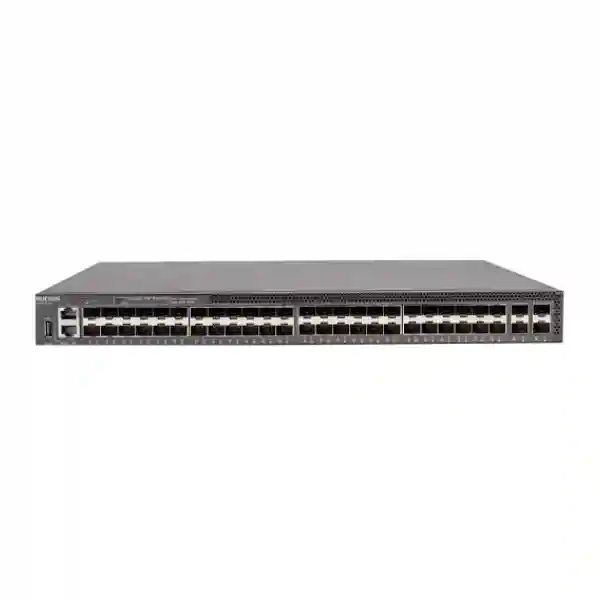
RUCKUS ICX 8200-48F Fiber Switch
The RUCKUS ICX 8200-48F is a stackable Ethernet switch built for fiber-heavy access and aggregation requirements where organizations need forty-eight 1GbE SFP access interfaces, flexible 1/10/25GbE uplinks, Layer 3 routing features and room to expand through stacking. FourTeck helps buyers turn the model name into a complete bill of materials by checking transceiver type, fiber medium, reach, connector, uplink speed, stack design, routing role, rack environment, power arrangement and support requirements before a quotation is finalized.
Access: 48 x 1GbE SFP ports.
Uplink/stack: 4 x 1/10/25GbE SFP28 ports.
Switching capacity: up to 296 Gb/s.
Stack: up to 12 switches; up to 1200 Gb/s aggregate stack bandwidth.
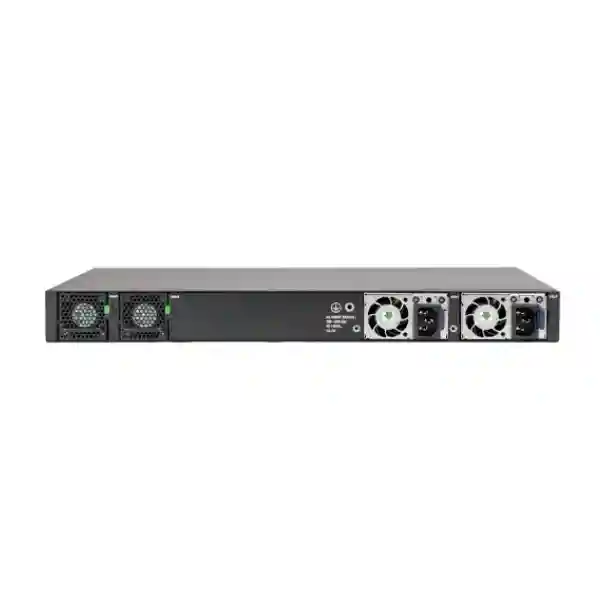
Power: single integrated power supply; this model does not offer a redundant power option.
Fiber-first access
Use forty-eight 1GbE SFP interfaces for fiber-connected endpoints, remote cabinets, building links or other supported optical/Ethernet handoffs.
Fast uplink choices
Four SFP28 interfaces can operate at 1, 10 or 25GbE, giving designers options for upstream aggregation and stack connectivity.
Layer 3 capability
Manufacturer specifications list static routing, RIP and OSPF, together with VRF, sFlow and VXLAN support for suitable designs.
Procurement clarity
The switch is only one line in a fiber project. Optics, patching, fiber type, rack, power and support should be confirmed as a complete requirement.
What the RUCKUS ICX 8200-48F is designed to do
The ICX 8200-48F belongs to the RUCKUS ICX 8200 family and is positioned as a 48-port 1GbE fiber switch. Its defining characteristic is that the access side is optical: the forty-eight primary data interfaces use SFP transceivers rather than forty-eight copper RJ45 sockets. That distinction matters when the switch is being specified for a campus distribution room, multi-building site, long-reach access design, fiber-connected surveillance or industrial cabinets, service-provider-style handoffs, or any environment where copper distance limits and electrical isolation make fiber attractive. Buyers should therefore treat the transceiver plan as part of the switch design, not as an accessory decision made after purchase.
RUCKUS publishes a maximum switching capacity of 296 Gb/s for this exact model. The four SFP28 interfaces are listed for 1, 10 and 25GbE operation and can be used for uplink or stacking functions according to the final topology and supported software configuration. The platform can stack up to twelve switches, with a published maximum aggregate stack bandwidth of 1200 Gb/s. This gives network teams a path to build a larger logical access system while retaining a familiar switch family, but the physical topology, optics, software version and operational failure plan still need to be designed deliberately.
The model supports sFlow and Layer 3 functions including static routing, RIP and OSPF. RUCKUS also lists VRF, OpenFlow with Hybrid Port Mode and VXLAN. At the same time, procurement teams should note what the manufacturer does not list for this model: PoE/PoE+ is not supported, there is no redundant power option, the internal power supply and fans are not hot-swappable, MACsec is not listed, BGP is not listed, and reversible airflow is not offered. Those boundaries are important because they determine whether the ICX 8200-48F fits the intended role or whether a different ICX model should be evaluated.
Verified specification guide
| Item | RUCKUS ICX 8200-48F | Buyer check |
|---|---|---|
| Access ports | 48 x 1GbE SFP | Confirm optic type, wavelength, fiber and reach for each link. |
| Uplink / stacking | 4 x 1/10/25GbE SFP28 | Confirm upstream port speed, optic compatibility and stack layout. |
| Switching capacity | Maximum 296 Gb/s | Validate traffic design rather than relying only on headline capacity. |
| Stack size | Maximum 12 switches | Plan software alignment, physical path, maintenance and failure domains. |
| Aggregate stack bandwidth | Maximum 1200 Gb/s | Select links and topology around real inter-switch traffic. |
| Layer 3 | Static, RIP, OSPF; VRF supported | Confirm software release and desired routing design. |
| Visibility / overlay | sFlow and VXLAN listed | Check collector, telemetry and overlay requirements. |
| PoE | No | Do not select this model to power APs, phones or cameras directly. |
| Power redundancy | No redundant power option | Review UPS, circuit design and availability target. |
Specifications above reflect the current manufacturer page for the exact ICX 8200-48F model. Final compatibility depends on software release, optics and the complete deployment design.
Optics, fiber and uplink planning before you request a quote
A fiber switch quotation is accurate only when the optical links are understood. Start by listing every connected device or remote switch, the required speed, the approximate cable distance, the installed fiber type and connector presentation. Single-mode and multimode links use different optical components, and even within the same fiber family the required transceiver depends on speed and reach. If the existing cabling plant terminates through patch panels, include the patch-panel connector type and any conversion jumpers in the review. If links connect buildings, cabinets or floors, identify which runs are existing and which still need testing or certification.
The four SFP28 interfaces deserve separate attention because they can support higher uplink rates than the 1GbE access ports. A buyer moving from a legacy 1GbE aggregation layer may initially use 10GbE and later plan for 25GbE, but the upstream switch, optics and fiber must support the selected speed. If the interfaces are used for stacking, the number of stack links and physical path between cabinets affects resilience and available inter-switch capacity. A stack should not be designed only around the maximum supported switch count; maintenance windows, rack placement, cable routing and the impact of a failed stack link should also be considered.
For organizations building a security refresh at the same time, the switch design should be coordinated with the edge firewall and segmentation plan. FourTeck’s firewall product catalogue can help identify complementary security platforms, while the network security service overview provides context for configuration and migration discussions. The purpose is not to treat a fiber switch as a firewall, but to make sure VLANs, routed interfaces, uplinks and security zones are designed as one network rather than as isolated purchases.
Use cases and fit questions
Campus and building fiber access
The model can suit designs where many access links arrive over fiber from remote telecommunications rooms, buildings, cabinets or equipment zones. Confirm whether every link is truly 1GbE and whether any locations need higher access speeds.
Fiber aggregation for distributed systems
Organizations can use dense 1GbE optical access with faster uplinks toward a core or security layer. Check oversubscription, traffic patterns, routing boundaries and failure behavior rather than selecting the uplink speed in isolation.
Networks that do not need PoE at this layer
Because the ICX 8200-48F does not provide PoE, it fits fiber roles where endpoint power is not expected from the switch. If APs, phones or cameras require power, another access-switch model or local power design is required.
Regional sourcing approach
FourTeck supports technology inquiries through regional websites and sales channels. Product availability, warranty handling, commercial terms, logistics and service scope can vary by country, quantity and sourcing route, so each project should be quoted against the final bill of materials rather than an assumed online stock position. Buyers in the UAE can review FourTeck UAE technology solutions; organizations in Uganda can use the FourTeck Uganda platform; Kenya projects can reference FourTeck Kenya; Kuwait buyers can use FourTeck Kuwait; and broader African requirements can be coordinated through FourTeck Africa.
For every region, a useful request should include the exact model, quantity, preferred support term, deployment city, required transceiver count, fiber type, estimated link distances, uplink speed, stacking requirement, routing role and any implementation assistance. That information allows the sales and technical discussion to focus on compatibility and a complete quotation rather than only the base switch.
RUCKUS ICX 8200-48F Fiber Switch Dubai
Customers searching for a RUCKUS ICX 8200-48F fiber switch in Dubai are often solving a denser network problem than a simple office desktop-switch replacement. Dubai projects commonly combine multiple floors, separated buildings, server rooms, camera networks, hospitality infrastructure, education campuses, warehouses, retail facilities, mixed-use properties or enterprise offices where fiber is used to extend Ethernet beyond normal copper reach or to keep inter-building links electrically isolated. In this context, the first buying question is not simply whether the ICX 8200-48F has forty-eight ports. The useful question is whether forty-eight 1GbE SFP access ports match the installed fiber plant and whether the four 1/10/25GbE SFP28 interfaces provide the right upstream path for current and future traffic.
For a Dubai quotation, prepare a port schedule that shows which fiber runs terminate in the rack, which devices sit at the far end, whether each run is single-mode or multimode, and the approximate distance. This avoids a common procurement failure in which the switch is ordered correctly but the transceivers do not match the cable plant or remote equipment. If the project is part of an office move or fit-out, also identify rack size, available power, UPS protection, cooling, patch-panel arrangement and the handoff from the internet or firewall. The ICX 8200-48F uses a single integrated power supply and does not offer the redundant power option listed on some other ICX family members, so availability objectives should be addressed at the network and power-system level.
Dubai buyers frequently ask whether the model is appropriate for access points, IP phones or PoE cameras. It is important to separate network connectivity from endpoint power: the ICX 8200-48F is a fiber switch and the manufacturer lists PoE/PoE+ as unsupported on this model. If powered endpoints are part of the same project, a separate PoE access layer or a different RUCKUS model may be required. Where the switch connects to a firewall, FourTeck can also help align VLANs and routing with a structured firewall deployment plan, so that the fiber topology and security zones are designed together.
When requesting an ICX 8200-48F price in Dubai, include quantity, optics, support expectations and deployment scope rather than asking only for a bare chassis figure. Commercial availability and lead time should be confirmed at quotation time. If the project includes configuration, define whether FourTeck should assist with base setup, VLANs, Layer 3 routing, OSPF, management addressing, sFlow, stack configuration, uplink testing or handover documentation. A complete request gives procurement a clearer comparison and reduces the risk of receiving an incomplete bill of materials.
RUCKUS ICX 8200-48F Fiber Switch UAE
A UAE-wide RUCKUS ICX 8200-48F requirement may involve more variation than a single-city project because branches, warehouses, campuses and operational sites can have different cabling standards, uplink speeds and support models. Organizations with locations in Dubai, Abu Dhabi, Sharjah, Ajman or other emirates should avoid assuming that one fiber bill of materials can be repeated unchanged at every site. Start with a common logical standard—VLAN structure, management convention, firmware policy, routing design and monitoring method—then verify the physical layer at each location. The forty-eight 1GbE SFP access ports are useful only when the transceivers, fiber type and remote interfaces are matched correctly.
The ICX 8200-48F can be considered where a business wants a standardized fiber access platform with stack capability and faster uplinks. RUCKUS lists stacking for up to twelve switches and a maximum aggregate stack bandwidth of 1200 Gb/s. That does not mean every UAE site needs a large stack. A branch with modest port density may need only one unit, while a campus or shared facility may benefit from multiple units managed as a stack. The design team should decide what happens during maintenance, how stack links are cabled, whether all members sit in one rack or multiple adjacent racks, and how upstream connectivity is protected if a link or member fails.
UAE procurement teams should also verify lifecycle and support items instead of relying on a switch-only comparison. Ask which support entitlement is proposed, what software access it provides, how failed hardware would be handled under the selected commercial terms, and whether optics are manufacturer-approved or third-party components. If the switch will operate below a firewall or security core, review the routed boundary and traffic flows. FourTeck’s perimeter firewall planning guidance is useful when the fiber layer is being redesigned alongside internet-edge controls, segmentation or VPN services.
For a UAE quotation, provide exact quantities per emirate, shipment destinations, transceiver requirements, desired uplink speeds, stack topology, rack details and configuration scope. Do not assume stock, delivery date or warranty conditions until they are written into the commercial offer. This approach is especially useful for multi-site rollouts because it separates the repeatable design standard from site-specific physical requirements. FourTeck can then coordinate a bill-of-material review and identify any information that still needs confirmation before the order is approved.
RUCKUS ICX 8200-48F Fiber Switch Uganda
For organizations searching for the RUCKUS ICX 8200-48F fiber switch in Uganda, the most valuable planning step is to map the physical distances and power conditions around the network. Fiber can be attractive for links between buildings, across larger compounds, between data rooms and remote cabinets, or where electrical isolation is preferred. Universities, schools, hospitals, hospitality sites, government environments, financial organizations, NGOs, industrial operations and multi-building offices may all have different reasons for choosing optical access. The ICX 8200-48F provides forty-eight 1GbE SFP access interfaces, so the deployment should be based on a verified list of fiber-connected devices rather than a generic port-count estimate.
Uganda projects should carefully document whether existing runs use single-mode or multimode fiber and whether termination quality has been tested. Long outdoor routes, legacy patch panels, mixed connector types or undocumented splices can affect link reliability even when the switch and optic specifications are correct. Procurement should therefore include any required optical modules, patch leads, cleaning materials and test scope. If the project spans more than one building, define where the Layer 3 boundary sits and whether OSPF or static routing will be used. RUCKUS lists both on the platform, along with VRF, which may be useful where separate routing domains are part of the design.
Power resilience also deserves attention. The manufacturer lists no redundant power option for this exact model, so the site design may need a suitable UPS, protected circuit and operational procedure for planned power work. If a high-availability requirement cannot tolerate the loss of one switch or one power source, the architecture should address that requirement through topology and equipment choice rather than assuming an unsupported redundant PSU configuration. For broader technology coordination, the FourTeck Uganda regional platform can be used to discuss local project context while the switch specification remains anchored to the manufacturer documentation.
When asking for an ICX 8200-48F quotation in Uganda, provide the destination city, quantity, expected support term, fiber type, transceiver count, maximum link distance, uplink speed and whether installation or remote configuration assistance is required. Also state whether the switch will connect directly to a core, firewall, data-center switch or another ICX stack. This information allows FourTeck to build a procurement discussion around real interfaces and dependencies. Availability, logistics, warranty route and service scope should be confirmed in the final quotation rather than inferred from a generic product listing.
RUCKUS ICX 8200-48F Fiber Switch Kampala
Kampala buyers often need a fiber switch for dense commercial buildings, campuses, hotels, hospitals, financial offices, education sites, shared compounds and growing enterprise networks where multiple telecommunications rooms must return to a central equipment area. The RUCKUS ICX 8200-48F can be relevant when those return links are primarily 1GbE fiber and the design benefits from four faster SFP28 interfaces for aggregation or stacking. A Kampala project should begin with a floor-by-floor or building-by-building cable map. Identify each remote cabinet, the equipment connected there and the physical route back to the proposed ICX switch.
In existing facilities, optical infrastructure may have been installed in phases. One floor may use multimode fiber while another route uses single-mode; connector presentation can also vary. Before ordering optics, verify the installed media and, where practical, obtain test results for important links. This is more useful than buying transceivers from a generic list and discovering during installation that link reach or connector type does not match. The same discipline applies to uplinks: if a core or firewall side supports only 10GbE, a 25GbE-capable port does not automatically create a 25GbE path. Both ends, optics and fiber must support the chosen speed.
Kampala organizations planning multiple ICX 8200 switches should decide whether stacking adds operational value. RUCKUS supports up to twelve switches in a stack on this family model, but the correct number depends on port density, rack layout and failure-domain requirements. Keep stack cabling short and understandable where possible, document member roles and management addresses, and align software versions before production changes. If the environment is security-sensitive, decide which VLANs terminate on the switch and which are routed or filtered through a firewall. That choice affects troubleshooting and the responsibility boundary between switching and security teams.
A strong Kampala quotation request includes the exact switch model, quantity, all required optics, destination, desired uplink rate, rack details, UPS availability, support expectation and configuration scope. If installation assistance is needed, mention whether fiber testing, rack mounting, patching, VLAN creation, OSPF, sFlow or stack configuration should be included. FourTeck can use that information to prepare a clearer commercial and technical response without making unsupported assumptions about stock or site readiness.
RUCKUS ICX 8200-48F Fiber Switch Arua
In Arua, a RUCKUS ICX 8200-48F fiber switch may be considered for organizations connecting separated buildings, compounds, education facilities, healthcare sites, hospitality properties, NGO operations, logistics locations or administrative networks where optical cabling offers useful distance and isolation. The dense forty-eight-port SFP layout can consolidate many 1GbE fiber links into one rack, but the design should be based on measured needs. If a site has only a small number of optical links and many copper endpoints, the ICX 8200-48F may not be the most efficient access model; a mixed or copper access platform could be more appropriate. The quotation process should therefore start with the topology rather than the product name alone.
Arua deployments can benefit from careful spare planning because a remote site may not have immediate access to replacement optics or patch components. This does not justify over-ordering arbitrary modules. Instead, standardize the optic types actually used, keep a documented spare quantity based on link criticality and make sure technicians can identify each wavelength, reach and connector. Labeling both ends of fiber runs and recording patch-panel positions can reduce troubleshooting time. Where older fiber is being reused, test key routes before the change window so an existing cable fault is not mistakenly attributed to the new switch.
The ICX 8200-48F supports Layer 3 functions including static routing, RIP and OSPF, but the site should decide whether routing belongs locally or at a central core or firewall. For a branch connected to a larger organizational network, simpler Layer 2 access with routed uplinks may be easier to operate. For a larger compound, local routing may reduce unnecessary traffic across upstream links. VRF support can help with separation in suitable designs, but configuration should follow a documented addressing and security plan. sFlow may also be useful where traffic visibility is required and a compatible collector is available.
When requesting an ICX 8200-48F in Arua, include the intended role, fiber inventory, link distances, quantity of each optic, upstream equipment, uplink speed, power-protection plan and support needs. If the project requires remote commissioning, identify who will provide hands-on rack and patch access at the site. Commercial lead time, logistics and warranty handling should be confirmed before order placement. This creates a realistic deployment plan without implying local stock or immediate service that has not been verified.
RUCKUS ICX 8200-48F Fiber Switch Mbarara
Mbarara organizations evaluating the RUCKUS ICX 8200-48F fiber switch may be building or refreshing a network for a university, healthcare environment, hospitality property, commercial campus, regional office, warehouse, manufacturing operation or multi-building institution. In these settings, fiber can connect distant equipment rooms while avoiding the distance constraints of copper Ethernet. The ICX 8200-48F offers forty-eight 1GbE SFP access ports, which can be useful when many remote links converge centrally. A buyer should confirm that the expected access speed remains 1GbE and reserve the four 1/10/25GbE SFP28 ports for the most appropriate uplink or stacking role.
Capacity planning should consider traffic concentration rather than simply port count. Forty-eight 1GbE access links will not all run at maximum rate continuously in most environments, but particular workloads such as backup traffic, video aggregation, storage access or synchronized updates can create bursts. Estimate which remote segments generate the heaviest traffic and select uplink speed accordingly. If a 10GbE uplink is sufficient today but 25GbE is a realistic future requirement, confirm that the installed fiber and upstream interface can support the future step; otherwise the nominal capability of the switch may not translate into an easy upgrade.
Operational planning is equally important in Mbarara, especially where a small IT team supports several sites. Standardize naming, VLAN IDs, management IP conventions, configuration backup procedures and firmware policy. If multiple ICX switches will form a stack, document the member order and stack cabling. The model does not provide PoE, so any Wi-Fi access points, IP phones or cameras at remote cabinets will need power from another local switch or source. It also lacks a redundant power option, so UPS sizing and power maintenance procedures should match the site’s availability requirement.
A procurement request should state the deployment building, quantity, port use, fiber media, transceiver types, expected link distances, uplink rate, routing requirement, stack plan and desired support. Buyers should also indicate whether configuration documentation and knowledge transfer are part of the project. FourTeck can review these details and prepare an offer around the complete solution. Availability and logistics should be verified at the time of quotation, particularly when optics and support entitlements are required alongside the base switch.
RUCKUS ICX 8200-48F Fiber Switch Gulu
For a Gulu network project, the RUCKUS ICX 8200-48F fiber switch is most relevant when optical links already form an important part of the campus or site design. Education, healthcare, hospitality, public-sector, NGO and commercial environments may need to connect buildings or equipment rooms where copper is unsuitable because of distance, pathway or electrical considerations. The switch’s forty-eight 1GbE SFP access interfaces can centralize a significant number of these links. Before selecting it, count actual fiber endpoints and identify which connections need 1GbE, which require faster service and which may be retired or consolidated during the refresh.
Gulu buyers should pay particular attention to installation readiness. A correct switch cannot compensate for contaminated fiber connectors, damaged patch leads, unknown splice quality or inconsistent labeling. Build time into the project for visual inspection, cleaning and testing of critical links. Record optical module part references and link destinations so future support teams can quickly identify what belongs in each SFP slot. If remote cabinets depend on local power, verify that the far-end equipment is protected as well; resilience is an end-to-end characteristic, not a feature located only in the central switch.
The platform offers Layer 3 options and OSPF support for designs that require dynamic routing. That can be useful in a larger site, but simpler is often better when the local operations team has limited time for network troubleshooting. Decide which device should be the default gateway for each VLAN, how routes reach the firewall or WAN, and what happens if an uplink fails. If sFlow is enabled, make sure there is a collector and an operational reason for the data. VXLAN support should likewise be used only as part of a defined architecture rather than enabled because the feature exists.
For a Gulu quote, provide quantity, fiber and optic details, destination, rack and power information, desired uplink speed, support requirement and any configuration tasks. If the system will be commissioned remotely, name the local contact who can verify port LEDs, move patch leads and power-cycle equipment under instruction. Confirm commercial availability, logistics and warranty terms before scheduling a change window. This reduces the risk of a technically correct design being delayed by missing optical or site-readiness details.
RUCKUS ICX 8200-48F Fiber Switch Kenya
Kenya buyers searching for a RUCKUS ICX 8200-48F fiber switch may be supporting corporate campuses, universities, hospitality groups, hospitals, manufacturing and logistics sites, data rooms, branch networks or multi-tenant buildings where a fiber access layer provides the right physical reach. In a nationwide organization, the key challenge is consistency: sites may have been cabled at different times and may use different fiber types or upstream equipment. A standard ICX 8200-48F design can simplify operations only if each location is validated against the standard before purchase.
Create a Kenya deployment template that defines approved optic types, management VLAN, naming convention, software baseline, uplink policy and stack design. Then record site exceptions rather than forcing every location into an unsuitable pattern. The switch supplies forty-eight 1GbE SFP access interfaces and four 1/10/25GbE SFP28 interfaces. A high-traffic Nairobi headquarters, for example, may justify faster uplinks than a smaller branch even when both use the same access model. The site survey should identify actual traffic sources, backup windows, video streams, server access and WAN architecture so uplink selection reflects workload rather than assumption.
Security integration is another procurement consideration. If the ICX switch carries multiple business networks, decide whether inter-VLAN routing occurs on the ICX platform or through a firewall. RUCKUS lists static routing, RIP, OSPF and VRF, so the switch can participate in a Layer 3 design, but that does not automatically make local routing the preferred security architecture. Where network segmentation policy is enforced at a firewall, keep the routing and VLAN handoff clear. Buyers comparing complementary edge platforms can review FourTeck’s Palo Alto Networks PA-Series overview as one example of a separate security layer that may sit upstream of switching.
For Kenya procurement, include quantity per site, delivery destination, transceiver schedule, fiber type, link distance, uplink speed, stack requirement, support term and implementation scope. Ask for a bill of materials that distinguishes the switch, optics, support and services so quotes can be compared fairly. Availability, lead time and warranty route should be confirmed in writing. Where multiple sites are involved, phased delivery and staging may be discussed after the equipment and service scope are validated.
RUCKUS ICX 8200-48F Fiber Switch Kuwait
In Kuwait, the RUCKUS ICX 8200-48F fiber switch can fit enterprise, education, hospitality, healthcare, commercial, oil-and-gas support, logistics and multi-building network designs where a dense optical access layer is preferable to copper. Buyers should first establish whether the switch will sit in a controlled data room, a building distribution frame or another technical area. Rack environment matters because the model has a single integrated power supply, no redundant power option and no reversible airflow option. Proper cooling, UPS support, clean power and cable management should therefore be included in the infrastructure plan rather than treated as separate facilities issues.
The fiber plan should list every optical link, its speed, reach and media. In Kuwait projects with long campus routes or links between buildings, single-mode fiber may already be standard; inside buildings, mixed legacy media may still exist. Do not assume that all installed fiber supports the same optic or future uplink rate. The four SFP28 uplink/stacking interfaces can operate at 1, 10 or 25GbE, but both link ends and the fiber channel must be compatible with the selected standard. When upgrading from an older 1GbE backbone, verify whether patch panels and existing optics will be replaced as part of the same scope.
Kuwait organizations with strict change procedures should define staging and acceptance tests before installation. A practical checklist includes firmware level, management access, VLAN database, routing, OSPF neighbors where used, stack state, optical receive levels, uplink redundancy, sFlow export if required and backup configuration. If the fiber switch feeds an internet-edge security platform, the security change plan should be coordinated. FourTeck’s PA-410 product page shows the type of branch firewall planning that may be considered separately for smaller sites, while larger environments require their own sizing exercise.
A Kuwait quote request should include the exact ICX 8200-48F model, quantity, optical modules, support expectations, rack location, uplink speeds, stack topology and any onsite or remote implementation assistance. Procurement should confirm current availability, commercial lead time, warranty handling and software entitlement in the formal offer. The objective is to buy a supported working network component with the required optics and services, not just a switch chassis whose surrounding dependencies remain undefined.
RUCKUS ICX 8200-48F Fiber Switch Ghana
Ghana organizations considering the RUCKUS ICX 8200-48F fiber switch may be expanding a campus network, consolidating links from remote buildings, replacing aging fiber aggregation equipment or standardizing optical access across offices, schools, healthcare facilities, hospitality properties, financial sites, logistics locations or industrial compounds. The model’s forty-eight 1GbE SFP ports make it attractive where many fiber circuits arrive in one communications room. Before purchase, however, audit those circuits. Identify the remote endpoint, cable medium, connector, approximate route length and whether the connected device can negotiate the intended speed.
In Ghana deployments with a mixture of newer and older fiber, a transceiver matrix is valuable. It prevents procurement from assuming that one optical module can serve every connection. For campus links, include any outdoor enclosures, intermediate patch panels and spare fibers in the documentation. Where service continuity is important, decide whether critical remote segments have alternate paths. The switch supports stacking, but stacking should not be confused with end-to-end redundancy. A resilient design may require diverse uplinks, redundant upstream equipment or other architectural measures depending on the business requirement.
The ICX 8200-48F supports OSPF, static routing and VRF, which can help a larger Ghana network organize multiple routed segments. Yet each feature adds operational responsibility. If a central firewall should enforce traffic between departments or sites, keep the routing design aligned with that security policy. If a local core should route internally, document route advertisement and failure behavior. Monitoring teams can consider sFlow if they have a collector and a defined visibility objective. The model also lists VXLAN support, but overlay networking should be designed against a specific architecture and software baseline, not enabled as a default.
When requesting a Ghana quotation, include destination, quantity, optic types, fiber media and distances, stack needs, uplink rate, routing role, support term and any installation or configuration assistance. Clarify whether patching and fiber testing are in scope. Buyers should ask for current availability and logistics information rather than relying on an unverified stock statement. A complete commercial offer should make clear which items are hardware, optics, support and professional services so that procurement can compare proposals on an equivalent basis.
RUCKUS ICX 8200-48F Fiber Switch Nigeria
Nigeria projects for the RUCKUS ICX 8200-48F fiber switch can range from a single corporate site to larger education, hospitality, healthcare, financial, industrial, logistics or multi-branch environments. In larger cities and distributed estates, fiber is frequently used to bridge distance between equipment areas and to aggregate remote access layers. The ICX 8200-48F is designed around forty-eight 1GbE SFP access ports, so it is particularly relevant where optical handoffs are already central to the topology. If the real requirement is predominantly copper access with PoE for phones, cameras or wireless access points, this exact model should not be selected merely because of its port count.
Network teams should build a per-site bill of materials. Start with the switch quantity, then add an optic for each populated fiber interface based on speed, media and reach, plus the required uplink optics. Document spare strategy separately. For sites where power stability is a concern, note that RUCKUS lists a single integrated power supply and no redundant power option for the ICX 8200-48F. The solution may therefore require suitable UPS capacity, surge protection, generator integration procedures or network-level redundancy according to the organization’s continuity objectives. These surrounding controls should be engineered locally rather than assumed to be part of the switch.
Nigeria enterprises that operate several locations may use stacking or a repeatable switch template to simplify support. RUCKUS supports up to twelve switches per stack and publishes up to 1200 Gb/s aggregate stack bandwidth. A standard should still define stack member numbering, uplink placement, management IPs, software baseline and backup procedures. For environments where the switching refresh accompanies a firewall upgrade, buyers can compare complementary security options such as the Sophos XGS 88 branch firewall for smaller edge roles, while higher-capacity sites require separate firewall sizing based on real traffic and enabled security services.
A useful Nigeria quotation request includes city, destination, quantity, optics, fiber medium, maximum link distance, upstream equipment, chosen uplink speed, routing requirement, stack design, support term and service scope. Availability and lead time can vary, so they should be confirmed at quotation time. If configuration support is requested, state whether FourTeck should include staging, VLANs, routing, OSPF, sFlow, stack setup, testing or documentation. This separates technical needs from logistics and helps procurement evaluate a complete solution.
RUCKUS ICX 8200-48F Fiber Switch Seychelles
A RUCKUS ICX 8200-48F fiber switch requirement in Seychelles may arise in hospitality, government, education, healthcare, financial, utility or multi-building commercial environments where fiber provides reliable links across a property or campus. Island logistics make complete planning especially important: a missing optic, patch lead or rack accessory can delay commissioning more than the switch itself. Begin with a link-by-link optical schedule that identifies the far-end equipment, fiber type, speed and approximate reach. Use that schedule to build the transceiver quantity and spare strategy instead of ordering a generic bundle.
Environmental and facilities conditions should also be reviewed. The ICX 8200-48F is a data-network switch and should be installed in an appropriate equipment environment with suitable power and cooling. The model does not offer a redundant power option, so continuity planning may rely on UPS protection, stable electrical distribution and network topology. If equipment is located near coastal environments, the rack room and cable entry should be designed to protect electronics and connectors from conditions outside normal equipment-room expectations. Site-specific environmental suitability should be confirmed by the project team rather than inferred from a general product specification.
For resorts or multi-building properties, the forty-eight 1GbE fiber ports can aggregate remote network zones while the four 1/10/25GbE SFP28 ports connect upstream. Decide whether guest, staff, surveillance, building-management and operational networks share the same physical switch and how they are segmented logically. The platform supports VLAN-based designs, Layer 3 functions and VRF, but security-sensitive traffic may still need to pass through a firewall. If an upstream firewall is part of the same project, the Palo Alto Networks PA-415 page illustrates the type of smaller-edge appliance planning that can be evaluated separately; every firewall should be sized independently for the actual site.
A Seychelles quotation should include final delivery destination, quantity, optics, fiber media, link distances, uplink speed, stacking requirement, support expectations and whether remote or onsite assistance is needed. Confirm shipping, lead time, warranty handling and all included services in the written offer. For critical sites, consider whether a spare switch or a resilient topology is more appropriate than relying on emergency logistics. The final choice should reflect business continuity requirements, technical fit and supportability rather than only the unit price.
Compatibility, security and adjacent infrastructure
The ICX 8200-48F should be treated as part of a larger architecture. Upstream compatibility includes more than matching nominal port speed. Confirm the optical standard, connector type, supported transceiver, auto-negotiation expectations and the configuration on both ends. If a 25GbE uplink connects to a core, make sure the core port is capable of the same speed and that the chosen optic and fiber channel support it. If the switch connects to a firewall using 10GbE, confirm the firewall interface type and whether the link is routed or carries VLAN trunks.
Security segmentation should be explicit. Network teams need to decide where default gateways live, which device enforces policy between user groups, how management traffic is protected and where monitoring data is sent. The ICX platform can route, but a firewall provides different controls and visibility. FourTeck’s PA-400R rugged firewall overview is relevant when an upstream security device may operate in more demanding environments, while the FourTeck network security overview explains the broader support context.
Before deployment, confirm the software release approved for the environment and verify that required features are supported on that release. Create a backup of the baseline configuration, document administrator access, use a dedicated management approach appropriate to the organization and record serial and support information. Where OSPF or VRF is used, include routing validation in the acceptance test. Where sFlow is required, identify the collector address and expected sample configuration. Avoid enabling advanced features simply because they appear in a data sheet; every feature should support a defined operational or security objective.
Frequently asked questions about the ICX 8200-48F
Does the RUCKUS ICX 8200-48F have 48 copper Ethernet ports?
No. The exact ICX 8200-48F model is the fiber version with 48 x 1GbE SFP access ports. Buyers should not confuse it with copper variants in the ICX 8200 family.
Does it support 25GbE?
Yes. RUCKUS lists four SFP28 ports that can operate at 1, 10 or 25GbE for uplink/stacking use. The remote interface, optic and fiber channel must also support the selected speed.
Can the ICX 8200-48F power access points or IP cameras?
No. PoE/PoE+ is not supported on this model. Powered endpoints need a separate power source or a different PoE-capable switch design.
Can it be stacked?
Yes. The manufacturer lists a maximum of 12 switches per stack and up to 1200 Gb/s aggregate stack bandwidth. The real stack layout should be planned around cabling, software and resilience requirements.
Does it have dual hot-swappable power supplies?
No. RUCKUS lists no redundant power option and no hot-swappable internal power supplies or fans for this exact model. Power resilience must therefore be addressed through the wider design.
What Layer 3 functions are listed?
The manufacturer lists static routing, RIP and OSPF, along with VRF. BGP is not listed for this model. Confirm the intended software release and feature requirements before deployment.
What should I provide for an accurate quote?
Provide switch quantity, delivery region, fiber type, number of populated ports, link distances, optic requirements, uplink speed, stacking plan, support term and any installation or configuration scope.
Related infrastructure buyers may review
A fiber-switch project often touches the firewall, branch edge and network-security design. The links below are same-site resources that can help buyers frame those adjacent requirements without implying that any one firewall is automatically the correct match for the ICX 8200-48F.
Firewall products
Review the Firewall Dubai product collection when the switch refresh also changes the security edge.
Deployment services
Use the firewall deployment guidance to coordinate VLAN, routing and cutover planning.
PA-Series
The Palo Alto Networks PA-Series overview can support separate firewall sizing discussions for enterprise edges.
PA-410
Review the Palo Alto Networks PA-410 when a compact branch edge is being evaluated separately.
PA-415
The Palo Alto Networks PA-415 is another branch security option whose interfaces, licenses and capacity require independent validation.
Sophos XGS 88
The Sophos XGS 88 firewall appliance can be reviewed for smaller security-edge requirements where Sophos is part of the organization’s strategy.
Rugged security edge
For harsher environments, review the PA-400R rugged firewall family as a separate edge-security consideration.
Decision recap: is the ICX 8200-48F the right model?
The ICX 8200-48F is a strong candidate when the requirement is specifically for dense 1GbE fiber access with four faster SFP28 uplink/stacking interfaces, stackability and Layer 3 capability. It is not the right fit when the project needs forty-eight copper access ports, integrated PoE for powered endpoints, a redundant internal power option, MACsec or BGP on this exact model. Those distinctions should be resolved before pricing because changing models later can alter optics, rack design, power requirements and configuration.
For technical approval, validate the port map, fiber medium, optics, uplink speed, routing role, stack plan, software baseline, monitoring requirements and power resilience. For commercial approval, validate switch quantity, optics, support, shipping destination, warranty route, services and quoted lead time. A procurement decision is strongest when both lists are complete and the written quotation matches the design.
Quotation checklist
Switch quantity
1GbE optic count
10/25GbE uplink optics
Single-mode / multimode fiber
Maximum link distance
Stack size and topology
Routing / OSPF / VRF needs
Support term
Delivery destination
Configuration / installation scope
Talk to FourTeck about the complete fiber-switch requirement
Send the model, quantity, destination, fiber type, optic schedule, uplink requirement, stack design and any configuration scope. FourTeck can review the requirement and prepare a quotation discussion around the complete bill of materials. Current availability, commercial terms, warranty handling and service scope should be confirmed in the formal offer.

Reviews
There are no reviews yet.