
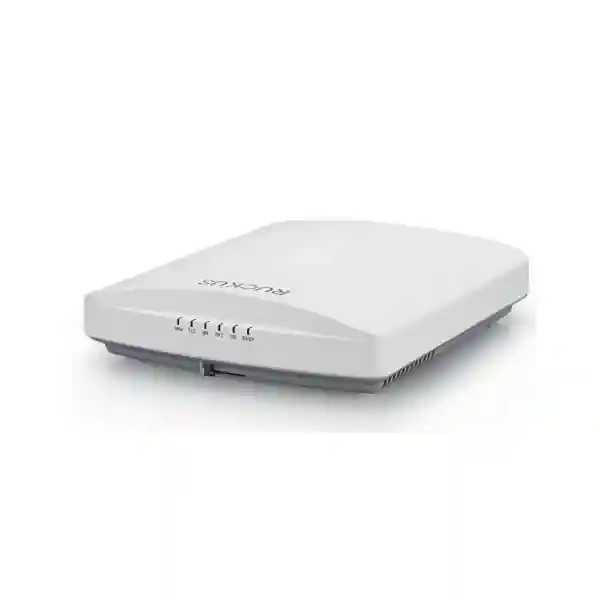
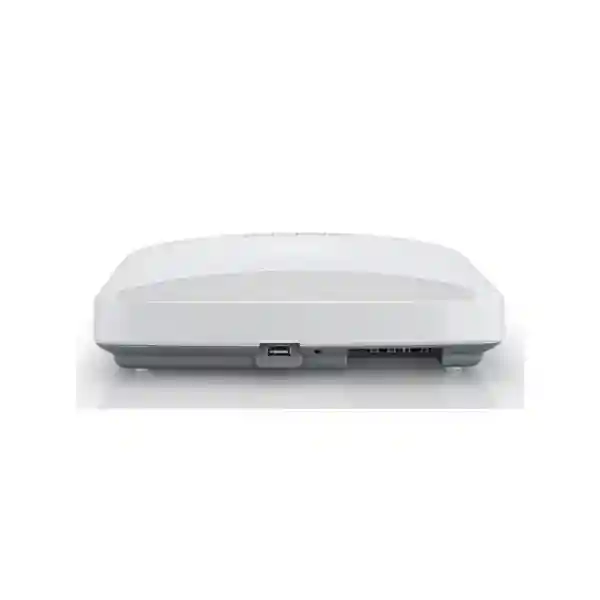
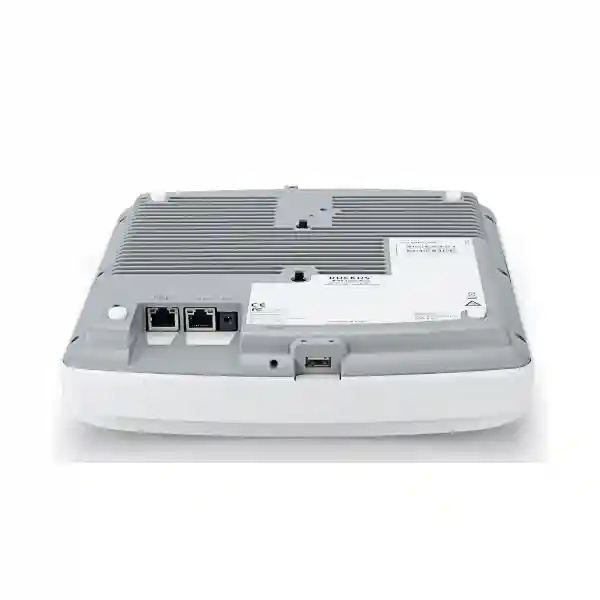
RUCKUS R760 Indoor Access Point
The RUCKUS R760 Indoor Access Point is built for organizations that need more wireless capacity than a conventional dual-band access point can comfortably provide. It operates across 2.4 GHz, 5 GHz and 6 GHz with three dedicated radios, each using 4×4:4 radio chains and spatial streams. RUCKUS publishes a combined maximum PHY rate of 8.348 Gbps, maximum association capacity of up to 1,536 clients per access point, and a multi-gigabit Ethernet interface supporting 1/2.5/5/10 GbE. These figures describe platform capability rather than guaranteed application throughput, so practical performance still depends on client radios, channel width, local spectrum rules, interference, AP placement, wired backhaul, PoE mode and network design.
For procurement teams, the important question is not simply whether the R760 is fast. The stronger buying question is whether its high-capacity radio design, 6 GHz support, 10 GbE backhaul, BeamFlex adaptive antenna technology, ChannelFly channel optimization, WPA3 security support, SmartMesh capability and IoT-ready BLE/Zigbee radio fit the actual site. FourTeck can help structure that review before a quotation is finalized.
Direct answer: what is the RUCKUS R760 used for?
The RUCKUS R760 is an enterprise indoor wireless access point for high-density environments where many devices need reliable access at the same time and where newer 6 GHz-capable clients can benefit from additional spectrum. Typical design targets include large offices, education spaces, convention areas, hospitality environments, public venues, collaborative workplaces and other indoor locations where airtime efficiency, roaming, application performance and centralized administration matter. RUCKUS positions the platform around ultra-high-density networking, but an AP count should still be designed from a site survey, floor plan, RF requirements and expected client activity rather than from the published maximum association figure alone.
The R760 combines OFDMA, MU-MIMO and Target Wake Time with RUCKUS BeamFlex adaptive antenna technology and ChannelFly dynamic channel selection. In practical planning terms, those technologies are useful because a modern business network is rarely carrying one kind of traffic. Video meetings, cloud software, voice, handheld devices, guest Wi-Fi, POS terminals, staff laptops, tablets and IoT devices can all compete for airtime. A higher-capacity AP can help the designer distribute that demand more effectively, provided switch uplinks, VLANs, authentication, firewall rules and RF coverage are engineered as one system.
The 6 GHz radio should be treated as a design opportunity, not a universal assumption. Client devices must support 6 GHz, the selected regulatory domain must permit the required channels and power levels, and administrators should verify local rules before deployment. Older clients remain relevant because the R760 also operates on 2.4 GHz and 5 GHz. This mixed-client reality is one reason procurement should include an endpoint inventory rather than choosing an access point only from the newest Wi-Fi label.
12 spatial streams
The platform uses 4×4:4 on 2.4 GHz, 5 GHz and 6 GHz. That tri-band architecture is designed to increase capacity and give the WLAN more radio resources for dense environments.
10 GbE-capable backhaul
The primary Ethernet interface supports 1, 2.5, 5 and 10 GbE. This helps avoid making the access switch port an obvious bottleneck when the WLAN is serving large volumes of traffic.
Enterprise radio optimization
BeamFlex and ChannelFly are central RUCKUS technologies for adapting antenna patterns and choosing channels. Their value depends on correct deployment, firmware, controller policy and the surrounding RF environment.
Verified RUCKUS R760 technical specifications
The following specifications are based on current RUCKUS product information and are presented as published platform limits or supported interfaces. Real application throughput is lower than PHY rate and varies with protocol overhead, channel plan, client capability, distance, interference, contention, security settings and upstream network design.
| Specification | Published detail | Buyer implication |
|---|---|---|
| Wi-Fi generation | Wi-Fi 6E, IEEE 802.11a/b/g/n/ac/ax | Useful for mixed-generation clients while adding 6 GHz capability for compatible devices. |
| Radios | Tri-radio, 4×4:4 on 2.4, 5 and 6 GHz | Supports a high-capacity tri-concurrent design rather than sharing one radio between bands. |
| Peak PHY rates | 1,148 Mbps at 2.4 GHz; 2,400 Mbps at 5 GHz; 4,800 Mbps at 6 GHz; 8,348 Mbps combined | These are protocol PHY figures, not a promise of internet or application throughput. |
| Client capacity | Up to 1,536 client associations per AP | Do not size a production network to this number alone; airtime and workload are the more important planning inputs. |
| Ethernet | One 1/2.5/5/10 GbE port and one 1 GbE port | Confirm multigig switch support, port speed, PoE budget and cable category before rollout. |
| Power | 802.3at/802.3bt PoE support and DC power option; operating capability is power-mode dependent | 802.3at can invoke reduced-power configurations, so full feature planning should include the exact switch and PoE method. |
| Security and management | WPA3; RUCKUS SmartZone, RUCKUS cloud management options and standalone support are product/software dependent | Confirm the intended software release, controller platform, licensing and support entitlement before ordering. |
| IoT | Onboard BLE/Zigbee and USB 2.0 | Useful where Wi-Fi and supported IoT services are planned together; exact integrations require compatibility validation. |
| Physical | 27.2 x 24.3 x 5.9 cm; 1.79 kg; wall, acoustic ceiling or desk mounting | Check ceiling structure, mounting hardware, cable path and service access before installation. |
| Operating temperature | -10 °C to +50 °C | Use indoors within the environmental limits and avoid treating this indoor model as an outdoor AP. |
Before you request a quote
For the fastest and most useful quotation, prepare the approximate floor area, number of floors, expected peak devices, number of staff and guests, major applications, current access point models, internet bandwidth, switch model, available multigigabit ports, PoE standard and budget, cabling category, VLAN requirements, guest network needs, authentication method, controller preference, redundancy expectations and target deployment date. If this is a replacement project, include known coverage problems and areas where users experience roaming or capacity issues.
Also identify the percentage of endpoints that actually support 6 GHz. A Wi-Fi 6E access point can add valuable spectrum, but the business case is stronger when compatible laptops, phones and tablets are present or planned. Procurement should therefore coordinate with endpoint refresh planning rather than evaluating the AP in isolation.
RUCKUS R760 deployment, switching and security considerations
A high-capacity wireless access point can expose weaknesses elsewhere in the LAN. If the access switch offers only 1 GbE, the wired edge may become a bottleneck before the R760 reaches its useful potential. A deployment should therefore review multigigabit switching, uplink oversubscription, switch fabric capacity, PoE delivery, cable quality and upstream routing. The R760 data sheet calls for Category 6/6A cabling with its PoE/multigigabit interface, so older or poorly terminated cable runs deserve testing before the wireless hardware is installed.
Power planning is equally important. The R760 supports 802.3at and 802.3bt, but the published power table shows that feature availability and transmit behavior can change by power mode. Buyers who want the full platform design should confirm the exact PoE mode of the proposed switch, per-port power, total switch PoE budget and any LLDP requirements. Do not assume that an access point turning on means it is operating with every intended feature at full design capability.
Wireless security should be coordinated with the firewall and VLAN architecture. Staff, guests, operational devices, voice and IoT endpoints may require different network policies. FourTeck’s perimeter firewall planning guidance explains why network segmentation should be designed as part of the wider security architecture rather than treated as an afterthought. For new sites or migrations, the firewall deployment service page also provides a useful checklist for VLAN, internet, VPN and policy readiness.
Some compact firewall platforms include limited PoE or faster LAN interfaces, but a dense R760 rollout normally benefits from a dedicated managed PoE switching design. Buyers comparing edge-security options can review the Palo Alto Networks PA-415, the Sophos XGS 88, and the Palo Alto Networks PA-410 as examples of security-edge products with different interface and branch-network roles. They are not direct substitutes for a multigigabit PoE access switch; they are linked to help buyers see how wireless, switching and security need to be separated and coordinated correctly.
RUCKUS R760 Indoor Access Point Dubai
Buyers searching for the RUCKUS R760 Indoor Access Point Dubai are usually trying to solve one of three problems: a high-density office or venue has outgrown older Wi-Fi, a new site needs 6 GHz capability for current and future devices, or an IT team wants a managed wireless platform with stronger capacity and multigigabit backhaul. For a Dubai project, the procurement conversation should start with the site rather than the product label. Share the floor plan, expected peak device count, meeting-room density, guest usage, current switch environment, cabling type and whether the project is a new installation or an upgrade. Dense commercial floors can have very different RF behavior from warehouses, hospitality areas, schools or public venues, so AP count should be based on survey and capacity goals rather than a generic coverage radius.
A Dubai R760 design should pay particular attention to multigigabit Ethernet and PoE. The AP can connect at up to 10 GbE on its primary interface, while power mode affects available functions. The switching proposal should therefore show the exact port speed, PoE standard, per-port power and total PoE budget. It is also useful to check whether current Cat6/Cat6A cable runs test cleanly at the required link rate. Where the WLAN will carry guest traffic, corporate traffic, voice, scanners or IoT devices, define VLANs and firewall policy before rollout so the access point becomes part of a controlled network architecture rather than a standalone radio.
Customers can use FourTeck UAE for broader networking and IT infrastructure context and the Firewall Dubai platform when the wireless project also requires segmentation, secure internet access or firewall planning. Before ordering, ask FourTeck to confirm the proposed regulatory domain, software-management path, support entitlement, mounting accessories and availability for the required quantity. No stock level or delivery promise should be assumed until the quotation is issued. The most useful Dubai request will include the delivery area, desired quantity, target deployment date and whether the customer needs hardware only, configuration guidance, installation coordination or a broader wireless redesign.
RUCKUS R760 Indoor Access Point UAE
For organizations evaluating the RUCKUS R760 Indoor Access Point UAE, the central buying question is whether a tri-band Wi-Fi 6E platform is justified by user density, endpoint mix and application demand. A multi-site UAE organization may have very different requirements between its head office, branch offices, training rooms, warehouses, showrooms or hospitality areas. Standardizing on one AP model can simplify operations, but only when its capability is appropriate at each site. Some locations may need the R760’s 12 spatial streams and 6 GHz capacity, while quieter sites may be better served by a smaller model. A site-by-site capacity plan prevents overbuying in low-demand areas and underbuilding in dense ones.
Procurement teams should also separate wireless generation from management strategy. The R760 can operate within RUCKUS management architectures, but the proposed controller, software version, subscription or support arrangement must be confirmed for the project. Ask how APs will be adopted, configured, monitored, upgraded and recovered if a device fails. For larger estates, define naming conventions, VLAN mappings, SSID standards, firmware policy and administrator roles before deployment. Wi-Fi security should align with identity and firewall policies, especially when staff, guests, contractors and operational devices share the same physical building.
The UAE sales discussion should include 6 GHz regulatory validation because permitted channels and operating rules are country specific. Client devices also need compatible radios to use that band. Older Wi-Fi devices can still connect through 2.4 GHz or 5 GHz, so a mixed estate is normal during transition. FourTeck can help buyers review the complete bill of materials, including AP quantity, compatible switching, PoE, cabling, mounting, management and security requirements. Visit FourTeck UAE for broader infrastructure support, and include the planned emirate, building type, user density, number of floors and current network details when asking for a quote. Final price, stock, lead time and warranty handling should be confirmed in the formal offer rather than inferred from a generic product listing.
RUCKUS R760 Indoor Access Point Uganda
Organizations searching for the RUCKUS R760 Indoor Access Point Uganda may be planning high-capacity Wi-Fi for offices, education facilities, hospitality properties, public-facing environments, multi-user workplaces or growing institutional networks. The R760 is most compelling when many active devices need shared airtime and when the network can take advantage of modern multigigabit switching. Before selecting quantity, create a practical inventory of user groups, peak concurrent devices, application types and coverage zones. A lecture space with hundreds of short-burst devices has different RF needs from an office where fewer users run continuous video meetings, cloud applications and file transfers. Those differences should drive AP placement and channel planning.
Power and cabling deserve early attention in Uganda projects because a high-end AP should not be installed on an edge network that cannot feed it correctly. Confirm the access-switch model, the number of multigigabit ports, 802.3at or 802.3bt support, total PoE capacity and the cable category for every proposed AP run. The R760 can operate in different power modes, and reduced power can change available interfaces or radio behavior. That makes the switch bill of materials part of the access point decision, not a separate purchasing exercise to resolve later.
For procurement or deployment discussions, FourTeck Uganda provides a regional route for networking and structured infrastructure inquiries. Buyers should provide the intended city, site type, floor plan if available, quantity, current Wi-Fi hardware, switch environment, internet link, management preference and target date. 6 GHz use must be checked against the applicable local regulatory domain and the capabilities of client devices; do not assume every Wi-Fi 6E feature is available identically in every market. Ask the quotation to identify the exact AP variant or part number, software-management approach, included mounting hardware, support terms and delivery basis. This avoids a common procurement problem where the access point model is correct but the power, mounting, controller or regional configuration is incomplete.
RUCKUS R760 Indoor Access Point Kampala
A RUCKUS R760 Indoor Access Point Kampala enquiry often needs more detail than a country-level request because city deployments are frequently tied to a specific building, campus, office floor, hotel area, training center or institutional site. In a dense indoor environment, the design should separate coverage from capacity. A strong signal in every room does not automatically mean users have enough airtime during busy periods. Ask how many devices are active at peak time, where users gather, which applications are business critical, whether guest Wi-Fi is expected and whether voice or real-time collaboration will use the wireless network. This information helps determine whether the R760 should be used throughout the site or concentrated in the busiest areas.
Kampala buyers should also review the pathway from the access point to the internet. The R760’s 10 GbE-capable uplink can only add value when the connected switch, upstream links and internet or local services are designed appropriately. Check cable test results, available multigigabit switch ports, PoE delivery, switch uplink speed and any aggregation bottlenecks. If the wireless network will host staff, guests, cameras, building devices or handheld terminals, build a VLAN and security policy that prevents unnecessary lateral access. WPA3 support is useful, but wireless security still depends on identity, segmentation, passwords or enterprise authentication, firmware discipline and firewall rules.
FourTeck can use a Kampala requirement to compare the AP against the rest of the network rather than quoting it as an isolated box. Start through FourTeck Uganda and include the Kampala site address area, approximate square meterage, number of floors, ceiling type, expected client count, current controller or WLAN system and whether a survey or deployment discussion is required. Because 6 GHz rules and available channels depend on regulatory settings, request explicit confirmation of the intended regulatory domain before installation. Also confirm supply status, warranty handling and support scope in writing. A clear city-level requirement reduces the risk of receiving an attractive hardware quote that omits switching, cabling, licensing, mounting or configuration work needed to make the R760 useful.
RUCKUS R760 Indoor Access Point Arua
For a RUCKUS R760 Indoor Access Point Arua project, procurement should begin by establishing whether the site truly needs a high-capacity tri-band AP or whether the requirement is primarily basic coverage. The R760 is designed for demanding indoor Wi-Fi and brings the strongest value where many devices compete for airtime, where business applications are sensitive to delay, or where the organization expects a growing population of 6 GHz-capable devices. A branch office with modest usage may not need the same hardware density as a training facility, education site, hospitality space or busy public area. Matching AP class to the real workload keeps the design commercially sensible.
Arua deployments can also benefit from careful power and resilience planning. Before ordering, document the switch that will power each access point, the available PoE standard, UPS coverage for the network rack, cable route and whether the wired LAN has enough capacity for the proposed WLAN. The R760 supports 802.3at and 802.3bt, but its operating characteristics vary by power mode. If the goal is to use its full radio and interface capability, the bill of materials should be validated end to end. The same applies to management: define how the AP will be configured, monitored and updated, and whether remote administration is needed.
Use FourTeck Uganda to route the Arua requirement and include the exact project scope rather than only the model name. Helpful details include the number of APs under consideration, site type, floor plan, peak users, internet bandwidth, existing switch models, available cabling and whether the wireless network will carry staff, guest or operational traffic. Ask the sales response to confirm the applicable RUCKUS regulatory domain, support entitlement and delivery basis. 6 GHz functionality should be validated against local rules and endpoint compatibility before the channel plan is finalized. This approach gives procurement a complete comparison between the AP, the supporting infrastructure and the deployment service instead of focusing on unit price alone.
RUCKUS R760 Indoor Access Point Mbarara
A RUCKUS R760 Indoor Access Point Mbarara requirement may arise from a new facility, an office expansion, a hospitality or education upgrade, or a business that has reached the limits of older Wi-Fi. The R760 should be evaluated from both a coverage and a capacity perspective. If the site includes open halls, meeting rooms, offices, guest areas and corridors, each zone may have a different number of active devices and different roaming behavior. Mapping those zones before purchase helps determine where the R760’s 4×4:4 tri-band radio design provides real value and where a lower-capacity AP could be sufficient.
The wired network is a critical part of the Mbarara plan. Confirm that access switches have enough multigigabit ports and appropriate PoE capability for the intended AP count. If existing cable is reused, test it rather than assuming every run can sustain the desired link speed and power delivery. Review rack UPS capacity and switch uplinks as well, because an access point cannot compensate for a congested or unstable LAN. The network design should also identify staff, guest, management and device VLANs and show how those networks are protected at the firewall. A well-segmented WLAN can be easier to troubleshoot and safer to operate than one large shared broadcast domain.
Buyers in Mbarara can submit networking requirements through FourTeck Uganda. A useful request should state whether the customer needs supply only or also design, configuration or installation coordination. Include the intended number of access points, approximate site area, existing network equipment, number of expected devices and target deployment date. Ask for confirmation of the correct RUCKUS part number and regulatory domain, because Wi-Fi 6E operation is subject to local spectrum rules and compatible client hardware. The quotation should also clarify mounting hardware, software or controller requirements, warranty terms and any services that are outside the hardware price. That level of detail is more valuable than a simple “best price” response because it exposes the items that determine whether the project will work after delivery.
RUCKUS R760 Indoor Access Point Gulu
For a RUCKUS R760 Indoor Access Point Gulu project, high-density wireless should be approached as a system design rather than a device replacement. If an existing network has dead zones, overloaded access points or unstable roaming, replacing each old AP one-for-one may reproduce the same layout problems. Use the upgrade to reconsider cell boundaries, channel reuse, device density and the location of gathering areas. The R760’s tri-band architecture can add capacity, especially for compatible 6 GHz clients, but AP placement and transmit settings still determine whether users receive a consistent experience across the building.
Gulu buyers should document application requirements as well as device counts. A hundred idle phones create a different load from a smaller number of laptops running video calls, cloud applications and large file transfers. Guest networks, classrooms, conference rooms, scanners or operational devices can also create traffic patterns that need separate treatment. When the WLAN carries business-critical applications, review roaming, authentication, QoS, switch uplinks and firewall policy together. RUCKUS features such as BeamFlex and ChannelFly help the radio layer adapt, but they do not eliminate the need for proper wired design and network segmentation.
Regional procurement support is available through FourTeck Uganda. For a Gulu quotation, provide the building type, floor plan or approximate area, expected active users, desired SSIDs, existing switch and firewall models, current AP family and any areas with poor service. Confirm the required quantity only after these inputs are reviewed. Because the R760 uses 6 GHz in addition to 2.4 and 5 GHz, the final configuration must follow the permitted regulatory domain and channel set for the deployment. Ask the quote to identify hardware, mounting, controller or software dependencies, support, warranty and delivery terms separately where practical. This helps technical and procurement teams compare a complete solution rather than judging the project by the AP line item alone.
RUCKUS R760 Indoor Access Point Kenya
Customers researching the RUCKUS R760 Indoor Access Point Kenya are often comparing enterprise Wi-Fi platforms for offices, education, hospitality, venues, campuses and other indoor environments where many devices share wireless capacity. The R760’s strongest differentiators are its three concurrent bands, 4×4:4 radio design on each band, high association ceiling and 10 GbE-capable wired interface. Those specifications make it a powerful platform, but a buyer should still define what problem the network must solve. If the main issue is coverage through walls, AP placement and density may matter more than maximum throughput. If the issue is congestion in busy areas, capacity planning and 6 GHz client adoption become more important.
A Kenyan deployment should include a switch and cable audit before hardware is ordered in quantity. Check whether each proposed R760 location has Cat6/Cat6A cabling, a multigigabit switch port and sufficient PoE. Review switch uplinks and core capacity as well so aggregate wireless traffic has somewhere to go. If the network will use multiple SSIDs for staff, guests, students, tenants or IoT devices, define the VLAN and security policy in advance. High wireless capacity should be matched by equally disciplined routing, DHCP, DNS, identity and firewall services.
For country-specific procurement, visit FourTeck Kenya and submit the intended city, site type, quantity, current WLAN, user count, switch models, cabling and required support scope. Ask FourTeck to confirm current availability, the correct regional part number, management compatibility, licensing or support requirements and delivery terms. 6 GHz channels and transmit rules should be verified against the applicable regulatory domain before final configuration, and client-device support should be checked so the business understands how much of the estate can actually use the new band. For multi-site projects, standardize documentation and controller policy while allowing AP quantity and radio tuning to vary by site. This balances operational consistency with the reality that every building has a different RF environment.
RUCKUS R760 Indoor Access Point Kuwait
A RUCKUS R760 Indoor Access Point Kuwait enquiry is usually most productive when it includes the complete indoor wireless requirement. The R760 is a high-capacity Wi-Fi 6E platform, so the deployment should be assessed around client density, room use, expected applications, cable infrastructure, PoE availability and management architecture. Offices with collaboration-heavy workloads, hospitality properties with guest demand, institutional spaces and other busy indoor environments can all benefit from a stronger wireless design, but the correct AP count depends on the local floor plan and RF conditions. Avoid translating a published client maximum directly into a design target.
In Kuwait projects, plan the 6 GHz radio deliberately. The AP supports that band, but usable channels and power must follow the country’s regulatory settings, and only compatible clients can connect there. During an upgrade, inventory laptops, phones and tablets to estimate the percentage of users that can move to 6 GHz. This helps set realistic expectations for the immediate benefit of Wi-Fi 6E. The 2.4 GHz and 5 GHz radios remain important for legacy and mixed-generation devices, so the channel plan needs to manage all three bands rather than treating 6 GHz as a replacement for the existing WLAN.
Use FourTeck Kuwait for regional networking and procurement enquiries. Share the project location, number of floors, expected user and device counts, required AP quantity if already estimated, switch and firewall models, cable category and whether configuration or installation assistance is needed. Ask for confirmation of the exact R760 part number, current availability, support terms and any controller or software dependencies. The quotation should also identify whether proposed switching provides the required multigigabit link speed and PoE mode for the desired AP operation. This is important because a high-capacity access point connected to a slower or underpowered edge can deliver a much smaller improvement than the headline specifications suggest.
RUCKUS R760 Indoor Access Point Ghana
Organizations considering the RUCKUS R760 Indoor Access Point Ghana should define whether their priority is capacity, modernization, coverage consistency or preparation for a growing number of Wi-Fi 6E devices. The R760 brings a large radio resource pool through 4×4:4 operation across 2.4, 5 and 6 GHz, but its strongest value appears when a site has enough active users and traffic to use that capacity. For an office, school, hospitality environment or public venue, map peak-use areas separately from quieter zones. Conference rooms, auditoriums, reception areas and shared spaces often need a different AP density from corridors or private offices.
Ghana projects should also assess infrastructure readiness. Verify Cat6/Cat6A cabling, PoE class, multigigabit switch ports and upstream bandwidth before committing to the final AP count. The R760 can operate with different power modes, so the design should identify how each unit will be powered and whether that mode supports the desired radio and interface behavior. If the deployment includes multiple SSIDs, design the related VLANs, DHCP scopes, firewall rules and authentication approach before the APs are installed. This makes commissioning easier and reduces the chance of creating insecure guest or device networks.
Regional buyers can visit FourTeck Ghana to discuss product sourcing and wider IT infrastructure requirements. For a useful quote, include the city, site type, estimated area, number of floors, expected concurrent devices, application profile, current wireless platform, switch models and whether a survey or technical review is available. Ask the supplier to confirm the exact RUCKUS regional variant, management platform compatibility, support and warranty terms. 6 GHz use must follow the applicable local regulatory domain and endpoint capability, so channel availability should be confirmed rather than assumed. If the project will span multiple Ghana locations, define a common management and security template but retain flexibility to adjust AP quantity and RF settings to the physical characteristics of each site.
RUCKUS R760 Indoor Access Point Nigeria
The RUCKUS R760 Indoor Access Point Nigeria is relevant to buyers planning dense indoor wireless networks where application performance and user capacity matter more than basic internet coverage. A large office, education site, hospitality property, event environment or multi-user commercial building can create heavy airtime demand even when the internet circuit itself is not saturated. Before choosing the R760, document where users gather, the percentage of mobile versus fixed devices, expected voice and video traffic, guest access demand and whether business applications depend on low-latency local services. These inputs help translate the R760’s high-capacity specifications into a practical deployment model.
Nigeria procurement teams should evaluate power continuity and network-edge design as part of the wireless bill of materials. The AP needs suitable PoE or DC power, and its features vary by PoE mode. A proposal should therefore state the exact switch platform, PoE budget, UPS strategy, cable type and multigigabit port speed. The 10 GbE-capable interface is most valuable when the rest of the path can support the traffic. For larger deployments, consider switch redundancy, uplink aggregation, DHCP resilience and the operational process for controller and firmware updates. These items often have more impact on long-term service quality than the AP hardware alone.
For regional sourcing, FourTeck Nigeria provides a route to discuss networking, supply and solution requirements. Include the state or city, building type, intended quantity, current AP and switch models, user count, application profile, management preference and delivery location. Ask FourTeck to confirm current availability, warranty handling, the correct regulatory-domain part number and any management licensing or support requirements. Since Wi-Fi 6E uses 6 GHz, the final deployment must comply with applicable local spectrum rules and should account for how many client devices support that band. For mixed estates, retain 2.4 and 5 GHz planning for older devices while using 6 GHz to add capacity where compatible endpoints are concentrated.
RUCKUS R760 Indoor Access Point Seychelles
A RUCKUS R760 Indoor Access Point Seychelles requirement may be driven by hospitality, corporate, institutional or other indoor environments where guests and staff expect stable wireless service across busy common areas. In these projects, the access point should be matched to the physical building and user behavior. Construction materials, room layout, ceiling height and the concentration of devices can change the effective cell size. The R760’s BeamFlex adaptive antenna technology and tri-band design provide strong tools for demanding RF environments, but they do not remove the need for a survey and channel plan. For hospitality-style deployments, guest onboarding, roaming, segmentation and back-office isolation can be as important as raw throughput.
Seychelles projects should also consider the complete supply chain and support model before standardizing on a high-end AP. Confirm the exact regional product code, management platform, software support, mounting kit, PoE requirements and replacement process. If the access point is being deployed at multiple properties or buildings, decide whether configuration will be centralized and how firmware changes will be tested. The primary Ethernet interface can scale to 10 GbE, so check that the switch edge and cabling can provide the desired speed and PoE mode. Where remote sites depend heavily on internet connectivity, include WAN resilience and secure remote administration in the broader design.
For a Seychelles enquiry, FourTeck IT Solutions Africa is the most relevant approved regional FourTeck route from this network. Share the island or project location, site type, floor plan if available, expected user count, current network hardware, desired AP quantity and whether design or deployment help is required. 6 GHz operation must be validated against the applicable local regulatory framework and client support before channels are planned. The formal quotation should state availability, delivery basis, warranty and support scope rather than assuming regional stock or service conditions. For organizations with guest and corporate networks, also define firewall separation and bandwidth policy so high-capacity Wi-Fi does not create uncontrolled access between user groups.
How to decide whether the R760 is the right AP
Choose the R760 because the site needs its capacity and feature set, not simply because it is a premium model. It is especially relevant when the environment contains high concentrations of active users, when 6 GHz adoption is meaningful, when the wired edge can provide multigigabit connectivity and suitable power, and when the organization has an enterprise management approach. If the site has only light traffic, few compatible endpoints or 1 GbE switching that will not be upgraded, a smaller RUCKUS model may deliver a better cost-to-need fit. FourTeck can help compare the requirement before the final bill of materials is approved.
Strong fit signals
- High active-device density in defined indoor zones.
- Growing fleet of Wi-Fi 6E / 6 GHz-capable clients.
- Multigigabit PoE switching and tested Cat6/Cat6A cabling.
- Need for enterprise management, segmentation and policy control.
- Applications sensitive to congestion, roaming or inconsistent airtime.
Questions to resolve first
- Which RUCKUS management platform and software release will be used?
- What regulatory domain and 6 GHz channels apply?
- Can the switch deliver the desired link speed and PoE mode?
- How many clients are active, not merely associated?
- What coverage, capacity and roaming targets define success?
Related FourTeck security and infrastructure resources
A wireless upgrade often intersects with firewall, segmentation, branch connectivity and access-switch decisions. The Palo Alto Networks PA-Series overview can help security teams frame branch and campus firewall requirements, while the FourTeck Firewall Dubai overview explains the wider security and network-support approach. These links are not presented as R760 accessories; they are relevant because guest Wi-Fi, staff WLANs and IoT networks typically need routing and security controls beyond the access point itself.
For regional coordination beyond the UAE, FourTeck maintains dedicated platforms for Kenya, Uganda, Ghana, Nigeria, Kuwait and Africa. Availability, delivery, support and warranty handling vary by product and project, so each enquiry should be confirmed against the destination and quantity rather than assumed from another market.
Frequently asked questions about the RUCKUS R760
Does the RUCKUS R760 support Wi-Fi 6E?
Yes. The R760 is a Wi-Fi 6E access point using IEEE 802.11ax across 2.4 GHz, 5 GHz and 6 GHz. Actual 6 GHz use depends on the regulatory domain and compatible client devices.
How fast is the RUCKUS R760?
RUCKUS publishes maximum PHY rates of 1,148 Mbps on 2.4 GHz, 2,400 Mbps on 5 GHz and 4,800 Mbps on 6 GHz, for a combined maximum of 8,348 Mbps. These are PHY values, not guaranteed user or internet throughput. Protocol overhead, client capability, channel width, interference, distance, network congestion and wired infrastructure all affect real performance.
How many clients can connect to an R760?
The published maximum association capacity is up to 1,536 clients per AP. That number should not be used as a recommended design target for active users. Capacity planning should consider airtime consumption, applications, channel plan, required data rates, roaming and service-level expectations.
Does the R760 have a 10 GbE port?
Yes. The primary Ethernet interface supports 1, 2.5, 5 and 10 GbE, and the AP also includes a 1 GbE interface. Confirm cable category, switch capability and PoE requirements before assuming a 10 GbE link will be available in a particular installation.
What PoE standard does the R760 need?
The R760 supports 802.3at and 802.3bt PoE, with behavior dependent on the selected power mode. RUCKUS documentation shows that reduced-power operation can disable or reduce certain functions, so the switch and PoE mode should be validated against the intended configuration.
Does the R760 support WPA3?
Yes, RUCKUS lists WPA3 support. Security design should still include authentication, VLAN segmentation, firewall policy, administrator access, logging and firmware management rather than relying on one wireless encryption feature.
Can older Wi-Fi devices connect?
The R760 supports Wi-Fi standards across 2.4 GHz and 5 GHz in addition to 6 GHz, so mixed-generation deployments are expected. The exact client experience depends on each device’s supported standard, channel width and radio capability.
Is the R760 suitable for outdoor use?
No. It is an indoor access point. Outdoor or environmentally exposed deployments should use an access point designed and rated for that purpose.
Does the R760 support IoT devices?
The platform includes onboard BLE/Zigbee capability and USB 2.0 and can participate in supported RUCKUS IoT architectures. The exact IoT use case, software, licensing and device compatibility should be checked before purchase.
Can the R760 be used in a mesh?
RUCKUS lists SmartMesh support. Wired backhaul is generally preferred where practical for predictable capacity, while mesh can be useful in locations where cabling is difficult. The controller/software combination and topology should be validated for the proposed deployment.
What should I send FourTeck for a quotation?
Send the deployment country and city, quantity, site type, approximate floor area, number of floors, expected peak devices, current access point and switch models, cable category, PoE capability, internet bandwidth, management preference, VLAN or guest-network requirements, target date and whether installation or configuration support is required. This allows the quotation to address the whole deployment rather than only the AP hardware.
Decision recap
The RUCKUS R760 is a high-capacity indoor Wi-Fi 6E access point for organizations that need tri-band 4×4:4 radios, additional 6 GHz spectrum, multigigabit backhaul and enterprise wireless features. Its strongest use case is not simply “faster Wi-Fi”; it is a well-designed dense network where AP placement, switching, PoE, cabling, management, identity, VLANs and firewall policy all support the radio layer. Published maximum figures should be treated as capability boundaries rather than guaranteed user outcomes.
Quotation checklist
- Exact quantity and destination.
- Site type, floor plan and peak client count.
- Switch, PoE and cable details.
- Controller or management preference.
- Guest, staff, IoT and VLAN requirements.
- Support, installation and target delivery schedule.
Consultation focus
FourTeck can help compare the R760 against actual user density, switching readiness, 6 GHz client adoption, security segmentation and support requirements. For broader security architecture, review the Firewall Dubai solution portal, then use the contact route below to submit the project details.
Request a RUCKUS R760 quotation
Contact FourTeck with the required quantity, destination, network design, switch and PoE details, and any deployment or support requirements. The team can help verify whether the R760 fits the project and prepare a quotation based on the requested scope. Current stock, price, lead time, warranty, software entitlement and regional product availability must be confirmed at the time of enquiry.
Use the verified FourTeck Firewall Dubai contact page for a direct UAE sales and consultation enquiry.

Reviews
There are no reviews yet.