
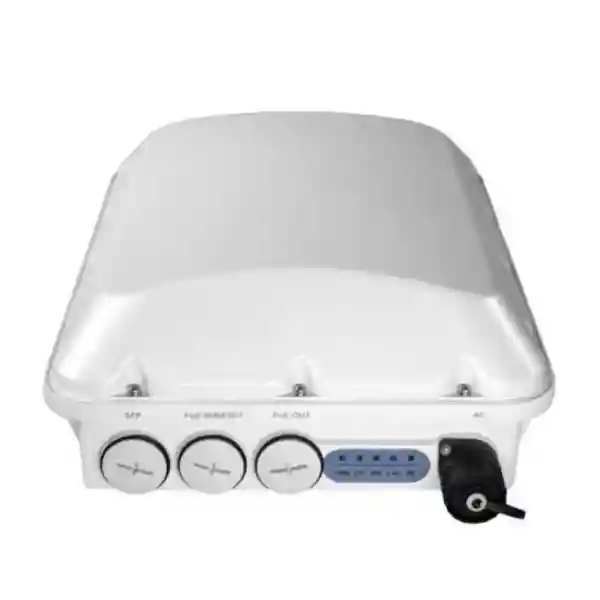
RUCKUS T750SE Outdoor Access Point
The RUCKUS T750SE is built for outdoor wireless projects where capacity, directed RF coverage, weather protection and uplink flexibility matter more than consumer-style simplicity. It combines dual-band Wi‑Fi 6, a 4×4:4 radio architecture, an integrated 120-degree sector antenna, optional external-antenna capability, multi-gigabit Ethernet, fiber support and a hardened IP67 enclosure. That combination makes the model particularly relevant to high-density seating areas, campuses, transport facilities, outdoor hospitality spaces, event venues and other projects in which the access point must serve a defined coverage sector rather than radiate equally in every direction.
Wireless generation: Wi‑Fi 6 (802.11ax)
Radio streams: 4×4:4
Sector antenna: 120° integrated
Backhaul: 2.5GbE plus 1GbE and fiber options
Outdoor protection: IP67
Deployment decision: confirm country code, management, power, mounting and antenna plan before ordering.
Direct answer: what is the RUCKUS T750SE designed to do?
The RUCKUS T750SE Outdoor Access Point is a sectorized version of the T750 outdoor Wi‑Fi 6 platform. Manufacturer information identifies it as a dual-band 4×4:4 access point with an integrated 120-degree sector antenna and the ability to attach external antennas. It supports a maximum published PHY rate of 2,400 Mb/s on 5 GHz and 1,148 Mb/s on 2.4 GHz, giving a combined maximum PHY rate of 3,548 Mb/s. The hardware provides a 2.5 Gigabit Ethernet port, an additional 10/100/1000 Ethernet port, PoE input and PSE output capabilities, and fiber SFP/SFP+ connectivity. The enclosure is rated IP67 and is specified for operation from -40°C to +65°C. Certain ordering variants include GPS, while corresponding no-GPS variants are also documented, so buyers should not assume that every regional part code has identical GPS capability.
The practical reason to choose the T750SE rather than a general omnidirectional outdoor access point is coverage shape. A sector antenna directs useful RF energy toward a defined area, which can be advantageous when users are concentrated in stands, courtyards, plazas, transport platforms, outdoor seating or a known approach path. This does not eliminate the need for a wireless survey. Mounting height, orientation, client density, neighbouring access points, channel planning, obstructions, regulatory power limits and expected device types still influence real performance. FourTeck therefore positions the T750SE as part of a designed WLAN rather than as a simple range-extension purchase.
Verified platform highlights
Wi‑Fi 6 capacity
Dual-band 802.11ax operation with a 4×4:4 architecture is aimed at demanding outdoor networks where many active devices and efficient airtime use are important.
120° sector antenna
The integrated sector antenna focuses coverage into a defined area. The SE model also supports external antennas, giving qualified designers additional options for specialized coverage.
Flexible backhaul
A 2.5GbE interface helps prevent a 1GbE uplink from becoming the immediate wired bottleneck, while additional Ethernet and SFP/SFP+ interfaces support varied deployment architectures.
Outdoor construction
An IP67 enclosure and a published -40°C to +65°C operating range make the platform suitable for properly installed outdoor environments, subject to site design and local installation practices.
T750SE versus T750: the purchasing distinction
The core purchasing distinction is the antenna system. RUCKUS documentation describes the T750 as using internal omnidirectional BeamFlex+ coverage, while the T750SE includes an internal 120-degree sector antenna and supports attachment of an external antenna. That difference can materially affect a design. An omnidirectional AP can make sense when users surround the mounting point, while a sectorized AP can be more efficient when clients occupy a defined direction from the installation point. The SE version should not be selected merely because it sounds like a higher edition; it should be selected because the RF geometry supports the project requirement.
Part-number verification also matters. RUCKUS support documentation identifies T750SE part-code formats ending in XX51 and XX52, with the exact country code represented by XX. Published ordering information distinguishes GPS and no-GPS variants. For procurement, request a quotation that identifies the complete part number, country code, power accessories, mounting components, antenna requirements, management platform and support entitlement rather than accepting a generic model-only line item.
Where the RUCKUS T750SE fits well
Stadiums and structured seating
Sector coverage can be planned toward seating blocks or concourses where client concentration is predictable. Capacity planning should still account for simultaneous usage, neighbouring sectors and wired uplink design.
Campus and education outdoors
Courtyards, walkways, assembly spaces, sports areas and outdoor learning zones can benefit from controlled wireless coverage when AP placement, roaming and security policies are designed as part of the broader campus WLAN.
Hospitality and resorts
Pool decks, gardens, terraces, event lawns and beach-facing guest areas may require outdoor APs that can survive exposure while directing service toward actual guest zones rather than wasting RF energy behind the mounting location.
Transport and public venues
Ports, station approaches, waiting areas and managed public spaces often combine dense users with challenging RF conditions. The T750SE can be considered where a sectorized design aligns with the physical site and network management architecture.
Deployment, compatibility and management questions to settle before purchase
A professional outdoor Wi‑Fi project begins before the hardware is ordered. Confirm how the access point will be managed, which software release is approved for the environment, whether the project uses RUCKUS SmartZone, RUCKUS One, Unleashed or another supported architecture, and whether the selected T750SE regional variant is supported in that design. RUCKUS continues to publish software and support material for the T750SE, including recent SmartZone and Unleashed releases, but the production version should be chosen through the manufacturer’s supported upgrade path rather than by installing the newest image without review.
Power and switching are equally important. A multi-gigabit AP should be paired with switching and cabling that match the intended backhaul and power plan. If fiber is part of the design, confirm the optical module, fiber type, connector, distance, enclosure routing and grounding requirements. If PoE is used, verify the exact power source and whether any downstream PSE use is planned. Environmental rating does not replace correct installation: cable entries, mounting hardware, surge protection, earthing, pole or wall condition and exposure should all be reviewed by the project team.
For security, design staff and guest WLANs around authentication, segmentation, upstream firewall policy and logging. The access point is one layer of the solution. Buyers who are also reviewing perimeter security can explore FourTeck’s perimeter firewall planning guidance and firewall deployment service to coordinate secure WLAN traffic with VLANs, guest access, internet policy and remote management.
Regional buying and deployment guidance
RUCKUS T750SE Outdoor Access Point Dubai
Customers searching for the RUCKUS T750SE Outdoor Access Point Dubai are commonly planning wireless coverage for hotels, event areas, schools, logistics compounds, residential communities, outdoor retail spaces, transport facilities or large corporate sites where indoor access points cannot provide suitable weather protection or RF coverage. In Dubai, the key purchasing question is not simply whether the T750SE is available; it is whether the sectorized antenna pattern fits the intended site. The 120-degree integrated sector antenna is especially useful when the installation point faces a defined user zone, such as a courtyard, pool deck, seating area, loading yard or outdoor gathering space. A survey should consider building materials, heat exposure, reflective surfaces, nearby Wi‑Fi, mounting height, expected client density and the direction of client movement.
Dubai projects also benefit from careful backhaul planning. The T750SE provides a 2.5GbE interface and fiber capability, which can be important where the AP is mounted far from the nearest switch or where client density could make a 1GbE design less desirable. The installer should confirm the correct PoE source, switch port capability, cable route, surge protection, grounding and any fiber transceivers before the mounting work begins. Procurement teams should ask for the complete regional part number rather than a generic “T750SE” line so that country code, GPS/no-GPS variant and included accessories are clear.
For a Dubai quotation, provide the number of APs, site type, outdoor area dimensions, expected users, existing RUCKUS controller or cloud environment, switch models, available uplink media, mounting preference and whether a new firewall or VLAN design is part of the project. FourTeck’s network security product collection can help buyers review the upstream security layer that will carry guest and staff WLAN traffic, while the services page provides context for deployment and support discussions. For wider UAE infrastructure requirements, buyers can also review FourTeck UAE solutions before requesting a consolidated quotation.
RUCKUS T750SE Outdoor Access Point UAE
A RUCKUS T750SE Outdoor Access Point UAE project may span very different environments: a resort terrace in the coast, a university campus, a logistics yard, an industrial compound, a sports facility, a transport terminal or a large residential development. The technical specification remains the same family, but the correct design depends heavily on geography and site usage. For Abu Dhabi, Sharjah, Ajman, Ras Al Khaimah, Fujairah and other emirates, buyers should treat radio planning, physical mounting and wired connectivity as one design problem. Sector antennas are strongest when aimed deliberately; using the T750SE without understanding the target coverage zone can create unnecessary overlap or leave users outside the intended pattern.
The IP67 enclosure and wide published operating-temperature range support outdoor use, but the full installation still needs weather-conscious engineering. Cable entries, exposed connectors, fiber transitions, earthing, surge protection, mounting brackets and pole condition should be reviewed for the specific site. The UAE also has many locations where outdoor wireless must coexist with CCTV, access control, point-of-sale, VoIP and guest internet systems. In those cases, VLAN separation, QoS, firewall policy and switching capacity are part of the WLAN conversation. A 2.5GbE AP uplink is most valuable when the rest of the wired path can support the expected traffic.
Procurement teams searching for a RUCKUS T750SE supplier in UAE should request the exact regional SKU, quantity, management method, required licenses or support, power accessories, mounting hardware and any external antennas in a single bill of materials. Do not assume that published overseas bundles match the regional quotation. If the project includes internet security and guest access, review FourTeck’s branch firewall example with PoE-capable networking only as an upstream security reference; the final firewall and switching platform should be sized independently for the WLAN traffic and organization policy.
RUCKUS T750SE Outdoor Access Point Uganda
Organizations evaluating the RUCKUS T750SE Outdoor Access Point Uganda often need reliable outdoor wireless for education campuses, hospitality properties, enterprise compounds, warehouses, public gathering areas, institutional sites or multi-building facilities. The most important design question is whether the site needs focused sector coverage or broad omnidirectional coverage. The T750SE is intended for a defined sector, so it can be a good match when the AP is installed at an edge and aimed toward the user population. For a campus with users surrounding the mounting point, another antenna pattern or multiple AP placements may be more appropriate.
Uganda deployments should also account for power continuity and backhaul availability. The T750SE supports Ethernet and fiber options, which gives designers alternatives when copper distances or lightning exposure make a direct outdoor copper run less attractive. A project can combine PoE at appropriate distances with fiber to more remote network points, but the switching, optics, enclosures and surge protection must be chosen as a complete system. Where generators, UPS systems or variable power conditions are part of the site, confirm the PoE switch and upstream network remain powered along with the AP.
Buyers looking for a RUCKUS T750SE price in Uganda should provide the number of APs, site map, user estimate, expected applications, controller platform, switching environment and installation scope so that a quotation can separate hardware from services and accessories. A low hardware-only price can be misleading if mounting, PoE, optics or controller requirements are omitted. FourTeck’s Uganda technology platform covers business networking and infrastructure topics and can be used as a regional enquiry path. For secure guest access or campus segmentation, the WLAN design should also define firewall rules between guest, staff, CCTV and administrative networks instead of placing all devices on one flat LAN.
RUCKUS T750SE Outdoor Access Point Kampala
For Kampala, the RUCKUS T750SE is most relevant where an outdoor Wi‑Fi project has a clear service area and a strong need for capacity: hotel gardens, conference grounds, university courtyards, school compounds, business campuses, healthcare facilities, retail complexes and event venues are examples. Kampala sites can include dense building clusters, trees, boundary walls, roofs and mixed indoor-outdoor users, so a sectorized AP should be positioned with a deliberate line of coverage. Mounting an AP high does not automatically improve service; too much height can change antenna geometry and increase interference. The design should relate antenna tilt and azimuth to where client devices are actually located.
Many Kampala buyers also need to integrate outdoor Wi‑Fi with an existing indoor RUCKUS network. Confirm controller compatibility, software support and roaming policy before ordering. If the outdoor area is part of a hotel or campus, SSIDs may need to follow users from indoor corridors to outdoor gardens without forcing a separate login. That means authentication, VLAN assignments and management architecture are as important as RF coverage. The T750SE’s 2.5GbE and fiber capabilities also allow planners to avoid treating the outdoor AP as an isolated endpoint.
When requesting a Kampala quotation, include the installation address, available switch model, nearest network cabinet, cable distance, whether poles already exist, desired coverage zone, number of simultaneous users and whether guest portal or enterprise authentication is required. If an external antenna is being considered, specify the reason and do not select it simply to increase “range”; antenna gain, pattern and local power rules must be engineered together. FourTeck can use this information to prepare a clearer bill of materials and avoid leaving necessary mounting or power items out of the initial quote.
RUCKUS T750SE Outdoor Access Point Arua
Arua buyers considering the RUCKUS T750SE may be planning wireless service across an institutional compound, school, hospitality site, warehouse area, yard, clinic campus or multi-building business location. In these environments, the sector antenna can be useful when the network point is installed on one side of the coverage area and directed inward. The first planning step should be to mark the exact outdoor zones that need service and identify obstructions, not simply to draw a large circle around the AP location. Trees, roofs, walls, metal structures and uneven terrain can all alter the useful signal path.
Backhaul resilience deserves attention in Arua projects because some outdoor locations are physically separated from the main network room. The T750SE’s fiber interface can be attractive where longer network runs or electrical isolation are part of the design. If fiber is used, the specification should identify the correct optic, fiber type and termination. If copper and PoE are used, cable distance, outdoor-rated pathways, surge protection and switch power budget must be checked. These details should be resolved before equipment is shipped to the site, where last-minute accessory changes can create avoidable delays.
For procurement, ask for a quote that identifies hardware, regional part code, mounting, power, management, support and optional external-antenna items separately. If the network will serve guest users, define whether the guest WLAN is internet-only and how it will be isolated from staff devices, cameras and administrative systems. A good Arua deployment is therefore not just an AP purchase: it is a small network design covering RF, power, backhaul, security and ongoing management. FourTeck’s Uganda regional enquiry route can help consolidate these requirements before a commercial proposal is prepared.
RUCKUS T750SE Outdoor Access Point Mbarara
In Mbarara, a RUCKUS T750SE Outdoor Access Point can suit hospitality, education, medical, commercial and institutional projects where people use Wi‑Fi in open areas beyond the building envelope. Courtyards, dining areas, parking approaches, campus paths and event grounds are common examples of spaces that need a different RF strategy from indoor rooms. Because the T750SE delivers a defined sector, the AP should be placed so the sector naturally overlays the intended client zone. Designers should avoid using sectorized APs as general-purpose “long-range” devices without considering client transmit power, interference and the return path from phones and laptops.
For hotels and educational sites, roaming and authentication can be important. Guests or students may move from indoor AP coverage to outdoor T750SE coverage, and the controller, WLAN configuration and VLAN structure should support that transition. The network team should also decide whether high-bandwidth applications such as video, cloud collaboration, surveillance viewing or event streaming are expected outdoors. Those workloads influence uplink and switching choices. The published 2.5GbE interface is useful only when the switch port, cabling and wider network are designed to take advantage of it.
Mbarara procurement teams should ask suppliers to state what is included: access point, bracket, power source, optics if any, licenses or controller entitlement, support, delivery scope and installation. Where a no-GPS variant is acceptable, that should be confirmed explicitly rather than assumed. Where GPS is required for the selected architecture or operational process, request the appropriate documented variant. This level of detail helps prevent a model-correct but project-incomplete order.
RUCKUS T750SE Outdoor Access Point Gulu
Gulu organizations planning outdoor connectivity may use the RUCKUS T750SE for campuses, institutional compounds, hospitality grounds, public-facing service areas, warehouses or business facilities where wireless users concentrate in a predictable outdoor direction. Sectorized coverage is useful when the physical layout has a natural edge: a building facade overlooking a courtyard, a mast facing a field, or a network point positioned outside a user zone. If users are distributed on all sides of the mounting location, a sector design may require several APs or a different antenna approach.
Site access and maintenance planning are important. An AP mounted very high may be difficult to service, and outdoor cable routes can be vulnerable to weather, accidental damage and electrical events. The project should define how technicians will reach the unit, how connectors are protected, how the AP is grounded and how configuration backups or controller management are handled. If fiber is chosen for the uplink, document the fiber path and spare strands. If Ethernet PoE is used, verify the cable length, category, outdoor protection and switch budget.
For Gulu buyers, the quotation request should include an approximate coverage map and state whether the requirement is staff Wi‑Fi, guest Wi‑Fi, public access, operational tablets, handheld scanners or a mixed environment. Different client types and security policies can change the design. If the project will later expand to additional outdoor zones, mention this during the first design so switch capacity, controller licensing and channel planning are not sized only for the initial phase. FourTeck can then discuss the T750SE as one component in a phased wireless architecture rather than as a stand-alone device.
RUCKUS T750SE Outdoor Access Point Kenya
The RUCKUS T750SE Outdoor Access Point Kenya is relevant to high-density and outdoor enterprise projects in Nairobi and across the country, including universities, hotels, logistics centers, industrial parks, sports facilities, transport sites, compounds and public venues. Buyers should start with antenna geometry. The integrated 120-degree sector pattern is appropriate when a known population of users is located in front of the AP. For a site with users distributed around a central pole, an omnidirectional model or multiple sectors may be more suitable. A predictive design followed by on-site validation is preferable for larger deployments.
Kenyan projects often include a mix of copper and fiber infrastructure. The T750SE’s 2.5GbE Ethernet and fiber interfaces give architects flexibility, but each path needs supporting hardware. A fiber design needs compatible optics and termination; a PoE design needs a capable switch or injector, suitable cable distance and power budget. Outdoor deployment should also include surge protection, grounding and mechanically secure mounting. IP67 protects the enclosure against outdoor conditions, but it does not protect an incorrectly installed connector or cable pathway.
Commercial buyers searching for RUCKUS T750SE price Kenya should compare complete configurations rather than headline device prices. Confirm the regional part number, whether the selected unit has GPS, management and support requirements, brackets, power accessories and any external antenna. For regional planning and business networking enquiries, visit FourTeck Kenya. If the wireless network will be used for payments, operations, staff applications or guest traffic, include firewall segmentation and logging in the scope so that outdoor convenience does not create unnecessary access to internal systems.
RUCKUS T750SE Outdoor Access Point Kuwait
A RUCKUS T750SE Outdoor Access Point Kuwait project may involve hospitality terraces, resort spaces, education campuses, commercial courtyards, logistics yards, event venues, industrial compounds or large public-facing sites. The platform’s wide published operating range and IP67 enclosure are relevant to outdoor installations, but high ambient heat, direct solar exposure and enclosed mounting positions should still be considered in the physical design. Equipment should be installed according to manufacturer guidance with appropriate airflow and without improvised covers that could trap heat.
The sector antenna is particularly useful where the AP can be mounted at a boundary and aimed toward the coverage zone. In a broad open area, more than one sector may be needed to create controlled cells. This can be preferable to trying to maximize transmit power from a single AP because client devices have much lower transmit power and must still communicate back to the access point. Proper channel planning, cell sizing and capacity design matter more than advertised range. The T750SE’s multi-gigabit uplink also deserves compatible switching if the site expects high aggregate usage.
Kuwait buyers should request a commercial quote that identifies the exact country part number, controller or cloud requirements, power method, mounting accessories, support term and installation scope. Outdoor sites should also document cable route, grounding and surge protection. For local business technology enquiries, FourTeck Kuwait provides a regional contact path. If a firewall upgrade is part of the same project, FourTeck’s compact firewall product example can illustrate the separate security-gateway decision, although actual firewall sizing must be based on site bandwidth, inspection services and VPN requirements rather than on the AP model.
RUCKUS T750SE Outdoor Access Point Ghana
Organizations searching for the RUCKUS T750SE Outdoor Access Point Ghana may be building outdoor connectivity for schools, universities, hotels, event spaces, office compounds, logistics sites, industrial properties or institutional campuses. Ghana’s mixture of urban and regional project sites makes backhaul planning especially important. The T750SE can connect through multi-gigabit Ethernet and supports fiber, giving network architects options when the AP is positioned beyond convenient copper distance or when optical distribution is already available around a campus.
The 120-degree sector antenna should be treated as a design feature, not merely a specification. It lets a planner focus coverage toward a target zone, which can reduce wasted RF energy behind the AP. However, good performance still depends on client density, device capability, neighbouring radios and channel planning. A hotel lawn with many transient phones has different requirements from a warehouse yard with a smaller number of handheld terminals. The number of APs and their orientation should therefore follow the application rather than a generic area-per-AP estimate.
Ghana procurement should clearly separate hardware from implementation. Ask whether the quotation includes mounting, PoE, optics, management licenses or subscription, configuration, testing and support. Confirm the correct regional T750SE variant and whether GPS is included where that matters. For regional supply and IT solution discussions, buyers can use FourTeck Ghana. If guest Wi‑Fi is expected, define how visitors authenticate and how guest traffic is isolated from internal resources. If operational devices use the same outdoor coverage, create separate WLAN and VLAN policies so a public network does not share unrestricted access with business systems.
RUCKUS T750SE Outdoor Access Point Nigeria
The RUCKUS T750SE Outdoor Access Point Nigeria can be considered for enterprise campuses, universities, hotels, large office compounds, event venues, transport locations, warehouses and industrial facilities that need robust outdoor Wi‑Fi. In Lagos, Abuja, Port Harcourt and other major business centers, dense radio environments may make RF planning especially important. A sectorized AP should be positioned and aimed to serve a specific cell. Using multiple smaller controlled cells can often produce a more manageable high-density network than trying to cover a very large area from one point.
Power and network continuity also deserve early planning. The access point may be on a UPS-backed PoE switch, remote cabinet or fiber-fed distribution point depending on the site. If power failover is important, ensure the entire path from core network to access point stays available rather than backing up only the AP power source. For fiber designs, specify compatible optics and protection. For copper designs, check distance, surge exposure, grounding and outdoor cable routing. The T750SE’s IP67 enclosure is one part of a reliable deployment, not a substitute for careful installation.
A Nigeria quotation should state exact part number, regional code, GPS/no-GPS variant, controller platform, software/support entitlement, power method, mounting and optional antennas. It should also state whether installation and RF optimization are included. Buyers can use FourTeck Nigeria for regional IT enquiries. For organizations connecting outdoor guest and staff Wi‑Fi to an enterprise security stack, FourTeck’s enterprise firewall platform overview can help frame upstream security questions, while final product choice should be made independently from the wireless model.
RUCKUS T750SE Outdoor Access Point Seychelles
The RUCKUS T750SE Outdoor Access Point Seychelles is especially relevant to hospitality and resort environments, waterfront public spaces, institutional sites and outdoor guest areas where weather protection and controlled coverage are important. Island and coastal deployments require more attention to physical installation than a typical indoor AP. Even with an IP67 enclosure, planners should review mounting hardware, cable glands, corrosion exposure, connector protection, grounding and the path between the access point and the nearest protected network cabinet. A maintenance plan should include inspection of mounts and cabling in exposed locations.
For resorts, the sector antenna can be aimed toward a beach-facing seating area, pool zone, event lawn or garden while reducing unnecessary energy toward the rear of the mounting position. Guest expectations are usually high, so the WLAN should be designed for the number of active devices and the applications used in the area. Roaming between guest rooms, lobby spaces and outdoor zones should be tested, and guest authentication should be integrated with the selected management architecture. If staff devices, payment terminals or operational handhelds also use outdoor Wi‑Fi, separate them through WLAN and VLAN policy.
Seychelles buyers should request the exact T750SE regional part number, controller/support requirements, power and mounting accessories, and shipping scope. The use of fiber can be valuable in larger properties with distributed buildings, but optic compatibility and termination must be planned. A complete quotation should also identify who is responsible for RF survey, installation, cable work, switch configuration and post-install testing. For broader African infrastructure enquiries, FourTeck can coordinate through its regional channels, while product availability and warranty handling should always be confirmed for the specific destination and order.
Procurement checklist before requesting a quote
Related FourTeck infrastructure resources
Outdoor Wi‑Fi performs best when switching, uplink capacity, VLAN design and perimeter security are planned together. These verified pages on the same FourTeck target site provide useful context for adjacent network decisions.
Firewall products
Review the FourTeck firewall product collection when staff and guest WLAN traffic will be separated and inspected at the network edge.
Deployment services
The network security service overview can help scope policy, VLAN and VPN work that interacts with the wireless design.
Perimeter security
Use the perimeter firewall guidance to plan how guest, staff and IoT WLANs reach the internet and internal services.
Implementation planning
The firewall deployment page outlines discovery, configuration and testing considerations that often accompany a new enterprise WLAN.
Branch firewall example
The Palo Alto PA-415 product page is an example of an upstream branch security device; it is not a required companion to the T750SE.
Compact security gateway example
The Sophos XGS 88 page shows another firewall class that may be evaluated separately for smaller WLAN edge requirements.
Enterprise firewall portfolio
For larger campuses, the PA-Series overview illustrates the type of enterprise perimeter platform that can be sized independently from the access points.
Sales contact
Use the FourTeck contact page to submit the wireless bill of materials, site details and required deployment scope for quotation.
Frequently asked questions about the RUCKUS T750SE
Is the T750SE an outdoor Wi‑Fi 6 access point?
Yes. RUCKUS documents the T750SE as an outdoor 802.11ax Wi‑Fi 6 access point using a 4×4:4 architecture on its dual-band platform.
What does “SE” change compared with the T750?
The T750SE uses an integrated 120-degree sector antenna and supports external antennas, whereas the T750 is documented with internal omnidirectional coverage. The correct choice depends on the geometry of the target area.
What is the published wireless rate?
Manufacturer data lists maximum PHY rates of 2,400 Mb/s on 5 GHz and 1,148 Mb/s on 2.4 GHz, for a combined maximum PHY rate of 3,548 Mb/s. Real application throughput is lower and depends on clients, RF conditions, channel width, contention, protocol overhead and network design.
Does the T750SE support 2.5 Gigabit Ethernet?
Yes. Ordering information identifies one 2.5G Ethernet port and an additional 10/100/1000 Ethernet port, plus fiber SFP/SFP+ support. Confirm the required transceiver and switch architecture for the project.
Can I connect an external antenna?
Yes, external antenna support is a documented T750SE capability. The antenna should be selected by an RF professional because gain, pattern, connector type, mounting and local regulatory limits affect the final design.
Is the T750SE weather resistant?
The enclosure is specified to IP67 and the manufacturer publishes an operating-temperature range of -40°C to +65°C. Outdoor reliability still depends on correct mounting, cable protection, grounding and installation practice.
Does every T750SE have GPS?
No. Published ordering information includes GPS and no-GPS variants. Request the complete part number and verify the exact unit being quoted for the destination region.
Can the T750SE be used for guest Wi‑Fi?
Yes, as part of a properly designed WLAN. Guest access should include appropriate authentication, VLAN assignment, internet-only policy where required, bandwidth controls and upstream firewall segmentation rather than relying on the access point alone for all security.
What information should I send for a quote?
Provide destination, quantity, site type, coverage drawing, expected users, existing RUCKUS management environment, switch and PoE details, desired mounting, fiber requirement, installation scope and any external antenna need. This produces a more useful quotation than a model-only request.
Is the T750SE still supported by current RUCKUS software?
RUCKUS support pages continue to list the T750SE and publish current software and documentation. Production deployments should follow the supported compatibility matrix and approved upgrade path for the selected management platform.
Decision recap
Choose the RUCKUS T750SE when your project requires high-capacity outdoor Wi‑Fi 6 and the RF design benefits from a 120-degree sector rather than omnidirectional coverage. Its 4×4:4 architecture, multi-gigabit Ethernet, optional fiber path, external-antenna capability, IP67 enclosure and broad environmental specification make it a capable building block for demanding outdoor wireless. The strongest deployments are those in which the AP is matched with a proper survey, compatible controller software, adequate switching and PoE, secure VLAN and firewall policy, and a documented mounting and backhaul plan.
Before placing an order, verify the full regional part number, GPS/no-GPS variant, management model, accessory list and support entitlement. Product availability, lead time, warranty handling and installation scope can vary by destination and should be confirmed in the formal quotation rather than inferred from another market.
Request a RUCKUS T750SE quotation
Send FourTeck your destination, quantity, site plan, expected client load, existing RUCKUS management platform, switch/PoE details, uplink preference, mounting locations and installation scope. The resulting discussion can cover the exact T750SE regional part code, required accessories and a project-appropriate wireless and security design.

Reviews
There are no reviews yet.