
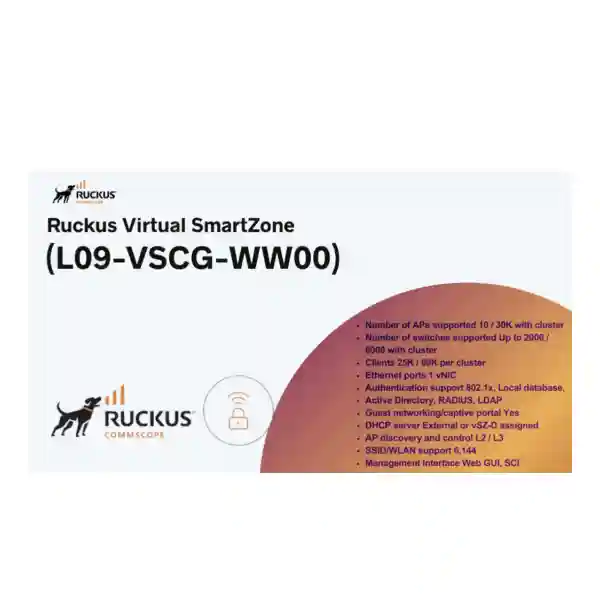
RUCKUS NETWORK SERVICES • VIRTUAL MACHINE DEPLOYMENT • LIFECYCLE GUIDANCE
RUCKUS WAN Gateway Virtual Appliance
RUCKUS WAN Gateway Virtual Appliance is the virtual-machine deployment approach for the RUCKUS WAN Gateway (RWG), a software platform created to combine critical enterprise and service-provider network services at the edge. The platform is documented by RUCKUS as supporting capabilities such as DNS, DHCP, routing and BGP, policy control, firewall functions, micro-segmentation, application-performance-aware WAN routing, automation and orchestration. RUCKUS also positions RWG for hospitality, multi-dwelling-unit, campus and service-provider environments where access, onboarding, policy, billing or property-management integrations can be important.
Lifecycle notice: RUCKUS announced that WAN Gateway reached End of Sale on January 16, 2026. This page therefore focuses on technical understanding, existing-environment support, entitlement checks, legacy availability questions, migration planning and architecture review. It does not claim that new licenses or new product subscriptions remain generally orderable.
Deployment form
Virtual machine installation is documented for VMware ESXi. Hardware and virtual resources must match the licensed design and intended scale.
Core role
RWG is designed to operate as an edge gateway and default gateway for users, combining network services, policy enforcement and access functions.
Key integrations
RUCKUS documentation describes integration with technologies such as SmartZone controllers, ICX switches, RADIUS, guest portals and property-management workflows.
2026 buying status
Because the product is End of Sale, procurement should begin with lifecycle, entitlement and replacement checks rather than an assumption of normal new-product availability.
What the RUCKUS WAN Gateway Virtual Appliance Does
The RUCKUS WAN Gateway is more than a simple software router. RUCKUS describes RWG as a unified platform that can provide routing with SD-WAN and traffic shaping, micro-segmentation-focused network access control, unified threat-management functions, application-layer firewall inspection and operational services that are useful in complex access networks. In a virtual deployment, those functions run on a hypervisor-based server rather than on a dedicated RWG hardware appliance. This architecture can suit organizations that already operate virtual infrastructure and want the gateway to be aligned with server, network and operations workflows.
The platform has been used in environments where ordinary branch-firewall thinking is too narrow. Hospitality networks may require captive portals and property-management-system integration. Multi-dwelling-unit and student-housing projects may require tenant isolation, onboarding and virtual residential gateway behavior. Service providers may need subscriber policy, RADIUS, billing integration and large-scale operational control. Enterprise and campus deployments may need DNS, DHCP, routing, access policy, segmentation, WAN path control and visibility delivered from a central edge point.
For customers evaluating an existing installation in 2026, the most important question is not only whether RWG has the right features. It is whether the deployed build, license, support entitlement, virtual resources, RUCKUS integrations and operational dependencies remain maintainable for the required business period. FourTeck can help structure that review and determine whether the environment should be maintained temporarily, consolidated, redesigned or migrated to another supported architecture.
Verified Virtual-Machine Deployment Considerations
RUCKUS published a Virtual Machine Installation guide for RWG that demonstrates deployment on VMware ESXi. The guide explains that RWG behaves as a router rather than as a conventional server, so the virtual network design must be planned accordingly. It requires at least two virtual interfaces for a basic design, while broader production deployments may use additional interfaces. The documented example uses separate WAN and LAN virtual switching and recommends appropriate resource margin above the licensed requirement.
The guide’s example minimum virtual-machine settings use 4 CPUs, 12 GB memory and an 80 GB disk, but these values should not be treated as universal sizing for every deployment. RUCKUS instructs administrators to calculate the required resources for the intended license and scale. The virtual network interface count is also important because the license is tied to VM resource configuration; changing CPU, memory or vNIC resources after deployment can require license re-issuance. For a production review, record the current VM specification before making changes.
The same guide explains that licensing uses an Installation Unique Identifier (IUI). Existing environments should preserve licensing information, current configuration exports, system build details, FQDN information, VM resource allocations and recovery procedures. A migration plan that ignores these dependencies can turn a routine hypervisor refresh into an avoidable outage.
Capabilities to Validate in an Existing RWG Environment
Routing, SD-WAN and traffic policy
Document default routes, BGP or other routing dependencies, WAN uplinks, failover behavior, traffic shaping, application-based routing and any public addressing that depends on RWG.
DHCP, DNS and RADIUS
Confirm whether RWG is providing core address, name or authentication services. Replacement projects must reproduce required scopes, reservations, realms, policies and upstream integrations.
Micro-segmentation and onboarding
Review guest, BYOD, resident, headless-device and tenant workflows, including VLAN behavior, dynamic segmentation, certificates, DPSK/eDPSK use and captive-portal dependencies.
Hospitality and property systems
Where PMS, billing, guest-loyalty or front-office systems depend on RWG, identify interface methods and operational owners before changing gateway architecture.
RUCKUS ecosystem integration
Confirm SmartZone, access-point, ICX switching and RUCKUS One dependencies. A gateway migration should preserve the wireless and switching behavior users rely on.
Security and operational controls
Review firewall rules, DPI functions, management access, logging, backups, HA design, VPN or tunnel configurations, monitoring and change procedures before committing to a lifecycle decision.
Important 2026 Lifecycle Guidance
RUCKUS published an End of Sale announcement stating that WAN Gateway would no longer be available for purchase after January 16, 2026, with the same date identified as the last ship date. The RUCKUS support catalogue now places RWG in its end-of-life product family. For that reason, a responsible quotation process should not represent RWG as a normal current-generation product without checking what entitlement, renewals, support, licensing or legacy channel options actually remain.
If your organization already operates RWG, provide the build version, license information, virtual-machine resources, deployment role, supported users or doors, integrations, WAN design and desired support period. FourTeck can then help frame the next step: short-term maintenance, environment documentation, hypervisor risk review, replacement assessment or a staged migration plan.
RUCKUS WAN Gateway Virtual Appliance Dubai
Organizations searching for RUCKUS WAN Gateway Virtual Appliance Dubai are often dealing with hospitality, mixed-use developments, managed Wi-Fi estates, campus networks or service-provider-style access environments rather than a simple branch router. Dubai projects can involve dense guest connectivity, apartment or residence networks, retail sites, hotels, education campuses, business parks and multi-tenant properties. In each case, the gateway may sit at the centre of internet access, user policy, onboarding, segmentation and operational integrations. The first procurement question in 2026 should therefore be lifecycle status. Because RWG reached End of Sale on January 16, 2026, FourTeck should verify the condition of any existing entitlement and avoid assuming that a new license can be ordered through normal channels.
For an existing Dubai deployment, start by documenting the WAN handoff, public addressing, virtual-machine host, vNIC count, CPU, memory, storage, hypervisor version, RWG software build and current license identifier. The virtual appliance is designed to act as a router and default gateway, so the hypervisor switching configuration is part of the network design, not merely a server detail. A planned VMware refresh, host migration or interface change should be reviewed against licensing and traffic-flow requirements before implementation. If the site depends on dual WAN, dynamic VLAN assignment, guest portals, RADIUS or property-management integration, those dependencies should be mapped into a migration workbook.
Dubai buyers also commonly need a clear boundary between RWG functionality and dedicated next-generation firewall functionality. RWG includes documented firewall and UTM capabilities, but organizations with current compliance, threat-prevention or vendor-support requirements may need to evaluate whether a separate supported firewall should sit upstream or replace parts of the existing gateway role. FourTeck’s perimeter firewall planning guidance can help structure questions around WAN security, segmentation, VPN, inspection and operational ownership.
When requesting a Dubai assessment, share user or room count, ISP links, guest-access workflow, SmartZone or ICX dependencies, PMS or billing integrations, remote-management needs and the business deadline for any change. FourTeck can review the existing design, compare a maintain-versus-migrate path and coordinate a quotation for available services or replacement components. For wider UAE technology requirements, the FourTeck UAE website provides broader infrastructure context.
RUCKUS WAN Gateway Virtual Appliance UAE
Searches for RUCKUS WAN Gateway Virtual Appliance UAE can come from multi-site groups that have RWG at hotels, residential developments, campuses or service-provider access points in more than one emirate. A country-level review should look beyond one server or one site. The useful question is whether each gateway performs the same role and whether licensing, user policies, onboarding, VLAN design and software levels are standardized. Variations that accumulated over several years can make lifecycle migration difficult, especially when a central IT team assumes that every site is identical.
For UAE estates, create an inventory by location. Record RWG VM resources, software build, license type, throughput or policy limits, interfaces, IP addressing, RADIUS relationships, SmartZone integration, guest portals, property-management links, WAN carriers and high-availability topology. Also identify which business services fail if RWG is unavailable. In a hotel, guest internet authentication or billing may depend on it. In an MDU, tenant onboarding and micro-segmentation may depend on it. In a campus or service-provider environment, routing, DHCP, DNS and policy services may all converge on the platform.
The UAE procurement team should be given a clear lifecycle statement: RUCKUS announced RWG End of Sale effective January 16, 2026. A purchase request written as though RWG were a current new platform can lead to wasted quotation cycles. Instead, specify whether the requirement is for support of an installed system, a license or entitlement query, a spare or recovery plan, professional services, or a replacement design. This wording helps suppliers and technical teams respond accurately.
If the target is to modernize the security edge while preserving wireless and switching services, FourTeck can help separate the functions that must remain from those that can move. Review current firewall alternatives through the Firewall Dubai product collection, then compare the requirements with the existing RWG role. The objective is not a like-for-like box replacement; it is continuity of routing, access, segmentation, guest services, identity and management with a supportable future architecture.
RUCKUS WAN Gateway Virtual Appliance Uganda
Customers searching for RUCKUS WAN Gateway Virtual Appliance Uganda may be planning networks for hotels, universities, residential compounds, managed Wi-Fi services, ISPs, enterprise campuses or organizations operating several sites with centralized IT. In these environments, the value of RWG has traditionally been its ability to combine multiple edge services in one software platform. That consolidation can simplify operations when it is documented well, but it can also create a large dependency if the gateway reaches a lifecycle milestone. With RWG now End of Sale, Ugandan organizations should identify which services are truly running on the appliance before deciding what to maintain or replace.
A practical Uganda assessment should start with connectivity reality. Record every upstream ISP or WAN circuit, public address, failover mechanism and routing dependency. Then map LAN services: DHCP scopes, DNS behavior, VLANs, subscriber or guest policies, captive portal, RADIUS and any SmartZone-controlled wireless environment. Where RWG is deployed virtually, confirm the VMware host, storage, physical NICs, virtual switches and port groups. The RUCKUS deployment guidance makes clear that RWG is expected to be the default gateway for users and that a basic VM needs at least two virtual interfaces. That means a server change can directly affect network forwarding.
For procurement teams in Uganda, avoid requesting an undefined ‘new RWG virtual appliance’ without a lifecycle note. Instead, identify whether you are seeking support for an existing deployment, migration assistance, licensing clarification, a design assessment or a replacement gateway architecture. If you already have RUCKUS access points, SmartZone or ICX switches, include their models and software versions so compatibility and operational continuity can be evaluated as one system rather than as isolated products.
FourTeck can coordinate regional requirement review through the FourTeck Uganda site. For organizations that want to separate security from access-network functions, FourTeck can also help review a dedicated firewall layer, routing design and phased migration. The quotation should clearly state what is being retained, what is being replaced and which services need validation before any cutover.
RUCKUS WAN Gateway Virtual Appliance Kampala
RUCKUS WAN Gateway Virtual Appliance Kampala searches often reflect a city-level deployment need where network teams must support many users in a concentrated property, campus, hotel, office complex or managed-access environment. Kampala projects can combine fibre, wireless distribution, guest internet, business applications and property systems, so an RWG installation may have accumulated responsibilities far beyond simple internet routing. Before planning a change, identify every function tied to the gateway and every team that depends on it.
For a Kampala hotel or serviced-apartment deployment, the review should specifically check guest onboarding, captive portal behavior, PMS integration, room or resident policy, VLAN separation, RADIUS and any billing or front-office workflow. For a university or institutional network, examine student and staff segmentation, device onboarding, internet policy, DNS and DHCP services, and how access points or controllers are integrated. For an ISP or managed Wi-Fi operator, document subscriber policy, WAN links, routing, monitoring and any Pack Manager or centralized operational method used across gateways.
Virtualization needs the same attention as networking. The current VM should be captured before modification: CPU, memory, disk, vNIC count, vSwitch mapping and host placement. RUCKUS documentation warns that license validity is tied to VM resource configuration, so increasing CPU or adding network interfaces is not necessarily an invisible infrastructure change. A host migration plan should include license recovery, configuration backup, test criteria and rollback procedures.
Because the RWG product is End of Sale as of January 16, 2026, Kampala buyers should ask for an architecture and lifecycle consultation rather than assuming a fresh new subscription will be available. FourTeck can help assess the current system, list dependencies, determine what can continue temporarily and build a staged replacement plan where necessary. If a dedicated security gateway is part of that plan, the FourTeck firewall services page outlines configuration, migration, VPN and support areas that can be scoped alongside the RUCKUS transition.
RUCKUS WAN Gateway Virtual Appliance Arua
A request for RUCKUS WAN Gateway Virtual Appliance Arua is likely to be driven by a need for centralized network services where local IT resources, WAN options or site access may be more constrained than in a major metropolitan data centre. In that situation, operational simplicity and recovery planning matter as much as feature breadth. If an existing RWG virtual machine provides routing, DHCP, DNS, access policy, guest services or segmentation, the organization should treat it as critical infrastructure and make sure configuration, licensing and hypervisor dependencies are documented.
Start the Arua review with failure scenarios. What happens if the VM does not boot? Can users reach the internet? Do access points still authenticate clients? Are guest credentials or portals available? Does DHCP continue? Is there a second gateway or only one instance? Can the site be supported remotely if the physical server fails? These questions are particularly important for a platform that has reached End of Sale, because future recovery may depend on what files, entitlements and operational knowledge are already preserved.
The RUCKUS virtual-machine guide shows that RWG needs deliberate hypervisor networking, with separate WAN and LAN paths in a basic configuration and licensing linked to VM resources. For an Arua site, preserve the VM’s current interface count, IP configuration and resource profile before changing host hardware. Where connectivity is intermittent or remote support depends on the same gateway, plan an out-of-band or local recovery route before a maintenance window.
FourTeck can help turn an undocumented appliance into a supportable design record. The output should include an interface map, service inventory, current license details, administrator access process, backup location, RUCKUS component relationships and a migration priority. If the site belongs to a larger Ugandan organization, compare the Arua build with Kampala, Mbarara and Gulu locations to identify where standardization is possible. A regional migration can then be staged so remote locations are not forced into a one-time disruptive change.
RUCKUS WAN Gateway Virtual Appliance Mbarara
Organizations looking for RUCKUS WAN Gateway Virtual Appliance Mbarara may include hospitality operators, education institutions, healthcare groups, business campuses, managed service providers and multi-location enterprises. The right approach in 2026 is to treat RWG as a legacy platform requiring lifecycle-aware planning. A site that depends on RWG can continue to be business-critical even though new sales have ended. The task is to understand the installed function, verify entitlement and build a controlled path that protects users from unnecessary disruption.
For Mbarara, include the local WAN environment in the assessment. Record primary and backup circuits, ISP handoff method, public IP allocation, NAT dependencies and how failover is handled. If RWG performs application-based routing or traffic shaping, capture those policies. Then review internal services: DHCP, DNS, VLANs, RADIUS, captive portals, wireless controller integration, tenant or guest segmentation and any application that uses fixed gateway addresses. This information becomes the basis for either a recovery plan or a replacement configuration.
Where the virtual appliance runs on a shared VMware host, confirm whether server administrators plan to upgrade ESXi, storage or physical NICs. Network and server changes should be coordinated because RWG is a router inside the hypervisor. The documented installation model requires network settings that allow the gateway to forward LAN and WAN traffic correctly. A standard virtualization migration performed without network context can break DHCP, VLAN trunking or uplink order.
For a quotation, Mbarara buyers should provide the current RWG build, license information, user or room scale, VM resources, RUCKUS controller details and desired outcome. FourTeck can then scope documentation, support review, migration design or security-gateway replacement rather than offering an unsupported generic product promise. If the site is one branch of a Ugandan estate, align naming, VLAN IDs, authentication methods and monitoring with the broader country design so future support becomes easier.
RUCKUS WAN Gateway Virtual Appliance Gulu
RUCKUS WAN Gateway Virtual Appliance Gulu requirements should be evaluated through the operational role of the gateway, not only the product name. A Gulu installation may serve a hotel, educational institution, NGO campus, enterprise office, managed Wi-Fi network or service provider. If RWG is the default gateway, it may simultaneously influence internet access, local addressing, authentication, segmentation and remote support. A change to that VM can therefore affect the entire site even when the underlying wireless access points remain healthy.
The first technical step is to build a dependency map. List WAN circuits, VLANs, IP ranges, DHCP scopes, DNS servers, RADIUS realms, portal URLs, controller addresses, switch uplinks, management networks and monitoring endpoints. If the network uses tenant or guest micro-segmentation, describe the user journey from device association to policy assignment and internet access. If staff rely on VPN or remote administration, document that path separately so support access is not lost during a gateway change.
The virtual-machine layer should be documented with the same care. Record host hardware, ESXi version, datastore, virtual switches, port groups, vNIC sequence and current CPU and memory allocation. RUCKUS guidance notes that resource changes can affect licensing. Before moving the VM or altering interfaces, verify the recovery method and whether a new license can be generated under the current lifecycle conditions.
Because RWG reached End of Sale in January 2026, Gulu organizations planning a multi-year network refresh should compare the cost and risk of maintaining the legacy gateway against a supported replacement architecture. FourTeck can help identify which services can move to a current firewall, router, wireless platform or dedicated identity service, and which RUCKUS dependencies need a separate transition. The result should be a phased design with clear test points, not a rushed replacement that disrupts user access.
RUCKUS WAN Gateway Virtual Appliance Kenya
RUCKUS WAN Gateway Virtual Appliance Kenya searches may come from hospitality groups, universities, residential developments, managed Wi-Fi operators, ISPs and enterprises that have standardized on RUCKUS access and switching. Kenya deployments can range from one property to national estates with many sites. RWG’s integrated approach can be attractive in those environments because routing, addressing, policy, portal and subscriber functions can be managed from a common gateway. The same integration means lifecycle planning must be disciplined now that the product is End of Sale.
For a Kenya-wide assessment, categorize locations by role and scale rather than reviewing each gateway independently. A hotel may depend on PMS authentication and guest portals. A university may rely on RADIUS, VLANs, DHCP and access policy. An MDU may use virtual residential gateway concepts and micro-segmentation. An ISP or managed service provider may use subscriber policy, routing and centralized management. Once these patterns are identified, the organization can design a small number of repeatable migration templates rather than inventing a different approach for every site.
Virtual infrastructure is another procurement factor. Confirm whether each site owns the VMware host, uses a shared data-centre platform or depends on a service provider. Capture resource allocations and interface topology before any host refresh. The official installation guidance demonstrates ESXi deployment and emphasizes that licensed resources and network interfaces must be planned. For environments with multiple WAN uplinks, 10 Gb interfaces or high user counts, do not extrapolate from the simple minimum example; verify the actual licensed design and traffic requirement.
Kenyan organizations can use the FourTeck Kenya site for regional engagement. When requesting a lifecycle review, include current software build, support status, license details, user scale, branch count, RUCKUS controller and switch environment, guest or subscriber workflows and the expected project horizon. FourTeck can then frame a practical route for maintenance, documentation or migration without representing an End-of-Sale platform as a normal current purchase.
RUCKUS WAN Gateway Virtual Appliance Kuwait
For RUCKUS WAN Gateway Virtual Appliance Kuwait enquiries, the most relevant deployments are likely to be hospitality, residential, education, enterprise campus and managed-access networks that need centralized policy and user services. Kuwait projects can also have strong requirements around business continuity, controlled internet access, guest experience and multi-site standardization. If RWG is already installed, the organization should determine whether it functions only as an edge router or whether it also provides DHCP, DNS, captive portal, RADIUS, segmentation, application routing or property-system integration.
The 2026 lifecycle status changes how a quotation should be written. RUCKUS announced End of Sale for RWG effective January 16, 2026. A Kuwait procurement request should therefore state whether it concerns an existing licensed instance, professional services, support entitlement, a recovery requirement or replacement planning. Avoid basing a project schedule on unverified assumptions about new licensing availability. If a legacy subscription or support path is proposed, request written confirmation of scope and term.
For virtual deployments, include VMware details in the network design pack. RWG’s documented architecture uses multiple virtual interfaces and expects the platform to route between WAN and LAN. Production designs may require additional physical NICs, virtual switches or interfaces for scale and separation. Capture the working configuration before hypervisor changes and record which interfaces connect to ISP, LAN, management or additional networks. Since licensing can be linked to VM resources, coordinate infrastructure changes with licensing review.
FourTeck can support Kuwait planning through the FourTeck Kuwait site. For sites moving security functions away from RWG, use FourTeck’s firewall deployment methodology as a checklist for WAN design, segmentation, policy, testing and rollback. A replacement architecture should preserve guest and business connectivity while giving the organization a supportable platform lifecycle.
RUCKUS WAN Gateway Virtual Appliance Ghana
RUCKUS WAN Gateway Virtual Appliance Ghana requests often involve environments where one gateway must coordinate several network services for a property, campus or managed user base. Hotels, universities, residential developments, enterprises and service providers can all have requirements that align with RWG’s documented feature set. The platform can combine routing, DHCP, DNS, RADIUS, policy, micro-segmentation, firewall and application-aware WAN controls, and can integrate with RUCKUS networking components. The key 2026 question is how those functions should be supported after the platform’s End-of-Sale milestone.
For a Ghana deployment review, begin with the user journey. How does a new guest, resident, student, employee or subscriber connect? What system authenticates the user? Which VLAN or segment is assigned? Where does the device receive an IP address? Which gateway applies policy? Is there a portal, billing system or property-management integration? Mapping that flow exposes the real dependencies that must be maintained during a migration. It also helps distinguish features that belong to RWG from features delivered by SmartZone, access points, ICX switches, upstream firewalls or external identity systems.
Next, document the virtual platform. Record ESXi version, VM resources, vNICs, storage, virtual switches, physical uplinks and license identifiers. If the organization is refreshing servers, do not treat the RWG VM as a stateless workload. A controlled migration should include configuration backup, license considerations, connectivity testing and rollback. If the current installation has high availability or multiple gateways, test failover behavior before making lifecycle changes.
FourTeck can help Ghana organizations prepare an architecture and quotation package that is specific enough for technical and procurement teams to act on. For broader regional coordination, use the FourTeck Africa site. The final recommendation may be to maintain the existing system for a defined period, migrate selected security functions first, or replace the gateway role in stages. The decision should be based on verified entitlement, operational risk and service dependencies rather than on product familiarity alone.
RUCKUS WAN Gateway Virtual Appliance Nigeria
RUCKUS WAN Gateway Virtual Appliance Nigeria can be relevant to large hospitality groups, residential estates, education networks, managed Wi-Fi services, ISPs and enterprises with complex access requirements. Nigeria’s scale means a customer may operate many properties or branches with different carriers, user densities and support conditions. If RWG is part of that estate, lifecycle planning should start with segmentation of the installed base: which gateways are business-critical, which provide only basic routing, which integrate with PMS or billing, and which can be retired with limited redesign.
A national organization should avoid managing the End-of-Sale transition site by site without a common standard. Create a reference architecture for each major use case, such as hotel, MDU, campus and branch. For each template, list required WAN behavior, authentication, DHCP, DNS, VLANs, portal functions, monitoring, logging, RUCKUS controller relationships and security requirements. This makes it possible to compare supported replacement platforms using real functional requirements instead of asking vendors for a generic equivalent to RWG.
The virtual appliance infrastructure also needs consistency. Record every host’s ESXi level, VM resources, interface order, datastore and backup method. The RUCKUS VM deployment guide notes that RWG is a router and that resource changes can affect licensing. Large estates should therefore define a controlled change process for any hypervisor maintenance involving the gateway. Where remote locations depend on central support, include local fallback access and a documented rollback process.
For Nigeria, the commercial request should acknowledge that RWG reached End of Sale on January 16, 2026. Ask FourTeck for a lifecycle assessment, support review or migration design based on the installed environment. If a current firewall platform is being considered for the security edge, the Palo Alto Networks PA-Series overview is one example of a supported product-family page that can be used for comparison of modern firewall requirements, without assuming direct feature equivalence with RWG.
RUCKUS WAN Gateway Virtual Appliance Seychelles
RUCKUS WAN Gateway Virtual Appliance Seychelles is particularly relevant to hospitality and resort-style networks where guest experience, property systems, segmented access and dependable WAN connectivity are closely connected. A resort may use RWG for more than internet routing: captive portal, RADIUS, guest policy, virtual residential gateway functions, micro-segmentation or property-management integration can all sit in the service path. In an island environment, a poorly planned gateway change can have a larger operational impact because replacement hardware, specialist access or maintenance windows may be more difficult to coordinate.
The first Seychelles priority should be documentation and recovery. Record the current VM, hypervisor host, software build, license, WAN connections, public IP addresses, local VLANs, wireless controller relationships and all guest-facing integrations. Confirm where backups are stored and whether the organization can restore service if the host or VM fails. The RUCKUS guide’s virtual deployment model requires deliberate WAN and LAN virtual networking, so a server administrator should not move or reconfigure the VM without a network rollback plan.
For resort groups with several properties, compare configurations before migration. One property may authenticate guests through PMS data while another uses vouchers or a simple portal. One may have dual WAN while another has a single carrier. One may use SmartZone and ICX throughout while another has a mixed-vendor LAN. These differences must be reflected in the replacement architecture. A single generic migration template can miss critical local behavior.
Because RWG reached End of Sale in January 2026, Seychelles procurement teams should request written confirmation of any proposed legacy licensing or support path. Where modernization is required, FourTeck can help separate the guest-access and network-control functions into supportable components, plan a staged cutover and identify the correct testing sequence. The goal is to protect guest connectivity and back-office operations while reducing long-term dependence on an End-of-Sale gateway platform.
Compatibility, Licensing and Change-Control Checklist
- Confirm lifecycle status first: treat any new licensing, renewal or support request as subject to current vendor and channel confirmation because RWG is End of Sale.
- Capture the working VM: record vCPU, memory, disk, vNIC count, interface order, virtual switches, port groups, datastore and ESXi version.
- Preserve license information: retain IUI, entitlement records, support information and any documentation required for recovery or re-licensing.
- Inventory network services: identify DHCP, DNS, RADIUS, routing, firewall, SD-WAN, traffic shaping, VPN, portal and segmentation functions.
- Map external integrations: include PMS, billing, guest-loyalty systems, SmartZone, ICX, RUCKUS One, logging, monitoring and authentication platforms.
- Design rollback: define how internet access, guest connectivity and administration will be restored if a migration step fails.
- Test business flows: validate staff, guest, resident, subscriber, device onboarding, DNS, DHCP, application access and WAN failover rather than checking only whether the VM responds to ping.
Related FourTeck Products and Services
An RWG lifecycle project may require more than a gateway replacement. The existing platform may combine routing, access policy, guest services and security, so the target architecture should be assembled deliberately. The following verified FourTeck pages are useful reference points when defining the replacement scope.
Firewall product portfolio
Review current firewall categories and product options through the FourTeck firewall products page when security-edge modernization is part of the project.
Deployment and migration services
Use the firewall services page to scope policy, VPN, migration, support and documentation work around a new edge design.
Perimeter security architecture
The perimeter firewall guidance helps frame internet edge, segmentation, VPN, NAT and security-policy requirements.
Structured deployment process
The firewall deployment page outlines planning, configuration, testing and handover considerations for replacement projects.
Palo Alto PA-Series family
For enterprises comparing current NGFW families, review the Palo Alto PA-Series overview. It is a security-platform reference, not a direct RWG equivalent.
Compact branch alternative
The Sophos XGS 88 product page illustrates a current branch-firewall option for smaller sites where RWG’s broader service-provider functions are not required.
Palo Alto PA-410
The Palo Alto PA-410 page provides another compact-security reference when a dedicated firewall role is being separated from access-network services.
Contact and quotation
Send the installed-environment details through the FourTeck Firewall Dubai contact page so the response can address lifecycle, migration and support scope accurately.
Frequently Asked Questions
Is RUCKUS WAN Gateway Virtual Appliance still a current product?
RUCKUS announced that WAN Gateway reached End of Sale on January 16, 2026. The support catalogue now places RWG in the end-of-life product family. Existing deployments may still require support, documentation or migration work, but new procurement must be verified rather than assumed.
Is the virtual appliance a separate RWG model?
The virtual-machine installation is a deployment form of RUCKUS WAN Gateway. RUCKUS documentation describes RWG installation on VMware ESXi using an ISO and a custom VM configuration.
What hypervisor does the documented installation use?
The published RUCKUS Virtual Machine Installation guide demonstrates VMware ESXi deployment. Any current compatibility decision should be checked against the version and documentation applicable to the installed RWG build.
How many network interfaces does RWG need?
The RUCKUS VM guide describes at least two virtual interfaces for a basic deployment, with WAN and LAN roles. Larger production deployments may use additional interfaces. The design must match routing, VLAN, uplink and licensing requirements.
Can I simply increase CPU or memory on the VM?
Do not assume resource changes are transparent. RUCKUS documentation states that licensing is tied to VM resource configuration and that changes to CPU, DRAM or vNIC resources can invalidate the license and require a new one. Review licensing before modification.
What services can RWG provide?
RUCKUS describes services including DNS, DHCP, routing and BGP, policy, firewall, micro-segmentation, application-performance-based WAN routing, automation and orchestration. Additional use cases include guest portals, RADIUS, PMS integration and service-provider workflows.
Does RWG integrate with other RUCKUS products?
RUCKUS describes integration with SmartZone controllers and ICX switches, and current RUCKUS One documentation also references monitoring and management access for RWG. The exact integration path depends on the installed environment and software versions.
Is RWG suitable for hospitality and MDU environments?
RUCKUS has documented hospitality, MDU and virtual residential gateway use cases, including guest onboarding, micro-segmentation and property-related integrations. Existing projects should map these workflows carefully before migration.
Can FourTeck quote a replacement architecture?
Yes. A useful request should include current RWG build, license information, VM resources, number of users or properties, WAN design, RUCKUS components, authentication and portal details, integrations and required migration deadline. FourTeck can then scope an assessment and suitable replacement or support path.
Decision Recap
RUCKUS WAN Gateway remains a technically capable installed platform for networks that depend on integrated routing, access, policy and service functions, but its 2026 End-of-Sale status changes the buying decision. A current project should begin with a lifecycle and dependency assessment rather than a simple request for a new virtual appliance.
Maintain temporarily
Suitable only where entitlement, operational risk, recovery and the required support period have been reviewed.
Document before change
Capture VM resources, interfaces, license details, services, integrations, configurations and rollback steps before maintenance.
Plan migration deliberately
Replace functions in a controlled sequence so guest, tenant, subscriber and staff connectivity continues during transition.
Quotation Checklist
Provide the following information when requesting FourTeck assistance. More complete inputs produce a more useful technical and commercial response.
- Country, city and deployment address or site type
- Current RWG software build and support status
- License type, IUI and entitlement information where available
- VMware ESXi version and host details
- vCPU, memory, disk and vNIC count
- WAN circuits, bandwidth and failover design
- User, room, door or subscriber scale
- SmartZone, ICX and access-point environment
- DHCP, DNS, RADIUS and portal dependencies
- PMS, billing or third-party integrations
- High-availability and recovery expectations
- Target date and acceptable maintenance window
Consult FourTeck Before Changing an Existing RWG
An RWG virtual machine can be deeply embedded in routing, user access, wireless integration and business workflows. Before changing VM resources, moving hosts, replacing the gateway or altering WAN design, capture the current configuration and verify how licensing and lifecycle constraints affect recovery.
Use the FourTeck consultation page to share your deployment details and request a lifecycle, migration or security-edge review.

Reviews
There are no reviews yet.