

SonicWall NSsp 13700 Firewall in Dubai, UAE
The SonicWall NSsp 13700 is built for organisations that cannot treat firewall capacity, encrypted traffic inspection, interface density and operational resilience as afterthoughts. It is positioned for large enterprise campuses, data centres, service providers, higher-education networks, government environments and security teams consolidating multiple perimeter functions into a high-performance next-generation firewall platform.
Quick Information
SonicWall NSsp 13700
High-end next-generation firewall
Large enterprises, data centres and MSSPs
Sizing, licensing, deployment and migration guidance
Overview of the SonicWall NSsp 13700
The NSsp 13700 belongs to SonicWall’s high-end firewall family and is intended for networks where the security gateway must inspect large volumes of traffic while supporting modern application control, intrusion prevention, VPN, advanced threat services and centralised management. Its value is not simply a single throughput number. The more important design question is whether the platform can sustain the organisation’s expected mix of internet traffic, east-west flows, encrypted sessions, branch connectivity, remote access, security logging and future growth while the required inspection services are enabled.
For a large UAE organisation, an edge firewall frequently sits between several high-speed zones: internet links, cloud on-ramps, campus cores, server farms, partner networks, guest services, remote-access infrastructure and disaster-recovery sites. Each zone can introduce a different security policy, routing requirement, inspection profile and availability expectation. The NSsp 13700 provides high port density and multi-speed interfaces so architects can build these connections without immediately depending on additional media-conversion layers or excessive external switching solely to adapt interface speeds.
SonicWall lists firewall inspection throughput of 60 Gbps, application inspection throughput of 57 Gbps, IPS throughput of 48 Gbps and threat prevention throughput of 45.5 Gbps for this model. These published figures are useful for platform comparison, but real deployment performance remains configuration dependent. Packet size, TLS inspection, application mix, logging, security signatures, VPN encryption, user authentication, policy complexity and concurrent connection behaviour all affect practical results. FourTeck therefore recommends a workload-led sizing exercise before a bill of materials is finalised.
The appliance is also suitable for organisations that want to simplify a fragmented perimeter. Instead of maintaining separate devices for basic firewalling, application control, intrusion prevention, site-to-site VPN and selected content-security functions, the security team can define a coordinated policy on one platform. Consolidation can reduce operational friction, but it must be accompanied by disciplined change management, clear rule ownership, tested rollback plans and sufficient log visibility.
Why This Platform Matters for Business Security
Capacity without casual oversizing
High-speed links can overwhelm a firewall that was selected only for yesterday’s bandwidth. The NSsp 13700 offers headroom for large traffic volumes, but a proper design still matches enabled services, encrypted traffic ratios and growth assumptions to the appliance.
Encrypted traffic visibility
A significant share of business traffic is encrypted. Security teams need a controlled inspection strategy that protects sensitive applications, respects exclusions and privacy requirements, and avoids introducing unplanned latency or certificate-management problems.
Operational resilience
Large organisations require more than raw speed. High availability, interface planning, change control, configuration backup, monitoring, support coverage and tested failover are fundamental to keeping security controls available during faults or maintenance.
Key Business Benefits
Supports demanding enterprise traffic profiles when properly sized and configured.
Helps connect varied core, WAN, data-centre and service-provider interfaces.
Brings firewall, IPS, application and VPN controls into a coordinated policy framework.
Supports central management, reporting and multi-environment administration choices.
Enables policy separation for users, servers, partners, guests, branches and critical services.
FourTeck can help turn business requirements into a practical architecture and bill of materials.
Platform Highlights
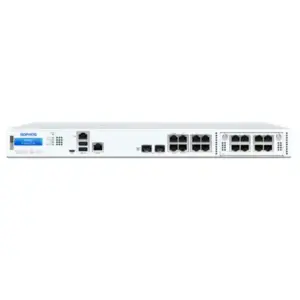
The NSsp 13700 combines high throughput with a varied interface layout. Official SonicWall documentation identifies two 100/40GbE interfaces, eight 25/10/5/2.5/1G interfaces, eight 10/5/2.5/1GbE interfaces and sixteen 1GbE interfaces. This mix supports direct attachment to high-capacity uplinks, aggregation layers and conventional Ethernet segments. Actual transceiver, cable and speed compatibility should be validated against the selected port, supported optics and the wider switching design.
The platform runs SonicOS and can apply stateful firewalling, application intelligence, intrusion prevention, VPN and security services according to the chosen licensing. Subscription services are not automatically identical across every bundle. Buyers should confirm whether the proposed SKU includes advanced threat protection, gateway anti-malware, content filtering, DNS security, cloud management, reporting and vendor support for the required term.
High availability is a major consideration for this class of appliance. A resilient design often requires two compatible units, matching subscriptions where required, redundant upstream and downstream paths, dedicated HA connectivity, synchronised configuration and a documented failover test. The exact design depends on routing, switching, link aggregation, public IP allocation, session behaviour and maintenance objectives.
Technical Specification Table
| Field | SonicWall NSsp 13700 Information |
|---|---|
| Brand | SonicWall |
| Model | NSsp 13700 |
| Product Type | High-end next-generation firewall appliance |
| Form Factor | 1U rack-mountable appliance |
| Firewall Inspection Throughput | 60 Gbps published value; practical performance is configuration dependent |
| Application Inspection Throughput | 57 Gbps published value |
| IPS Throughput | 48 Gbps published value |
| Threat Prevention Throughput | 45.5 Gbps published value |
| High-Speed Interfaces | 2 x 100/40GbE; 8 x 25/10/5/2.5/1G; 8 x 10/5/2.5/1GbE |
| 1GbE Interfaces | 16 x 1GbE interfaces |
| PoE Support | Not positioned as an integrated PoE access-switch platform |
| Wireless Support | No integrated Wi-Fi radio; wireless security architecture is solution dependent |
| High Availability | Supported; topology and licensing should be validated during design |
| VPN Support | Site-to-site and remote-access capabilities; limits and client choices are configuration and license dependent |
| SD-WAN Support | Supported through SonicOS features; design dependent |
| Security Services | IPS, application control, anti-malware, content and advanced threat services depending on subscription |
| License Bundle | Appliance-only and subscription bundles may differ; contact FourTeck for current options |
| Management | Local SonicOS administration and compatible central management options; subscription dependent |
| Logging / Reporting | Local and centralised options; retention and analytics depend on architecture and licensing |
| Power | Validate input, redundancy and rack power requirements against the current hardware datasheet |
| Warranty Guidance | Coverage depends on the supplied SKU, region and support subscription |
| Availability | Contact FourTeck for current UAE availability and lead-time coordination |
| Notes | Specifications, subscriptions and part numbers should be reconfirmed before ordering |
Configuration and Buyer Guidance
Buying a high-end firewall should begin with a traffic and risk profile, not a model name. Start by documenting present and expected internet bandwidth, internal routed traffic that will cross security zones, number of sites, public services, cloud connections, remote users, peak concurrent sessions and the percentage of traffic likely to be decrypted. This baseline should include at least three years of realistic growth rather than an arbitrary multiplier.
Next, identify which inspection services must operate simultaneously. A design that enables application control, IPS, gateway anti-malware, content filtering, DNS security and TLS inspection has a different resource profile from simple stateful firewalling. The selected bundle must include the required subscriptions for the intended term. Buyers should compare one-year and multi-year options based on procurement policy, lifecycle plans and renewal risk rather than choosing only the lowest initial price.
Interface planning is equally important. Each physical link should have a defined purpose, speed, media type, VLAN plan, redundancy method and upstream/downstream device. Confirm supported transceivers and direct-attach cables before purchase. For aggregated links, validate the switching design, hashing behaviour and failover expectations. For 100GbE or 25GbE connections, confirm that the rest of the path can actually sustain the traffic and that monitoring tools can observe it.
High availability requires a complete failure-domain review. Two firewalls do not create resilience when both depend on one power feed, one switch, one carrier handoff or one rack. The design should consider redundant power, diverse links, upstream routing, state synchronisation, maintenance procedures and periodic failover tests. Organisations should also decide how configuration changes are approved, backed up and rolled back.
Finally, plan the migration. Existing rules should be reviewed rather than blindly copied. Duplicate, expired and overly broad policies can carry old risk into the new platform. Objects, NAT rules, VPNs, certificates, authentication sources, logging destinations and monitoring integrations need validation. A staged cutover with acceptance criteria and rollback steps is usually safer than a rushed replacement.
Ideal Business Use Cases
Data-centre internet edge
Protect high-bandwidth internet connections, public services and cloud access while applying application-aware and threat-prevention policies.
Large enterprise campus
Segment corporate users, servers, guests, operational networks and partner connections with clear policy boundaries and central visibility.
MSSP or shared services
Support complex managed environments where policy separation, operational scale and consistent administration are essential.
Higher education
Handle large user populations, diverse devices, research traffic, guest access and high session counts with adaptable security controls.
Government and critical services
Build layered inspection, resilient connectivity and controlled segmentation aligned with governance and audit requirements.
Firewall consolidation
Replace multiple undersized gateways with a carefully designed platform while preserving isolation, accountability and change control.
High-Speed Connectivity and Segmentation
Port density gives architects more freedom, but every interface should support a deliberate security outcome. The NSsp 13700 can connect high-capacity uplinks and multiple lower-speed zones without forcing every network into the same switching domain. This is useful for separating internet carriers, DMZs, campus cores, server fabrics, management networks, backup systems and partner links.
Segmentation should be designed around trust, business function and data sensitivity. A common mistake is to create many VLANs but allow broad communication between them. Effective segmentation requires explicit policy, limited administrative paths, logging and periodic review. Security teams should identify critical assets, define required application flows and deny unnecessary lateral movement.
At higher speeds, the physical layer matters. Incorrect optics, unsupported cabling, mismatched auto-negotiation and inconsistent forward-error-correction settings can create unstable links. Procurement should therefore include validated transceivers, cable lengths and switch-side compatibility. Monitoring should capture errors, drops, utilisation and link-state changes so operational teams can distinguish security events from physical connectivity faults.
Threat Prevention and Encrypted Traffic Strategy
Modern firewall policy must recognise applications and threats rather than relying only on ports and addresses. Intrusion prevention can inspect traffic for exploit patterns, while application control helps identify software and services that may use common ports or encryption. Gateway anti-malware and advanced threat services add further inspection layers depending on the active subscription.
Encrypted traffic inspection requires governance. Organisations should define which categories are inspected, which are excluded for privacy or technical reasons, how certificates are distributed, and how failures are handled. Sensitive financial, health or identity services may require exclusions under organisational policy, while unmanaged devices may need a different approach from domain-joined endpoints.
Capacity planning must account for the cost of decryption and re-encryption. A firewall that meets a plain-traffic target may not meet the same target with broad TLS inspection enabled. Pilot testing with representative traffic is strongly recommended. Security teams should also plan certificate lifecycle management, user communication, exception review and monitoring for applications that use certificate pinning or unsupported encryption behaviour.
High Availability, Management and Reporting
Availability objectives should drive the firewall topology. Active-passive resilience is commonly used, but the wider network must be designed so traffic can reach the active unit after a failure. Routing adjacencies, link aggregation, virtual addresses, session synchronisation and upstream failover timers should be reviewed together. The target is predictable recovery, not merely a second appliance in the rack.
Central management can improve consistency across multiple firewalls, but it also becomes a privileged system that requires strong access control, multifactor authentication where supported, role separation, configuration backup and audit logging. Administrators should use named accounts and avoid shared credentials. Changes should have a documented business owner, technical reviewer and rollback method.
Reporting should answer operational and security questions. Useful outputs include top applications, blocked threats, bandwidth consumers, VPN status, policy hits, failed authentication, administrative changes and system-health indicators. Retention requirements depend on internal policy and applicable regulation. If long-term analytics are needed, the logging architecture and storage capacity should be designed before deployment rather than after an incident.
Buyer Checklist
✓ Confirm current and three-year bandwidth forecasts.
✓ Measure peak sessions and new connections.
✓ Estimate encrypted traffic inspection scope.
✓ List required security services and subscriptions.
✓ Decide appliance-only or multi-year bundle.
✓ Validate high-availability requirements.
✓ Map every physical and logical interface.
✓ Confirm optics, DACs and cable compatibility.
✓ Define VPN sites and remote users.
✓ Review routing, NAT and public services.
✓ Specify central management and logging.
✓ Set log-retention and reporting requirements.
✓ Plan identity integration and administrator roles.
✓ Clean up legacy rules before migration.
✓ Document cutover and rollback steps.
✓ Verify regional warranty and support coverage.
✓ Request current UAE lead time and quotation.
✓ Schedule post-deployment review and failover test.
UAE Availability and Service Support
FourTeck can assist UAE buyers with product selection, firewall sizing, subscription comparison, high-availability planning, interface mapping and deployment preparation. Availability is subject to the exact appliance or bundle part number, subscription term, vendor supply and regional logistics. A current quotation should identify hardware, licenses, support, accessories and implementation services separately so procurement teams can compare options accurately.
Support requirements should be discussed before purchase. Some organisations need only supply and basic guidance, while others require configuration, migration, VPN setup, policy conversion, testing and documentation. FourTeck can help define a practical scope based on the existing environment, access arrangements and change window. Visit or delivery coordination remains subject to project requirements and confirmed schedules.
Explore firewall products | Review firewall services | Contact FourTeck
Dubai, Abu Dhabi, Sharjah and Ajman Coverage
FourTeck supports firewall enquiries and project coordination for organisations in Dubai, Abu Dhabi, Sharjah and Ajman. Engagement can include requirement discovery, model comparison, licensing guidance, remote planning and coordination for delivery or onsite activity where agreed. Coverage does not imply fixed stock, guaranteed delivery time or an automatic installation commitment; each project is confirmed against scope, access and availability.
GCC and Africa Availability
Regional organisations may also request assistance for GCC and selected African requirements. Cross-border availability, commercial terms, logistics, taxes, support and installation vary by destination and project. FourTeck can help evaluate suitable sourcing and coordination routes without making unverified promises about stock or delivery.
Kuwait solutions | Africa solutions | Kenya support | Uganda support
Related FourTeck Products and Services
Firewall sizing consultation
Translate traffic, users, applications and growth into a defensible platform recommendation.
High-availability design
Plan redundant links, failover behaviour, power, routing and maintenance procedures.
Firewall migration
Review legacy rules, objects, NAT, VPN and logging before controlled cutover.
License and renewal guidance
Compare subscription terms, required security services and renewal implications.
Why Buyers Choose FourTeck
Enterprise firewall procurement benefits from a partner that discusses architecture and operational needs, not only a box and a price. FourTeck focuses on clarifying the intended use, expected traffic, required subscriptions, high-availability approach and migration scope. This helps buyers reduce the chance of ordering an unsuitable bundle or overlooking accessories, support terms and implementation tasks.
FourTeck can also help procurement and technical stakeholders use a common bill of materials. Hardware, subscriptions, support, optics, cables, management, logging and services can be presented as separate line items where applicable. This visibility makes comparison easier and reduces ambiguity during approval.
No security appliance provides guaranteed protection. Effective outcomes depend on correct design, secure configuration, timely updates, monitored alerts, trained administrators and a wider security programme. FourTeck’s role is to help buyers make informed choices and plan a deployment that fits their environment.
Frequently Asked Questions
What type of organisation should consider the SonicWall NSsp 13700?
It is intended for demanding environments such as large enterprises, data centres, higher-education institutions, government networks and managed security providers. Suitability should be confirmed through traffic, service and resilience requirements.
What is the published firewall throughput?
SonicWall publishes 60 Gbps firewall inspection throughput for the NSsp 13700. Real performance depends on traffic characteristics, enabled security services, encryption, policy complexity and system configuration.
Does the appliance include all security subscriptions?
Not necessarily. Appliance-only and bundled SKUs can differ. Buyers should confirm the exact subscription services, management, reporting and support term included in the quotation.
Can the NSsp 13700 be deployed in high availability?
Yes, high-availability designs are supported. The final topology, paired hardware, licensing, switching, routing and failover behaviour should be validated before ordering.
Does it support 100GbE connectivity?
Official documentation lists two 100/40GbE interfaces. Compatible optics, cabling and switch-side support must be confirmed for the intended deployment.
How should encrypted traffic inspection be sized?
Estimate the percentage and type of TLS traffic, certificate requirements, exclusions, application compatibility and concurrent sessions. Use representative testing where possible because decryption changes performance.
Can FourTeck help migrate from an existing firewall?
FourTeck can help define migration scope, review policies, map objects, plan NAT and VPN changes, prepare testing and coordinate a controlled cutover subject to the agreed project scope.
Is the NSsp 13700 available in Dubai?
Availability and lead time depend on the exact SKU, bundle and regional supply. Contact FourTeck for a current UAE availability check and quotation.
What warranty applies?
Warranty and support coverage depend on the supplied part number, region and active support subscription. The quotation should state the applicable terms clearly.
How can I get a current UAE price?
Provide the required subscription term, security services, high-availability need, management choice and implementation scope. FourTeck can then prepare a configuration-based quotation.
Get Practical Buying Assistance for the NSsp 13700
Share your bandwidth, user count, sites, security-service requirements and resilience goals. FourTeck will help review the platform fit, licensing choices and deployment scope for your UAE environment.

Reviews
There are no reviews yet.