

Outdoor airMAX wireless bridge planning
Ubiquiti airMAX LiteBeam 5AC LBE-5AC-GEN2 in Dubai, UAE
A lightweight 5 GHz directional CPE for carefully engineered point-to-point and airMAX point-to-multipoint links. FourTeck helps buyers confirm fit, link conditions, accessories, configuration scope and current UAE availability before purchase.
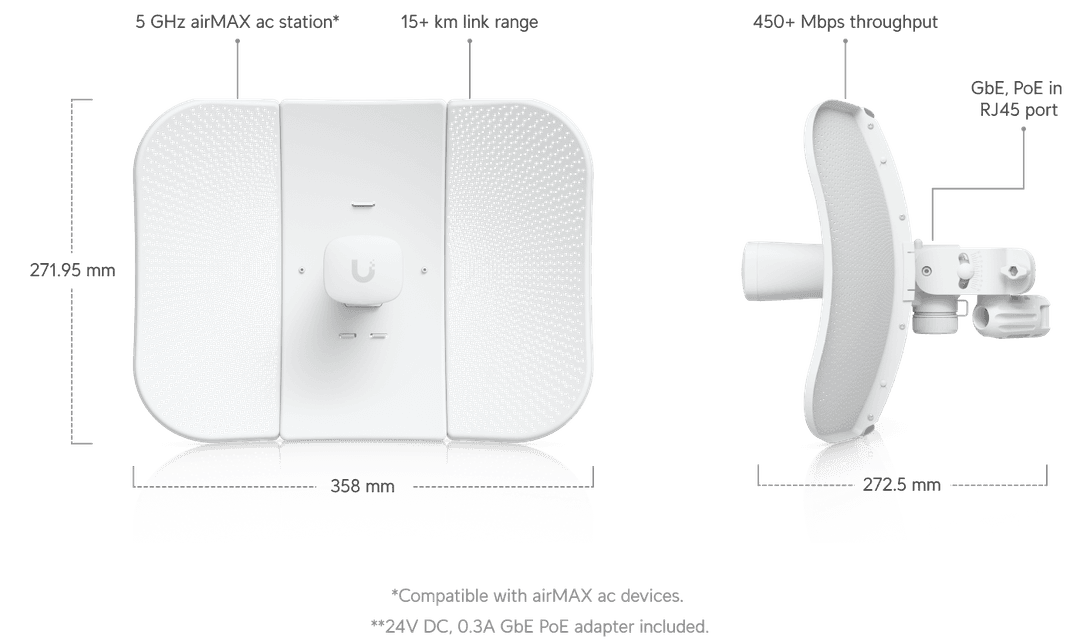
Model accuracy matters. This page concerns the LBE-5AC-GEN2, not the larger LiteBeam LR or XR variants.
Direct answer for buyers
The Ubiquiti airMAX LiteBeam 5AC LBE-5AC-GEN2 is an outdoor directional wireless device used to create a 5 GHz network bridge or operate as a customer-premises station in an airMAX network. It is mainly considered when running fibre or copper between sites is impractical, expensive or disruptive. Businesses, WISPs, schools, warehouses, farms, accommodation sites and project locations may use it to connect a remote building or serve a subscriber endpoint. Before proceeding, confirm unobstructed line of sight, distance, required real-world capacity, radio interference, permitted channels, pole and cable route, grounding and surge-protection requirements, and compatibility with the opposite radio or access point.
What it does
The LBE-5AC-GEN2 concentrates radio energy in a directional pattern rather than broadcasting broadly like a typical indoor Wi-Fi access point. This enables it to form a focused outdoor connection between aligned endpoints or to act as a station linked to a compatible airMAX access point.
Its role is transport: carrying Ethernet traffic over a planned wireless path. It does not replace a firewall, router, managed switch or indoor Wi-Fi system unless the network design explicitly assigns some routing functions to the radio.
Who it suits
The product suits organisations that need a modestly priced outdoor bridge with a compact reflector and straightforward pole mounting. Typical buyers include IT teams linking nearby facilities, integrators serving temporary or remote sites, WISPs deploying subscriber equipment and property operators connecting buildings across a campus.
It is less appropriate where the path is heavily obstructed, where a very high-capacity backhaul is required, where multiple independent Ethernet ports are needed, or where operation outside airMAX compatibility is a core requirement.
Business challenges this radio can help address
No practical cable route
Roads, yards, leased spaces or finished surfaces can make trenching difficult. A well-planned wireless bridge can carry network traffic without a new physical data cable between buildings.
Remote operational location
A gatehouse, farm office, workshop, storage area or temporary site may need network access from a main facility. The radio can form one segment of that extension when power and mounting are available.
Subscriber access requirement
WISPs and managed-network operators can consider it as a customer endpoint in a compatible airMAX deployment, subject to access-point design, sector capacity and local spectrum conditions.
Need for manageable installation
Dedicated management Wi-Fi, airOS tools and separate azimuth and elevation adjustment can make initial setup and alignment easier for a trained installer working near the mounted device.
Core capabilities in buyer terms
Product-fit matrix
| Requirement | Suitable when | Confirm before ordering |
|---|---|---|
| Building-to-building link | Both endpoints can be aligned with clear line of sight and the capacity requirement fits the radio design. | Distance, Fresnel-zone clearance, interference, mast height and the radio required at each side. |
| WISP subscriber endpoint | The provider uses a compatible airMAX access point and has planned sector loading. | AP model, channel width, frequency plan, authentication, service capacity and mounting policy. |
| Remote CCTV or IoT segment | Aggregate traffic is understood and the remote site has suitable switching, power and environmental protection. | Bitrate, number of devices, PoE requirements for cameras, local switch and backup power. |
| Temporary project connectivity | Stable mounting and line of sight can be maintained for the project period. | Relocation frequency, weather exposure, access permissions and who will realign the link. |
| High-capacity core backhaul | Only where a link assessment shows the expected traffic and availability objectives are realistic. | Consider whether a higher-gain, higher-capacity or different-frequency platform is more suitable. |
Verified technical information
| Brand | Ubiquiti |
|---|---|
| Product name | airMAX LiteBeam 5AC |
| Model | LBE-5AC-GEN2 |
| Product type | 5 GHz airMAX ac outdoor CPE / directional bridge radio |
| Antenna gain | 23 dBi |
| Maximum aggregate throughput | 450+ Mbps platform figure; actual application throughput depends on channel width, signal quality, interference, protocol overhead and network design. |
| Networking interface | One 10/100/1000 Ethernet RJ45 port |
| Power method | Passive PoE, two-pair |
| Included power supply | 24V, 0.3A Gigabit PoE adapter |
| Supported input range | 22–27V DC |
| Maximum power consumption | 7W |
| Maximum transmit power | 25 dBm, subject to regional limits and configuration |
| Channel widths | Point-to-point: 10/20/30/40/50/60/80 MHz. Point-to-multipoint: 10/20/30/40 MHz. |
| Operating modes | Access point and station modes within supported airMAX configurations |
| Dimensions | 358 × 271.95 × 272.5 mm |
| Weight | 800 g without mount; 980 g with mount |
| Wind survivability | Up to 200 km/h under stated manufacturer test conditions; mounting structure must also be suitable. |
| Operating temperature | -40°C to 70°C |
| Operating humidity | 5% to 95% non-condensing |
| Management | airOS interface, dedicated management Wi-Fi and supported UISP management workflows. Confirm current firmware and platform support for the intended deployment. |
Compatibility and dependency notice
Wireless performance is not determined by the radio specification alone. Link distance, clear line of sight, Fresnel-zone clearance, channel width, local interference, rain fade, alignment accuracy, transmit-power limits, access-point load and Ethernet-side traffic all affect the result. A quoted platform throughput figure should not be treated as guaranteed user throughput.
The LBE-5AC-GEN2 is designed around Ubiquiti airMAX ac operation. Confirm the exact radio at the opposite endpoint, the firmware branch, wireless mode, regulatory domain and any management-platform requirements. Passive PoE must not be confused with every form of standards-based 802.3af or 802.3at PoE. Use the supplied adapter or a verified compatible power source and follow proper outdoor cabling, grounding and surge-protection practices.
A practical purchase and deployment journey
Define the traffic requirement
List the applications crossing the link, peak usage, number of users or cameras, tolerance for interruption and expected future growth. This sets a realistic capacity target.
Survey the wireless path
Confirm endpoint coordinates, distance, elevations, obstacles, pole positions and nearby RF activity. Photos alone may not replace a proper path profile or site survey.
Confirm the bill of materials
Determine radio quantity, pole or bracket needs, shielded outdoor cable, surge protection, grounding, enclosure, switching and backup-power requirements.
Install, align and configure
Mount securely, weatherproof cable entries, set the correct regulatory domain, choose a suitable channel, align carefully and apply documented network settings.
Validate and document
Test signal, noise floor, modulation, throughput, latency, packet loss and failover expectations. Record configuration, cable routes, mounting details and support ownership.
Focused RF design and noise management
The LiteBeam design uses a directional reflector to focus energy toward the intended remote radio. In business terms, this matters because outdoor 5 GHz environments can contain signals from access points, bridges, consumer equipment and neighbouring networks. A directional antenna can reduce reception of some unwanted signals outside its main beam and can help create a more usable link than a broad-coverage antenna in the same location.
Directionality does not eliminate interference. Installers must still scan available channels, understand local use, select a sensible channel width and align the antenna precisely. A wider channel may produce higher peak throughput in clean spectrum but can be more difficult to sustain in a congested area. A narrower channel may provide a more stable operating margin, although with less maximum capacity. The correct choice depends on the measured RF environment and business requirement rather than a single preferred setting.
Buyers should also distinguish signal strength from signal quality. A strong signal can still perform poorly if noise is high, reflections are severe or the two radio chains are imbalanced. Good commissioning checks include signal-to-noise ratio, modulation rate, chain balance, retransmissions, airMAX capacity indicators and actual traffic tests. FourTeck can help define the assessment and configuration scope, while final performance remains dependent on the deployed path and surrounding radio conditions.
Management, commissioning and operational visibility
The dedicated management Wi-Fi radio is intended to make initial access easier while the installer is near the device. This can be useful on a pole or rooftop because the technician may not need to disconnect the main Ethernet path simply to reach the configuration interface. The management feature should still be used with appropriate credentials and operating procedures, and remote administrative access should be limited according to the organisation’s security policy.
airOS provides configuration and diagnostic functions for the wireless link. Useful operational information can include link signal, channel use, throughput, Ethernet status, uptime and wireless statistics. These metrics help a support team distinguish between RF degradation, cable problems, Ethernet negotiation issues and application-side congestion. Where multiple airMAX devices are deployed, supported UISP workflows can assist with central visibility, inventory and monitoring; confirm the current software requirements and support status during solution design.
A maintainable installation also requires documentation outside the device interface. Record management IP addresses, VLAN design, radio names, channel plan, antenna direction, mounting height, cable length, power source and configuration backup location. Set an ownership process for firmware review, credential rotation, alarm handling and physical inspection. Outdoor links are infrastructure assets, and their reliability depends as much on operational discipline as on the hardware.
Mechanical installation and outdoor resilience
The LBE-5AC-GEN2 is comparatively lightweight and provides separate azimuth and elevation adjustment, which can simplify physical alignment. Even so, the pole, bracket and building attachment must be selected for the location. Manufacturer wind-survivability information describes the device under stated conditions; it does not certify the strength of a customer’s mast, wall, fasteners or roof structure. A competent installer should evaluate the complete mounting assembly.
Outdoor Ethernet cable should be UV-resistant and appropriate for the environment. Shielding, grounding and surge protection deserve particular attention in exposed locations, especially when cable runs enter a building. The PoE adapter should be located in a suitable indoor or protected area, and the power source should match the passive PoE requirement. Avoid improvised power arrangements or assumptions based on connector shape alone.
Access for maintenance is another procurement consideration. Rooftop or high-pole installations may require permits, fall-protection procedures, lifting equipment or scheduled access. A slightly different mounting location may reduce installation cost and improve serviceability while still preserving line of sight. Buyers should include access constraints and safety requirements in the quotation request so that hardware supply and installation scope are not treated as separate afterthoughts.
Ideal business environments and use cases
Office and warehouse campuses
Connect a warehouse, guard room or secondary office to a main network where trenching is undesirable. Confirm whether the remote building needs only data transport or also local switching, Wi-Fi, CCTV and voice services.
Education and community sites
Extend connectivity between separate buildings or facilities. Capacity planning should account for class schedules, video use, cloud applications and future growth rather than only today’s average traffic.
Agriculture and remote operations
Carry network access to a farm office, pump station, gate, sensor aggregation point or field facility where a clear path exists. Power continuity and equipment enclosure design may be as important as the radio.
Hospitality and property operations
Link annexes, staff areas or service buildings. Network segmentation and security should be designed so guest, operational, voice and surveillance traffic remain appropriately separated.
WISP subscriber connections
Use as a client station in a compatible airMAX sector. The operator must assess sector capacity, airtime fairness, customer service profile and upgrade path instead of sizing only by link distance.
Construction and temporary facilities
Provide interim connectivity where physical infrastructure is not yet installed. Include relocation, remounting, re-alignment and equipment-protection responsibilities in the project plan.
Integration and operational considerations
The radio commonly sits between an Ethernet network and an outdoor wireless path. Decide whether traffic should be bridged transparently, routed, tagged with VLANs or passed to another device that handles policy enforcement. The firewall and switching design should define which systems can communicate across the link, how broadcast traffic is controlled and how management access is protected.
For CCTV, calculate aggregate camera bitrate under busy conditions and consider recording direction. A remote camera site may send continuous upstream traffic, while an office extension may have mixed two-way demand. For voice or real-time applications, evaluate latency, jitter and packet loss, not only throughput. For business continuity, decide whether the wireless link is primary, backup or best-effort connectivity and whether a second path is required.
The LBE-5AC-GEN2 has one Ethernet port. Any requirement for multiple local devices, standards-based PoE output, fibre uplinks or redundant network interfaces must be handled by other equipment. The complete design may include a switch, router, firewall, UPS, surge protector, enclosure or indoor access point. FourTeck can help prepare a bill of materials based on the required outcome rather than supplying the radio in isolation.
Buyer questions to resolve before ordering
Share coordinates, elevations, photographs and known obstacles so the design can evaluate line of sight and Fresnel clearance.
State user count, camera count, expected traffic, critical services and growth instead of requesting only a generic “fast link.”
A point-to-point link normally needs a compatible radio at both endpoints; a subscriber deployment depends on the access-point platform.
Clarify whether the quotation should include survey, mounting, cabling, configuration, testing and documentation.
Confirm passive PoE, cable distance, protected power location, UPS requirements and grounding.
Decide whether support covers hardware supply only, remote configuration, on-site work, monitoring or ongoing maintenance.
Procurement checklist
☐ Exact model: LBE-5AC-GEN2
☐ Required radio quantity
☐ Endpoint addresses or coordinates
☐ Link distance and clear-path confirmation
☐ Expected throughput and traffic profile
☐ Compatible opposite-end radio or access point
☐ Pole, bracket and structural requirements
☐ Outdoor shielded Ethernet cable length
☐ Surge protection and grounding plan
☐ PoE and backup-power arrangement
☐ VLAN, IP addressing and security scope
☐ Installation, alignment and testing scope
☐ Delivery destination and requested schedule
☐ Warranty terms to be confirmed in quotation
How FourTeck can assist
FourTeck can review the intended use, help confirm whether the LiteBeam 5AC is appropriate, identify the number of units required and discuss supporting components. For a point-to-point project, the requirement review can cover both endpoints, expected traffic, mounting positions, cable routes, power and network integration. For an airMAX subscriber deployment, the discussion can include access-point compatibility, sector design assumptions and customer-premises installation scope.
Quotation support may include hardware supply, accessories, installation coordination, configuration, testing or documentation where agreed. Scope is not assumed: buyers should state whether they need product-only pricing or a planned deployment. FourTeck can also help compare related wireless options when the distance, interference level, capacity or environmental requirement suggests that a different antenna gain or platform may be more suitable.
To begin, share the exact model request, quantity, delivery location, endpoint coordinates, distance, mounting height, expected throughput and any installation deadline. For wider infrastructure requirements, explore FourTeck technology products, review available implementation and support services, or contact the Dubai team with the project details.
UAE availability and support guidance
Contact FourTeck to confirm current UAE availability for the Ubiquiti LBE-5AC-GEN2. Supply can depend on quantity, regional version, vendor lead time and the timing of the request. Delivery and project coordination can be discussed after the exact requirement is confirmed. Where installation or configuration is needed, include that scope in the quotation so labour, mounting, cable, access equipment and testing responsibilities are clear.
FourTeck can coordinate requirements for Dubai, Abu Dhabi, Sharjah and Ajman in one project discussion. Buyers operating across several sites should provide a location schedule rather than assuming every site has identical line-of-sight, mounting and cable conditions. Each link may need its own path assessment and bill of materials, even when the same radio model is proposed.
GCC Availability
FourTeck can assist organisations planning airMAX wireless links across GCC markets, including the United Arab Emirates, Saudi Arabia, Kuwait, Qatar, Bahrain and Oman. Support can begin with requirement review and model selection, then move to quotation coordination, delivery planning and definition of any configuration or installation scope. The buyer should provide the destination country, exact model, quantity, intended link type, endpoint distance, preferred schedule and any accessory or support needs. Product availability, permitted frequency use, regional device versions, delivery schedules, service visits and vendor lead times can vary by country and project. A radio suitable for one site may not automatically fit another because terrain, interference, mounting access and local regulatory conditions differ. FourTeck can help structure a consistent bill of materials while identifying site-specific exceptions. For Kuwait-related technology planning, buyers may also review FourTeck Kuwait resources. Confirm current commercial and delivery terms before placing an order.
Africa Availability
FourTeck can support businesses, integrators and project teams evaluating the LBE-5AC-GEN2 for selected African deployments. Requirement planning may include radio quantity, compatible access-point or peer radio, outdoor cable, surge protection, power arrangements, mounting, configuration, testing and support expectations. Availability and fulfilment depend on the destination, current vendor supply, product region, quantity, shipping arrangements, power requirements and local project conditions. Buyers should share the destination country, endpoint locations, estimated distance, capacity target, preferred deployment schedule and whether remote or on-site assistance is required. Projects in East Africa may use FourTeck Kenya or FourTeck Uganda as relevant starting points, while broader regional enquiries can be directed through FourTeck Africa. Local inventory, customs outcomes, delivery dates and on-site coverage should be confirmed for each project rather than assumed.
Related products, services and alternatives
Second LBE-5AC-GEN2 unit
A point-to-point link generally requires a compatible radio at both ends. Confirm whether the quotation covers one endpoint or a complete pair.
Higher-gain airMAX options
Longer or more demanding paths may need a larger antenna or a different platform. Selection should follow a link assessment rather than model-name similarity.
Outdoor cabling and protection
Shielded cable, surge protection, grounding and weather-resistant routing are part of the system and should be specified with the radio.
Wireless site survey
A survey or path review can identify obstacles, interference, mounting constraints and likely capacity before equipment is committed.
Installation and configuration
Mounting, alignment, channel planning, IP configuration, VLAN setup, testing and handover can be defined as a separate project scope.
Network security integration
The bridge should connect into suitable switching, routing and firewall policies. Review FourTeck network security solutions for the wider design.
Why businesses contact FourTeck
Buyers often need more than a product code. They need confidence that the selected radio fits the distance, traffic profile, mounting conditions and existing network. FourTeck can help clarify the requirement, review model suitability, identify supporting components, coordinate quotations and define installation or configuration work where required.
This practical review can reduce common procurement errors such as ordering only one radio for a two-ended link, overlooking passive PoE requirements, omitting surge protection, assuming line of sight from a map, or selecting a device without checking access-point compatibility. For company information, visit About FourTeck.
Frequently asked questions
Is the LBE-5AC-GEN2 an indoor Wi-Fi access point?
No. It is an outdoor directional airMAX ac radio designed mainly for wireless bridge and customer-premises applications. Indoor user Wi-Fi normally requires a separate access point.
Do I need two units for a point-to-point link?
Usually, a point-to-point bridge needs a compatible radio at each endpoint. Confirm the complete design and whether both devices are included in the quotation.
Does the quoted 450+ Mbps equal guaranteed business throughput?
No. It is a platform capability figure. Real throughput depends on channel width, modulation, signal quality, interference, protocol overhead, distance and configuration.
Can it work without clear line of sight?
A reliable 5 GHz directional link normally benefits from clear line of sight and adequate Fresnel-zone clearance. Obstructions can sharply reduce stability and capacity.
Is a PoE adapter included?
The manufacturer specification lists a 24V, 0.3A Gigabit passive PoE adapter as included. Confirm the exact package contents in the FourTeck quotation.
Can I power it from any PoE switch?
Not automatically. The device uses passive PoE. Confirm voltage and pin compatibility before connecting it to a switch or injector.
What information is needed for an accurate quote?
Provide model, quantity, destination, link type, endpoint coordinates, distance, required capacity, mounting details, cable length and any installation or configuration needs.
Does FourTeck provide installation and configuration?
Installation and configuration can be discussed and quoted where required. Scope depends on site access, mounting, cabling, alignment, network settings and testing needs.
Is the product currently available in Dubai?
Contact FourTeck to confirm current UAE availability. Supply can vary by quantity, regional version and vendor lead time.
What warranty applies?
Warranty terms can vary by supply channel and region. Ask FourTeck to state the applicable warranty terms in the formal quotation.
Plan the link before purchasing the radio
Send FourTeck the endpoint locations, distance, expected traffic, quantity and installation requirement. The team can help confirm model suitability, supporting materials, current UAE availability and quotation scope.

Reviews
There are no reviews yet.