

Compact directional antenna for outdoor wireless infrastructure
Ubiquiti UISP Dish Mini UISP-Dish-Mini in Dubai, UAE
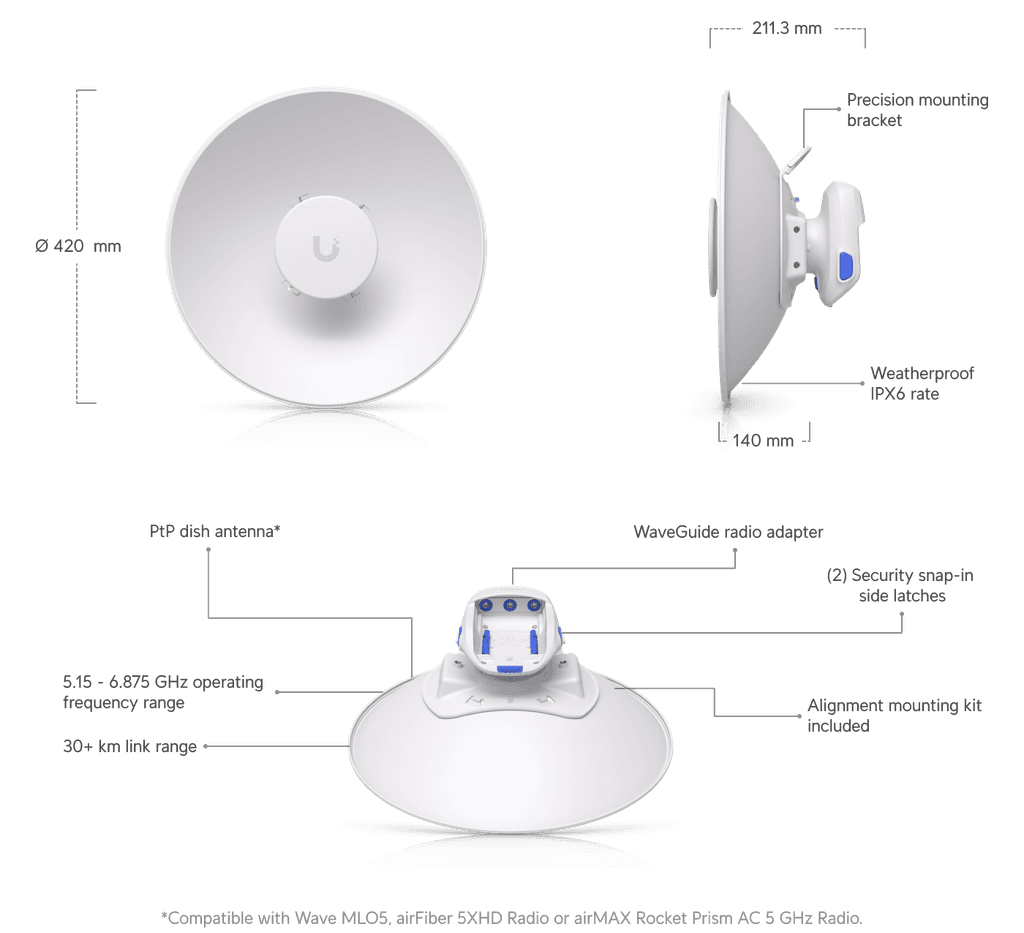
The UISP Dish Mini is a compact 5.15 to 6.875 GHz directional antenna with 26 dBi gain, dual-linear polarisation and direct attachment support for selected Ubiquiti radios. It is designed for organisations that need a focused outdoor wireless link without the physical size of a larger dish, while still requiring disciplined alignment, compatible radio selection and proper site planning.
Quotation planning starts with the link
Share the proposed link distance, installation height, compatible radio choice, pole diameter, quantity and destination. FourTeck can use this information to help clarify the bill of materials and project scope.
Focused directional coverage
Broad supported antenna range
Outdoor weather resistance
Compatible-model dependent
Direct answer for buyers
The Ubiquiti UISP Dish Mini is a passive compact dish antenna for directional outdoor wireless links. It is mainly used to concentrate radio energy toward a defined remote endpoint, helping create a more controlled link than an omnidirectional antenna. Wireless internet service providers, industrial sites, campuses, warehouses, farms, hospitality properties and multi-building organisations may consider it when a compatible Ubiquiti radio and clear line of sight are available. Before proceeding, buyers should confirm radio compatibility, legal frequency use, link budget, distance, mounting location, mast diameter, wind exposure, grounding, cable routing and whether installation or alignment assistance is required. The antenna does not replace the radio, network switch, power injector or project design.
What the UISP Dish Mini does
A directional dish antenna shapes the radio pattern into a narrower beam than a wide-area antenna. In practical terms, this helps a network designer direct energy toward the intended remote site and reduce unnecessary coverage in other directions. The 26 dBi antenna gain is useful where a compact form factor is preferred but the link still requires a concentrated signal pattern. Actual throughput, latency, distance and stability depend on the radio pair, channel width, interference, modulation, legal transmit limits, line of sight, Fresnel-zone clearance and installation quality.
The product includes an alignment mounting kit and supports direct connection to selected radios. This can reduce the need for separate RF jumper cables in supported combinations, but it does not mean every UISP or airMAX radio will fit. FourTeck recommends confirming the exact radio model and hardware revision before finalising the order.
Who should consider it
The antenna may suit service providers and business networks that need a compact point-to-point link, a backhaul connection between buildings, a remote CCTV uplink, a temporary project network, an industrial telemetry route or a wireless alternative where trenching fibre is impractical. It is also relevant where mounting space and wind loading need closer attention than with a large dish.
It should not be selected only from gain figures. A buyer with a very long path, high interference, obstructed terrain or demanding availability target may need a larger antenna, another frequency band, licensed microwave, fibre or a redundant design. A proper link study remains more valuable than assuming one model fits every distance.
Business challenges this antenna can help address
Connecting separated buildings
A directional wireless link may provide a practical route between offices, warehouses, guard houses or operational buildings when cable installation is difficult. The result depends on line of sight, bandwidth expectations and site permissions.
Reducing unwanted coverage
A narrow antenna pattern concentrates coverage toward the intended endpoint. This can support cleaner design than a broad antenna, although it does not eliminate interference and still requires spectrum planning.
Managing physical footprint
With a 420 mm dish diameter, the Mini can be considered where a larger antenna is difficult to accommodate. Structural suitability, pole loading and safe access must still be checked.
Simplifying radio attachment
Direct radio connection on compatible models can simplify the radio-to-antenna interface. The compatible radio list and mounting arrangement should be verified before procurement.
Core capabilities at a glance
Supports focused outdoor link design when paired with an appropriate radio and compliant power settings.
Supports compatible dual-polarised radio operation and helps make efficient use of the radio platform.
Provides mechanical elevation adjustment of plus or minus 20 degrees for installation and alignment.
Uses powder-coated metal and UV-stabilised polymer components with IPX6 weatherproofing.
Product-fit decision matrix
| Requirement | Suitable when | Confirm before ordering |
|---|---|---|
| Compact directional link | A 420 mm dish is physically suitable and 26 dBi gain fits the link design. | Distance, path profile, interference and link budget. |
| Compatible radio attachment | The selected radio supports the UISP Dish Mini direct-connect interface. | Exact radio model, revision and required accessories. |
| Outdoor mast installation | The pole diameter and structure suit the included mount. | Pole size, wind exposure, earthing and installer access. |
| High-availability service | The complete design includes path margin, monitoring and redundancy as needed. | Service target, backup path and maintenance plan. |
| Regional deployment | The planned frequency use and radio configuration comply with local rules. | Country, allowed channels, EIRP and equipment region. |
Verified technical information
| Brand | Ubiquiti |
|---|---|
| Product name | UISP Dish Mini |
| Model | UISP-Dish-Mini |
| Product type | Compact outdoor directional dish antenna |
| Frequency range | 5.15 to 6.875 GHz |
| Gain | 26 dBi |
| Beamwidth | Azimuth and elevation: 5.8–9° at 3 dB; 7.6–12.5° at 6 dB |
| Polarisation | Dual-linear |
| Cross-polarisation isolation | 15 dB |
| Maximum VSWR | 2:1 |
| Dish dimensions | 420 x 140 mm; with waveguide 420 x 211.3 mm |
| Weight | Dish 1.95 kg; mount 1 kg; waveguide 0.45 kg |
| Mounting | Pole mount; alignment kit included; ±20° elevation adjustment |
| Supported pole diameter | 32–76 mm |
| Weatherproofing | IPX6 |
| Wind survivability | Up to 200 km/h |
| Wind loading | 348 N at 200 km/h |
| Availability | Contact FourTeck for current UAE options and lead-time guidance. |
Compatibility and scope dependencies
The UISP Dish Mini is an antenna, not a complete wireless bridge. A functioning link requires compatible radios at one or both endpoints, suitable power supplies or PoE injectors, Ethernet cabling, surge protection, grounding, mounting hardware, network configuration and a clear radio path. Ubiquiti identifies direct-connect compatibility with selected products, including Wave MLO5, AF-5XHD and RP-5AC-Gen2, but model availability, regional versions and fit should be reconfirmed at the time of quotation. Frequency range does not automatically authorise operation on every channel in every country. The installed radio configuration must follow local spectrum and EIRP requirements.
The alignment kit supports elevation adjustment, but the installer must also achieve accurate azimuth alignment and secure the structure. In high-wind or critical-service environments, structural review and an appropriate safety margin may be required. FourTeck can help identify the commercial and technical questions that should be resolved before purchase, but final site engineering may require an onsite survey.
A practical purchase and deployment journey
Define the link outcome
State whether the connection is for internet backhaul, CCTV, branch networking, industrial control, guest services or another workload. Include required bandwidth and availability expectations.
Review the path
Confirm coordinates, distance, installation heights, terrain, obstacles and Fresnel-zone clearance. A visual line of sight alone may not be enough for a stable design.
Select the radio pair
Match the dish with a supported radio platform and confirm regional versions, channel plan, expected modulation and power method.
Build the bill of materials
Include antennas, radios, mounting items, outdoor cable, surge protection, grounding, network ports and any installation services.
Install and align
Use safe access methods, weatherproof cable entry, correct torque and precise alignment. Validate signal quality rather than relying only on visual direction.
Test and document
Record link metrics, throughput, channel settings, endpoint details, photographs and support contacts for future maintenance.
Focused gain without assuming guaranteed distance
The 26 dBi gain figure describes antenna directivity, not a guaranteed service radius. Link distance is the result of the complete RF budget: transmitter power, antenna gain at both ends, receiver sensitivity, cable losses, legal EIRP limits, fade margin, interference and path conditions. A short link in a noisy urban environment can be more difficult than a longer rural path with clean spectrum and clear elevation. For this reason, buyers should avoid choosing the antenna only from a distance estimate found in a generic listing.
In Dubai and other dense commercial areas, rooftop clutter, reflective surfaces, co-channel use and changing construction can influence performance. A site survey or spectrum review may be appropriate. For remote or industrial paths, terrain and seasonal conditions may matter more. FourTeck can help convert the business requirement into a set of technical inputs for product selection and quotation, while field validation remains important before a critical deployment.
Compact mechanics and installation planning
The smaller dish diameter can simplify placement compared with larger high-gain antennas, but it still creates a wind load and must be attached to a suitable pole or structure. The stated pole range is 32 to 76 mm, and the included alignment mounting kit offers plus or minus 20 degrees of mechanical elevation adjustment. These values help the installer assess compatibility with an existing mast, but they do not replace a structural inspection. Corroded poles, lightweight brackets, parapet mounts and improvised wall fixings may not be appropriate.
Outdoor installation should also include cable strain relief, drip loops, surge protection, grounding and a route that avoids unnecessary exposure or sharp bends. The radio and Ethernet connection must be weather-protected according to the equipment instructions. If the location is difficult to access, buyers should consider future maintenance before choosing the mounting point. A position that is easy to install but difficult to service can increase operational cost later.
Radio integration and operational control
Because the UISP Dish Mini is passive, its operational visibility comes from the attached radio and management platform. Network teams should decide how link health will be monitored, who will receive alerts, which metrics will be retained and how configuration changes will be controlled. Signal level alone is not sufficient. Useful operational indicators may include modulation, capacity, retransmissions, noise floor, channel utilisation, Ethernet errors, device temperature and uptime.
For service-provider deployments, the link should be incorporated into a wider topology and fault-management process. For a business bridge, the network team should decide whether spanning-tree, VLANs, routing, QoS or failover is required. These functions belong to the radio and connected network, not the antenna. FourTeck can assist with identifying the required configuration scope and related products, but the final architecture should reflect the organisation’s operational standards.
Suitable business environments and use cases
Warehouse and logistics compounds
A directional bridge may connect a warehouse, gatehouse, loading area or remote office when trenching is disruptive. Bandwidth, vehicle obstruction and mounting height should be assessed.
Hospitality and leisure properties
Separate buildings, service areas or outdoor facilities may be linked to the main network. The design should account for guest traffic, surveillance and business systems separately.
Construction and temporary sites
A wireless route can support phased projects where fixed cabling is not yet available. Temporary does not remove the need for safe mounting, grounding and documented settings.
Remote CCTV connectivity
The antenna may form part of a camera backhaul link. Required throughput should be calculated from camera count, codec, frame rate, retention and concurrent viewing.
Industrial and utility locations
Telemetry or operational traffic may use a directional wireless path where cable routes are difficult. Environmental, redundancy and cybersecurity requirements should be defined.
Internet service provider networks
The compact dish can be considered for selected backhaul or customer-side designs using compatible radios. Capacity planning and spectrum coordination remain essential.
Integration considerations
Confirm VLAN design, IP addressing, routing, switch capacity, PoE method, surge protection, monitoring and backup connectivity. The wireless link should be treated as part of the network, not as an isolated appliance. Where voice, cameras or business applications share the path, traffic prioritisation and capacity headroom may be required.
The chosen radio firmware and management method should align with the organisation’s maintenance process. Credential ownership, backup configuration and access-control rules should be agreed before handover.
Operational considerations
Outdoor links can change over time because of new buildings, vegetation, rooftop equipment, channel congestion or physical movement. Periodic review of alignment and link metrics helps identify deterioration before it becomes an outage.
For critical traffic, document a recovery process and keep records of radio models, configuration, mounting position and cable route. A spare strategy may be appropriate where replacement lead time would create unacceptable downtime.
Questions to resolve before ordering
Accurate locations allow a path profile and more realistic link planning.
Compatibility must be checked against the exact radio model and region.
Application needs and peak load influence radio and channel selection.
Line of sight and Fresnel-zone clearance should be assessed at installation height.
Pole diameter, wind loading, corrosion and safe access all matter.
A single wireless path may not meet a high-availability business objective.
Procurement checklist
☐ Exact model: UISP-Dish-Mini
☐ Required quantity and spare strategy
☐ Compatible radio model and region
☐ Link distance and endpoint coordinates
☐ Required throughput and traffic type
☐ Frequency and regulatory confirmation
☐ Pole diameter and mounting location
☐ Wind and structural suitability
☐ Outdoor Ethernet and PoE requirements
☐ Surge protection and grounding scope
☐ Installation and alignment assistance
☐ Configuration, testing and documentation
☐ Delivery destination and target schedule
☐ Warranty and support guidance at quotation
How FourTeck can assist
FourTeck can help buyers move from a product name to a more complete purchasing requirement. This may include checking the exact antenna model, reviewing direct-connect radio compatibility, clarifying the number of endpoints, preparing a preliminary bill of materials, identifying mounting and power dependencies, and coordinating a quotation. Where installation is required, the scope can be discussed separately so that access, alignment, cabling, grounding, configuration, testing and handover expectations are clear.
For wider network projects, FourTeck can also help relate the wireless link to switching, routing, firewall, surveillance or managed-network requirements. Buyers can browse additional business technology products, review available installation and configuration services, or send project details to FourTeck. Product selection should follow the complete link requirement rather than an isolated specification.
UAE availability and support guidance
Contact FourTeck to confirm current UAE availability for the Ubiquiti UISP Dish Mini. Availability can depend on quantity, regional product version, vendor lead time and the associated radio or accessories required for the project. Delivery and project coordination can be discussed after the exact requirement is confirmed. Installation and configuration should be included in the quotation when needed rather than assumed to be part of the hardware price.
For projects across Dubai, Abu Dhabi, Sharjah and Ajman, buyers should share the delivery location, site-access conditions, installation height, preferred timeline and whether a survey or remote design review is required. FourTeck can help coordinate the commercial requirement and advise which information is needed before a reliable quotation can be prepared.
GCC Availability
FourTeck can assist organisations planning UISP Dish Mini deployments across GCC markets by reviewing the requested antenna model, compatible radio, quantity, destination and installation scope before quotation. Projects in the United Arab Emirates, Saudi Arabia, Kuwait, Qatar, Bahrain or Oman may involve different spectrum rules, regional radio versions, logistics arrangements and onsite service conditions. Product availability, licensing where applicable, delivery schedules, vendor lead times and service visits can therefore vary by country and requirement. Buyers should provide the destination country, endpoint locations, expected bandwidth, quantity, preferred radio platform, mounting environment and target deployment period. This information allows a more useful discussion about product selection, configuration responsibilities and delivery coordination. FourTeck does not assume local stock or a fixed installation date without confirmation. For Kuwait-based requirements, buyers may also review FourTeck Kuwait technology support and then submit the exact project details for current guidance.
Africa Availability
Organisations planning wireless links in Africa can contact FourTeck for product evaluation, accessory planning, radio compatibility review and regional procurement guidance. The correct solution may depend on the destination country, path distance, permitted frequency range, local power conditions, mounting structure, shipping arrangements, vendor lead time and whether installation support is expected. Buyers in East Africa, including Kenya and Uganda, should share the exact model request, quantity, endpoint locations, preferred schedule and any need for configuration or field coordination. FourTeck can then help clarify the bill of materials and quotation assumptions without promising inventory, customs outcomes or universal onsite coverage. Regional resources are available through FourTeck Africa, FourTeck Kenya and FourTeck Uganda. Each project should still be reviewed against its local technical and logistical conditions.
Related products and services to consider
Compatible Ubiquiti radio
The dish requires a supported radio. Confirm Wave MLO5, AF-5XHD, RP-5AC-Gen2 or another approved option before ordering.
UISP Dish 30 dBi
A larger 30 dBi model may be relevant when the link budget calls for more antenna gain and the mounting environment can support the larger form factor.
Outdoor cabling and surge protection
A reliable installation normally requires shielded outdoor cable, grounding and suitable surge-protection planning.
Wireless link installation
Site access, mounting, alignment, configuration and testing can be quoted as a defined project scope.
Why businesses contact FourTeck
The main value of a procurement discussion is clarity. FourTeck can help confirm whether the UISP Dish Mini is the right antenna, whether the chosen radio fits, which accessories are needed and what information is missing from the quotation request. This reduces the risk of ordering only the visible hardware while overlooking power, cabling, protection, installation or configuration. Businesses may also request assistance with link-planning inputs, installation coordination, network integration and support expectations. Learn more about FourTeck or discuss the requirement through the FourTeck contact team.
Frequently asked questions
Is the UISP Dish Mini a complete wireless bridge?
No. It is a passive directional antenna. A compatible radio, power method, Ethernet connection, network configuration and matching remote endpoint are required for a complete link.
What frequency range does it support?
The verified antenna frequency range is 5.15 to 6.875 GHz. Actual usable channels depend on the attached radio, regional version and local regulation.
Which radios are compatible?
Ubiquiti lists direct-connect compatibility with selected radios including Wave MLO5, AF-5XHD and RP-5AC-Gen2. Compatibility should be reconfirmed against the exact model and hardware revision.
How far can the antenna reach?
There is no single guaranteed distance. Range depends on the radios, legal power limits, path clearance, interference, channel width, weather margin and installation quality.
Is the mounting kit included?
The official specification states that a pole-mount alignment kit is included, with mechanical elevation adjustment of plus or minus 20 degrees.
What pole size is supported?
The stated pole diameter range is 32 to 76 mm. The pole and supporting structure must also be suitable for the wind load and installation environment.
Can FourTeck assist with installation?
Installation, alignment, cabling, configuration and testing can be discussed as a separate project scope. Site conditions and access requirements should be shared before quotation.
Is it currently available in Dubai?
Contact FourTeck to confirm current UAE availability. Stock status, quantity, regional version and vendor lead time can change.
What information is needed for a quote?
Provide quantity, destination, link distance, endpoint coordinates, preferred radio, required bandwidth, mounting details and whether installation or configuration is required.
Plan the complete UISP Dish Mini requirement
Send the link distance, radio preference, quantity, mounting environment and delivery location. FourTeck can help clarify compatibility, accessories, installation scope and current UAE quotation options.

Reviews
There are no reviews yet.