

High-density multi-gigabit PoE switching
Ubiquiti Pro HD 24 PoE USW-Pro-HD-24-PoE in Dubai, UAE
The Ubiquiti Pro HD 24 PoE is built for network rooms where access-layer speed, PoE capacity and 10G aggregation must coexist in a compact 1U form factor. With a combination of 2.5 GbE, 10 GbE RJ45, 10G SFP+, PoE++ and Layer 3 functions, it supports demanding wireless, surveillance, AV and business connectivity projects without forcing buyers to split those requirements across several smaller switches.
Direct answer for buyers
The USW-Pro-HD-24-PoE is a professional UniFi Layer 3 switch for networks that need many multi-gigabit PoE connections and multiple 10G uplinks. It is mainly used to connect and power high-performance access points, cameras, AV endpoints, phones and other Ethernet devices while maintaining centralised UniFi management. It is most relevant to organisations planning a dense Wi-Fi 6E or Wi-Fi 7 access layer, high-resolution surveillance, converged AV, or a multi-gigabit office refresh. Before proceeding, confirm the port-speed mix, total PoE draw, rack depth, cooling, optics or DAC requirements, management platform version and whether DC backup through a UniFi Power Backup is required.
What the switch does
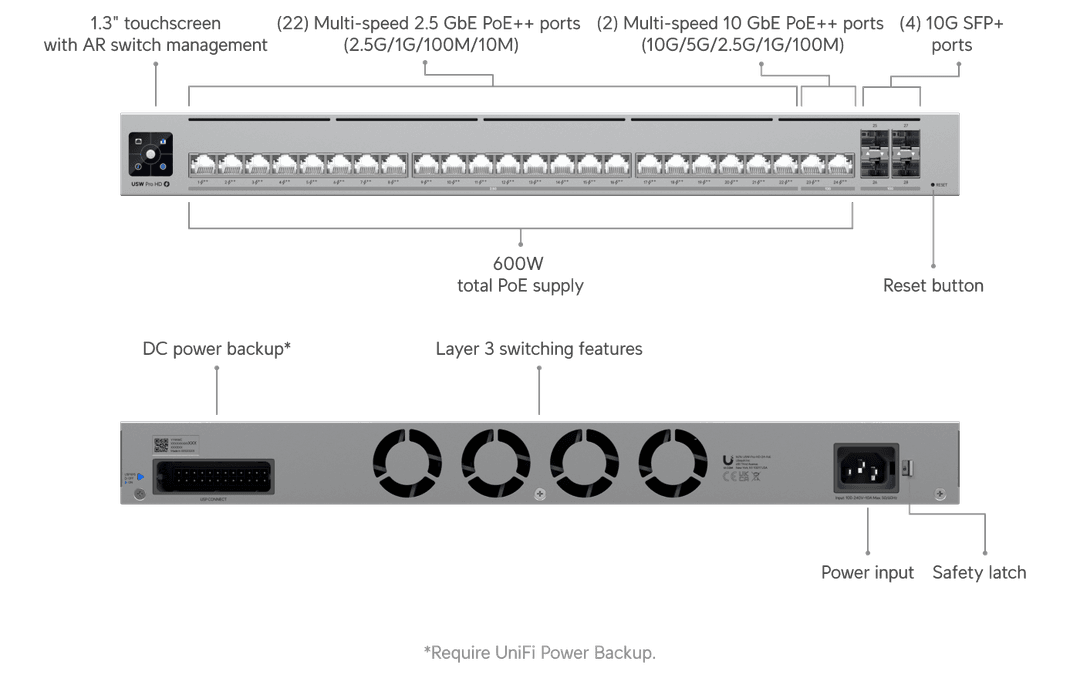
The Pro HD 24 PoE combines access switching, PoE power delivery, uplink aggregation and selected Layer 3 functions in one managed appliance. Its twenty-two 2.5 GbE ports are well suited to modern access points and workstations that can exceed 1 GbE, while two 10 GbE copper ports accommodate very high-throughput endpoints or short-distance copper interconnects. Four 10G SFP+ ports provide options for fibre uplinks, direct-attach links to servers or aggregation switches, and resilient topologies where the network design supports them.
Because every RJ45 port supports PoE++, the platform can serve mixed fleets of standard PoE, PoE+ and higher-power PoE++ equipment. The total power budget remains the practical limit, so device-by-device power planning is essential.
Who should consider it
This model is a strong fit for IT teams building a compact but powerful access layer. Typical buyers include businesses deploying many Wi-Fi access points, hospitality groups supporting dense guest connectivity, schools upgrading classroom networks, security teams consolidating IP cameras, and integrators delivering AV-over-IP or collaboration environments.
It may be more switch than necessary for a small office with only 1 GbE endpoints and a modest PoE requirement. In those cases, a lower-capacity UniFi switch could be more economical. The correct choice depends on the real port count, port speed and power budget rather than the headline model alone.
Business challenges this model can address
1 GbE access bottlenecks
Wireless and endpoint performance can be restricted when uplinks remain limited to 1 GbE. The 2.5 GbE and 10 GbE copper interfaces provide additional headroom where connected devices and cabling support those rates.
Fragmented PoE deployment
A 600W total PoE budget can reduce the need for multiple injectors or separate low-capacity switches, provided the final endpoint count and per-device draw remain within the available power envelope.
Limited uplink flexibility
Four SFP+ interfaces create more options for aggregation, server links, fibre runs and redundancy than conventional access switches with only two uplinks.
Inconsistent operational visibility
UniFi Network management, Etherlighting and the front touchscreen can help administrators identify ports, review status and manage switching from a unified interface.
Core capabilities at a glance
Twenty-two 2.5 GbE ports support common 2.5G endpoint and access-point requirements while retaining backward negotiation to lower speeds.
Two 10 GbE RJ45 ports and four 10G SFP+ ports provide a mix of copper and optical connectivity for high-throughput links.
All 24 RJ45 ports support up to PoE++, with a shared 600W budget that must be allocated across attached devices.
Features include VLANs, static routing, inter-VLAN routing, DHCP functions, ACLs, LACP, STP/RSTP and traffic controls.
Product-fit matrix
| Requirement | Suitable when | Confirm before ordering |
|---|---|---|
| Dense Wi-Fi access layer | Many APs need 2.5 GbE and PoE+/PoE++ | AP power draw, cable category and uplink capacity |
| High-resolution surveillance | Numerous cameras need central power and segmented switching | Camera count, PoE class, retention server uplink and VLAN plan |
| AV-over-IP environment | Multicast, QoS and vendor profiles are required | Endpoint profile, bandwidth, timing and multicast design |
| 10G server or NAS access | A small number of high-speed copper or SFP+ links are needed | Transceiver type, cable distance, link aggregation and storage workload |
| Small office refresh | Only when growth, PoE and multi-gigabit demand justify the platform | Whether a lower-cost 1G model would meet the actual requirement |
Verified technical information
| Brand | Ubiquiti |
|---|---|
| Product name | UniFi Pro HD 24 PoE |
| Model | USW-Pro-HD-24-PoE |
| Product type | Managed Layer 3 PoE switch |
| 2.5 GbE RJ45 | 22 ports, all supporting PoE++ and 2.5G/1G/100M/10M |
| 10 GbE RJ45 | 2 ports, all supporting PoE++ and 10G/5G/2.5G/1G/100M |
| 10G SFP+ | 4 ports supporting 10G and 1G |
| PoE capability | Up to PoE++ on all 24 RJ45 ports |
| Total PoE availability | 600W shared budget |
| Maximum per-port PSE output | 15.4W PoE, 30W PoE+, 64W PoE++ |
| Switching capacity | 230 Gbps |
| Non-blocking throughput | 115 Gbps |
| Forwarding rate | 171 Mpps |
| VLAN support | Up to 1,000 VLANs |
| MAC table | 32,000 entries |
| IPv4 static routes | 256 |
| Form factor | 1U rack mount |
| Dimensions | 442 × 400 × 44 mm |
| Weight | 6.2 kg without brackets; 6.3 kg with brackets |
| Power supply | Internal 660W AC/DC power supply |
| Power input | 100–240V AC, 50/60 Hz; USP RPS DC input supported |
| Maximum consumption | 60W excluding PoE; 660W including PoE output |
| Operating temperature | -5°C to 40°C |
| Management requirement | UniFi Network version 9.0.114 or later |
| Availability | Contact FourTeck for current UAE options, quantity and lead time |
Configuration and compatibility dependencies
The switch hardware provides substantial capacity, but a successful deployment depends on the rest of the network design. Multi-gigabit operation requires compatible endpoint network interfaces and suitable cabling. Existing Category 5e runs may support 2.5 GbE in many environments, but cable quality, distance, termination and interference should be assessed rather than assumed. Ten-gigabit copper links are more sensitive to distance and cable performance. SFP+ links require the correct direct-attach cable, active optical cable or transceiver pair for the intended distance and fibre type.
PoE++ availability does not remove the need for budgeting. Add the maximum or realistic power draw of every attached device, include future growth, and check whether startup peaks or environmental conditions influence consumption. The 600W budget is shared across all ports. DC backup requires the appropriate UniFi Power Backup arrangement and should be reviewed as part of the rack power design. Management requires UniFi Network 9.0.114 or later, so the selected console, gateway or hosted controller must be compatible and maintained.
A practical purchase and deployment journey
Map endpoints
List access points, cameras, phones, AV devices, servers and other clients, including required speeds and PoE classes.
Calculate capacity
Confirm port count, PoE wattage, expected traffic and uplink oversubscription with growth allowance.
Choose uplinks
Select SFP+ optics, DACs or 10G copper based on distance, medium, aggregation design and resilience.
Prepare the rack
Check depth, ventilation, power, backup strategy, patching and cable management before installation.
Adopt and configure
Update the UniFi platform, adopt the switch, create VLANs, assign port profiles, configure protections and test services.
Multi-gigabit performance where it matters
The most important architectural advantage of the USW-Pro-HD-24-PoE is not simply that it has faster ports; it is that it offers a useful distribution of speeds for a modern access layer. Most connected devices do not require 10 GbE, yet many high-end access points and specialist endpoints can benefit from more than 1 GbE. Twenty-two 2.5 GbE interfaces address that middle ground efficiently. They allow a business to upgrade selected workloads without paying for twenty-four full 10G copper ports or introducing separate switch tiers for every use case.
The two 10 GbE RJ45 ports can serve demanding local devices such as a storage appliance, media workstation, high-performance server or specialist edge platform. Four SFP+ ports give network designers additional paths to aggregation switches, server rooms or remote distribution cabinets. Whether these links operate at their expected performance depends on the connected equipment, transceivers, cabling and traffic design. Link aggregation can improve total bandwidth and resilience in supported designs, but it does not turn every single flow into a combined-rate session.
The published switching capacity of 230 Gbps, non-blocking throughput of 115 Gbps and forwarding rate of 171 Mpps indicate that the platform is designed to process its full-duplex interface mix without the internal limitations common to low-end switching hardware. Real application performance will still reflect endpoint limitations, packet sizes, topology, storage performance and uplink contention. FourTeck can help buyers evaluate these factors before finalising a bill of materials.
PoE planning for dense device estates
Power over Ethernet simplifies deployment by carrying both network connectivity and electrical power over the same cable. In practice, however, PoE design is a capacity-planning exercise. The Pro HD 24 PoE supports standard PoE, PoE+ and PoE++ classes, with maximum PSE values up to 15.4W, 30W and 64W per port respectively. The total available PoE power is 600W. This allows many combinations of access points, cameras, phones, door systems and AV devices, but it does not mean every port can continuously deliver 64W at the same time.
A sound design starts with the manufacturer-rated power requirement of each powered device. It should then consider startup behaviour, heater or infrared use in cameras, USB or accessory loads on access points, and any expected future additions. Critical endpoints should be identified so that power priority and backup strategy can be planned. Where the switch supports the required controls, port-level monitoring helps administrators compare actual consumption with the planned budget over time.
The 660W internal power supply accounts for both the switch itself and the maximum PoE output. The unit can consume up to 60W excluding PoE. Rack power distribution, UPS sizing and thermal planning should therefore be based on a realistic maximum rather than the idle draw. In Dubai and other warm operating environments, the stated ambient range of -5°C to 40°C makes conditioned rack space and unrestricted airflow especially important.
Operational control through UniFi Network
The switch is managed through UniFi Network version 9.0.114 or later. This platform relationship is a major buying consideration. Organisations already using UniFi gateways, access points and switches can bring the Pro HD 24 PoE into a common operational view, while businesses using another management stack should assess whether introducing UniFi aligns with their standards, support processes and security controls.
Supported functions include VLANs, static routing, inter-VLAN routing for local networks, DHCP server and relay capabilities, LACP, spanning tree, QoS, access controls, device isolation, DHCP snooping and guarding, storm control, port isolation, mirroring, jumbo frames, LLDP-MED and voice VLAN. These tools help administrators segment departments and device classes, protect the switching layer from common misconfigurations, troubleshoot traffic and support converged voice or AV environments. Their effectiveness depends on correct design and policy implementation.
Etherlighting can visually identify port roles or status using illuminated port indicators, which can be useful in dense racks during moves, additions and troubleshooting. The 1.3-inch touchscreen offers local status and augmented-reality management support. These convenience features complement, rather than replace, documented port schedules, labels and configuration records. FourTeck can include VLAN planning, port-profile creation, uplink configuration and testing in the requested project scope.
Ideal business environments and use cases
Enterprise Wi-Fi refresh
Connect multi-gigabit access points with PoE+ or PoE++ while retaining 10G uplinks to the aggregation layer.
Hospitality and venue networks
Support dense wireless coverage, IP cameras, phones and AV endpoints from a centrally managed rack platform.
Education campuses
Serve classrooms, labs, surveillance and staff networks with VLAN segmentation and a high shared PoE budget.
AV and collaboration systems
Use multicast controls, QoS and supported Pro AV profiles where the endpoint ecosystem and design require them.
Security and surveillance
Consolidate high-resolution cameras and related devices while separating surveillance traffic from business networks.
High-performance office access
Provide 2.5G connectivity to workstations and 10G links to selected servers or storage appliances.
Integration and operational considerations
A switch of this class should be treated as part of a larger architecture. The upstream gateway or firewall must support the intended VLAN, routing and security model. Aggregation links should be sized for the combined access traffic rather than selected only by port availability. Where the switch performs local inter-VLAN routing, administrators should decide which controls remain at the gateway and which functions are delegated to the access layer. This has implications for visibility, policy enforcement and troubleshooting.
For optical uplinks, confirm multimode or single-mode fibre, connector type, distance, transceiver compatibility and link speed. For direct-attach cables, verify supported length and endpoint compatibility. For copper 10G, assess cable category, pathway, temperature and run length. Rack depth is also important because the chassis is 400 mm deep and the supported rack depth is 600 to 1,200 mm. Allow additional clearance for power and data cabling.
Operational planning should include firmware management, controller backups, administrator access controls, logging, configuration standards and maintenance windows. The switch supports DC power backup through a USP RPS input, but redundancy design should account for upstream devices, power distribution and the wider failure domain. A backed-up switch does not keep the network available if the gateway, controller, aggregation path or internet circuit remains a single point of failure.
Questions to resolve before requesting a quotation
The answer determines whether this model is the right fit or whether a different port mix would be more economical.
Provide device models and quantities so the 600W budget can be checked with suitable headroom.
Distance and infrastructure determine whether DAC, multimode fibre, single-mode fibre or 10G copper is appropriate.
Controller location, software version, ownership and backup arrangements should be understood before adoption.
Define rack work, patching, VLAN creation, migration, testing, documentation and handover as separate scope items.
Consider dual uplinks, spanning tree, LACP, UPS and UniFi Power Backup requirements across the whole network.
Procurement checklist
- Confirm exact model USW-Pro-HD-24-PoE
- State required quantity and deployment location
- List endpoint models and port-speed requirements
- Calculate total PoE demand with growth allowance
- Choose 10G copper, DAC or optical uplinks
- Confirm transceiver and fibre compatibility
- Check rack depth, airflow and cable clearance
- Confirm AC, UPS and optional DC backup design
- Verify UniFi Network version and controller ownership
- Define VLAN, routing and access-control scope
- Clarify installation, migration and testing needs
- Request warranty and lead-time confirmation in the quote
How FourTeck can assist
FourTeck can help translate a device list and network objective into a more accurate switching bill of materials. This may include checking whether the Pro HD 24 PoE has the correct port mix, calculating PoE demand, selecting suitable optics or DACs, reviewing rack and power requirements, and identifying related gateways, access points or aggregation components. Buyers can also request a scope for installation, UniFi adoption, VLAN configuration, uplink setup, migration, testing and documentation.
For broader network projects, review the available technology services, browse additional network and security products, or discuss the requirement through the FourTeck contact team. Organisations with multi-country needs can also visit the FourTeck UAE technology site for wider project coordination information.
UAE availability and support guidance
Contact FourTeck to confirm current UAE availability for the USW-Pro-HD-24-PoE. Supply may depend on quantity, regional version, vendor lead time and the complete bill of materials. Buyers should share the exact model, number of units, required accessories, destination and target project schedule. Delivery and project coordination can be discussed after the requirement is confirmed. Installation and configuration should be included in the quotation when required rather than assumed to be part of the hardware purchase.
FourTeck can coordinate requirements for Dubai, Abu Dhabi, Sharjah and Ajman through one combined project discussion. This helps keep hardware, uplink accessories, rack requirements, configuration scope and delivery planning aligned across multiple locations. Warranty terms, service options and availability should be confirmed for the specific quotation because they can vary by source, region and purchasing arrangement.
GCC Availability
FourTeck can support GCC organisations evaluating the Ubiquiti Pro HD 24 PoE for multi-gigabit access, high-density PoE and 10G aggregation projects. Requirement review may include model validation, port and power sizing, transceiver selection, quotation coordination, delivery planning, installation scope and UniFi configuration requirements. Projects may involve the United Arab Emirates, Saudi Arabia, Kuwait, Qatar, Bahrain or Oman, but product availability, regional versions, licensing, delivery schedules, service visits and vendor lead times can vary by country, quantity and project conditions. Buyers should provide the destination country, exact model, required quantity, endpoint list, expected PoE load, preferred uplink medium and target timeline. FourTeck can then advise on the appropriate quotation structure and any accessories or implementation services that should be included. No stock, customs, certification or fixed delivery assumption should be made until the regional requirement is reviewed and confirmed.
Africa Availability
Businesses planning network upgrades in Africa can contact FourTeck for product evaluation and regional procurement guidance for the USW-Pro-HD-24-PoE. Support may cover endpoint and PoE assessment, model selection, optics or DAC requirements, controller compatibility, rack planning, configuration scope, support expectations and renewal or lifecycle considerations where relevant. Availability and fulfilment depend on the destination, quantity, regional power and regulatory requirements, shipping arrangements, vendor lead time and local project conditions. For East African projects, organisations can also review FourTeck resources for Kenya technology requirements and Uganda project coordination. Buyers should share the destination country, exact quantity, expected deployment schedule, installation needs and desired support model so the requirement can be assessed properly. Local inventory, immediate shipment, customs outcomes and country-wide onsite coverage must be confirmed rather than assumed.
Related options and complementary services
UniFi aggregation switching
Consider an appropriate 10G or higher-speed aggregation layer where several access switches or high-volume servers must connect centrally.
UniFi Wi-Fi access points
Match access-point port speed and PoE class to the switch design rather than selecting devices independently.
10G optics and DACs
Select transceivers or cables according to distance, fibre type, connector, endpoint compatibility and redundancy plan.
Rack and power planning
Include rack depth, PDU capacity, UPS sizing, airflow, patch panels and cable management in the deployment scope.
Installation and configuration
Request adoption, firmware updates, VLANs, port profiles, uplinks, testing and documentation as defined services.
Lower-capacity alternatives
Where 2.5G density or 600W PoE is unnecessary, a smaller UniFi PoE model may offer a better commercial fit.
Why businesses contact FourTeck
The value of procurement support is clarity. Buyers often know the preferred switch but still need to confirm whether the endpoint mix, power budget, uplink design and controller environment are aligned. FourTeck can help review those details before a quotation is finalised. This reduces the risk of omitting optics, ordering the wrong cable type, underestimating PoE draw or discovering that the rack and power arrangement need changes after delivery.
Businesses also contact FourTeck to separate hardware supply from deployment scope. Installation, configuration, migration, testing and handover can then be discussed explicitly. This makes commercial comparisons easier and gives technical teams a clearer basis for approval. Learn more about FourTeck project assistance or request a detailed requirement review through the contact team.
Frequently asked questions
What is the USW-Pro-HD-24-PoE mainly used for?
It is used as a high-density managed access switch for multi-gigabit endpoints, PoE-powered devices and 10G uplinks in UniFi-managed networks.
How many PoE ports does it provide?
All 24 RJ45 ports support PoE++, consisting of twenty-two 2.5 GbE ports and two 10 GbE ports. The total shared PoE budget is 600W.
Can every port deliver 64W at once?
No. Although each port can support up to PoE++ with a maximum PSE output of 64W, the total available PoE power across the switch is 600W.
Does it support 10G uplinks?
Yes. It includes four SFP+ ports supporting 10G or 1G, plus two multi-speed 10 GbE RJ45 PoE++ ports.
Which management software is required?
Ubiquiti specifies UniFi Network version 9.0.114 or later. The controller or console arrangement should be confirmed before deployment.
Is this switch suitable for Wi-Fi 7 access points?
It can be suitable where the access point uses compatible 2.5G or 10G Ethernet and supported PoE. The exact access-point model, power draw and expected traffic should be checked.
Does it include optical transceivers?
Transceiver inclusion is not assumed. The required SFP+ modules, DACs or optical cables should be listed separately in the quotation.
Can it be connected to backup power?
The switch supports a USP RPS DC input for UniFi Power Backup. The complete power-resilience design should be reviewed, including UPS and upstream devices.
Is installation included with the hardware?
Installation is scope dependent. Rack mounting, patching, adoption, configuration, migration, testing and documentation should be stated in the quotation when required.
How can I check Dubai availability and pricing?
Send FourTeck the exact model, quantity, destination, required accessories and desired timeline. Current UAE availability and quotation details can then be confirmed.
Plan the switch, uplinks and PoE budget together
Share your endpoint list, required quantity, rack location and deployment timeline. FourTeck can help confirm the model, accessories, UAE availability and implementation scope.

Reviews
There are no reviews yet.