
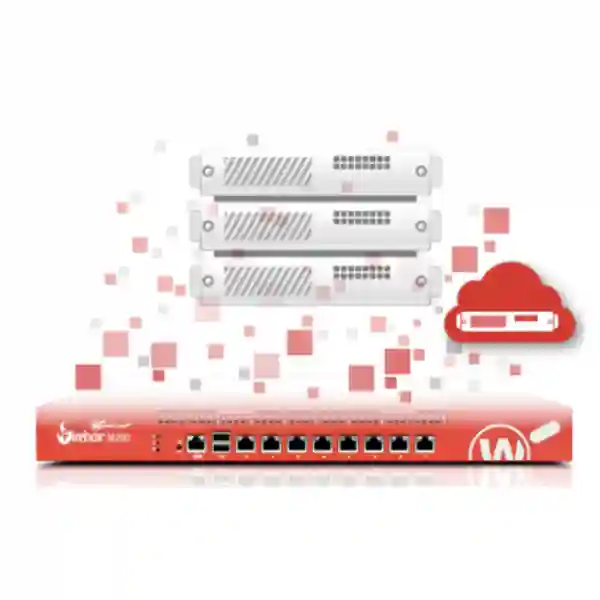
WatchGuard FireboxV Medium
WatchGuard FireboxV Medium is a virtual Firebox model for organizations that want WatchGuard network security controls inside a virtualized environment. It is designed to run on supported VMware ESXi, Microsoft Hyper-V, Linux KVM and Proxmox VE platforms while using the same Fireware operating approach and management tools as other Firebox models. This makes it useful for data-center virtualization, private-cloud projects, branch consolidation, hosted business applications, lab-to-production standardization and organizations that prefer software-defined security boundaries rather than a dedicated hardware appliance for every workload.
For procurement, the important question is not simply whether the Medium license is available. Buyers should confirm the hypervisor platform, vCPU and memory allocation, network-interface design, inspected traffic level, VPN requirements, VLAN count, user expectations, security-service bundle, support term and growth plan. FourTeck can help structure that requirement into a quotation and deployment scope without assuming that a published maximum equals guaranteed production performance.
*Vendor-published throughput varies with environment, enabled inspection and configuration. Use it as a sizing reference, not a guarantee.
Direct answer: what is WatchGuard FireboxV Medium?
WatchGuard FireboxV Medium is the mid-range licensed tier in the FireboxV virtual-firewall family. WatchGuard currently lists the Medium tier with up to 4 Gbps firewall throughput, 8–10 virtual interfaces depending on platform, unrestricted supported nodes, up to 300 VLANs, a stated user count of 250, up to 600 Branch Office VPN tunnels, up to 600 Mobile VPN with SSL connections, up to 600 Mobile VPN with IPsec connections and up to 3,000 authenticated users. WatchGuard also lists 150 EDR Core licenses with a qualifying Total Security Suite purchase. These figures come from the vendor’s model comparison and should be interpreted within the vendor’s stated testing and licensing conditions.
The virtual appliance uses Fireware and can be managed through WatchGuard Cloud, WatchGuard System Manager, Fireware Web UI and command-line workflows. Current WatchGuard documentation identifies deployment support across VMware ESXi, Microsoft Hyper-V, Linux KVM and Proxmox VE environments. Resource guidance for Medium lists 4096 MB of memory and up to four vCPUs, while FireboxV itself requires virtual disk space as documented for the supported platform and Fireware release. The exact software image, supported hypervisor version and migration path should be checked against the Fireware release you intend to deploy.
This product is therefore best evaluated as a licensed virtual security platform rather than as a box with fixed copper or fiber ports. Network connectivity is created through the virtual-switch and hypervisor design, and performance depends on host resources, virtual NIC architecture, traffic mix, inspection features, encryption, logging, policy complexity and contention with other virtual machines. Buyers who compare only the 4 Gbps headline figure can miss the more important architectural questions that determine the result in production.
Where it fits
Consider FireboxV Medium for virtualized edge security, protected application segments, branch aggregation, secure hosted environments, lab-to-production designs, disaster-recovery environments and organizations that need the Firebox operating model inside a hypervisor cluster.
What to size first
Start with inspected traffic rather than internet speed alone. Include east-west flows, encrypted traffic, VPN load, segmentation policies, logging, burst demand, failover conditions and host-resource contention when deciding whether Medium is appropriate.
What to quote
A complete quotation should identify the exact FireboxV model, license or security-suite term, support entitlement, implementation scope, required virtual infrastructure and any services for migration, policy build, VPN configuration, testing, handover or ongoing support.
Verified technical reference for FireboxV Medium
Selection, licensing and deployment guidance
A virtual firewall still needs the same design discipline as a physical perimeter firewall. First map trust zones, internet-facing services, internal segments, management networks, backup paths, VPN termination points and any east-west traffic that must cross the firewall. Then estimate peak inspected traffic rather than simply adding WAN circuits. If decryption, malware inspection, IPS, application control or multiple proxy services are important, include them in the sizing conversation because security inspection can materially change observed throughput.
Licensing should be treated as part of the architecture. FireboxV can be purchased with different support and security-service combinations, and the available features depend on the selected entitlement. Procurement teams should ask for the exact subscription term and included services in writing, especially when comparing Standard Support, Basic Security Suite and Total Security Suite options. A lower entry price may not represent the same security capability or support level as a bundled security suite.
The hypervisor design matters just as much as the license. Reserve the required CPU and memory, plan virtual NICs and port groups carefully, avoid accidental bypass paths, define where management access originates and document how the firewall starts after host maintenance or failure. For clustered virtualization, review how network connectivity and firewall state should behave when workloads move. High availability or FireCluster requirements should be designed against the exact platform and WatchGuard documentation rather than assumed from another hypervisor.
If the project is replacing an existing firewall, provide the current rule base, VPN inventory, published services, address objects, VLANs, NAT rules, authentication method, logging destination and decryption policy. This reduces migration risk and makes the quotation more accurate. FourTeck’s perimeter firewall planning guidance can also help teams frame internet-edge and segmentation requirements before choosing the final virtual or physical platform.
WatchGuard FireboxV Medium Dubai
Organizations searching for WatchGuard FireboxV Medium Dubai are often trying to solve one of three problems: secure a virtualized server environment, replace a physical firewall with a software-defined alternative, or create a consistent WatchGuard policy layer for hosted and on-premises workloads. In Dubai, that can include head offices operating private virtualization clusters, technology companies hosting customer-facing applications, professional-service firms consolidating server rooms, retail and hospitality groups linking branches to centrally hosted systems, and businesses building disaster-recovery capacity without wanting to duplicate every physical appliance. FireboxV Medium can be evaluated for these scenarios because it runs in supported virtualization platforms while retaining Fireware management and policy concepts.
For a Dubai deployment, procurement should start with the environment rather than the product name. Confirm whether the target host is VMware ESXi, Hyper-V, KVM or Proxmox VE; the exact software release; available CPU and memory; physical uplink design; number of virtual networks; and whether the firewall will protect north-south internet traffic, east-west application traffic or both. The published 4 Gbps firewall figure is useful for comparison, but a business should size against expected security inspection, VPN encryption, logging and concurrency. Dubai organizations with high-speed internet circuits should also consider whether traffic will remain local, traverse cloud services, terminate remote-access VPNs or pass between multiple server segments.
Licensing and support are equally important. Ask for the exact FireboxV Medium entitlement, security-suite option, subscription term and implementation scope. If the firewall will replace another vendor, include migration of NAT, policies, site-to-site VPNs, remote access, authentication and monitoring in the project plan. FourTeck’s Firewall Dubai solution overview explains the wider multi-brand approach, while the FourTeck firewall support profile outlines supported firewall families and service context. Buyers who also want to compare virtual security with a compact physical appliance can review the PA-415 branch firewall page as a different deployment model rather than as a direct feature-for-feature substitute.
Before requesting a Dubai quote, prepare the hypervisor version, internet bandwidth, peak inspected traffic estimate, VLAN count, branch and remote-access VPN requirements, security services, support term and desired deployment date. That information gives sales and engineering teams a much better basis for confirming whether FireboxV Medium is the appropriate tier and what must be included in the final bill of materials.
WatchGuard FireboxV Medium UAE
For UAE buyers, WatchGuard FireboxV Medium is most relevant when security must follow virtual infrastructure across a head office, private-cloud cluster, disaster-recovery site or centrally hosted service environment. A virtual firewall can reduce dependence on a separate physical chassis at every logical boundary, but that does not remove the need for capacity planning. Organizations should define which Emirates and sites depend on the virtual firewall, where internet traffic enters, which business applications require segmentation, how branch VPNs terminate and whether remote users connect directly to the FireboxV instance. These decisions determine both performance requirements and operational risk.
UAE procurement teams should ask for an exact license description and should avoid treating “FireboxV Medium” as a complete bill of materials by itself. The commercial package may include different support or security-suite terms, and security services can affect both functionality and performance. Confirm the selected subscription, renewal period, technical support entitlement, any implementation services, and whether configuration migration is included. The current vendor model comparison lists the Medium tier at up to 4 Gbps firewall throughput, 300 VLANs and 600 branch-office VPN tunnels, but these are product limits or test results, not a promise that every UAE production environment will sustain the same traffic with all inspection enabled.
Virtualization compatibility should be checked against the exact Fireware version and the organization’s hypervisor lifecycle. A company running a mature VMware environment may have different operational processes from one standardizing on Hyper-V, Linux KVM or Proxmox VE. Snapshot policy, backup strategy, host maintenance, network interface mapping and administrator access should be documented before deployment. If the virtual firewall protects services that cannot tolerate extended downtime, resilience planning should address the host platform, network uplinks and firewall availability as one system rather than assuming the virtual machine alone provides continuity.
FourTeck’s broader UAE IT and cybersecurity portfolio can provide adjacent infrastructure context for buyers who are coordinating firewall, networking and server projects together. On the Firewall Dubai site, the PA-410 compact firewall reference offers another example of how a physical branch platform is sized differently from a virtual firewall. For FireboxV Medium, send the virtualization platform, protected workloads, traffic levels, VPN counts, license preference and support expectations so the quotation reflects the actual UAE deployment.
WatchGuard FireboxV Medium Uganda
Organizations looking for WatchGuard FireboxV Medium Uganda are commonly evaluating centralized security for virtual servers, multi-branch connectivity, remote user access or a hosted business application environment. The key benefit of a virtual firewall is architectural flexibility: the security gateway can run inside supported virtualization infrastructure rather than requiring a dedicated physical security appliance at the same location as every protected workload. That can be relevant to enterprises, service providers, NGOs, universities, financial organizations and distributed businesses that already operate centralized compute resources and need structured firewall policy around them.
Uganda deployments should account for connectivity diversity. Branch sites may use different internet providers, bandwidth levels or backup links, while centrally hosted applications can create concentrated VPN and inspection demand. When sizing FireboxV Medium, map how many sites will connect, estimate peak encrypted traffic, identify whether remote users also terminate on the firewall, and separate branch-tunnel counts from throughput expectations. The vendor publishes a high maximum for branch-office VPN tunnels on the Medium tier, but the practical experience still depends on traffic per tunnel, security inspection, host resources and application behavior. A design with many lightly used tunnels is different from one carrying large backup, video or database flows.
The virtualization host should be treated as part of the security boundary. Reserve appropriate resources, document virtual switching, control administrative access and verify that the selected Fireware release supports the exact hypervisor version. Medium currently calls for 4 GB of recommended memory and up to four vCPUs in WatchGuard guidance. If a business plans future growth, compare that capacity with expected increases in users, VLANs, encrypted traffic and new branch connections rather than sizing only for today. Licensing should also be explicit: confirm whether the requirement is support-only or a Basic or Total Security Suite package and what services are included in the quotation.
FourTeck’s Uganda technology solutions site provides local-market context for networking and business infrastructure projects. For a FireboxV Medium quotation, Ugandan buyers should send the hypervisor type, data-center or server-room topology, branch count, internet capacities, VLAN plan, VPN requirements, security services and target support period. This allows the project to be evaluated as a complete virtual-security deployment rather than a license-only purchase.
WatchGuard FireboxV Medium Kampala
Kampala buyers often have a different requirement from a countrywide deployment. A head office or data center in Kampala may host accounting, ERP, file services, communications platforms, customer systems or shared business applications used by branches elsewhere in Uganda. In that architecture, WatchGuard FireboxV Medium can be evaluated as the virtual policy enforcement point between internet access, server networks, management zones, branch VPNs and selected internal segments. The focus should be on protecting the actual application flows rather than simply placing a firewall virtual machine next to the servers.
Start with traffic mapping. Determine which services are published to the internet, which branches connect by site-to-site VPN, how many remote users need mobile VPN access and whether east-west traffic between server VLANs will cross FireboxV. A virtual firewall can see only the traffic intentionally routed through it, so virtual-switch and routing design are critical. If sensitive workloads share the same virtualization cluster, use clear port-group, VLAN and routing controls so security policy is not bypassed accidentally. The Medium tier’s published VLAN and VPN capacities provide room for structured segmentation, but the final design should remain understandable and operationally supportable.
Kampala organizations should also decide how the firewall will be managed. WatchGuard supports WatchGuard Cloud, WatchGuard System Manager, Fireware Web UI and CLI-based administration. Choose an approach that matches the IT team’s skills, logging needs and change-control process. If multiple WatchGuard devices already exist in branches, consistent management and policy conventions can reduce administrative friction. For a new deployment, document administrator roles, configuration backup, monitoring, alert routing, certificate handling and software-update responsibilities before production cutover.
A useful Kampala quotation request should include the host platform, Fireware compatibility target, virtual networks, internet bandwidth, expected inspected throughput, branch VPN count, remote-access user count, required subscriptions and whether FourTeck should include migration or implementation assistance. Buyers comparing alternative architectures can also review the Firewall Dubai site’s physical PA-Series firewall overview to understand the procurement differences between software-defined and dedicated-appliance security.
WatchGuard FireboxV Medium Arua
For organizations in Arua, the strongest case for WatchGuard FireboxV Medium may be centralized rather than local. A business, NGO, education provider, healthcare group or distributed organization can place the virtual firewall in its primary virtualized environment and use it to terminate secure branch connectivity, protect shared applications and enforce consistent access controls. If the Arua site is itself hosting virtual servers, the same product can be considered locally, provided the virtualization host and network design meet the supported requirements. The decision should follow where the protected workloads and traffic actually reside.
Connectivity planning is important when branch links have varying capacity or resilience. Define the primary and backup internet paths, critical applications, acceptable outage behavior and what traffic must continue during degraded connectivity. VPN tunnel quantity by itself is not a sizing method. Instead, estimate the combined encrypted traffic during busy periods and identify large transfers such as backups, CCTV replication, software updates or database synchronization. These flows can consume capacity very differently from normal office traffic. If remote users also connect to the same virtual firewall, include their peak load and authentication requirements in the design.
Arua procurement teams should request transparent license details. FireboxV Medium can be paired with different support and security-service packages, so compare quotations by entitlement, term and included functionality rather than product name alone. Ask whether implementation includes initial system deployment, interface mapping, routing, VLANs, policies, NAT, branch VPNs, remote access, security profiles, logging and administrative handover. If migration is required, provide the existing firewall configuration and a list of essential business services before work begins.
The target hypervisor must also be confirmed. WatchGuard documents VMware ESXi, Hyper-V, Linux KVM and Proxmox VE support, but compatibility is release-specific. Plan enough CPU and memory for FireboxV Medium, maintain headroom on the virtualization host and avoid resource overcommitment that could undermine predictable security performance. For Arua buyers, the most useful quotation input is therefore a short architecture summary: where the virtual firewall will run, which networks and branches it protects, bandwidth figures, VPN needs, security-service requirements, expected growth and the support model after deployment.
WatchGuard FireboxV Medium Mbarara
Mbarara organizations considering WatchGuard FireboxV Medium should first decide whether the virtual firewall is intended to protect a local virtualization cluster, connect the site to a centrally hosted environment, or act as a shared security gateway for several western Uganda locations. Those are different designs with different performance and resilience requirements. A local server environment may need strong east-west segmentation and internet-edge controls, while a branch-focused architecture may place more emphasis on site-to-site VPN stability, identity, application access and continuity when an upstream circuit changes.
The Medium tier provides significant published scale for a virtual appliance, including 300 VLANs and up to 600 branch-office VPN tunnels, but buyers should not confuse maximum counts with recommended everyday configuration size. A cleaner design is usually easier to operate and troubleshoot. Group networks according to business purpose, keep management interfaces separate, document routing clearly and avoid unnecessary policy sprawl. If the organization uses multiple business units, guest services, CCTV, voice, staff Wi-Fi, servers and management systems, segmentation should be based on access requirements and risk rather than creating VLANs merely because the platform supports a large number.
When comparing licensing, clarify which security services are required. Web filtering, intrusion prevention, antivirus, application control, DNS protections and other services are subscription-dependent, and the final security posture depends on the selected package. A business that only needs routing and VPN is buying for a different purpose from one that expects layered threat inspection on all internet traffic. Make that distinction in the request for quotation so the commercial response can be compared accurately.
Mbarara deployment planning should also include operational ownership. Decide who updates Fireware, reviews alerts, renews subscriptions, modifies policies, validates backups and tests VPN failover. Virtual appliances can be convenient to deploy, but security quality still depends on disciplined administration. Share the hypervisor, available resources, WAN capacity, protected networks, branch count, remote-user requirement, security package and support expectations with FourTeck. This creates a practical basis for confirming whether FireboxV Medium is the right tier or whether a smaller, larger or differently deployed firewall architecture should be considered.
WatchGuard FireboxV Medium Gulu
In Gulu, WatchGuard FireboxV Medium can be relevant for organizations that centralize applications in a virtual server environment while serving users across offices, campuses, clinics, projects or branch locations. A virtual firewall allows the security layer to sit close to those hosted applications and can provide policy enforcement between external connectivity, branch VPNs and internal server zones. The architecture is particularly useful when the organization already has virtualization skills and wants to avoid adding a separate physical firewall purely for workloads that exist inside the hypervisor environment.
A Gulu deployment should begin with a dependency map. Identify which business services require internet access, which must be reachable from branches, which are internal only and which contain data that deserves additional segmentation. Then define the routes that force those flows through FireboxV. Virtualization makes it possible to connect networks in many ways, so configuration discipline is necessary to prevent a server from reaching another zone through an unfiltered path. Administrators should also control who can modify the virtual switch or hypervisor networking because those permissions can directly affect firewall enforcement.
Capacity planning should consider the nature of northern Uganda branch connectivity and the organization’s workload. Bandwidth may be modest at some sites while centralized services create bursty traffic at predictable times. Backup synchronization, cloud storage, endpoint updates and video can add large flows that are easy to miss in a user-count estimate. Include those peaks along with encryption and inspection requirements when judging the vendor’s published Medium-tier performance. If the organization relies heavily on remote access, validate authentication design, certificate management and the expected number of concurrent VPN users.
For procurement, request the exact FireboxV Medium license bundle, term and support level, then separate software cost from any professional services for deployment or migration. Provide current firewall details if replacing another product, including site-to-site tunnels and published applications. A clear quotation should identify what will be configured, tested and handed over. Gulu customers can use FourTeck’s Uganda channel for wider infrastructure discussions, while the firewall-specific project should still be scoped around the virtual environment, network segmentation, connectivity and security operations that the local organization actually needs.
WatchGuard FireboxV Medium Kenya
WatchGuard FireboxV Medium Kenya searches typically indicate a buyer who wants a licensable virtual firewall for a data center, enterprise virtualization environment, hosted application stack or multi-branch network. Kenyan organizations with established VMware, Hyper-V, KVM or Proxmox VE infrastructure can evaluate FireboxV as a way to place network security policy inside the same virtual environment as protected workloads. This can be useful for Nairobi-based headquarters and data centers, distributed enterprises, technology firms, educational institutions and organizations that want a consistent policy platform without making every security boundary dependent on a physical appliance.
The technical conversation should include both north-south and east-west traffic. Internet-edge inspection may be the obvious requirement, but a virtual firewall can also segment application tiers, administrative networks, partner access, development environments and shared services when routing is designed accordingly. The current FireboxV Medium model comparison lists up to 4 Gbps firewall throughput, 300 VLANs and substantial VPN scale. However, Kenyan buyers should size using realistic encrypted and inspected traffic, particularly where multiple branches, cloud applications and remote workers converge on one virtual firewall.
Operational resilience deserves equal attention. If FireboxV runs on a shared virtualization host, consider what happens during host maintenance, resource pressure, switch failure and storage interruption. Align the firewall’s availability design with the virtualization cluster and physical uplinks. Document configuration backups, management access and software lifecycle. Hypervisor compatibility can change with Fireware releases, so confirm the exact supported combination before implementation instead of relying on an older product listing.
FourTeck’s Kenya business IT and network-security portal can support wider project discussions that include switching, communications and infrastructure. On the target firewall site, buyers comparing deployment forms can review the PA-400R rugged firewall overview as an example of a physical platform intended for very different operating conditions. For FireboxV Medium, send the host platform, workload location, inspected traffic estimate, number of sites and VPN users, subscriptions and support term so the quote addresses the Kenyan deployment rather than merely listing a software license.
WatchGuard FireboxV Medium Kuwait
Kuwait organizations evaluating WatchGuard FireboxV Medium may be planning a virtualized perimeter, secure server-zone segmentation, branch aggregation or an alternative to a dedicated hardware firewall in a private-cloud environment. The software-defined form factor is useful where businesses already operate resilient compute clusters and want the firewall to follow virtual infrastructure standards. It can also fit testing and disaster-recovery environments where reproducing security policy without duplicating physical appliances simplifies planning.
For Kuwait, capacity planning should reflect high-speed business connectivity and the possibility of substantial encrypted traffic. A 4 Gbps published firewall figure does not mean 4 Gbps of every security service under every traffic profile. Estimate peak internet traffic, inter-zone application flows, site-to-site VPN, remote-access VPN and expected growth. If SSL/TLS inspection, intrusion prevention, gateway antivirus, application control or other security services are required, make that explicit during sizing. The chosen subscription determines which protections are available, and the operational configuration determines how much processing each flow requires.
Kuwait IT teams should also align FireboxV with their virtualization operations. Reserve resources, control virtual networking changes, create a documented interface map and define startup dependencies. If the firewall protects critical services, avoid a design in which a single host, switch or uplink failure defeats the entire security path. Review backup, monitoring and upgrade processes with the same rigor applied to other production virtual machines. FireboxV uses familiar Fireware management options, but the deployment is only as robust as the surrounding hypervisor and network architecture.
FourTeck’s Kuwait IT and firewall solutions site gives local-market procurement context for organizations combining security with broader infrastructure requirements. Buyers should submit the exact virtualization platform, circuit speeds, expected inspected traffic, VLAN count, VPN demand, security-suite preference and support duration. If the project involves replacing a hardware firewall, include interface and policy details so the scope accounts for migration, testing and rollback rather than treating FireboxV Medium as a simple software install.
WatchGuard FireboxV Medium Ghana
For Ghanaian organizations, WatchGuard FireboxV Medium can support a virtualized security architecture where enterprise applications, shared services or branch connectivity converge in a centralized compute environment. Businesses that already use hypervisors for server consolidation can place the firewall as a controlled routing point between internet access, branch VPNs, application segments and administrative networks. This model can be attractive to financial services, education, healthcare, logistics, professional services and distributed companies, but the final fit depends on traffic and operations rather than industry label alone.
A Ghana deployment should inventory both critical and high-volume traffic. ERP and database applications may be latency-sensitive; backups and software distribution can create large bursts; cloud collaboration can dominate internet usage; and branch tunnels can aggregate many modest links into a significant central load. Use these patterns to estimate practical capacity. The vendor’s published Medium-tier figures provide an upper reference, but security inspection, encryption, virtual-host contention and packet characteristics affect real throughput. If the business expects rapid branch expansion, include future sites in the VPN and segmentation plan rather than treating growth as an afterthought.
Licensing should be matched to the security outcome. Some buyers primarily need firewalling, routing and VPN, while others expect content filtering, IPS, anti-malware, application control and other subscription services. Ask the supplier to name the bundle and term clearly so competing quotations are comparable. Also clarify implementation: who creates the virtual appliance, who maps interfaces, who builds policies and tunnels, who tests failover, and who owns ongoing Fireware upgrades and security-service renewals.
For multi-country projects, the FourTeck Africa technology portal can provide a broader regional path for infrastructure discussions. Ghana buyers should still provide site-specific details for the firewall quote, including whether the virtual appliance will run locally or in another data center, the chosen hypervisor, available host resources, bandwidth, user and branch counts, VLAN design, required security subscriptions and expected support. That information allows FireboxV Medium to be evaluated in the context of the actual Ghana network rather than as a generic virtual firewall.
WatchGuard FireboxV Medium Nigeria
Nigeria deployments can span everything from a single virtualized headquarters environment to large distributed networks with branches in multiple cities. WatchGuard FireboxV Medium is most useful when the organization has a clear need for virtualized security enforcement around hosted workloads, aggregated VPN connectivity or segmented server infrastructure. The virtual form factor allows the firewall to be deployed on supported hypervisors without waiting for a physical appliance installation, but it does not eliminate the need for careful network engineering and license planning.
For a multi-branch Nigerian business, calculate traffic at the central point. Hundreds of branch tunnels can be technically within the model’s published limits while still creating substantial throughput and session demand if each branch carries cloud access, voice, file synchronization or centralized application traffic. Remote employees can add another layer of encrypted connections. Build a peak-hour estimate and include redundancy behavior: when one link or site fails, traffic may shift and create a different load profile than normal operations. The Medium tier’s 4 Gbps published firewall figure should be interpreted with WatchGuard’s note that throughput varies by environment and configuration.
Organizations running critical services should also examine virtualization resilience. Document where the FireboxV instance runs, which physical NICs and virtual switches carry each security zone, how the firewall is backed up, and how administrators reach it if normal paths fail. If high availability is required, design it specifically for the supported hypervisor and Fireware release. Avoid assuming a generic virtual-machine failover mechanism automatically delivers the same behavior as a firewall cluster.
Commercially, insist on an itemized license description, security-suite term and professional-services scope. Nigeria projects often involve migration from another firewall, so provide the existing NAT rules, VPNs, VLANs, public services and authentication sources to reduce surprises during cutover. If comparing alternative enterprise security architectures, the target site’s PA-5450 modular firewall reference illustrates the very different requirements of large physical platforms. FireboxV Medium should be selected because its virtual deployment model and licensed capacity fit the Nigerian environment, not because of a headline specification alone.
WatchGuard FireboxV Medium Seychelles
Seychelles organizations may value a virtual firewall because specialized hardware replacement logistics can be more complex than in larger markets. Where a business already maintains suitable virtual infrastructure, WatchGuard FireboxV Medium can place the network-security function in software and make it easier to reproduce configurations across primary and recovery environments. This can be relevant to hospitality, professional services, government-related environments, education, service providers and businesses that operate critical applications on virtual servers. The benefit is architectural flexibility, not immunity from infrastructure failure, so the host platform and network path must still be resilient.
Island connectivity makes traffic planning especially important. Identify which applications are local, which depend on overseas cloud services, which branches or properties connect by VPN and what happens when a primary internet path degrades. Security services such as IPS and content inspection can add processing overhead, while VPN encryption can concentrate demand at the virtual firewall. Rather than sizing only from user count, capture real bandwidth peaks and business-critical flows. The published Medium-tier capacity offers a useful reference for growing environments, but actual performance should be validated against the proposed configuration.
Operational planning should include remote administration and recovery. Determine who can access FireboxV management, where configuration backups are stored, how alerts are received and how changes are approved. If local IT resources are limited, the support scope should state whether assistance includes policy changes, troubleshooting, software updates or only deployment. Licensing needs the same clarity: document the exact security suite, support term and renewal responsibility so services do not lapse unexpectedly.
For Seychelles procurement, provide FourTeck with the virtualization platform and version, protected workloads, internet circuits, VPN requirements, VLAN design, remote-user estimates, security services and desired support model. If the virtual firewall is intended for disaster recovery, include how the secondary environment will be activated and whether addressing or routing changes during failover. A well-scoped quotation should make the software entitlement, implementation tasks and operational assumptions visible so the organization can evaluate total deployment readiness rather than a license price in isolation.
Related firewall resources on Firewall Dubai
Firewall architecture planning
Review perimeter firewall design considerations for internet gateways, segmentation, VPN and migration projects before finalizing the FireboxV topology.
Compact physical comparison
The PA-410 branch firewall shows how a dedicated physical appliance differs in interfaces, deployment and sizing from a virtual FireboxV instance.
PoE-capable branch platform
See the PA-415 firewall page when the project calls for a physical edge appliance with integrated branch connectivity considerations.
Rugged edge environments
For industrial or uncontrolled physical locations, review the PA-400R rugged firewall family, which solves a different problem from a data-center virtual firewall.
Enterprise physical portfolio
Use the PA-Series overview to compare physical next-generation firewall deployment patterns with a software-defined FireboxV architecture.
High-capacity modular platform
The PA-5450 modular platform page is relevant when data-center requirements move far beyond the scale and deployment model targeted by FireboxV Medium.
Frequently asked questions
Is FireboxV Medium a physical firewall?
No. FireboxV is a virtual firewall model designed to run as a virtual machine on supported virtualization platforms. Network interfaces are provided through the hypervisor and virtual-network architecture rather than fixed appliance ports.
What throughput does WatchGuard publish?
WatchGuard’s current model comparison lists FireboxV Medium at up to 4 Gbps firewall throughput. The vendor explicitly notes that throughput rates vary by environment and configuration, so inspected production traffic should be sized conservatively.
Which hypervisors are supported?
Current WatchGuard documentation covers VMware ESXi, Microsoft Hyper-V, Linux KVM and Proxmox VE for FireboxV. Exact supported versions depend on the Fireware release, so compatibility should be confirmed before deployment.
How much memory and CPU should be assigned?
WatchGuard currently lists 4096 MB memory for FireboxV Medium and a maximum of four vCPUs. Resource allocation should also account for host contention and the wider virtualization platform.
Does the license include all security services?
Not necessarily. Security capabilities depend on the purchased support or security-suite entitlement. Request the exact package, term and included services in the quotation rather than assuming every FireboxV Medium license has the same bundle.
Can it replace an existing physical firewall?
It can be evaluated as a replacement when the virtual architecture, interfaces, capacity, VPN needs, features and operational model fit. Migration should include rule, NAT, routing, authentication, VPN and monitoring review before cutover.
Decision recap
Choose FireboxV Medium because the virtual deployment model and licensed capacity match your architecture, not simply because it is the middle size in the product family. It is a strong candidate when your organization already operates supported virtual infrastructure, needs centralized firewall and VPN functions, wants segmented virtual networks and values management consistency with Fireware. A different tier or a physical appliance may be more appropriate when resource requirements, interface design, lifecycle or operational constraints point elsewhere.
Quotation checklist
- Target country, city and location of the virtualization host.
- Hypervisor platform and exact version: VMware ESXi, Hyper-V, KVM or Proxmox VE.
- Available CPU, memory, storage and physical uplink resources.
- Internet circuit speed, expected peak traffic and estimated inspected throughput.
- Number of VLANs, security zones, branch VPN tunnels and remote-access users.
- Required security services and preferred support or subscription term.
- Current firewall make/model and migration requirements, if replacing an existing platform.
- Required deployment services, testing, documentation, training and ongoing support scope.
Talk to FourTeck about WatchGuard FireboxV Medium
Send your virtualization platform, protected networks, inspected traffic target, VPN requirements and preferred license term. FourTeck can use those details to structure a product and deployment discussion for Dubai, the UAE, Uganda, Kenya, Kuwait and wider African requirements without assuming stock, delivery timing or entitlement details that have not been confirmed.
The goal of the quotation should be a deployable solution: the right FireboxV tier, the right security entitlement, a compatible virtual infrastructure and a clear implementation scope. That gives technical and procurement teams a common basis for approval and reduces the risk of discovering missing subscriptions or architecture constraints after purchase.

Reviews
There are no reviews yet.