
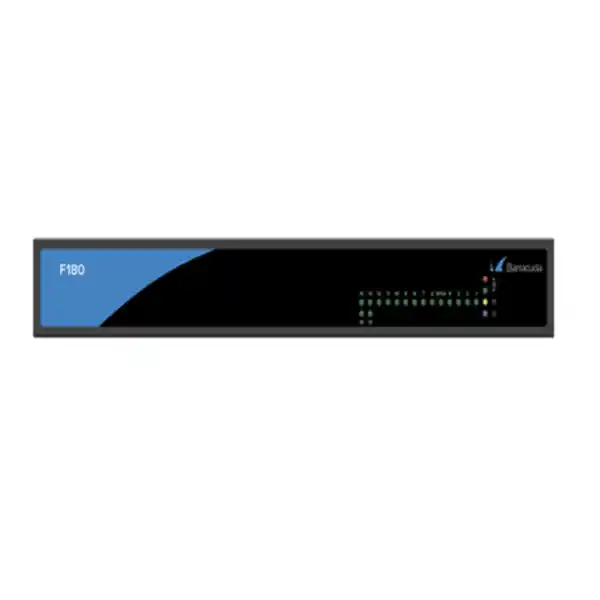
Barracuda CloudGen Firewall F180 Revision B
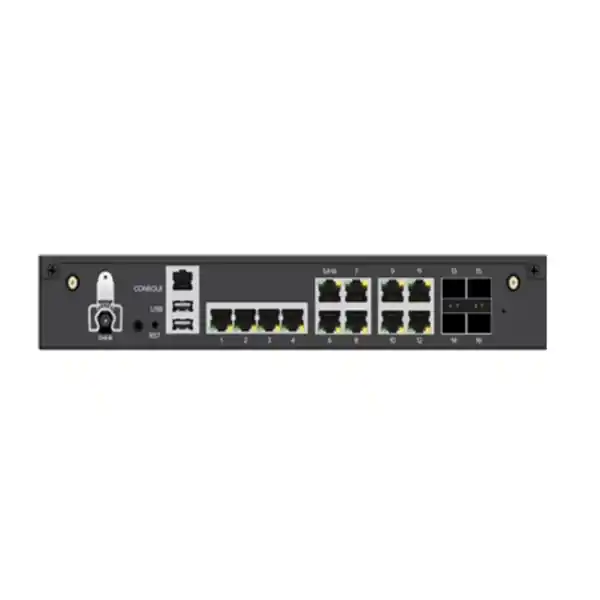
A compact CloudGen Firewall platform for branch and distributed enterprise networks that require twelve copper Gigabit Ethernet interfaces, four 1GbE SFP interfaces, integrated Wi-Fi, secure VPN connectivity, SD-WAN policy control, application-aware security, and centralized operational management.
Well suited to organizations prioritizing segmented 1GbE access, fiber uplinks, policy-based WAN selection, encrypted site connectivity, and manageable security services in a compact appliance footprint.
What the F180 Revision B is designed to do
The Barracuda CloudGen Firewall F180 Revision B occupies a practical position between very small branch firewalls and larger rack-class appliances. Its value is not simply the number of ports on the chassis. The platform is intended to function as a policy enforcement point at the intersection of the local network, internet circuits, private WAN links, remote-access users, cloud resources, and other sites. In a correctly designed deployment, the firewall becomes a controlled network boundary where routing, segmentation, encrypted connectivity, application policy, security inspection, and operational visibility are brought together instead of being handled by a collection of unrelated edge devices.
For a Dubai office, warehouse, clinic, retail head office, professional services branch, educational facility, hospitality property, or regional operations site, the F180 Revision B can be particularly attractive when several physical network segments must be terminated directly on the firewall. Twelve 10/100/1000 Mbps RJ45 interfaces allow designers to dedicate ports to separate functions such as primary WAN, secondary WAN, corporate LAN, guest network, voice network, server segment, CCTV segment, building-management network, wireless infrastructure, out-of-band operations, partner connectivity, or temporary migration networks. Four additional 1GbE SFP positions give the design team flexibility where optical uplinks are preferred for distance, electrical isolation, structured cabling, or aggregation-switch connectivity.
This interface density does not mean every deployment should use every physical port as a separate security zone. Good design begins with the business policy, traffic flows, failure domains, addressing plan, switch architecture, and expected growth. In many environments, one or two physical interfaces may carry multiple tagged VLANs, while other ports are reserved for WAN circuits, high-trust management, or future expansion. The advantage of the F180 Revision B is that the engineer is not forced into one topology. The mix of copper and fiber gives useful physical options, while CloudGen Firewall software provides the logical controls needed to build a segmented security architecture.
FourTeck can position the appliance as part of a broader UAE network-security project rather than treating it as a standalone box sale. That may include switch and VLAN mapping, ISP handoff review, VPN design, policy migration, change planning, staged cutover, logging strategy, and post-deployment validation. For organizations that want local assistance with firewall design or related infrastructure, the FourTeck Firewall Dubai practice can be used as the technical engagement point.
Verified F180 Revision B hardware profile
Hardware specifications may vary with manufacturing changes and appliance lifecycle status. Exact serial-number configuration, power accessories, transceiver compatibility, software eligibility, subscription status, and support entitlement should be verified before procurement or migration.
Interface architecture and port-planning methodology
The most important hardware characteristic of the F180 Revision B is its unusually useful collection of sixteen Gigabit-class Ethernet interfaces for a compact security appliance. Twelve are copper RJ45 and four are optical SFP. This gives network architects enough physical termination points to design deliberate separation between services while still preserving ports for expansion. In a small office, the appliance might use only a handful of those interfaces. In a more complex branch, the additional ports can eliminate unnecessary intermediate devices at the security boundary or provide clean physical separation for infrastructure with different trust requirements.
A practical port plan normally starts by assigning the external circuits. One RJ45 interface may connect to an Ethernet handoff from the primary ISP, while another may connect to a second provider, managed router, or LTE/5G gateway supplied by a telecom operator. If the provider hands off over optical fiber and a compatible SFP is supported, one of the four 1GbE SFP positions may be used instead. The remaining optical interfaces can serve distribution switches in different equipment rooms or buildings, especially where fiber is preferred because of cable length, electromagnetic conditions, or existing structured cabling.
The internal side should then be mapped by security policy rather than by department names alone. A corporate user VLAN, voice VLAN, guest wireless VLAN, CCTV network, building automation segment, point-of-sale segment, server VLAN, backup network, and administrator management segment may all have distinct security requirements. Some can share a tagged trunk to a managed switch; others may deserve dedicated physical firewall interfaces. For example, a CCTV network may be physically connected through a dedicated port so that cameras and recorders do not share the same layer-2 path as corporate workstations. A guest network may use a separate access-switch path and an independent policy that permits internet access but denies access to business resources.
The four SFP ports should also be planned with transceiver support and operational spares in mind. Barracuda identifies the internal fiber network module for this revision as fixed rather than field-replaceable, so a failed network controller is not equivalent to replacing a pluggable expansion card. The SFP optical transceiver itself is a separate component, and its optical type, wavelength, connector, fiber mode, and link partner must be selected correctly. A common procurement error is to order the firewall without confirming whether the existing switch uses 1000BASE-SX multimode, 1000BASE-LX single-mode, or a vendor-specific optic policy. The firewall project should therefore include a port schedule showing media type, switch name, switch port, VLAN mode, IP addressing, redundancy purpose, and the required transceiver at each fiber interface.
The result is a deployment that can be supported years later. Instead of relying on undocumented patch leads and default settings, each F180 port should have a defined role, cable label, logical zone, addressing plan, monitoring expectation, and failover behavior. This discipline is particularly important in multi-site businesses where a centralized network team may support Dubai, Abu Dhabi, Sharjah, other Gulf offices, and African sites remotely. A consistent port-plan template reduces troubleshooting time and makes configuration migration much more predictable.
Security architecture: inspection without design shortcuts
Policy enforcement
Firewall rules should express business intent: which sources can reach which destinations, over what applications or services, under which identities or network conditions, and with which inspection services enabled. A migration should not simply copy years of legacy rules without confirming ownership, use, and risk.
Segmentation
The interface count supports physical and VLAN-based segmentation. Corporate users, servers, guests, cameras, voice, OT, and management systems can be separated so lateral movement is constrained and permitted traffic is explicit rather than assumed.
Encrypted connectivity
CloudGen Firewall supports site-to-site and client-to-site VPN use cases. Production design should account for encryption overhead, tunnel count, remote-site bandwidth, failover behavior, authentication, certificate lifecycle, and the performance effect of concurrent inspection.
Threat services
Optional security subscriptions can extend the base platform with services such as malware protection and Advanced Threat Protection. These services should be selected against actual risk and inspected traffic rather than enabled by assumption without capacity planning.
Routing, SD-WAN, and multi-link operation
Modern branch connectivity is rarely a single static default route to one ISP. Businesses increasingly combine multiple internet circuits, private circuits, cloud connectivity, and encrypted overlays. The CloudGen Firewall platform is designed to participate in this type of environment through routing, VPN, and SD-WAN functions. On the F180 Revision B, the physical interface density is useful because each carrier or upstream device can be connected cleanly, while policy controls determine how traffic uses those paths.
An effective SD-WAN design begins by classifying applications and business dependencies. Voice and real-time collaboration may require low latency, low jitter, and low loss. ERP traffic may prioritize stability and security over raw bandwidth. Cloud backup may be allowed to use a lower-cost circuit and can often tolerate delay. Guest internet traffic can be prevented from consuming the preferred path during congestion. The objective is not merely to balance sessions across links; it is to steer each category of traffic according to measurable service quality and business priority.
The engineer must also define what happens when a path degrades rather than fully fails. A circuit can remain electrically up while packet loss, latency, or upstream routing problems make it unsuitable for a critical application. Health monitoring and path-selection policies should therefore be designed to react to actual service conditions. Equally important is return-path consistency. NAT, routing, VPN tunnel design, provider addressing, and upstream filtering should be reviewed so that failover does not create asymmetric traffic that the security policy cannot process correctly.
For multi-site organizations, encrypted overlay connectivity can reduce dependence on a single private WAN provider. Sites can establish secure tunnels over multiple internet links and use policy-based path selection to maintain application reachability. However, SD-WAN is not a substitute for WAN sizing. If the backup link is only a fraction of the primary link’s capacity, the business must decide which applications remain available during failover. Rate limiting, priority queues, traffic shaping, and explicit contingency policies may be necessary so that critical systems remain usable.
When FourTeck designs a branch edge, the WAN worksheet should capture provider, circuit ID, committed bandwidth, handoff type, public addressing, modem or NTE information, upstream gateway, DNS dependencies, required VLAN tags, expected MTU, failover priority, monitoring targets, and escalation contacts. This turns the firewall configuration into an operational design rather than an isolated set of rules. Broader network and infrastructure services can be coordinated through FourTeck IT Services UAE when the project includes switching, cabling, server, cloud, or managed-service workstreams.
VPN engineering for site-to-site and remote access
VPN design is one of the areas where appliance sizing and network architecture intersect directly. Barracuda CloudGen Firewall supports IPsec-based site connectivity and remote-access scenarios, but the design must be based on encrypted traffic volume rather than only internet link speed. Encryption consumes CPU resources, and real deployments often apply firewall policy, routing, logging, application identification, and additional inspection to the same traffic. A firewall that can forward a high volume of simple packets may achieve a lower effective rate when many encrypted tunnels and inspection services are active simultaneously.
For site-to-site connectivity, the project should document local and remote subnets, tunnel endpoints, public addressing, encryption domains, route behavior, authentication method, key or certificate lifecycle, rekey intervals, dead-peer detection, failover path, NAT exclusions, and logging. Overlapping networks must be identified before migration. Two acquired companies may both use the same private subnet, or a branch may use addressing that conflicts with a cloud virtual network. These conflicts can force NAT-based workarounds or, preferably, an addressing remediation project.
Remote access adds identity and endpoint considerations. User authentication, directory integration, multi-factor authentication, client distribution, split-tunnel policy, DNS behavior, permitted applications, certificate validation, and help-desk procedures all need defined ownership. The firewall should not grant broad internal access merely because the connection is encrypted. Remote users should receive the least network access needed for their role, and sensitive administration should be separated from general workforce VPN permissions.
Historical Barracuda comparison literature for the F180 family has published VPN throughput around 300 Mbps under vendor test conditions. That figure is useful only as an initial reference point. Real encrypted throughput varies with firmware, cryptographic parameters, packet sizes, tunnel count, inspection policy, logging, concurrent services, and application behavior. A site with a 1Gbps internet circuit and a requirement to encrypt most traffic should not assume the F180 is automatically an appropriate fit simply because its physical interfaces are Gigabit Ethernet. The encrypted workload must be sized independently.
For critical VPN deployments, engineers should model normal traffic, peak traffic, failover traffic, and growth. If the site normally uses two WAN links, the firewall must still be able to carry prioritized business traffic when one path fails. Capacity planning should include the scenario where backup jobs, video calls, cloud applications, and remote-access users are simultaneously active. This is how the project avoids a firewall that works in steady state but becomes a bottleneck precisely during an outage.
Application control, SSL inspection, IPS, and threat-protection planning
A next-generation firewall is valuable because security policy can be based on more than source IP, destination IP, and port number. Application-aware controls can help identify traffic categories that share common transport ports, while URL and security services can add context to internet access. Barracuda’s current licensing documentation identifies application-control reporting, SSL inspection on applicable models, SD-WAN, and VPN capabilities within the CloudGen Firewall base feature set, with additional services available through subscriptions. For procurement, the crucial task is to map required controls to the correct license set before the order is placed.
SSL inspection deserves separate sizing and governance consideration. A very large share of modern application traffic is encrypted. If a firewall does not inspect permitted encrypted sessions, several security functions have less visibility into the payload. If SSL inspection is enabled, however, the firewall must perform cryptographic operations, certificate handling, and content inspection that increase resource consumption. Organizations must also define exceptions for applications that use certificate pinning, regulated services, sensitive categories, or systems that should not be decrypted. Endpoint trust of the inspection certificate chain, browser behavior, mobile devices, and unmanaged clients must be considered during rollout.
Intrusion-prevention policy should be tuned to the protected assets and traffic direction. Applying every possible signature at maximum sensitivity to every flow can create unnecessary overhead and operational noise. A public web server segment, employee browsing traffic, site-to-site ERP traffic, and guest network do not have identical threat profiles. The policy should select relevant protection while maintaining a clear process for reviewing blocked events, false positives, exceptions, and signature updates. Logging must be detailed enough for investigation but not so indiscriminate that administrators cannot distinguish important events from routine noise.
Malware Protection and Advanced Threat Protection should similarly be treated as subscription-enabled security services with operational implications. Barracuda documentation lists Malware Protection, Advanced Threat Protection, Advanced Remote Access, and Firewall Insights among the available subscriptions. The correct commercial bundle depends on the desired controls, support model, and license status of the specific appliance. For an existing F180 Revision B being redeployed, the serial number and current entitlement are as important as the hardware itself. A used or spare appliance with expired subscriptions may not provide the same services as a newly entitled production unit.
Historical performance tables for the F180 family have shown firewall throughput around 1.65 to 1.7 Gbps and IPS figures in roughly the 500 to 600 Mbps range depending on the Barracuda publication and test methodology. These numbers should be treated as reference benchmarks, not as guaranteed application throughput for Revision B in a particular UAE network. Packet size, session mix, VPN usage, SSL inspection, security subscriptions, logging, firmware, and traffic direction all change the effective capacity. FourTeck therefore recommends sizing against the full enabled-service profile and expected peak workload rather than choosing the model from interface speed alone.
Licensing and subscription structure
The F180 Revision B is a hardware appliance, but the usable security feature set is determined by both hardware and licensing. Barracuda’s current CloudGen Firewall documentation describes a hardware base license associated with the appliance and separately identifies Energize Updates and optional security subscriptions. Energize Updates is mandatory for the first year of a hardware CloudGen Firewall purchase according to the current product documentation, and it is the service through which important update-driven capabilities are maintained. Procurement teams should therefore avoid comparing quotes solely by appliance part number; two quotations for an F180 can represent materially different security capabilities if their subscriptions, terms, support, or replacement services differ.
The documented base-license capabilities include application-control reporting, SSL inspection on supported models, SD-WAN, and VPN features. Optional subscriptions listed by Barracuda include Malware Protection, Advanced Threat Protection, Advanced Remote Access, and Firewall Insights. The relationship between these services matters. Some advanced services have prerequisites, and pool or enterprise licensing can be structured differently from an individual appliance license. A multi-site customer that centrally manages many CloudGen Firewalls may therefore have different commercial and operational choices from a business purchasing a single standalone F180.
Support and hardware replacement should also be separated from software feature licensing during review. An organization may require rapid replacement coverage for a headquarters firewall while accepting standard replacement terms for a non-critical lab unit. If the F180 is supporting revenue-generating connectivity, voice, cloud access, or branch operations, the business impact of hardware failure should be quantified. That assessment determines whether a cold spare, active-passive design, enhanced replacement entitlement, or a larger architecture is justified.
For existing hardware, the exact serial number should be checked for entitlement, warranty state, license expiration, firmware eligibility, and ownership-transfer considerations where applicable. The presence of a Barracuda logo and an operational boot screen does not confirm that current subscriptions are active. The purchasing team should request a clear bill of materials that identifies appliance status, license type, subscription modules, subscription duration, support level, replacement service, and any required optics. This is particularly important when sourcing discontinued or lifecycle-sensitive hardware.
A FourTeck quotation can be structured around the intended deployment outcome: new branch deployment, replacement of an older firewall, migration of an existing CloudGen configuration, renewal of an installed environment, or multi-site standardization. For broader UAE commercial coordination and technology procurement, customers can also use the FourTeck UAE portal.
Centralized management and distributed operations
A single firewall can be managed as a standalone device, but the operational value of the CloudGen platform becomes more significant in distributed environments where many gateways must follow common standards. Centralized management can reduce configuration drift, simplify policy administration, coordinate changes, and give the network team a consistent view across sites. This is relevant to UAE organizations that operate a head office in Dubai with satellite branches in other emirates, as well as regional groups that extend into the Gulf, East Africa, or other markets.
The management model should distinguish global policy from local exceptions. A corporate security baseline may define prohibited inbound services, DNS policy, administrative access, logging destinations, VPN encryption requirements, and standard network objects. Local sites then require controlled exceptions for ISP addressing, local printers, point-of-sale services, warehouse systems, hotel applications, tenant networks, or country-specific provider requirements. Without a governance model, centralized management can become either too rigid to operate efficiently or too permissive to deliver standardization.
Change control is equally important. Firewall configuration affects production traffic immediately, so a technically valid change can still cause an outage if it is implemented without dependency analysis. A mature process records the business owner, affected services, source and destination, ports or applications, implementation window, rollback plan, test method, and expiration date where access is temporary. Rules created for projects, vendors, audits, and troubleshooting should not automatically become permanent. Periodic rule review keeps the policy understandable and reduces exposure.
Configuration backup must be included in the operational design. Barracuda provides migration mechanisms for supported hardware transitions, including PAR-file based workflows for certain model changes. Nevertheless, a backup is useful only if the team knows what version created it, where it is stored, what credentials are required, and what dependencies are external to the appliance. Certificates, authentication systems, DNS records, switch VLANs, ISP configuration, and remote peer definitions may all influence recovery even when the firewall configuration itself is available.
Regional groups can coordinate common architecture while still using local delivery and support resources. Customers with operations beyond the UAE can reference FourTeck Africa for related regional infrastructure requirements, while keeping the firewall policy model consistent across the organization.
High availability, resilience, and failure-domain design
Resilience begins by identifying what can fail. A firewall outage can be caused by hardware, power, software, a cable, an SFP, an ISP, a switch, DNS, upstream routing, a certificate, or a configuration change. Installing two firewalls does not automatically remove these dependencies. A well-designed redundant deployment separates failure domains so that the secondary path does not depend on the same single power adapter, access switch, carrier handoff, fiber strand, or upstream router as the primary path.
Where supported by the selected software and license design, a high-availability firewall pair can improve continuity, but the topology should be planned end to end. Each WAN circuit may need a switching or provider arrangement that permits both firewalls to reach the handoff. Internal networks may need redundant switch paths. Synchronization and management connectivity must be isolated from ordinary user traffic where appropriate. The cutover mechanism should be tested under realistic conditions rather than assumed from configuration status alone.
The F180 Revision B uses a single external power supply according to Barracuda’s hardware documentation. This makes upstream power design particularly relevant. A quality UPS can protect against short interruptions and power-quality issues, but it does not transform a single power input into dual-feed hardware. In a critical deployment, two appliances connected to independent UPS circuits may offer greater resilience than one appliance, provided that the surrounding network has also been designed without single points of failure.
Physical interface planning affects failover as well. If an SFP uplink is critical, the organization should stock an appropriate spare optic and confirm fiber polarity, patch-panel documentation, and switch configuration. If the primary internet circuit is fiber and the backup is copper Ethernet, the firewall can use different media paths, reducing the chance that one local physical issue disables both. At the same time, each failover scenario needs policy validation so that NAT rules, VPN endpoints, DNS behavior, and application allowlists remain correct when the egress address changes.
Business continuity testing should include more than unplugging the WAN cable. The team should simulate loss of the primary carrier, degradation without physical link loss, firewall reboot, switch failure, DNS failure, and a configuration rollback. For branches with cloud-dependent applications, the acceptable failover time can be very short. The network design should therefore translate business recovery objectives into measurable network behavior, then test those conditions during a controlled window.
Integrated Wi-Fi: useful capability with clear design boundaries
The F180 Revision B documentation lists integrated IEEE 802.11b/g/n Wi-Fi. That capability can be useful for appliance access or selected wireless scenarios, but it should not be mistaken for a modern enterprise wireless architecture by itself. Large offices, dense hospitality environments, classrooms, warehouses, and multi-floor sites normally require purpose-built access points with planned channel reuse, roaming, capacity, security, power, and centralized radio management.
Because the integrated radio is based on older 802.11 generations, organizations should decide deliberately whether it has a role in the production design. A small low-density location may find it adequate for limited purposes. A modern office expecting high-throughput collaboration, dense mobile-device usage, or newer wireless security features will typically use dedicated contemporary access points connected through the LAN infrastructure. In that design, the firewall still provides policy enforcement between wireless VLANs and business resources even though it is not the primary radio platform.
Wireless security should be aligned with wired segmentation. Guest users should not be bridged directly into the corporate user network. Employee wireless, guest wireless, IoT wireless, and voice or scanner networks may require separate VLANs and firewall policies. The firewall can then enforce internet-only access for guests, restricted access for IoT devices, and role-appropriate access for staff. This approach limits lateral movement and helps administrators understand which traffic belongs to which device population.
During a refresh project, the existence of integrated Wi-Fi on the F180 should therefore be recorded as a hardware feature but not automatically counted as the site’s wireless solution. The decision should be based on RF coverage, device density, application requirements, client compatibility, security policy, and expected lifecycle. In many UAE commercial deployments, dedicated Wi-Fi infrastructure will be the better choice while the F180 remains focused on routing, VPN, SD-WAN, segmentation, and security enforcement.
Sizing the F180 Revision B correctly
Firewall sizing should start with workload, not employee count. Two organizations with one hundred users can place radically different demands on a security appliance. A software-development office may move large repositories and cloud workloads, a design studio may transfer large media files, a contact center may create many simultaneous voice sessions, and a warehouse may have modest user browsing but hundreds of scanners, cameras, controllers, and IoT connections. The correct model depends on traffic characteristics, inspection requirements, encryption, session behavior, and resilience expectations.
The first sizing input is aggregate WAN capacity. Record each active circuit and its maximum usable throughput, not only the contracted headline rate. Then identify whether links are used active-active or active-standby. If two 500 Mbps links are simultaneously active, the firewall may see close to 1 Gbps of internet traffic under peak conditions. If one is standby, normal throughput may be lower, but the backup path still needs to carry prioritized business traffic during an outage. Growth over the intended service life should also be included.
The second input is the proportion of traffic receiving advanced inspection. Basic firewall forwarding, IPsec encryption, intrusion prevention, SSL inspection, malware scanning, application classification, and threat analysis have different resource costs. The production workload is usually a combination. A branch where only selected web traffic is inspected can behave very differently from one where nearly all outbound TLS traffic is decrypted and scanned. The sizing calculation should therefore use the most security-intensive realistic policy, not a bare firewall benchmark.
The third input is concurrency. Session count, new connection rate, VPN tunnels, remote-access users, DNS requests, application behavior, and logging volume all matter. Modern browsers and cloud applications create many parallel connections. Cameras and IoT devices may maintain persistent sessions. Backup software can open sustained high-throughput flows. Remote users may create bursts at the beginning of the workday. Monitoring data from the existing firewall is extremely valuable because it converts assumptions into measured traffic.
Historical Barracuda comparison documents place the F180 family around 1.65–1.7 Gbps for baseline firewall throughput, around 300 Mbps for VPN throughput, and roughly 500–600 Mbps for IPS throughput depending on the specific publication and test definition. Those figures should not be combined arithmetically or treated as simultaneous guarantees. Vendor laboratory benchmarks are designed to compare platforms under defined conditions; production networks use different packet sizes, protocols, encryption settings, logging levels, firmware releases, and security-service combinations.
A sensible design therefore maintains headroom. If measured peak inspected traffic is already close to a published security-service benchmark, selecting the F180 merely because the current average is lower would create little room for bursts, new cloud applications, increased encryption, or an additional WAN link. Conversely, a modest branch with a 100–200 Mbps internet circuit and carefully scoped inspection may not benefit from a substantially larger appliance unless high availability, future circuit upgrades, or corporate standardization justify it.
FourTeck sizing engagements can use existing firewall exports, interface statistics, ISP invoices, application inventories, VPN requirements, and growth forecasts to build a more defensible model selection. The outcome may confirm the F180 Revision B as appropriate, identify a larger successor platform, or show that the key requirement is licensing and policy optimization rather than raw hardware capacity.
Migration from an existing firewall
Replacing a firewall is a network migration, not a cable swap. The existing device contains routing decisions, NAT behavior, VPN relationships, access rules, objects, certificates, administrative controls, and hidden operational knowledge accumulated over years. A successful F180 deployment begins by extracting and reviewing that information before the maintenance window. The goal is to preserve required business connectivity while removing obsolete, unsafe, or undocumented behavior.
The discovery stage should inventory interfaces, IP addresses, VLAN tags, static routes, dynamic routing where used, DHCP scopes, DNS dependencies, NAT rules, inbound publications, site-to-site VPNs, remote-access profiles, authentication sources, certificates, logging destinations, monitoring systems, scheduled jobs, custom service objects, and administrative access. Every rule should have a business owner where possible. Rules that have no identifiable purpose can be investigated before migration instead of being copied indefinitely.
Barracuda provides migration workflows for supported CloudGen Firewall hardware transitions, including PAR-file based migration in documented scenarios. These mechanisms can reduce manual re-entry, but they do not remove the need for validation. Interface naming and hardware capabilities differ between models, and modified settings may require manual review. When moving between revisions or from another model, the engineer should verify port mappings, network labels, address assignments, management access, license state, and firmware compatibility before production cutover.
A staged cutover plan defines which cables move, in what order, who validates each service, and when rollback is triggered. Before the window begins, the new firewall should have its base configuration, licenses, management access, current approved firmware, network objects, routes, and policies prepared. Remote peers should be notified if VPN endpoints or public addresses are changing. DNS TTL may need adjustment for published services. Monitoring systems should be ready to confirm reachability immediately after migration.
Validation should be application-based. Successful ping tests are useful but insufficient. The team should verify internet browsing, DNS resolution, email flow where relevant, ERP connectivity, cloud applications, VoIP, site-to-site resources, remote access, inbound published services, printing, cameras, guest internet, and management access. Logs should be watched for denied traffic that indicates missing policy. Performance should be measured while representative applications are active.
Rollback criteria should be explicit. If a critical system cannot be restored within the approved outage window, the project team should know whether to revert to the original firewall, continue troubleshooting, or activate a contingency path. This decision should not be improvised under outage pressure. A well-run migration combines technical configuration, communications, validation, and change governance into one controlled execution plan.
Dubai and UAE deployment considerations
ISP handoff and addressing
Confirm whether each UAE carrier presents copper Ethernet, optical Ethernet, an upstream managed router, tagged VLANs, static public IP addressing, PPPoE, or other service-specific requirements. Capture the provider escalation details and circuit identifiers before the firewall change.
Environmental control
The documented operating range is 0°C to +40°C. UAE equipment rooms should maintain controlled temperature, clean airflow, and monitored power. The compact appliance should not be placed in an unconditioned cabinet exposed to rooftop, warehouse, or outdoor heat.
Power protection
Use appropriately sized UPS protection and verified grounding. Because the appliance is documented with a single external power supply, critical sites should evaluate redundancy at the appliance, UPS, and circuit level instead of relying on a single protected socket.
Local support logistics
Define who can physically reach the site, replace an optic, move a cable, connect to the serial console, or power-cycle equipment under remote guidance. This is essential for branches managed by a centralized IT team outside the emirate or outside the UAE.
Dubai businesses often operate from mixed environments: dedicated offices, shared commercial buildings, free-zone facilities, warehouses, retail locations, hotels, and industrial sites. Each environment changes the physical deployment details. In a shared building, the ISP demarcation may be in a central telecom room with fiber extended to the tenant suite. In a warehouse, cable runs may traverse electrically noisy areas where fiber is preferred. In a hotel or campus, multiple distribution switches may require routed or VLAN-based connections to the firewall. The F180’s combination of copper and optical interfaces can simplify these designs when the physical cabling plan is understood in advance.
Procurement should also include the unglamorous but essential items: compatible SFP optics, fiber patch leads, rack shelf or bracket requirements, labeled copper patch cords, UPS capacity, console cable access, and spare components. A firewall cannot be commissioned on schedule if the ISP circuit is ready but the correct optic is missing. FourTeck can coordinate the appliance with associated infrastructure so the project arrives as a deployable solution rather than a collection of unrelated line items.
Physical installation, rack planning, cooling, and power
The F180 Revision B is documented at approximately 300 mm wide, 219 mm deep, and 44 mm high, with an appliance weight around 2.3 kg. It is categorized as a desktop form factor, while L-shaped rack-mount brackets are included in the documented package. This compact footprint makes installation flexible, but the appliance still deserves proper mechanical support, cable management, and airflow. It should not be left hanging from cables or placed loose on top of active equipment in a crowded cabinet.
The fan-cooled design requires unobstructed ventilation. Dust, blocked vents, and recirculated hot air reduce thermal margin. The published operating range of 0°C to +40°C should be treated as an equipment limit, not as a target room temperature. In UAE deployments, an air-conditioned telecom room should maintain a stable temperature well below the maximum so that temporary cooling degradation does not immediately push the appliance outside its supported environment. Temperature monitoring is valuable in remote branches where air-conditioning failure may otherwise go unnoticed until network equipment becomes unstable.
The external power supply is specified for a broad 90–264 V AC input range at 50–60 Hz, making it compatible with standard UAE commercial power when used correctly. The documentation lists a maximum power draw of 90 W and maximum heat dissipation around 52 W or 180 BTU. These values are modest compared with large data-center appliances but still matter for UPS runtime and cabinet heat calculations. UPS selection should account for the firewall, ISP termination device, core or access switches needed for connectivity, and any management equipment required during an outage.
Cable management should preserve serviceability. Each connection should be labeled at both ends using names that correspond to the network diagram and firewall configuration. Fiber patch cords should maintain bend-radius requirements and avoid being crushed by cabinet doors. Copper patch leads should not obstruct airflow. The serial-console port should remain physically accessible so that an engineer can recover management access without dismantling the installation.
For a high-availability pair, rack position and power distribution should be deliberately separated. Placing both firewalls on the same unprotected power strip creates an avoidable common failure. Likewise, connecting both to the same single access switch can negate the value of dual appliances. Resilience has to be carried through the physical topology, power architecture, provider handoffs, and switching layer.
Logging, monitoring, and operational visibility
A firewall should provide evidence, not just enforcement. When users report that an application is slow, a VPN tunnel is unstable, or an external service cannot connect, operations teams need logs and metrics that distinguish policy denial from routing failure, DNS problems, ISP loss, server outage, certificate errors, or performance saturation. The monitoring design for the F180 Revision B should therefore be decided during implementation rather than added after the first incident.
At minimum, administrators should monitor interface state, traffic utilization, packet loss indicators, CPU and memory behavior, VPN tunnel state, system health, license status, security-event counts, and storage-related alerts. The exact logging architecture depends on the environment. A small standalone branch may retain local logs and forward important events to a central system. A larger organization may integrate firewall events with SIEM, SOC, or managed security operations. Retention requirements should match incident-response and compliance objectives.
Logging every allowed packet indefinitely is usually neither necessary nor efficient. The team should prioritize security events, administrative changes, denied connections, VPN establishment and failure, authentication events, important published services, and traffic required for troubleshooting or audit. High-volume allow rules may use summarized or selective logging where appropriate. The goal is to preserve useful evidence without overwhelming storage and analysts.
Time synchronization is critical. Logs from the firewall, servers, switches, endpoints, identity systems, and cloud applications must share accurate time if they are to be correlated during an incident. NTP configuration should therefore be treated as a security and operations dependency. Administrator accounts should also be individualized rather than shared wherever possible so configuration changes can be attributed accurately.
Monitoring thresholds should reflect the site’s normal baseline. A WAN interface that routinely runs at 70 percent during backup windows may not require an urgent alert, while a sudden increase in denied outbound connections from a CCTV VLAN could indicate compromise. Baselines help distinguish expected peaks from anomalies. After commissioning, FourTeck can assist with tuning the monitoring view and documenting the normal operational profile for handover.
Typical deployment patterns
Dual-ISP branch
Two WAN interfaces connect independent internet providers. LAN services are segmented by VLAN, and SD-WAN policy prefers the better path by application or link health. Site-to-site VPNs can use both links for resilience, while guest browsing is deprioritized during failover.
Fiber-connected campus edge
SFP interfaces connect distribution switches or distant network rooms over 1GbE fiber. Copper ports terminate ISP equipment and local management. Security zones separate corporate, guest, server, voice, CCTV, and facilities networks.
Regional office VPN hub
The Dubai site terminates encrypted connectivity to smaller branches or cloud networks. Capacity planning focuses on aggregate encrypted throughput, concurrent tunnels, remote-access demand, and the impact of inspection on traffic entering or leaving the tunnels.
Migration gateway
During a staged refresh, spare interfaces temporarily connect old and new network segments so applications can be moved in phases. Temporary rules are documented with expiry dates and removed after the migration is complete.
Security-zone design for common business systems
The F180 Revision B has enough interfaces to encourage better segmentation, but segmentation succeeds only when the access rules are meaningful. A corporate user zone usually requires access to identity services, DNS, business applications, approved internet destinations, printing, and perhaps management portals. A server zone should not automatically initiate unrestricted connections to user devices. A guest network should normally be internet-only. CCTV cameras may need to reach recording servers, NTP, and management services but should not browse the corporate LAN. Voice systems may require SIP, RTP, provisioning, DNS, NTP, and management flows while remaining isolated from ordinary workstations.
IoT and building-management devices deserve particular attention because their patch cycles and security capabilities can be limited. Door controllers, environmental sensors, digital signage, meeting-room panels, access-control equipment, and smart appliances should be grouped according to function and vendor requirements. The firewall can restrict their outbound destinations and prevent them from initiating connections to sensitive networks. Vendor remote support should use a controlled method with authentication and logging rather than a permanent broad inbound rule.
Management traffic should have its own policy. Switches, access points, hypervisors, storage arrays, UPS systems, CCTV recorders, and the firewall itself should not generally be administered from the same unrestricted network used by every employee. A dedicated management VLAN, privileged administrator access, multi-factor authentication where supported, jump-host controls, and logged change activity can significantly reduce administrative exposure.
Published services such as web applications, VPN portals, mail gateways, or partner integrations should be treated as inbound trust boundaries. NAT rules must be paired with precise firewall policies, and the internal destination should ideally reside in a controlled segment rather than the user LAN. If an internet-facing server is compromised, segmentation should limit the attacker’s ability to reach identity systems, file shares, management interfaces, and backups.
The interface and VLAN design should be documented visually. A one-page logical diagram showing zones, VLAN IDs, subnets, gateways, trunk ports, WAN circuits, and major allowed flows is often more useful during incident response than dozens of screenshots. FourTeck can include this documentation as part of a structured implementation and handover package.
Lifecycle, firmware, and compatibility considerations
Revision identification matters with Barracuda hardware. The product family name alone is not sufficient because different hardware revisions can have different processors, interfaces, firmware requirements, and lifecycle status. The rear appliance label should be checked to confirm the exact revision. For this page, the target is explicitly the F180 Revision B, whose documented port density is twelve 1GbE RJ45 interfaces plus four 1GbE SFP interfaces and integrated Wi-Fi.
Barracuda’s hardware documentation lists firmware prerequisites for different revisions, and current migration notes show that F180 Revision B is supported by multiple later CloudGen Firewall firmware trains, including documented 9.0.x releases. That does not mean every appliance can be upgraded directly from any old version to the newest supported version. Upgrade paths may require intermediate versions, configuration conversion, disk-space checks, certificate changes, or release-specific preparation. Before an upgrade, the team should record the current firmware, read the migration notes for each required step, verify backups, and schedule rollback options.
Firmware currency is a security control. Staying indefinitely on an old release can leave the organization without later fixes, security improvements, application signatures, or compatibility updates. At the same time, deploying a new version without reviewing release notes can create avoidable risk. Enterprises normally use a controlled software lifecycle: monitor vendor advisories, test relevant releases, document known issues, schedule maintenance windows, validate critical functions, and maintain supported versions.
Transceiver compatibility should also be considered a lifecycle item. The SFP ports are 1GbE, not SFP+ 10GbE. A network refresh that replaces distribution switching with 10GbE-only uplinks may therefore change the firewall topology or require a different appliance model. Similarly, organizations planning internet upgrades above the effective inspected capacity of the F180 should evaluate a platform refresh rather than assuming a Gigabit physical port guarantees Gigabit security performance.
Before purchasing F180 Revision B hardware for a new deployment, FourTeck recommends confirming current sale status, support horizon, license availability, target firmware support, and whether a newer platform offers better lifecycle value. The F180 can still be a technically appropriate appliance in an installed base, spare strategy, migration project, or supported environment, but lifecycle economics should be considered alongside purchase price.
Operational hardening checklist
Administrator security
Use named administrator accounts, strong authentication, management access restrictions, trusted management networks, encrypted administration, and documented privilege levels. Disable or restrict unused management paths and review administrative logs regularly.
Policy hygiene
Give rules meaningful names, document owners, avoid unnecessary any-to-any access, place specific rules before broad rules, log important decisions, and schedule review dates for temporary vendor or project access.
Cryptographic maintenance
Track certificate expiry, VPN keys, trusted certificate authorities, client compatibility, and remote-peer ownership. A firewall change plan should include certificates because an expired or incompatible certificate can interrupt service even when routing and policy are correct.
Backup and recovery
Keep verified configuration backups before significant changes, record the firmware context, secure backup access, and test recovery procedures. Maintain diagrams and provider details so the network can be reconstructed if the appliance itself is unavailable.
Update discipline
Maintain supported firmware and active subscriptions required for the intended security services. Review vendor advisories and migration notes instead of performing blind upgrades or indefinitely postponing security maintenance.
Monitoring ownership
Define who receives alerts, who investigates them, and what response time is expected. Monitoring without ownership simply produces unattended notifications. Escalation procedures should cover firewall, ISP, switch, server, and security incidents.
Use case: secure branch office with cloud-first applications
Consider a Dubai branch with approximately eighty staff, two internet providers, Microsoft 365 or similar cloud collaboration, a cloud-hosted ERP platform, IP telephony, local printers, guest Wi-Fi, CCTV, and a small server room. The primary design goal is not to connect all of these systems to the internet; it is to maintain predictable business access while containing risk. The F180 Revision B can dedicate copper ports to both WAN providers, use SFP fiber to connect the primary switching layer, and carry tagged VLANs for corporate users, voice, guests, cameras, servers, and management.
The corporate user policy can allow approved cloud applications, DNS, web browsing, and specific internal services while blocking unsolicited inbound traffic. Guest Wi-Fi can use its own VLAN with NAT to the internet and no access to internal RFC1918 networks. CCTV devices can reach the network video recorder and approved management hosts but not business servers. Voice devices can reach call-control and required provider destinations with appropriate quality-of-service treatment. Administrators can manage infrastructure from a dedicated management segment rather than from the general user network.
SD-WAN policy can measure both ISPs and prefer the primary link for interactive business applications. Guest traffic and scheduled cloud backup can use the secondary circuit when conditions are healthy. If the primary ISP degrades, critical traffic can move to the secondary circuit while lower-priority usage is limited. Site-to-site VPNs to headquarters or cloud networks can be established over both carriers, with policy defining failover behavior.
The security-service profile is then sized against the actual traffic. If SSL inspection and IPS are enabled for most user browsing, the engineer measures peak internet use and compares it with realistic inspected capacity, leaving operational headroom. If the branch expects a future 1Gbps internet upgrade, the team evaluates whether the F180 remains the right long-term platform rather than waiting until the circuit upgrade exposes a firewall bottleneck.
The final handover includes a port map, logical diagram, VLAN list, IP plan, WAN information, VPN inventory, policy summary, admin procedure, backup location, support entitlement, and escalation contacts. This converts the firewall from a black box into an understandable component of the branch architecture.
Use case: segmentation for warehouse, CCTV, scanners, and business systems
A warehouse environment illustrates why port density can matter even when user bandwidth is moderate. The site may contain handheld scanners, inventory terminals, CCTV cameras, access-control systems, Wi-Fi access points, label printers, building automation, office workstations, and a local recording or application server. Many of these systems are operationally important, but they have different patching cycles and security characteristics. Placing all devices on one flat LAN allows a compromise in one category to reach many others.
The F180 Revision B can support a segmented design in which business users, warehouse devices, cameras, building systems, guests, voice, and management are separated logically. A dedicated copper interface might connect a CCTV aggregation switch, while a fiber SFP uplink connects the main distribution switch. VLAN trunks can carry office and warehouse networks where physical separation is not required. Firewall rules permit only the specific cross-zone flows needed for operation.
For example, scanners may need to reach only the warehouse-management application, DNS, NTP, and approved update services. Cameras may need to communicate with recorders, NTP, and management stations. Building systems may need access to a vendor cloud service but no route to the finance network. Guest Wi-Fi can remain internet-only. Administrative access to infrastructure can be limited to a management VLAN or controlled jump host. These restrictions reduce the pathways available to malware and make troubleshooting easier because each device class has a documented communication profile.
Warehouse design also raises physical considerations. Equipment rooms may be dusty or warm, and long copper runs may be undesirable. The F180’s 1GbE SFP interfaces can be useful for fiber connections between network areas, provided the correct supported optics and fiber type are selected. The appliance itself should remain in a conditioned cabinet within its supported temperature range rather than in an exposed warehouse location.
This kind of project benefits from combining firewall policy with switching, wireless, cabling, and endpoint discovery. The firewall can enforce segmentation only if the VLANs and physical topology underneath it are designed coherently. FourTeck can coordinate these dependencies so that the network boundary, access layer, and operational documentation form one maintainable system.
Why organizations choose FourTeck for Barracuda firewall projects
Firewall procurement is most successful when commercial supply and technical delivery are connected. FourTeck approaches the F180 Revision B as a network-security component that must fit the customer’s ISP circuits, switching design, addressing, applications, VPN peers, compliance expectations, and support model. This reduces the risk of purchasing an appliance that has the right brand and model name but the wrong licensing, optics, capacity, or lifecycle fit for the actual environment.
During pre-sales discovery, FourTeck can review WAN bandwidth, expected growth, number of sites, remote users, major application flows, SSL inspection requirements, security subscriptions, port-media requirements, high-availability objectives, and migration constraints. The result is a clearer bill of materials and deployment scope. If the environment has outgrown the F180 family, that should be identified before purchase. If the F180 is sufficient, the project can proceed with a documented rationale rather than guesswork.
Implementation can include baseline configuration, interface and VLAN setup, routing, NAT, firewall policy, VPNs, logging, licensing activation support, migration preparation, change-window assistance, validation, and handover documentation according to the agreed scope. Existing rules can be reviewed instead of copied blindly, and temporary migration access can be marked for later removal. Where wider infrastructure changes are needed, FourTeck can coordinate related IT work rather than forcing the customer to manage disconnected vendors.
The objective is a firewall deployment that operations teams can understand and support after go-live. Clear naming, diagrams, port maps, backup procedures, license records, and escalation paths are part of that outcome. Security technology is most effective when it is technically appropriate, correctly configured, monitored, documented, and maintained throughout its lifecycle.
Frequently asked technical questions
Does the F180 Revision B have 10GbE interfaces?
No. The documented interfaces for F180 Revision B are twelve 10/100/1000 Mbps RJ45 ports and four 1GbE SFP ports. The SFP positions are Gigabit Ethernet, not 10GbE SFP+.
Can the SFP network module be replaced?
Barracuda documentation identifies the F180 Revision B’s four-port Intel i350-AM4 1G SFP network module implementation as fixed and non-replaceable. The pluggable SFP optical transceivers remain separate components.
Is Wi-Fi integrated?
Yes. Revision B documentation lists integrated IEEE 802.11b/g/n Wi-Fi. For modern high-density production WLAN requirements, dedicated contemporary access points should still be evaluated.
How much RAM and storage does it have?
The published hardware specification lists 4 GB of RAM and an SSD with a documented capacity of 100+ GB for this revision.
Is 1GbE port speed equal to 1Gbps inspected throughput?
No. Interface line rate is not the same as effective security throughput. VPN, IPS, SSL inspection, application control, logging, traffic mix, packet size, and firmware affect real performance. Size the appliance against the enabled-service workload.
What subscriptions may be relevant?
Barracuda documentation lists Energize Updates and optional services including Malware Protection, Advanced Threat Protection, Advanced Remote Access, and Firewall Insights. Exact entitlement should be confirmed for the appliance serial number and intended deployment.
Can it support dual internet providers?
The interface density and CloudGen routing and SD-WAN capabilities can support multi-link designs. The architecture must define path monitoring, NAT, VPN behavior, failover priorities, and capacity during degraded operation.
Should an older F180 be upgraded or replaced?
That depends on firmware support, subscription status, performance headroom, circuit upgrades, hardware lifecycle, security requirements, and desired support horizon. FourTeck can assess the installed environment before recommending renewal, redeployment, or replacement.
Performance interpretation for technical buyers
Performance specifications are often the most misunderstood part of firewall procurement. A headline firewall-throughput figure typically represents a controlled test profile designed to measure packet forwarding under defined conditions. VPN throughput measures encrypted traffic under another profile. IPS throughput measures traffic when intrusion-prevention processing is active. NGFW or threat-protection figures, where published, represent yet other combinations of services. These are not interchangeable numbers, and they do not mean the firewall can perform each workload at its individual maximum simultaneously.
Real traffic contains a mixture of large and small packets, short and long sessions, encrypted and unencrypted flows, uploads and downloads, interactive and bulk applications. Small packets increase packet-per-second processing demand. Large numbers of short-lived connections increase session setup work. TLS decryption introduces cryptographic operations. IPS and malware inspection add content-processing work. Detailed logging adds storage and processing activity. VPN traffic may also be inspected after decryption, causing several processing stages to apply to the same flow.
For the F180 family, published Barracuda documents from different generations show similar but not identical benchmark values. That is expected because test methodology and product literature change over time. Rather than selecting the highest number found online, technical buyers should use the vendor documentation applicable to the exact hardware revision, firmware, and subscription profile being proposed. If the deployment is capacity-sensitive, request current sizing guidance and design with headroom.
Monitoring the existing firewall before replacement is particularly valuable. Peak WAN utilization, average and maximum concurrent sessions, VPN throughput, security-service CPU load, top applications, denied traffic, and seasonal peaks provide evidence for sizing. If the old firewall is already saturated, its observed throughput may understate true demand because users and applications are being throttled by the device. In that case, circuit capacity and business growth must also be considered.
The safest procurement question is therefore not “What is the maximum throughput of the F180?” but “Can the F180 sustain our expected peak traffic with our required security services, VPN load, growth, and failover scenario while retaining adequate headroom?” FourTeck can structure the sizing discussion around that question.
Procurement checklist for a complete F180 Revision B deployment
A complete quotation should identify more than the firewall appliance. The following information prevents common delivery and commissioning problems. First, confirm whether the requirement is for new hardware, existing installed hardware, replacement hardware, or a spare. Second, confirm the exact revision from the chassis label. Third, confirm the license and subscription package, term, and current entitlement. Fourth, confirm the required support and replacement level. Fifth, confirm the number and type of optical transceivers. Sixth, confirm rack or shelf mounting requirements. Seventh, confirm UPS and power availability. Eighth, confirm the implementation and migration scope.
The network worksheet should list each WAN provider, circuit bandwidth, handoff media, public IP range, gateway, VLAN tag where applicable, and contact details. The LAN worksheet should list VLAN ID, subnet, gateway, DHCP ownership, switch trunk, security zone, and allowed dependencies. The VPN worksheet should list remote peers, protected networks, authentication type, encryption requirements, public endpoint, routing method, and business owner. The application worksheet should identify critical systems and test cases for cutover.
The security worksheet should state which services are required: application visibility, web filtering, IPS, SSL inspection, malware scanning, Advanced Threat Protection, remote access, reporting, centralized management, or other functions. This allows the licensing and performance design to be checked together. If the customer requires only basic routing and VPN, the commercial configuration may differ from a site that wants full inspection of internet traffic.
The lifecycle worksheet should record current firmware, desired firmware, subscription expiry, warranty or replacement entitlement, and target service life. If the F180 is being purchased from secondary stock, the team should clarify supportability and entitlement before treating it as equivalent to a current production appliance. If the site is scheduled for a major bandwidth upgrade, that future state should drive sizing.
Finally, the quotation should distinguish hardware supply from professional services. Appliance delivery, license activation, configuration, migration, after-hours cutover, site attendance, documentation, training, and managed support are different work items. Clear scope protects both the customer and the engineering team and makes project expectations measurable.
Decision recap: where the F180 Revision B fits best
Strong fit
Branches and compact enterprise sites that benefit from many 1GbE copper interfaces, several fiber uplinks, segmented LAN design, secure VPN, SD-WAN policy, centralized operations, and moderate security-service throughput.
Re-evaluate the model
Sites requiring multi-gigabit inspected throughput, 10GbE interfaces, very heavy SSL decryption, high aggregate VPN throughput, large growth headroom, or a lifecycle horizon better served by a newer platform should be sized against larger or current-generation options.
Validate before ordering
Exact revision, serial-number entitlement, firmware path, support status, license bundle, SFP compatibility, WAN media, power accessories, and replacement coverage should be confirmed before procurement or redeployment.
Design for operations
Include diagrams, port maps, configuration backups, monitoring ownership, change control, VPN inventory, ISP escalation details, and tested rollback procedures so the firewall remains supportable after go-live.
The F180 Revision B remains a technically interesting platform because its physical interface mix is flexible for branch networks. The right decision, however, depends on the whole system: bandwidth, security services, VPN demand, resilience, licensing, firmware, lifecycle, and operational support. FourTeck can evaluate those factors together and provide a deployment-oriented recommendation instead of a model-number-only quotation.
Quotation input checklist
For the fastest and most accurate Barracuda CloudGen Firewall F180 Revision B quotation, provide as much of the following information as possible. The checklist is designed to let the engineering and commercial teams validate both the appliance requirement and the services needed to deploy it.
Plan the F180 Revision B around your real network
Share your WAN speeds, VLAN plan, VPN requirements, desired security subscriptions, current firewall model, and availability objectives. FourTeck can help determine whether the Barracuda CloudGen Firewall F180 Revision B is the right fit, identify the required licenses and optics, and structure a deployment or migration plan for Dubai and wider UAE operations.
For projects that combine firewall replacement with broader infrastructure modernization, FourTeck can coordinate network, security, and IT service requirements under one technical scope. The emphasis is on correct sizing, clean segmentation, documented change control, tested connectivity, and a supportable post-migration state.
Final consultation panel
The Barracuda CloudGen Firewall F180 Revision B combines a dense 1GbE interface set with the routing, VPN, SD-WAN, application-awareness, and subscription-based security capabilities of the CloudGen platform. Its twelve RJ45 Gigabit Ethernet ports and four 1GbE SFP ports are particularly useful where a compact branch or campus-edge firewall must terminate multiple physical or logical zones. The integrated Wi-Fi, serial console, USB interfaces, SSD storage, and compact dimensions round out a platform designed for branch deployment rather than high-density data-center use.
A good procurement decision should still be based on workload rather than port count. Confirm inspected throughput requirements, aggregate VPN demand, SSL decryption scope, subscription services, growth, high availability, and firmware lifecycle. Historical benchmark numbers should be treated as reference points, while actual sizing should use the intended production policy. Confirm exact hardware revision and entitlement before ordering, especially when the appliance is existing stock or part of a refresh project.
FourTeck can support the process from technical discovery through quotation, deployment, migration, validation, documentation, and ongoing infrastructure coordination. The objective is not only to put a firewall online, but to deliver a secure WAN edge that is understandable, maintainable, and aligned with the business services it protects.

Reviews
There are no reviews yet.