
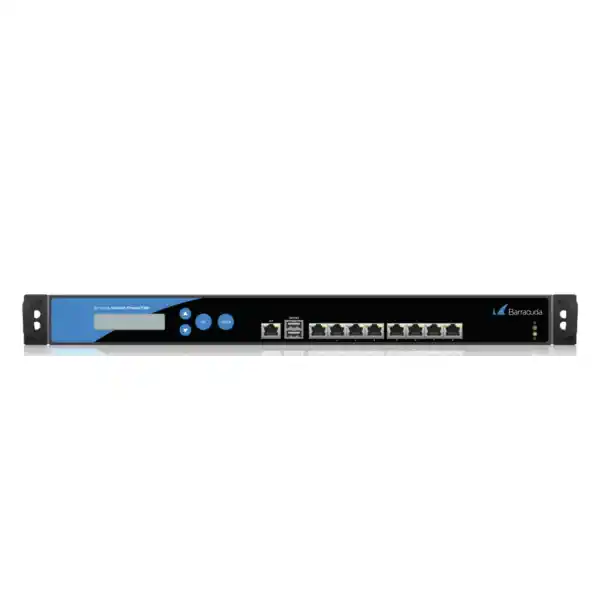
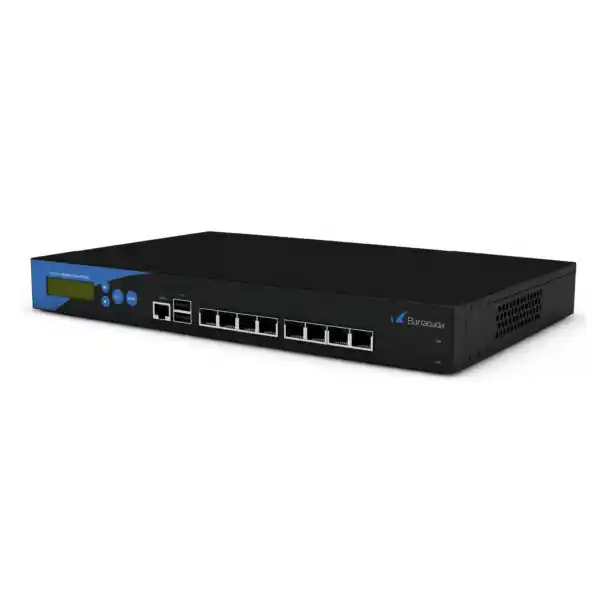
Barracuda CloudGen Firewall F380 Revision B in Dubai, UAE
The Barracuda CloudGen Firewall F380 Revision B, commonly referenced as F380B, is a 1U rackmount security appliance for organizations that need integrated next-generation firewalling, secure SD-WAN, routing, VPN, application control, intrusion prevention, TLS inspection, web filtering, remote access, and centralized operations. It is positioned for branch aggregation, larger regional offices, internet edges, hybrid-cloud access, and distributed enterprise designs where WAN resilience and security policy must be managed together.
For Dubai and wider UAE deployments, FourTeck can support appliance selection, serial-revision validation, optics planning, high-availability architecture, WAN design, migration preparation, rule-base engineering, SD-WAN policy creation, and post-deployment operational handover. Exact sizing should be based on inspected traffic, encrypted traffic share, session behavior, WAN capacity, application mix, subscription requirements, and expected growth rather than on headline firewall throughput alone.
Current F380B performance snapshot
Published figures are maximum laboratory values under defined test conditions. Real production throughput varies with enabled services, packet size, TLS decryption, application behavior, policy complexity, routing, logging, and infrastructure.
Direct answer: where the F380 Revision B fits
The F380 Revision B fits organizations that have outgrown small desktop firewalls but do not need the port density, session scale, or multi-power-supply options associated with larger data-center appliances. Its design is especially relevant when an enterprise wants a single security platform to terminate internet connections, apply next-generation inspection, build encrypted site-to-site overlays, steer applications across multiple providers, and maintain a consistent policy framework across branches and clouds.
The current Barracuda hardware datasheet lists the F380B at up to 13 Gbps firewall throughput, 3.6 Gbps SD-WAN throughput, 4.2 Gbps intrusion-prevention throughput, 3.7 Gbps NGFW throughput, and 3.1 Gbps threat-protection throughput. It also lists up to 500,000 concurrent sessions and 20,000 new sessions per second. These are useful boundaries for architecture, but they are not an invitation to size an appliance at 100 percent of its benchmark. A real design must reserve headroom for bursts, encrypted traffic, failover, policy growth, software upgrades, additional security services, and the operational reality that traffic rarely resembles a single laboratory test profile.
The platform is particularly attractive for UAE enterprises with multiple ISP circuits, business-critical SaaS, private connectivity, branch-to-head-office tunnels, regional African connectivity, or hybrid workloads. FourTeck can combine product supply through the Firewall Dubai practice with wider UAE infrastructure support from FourTeck UAE, helping the firewall become part of an engineered network rather than an isolated appliance purchase.
F380B key specifications and what they mean in production
Security performance
Up to 13 Gbps firewall, 4.2 Gbps IPS, 3.7 Gbps NGFW, and 3.1 Gbps threat protection. The descending figures demonstrate why sizing must be tied to the services that will actually be enabled. A project that relies on IPS, application control, web filtering, antivirus, Advanced Threat Protection integration, and TLS inspection should use the threat-protection profile as a more realistic reference point than basic firewall throughput.
Secure SD-WAN
Up to 3.6 Gbps published SD-WAN throughput provides a planning reference for encrypted overlay traffic and multi-uplink designs. Application-aware path selection, dynamic bandwidth detection, performance-based transport selection, traffic shaping, QoS, forward-error-correction capabilities, and adaptive session distribution allow the appliance to make WAN decisions using more context than simple route preference.
Sessions and connection rate
The current datasheet lists up to 500,000 concurrent sessions and 20,000 new sessions per second. Session capacity matters for user-heavy offices, guest networks, web applications, cloud services, DNS-intensive environments, collaboration tools, software updates, and sites with many IoT endpoints. Connection rate becomes important during traffic bursts, failover events, large-scale user logons, or synchronized application behavior.
Physical interfaces
The platform includes eight 1GbE RJ45 copper interfaces and two 10GbE SFP+ interfaces. Later F380B serial-number hardware also provides four 1GbE SFP ports. This mix supports copper ISP handoffs, LAN or DMZ segmentation, fiber uplinks, and 10GbE switching or aggregation. Optics, cabling standards, switch transceivers, and serial-specific port availability should be verified before purchase.
System and storage
Barracuda documents a hardware change by serial range: earlier units below serial 3641796 use a two-core Intel Celeron G-Series CPU with 4 GB RAM, while later units above that threshold use a four-core Intel Pentium Gold Series CPU with 8 GB RAM. Mass storage is SSD-based at 120 GB or higher. For refurbished, spare, or secondary-market equipment, serial verification is therefore essential.
Rack, power, and environment
The appliance is a 1U rackmount unit measuring approximately 440 x 440 x 44 mm and weighing about 8.4 kg. It uses fan cooling and a single internal AC power supply rated for 100–240 V, 50–60 Hz. Published maximum power draw is 174 W. The operating-temperature range is 0 to 40°C, which makes proper conditioned rack airflow especially important in UAE equipment rooms.
Revision B hardware detail: serial number matters
The phrase “Revision B” is not enough by itself to guarantee that every F380B has identical internal resources and front-panel interface density. Barracuda’s hardware documentation separates F380 Revision B units at serial number 3641796. Appliances below that threshold are documented with eight 10/100/1000 RJ45 ports plus two 10GbE SFP+ ports. Appliances above that threshold retain those interfaces and add four 1GbE SFP ports. The same serial split is used for processor and memory: earlier units are listed with a two-core Intel Celeron G-Series processor and 4 GB RAM; later units are listed with a four-core Intel Pentium Gold Series processor and 8 GB RAM.
This difference has practical procurement consequences. If a bill of materials assumes four 1GbE optical handoffs for WAN, DMZ, HA-adjacent switching, or campus segmentation, a unit from the earlier serial population can force an unplanned architecture change. The project may suddenly need copper media conversion, different switch ports, additional aggregation hardware, or an alternate firewall model. A purchase order that says only “F380 Rev B” therefore leaves room for ambiguity when sourced outside a controlled current channel.
For new UAE deployments, FourTeck recommends documenting the required interface map in the quotation: number of copper WANs, number and type of 1GbE optical circuits, required 10GbE uplinks, transceiver type, fiber mode, connector type, switch-side compatibility, and whether any ports are reserved for management, HA, DMZ, transit, or dedicated service networks. If equipment is being supplied for an existing standard, record the exact serial population and existing configuration so that replacement units do not introduce unexpected resource differences.
The default management interface is port 1, represented in Barracuda OS notation as p1. Later units map the four 1GbE SFP interfaces as p9 through p12 and the 10GbE SFP+ interfaces as a1 and a2. Port naming becomes important during migration because configuration references, monitoring systems, diagrams, and operational runbooks should all describe the same physical-to-logical mapping. A clean handover package should include the final port map, VLAN IDs, IP assignments, link descriptions, transceiver details, and switch counterpart information.
How to read the performance figures correctly
Firewall throughput is not full-security throughput
Barracuda measures basic firewall throughput with large UDP packets, bidirectionally across multiple ports and using the available port density. That is useful for comparing platforms, but enterprise traffic contains a mixture of packet sizes, TCP state, retransmissions, web transactions, encrypted sessions, DNS, collaboration traffic, remote access, backups, APIs, software distribution, and application bursts. It also crosses rules, objects, NAT policies, routes, tunnels, and inspection engines. A firewall can therefore meet a raw forwarding target while still being undersized for an environment that requires multiple security services on most flows.
The F380B’s current 13 Gbps firewall figure should be treated as the outer forwarding benchmark, not the sole sizing number. If the requirement includes inspection and encrypted services, use the more relevant workload benchmark and add engineering headroom.
Threat protection is the better planning anchor for security-heavy sites
Barracuda’s threat-protection benchmark activates IPS, application control, Advanced Threat Protection, web filtering, antivirus, and TLS inspection. For the F380B, the current published figure is up to 3.1 Gbps under Barracuda’s defined enterprise traffic mix. This figure is more informative when a customer expects the firewall to inspect internet-bound user traffic rather than merely route it.
Even 3.1 Gbps should not be interpreted as a guaranteed production value. TLS cipher selection, certificate handling, traffic direction, content types, logging volume, rule complexity, concurrency, inspection exclusions, software release, cloud service latency, and packet-size distribution can all change real results. Design should therefore include margin rather than target sustained operation at the published maximum.
A practical UAE sizing methodology for the Barracuda F380B
Start with measured traffic rather than the ISP invoice. A site may buy two 1 Gbps internet links yet sustain only 250 Mbps during normal business hours, or it may burst close to circuit capacity during backups, endpoint updates, video meetings, or cloud synchronization. Collect at least a representative working period of interface utilization, top applications, session counts, new connection rates, encrypted traffic share, remote-access use, tunnel throughput, and peak concurrency. If no monitoring data exists, build a conservative estimate from user count, workload type, WAN speed, SaaS dependency, server exposure, guest traffic, branch count, and expected growth.
Next, identify which security services will be applied to which flows. Internet access with TLS inspection, IPS, application control, antivirus, web filtering, and Advanced Threat Protection should be sized differently from a private MPLS or IP-VPN transit path that receives stateful policy but limited content inspection. East-west traffic between internal zones may have different requirements again. The objective is to calculate the demanding traffic mix, not to assume every byte has identical processing cost.
Then model failure conditions. In dual-ISP environments, can one remaining circuit carry the entire critical workload when the other fails? In an active-passive firewall pair, can the surviving appliance handle the aggregate load during maintenance or failure without hitting an unsafe utilization level? If branches establish tunnels to two hubs, what happens when all spokes converge on a single hub? A design that performs comfortably in the normal state can fail during exactly the incident in which resilience matters most.
Finally, reserve capacity for the lifecycle. UAE businesses commonly add SaaS platforms, cameras, guest networks, cloud workloads, new branches, security services, and internet bandwidth faster than original forecasts. Size for the expected three-to-five-year change window, not only for today’s average. FourTeck’s IT Services UAE team can assist with discovery, monitoring baselines, addressing plans, migration windows, and operational documentation when the F380B is part of a broader network refresh.
As a rule, a green sizing outcome is one where projected inspected peak traffic, session use, and tunnel load remain comfortably below the platform’s relevant limits during normal operations and degraded failover states. An amber outcome needs design controls such as inspection segmentation or growth constraints. A red outcome means the project should move to a larger platform rather than rely on optimistic assumptions.
Next-generation firewall controls in the data path
CloudGen Firewall combines stateful packet inspection with user-aware policy, intrusion detection and prevention, application control, TLS interception, antivirus, web filtering, reputation controls, NAT, dynamic rules, and additional safeguards. The value of this integrated design is not that every function is simply turned on globally. The value is the ability to build differentiated policy by source, destination, identity, application, network zone, service, and business intent while keeping routing and security behavior coordinated.
Intrusion prevention
IPS adds exploit, threat, vulnerability, anomaly, fragmentation, anti-evasion, and obfuscation defenses with signature updates. Placement matters: internet ingress, server publishing, remote access, partner links, and high-risk outbound segments may require different inspection profiles and exception handling.
Application control
Application-aware enforcement helps distinguish business applications from generic ports and protocols. Policy can prioritize critical services, restrict risky tools, identify unsanctioned usage, and coordinate with SD-WAN so application identity influences both security and path selection.
TLS inspection
Encrypted application inspection improves visibility into HTTPS and other TLS-protected traffic, but it must be introduced with certificate planning, privacy considerations, bypass policy, endpoint trust distribution, application testing, and performance headroom. Business-critical certificate-pinned services should be identified before broad enforcement.
Web and malware controls
Web filtering, malware protection, reputation services, and Advanced Threat Protection can reduce exposure to malicious downloads, compromised sites, command infrastructure, and unknown content. Subscription status and cloud-service reachability should be validated during design and acceptance testing.
Barracuda also documents spoofing and flooding protection, DoS/DDoS defenses, ARP protections, DNS reputation filtering, SafeSearch enforcement, and Google Accounts Enforcement. These capabilities should be mapped to a security policy rather than enabled without context. For example, anti-spoofing depends on correct interface and route knowledge, DNS controls depend on the intended resolver design, and application enforcement depends on correctly defined exceptions for approved business workflows.
Secure SD-WAN: why the F380B is more than an internet-edge firewall
CloudGen Firewall is designed around the idea that WAN connectivity and security should be operated as one system. Traditional branch designs often combine separate routers, VPN concentrators, link-balancing appliances, and security gateways. That architecture can work, but it increases operational handoffs and can make application troubleshooting difficult because routing, path quality, encryption, and security decisions are split across multiple management planes. The F380B can consolidate many of those functions for appropriately sized sites.
The SD-WAN feature set includes optimized direct-internet uplink selection, dynamic bandwidth detection, performance-based transport selection, application-aware routing, adaptive session balancing, traffic shaping, QoS, and the ability to use multiple transports. Barracuda also documents forward error correction for uplink optimization and on-demand direct connection creation between remote spokes based on application type. These capabilities can be valuable when an enterprise replaces or supplements MPLS with DIA, broadband, leased internet, or diverse carriers.
In UAE deployments, the strongest designs start by classifying business traffic. Real-time voice and video may need low latency and jitter. ERP traffic may tolerate some delay but require predictable reachability. Microsoft 365 and other SaaS traffic may benefit from local internet breakout instead of hairpinning through a data center. Backup traffic may be scheduled or rate-limited. Guest access may use a lower-cost link and be isolated from corporate tunnels. Security updates and large file transfers may be allowed to consume spare capacity but should not compete with interactive applications.
Path decisions should use measurable link health rather than static assumptions. A circuit can remain administratively up while suffering severe packet loss, latency, or jitter. Performance-based selection helps move critical traffic away from a degraded provider before users experience a complete outage. This is one of the main operational differences between simple dual-WAN failover and an engineered SD-WAN policy.
For multinational companies connecting Dubai to East Africa or other regions, FourTeck’s Africa network and infrastructure practice can be referenced alongside UAE design work when branch standards, procurement, and secure WAN architecture need to stay consistent across countries.
Routing, segmentation, VLANs, and infrastructure services
A firewall at the enterprise edge often becomes a routing platform whether the original project planned for that role or not. The CloudGen Firewall platform supports IPv4 and IPv6 plus dynamic routing protocols including BGP, OSPF, and RIP, as well as multicast functions. It also supports 802.1Q VLANs. That combination allows the F380B to operate as a routed perimeter, a WAN edge, a DMZ gateway, a branch core for smaller environments, or a policy enforcement point between selected network zones.
BGP is relevant when a customer exchanges routes with service providers, data centers, cloud interconnects, or complex WAN domains. OSPF is often suitable for internal routed campus or data-center environments where dynamic convergence is preferred to large static route tables. Static routing remains appropriate for simple topologies. The right design minimizes unnecessary complexity: dynamic routing should be introduced because it improves convergence and manageability, not simply because the feature exists.
The firewall also supports DHCP server and relay capabilities, DNS services and cache functions, SIP and HTTP proxy functions, SNMP, IPFIX, and LLDP. These services can reduce appliance count in some branches, but consolidation should be intentional. A large enterprise may prefer centralized DHCP, dedicated DNS, or independent monitoring collectors for governance reasons. A smaller office may value local resilience and reduced dependencies. The design should make that choice explicitly and document ownership of each service.
Segmentation is where the physical port count and VLAN capability work together. Eight copper ports can be assigned to WAN, LAN, DMZ, management, partner, or appliance transit roles; the 10GbE SFP+ ports can connect to distribution switches or server fabrics; later hardware adds four 1GbE SFP options for optical circuits. VLAN trunks can create additional logical zones without dedicating a physical port to every segment. However, high traffic between many VLANs can increase inspection load, so east-west design should be included in performance sizing.
When migrating from a legacy firewall, inventory not only the rules but also route tables, policy-based routes, NAT translations, DHCP relays, DNS behavior, VLAN tagging, MTU settings, multicast requirements, VPN selectors, monitoring destinations, and failover dependencies. Most migration outages are caused by overlooked dependencies around the rule base rather than by the obvious permit-and-deny policies.
VPN, remote access, and encrypted connectivity
CloudGen Firewall supports client-to-site and site-to-site VPN use cases, and the broader platform is designed for encrypted branch connectivity as part of its SD-WAN architecture. For site-to-site design, the important questions are not only how many tunnels exist, but what happens to routing, path selection, application policy, and failover when one or more tunnels change state. An encrypted overlay should make the network more resilient, not hide complexity until an outage occurs.
Remote access planning begins with identity. Determine whether authentication will rely on directory services, RADIUS, multi-factor services, certificates, or other controls. Barracuda documents TOTP, RADIUS, or RSA MFA support for remote-access clients when the relevant Advanced Remote Access subscription requirements are met, along with MFA for browser-based remote access and CudaLaunch. Subscription and software-version dependencies should always be checked against the intended deployment before a quotation is finalized.
Capacity planning must account for remote user behavior. A few administrators using remote access intermittently is very different from hundreds of staff members running collaboration, virtual desktops, cloud storage, voice, and internal applications simultaneously. Split tunneling, full tunneling, DNS behavior, endpoint posture, route advertisement, certificate lifecycle, MFA latency, and help-desk workflows all affect the user experience. During business-continuity events, remote access can become the dominant traffic source within hours, so peak assumptions should reflect emergency operation rather than only normal days.
For site-to-site designs, define which applications may use direct internet breakout and which must traverse corporate security or private destinations. SD-WAN policies can select providers based on application and performance, but routing and security must remain deterministic. Document tunnel addressing, route ownership, preferred and backup paths, NAT expectations, MTU, monitoring probes, and failure timers. Test both hard failure, where a link goes down, and soft failure, where it stays up but becomes unusable due to packet loss or latency.
For sensitive environments, key management, cipher requirements, logging retention, administrative access, and change control should be aligned with organizational security policy. The F380B provides the platform capabilities, but secure operation depends on configuration discipline and ongoing lifecycle management.
High availability design with two F380B appliances
Barracuda documents active-passive high availability with transparent failover designed to preserve sessions, together with encrypted HA communication. For organizations where the firewall is the default route to internet, cloud, branches, or published services, deploying a pair is often more appropriate than relying on a single appliance. High availability protects against an appliance failure and creates a path for planned maintenance, but it does not eliminate every single point of failure by itself.
Each F380B uses a single internal power supply. That means an HA pair should be distributed across independent power sources where the facility allows it. Connect each appliance to a separate UPS or PDU path, ideally backed by different power branches. Likewise, avoid connecting both firewalls through one access switch if a pair of switches can be used. Provider handoffs, LAN trunks, HA links, and management paths should be reviewed as a complete failure-domain map.
Capacity is equally important. In active-passive operation, the passive unit must be capable of carrying the full production workload when it becomes active. Do not sum the throughput of two appliances as though both were forwarding the same stateful traffic simultaneously. The design target is one appliance carrying the required peak workload with safe headroom while the other is unavailable.
HA testing should include firewall power loss, service restart, ISP loss, switch-link loss, upstream degradation, planned failover, configuration synchronization, tunnel recovery, NAT continuity, published-service reachability, dynamic routing reconvergence, and monitoring alerts. A successful technical failover is not enough if applications take minutes to recover because adjacent systems were not designed for the same failure model.
Operational documentation should define how administrators know which unit is active, how changes are synchronized, how firmware upgrades are staged, how backups are validated, and how failed hardware is replaced. If Instant Replacement or other support coverage is purchased, confirm the exact service terms and local logistics for the UAE contract rather than assuming a generic global service level.
Centralized management, automation, and multi-site operations
A major reason to choose a CloudGen Firewall platform is the ability to standardize policy across many locations. Barracuda Firewall Control Center provides centralized management options for large firewall estates, including multi-tenancy, multi-administrator workflows, template and repository-based management, zero-touch deployment, and API-driven operations. For an enterprise with dozens or hundreds of branches, the management model can be more important than the individual appliance interface.
Templates reduce configuration drift when they are designed correctly. Common objects, WAN policies, logging, DNS settings, admin standards, security profiles, monitoring destinations, and baseline firewall rules can be inherited, while site-specific parameters such as IP addressing, circuits, local subnets, and provider details remain unique. This approach improves repeatability, but it requires governance: a poorly designed global template can distribute a mistake just as efficiently as a good one distributes best practice.
Zero-touch deployment is valuable for remote sites where skilled firewall engineers are not physically present. Hardware can be staged around a controlled activation workflow, then receive configuration from centralized management. For UAE headquarters deploying branches across GCC or Africa, this can reduce travel and shorten rollout windows. The staging process should still include serial tracking, entitlement validation, shipping records, local circuit readiness, port maps, fallback contact procedures, and a remote hands checklist.
CloudGen Firewall also exposes lifecycle automation capabilities and supports REST/API-based administration within the platform ecosystem. Automation is most effective for repeatable tasks such as configuration generation, object updates, backups, deployment checks, or inventory integration. Sensitive changes should include approvals, validation, rollback plans, and audit logs. Automating an unsafe change only increases the speed at which it can create an outage.
Operationally, define who owns firewall policy, who owns WAN routing, who approves security exceptions, who monitors SD-WAN health, and who renews subscriptions. The technology supports integrated operations; the organization should mirror that integration with clear responsibility boundaries.
Cloud connectivity and direct internet breakout
Modern UAE networks rarely have a single “data center” destination. Users consume Microsoft 365, Salesforce, collaboration platforms, public-cloud workloads, private applications, partner services, and internet resources from the same office. Backhauling all traffic to a central security hub may simplify one part of policy, but it can increase latency and bandwidth cost. CloudGen Firewall is designed to combine local security with secure SD-WAN so selected cloud and SaaS traffic can use optimized local paths without abandoning centralized policy.
The platform includes cloud-connectivity automation features, including support for Azure Virtual WAN in current product documentation. The exact integration architecture should be validated against the customer’s cloud subscription, regions, routing model, hub design, address space, security requirements, and Barracuda software release. Cloud automation is not a substitute for network architecture; it is a mechanism for implementing that architecture consistently.
Direct internet breakout should be segmented by application and risk. Trusted SaaS services may be allowed direct paths with full security inspection and identity policy. Unknown or high-risk traffic may be forced through stricter controls. Private applications may continue to use encrypted tunnels to a data center or cloud hub. Large software updates can use a secondary provider. Voice can select the lowest-latency path. The objective is to make the WAN respond to application requirements while preserving visibility and policy.
DNS design becomes especially important. The chosen resolver path influences SaaS geolocation, CDN selection, split-domain behavior, and failover. During migration, test whether users in Dubai are resolving cloud endpoints to appropriate regional services and whether private names remain reachable over the intended tunnel. Poor DNS architecture can make a perfectly functioning SD-WAN appear slow or unreliable.
For hybrid-cloud projects, include route symmetry in the review. Stateful firewalls expect flows to return through compatible paths. Multiple cloud gateways, direct circuits, internet VPNs, and dynamic routing can create asymmetric traffic if preferences are not coordinated. The firewall policy, cloud route tables, WAN edge, and internal routing domain should be designed as one system.
Industrial protocols, VoIP, and mixed enterprise traffic
Barracuda documents support for common enterprise and industrial protocol families, including SIP, H.323, SCCP, ONC-RPC, DCE-RPC, and industrial protocols or subprotocols such as S7, S7+, IEC 60870-5-104, IEC 61850, MODBUS, and DNP3. This does not mean the same policy template should be applied to office users, voice systems, and operational technology. It means the platform can participate in more diverse environments when the segmentation and security model is designed around each traffic type.
Voice traffic is highly sensitive to packet loss, jitter, and latency. SD-WAN path selection and QoS can therefore be valuable for SIP and collaboration deployments. The firewall should prioritize media and signaling appropriately without allowing broad “voice” exceptions that bypass necessary security. NAT behavior, SIP helpers or proxies, carrier requirements, SBC placement, and failover should all be tested with the actual telephony design.
Industrial and OT networks require even stricter change discipline. Legacy control systems may use fixed addressing, fragile protocol implementations, old operating systems, or deterministic communication patterns. A firewall can create valuable segmentation between IT and OT, remote maintenance, vendor access, and control zones, but inspection should be introduced through controlled testing. Rules should be narrow, logging should be meaningful, and emergency-access procedures should be documented before enforcement changes are made.
For IoT-heavy facilities such as warehouses, retail, hospitality, campuses, or logistics sites, session counts can grow faster than user counts. Cameras, sensors, building systems, printers, access control, point-of-sale devices, and cloud-managed equipment all create persistent or frequent connections. This is why session and new-session metrics belong in the sizing exercise alongside bandwidth.
The F380B can therefore be a strong consolidation platform, but mixed environments benefit from policy separation. Build distinct zones, objects, inspection profiles, QoS rules, and logging strategies for users, servers, guests, voice, management, IoT, and OT rather than treating the entire LAN as one trusted network.
Power, rack, cooling, and Dubai environmental planning
The F380B occupies one rack unit and measures approximately 440 mm wide, 440 mm deep, and 44 mm high. Appliance weight is approximately 8.4 kg. The chassis uses active fan cooling and a single internal AC power supply. Barracuda documents universal 100–240 V AC input at 50–60 Hz, with a maximum power draw of 174 W. Average power-supply efficiency is documented above 87 percent, and the operating temperature range is 0 to 40°C with non-condensing operating humidity from 10 to 85 percent.
In Dubai, the main environmental design consideration is not outdoor temperature but the continuity of conditioned air in the communications room. A firewall in a properly cooled data room can operate well within its range, while an appliance in a poorly ventilated wall cabinet can exceed limits during HVAC outages or reduced nighttime cooling. Rack planning should therefore consider front-to-back airflow, blanking panels, neighboring heat sources, dust control, cabinet depth, and whether the site’s cooling remains active outside normal office hours.
Because the unit has one internal power supply, local resilience comes from the facility design and, where availability matters, from deploying two firewalls. Use UPS-backed power and avoid sharing the same single PDU for both HA members. If the site has A and B feeds, distribute the pair accordingly. Document the socket type, PDU capacity, UPS runtime, and maintenance bypass arrangements. Power design is often ignored during firewall procurement even though a perfectly configured HA pair can still fail together if both units depend on the same power path.
The rack elevation should reserve appropriate space for cable management and optical bend radius. Label each WAN, LAN, HA, management, and DMZ cable at both ends. Record SFP and SFP+ transceiver models and fiber type. For later-serial F380B appliances with four 1GbE SFP ports, confirm whether the project expects multimode, single-mode, or copper-transceiver use and whether switch-side optics match.
During acceptance, capture front and rear photographs, serial numbers, rack position, power source, port labels, and switch counterparts. These details reduce troubleshooting time months later when the original deployment team may no longer be present.
Licensing, subscriptions, and support planning
The appliance provides the hardware platform, but the complete security outcome depends on active licensing and subscriptions. Current Barracuda materials list core capabilities across firewall models and separately identify optional services such as Advanced Threat Protection, Malware Protection, Advanced Remote Access, and Firewall Insights. Support offerings such as Energize Updates and Instant Replacement add update services and support entitlements. Exact bundles, names, terms, and regional availability can change, so the quotation should specify the subscription level and support duration rather than using the word “licensed” without detail.
Energize Updates is associated with technical support, firmware updates, IPS signatures, application-control definition updates, and web-filter updates in Barracuda’s current product information. These ongoing feeds matter because a next-generation firewall without current signatures and definitions loses part of its protective value over time. Renewal planning should therefore be treated as an operational requirement, not an administrative afterthought.
Advanced Threat Protection extends the security workflow by analyzing suspicious content and advanced malware using cloud-based techniques, including sandboxing and dynamic analysis. Malware Protection addresses gateway protection for malicious programs across supported protocols. Advanced Remote Access adds capabilities relevant to browser-based and client remote access, including specific MFA options. Firewall Insights consolidates security, application-flow, and connectivity information across distributed firewall environments. The right bundle depends on how the F380B will actually be used.
Before procurement, list required functions in three categories: mandatory on day one, planned within the first year, and not required. That prevents two common errors: purchasing an appliance without the entitlement needed for a key feature, or buying a large bundle whose advanced services are never configured. Align subscription term with hardware lifecycle and budget approvals. If the organization uses centralized management, include those licensing requirements in the same bill of materials.
Support planning should include replacement logistics, escalation contacts, account ownership, entitlement registration, and the procedure for opening a critical case. For UAE deployments, validate local commercial terms and delivery expectations in the final quotation rather than assuming that global marketing language automatically defines the contracted service level.
Migration from an existing firewall to the F380B
A successful migration is an engineering project, not a rule-export exercise. Begin with discovery of the existing firewall, routers, switches, ISP equipment, public IPs, private subnets, VLANs, VPNs, NAT rules, policy objects, dynamic routes, static routes, DHCP or DNS dependencies, logging destinations, monitoring systems, authentication sources, remote-access users, and any services published to the internet. Compare the documented design to live behavior because old rule bases often contain stale objects, undocumented exceptions, and traffic that no current owner recognizes.
Normalize the policy before translation. Duplicate and shadowed rules should be identified. Wide any-to-any entries should be challenged. Temporary rules should be validated. NAT behavior should be mapped carefully because different firewall vendors use different terminology and processing order. If public services are moving to new addresses or circuits, coordinate DNS TTL changes, certificates, third-party allowlists, and external partners well before the cutover.
Build a test matrix around business services rather than network primitives. “Ping works” proves almost nothing. Test internet browsing, Microsoft 365, ERP, DNS, NTP, voice, remote access, site-to-site VPN, server publishing, cloud applications, backup, monitoring, printers, partner connectivity, and any specialized operational systems. Include tests from every important VLAN and remote branch. Record expected result, observed result, owner, and rollback condition.
The cutover plan should define exact sequencing: save final backups, freeze changes, capture current state, shut or disconnect legacy paths, connect the F380B, validate upstream ARP or routing, verify internal routes, test NAT, bring up tunnels, validate applications, confirm monitoring, then release the change window. Keep a timed rollback threshold. If validation cannot be completed before that threshold, restore the previous design while the team still has time to recover cleanly.
After migration, monitor traffic and logs for denied legitimate sessions, unexpected route changes, tunnel instability, asymmetric flows, high CPU or memory utilization, session growth, and packet loss. A technically successful cutover can still reveal hidden application dependencies over the next several business days. Post-change monitoring should therefore be part of the project scope.
Finally, update diagrams, IP plans, credentials escrow, support registration, firewall backups, ruleset ownership, renewal records, and change documentation. The operating team should receive enough information to manage the firewall without relying on the implementation engineer’s memory.
Security hardening after installation
Initial connectivity is only the first milestone. The F380B should be hardened around least privilege, identity, management-plane isolation, logging, backups, updates, certificate lifecycle, and controlled administrative access. Management should be reachable only from designated networks or secured remote workflows. Default or temporary credentials should be removed. Administrative roles should follow job requirements, and strong authentication should be enabled where supported by the organization’s identity system.
Rule sets should use named objects and business descriptions so future administrators understand intent. Avoid broad source or destination ranges where specific networks are known. Use explicit logging for security-relevant permits and denies, but tune noisy events so monitoring systems remain usable. A log volume that nobody reviews is not the same as visibility. Define which events create alerts, which are retained for investigation, and which are forwarded to SIEM or centralized monitoring.
TLS inspection requires a dedicated governance process. Distribute trust certificates correctly, define bypass categories for applications that cannot be intercepted, monitor certificate errors, and review privacy requirements. When decryption is deployed gradually, begin with controlled user groups and common applications before extending coverage. This reduces the risk of breaking certificate-pinned or unusual applications across the whole business at once.
Firmware should follow a lifecycle policy. Track supported releases, read migration and known-issue documentation, maintain configuration backups, and test critical functions after upgrades. Barracuda documentation shows that the F380 Revision B remains supported across current CloudGen software families, but any specific upgrade should be checked against the exact hardware, serial range, installed version, and release notes at the time of change.
Backups should be stored outside the appliance and periodically tested for usability. A backup is only useful if the team knows where it is, what version it represents, how to restore it, and which external dependencies such as certificates or credentials are also required. For HA pairs, include synchronization status and failover readiness in recurring operational checks.
Monitoring and operational KPIs
A firewall should be monitored as both a security control and a network service. Core operational KPIs include interface utilization, packet drops, CPU and memory trends, concurrent sessions, new-session rate, tunnel state, SD-WAN path quality, latency, jitter, packet loss, routing adjacency status, HA state, storage health, license status, update status, and critical security events. The exact alert thresholds should reflect normal baselines rather than arbitrary percentages.
IPFIX can provide flow-level visibility to external analytics systems, while SNMP supports infrastructure monitoring. Centralized Barracuda management and reporting options can add broader context across many sites. The monitoring design should answer practical questions: Is the ISP link saturated? Did traffic move to the backup provider? Are users reaching cloud applications over the intended path? Is a tunnel flapping? Are session counts abnormal? Is the firewall denying a newly deployed application? Are security signatures current?
Baselining is essential. Capture at least a few normal weeks after deployment, including business peaks, backup windows, software-update periods, and month-end or seasonal events. Use those baselines to determine whether growth is consuming performance headroom. If threat-protection traffic approaches the sizing boundary during normal operations, plan an upgrade before the next circuit increase or business expansion.
WAN monitoring should focus on quality, not only up/down state. A path with 10 percent packet loss can remain technically “up” while voice, VPN, and SaaS become unusable. SD-WAN health thresholds should reflect the applications that use each circuit. Critical voice may fail at a quality level that bulk replication tolerates. Application-aware path policies should therefore be paired with application-relevant monitoring.
Create a monthly or quarterly firewall health review that checks subscription expiry, software currency, configuration backups, unused rules, administrator accounts, failed login events, resource trends, WAN quality, HA test status, certificate expiry, and open security exceptions. This routine converts the firewall from a set-and-forget appliance into a managed security service.
Procurement guidance for Dubai and UAE organizations
A technically correct F380B order should identify more than the firewall model. The bill of materials should state appliance quantity, whether HA is required, license or subscription bundle, support term, centralized management requirements, optics, patch leads, rack accessories, and implementation scope. If the design needs the four 1GbE SFP ports documented on later Revision B units, require serial-compatible hardware explicitly.
Optics deserve special attention. The F380B provides 10GbE SFP+ interfaces, and later serial-number units also provide 1GbE SFP interfaces, but the correct transceiver depends on fiber type, distance, wavelength, connector standard, and the switch or carrier handoff on the other side. Do not order optics using only the word “fiber.” Record whether each link is multimode or single-mode, expected distance, and counterpart module.
For ISP connectivity, capture provider name, service type, bandwidth, handoff medium, VLAN tagging, static or dynamic addressing, BGP requirements, public subnet, gateway information, and whether the circuit is delivered through a provider CPE. For two circuits, decide whether they are physically diverse or merely commercially separate. Two providers entering the building through the same duct can still fail together.
Implementation scope should state whether FourTeck will perform discovery, configuration, rack installation, switch changes, rule migration, VPN migration, SD-WAN policy, HA setup, remote access, acceptance testing, documentation, and post-cutover support. Ambiguous “installation” language often causes project gaps because one party assumes the other owns routing, optics, DNS, or application testing.
If the project replaces an older F380 Revision A, note that Barracuda lists Revision A with end-of-life dated January 31, 2026, while current Barracuda lifecycle information does not list an end-of-sale or end-of-life date for F380 Revision B. This distinction matters for lifecycle planning and should be reflected in asset records.
For a coordinated UAE infrastructure project, the customer can engage FourTeck UAE for broader network and systems scope while using the specialized Firewall Dubai team for security-gateway architecture and deployment.
Common F380B deployment topologies
Dual-ISP regional office
Two internet circuits terminate on separate WAN interfaces. The F380B applies security inspection, local internet breakout, site-to-site tunnels, and application-aware SD-WAN. Critical SaaS uses the best-performing circuit, voice receives priority, guest traffic uses a preferred lower-cost path, and failover policies keep essential applications online when one provider degrades.
HA internet edge
Two F380B appliances run active-passive, connecting redundantly to upstream provider equipment and downstream switching. The pair protects published services, user internet access, VPNs, and cloud routes. This topology is appropriate where a single firewall failure would otherwise disconnect the office or data-center edge.
Branch hub for SD-WAN
The F380B terminates encrypted connectivity from multiple branches while also providing local security and dynamic routing to headquarters networks. Hub sizing must account for aggregate tunnel traffic and the failover scenario in which more spokes than normal converge on the same site.
Cloud-connected campus edge
The appliance connects a campus or large office to local internet, private cloud paths, and public cloud. Application routing sends trusted SaaS locally, private workloads through secured overlays, and backup traffic over secondary capacity. VLAN trunks connect multiple internal security zones through 10GbE switching.
Each topology can be valid, but no topology should be copied blindly. The right physical and logical design depends on circuit handoffs, switching redundancy, address space, route ownership, cloud architecture, inspection scope, and business recovery requirements.
Technical decision guide: when to choose F380B and when to step up
Choose the F380B when its inspected throughput, SD-WAN capacity, session scale, interface mix, single-power-supply design, and projected growth all fit with safe margin. It is well suited to mid-range deployments that need 10GbE uplinks but do not require the much larger session tables or port density of high-end models. It can also be attractive where eight copper ports plus four 1GbE SFP and two 10GbE SFP+ ports on later hardware provide enough physical flexibility without an external router.
Step up to a larger model when the project expects sustained security-inspected traffic near the F380B threat-protection boundary, needs materially more concurrent sessions or new-session rate, requires more interfaces, requires dual hot-swap power supplies in a single chassis, or expects rapid circuit growth. Buying a larger firewall is usually less disruptive than replacing an undersized one after production traffic exposes the mismatch.
Also step up when the F380B would become a major aggregation point for many branches. A hub can receive much more traffic during another hub’s failure than in normal operation. If a design has two regional hubs, each should be able to carry the survivable branch set expected during outage. The same principle applies to internet edges supporting large VPN populations or multiple tenant networks.
Conversely, do not oversize solely because the ISP circuit headline is high. A 5 or 10 Gbps carrier handoff does not prove that 5 or 10 Gbps of fully inspected application traffic is required. Use measurements and application forecasts. In some cases, the F380B’s 10GbE physical uplinks are useful for switch integration even when inspected traffic remains comfortably within a few gigabits per second.
The decision should be documented in a sizing worksheet that records current peak bandwidth, projected peak, inspection profile, session count, connection rate, WAN topology, HA state, port requirements, and growth margin. That creates an auditable reason for selecting the model and makes future upgrades easier to justify.
F380B technical specification table
| Category | F380 Revision B specification | Engineering note |
|---|---|---|
| Firewall throughput | Up to 13 Gbps | Large-packet laboratory benchmark; do not use alone for full-security sizing. |
| SD-WAN throughput | Up to 3.6 Gbps | Reference for encrypted overlay and WAN optimization workloads. |
| IPS throughput | Up to 4.2 Gbps | Relevant when intrusion prevention is a principal inspection service. |
| NGFW throughput | Up to 3.7 Gbps | Measured with multiple advanced security functions enabled. |
| Threat protection | Up to 3.1 Gbps | A useful planning anchor for security-heavy internet traffic. |
| Concurrent sessions | Up to 500,000 | Track real session peaks and allow room for bursts and failover. |
| New sessions per second | Up to 20,000 | Important for busy user networks, web services, IoT, and recovery events. |
| Copper interfaces | 8 x 1GbE RJ45 | Port 1 is the documented default management interface. |
| 1GbE fiber | 4 x SFP on serial numbers above 3641796 | Earlier Revision B units do not have these four ports. |
| 10GbE fiber | 2 x SFP+ | Suitable for high-speed switch uplinks, trunks, or optical handoffs. |
| Memory | 4 GB earlier / 8 GB later serial range | Serial verification is important when sourcing a specific hardware population. |
| Storage | SSD, 120 GB or higher | Hardware components can change; verify delivered specification. |
| Form factor | 1U rackmount, 440 x 440 x 44 mm | Plan rack depth, airflow, and cable management. |
| Power | Single internal AC, 100–240 V, 50–60 Hz | Use HA plus diverse power paths when availability requires appliance redundancy. |
| Operating range | 0 to 40°C, 10–85% non-condensing humidity | Maintain conditioned equipment-room cooling and airflow. |
Specifications and performance figures are subject to change by the manufacturer. Confirm current datasheet, serial-specific hardware, firmware compatibility, subscription bundle, and local support terms before final procurement.
Frequently asked technical questions
Does every F380 Revision B have four 1GbE SFP ports?
No. Barracuda’s model documentation states that the four 1GbE SFP ports are present on F380 Revision B units with serial numbers above 3641796. Earlier Revision B units have the eight 1GbE RJ45 ports and two 10GbE SFP+ ports but not the four additional 1GbE SFP interfaces.
Is 13 Gbps the expected throughput with all security services enabled?
No. Thirteen gigabits per second is the current published firewall throughput figure. Barracuda separately lists 3.7 Gbps NGFW throughput and 3.1 Gbps threat-protection throughput under its defined test conditions. Real production performance varies further with traffic and configuration.
Can the F380B be deployed in high availability?
Yes. CloudGen Firewall supports active-passive HA with transparent failover capabilities. Each F380B has a single internal power supply, so resilient designs should distribute the two appliances across independent power and switching paths where possible.
Does it support dynamic routing?
Yes. The CloudGen platform supports IPv4, IPv6, BGP, OSPF, RIP, and multicast functions. The routing design should be chosen according to topology, convergence requirements, cloud connectivity, and operational expertise.
Is the F380B suitable for dual-ISP SD-WAN?
Yes, when traffic volume and session demand fit the platform. CloudGen Firewall includes application-aware path selection, traffic shaping, QoS, dynamic bandwidth detection, performance-based transport selection, and other SD-WAN functions intended for multi-uplink environments.
What should be confirmed before ordering in Dubai?
Confirm serial-dependent port requirements, appliance quantity, subscriptions, support term, optics, rack and power design, ISP handoffs, HA requirements, migration scope, software compatibility, and whether remote access or centralized management features require additional licensing.
Decision recap for UAE buyers
The Barracuda CloudGen Firewall F380 Revision B is a credible mid-range choice when an organization needs integrated security and secure SD-WAN in a 1U platform. Its current published performance profile—13 Gbps firewall, 3.6 Gbps SD-WAN, 4.2 Gbps IPS, 3.7 Gbps NGFW, and 3.1 Gbps threat protection—provides meaningful capacity for regional offices, branch hubs, and moderate enterprise edges when the real inspected workload remains within safe engineering limits.
The strongest reason to buy the F380B is not any single throughput figure. It is the combination of next-generation security, routing, application-aware WAN control, VPN, remote access, centralized operations, automation, 10GbE connectivity, and later-revision 1GbE fiber density. That consolidation can simplify a distributed architecture, especially when the organization wants one policy model across office, cloud, and branch environments.
The most important procurement caution is the serial-number hardware distinction. If four 1GbE SFP ports or the later CPU and memory configuration are mandatory, record that requirement explicitly. Also remember that each appliance has one internal PSU. Customers needing hardware-level availability should normally evaluate an HA pair with independent power and switching paths.
For projects that may grow beyond the F380B’s security throughput, sessions, or interface limits, it is better to step up before deployment than to rely on a narrow margin. FourTeck can review circuit capacity, traffic measurements, application requirements, branch count, encrypted traffic, and failover scenarios before recommending the final model.
Quotation input checklist
Traffic and users
Provide current and projected internet bandwidth, measured peak utilization, number of users, number of sites, concurrent remote users, estimated concurrent sessions, critical applications, encrypted traffic percentage, and expected three-year growth.
WAN and routing
Provide ISP count, circuit speeds, copper or fiber handoff, IP addressing, VLAN tags, BGP or static routing, private circuits, cloud connectivity, SD-WAN requirements, branch tunnel count, and failover objectives.
Security services
Identify IPS, application control, web filtering, TLS inspection, antivirus, Advanced Threat Protection, remote access, MFA, server publishing, segmentation, industrial traffic, logging, and compliance requirements.
Hardware and optics
State appliance quantity, HA requirement, required 1GbE SFP port count, 10GbE uplink count, multimode or single-mode optics, cable distances, rack location, UPS/PDU arrangement, and switch models.
Licensing and support
Choose required security subscriptions, support duration, replacement coverage, centralized management, reporting, remote-access options, and the preferred renewal term. Existing Barracuda entitlements should be listed if the project is an upgrade.
Migration services
Share current firewall model, configuration backup availability, rule count, NAT count, VPN inventory, change window, rollback limits, application test owners, documentation requirements, and whether onsite Dubai support is required.
Plan your Barracuda F380B deployment with FourTeck Dubai
A firewall purchase is most successful when the hardware, licenses, WAN design, security policy, optics, HA topology, routing, migration, and support plan are agreed before installation. FourTeck can help translate business requirements into a practical F380B architecture, validate whether the model has sufficient security headroom, and prepare a bill of materials that reflects the exact interface and subscription needs of the UAE site.
For organizations replacing legacy perimeter equipment, the engagement can include configuration discovery, policy cleanup, NAT and VPN mapping, target design, staging, controlled cutover, validation, and operational handover. For new environments, the design can start from circuit, cloud, VLAN, identity, and application requirements rather than inheriting unnecessary complexity from an old firewall.
Use the FourTeck consultation process to confirm serial-revision requirements, fiber optics, subscription options, support terms, high availability, and implementation scope before issuing the final purchase order.
• Model and capacity validation
• Serial/port requirement check
• License and support BOM
• WAN and HA topology
• Migration and test plan
• UAE deployment handover

Reviews
There are no reviews yet.