
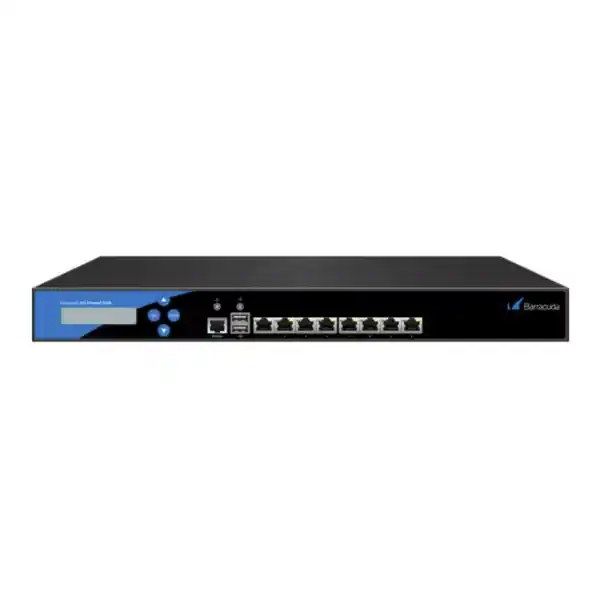
Barracuda CloudGen Firewall F400 Revision C
A technically balanced 1U CloudGen Firewall platform for mid-sized enterprise sites, regional hubs, data-center edge roles and SD-WAN deployments that need multi-gigabit security, 10 GbE uplinks, centralized policy control and dependable encrypted connectivity.
FourTeck supports UAE organizations with architecture review, hardware-variant validation, migration planning, secure deployment and lifecycle guidance for Barracuda CloudGen Firewall environments in Dubai, Abu Dhabi, Sharjah and multi-site regional networks.
What the F400 Revision C is designed to do
The Barracuda CloudGen Firewall F400 Revision C sits in the mid-range of the CloudGen hardware family and is intended for organizations that need substantially more than basic perimeter filtering. Its value is in combining network firewalling, application-aware policy control, intrusion prevention, secure site connectivity, SD-WAN path selection, routing and centralized operational control in one appliance platform. In practical UAE deployments, that makes the F400 Revision C relevant to headquarters, larger branch offices, logistics hubs, clinics, education sites, professional-services organizations, manufacturing facilities, retail regional offices and other environments where several WAN circuits, business-critical SaaS traffic and encrypted inter-site links converge on one security edge.
The appliance is especially useful when an organization wants to move away from a design in which routing, VPN, WAN optimization decisions and firewall policy are spread across separate devices. CloudGen Firewall can consolidate those functions into a more policy-driven architecture. The technical benefit is not simply fewer rack units. A unified edge can evaluate traffic with more context, apply consistent access rules, select an appropriate WAN path, enforce application policy, inspect threats and maintain encrypted connectivity without requiring every branch to be engineered as an independent island.
Revision C is important because hardware revisions matter. The F400 name has existed across multiple hardware generations, and procurement teams should not assume that every appliance labeled F400 has the same ports, processor generation, supported software lifecycle or performance profile. FourTeck therefore recommends specifying the complete designation—Barracuda CloudGen Firewall F400 Revision C—on quotations, bills of materials and migration documents. That approach reduces the risk of receiving an older revision, mismatching spare units, or designing around interfaces that are not present on the delivered chassis.
For customers comparing enterprise firewall platforms in the Emirates, the key question is not whether a device has a published top-line firewall throughput number. The correct question is whether the appliance can sustain the required business services after inspection, VPN encryption, logging, routing policy, user growth, session bursts and high-availability overhead are considered. FourTeck’s Firewall Dubai practice focuses on this workload-based sizing approach rather than choosing hardware from a single benchmark figure.
F400 Revision C technical profile at a glance
Network interfaces
Standard Revision C models provide eight 10/100/1000 Mb/s RJ45 Ethernet interfaces and two 10 GbE SFP+ interfaces. The F20 sub-model adds four 1 GbE SFP interfaces and uses a different power-supply arrangement.
Session capacity
Published model-family specifications identify up to 500,000 concurrent sessions and up to 20,000 new sessions per second, useful for busy branch, hub and shared-service environments.
Security throughput
Current Barracuda performance tables list F400C figures up to 17.1 Gbps firewall, 4.7 Gbps SD-WAN, 5.5 Gbps IPS and up to 7.8 Gbps NGFW for the standard variant under stated test conditions.
Appliance platform
The platform is a rack-mount security appliance with 8 GB RAM on published Revision C hardware references, SSD storage and dedicated console/USB connectivity for appliance operations.
Core services
Firewall, application control, intrusion prevention, dynamic routing, client-to-site and site-to-site VPN, SSL interception, SD-WAN and web security functions can be integrated according to licensing and policy design.
Deployment roles
Common roles include internet edge, branch hub, regional aggregation, data-center perimeter, secure WAN gateway, VPN concentrator and high-availability pair for business-critical sites.
Understanding the F400C hardware variants
One of the most important details in an F400 Revision C project is the distinction between the standard chassis and the F20 sub-model. The standard unit is the simpler port profile: eight 1 GbE copper RJ45 ports plus two 10 GbE SFP+ ports. This combination suits many enterprise edge designs because the copper interfaces can terminate ISP handoffs, LAN transit networks, management segments or DMZs, while the 10 GbE SFP+ ports can provide higher-speed connectivity toward a distribution switch, data-center fabric or aggregation layer.
The F20 sub-model is more connectivity-rich. In addition to the eight 1 GbE copper ports, it provides four 1 GbE SFP ports and two 10 GbE SFP+ ports. This matters in sites where fiber is already the preferred medium for campus distribution, telecom-room uplinks, longer in-building runs or electrically isolated links. The F20 arrangement can reduce dependence on external media converters and can simplify structured fiber designs, especially in larger sites where the firewall sits in a central equipment room and connects to multiple switching zones.
Power architecture is another difference. The standard F400 Revision C is documented with a single internal power supply, whereas the F20 sub-model uses dual power supplies. That distinction should influence high-availability planning. A dual-firewall cluster built from standard models protects against appliance failure, but each individual appliance still has a single PSU path unless upstream power design adds other protections. With an F20, dual power inputs can be mapped to separate PDUs or UPS circuits, providing greater resilience against a single power-feed problem. Customers should verify the exact delivered part number and power-cord specification before rack installation.
Barracuda documentation also differentiates hardware details by serial-number ranges. That is a reminder that processor and internal component changes can occur within a revision over its manufacturing life. For estate standardization, record each unit’s revision, sub-model, serial number, software version, license state and installed transceivers in the configuration management database. This is particularly useful for replacement planning, RMA handling and maintaining an HA pair with predictable behavior.
The 10 GbE SFP+ interfaces in Revision C are documented as fixed network interfaces rather than replaceable modular interface cards. The practical procurement implication is that customers should choose the chassis because its native port mix fits the expected topology. If a design requires substantially more high-density fiber, different interface speeds or expansion-module flexibility, the correct solution may be a different CloudGen hardware model rather than attempting to force the F400C into an unsuitable physical design.
Performance: how to read the published numbers correctly
Firewall datasheets are easy to misread because each throughput figure represents a different test condition. A basic firewall throughput test is not equivalent to a production policy with intrusion prevention, application identification, encryption, content inspection and logging enabled. Current Barracuda hardware documentation lists the F400C standard and F20 variants with firewall throughput up to 17.1 Gbps. It also lists SD-WAN throughput up to 4.7 Gbps, IPS throughput up to 5.5 Gbps and threat-protection throughput up to 4.2 Gbps. For NGFW throughput, the published current table distinguishes the standard model from the F20 sub-model, with values that differ by variant. These are “up to” laboratory values, not guarantees for every customer configuration.
Why can a firewall number be much higher than the threat-protection number? Stateful packet forwarding requires less work than a pipeline that identifies applications, evaluates signatures, tracks sessions, decrypts traffic where permitted, examines content and records events. As more security controls are enabled, each flow consumes more CPU and memory resources. The correct sizing metric is therefore the most demanding enabled service mix, not the highest number in the table.
Encrypted traffic adds another layer. Site-to-site VPN and SD-WAN tunnels require cryptographic operations, encapsulation and sometimes additional path-quality logic. Client-to-site remote access can create many simultaneous encrypted sessions with different packet sizes and user behaviors. SSL interception can be even more resource-sensitive because the firewall participates in certificate handling and decryption/re-encryption for eligible traffic. When customers plan to inspect a large percentage of outbound HTTPS, FourTeck recommends modelling that explicitly rather than assuming raw firewall throughput remains available.
Session scale is equally important. The F400 family is documented for up to 500,000 concurrent sessions and 20,000 new sessions per second. A business with 500 staff can generate vastly different session demand depending on workload. Traditional office browsing may be modest, while call centers, cloud-heavy desktops, software development, guest Wi-Fi, IoT fleets, VDI, large SaaS estates and web-proxy traffic can drive session counts sharply higher. New-session rate is especially relevant during morning logins, application reconnect storms, failovers or large numbers of short-lived API transactions.
Published recommendations of roughly 300 to 1,000 concurrent users are useful for initial placement but should never be treated as an absolute capacity boundary. User count is a proxy, not a workload definition. A 300-user engineering site moving large design files and maintaining many encrypted cloud connections can be more demanding than a 1,000-user light transactional office. Good sizing therefore starts with measured bandwidth, peak-hour utilization, security services, session behavior, tunnel count, growth assumptions and availability requirements.
Firewall policy and application-aware security
At the foundation, the F400 Revision C operates as a stateful firewall that controls traffic between trust zones, WAN circuits, DMZs, server networks, user VLANs and other routed segments. Enterprise security depends on how those policies are designed. A strong rule base is explicit about source, destination, service, application context, identity where applicable, logging and business purpose. Broad “any-to-any” rules may make a deployment fast, but they also erase the segmentation value that an enterprise firewall is supposed to provide.
Application control extends policy beyond ports and IP addresses. Modern applications routinely use common protocols such as HTTPS, which makes simple port-based rules too coarse for many environments. Application-aware controls allow organizations to treat different traffic classes according to business risk and priority. For example, sanctioned Microsoft 365 or ERP traffic may be prioritized, while unapproved remote-access tools, anonymizers, risky file-sharing services or unknown applications can be restricted or monitored.
Intrusion prevention adds signature and behavior-based inspection for malicious or exploit-like traffic patterns. The IPS policy should be matched to the organization’s exposed services and risk tolerance. An internet-facing server segment may warrant a more aggressive profile than a controlled internal management network. Tuning also matters. Security teams should review blocked events, false positives, recurring sources, targeted assets and policy exceptions rather than leaving a deployment permanently in a default state.
Web filtering and optional threat services can provide additional controls around user browsing and malicious destinations. Licensing determines which services are available, so the appliance price alone is not the complete commercial picture. During quotation, customers should specify whether they require baseline firewall functionality only, advanced security subscriptions, remote-access capabilities, support coverage and centralized management. A complete bill of materials should separate hardware, subscriptions, support term, optics, implementation and any migration services.
For organizations that need broader infrastructure assistance around the firewall project, FourTeck’s UAE IT services team can align switching, VLAN design, server connectivity, endpoint dependencies and operational handover with the security-edge deployment.
SD-WAN and multi-link path selection
SD-WAN is one of the defining CloudGen Firewall use cases. Many UAE organizations now operate with more than one internet or WAN service: for example, a primary enterprise fiber circuit, a secondary broadband service, MPLS, 5G backup or an alternate carrier. Traditional routing can fail traffic over when a link drops, but business requirements increasingly depend on more granular decisions. A link may still be technically “up” while experiencing latency, jitter or packet loss severe enough to damage voice, video or interactive applications.
Application-aware path selection allows traffic to be steered according to service needs and link quality. Voice can prefer a low-jitter path, bulk replication can use a lower-cost circuit, trusted SaaS traffic can break out locally, and critical inter-site traffic can maintain encrypted overlays across multiple providers. This can improve resilience and make better use of WAN investments without requiring every packet to traverse a central data center.
In a hub-and-spoke design, the F400C can serve as a capable aggregation point for branch tunnels when tunnel count and traffic volume fall within the validated design. For larger deployments, architects should model aggregate encrypted throughput, simultaneous tunnels, expected east-west traffic between branches, hub failure behavior and the effect of security inspection on tunneled traffic. A topology that appears small when counted by branch devices can still be demanding if every branch sends high-volume traffic through a central hub.
Routing design remains fundamental. Depending on the environment, the firewall may participate in static routing or dynamic routing protocols to exchange reachability with core switches, data-center routers, service-provider networks or cloud edges. Route redistribution, administrative preferences, summarization and failure domains should be documented before cutover. The goal is deterministic failover—not simply “more routes.”
For branch transformation projects, FourTeck recommends capturing baseline WAN statistics for at least the busiest operational periods. Measure utilization, latency, loss, jitter, peak session counts and the business impact of outages. That data can guide link-policy thresholds and help determine whether an F400C should operate as the primary edge, an aggregation hub or a member of an HA pair.
VPN architecture for site-to-site and remote connectivity
Secure connectivity is frequently the reason an enterprise chooses a CloudGen Firewall. Site-to-site VPN can connect branches, warehouses, data centers and partner zones across public networks. Client-to-site VPN can provide remote users with controlled access to internal resources. The technology is mature, but a secure and reliable VPN design still requires deliberate planning around authentication, encryption, address assignment, DNS, routes, split tunneling, user groups and endpoint security.
For site-to-site tunnels, network architects should first eliminate address overlap wherever possible. Two branches using the same private subnet create avoidable complexity and often lead to NAT workarounds that are harder to troubleshoot. A structured addressing plan makes route advertisement, logging and incident response much cleaner. Tunnel definitions should also map to clear traffic selectors and security rules so that a VPN does not automatically become an unrestricted bridge between sites.
Remote-access planning should start from identity. Users should be authenticated through an appropriate enterprise identity source, and multi-factor authentication should be applied wherever feasible. Remote users should receive only the network access required for their role. Administrators, contractors and standard staff may need distinct profiles. Split tunneling should be a conscious risk decision: sending all traffic through the enterprise provides more centralized inspection, while selective tunneling can reduce bandwidth use and improve SaaS performance.
VPN throughput should be sized against the busiest aggregate encrypted load, not the nominal speed of one circuit. A headquarters site with ten branches and hundreds of remote users may see high simultaneous encryption demand even if each individual tunnel is modest. Backup jobs, software distribution and cloud synchronization can create large bursts. These patterns should be scheduled or traffic-shaped where appropriate so they do not starve real-time business applications.
When a deployment uses HA, VPN failover behavior should be tested explicitly. During planned maintenance or an appliance failure, administrators should confirm how quickly tunnels re-establish, whether remote clients reconnect as expected, and whether routes and session state converge cleanly. A successful HA test is not merely seeing the secondary unit become active; it is verifying that business transactions recover within the organization’s operational tolerance.
Suggested F400C interface mapping
| Interface role | Typical use | Design note |
|---|---|---|
| 1 GbE copper | ISP handoff, management, DMZ, branch LAN transit | Confirm speed/duplex negotiation and provider handoff requirements. |
| 10 GbE SFP+ | Core switch or data-center aggregation | Use supported optics/DAC and validate switch-side compatibility. |
| 1 GbE SFP on F20 | Fiber WAN or campus distribution | Available on the F20 sub-model, not the standard port layout. |
| Console | Out-of-band setup and recovery | Document console access and store credentials securely. |
This mapping is illustrative. Final port assignments should follow the exact appliance variant, HA topology, VLAN plan, ISP presentation and switch architecture at the customer site.
High availability and resilience engineering
A firewall often becomes one of the most critical infrastructure components in a site. If internet access, cloud applications, inter-branch connectivity and remote access all depend on it, a single appliance can represent an unacceptable failure domain. High availability addresses the device layer by pairing firewalls so that one unit can assume service if the other fails or is taken down for maintenance.
However, two firewalls do not automatically create end-to-end resilience. The surrounding topology must also be redundant. If both firewalls connect to one access switch, one PDU and one ISP router, those components remain single points of failure. A mature HA design considers dual switches, diverse power feeds, separate UPS capacity, carrier diversity, redundant transceivers and physical cable paths. In data-center environments, the pair may connect across separate switching members or fabrics so a maintenance event does not isolate both units.
The standard F400C’s single PSU makes upstream power design especially relevant. In an HA pair, each firewall can be connected to a different protected power circuit, reducing the chance that one failed PDU removes both units. The F20’s dual-power design can improve power-path redundancy at the individual appliance level when each PSU is connected to a separate protected source.
HA capacity should be designed so one surviving unit can carry the full production load. Engineers sometimes size a pair as if traffic is permanently split 50/50. That is risky if a failover forces one unit to absorb all sessions while inspection and VPN services remain enabled. The chosen appliance should have enough headroom to handle peak traffic, session bursts and security services during degraded operation.
Maintenance procedures are another resilience control. Establish a repeatable sequence for configuration backup, software upgrade, failover validation, post-change testing and rollback. Record the expected status of tunnels, routes and monitored services before and after each change. The aim is to make maintenance routine rather than heroic.
FourTeck can coordinate firewall HA with broader LAN and WAN architecture through its UAE enterprise infrastructure team, particularly where switch redundancy, structured cabling, rack power and ISP diversity are part of the same project.
Segmentation, DMZ and zero-trust-oriented design
The firewall delivers the most security value when it sits inside a deliberate segmentation architecture. Flat networks allow compromised systems to reach too many other devices. Segmentation places meaningful boundaries between users, servers, administrators, guests, IoT devices, voice systems, payment environments, cameras, building management systems and externally published services. The F400C can enforce policy across these boundaries when traffic is routed through it and the design is sized for the resulting east-west load.
A DMZ remains useful for systems that must accept connections from less trusted networks. Public web applications, reverse proxies, remote-access gateways, mail relays or partner-facing services should not simply share the same trust zone as internal servers. Firewall rules can tightly define which inbound services are allowed and which internal dependencies the DMZ system may reach. Logging those transitions gives security teams better visibility into attempted lateral movement.
Zero-trust principles reinforce this model by avoiding implicit trust based solely on network location. The firewall is one enforcement point among several. Identity, endpoint posture, application authentication, least privilege and continuous monitoring remain important. The network’s job is to reduce unnecessary reachability and make permitted paths explicit. Even where a full zero-trust architecture is not implemented, using narrower rules and well-defined zones materially improves security over a broad trusted LAN.
Operationally, segmentation needs naming standards. Avoid a rule base full of unexplained IP addresses. Use descriptive network objects, service groups and rule comments that indicate business ownership and purpose. Establish a review cycle for temporary rules and exceptions. When a project ends or a server is retired, remove the associated access rather than leaving dormant permissions indefinitely.
Before migration, export or document the existing rule base and classify entries as required, redundant, shadowed, temporary or unknown. Firewall replacement is an opportunity to reduce policy debt instead of carrying every historical exception into the new platform.
SSL inspection: capability, sizing and governance
Most modern internet traffic is encrypted, which limits what a firewall can inspect when it only sees connection metadata. SSL interception can provide visibility into eligible encrypted sessions by terminating and re-establishing TLS under enterprise policy. This can improve threat inspection, application identification and web controls, but it must be designed carefully because it changes both computational load and trust relationships.
From a performance standpoint, TLS inspection is more intensive than forwarding already-encrypted packets. The firewall must perform cryptographic handshakes, certificate operations and content inspection. Real-world results depend on TLS versions, cipher suites, session reuse, object sizes, concurrent connections and the inspection stack enabled. Organizations planning broad HTTPS inspection should leave substantial capacity headroom and test representative applications before full deployment.
From a governance standpoint, not every encrypted session should necessarily be decrypted. Banking, health, legal, certificate-pinned applications and privacy-sensitive categories may require bypass policies based on organizational requirements and applicable law. The enterprise also needs a trusted certificate distribution method so managed endpoints recognize the inspection certificate. Unmanaged guest or BYOD networks may require a different strategy.
Application compatibility testing is essential. Some applications reject interception because they pin certificates or use proprietary validation. A staged rollout can identify these cases while minimizing business disruption. Start with controlled user groups, observe logs and support tickets, create justified exceptions, then expand coverage.
For UAE deployments, security policy should be aligned with internal governance, data-handling requirements and contractual obligations. The firewall provides a technical capability; the organization determines where that capability is appropriate. FourTeck can implement the agreed policy but recommends that privacy and compliance owners approve inspection categories before production activation.
Routing and WAN integration in UAE enterprise networks
The F400C may sit between carrier routers, internet circuits, core switches, MPLS handoffs and private cloud connections. A successful design therefore requires a clear routing model. Static routes can be sufficient for smaller sites with simple failover, while dynamic routing can improve convergence and reduce manual configuration in larger networks. The right choice depends on topology complexity, operational skill and how routes are exchanged with upstream and downstream systems.
Default-route design should identify exactly how internet traffic exits during normal operation and during each failure scenario. When multiple ISPs are present, engineers should define whether they operate active/standby or simultaneously. NAT behavior must remain predictable when traffic changes provider, particularly for applications that whitelist public IP addresses or maintain long-lived sessions.
For private WANs, route advertisement should be controlled. Summarizing branch networks where possible reduces routing-table complexity. Redistributing routes between protocols should be done with filters to avoid accidental leaks or loops. When SD-WAN overlays are added, underlay routes and tunnel routes must be understood separately so troubleshooting teams can determine whether a failure is physical, routing-related, cryptographic or application-specific.
UAE sites frequently depend on cloud-hosted business platforms as much as local servers. Direct internet breakout can improve SaaS latency, but it also moves the security boundary to each branch. That makes consistent policy, logging and centralized management more important. A branch should not become weaker simply because traffic no longer backhauls to headquarters.
When the UAE deployment is part of a broader regional estate, FourTeck can align local design with cross-border operational requirements through its regional infrastructure coverage for organizations that manage connected offices beyond the Emirates.
Logging, monitoring and operational visibility
A firewall should not be managed as a black box that is only visited when users complain. Security and network teams need continuous visibility into traffic, link status, VPN health, policy hits, blocked threats, resource utilization and hardware state. The monitoring design should define which events remain on the appliance, which are forwarded to centralized systems and how long logs are retained.
Operational dashboards should focus on actionable signals. WAN latency and packet loss can explain voice quality complaints. Rising concurrent sessions may indicate workload growth or abnormal behavior. Repeated IPS hits against an internet-facing service may warrant application patching or access restriction. A sudden increase in denied outbound connections can point to malware, misconfiguration or a new application deployment.
Centralized log collection improves incident response because events can be correlated with endpoint, server, identity and cloud logs. The firewall should use accurate time synchronization so timestamps line up across systems. Administrators should also document timezone presentation in dashboards and exported events, particularly in organizations that operate across multiple countries.
Alerting must be tuned to avoid fatigue. If every transient interface flap creates a critical notification, operations teams will eventually ignore alerts. Classify events by business impact: complete site loss, HA failure, VPN hub outage, sustained high utilization, license expiry and hardware alarms deserve different escalation paths than short-lived low-risk events.
Finally, monitor capacity over time. The F400C may be correctly sized at deployment but become constrained after new SaaS platforms, branch migrations, additional VPNs or higher internet circuits are introduced. Quarterly or semiannual utilization review can identify growth before it becomes a production incident.
License and subscription planning
Enterprise firewall procurement is a combination of hardware and software entitlement. The physical F400 Revision C provides the processing platform and interfaces, while enabled services depend on the selected subscription and support package. Customers should decide which capabilities are required at the start of the project rather than ordering hardware first and discovering later that the expected security feature requires a different entitlement.
A licensing workshop should map business requirements to features. Core firewalling and routing may be enough for a controlled private-network role. Internet edge deployments commonly require application control, IPS, web security and threat services. Organizations with a large mobile workforce may place more emphasis on remote access. SD-WAN estates need consistent feature coverage across hubs and branches so policy behavior remains predictable.
Support term is equally important. A three-year hardware decision paired with a one-year subscription creates a renewal event much sooner than many procurement teams expect. Aligning support and subscription periods to the organization’s budget cycle can simplify operations. For multi-site rollouts, co-terminating renewals may reduce administrative overhead compared with dozens of different expiry dates.
Customers should also distinguish product lifecycle from subscription duration. Barracuda publishes hardware lifecycle information by exact model and revision. Revision C is listed separately from earlier F400 revisions, which means an older F400 Rev A or Rev B should not be assumed to share the same lifecycle state. The complete revision is therefore important in asset records and support discussions.
FourTeck quotations can be structured to show appliance, subscription, support, optics, rack accessories, professional services and optional HA components as separate lines. This makes technical and commercial review easier and reduces ambiguity during purchase approval.
Sizing methodology for a production F400C deployment
A reliable sizing exercise begins with current production data. Collect the committed and physical bandwidth of each WAN connection, then capture real peak utilization rather than monthly averages. A circuit that averages 200 Mb/s but spikes above 800 Mb/s during backups or software distribution should not be sized as a 200 Mb/s workload. Record both directions because upload demand can be significant for cloud backups, video conferencing and replicated services.
Next, define the security stack. Will IPS be enabled on all internet traffic? Will HTTPS be intercepted for managed users? Is application control required? Will web filtering or advanced threat services run? Is the firewall also terminating VPNs? Every additional inspection stage affects the practical throughput ceiling. The appliance should be sized against the enabled stack during the busiest period.
Session behavior is the third dimension. Determine average and peak concurrent sessions where existing monitoring makes that available. If not, estimate conservatively from endpoint count and application mix. Developer workstations, browser-heavy knowledge workers, collaboration suites and microservice-oriented applications can open many more sessions than basic office clients. Guest Wi-Fi and unmanaged IoT should be included because they consume state-table resources even if they are isolated from corporate systems.
Tunnel aggregation comes next. Count site-to-site VPNs, remote users and SD-WAN paths. Estimate aggregate encrypted throughput under normal operation and during failover. If a secondary data center is expected to absorb all branch tunnels after a primary-site outage, its firewall must be able to handle that scenario. Likewise, if one ISP fails and all traffic shifts to another, the surviving path and firewall processing must still meet service objectives.
Then add growth. Hardware is rarely purchased for today only. Consider planned headcount, new branches, higher internet circuits, cloud migration, voice/video growth, new security controls and potential acquisitions. A reasonable design leaves operating headroom so ordinary growth does not trigger an emergency replacement. The exact margin depends on how fast the organization changes and how critical the site is.
Finally, model failure mode. If two F400Cs operate as an HA pair, each unit should be capable of carrying the full required load when the other is unavailable. If inspection is temporarily reduced during a failure because the design lacks capacity, that tradeoff should be explicit and approved—not discovered during an outage.
The result of this methodology is a defendable sizing decision. Sometimes it confirms that the F400 Revision C is well matched. In other cases it reveals that a smaller or larger model is more appropriate. Correct sizing is about fit, not simply selecting the largest appliance the budget allows.
Important note about published F400 performance values
Barracuda has published different F400 performance figures across document generations and firmware-era test methodologies. Older NextGen Firewall F datasheets show lower values for the F400 family, while current CloudGen Firewall hardware datasheets list higher F400C results. This does not mean every historical number is wrong; it means benchmark methodology, firmware, platform revision and test profile matter. Procurement teams should use the documentation that matches the exact F400 Revision C hardware and the intended software release.
For production sizing, FourTeck treats published values as reference ceilings and validates them against the customer’s enabled services. If an application requires a contractual minimum throughput under a specific inspection profile, that requirement should be proven through architecture validation or testing rather than inferred from a generic firewall benchmark.
Migration from an existing firewall
Replacing an existing firewall is not a simple export-and-import task. Even when conversion tools exist, rule semantics, object structures, NAT behavior, VPN definitions, authentication methods and routing priorities may differ between platforms. A controlled migration starts by documenting what the current device actually does, not what old network diagrams say it does.
Inventory all interfaces, VLANs, IP addresses, static and dynamic routes, NAT rules, firewall policies, service objects, schedules, authentication dependencies, VPNs, certificates, public DNS records, remote-access profiles and management integrations. Identify rules with zero or very low hit counts and determine whether they are genuinely obsolete. Remove expired temporary access where business owners agree. This reduces clutter before the new configuration is built.
NAT deserves special attention because public services often depend on address translation that is poorly documented. Create a map of each public IP, published port, destination server, source restriction and DNS name. For outbound NAT, identify systems that require fixed source addresses because external partners whitelist them. During ISP changes, coordinate public addressing and DNS TTL values so cutover does not leave stale external records.
VPN migration should be coordinated with peer administrators. A site-to-site tunnel has two ends, so changes to encryption parameters, peer addresses or traffic selectors may require synchronized work. For remote access, communicate client changes and provide support instructions before the cutover window. If certificate-based authentication is used, validate trust chains and expiry dates in advance.
Testing should be based on business services, not just ping. Confirm internet browsing, SaaS access, email, DNS, directory services, ERP, voice, video, remote access, site-to-site applications, inbound published services, monitoring and backups. Use a rollback threshold defined before the change: for example, if a critical application remains unavailable after a set troubleshooting window, restore the previous firewall path.
After cutover, retain the old configuration and logs for reference according to policy. Update network diagrams, IP plans, passwords, support contacts and asset records while the project details are still fresh. A technically successful migration is not complete until operations can support the new environment without relying on the implementation engineer’s memory.
Physical deployment, rack and power considerations
The F400C is a 1U rack-mount appliance, so it fits standard enterprise network and server racks, but physical planning still matters. Ensure adequate front-to-rear airflow, avoid obstructing ventilation, and maintain a rack temperature suitable for network appliances. In compact telecom rooms, heat accumulation can be more limiting than rack space.
Published Revision C references show chassis dimensions around 17.3 × 17.3 × 1.7 inches and a weight around 8.4 kg for the appliance family. Exact shipment contents and accessory weights can vary. Check rack depth, rail/shelf requirements and neighboring equipment before installation. Heavy cable bundles should not place lateral strain on the firewall interfaces.
Power mapping should be documented in the rack elevation. In HA designs, connect units so one electrical fault does not remove both appliances. The standard model’s single internal PSU should be protected by an appropriate UPS and reliable PDU. For the F20 sub-model with dual power supplies, use independent protected feeds where the facility supports them; connecting both PSUs to the same single PDU does not provide meaningful source redundancy.
Transceiver selection requires equal care. The F400C uses SFP+ connectivity for 10 GbE and the F20 adds 1 GbE SFP interfaces. Match optical wavelength, fiber type, connector, distance and switch compatibility. For short rack-level connections, supported direct-attach options may be appropriate. For building or campus fiber, verify single-mode versus multimode requirements and optical budgets.
Label both ends of every cable with the firewall interface and destination device/port. Maintain a port map in the handover pack. During an outage, a clear label can save more time than an elaborate diagram that nobody can find.
UAE deployment considerations
Organizations in the UAE often operate from a mix of headquarters, free-zone offices, warehouses, retail branches and remote project sites. Connectivity can range from enterprise leased lines to business broadband and mobile backup. The F400 Revision C is well positioned where a site needs to combine several of these links under consistent security and routing policy.
Carrier handoff details should be gathered before configuration. Confirm whether the provider presents copper or fiber, tagged or untagged Ethernet, static addressing, PPPoE or another access method, and whether customer-premises equipment must remain in path. Public IP allocations, gateway addresses and DNS information should be validated in writing. When two providers are used, determine whether both allow inbound services and whether failover requires DNS changes or provider-specific NAT.
For multi-emirate organizations, latency between sites may be low, but resilience still depends on carrier diversity and routing design. Two links from different commercial providers can sometimes share underlying physical infrastructure. Where availability is critical, ask providers about route diversity and building entry points rather than assuming separate invoices mean fully diverse paths.
Environmental conditions also matter. Most enterprise firewalls operate in controlled indoor racks, but warehouses and remote facilities can experience higher heat or dust. Ensure the communications room has stable cooling, clean power and physical access control. If the site cannot provide an appropriate environment, improve the enclosure or room rather than relying on the appliance to tolerate unsuitable conditions.
Procurement should account for lead time, support registration and licensing activation. Confirm the exact hardware revision on the quotation, especially when replacing an older F400. If the project requires an HA pair, order matching models together where possible and document both serial numbers as part of the deployment record.
FourTeck can deliver projects as a complete UAE engagement encompassing supply, staging, onsite installation, configuration, migration, testing and handover. The most effective scope is based on a validated network questionnaire rather than a generic “install firewall” line item.
Security hardening checklist for the F400C
Management access
Restrict administrative interfaces to trusted networks or dedicated management zones. Avoid exposing management services directly to the public internet unless a controlled support design explicitly requires it.
Administrator identity
Use named administrator accounts, strong authentication and least privilege. Separate routine monitoring access from full configuration privileges.
Rule hygiene
Remove unused rules, document exceptions and minimize broad source/destination/service combinations. Review temporary rules on a defined expiry cycle.
Software maintenance
Keep software within Barracuda-supported releases, evaluate advisories and use staged upgrade procedures with backups and rollback planning.
Logging and time
Enable meaningful policy logging, synchronize time accurately and forward important security events to centralized monitoring where required.
Configuration backup
Back up configurations before changes, store them securely and verify that recovery procedures are documented for both standalone and HA deployments.
When the F400 Revision C is a strong fit
The F400C is a compelling option when the required performance sits comfortably inside its inspected-traffic envelope and the port mix aligns with the network. A larger branch with dual internet connections, a 10 GbE core uplink, multiple VPNs and application-aware policies is a natural example. A regional hub serving several smaller sites can also be suitable if aggregate encrypted throughput and session counts are validated.
It is also attractive for organizations standardizing on Barracuda CloudGen Firewall management across multiple locations. Using a consistent platform family can simplify policy templates, operations and support, provided each site receives a correctly sized model. Standardization should not mean installing the same appliance everywhere regardless of workload; it should mean applying a common architecture with the right capacity tier at each site.
The F20 sub-model deserves attention where four additional 1 GbE fiber interfaces and dual power supplies materially simplify the architecture. For example, a campus with fiber handoffs to separated switching zones may benefit from native SFP connectivity, while a critical site with independent power distribution may value dual PSU inputs. The standard model remains appropriate when eight copper and two 10 GbE ports are sufficient and appliance-level dual power is not required.
An F400C may be the wrong fit when future inspected throughput is close to its practical ceiling, when very high 10/25/40 GbE interface density is required, or when the site’s session/tunnel scale significantly exceeds the model’s intended range. In those cases, choosing a larger appliance at the start can be less expensive than an early replacement.
Comparing standard F400C and F400C.F20
| Attribute | F400C Standard | F400C.F20 |
|---|---|---|
| 1 GbE copper | 8 ports | 8 ports |
| 1 GbE SFP | Not part of standard port set | 4 ports |
| 10 GbE SFP+ | 2 ports | 2 ports |
| Power supply | Single internal PSU | Dual power supplies |
| Best physical fit | Copper-heavy edge with 10 GbE uplinks | Mixed copper/fiber edge requiring added PSU resilience |
Always validate the exact Barracuda part number and serial-specific hardware notes before finalizing a bill of materials or spare strategy.
Branch, headquarters and data-center deployment patterns
In a branch role, the F400C can terminate one or more WAN services, route segmented VLANs, enforce internet policy and maintain encrypted tunnels to headquarters or cloud gateways. Local breakout keeps SaaS traffic from being backhauled unnecessarily, while SD-WAN logic can direct critical applications to the best available circuit. Branch designs should still preserve centralized visibility so security rules and operational standards remain consistent across locations.
At headquarters, the firewall may have a heavier concentration role. More users, servers, guest networks and branch tunnels converge on the platform. Here, session scale and inspected throughput become more important than raw internet speed. Even a 1 Gb/s ISP circuit can generate significant processing demand if most traffic is encrypted, multiple security services are enabled and hundreds of users maintain many simultaneous cloud sessions.
At a smaller data-center edge, the F400C can secure north-south traffic between external networks and hosted services or provide a controlled perimeter for a private application environment. This role needs careful DMZ segmentation, public-service NAT, logging and HA. If the data center has high east-west traffic or multiple 10 Gb/s server networks that must all be inspected, architects should validate whether the F400C remains appropriate or whether a higher-capacity model is needed.
For disaster recovery, a secondary F400C can terminate standby VPNs and provide alternate application access. Capacity must be tested under DR conditions because the secondary site may carry more traffic during an incident than it handles day to day. DNS failover, public IP changes and application dependencies should be documented as part of the DR runbook.
Hybrid environments may use the hardware firewall alongside cloud-native or virtual security controls. Policy ownership should be clear so overlapping firewalls do not create contradictory rules. A documented zone model and traffic-flow diagram can reduce troubleshooting time across on-premises and cloud teams.
Procurement checklist for UAE customers
Implementation approach used by FourTeck
A production firewall deployment should follow a repeatable sequence. The first stage is discovery: existing topology, business applications, WAN circuits, address space, routing, VLANs, authentication, VPNs, security policy, logging and operational constraints are documented. This establishes the real scope and reveals dependencies that would otherwise appear during the cutover.
The second stage is design. FourTeck maps interfaces, zones, routes, NAT, firewall rules, VPNs, SD-WAN policy, management access, HA behavior and monitoring. The design should answer failure scenarios before hardware is installed. What happens if ISP 1 fails? What happens if the active firewall fails? How does a branch reach the data center during that event? Which traffic may exit ISP 2? Clear answers make implementation faster and safer.
The third stage is staging. Wherever possible, the F400C is configured before the onsite cutover window. Base system settings, administrator access, interface definitions, objects, policies and VPN templates can be prepared in advance. Software versions and licensing are verified. This reduces time spent making fundamental changes while users are waiting for service restoration.
The fourth stage is controlled cutover. Cabling is moved according to the port map, routes and NAT are activated, and predefined business tests are executed. Engineers monitor logs while application owners validate critical services. If an issue occurs, the troubleshooting path is guided by the design documentation rather than ad hoc guesses.
The fifth stage is stabilization. After initial success, monitor session load, CPU, interface utilization, tunnel stability, IPS events and user support incidents. Tune policies where justified. Confirm scheduled backups, alert destinations and support access. Only after the environment is stable should temporary migration allowances be removed.
The final stage is handover. Provide updated diagrams, addressing, port mappings, backup procedures, software details, license information, admin-access process and escalation contacts. FourTeck treats documentation as part of the technical deliverable because the long-term value of a firewall depends on how well the customer can operate it after deployment.
Operations after go-live
The first month after deployment establishes the baseline for future operations. Capture normal CPU and memory utilization, session counts, WAN quality, VPN usage and top applications during busy periods. These metrics become reference points. When users later report performance degradation, administrators can compare current behavior with known healthy values rather than troubleshooting without context.
Policy review should become routine. New business systems generate access requests, and temporary exceptions accumulate. Assign rule ownership where possible and record a reason for every non-obvious permission. Rules tied to projects or contractors should have review dates. This prevents the firewall from becoming a permanent archive of historical decisions.
Software maintenance should follow Barracuda guidance and organizational change control. Security fixes may make upgrades urgent, while feature releases may be scheduled more conservatively. In HA environments, use supported upgrade procedures and test failover behavior. Back up configuration before significant changes and ensure someone can access the console if remote management becomes unavailable.
License and support expiry should be monitored well in advance. If subscription services lapse unexpectedly, the security posture or update availability may change. Centralized procurement records and renewal reminders help avoid emergency purchasing. For an estate of multiple appliances, consider aligning renewal dates where commercial terms allow.
Capacity management is ongoing. Internet circuits get faster, more applications move to cloud services, and encrypted traffic continues to grow. Review whether the F400C still provides sufficient headroom every time a major WAN upgrade, branch consolidation or security-service expansion is planned.
Troubleshooting framework for F400C environments
Structured troubleshooting separates physical, network, security and application layers. Start by identifying scope: one user, one VLAN, one application, one branch or the entire site. Check interface state and errors before changing policy. Verify routing in both directions. Confirm NAT where public or overlapping addresses are involved. Then review firewall and security logs to see whether the traffic is permitted, denied or inspected.
For WAN problems, measure packet loss and latency independently of application symptoms. A link can remain up while performance is degraded. Compare multiple destinations to distinguish an ISP problem from a remote-service issue. In SD-WAN deployments, confirm which path the application actually selected and whether policy thresholds caused a path change.
For VPN problems, separate tunnel establishment from traffic flow. A tunnel may be established while routes, selectors or firewall policies prevent application traffic. Verify peer reachability, encryption parameters, authentication, routing and packet counters. When only one subnet fails, the issue is often a selector or route mismatch rather than a cryptographic failure.
For web or SaaS issues, determine whether SSL inspection or application policy is involved. Certificate errors can indicate interception trust problems or pinned applications. Test a controlled bypass only when policy permits and record the result. Avoid solving compatibility issues by broadly disabling inspection for large categories without understanding the impact.
For performance concerns, examine resource utilization and session counts during the incident. Compare against the baseline. High bandwidth with low CPU suggests a different problem from modest bandwidth with very high inspection load. Good telemetry prevents unnecessary hardware replacement and helps identify the exact bottleneck.
Technical FAQ
Does the standard F400 Revision C have fiber interfaces?
Yes. The standard Revision C has two 10 GbE SFP+ interfaces in addition to eight 1 GbE copper RJ45 ports. The F20 sub-model adds four 1 GbE SFP interfaces.
Does F400C support dual power supplies?
The standard model is documented with a single internal power supply. The F20 sub-model uses dual power supplies. Validate the exact part number before purchase.
How many users can it support?
Barracuda publishes a recommended range of roughly 300–1,000 concurrent users for the F400 family, but workload and enabled security services are more reliable sizing inputs than user count alone.
What is its session capacity?
Published specifications list up to 500,000 concurrent sessions and up to 20,000 new sessions per second.
Can it be used for SD-WAN?
Yes. SD-WAN is a core CloudGen Firewall use case, with application-aware path selection and encrypted connectivity across multiple WAN links when configured appropriately.
Can it replace a router?
In many enterprise edge designs it can perform routing functions alongside firewalling and SD-WAN. The decision depends on provider handoff, routing protocol requirements, failure domains and operational standards.
Should I choose standard or F20?
Choose based primarily on physical interfaces and power resilience. If four additional 1 GbE SFP ports and dual power supplies are important, the F20 may be preferable. If eight copper ports and two 10 GbE SFP+ ports are sufficient, the standard model can be a simpler fit.
Is Revision C the same as older F400 appliances?
No. Barracuda tracks hardware revisions separately. Revision C has its own hardware documentation and lifecycle entry, so quotations and support records should always identify the revision explicitly.
Why buy the Barracuda F400 Revision C through FourTeck UAE
Firewall projects combine product selection with network engineering. A correctly sourced appliance can still fail to meet expectations if the wrong sub-model is ordered, optics are omitted, licensing does not match required services, or existing routing and NAT dependencies are not captured. FourTeck approaches the F400C as part of the customer’s network architecture rather than as an isolated box.
The engagement can begin with hardware-only supply when the customer already has Barracuda expertise, or expand into design, staging, migration and support. FourTeck can validate whether the standard F400C or F20 variant is better suited to the physical topology, whether an HA pair is justified, and whether published performance provides enough headroom for the intended inspection and VPN load.
For customers with wider IT procurement requirements, FourTeck UAE can coordinate firewall work with servers, switching, wireless, telephony and infrastructure services. This can simplify project ownership where the security edge is being upgraded as part of a larger office move, data-center refresh or branch rollout.
The technical objective is simple: deliver a firewall platform that fits the traffic, interfaces, security policy and operational model of the organization, then document it well enough that the customer can run it confidently.
Detailed quotation inputs: what FourTeck needs for accurate sizing
A good quotation is more than a product code. The following information allows the proposed F400C configuration to be tied to real requirements. Start with site type and criticality. A warehouse that can tolerate a short outage has different redundancy needs from a hospital, financial office or 24×7 operations center. Indicate whether the firewall will be the only internet edge or part of an HA pair.
List all WAN circuits with provider, bandwidth, handoff type and public IP details. Include planned upgrades that will occur during the expected life of the firewall. If there are private WAN or MPLS links, describe their routing and failover relationship with internet VPNs. For SD-WAN, state which applications are latency-sensitive and whether local internet breakout is required at each site.
Provide approximate endpoint and user counts, but also describe workload. Note large guest Wi-Fi populations, CCTV, VoIP, VDI, developer environments, cloud backup, high-volume file transfer, IoT or public-facing services. These workloads can affect sessions and inspection much more than employee count suggests.
Identify required security functions: application control, IPS, web filtering, SSL inspection, advanced threat protection, remote access and centralized management. If the organization has a preferred policy for TLS decryption or categories that must be excluded, state that during design. Security services should be sized from day one rather than enabled later without capacity review.
List all VPN requirements. Count branch tunnels, partner tunnels, cloud tunnels and approximate remote users. Include expected peak encrypted throughput and any systems that rely on fixed peer addresses. For migrations, provide the existing VPN parameters where available so interoperability can be planned before the cutover.
Describe the LAN side. Include core-switch models, expected 10 GbE connectivity, VLAN count, routing location and whether fiber interfaces are needed. This is where the standard-versus-F20 decision often becomes clear. A design with several direct fiber links may benefit from the F20, while a firewall connected through a redundant 10 GbE switch pair may need only the standard interfaces.
Finally, specify implementation constraints. Is after-hours work required? Is there a fixed maintenance window? Will the old firewall remain available for rollback? Are remote application owners available for testing? Does the site require visitor passes or data-center access approval? Operational details often determine the cutover plan as much as technical configuration does.
With these inputs, FourTeck can prepare a more precise bill of materials and implementation scope, reducing change orders and last-minute component gaps.
Capacity headroom and lifecycle planning
A firewall should normally operate with meaningful headroom. Sustained utilization near a platform’s practical limit leaves little capacity for traffic bursts, failover events, new inspection features or future bandwidth upgrades. Capacity planning therefore uses a target operating zone below maximum benchmark numbers. The exact target depends on the customer’s risk tolerance and how predictable the workload is.
Growth can come from unexpected places. Migrating file servers to cloud storage can increase internet traffic. Replacing desktop phones with softphones can add real-time flows. Deploying endpoint agents can increase cloud telemetry. Moving ERP to SaaS can shift previously internal traffic through the firewall. Security teams may later enable broader TLS inspection, increasing CPU demand without any change in circuit speed.
Lifecycle planning should align with vendor support. Barracuda maintains lifecycle information by model and hardware revision. Customers with older F400 Rev A or Rev B units should not assume that their support timeline applies to Revision C. During a refresh, record the new hardware identifier and software support policy so replacement planning is based on accurate data.
Spare strategy depends on business criticality. An HA pair protects uptime but does not necessarily provide a cold spare if one unit is removed for RMA. Large estates may justify a compatible spare, while smaller organizations may rely on support replacement commitments. The choice should be explicit and based on acceptable downtime.
A well-planned F400C purchase therefore includes more than present-day throughput. It covers expected growth, support term, redundancy, transceiver availability, software maintenance and eventual refresh. That turns the appliance from a one-time procurement into a managed infrastructure lifecycle.
Decision recap: is the F400 Revision C right for your site?
Choose it when
You need a mid-range 1U firewall with eight 1 GbE copper ports, two 10 GbE SFP+ uplinks, strong session scale, SD-WAN, VPN and multi-service security for a branch, headquarters or regional hub.
Choose F20 when
Your topology benefits from four additional 1 GbE SFP interfaces and dual power supplies, especially where fiber distribution and individual-appliance power resilience are priorities.
Re-size upward when
Projected inspected throughput, tunnel aggregation, session demand or high-speed interface requirements approach the F400C’s practical limits or leave insufficient failover headroom.
Validate before ordering
Exact revision, standard versus F20, subscription bundle, support term, optics, power design, HA quantity, software compatibility and implementation scope.
Quotation input checklist
Location, site role, concurrent users, endpoint count, guest/IoT scale and business criticality.
ISP names, circuit speeds, handoff media, public IP blocks, primary/backup behavior and planned upgrades.
IPS, application control, web filtering, TLS inspection, threat protection and logging requirements.
Branch tunnels, cloud peers, remote users, encrypted throughput, real-time applications and path policies.
Core-switch uplinks, VLANs, fiber/copper needs, 10 GbE requirements, DMZs and routing protocols.
Standalone or HA, standard versus F20 power design, UPS/PDU layout, support SLA and maintenance window.
Consult FourTeck for F400 Revision C sizing and deployment in UAE
If you are planning a new Barracuda CloudGen Firewall F400 Revision C deployment, replacing an older F400 revision, building an HA pair or redesigning branch connectivity around SD-WAN, FourTeck can review the complete technical requirement before the order is finalized. The review can include interface mapping, performance sizing, subscription selection, optics, routing, VPN migration, high availability, rack/power dependencies and cutover planning.
For accurate pricing, provide the site location, number of users, WAN bandwidth, required security services, expected VPN load and whether the standard or F20 hardware profile is preferred. If you are uncertain about the sub-model, share the switch and WAN handoff details and FourTeck can determine which port layout is more appropriate.
The goal is to deliver a documented security edge with enough capacity for normal operation, failure scenarios and planned growth—without paying for unnecessary hardware or discovering missing interfaces and subscriptions during installation.

Reviews
There are no reviews yet.