
Cisco C9610 Smart Switches
A high-capacity modular switching platform engineered for resilient enterprise campus cores, aggregation layers, high-speed building backbones, and organizations preparing for 100G and 400G growth. The Cisco C9610 family combines a 10-slot chassis, eight line-card positions, dual supervisor slots, multiple high-density line-card choices, and Cisco Silicon One-based forwarding to create a scalable foundation for always-on UAE network infrastructure.
Direct answer: where the Cisco C9610 fits in a modern enterprise network
The Cisco C9610 Series Smart Switches are designed for organizations that have outgrown fixed-form-factor core switching or smaller modular systems and need a platform with substantially more interface density, bandwidth per slot, hardware scale, redundancy, and upgrade flexibility. In practical UAE deployments, the C9610 is most relevant at the campus core, large distribution layer, high-capacity aggregation point, or network backbone where dozens or hundreds of high-speed access, distribution, server, security, wireless, and inter-building links must converge without forcing an early chassis replacement.
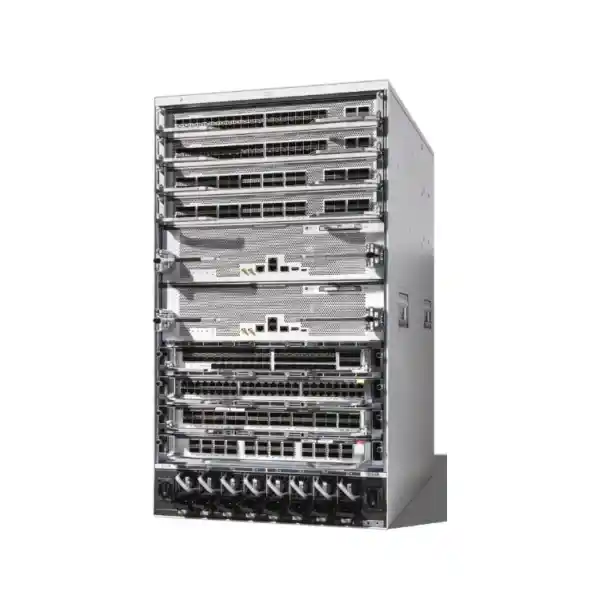
The C9610R chassis provides ten horizontal slots. Two are dedicated to supervisor modules and eight are available for line cards. With supported Supervisor 3 or Supervisor 3XL modules, the platform can scale to as much as 51.2 Tbps of system switching capacity, equivalent to 25.6 Tbps full-duplex throughput in Cisco’s specification convention, with as much as 6.4 Tbps aggregate capacity per line-card slot. Forwarding performance can reach 15.6 billion packets per second, depending on supervisor and platform configuration. The architecture is therefore intended not merely to provide more ports, but to preserve nonblocking high-speed operation as campus traffic patterns become increasingly east-west, application-heavy, encrypted, and sensitive to latency.
For UAE customers planning a five-to-ten-year core refresh, the architectural value lies in modularity. Instead of replacing an entire switch when uplink speeds increase, a correctly sized C9610 deployment can evolve by changing line cards, optics, supervisor modules, licensing, or link designs. That makes the platform especially attractive in large headquarters, financial organizations, airports, universities, healthcare groups, government environments, hospitality campuses, industrial sites, and multi-building enterprises where downtime, forklift upgrades, and backbone redesigns carry substantial operational risk.
C9610 chassis architecture and physical design
10-slot modular chassis
The C9610R provides ten total slots: eight for line cards and two dedicated supervisor slots. This gives network architects room to build dense campus-core designs without concentrating every traffic class into a small number of fixed uplinks.
Dual supervisors
Supervisor slots support redundant operation. In high-availability designs, dual supervisors enable stateful control-plane resilience, reducing the operational impact of a supervisor failure or controlled maintenance event.
Eight PSU bays
The chassis provides eight power-supply bays and supports 3000W AC, 2000W AC, and 2000W DC power options. The minimum installed quantity depends on the selected power design and chassis loading, so power sizing should be treated as an engineering calculation rather than a generic bundle choice.
Four fan trays
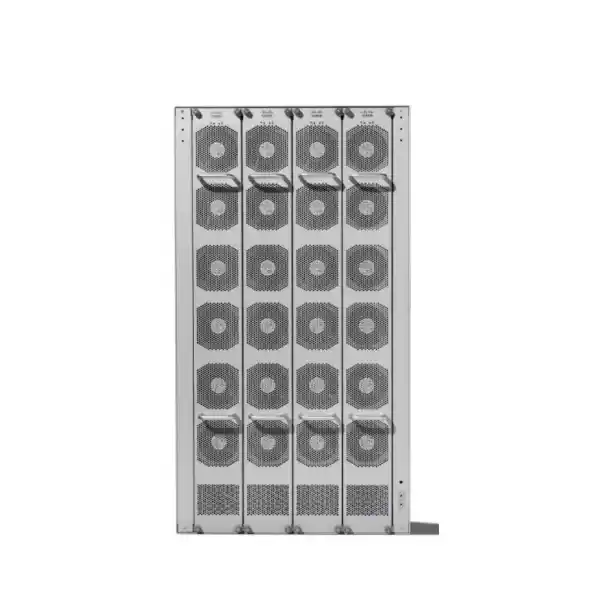
Four fan-tray bays provide the airflow architecture required by a densely populated modular chassis. This is particularly relevant in UAE data rooms where high ambient temperatures outside the conditioned space make correct rack cooling and airflow management essential.
The C9610R is an 18RU chassis measuring approximately 79.93 cm high, 44.20 cm wide, and 66.29 cm deep. It is therefore a physically substantial core platform that should be planned into the rack rather than treated like a conventional access switch. Bare chassis weight is approximately 83.5 kg, while a chassis equipped with four 3000W power supplies and four fan trays is roughly 114.78 kg. A more heavily equipped chassis can exceed 120 kg before accounting for line cards, supervisors, optics, and cabling. For an installation in Dubai, Abu Dhabi, Sharjah, or other UAE facilities, cabinet load rating, floor loading, rack depth, service clearance, cable bend radius, airflow direction, lifting procedures, and maintenance access should all be reviewed before delivery.
Cisco Silicon One forwarding architecture
The defining technical change in the C9610 generation is its Cisco Silicon One-based supervisor architecture. The Supervisor 3 and Supervisor 3XL use four high-performance forwarding ASICs plus a Q200L device for control and system functions. Cisco specifies up to 51.2 Tbps system switching capacity and up to 15.6 Bpps forwarding performance. The supervisor design dedicates high-speed ASIC connections toward line-card slots rather than consuming supervisor faceplate space with uplink ports, a choice that aligns the platform with large modular-core requirements where interface flexibility is better placed on replaceable line cards.
This architecture matters because campus cores increasingly carry traffic profiles that look less like traditional user-to-server forwarding and more like a combination of high-volume video, Wi-Fi 6/6E and Wi-Fi 7 aggregation, encrypted SaaS access, distributed data-center connectivity, IP storage, virtual desktop traffic, cloud on-ramps, AI-assisted applications, building systems, surveillance, and microservice traffic. Core switches must accommodate high packet rates and bursts while maintaining policy enforcement, visibility, routing convergence, and predictable latency. Raw port speed is only one element; table scale, buffering behavior, forwarding pipelines, route capacity, ACL resources, telemetry, and software feature integration determine whether a platform remains effective as the environment grows.
Cisco lists up to 128,000 MAC addresses on the Supervisor 3 and 3XL options, with large route and hardware-classification scale intended for demanding enterprise deployments. The 3XL variant is positioned for environments requiring additional hardware scale and memory characteristics. Exact IPv4, IPv6, multicast, security, NetFlow, and policy scale can depend on software release, feature templates, table allocation, and enabled services. FourTeck therefore recommends sizing around the actual routing and segmentation design rather than choosing a supervisor only from headline bandwidth. Networks using large-scale VRFs, dense routed access, extensive policy maps, macro- or micro-segmentation, or unusually high route counts should be modeled against Cisco’s current scale documentation for the intended IOS XE release.
Supervisor 3 versus Supervisor 3XL
C9610-SUP-3
Supervisor 3 is the mainstream high-performance choice. Cisco specifies four E100 forwarding ASICs plus a Q200L, 32 GB DRAM, 16 GB flash, optional SSD capacity up to 960 GB, up to 51.2 Tbps system switching capacity, up to 6.4 Tbps per slot, and up to 15.6 Bpps forwarding.
It is well aligned to large enterprise campus cores that need substantial density and performance but do not require the maximum table-scale profile associated with the 3XL positioning. The design decision should account for route scale, segmentation count, policy scale, telemetry, and future expansion.
C9610-SUP-3XL
Supervisor 3XL is the scale-focused option and uses Cisco Silicon One K100 forwarding silicon with high-bandwidth-memory characteristics. It retains the same headline chassis and slot bandwidth class while targeting networks that need greater hardware scale for routing, policy, telemetry, or large enterprise segmentation.
For a new core expected to support major business expansion, mergers, campus consolidation, large routing domains, high endpoint counts, or extensive policy objects, the 3XL should be evaluated early because supervisor selection can influence long-term platform headroom.
Both supervisors support the same broad role: centralized control and forwarding for the modular chassis. In a resilient production design, installing two matching supervisors is strongly preferred when the business requires high availability. A dual-supervisor architecture allows Stateful Switchover and Non-Stop Forwarding behavior, subject to software feature support and operational design. It also enables maintenance strategies that reduce the need to schedule a complete core outage for every control-plane intervention. The value of redundancy becomes especially clear in hospitals, airports, hotels, financial institutions, public-sector campuses, universities, and large corporate environments where a core interruption can simultaneously affect wired access, wireless, voice, CCTV, building systems, Internet access, cloud applications, and inter-site connectivity.
C9610 line-card options and port-density planning
A major advantage of the C9610 is the ability to mix high-density line cards according to the real traffic profile of the campus. The platform supports native C9610 line cards and, through the relevant adapter, selected Catalyst 9600 line cards. That provides an important migration advantage for organizations that already own compatible Catalyst 9600 hardware and want to protect part of the existing line-card investment while moving to the larger C9610 chassis.
| Line card | Native ports | Typical use in a core design |
|---|---|---|
| C9610-LC-32CD | 30 x 100G/40G QSFP28 plus 2 x 400G/200G/100G/40G QSFP-DD | High-density 100G aggregation with 400G backbone or inter-chassis connectivity. |
| C9610-LC-40YL4CD | 40 high-speed SFP-family ports plus QSFP/QSFP-DD uplink ports, supporting 10G/25G/50G and high-speed 100G/400G combinations according to port type | Mixed-speed campus distribution, migration from 10/25G toward 50G, and high-speed aggregation. |
| Compatible Catalyst 9600 cards via adapter | Selected 1G, 10G, 25G, 40G, 50G, 100G, and 400G combinations depending on card | Investment protection, brownfield migration, mixed-media transitions, and staged core refreshes. |
At maximum scale, Cisco states that the C9610 architecture can reach up to 448 native 10G, 25G, or 50G SFP56 Ethernet ports, with higher logical SFP counts possible through supported breakout approaches; up to 256 native 40G or 100G QSFP28 ports; or up to 16 native 400G QSFP-DD ports, depending on the selected line-card combination. These are maximum density statements, not a recommendation to build every chassis to the limit. A production core should reserve enough line-card slots, optic capacity, forwarding headroom, and power margin for growth, maintenance, and failure scenarios.
Port planning should begin with a connection matrix. List every distribution switch, access-stack uplink group, firewall cluster, router, data-center leaf pair, wireless controller, load balancer, storage platform, WAN edge, Internet edge, and inter-building fiber pair. Record the current speed, target speed, media type, optic standard, distance, redundancy method, and expected traffic growth for each connection. This prevents the common mistake of buying a chassis with ample aggregate bandwidth but the wrong mix of physical interfaces. For example, a campus with many 25G distribution uplinks and only a few 100G inter-core links requires a different line-card mix than a university core aggregating hundreds of 100G research and data-center connections.
High availability: designing the C9610 as infrastructure rather than a single switch
A modular chassis becomes valuable when its resilience is engineered across multiple failure domains. The C9610 supports redundant supervisors, multiple power supplies, multiple fan trays, field-replaceable line cards, and software mechanisms such as Stateful Switchover, Non-Stop Forwarding, and in-service software upgrade capabilities where supported. These features reduce risk, but they do not automatically create a highly available network. The complete topology must eliminate single points of failure from the application path.
For a business-critical UAE campus, FourTeck generally evaluates a pair of core switches rather than one heavily populated chassis. Each core can be fitted with redundant supervisors and an appropriate power design, then connected to diverse electrical circuits and UPS systems where possible. Distribution or access blocks can dual-home across the core pair using routed links, EtherChannel designs, supported multi-chassis technologies, or other validated Cisco architectures. Firewalls, WAN routers, wireless controllers, server fabrics, and Internet edge devices should also be connected so that a failure of one chassis does not isolate the service.
Power redundancy deserves the same attention as control-plane redundancy. The C9610 provides eight power-supply bays, allowing N+1 or N+N-type strategies depending on the selected supplies, input voltage, and configuration. In the UAE, the design should account for UPS topology, PDU capacity, A/B feeds, generator behavior, input-circuit loading, and the effect of a failed power module or feed. A nominally redundant chassis can still become vulnerable if every PSU is connected to one PDU or one upstream breaker.
Operational resilience also depends on software lifecycle discipline. ISSU and stateful features can reduce planned downtime, but release compatibility, feature support, line-card firmware, redundancy state, and recommended upgrade paths must be validated before a maintenance event. Core upgrades should have a documented rollback plan, out-of-band management path, configuration backup, baseline health checks, pre-change route and neighbor captures, and post-change verification. For high-impact environments, testing the target IOS XE release against a representative lab or staging system can be more valuable than relying solely on theoretical feature compatibility.
Campus-core use cases in Dubai and the wider UAE
Large corporate headquarters
A multi-building headquarters may aggregate dozens of distribution switches, thousands of wired users, dense Wi-Fi, IP telephony, meeting-room systems, CCTV, access control, cloud traffic, and data-center links. The C9610 provides the interface flexibility and core bandwidth to consolidate those services while preserving modular growth.
Universities and education campuses
Higher-education networks can combine large endpoint populations with research workloads, student Wi-Fi, media streaming, lab traffic, security inspection, and multiple buildings. Large route and MAC scale, high-speed fiber aggregation, and a modular 100G/400G roadmap can be more important than simple port count.
Healthcare and mission-critical services
Hospitals and healthcare groups need reliable connectivity for clinical systems, imaging, voice, wireless mobility, building infrastructure, and security systems. Core redundancy, predictable maintenance procedures, segmentation, and high-capacity east-west forwarding are critical design considerations.
Hospitality, retail and mixed-use developments
Large hotels, malls, and mixed-use sites increasingly converge guest Wi-Fi, IPTV, POS, surveillance, BMS, digital signage, tenant networks, VoIP, and administrative systems. A high-density modular core can simplify aggregation while maintaining separation between operational and customer-facing services.
Government and public-sector campuses
Public-sector environments often prioritize lifecycle stability, controlled change, resilient routing, segmentation, auditability, and scalable policy. A modular core enables conservative capacity planning while supporting higher-speed services when business requirements evolve.
Data-intensive enterprise aggregation
Organizations linking campus, private cloud, colocation, edge compute, and security clusters may need 100G and 400G connectivity sooner than a traditional office network. The C9610 provides a path to aggregate those high-speed connections within the same modular chassis family.
Routing, segmentation, and policy scale
Core-switch selection should be based on more than switching throughput. Large enterprises commonly operate thousands of VLANs, switched virtual interfaces, multiple routing domains, high endpoint counts, access-control policies, telemetry flows, and security classifications. Cisco lists support for 4094 VLAN IDs, thousands of SVIs, large spanning-tree scale, jumbo frames up to 9216 bytes, and substantial MAC capacity on the C9610 supervisors. These platform-level capabilities are important for organizations consolidating multiple business units or buildings into one resilient core.
However, the most relevant sizing questions concern the actual forwarding tables. How many IPv4 and IPv6 routes will be installed? How many VRFs are expected? Will the campus run a routed-access architecture? Are there large BGP tables from WAN or Internet edge devices? How many multicast groups will support IPTV or video distribution? How many ACL entries, security groups, or policy constructs are required? Is NetFlow or other telemetry enabled at broad scale? Each feature can consume hardware resources differently. The Supervisor 3XL exists specifically for environments where expanded hardware scale and buffering characteristics matter, so it should be evaluated whenever the design is unusually route-heavy or policy-heavy.
Modern segmentation also changes the core role. Traditional campus networks often relied on large Layer 2 domains, while newer designs increasingly move the Layer 3 boundary closer to access or distribution and use VRFs, routed links, overlays, software-defined policy, or identity-driven segmentation. The C9610 can participate in these architectures, but the correct design depends on the wider Cisco software and management stack. When Cisco Catalyst Center, Software-Defined Access, TrustSec, telemetry, or automation is part of the target architecture, license level, IOS XE release, device role, and integration prerequisites must be matched to the project scope.
For organizations that prefer a more traditional three-tier campus, the C9610 can also operate as a high-capacity collapsed or dedicated core, aggregating routed distribution blocks over 40G, 100G, or 400G links. The key is to avoid reproducing legacy Layer 2 failure domains merely because the chassis has high port density. A strong modernization project uses the core refresh to simplify routing, reduce spanning-tree dependency, introduce deterministic failure behavior, improve telemetry, and establish a documented path for future network automation.
Optics, fiber, breakout, and cabling engineering
High-speed core switching projects are frequently delayed not by the chassis, but by optics and cabling assumptions. The C9610 supports multiple SFP, SFP56, QSFP28, and QSFP-DD interface families depending on the line card. These interfaces can cover speeds from 10G through 400G, but the physical connection must be engineered for distance, fiber type, connector type, patching topology, optic compatibility, and breakout requirements.
A 100G link between a core rack and a distribution room may use short-reach multimode optics if the distance and fiber plant permit, while a building-to-building link may require single-mode optics with a completely different reach and optical budget. A 400G connection can have even more stringent requirements around fiber count, connector polarity, supported module type, and thermal behavior. Before ordering, FourTeck recommends validating every link against an as-built fiber schedule or performing OTDR and loss testing where the plant is uncertain. Assumptions inherited from older 1G or 10G networks are often insufficient for 100G and 400G deployments.
Breakout can improve port efficiency. Certain QSFP interfaces can be divided into multiple lower-speed lanes using supported breakout cables or optics, allowing a high-speed port to connect to several downstream interfaces. Yet breakout should be treated as an engineering feature rather than a universal adapter. The exact breakout mode depends on the line card, optic or cable, software support, and transceiver matrix. It also changes logical port numbering and capacity planning, which must be captured in the low-level design and operations documentation.
Cable management matters physically as well. An 18RU chassis with eight high-density line cards can produce a large number of fiber jumpers at the front of the rack. Patch panels, horizontal managers, vertical managers, service loops, label standards, optic-removal clearance, and air intake/exhaust areas should be planned before the equipment arrives. Clean fiber management is not cosmetic: it reduces accidental disconnection, prevents excessive bend radius, improves maintenance access, and makes future line-card replacement safer. For large deployments, color-coded or structured patching by role—core interconnect, distribution uplink, firewall, WAN, data center, management—can materially reduce troubleshooting time.
Power, cooling, rack, and UAE facilities planning
The physical characteristics of the C9610 make facilities engineering part of the network design. Cisco supports 3000W AC, 2000W AC, and 2000W DC power modules in the C9610R, with eight PSU bays and a minimum supply population that depends on the chosen configuration. The switch supports broad AC and DC input ranges, but the operational design must still match the local data-room power architecture. Exact consumption varies with supervisor type, line-card population, optic mix, traffic load, fan behavior, and redundancy mode, so nameplate capacity should not be confused with normal operating draw.
For a UAE deployment, the rack should have verified PDU capacity and appropriately sized circuits. If A/B power redundancy is required, feeds should be separated through independent PDUs and preferably independent UPS paths. Power supplies should be allocated across those feeds according to Cisco guidance and the desired redundancy model. When a chassis is installed in a site supported by generator power, the facility team should also confirm transfer behavior and the combined inrush and steady-state loads of network, server, storage, and cooling equipment.
Cooling must be evaluated using real rack heat load rather than only room-level tonnage. Cisco publishes a maximum BTU figure for the chassis and fan assembly, but line cards, supervisors, power supplies, and optics add heat. High-density 100G and 400G optics can be significant thermal contributors. Air-conditioning supply, hot-aisle return, blanking panels, rack perforation, cable obstructions, and adjacent high-power equipment all affect inlet temperature. The switch has an operating temperature range specified by Cisco, but a production design should preserve a healthy margin rather than operating continually near the upper environmental limit.
The chassis depth and weight also influence rack choice. A shallow communications cabinet that comfortably holds access switches may not safely accommodate an 18RU, 66 cm-deep modular core plus cable managers and service loops. Rack rail compatibility, anchoring, static load, center of gravity, rear clearance, equipment lifting path, and floor access should be reviewed. In raised-floor data rooms, tile load and cabinet placement may be relevant. For existing facilities, a site survey before shipment can prevent expensive rework.
FourTeck can coordinate these infrastructure considerations alongside broader UAE IT services requirements, helping customers align network design with rack, power, fiber, migration, and operational constraints rather than treating the switch as an isolated purchase.
Licensing, software, management, and lifecycle considerations
Cisco C9610 hardware is part of a software-driven enterprise switching ecosystem. Ordering therefore involves more than chassis, supervisors, line cards, optics, power supplies, and fan trays. Cisco offers networking subscription licenses in multiple terms, and the required tier depends on the intended feature set and management architecture. Current C9610 ordering references include Cisco Switching Advantage licensing options for the platform. Because Cisco licensing programs evolve, the final bill of materials should be validated against the current ordering guide at the time of purchase.
The IOS XE release must also be considered as part of hardware compatibility. New C9610 supervisors and line cards require a minimum software release, and features mature across later versions. A project should not select an IOS XE image merely because it boots the hardware. The release should be assessed for Cisco’s recommended status, security advisories, field notices, known defects, feature parity, compatibility with the existing network, and supported upgrade path. Large campus cores benefit from conservative release governance because they carry many dependent services.
Management choices may include command-line operations, model-driven APIs, telemetry, centralized Cisco management platforms, automation systems, and enterprise monitoring. The most effective operational model usually combines traditional control with automation. Standard templates can enforce interface descriptions, routing policies, logging, NTP, AAA, SNMP or telemetry, control-plane protection, QoS, and security baselines, while change workflows preserve peer review and rollback. This is particularly useful in multi-campus UAE organizations where consistent configuration matters as much as individual device capability.
Lifecycle planning should include software entitlement, support coverage, spares strategy, optic compatibility, line-card availability, and the expected refresh date of adjacent infrastructure. A core chassis may remain in service through several access-switch generations. Selecting enough supervisor and line-card headroom can prevent the core from becoming the bottleneck when Wi-Fi uplinks move from 10G to 25G or distribution moves from 40G to 100G. Conversely, overbuilding every element on day one can waste budget. The objective is staged scalability: install what the current topology needs, reserve chassis and power capacity for known growth, and document which line-card or optic changes will unlock future speeds.
Security architecture for the campus core
A campus core is both a performance platform and a security control point. The C9610’s large hardware tables, Cisco IOS XE feature set, policy capabilities, telemetry, and integration with broader Cisco architectures allow it to participate in segmentation and network-security designs. The exact controls depend on licensing and software release, so a deployment should begin with a threat and trust-zone model rather than a checklist of switch features.
At minimum, the core should be hardened as infrastructure. Management access should be restricted to dedicated administrative networks or out-of-band paths. AAA should integrate with enterprise identity services where appropriate. Unused services should be disabled. Control-plane protection, secure management protocols, encrypted credentials, logging, time synchronization, configuration archive, role-based administration, and secure software-image practices should be standardized. Access to the physical chassis should also be controlled because modular components and console interfaces are security-sensitive assets.
Segmentation can be implemented through VRFs, routed boundaries, VLAN separation, ACLs, policy frameworks, and higher-level Cisco architectures. A mature design separates user, server, voice, guest, IoT, CCTV, BMS, OT, security, management, and partner traffic according to business requirements. The core should provide enough table capacity and bandwidth that segmentation does not become a reason to collapse services into one trust zone. Where traffic must cross security boundaries, the design can steer flows through next-generation firewall clusters rather than relying solely on switch ACLs.
For organizations refreshing both switching and perimeter security, FourTeck’s Firewall Dubai practice can help align core routing, firewall HA, transit VLANs, dynamic routing, link speeds, and inspection capacity. This coordination is especially important when 100G or 400G core links converge on firewalls that have much lower inspected throughput than the switch fabric.
Cisco also positions the C9610 generation around stronger platform security and a roadmap for post-quantum-oriented protection. Those capabilities should be interpreted in the context of the complete Cisco software release, crypto configuration, endpoint capabilities, and enterprise security policy. Procurement teams should distinguish between platform readiness, supported cryptographic features, and the actual controls enabled in the customer design.
Migration methodology from an existing core
A core migration is not simply an equipment replacement. It touches routing, addressing, spanning tree, firewall paths, Internet access, WAN adjacency, server connectivity, wireless, voice, network management, and often business-critical systems that are not fully documented. The safest C9610 deployment therefore starts with discovery. Existing configurations, routing tables, MAC tables, VLAN databases, neighbor relationships, interface utilization, optic inventories, IP helper addresses, multicast settings, QoS policies, ACLs, first-hop redundancy, and management dependencies should be captured before the low-level design is finalized.
The next stage is target-state architecture. Decisions include whether the new core will preserve the current Layer 2/Layer 3 boundaries or move toward routed access, whether current VLANs will be consolidated, whether redundant links will use Layer 3 ECMP or port channels, where default gateways will reside, how firewalls will connect, and whether dynamic routing will replace static routes. The C9610’s high port density can tempt teams to replicate the old network exactly, but a refresh is often the best opportunity to remove obsolete VLANs, simplify route redistribution, standardize naming, and eliminate hidden single points of failure.
A migration runbook should map every physical and logical move. For each link, record the old port, new port, optic type, patch-panel position, VLAN or routed configuration, expected neighbor, rollback action, and verification test. Critical services should have business owners and test cases. During the cutover, the engineering team should verify control-plane health, routing convergence, MAC learning, DHCP relay, DNS reachability, firewall paths, Internet access, WAN reachability, wireless controller status, IP telephony, server connectivity, and monitoring visibility.
Where risk is high, parallel operation can reduce outage exposure. A new C9610 pair can be staged, configured, and partially connected while the old core remains operational. Routing adjacencies can be introduced gradually and groups of downstream switches migrated in controlled waves. This requires careful loop avoidance and route preference design, but it provides more rollback flexibility than a single overnight forklift replacement.
FourTeck’s broader UAE technology solutions capability can support procurement, design coordination, installation, and migration planning so that the hardware bill of materials aligns with the operational cutover plan.
Sizing methodology: how to specify the right C9610 configuration
The correct C9610 configuration is built from a sizing model rather than a single product SKU. The chassis is only the starting point. A complete bill of materials must define supervisors, line cards, adapters where required, power supplies, fan trays, SSD options where relevant, software subscriptions, transceivers, breakout cables, direct-attach cables, patching, spare optics, rack accessories, and support. FourTeck recommends evaluating capacity across at least seven dimensions: interface count, interface speed, slot utilization, system bandwidth, forwarding-table scale, power/cooling, and operational redundancy.
1. Interface count and speed. Count every production and growth connection by media and target speed. Separate 10G, 25G, 40G, 50G, 100G, and 400G requirements. Include redundant links independently; a dual-homed distribution block consumes two core interfaces even if its normal traffic uses less than one link’s capacity.
2. Slot utilization. Map the interface matrix onto specific line cards. Reserve realistic free capacity. A design using all eight line-card slots on day one has no card-level expansion path and may complicate maintenance or migration. Depending on growth expectations, leaving one or more slots available can be strategically valuable.
3. Bandwidth and oversubscription. Compare aggregate downstream capacity to expected upstream and inter-core traffic. Most campus networks are not simultaneously saturated, so some oversubscription is acceptable, but critical links should not be engineered from port counts alone. Use observed utilization, 95th-percentile peaks, application roadmaps, wireless growth, and backup windows to estimate future demand.
4. Table scale. Record current and projected MAC addresses, IPv4/IPv6 routes, VRFs, ACL entries, multicast groups, NetFlow scale, and policy objects. This informs the Supervisor 3 versus 3XL decision and prevents late discovery that the network is constrained by hardware tables rather than throughput.
5. Availability requirement. Determine whether the design requires two chassis, two supervisors per chassis, redundant line cards for certain link groups, dual power feeds, and spare optics. Availability objectives should be stated in business terms: acceptable outage duration, maintenance windows, and failure tolerance.
6. Power and cooling. Model both normal and failure states. A redundant design should remain within safe electrical and thermal limits after a PSU, feed, or cooling component fails. Include growth cards and optics in the future-state heat load.
7. Lifecycle and procurement. Decide which capabilities are needed on day one and which are part of a documented expansion roadmap. This supports budget control while preventing incompatible future upgrades. For multinational organizations, FourTeck can also coordinate requirements through its Africa technology solutions presence where regional projects extend beyond the UAE.
Example deployment topologies
Dual-core enterprise campus
Two C9610 chassis form the resilient campus core. Distribution blocks connect to both cores over routed 40G or 100G links. Firewalls, WAN routers, data-center fabrics, wireless controllers, and critical services are dual-connected. This design minimizes dependence on Layer 2 between buildings and supports deterministic routing convergence.
Collapsed core for a large single site
A pair of C9610 switches combines core and distribution functions in an environment where building count does not justify a separate distribution tier. High-density access or aggregation switches dual-home directly to the core pair. This can reduce device count while preserving modular capacity and redundancy.
100G/400G backbone aggregation
The C9610 aggregates multiple 100G domains and uses 400G links for high-capacity inter-core or backbone connections. This model is appropriate where data-center, research, media, storage, or large campus traffic makes 100G a common edge-of-core speed rather than an exceptional uplink.
Brownfield Catalyst 9600 migration
An organization reuses selected compatible Catalyst 9600 line cards through C9610 adapters while introducing new C9610-native cards for higher-speed growth. This can reduce migration cost and stage the transition, provided software and hardware compatibility are validated.
Operational telemetry, observability, and troubleshooting
High-capacity networks need equally strong observability. A 51.2 Tbps-class chassis can carry enormous traffic volumes, making ad hoc troubleshooting based on interface counters alone insufficient. The C9610 should be integrated into an operations framework that captures device health, environmental status, routing changes, link errors, queue behavior, traffic flows, authentication events, configuration changes, and software alarms.
Streaming telemetry can provide higher-frequency operational data than traditional polling, while flow visibility helps identify large traffic sources, application patterns, unexpected east-west communication, or asymmetrical routing. Syslog, SNMP where still required, model-driven telemetry, APIs, and centralized analytics can coexist. The selected tooling should map alerts to operational actions. A temperature threshold, optic receive-power warning, route-flap notification, PSU fault, or CRC error is only valuable if the NOC knows its severity and escalation path.
Baseline data is particularly important before and after a core migration. Engineers should record normal CPU and memory utilization, supervisor state, line-card health, interface error rates, optic power, routing neighbor counts, route-table size, multicast state, MAC counts, and traffic levels. After the migration, the same metrics can quickly expose hidden issues such as mismatched MTU, optic degradation, unexpected Layer 2 flooding, route churn, or insufficient capacity on a downstream device.
Troubleshooting workflows should follow layers. First validate physical state and optics; then link negotiation and errors; then Layer 2 adjacency where applicable; then Layer 3 addressing and routes; then policy and ACL behavior; then application reachability. In a modular chassis, include supervisor and line-card state in the workflow because a localized hardware issue can affect a subset of ports while the chassis remains broadly operational.
Configuration backup and change history should be automated. A core switch should never depend on the memory of an individual engineer to reconstruct its intended state. Source-controlled templates, standardized comments, meaningful interface descriptions, documented routing policy, and versioned backups reduce mean time to repair and simplify audit requirements. This operational discipline is as important to uptime as redundant hardware.
Interoperability with firewalls, WAN, data center, and access layers
The core sits at the intersection of multiple technology domains. A C9610 project is therefore most successful when adjacent devices are included in capacity and protocol planning. Firewalls may connect over routed port channels or redundant routed links and can participate in OSPF or BGP where supported by the security design. Their throughput should be sized for inspected traffic, not only interface speed. Connecting a 100G core port to a firewall does not create 100G of threat-inspected capacity unless the firewall platform and enabled security services can sustain it.
WAN and SD-WAN routers may advertise hundreds, thousands, or millions of routes depending on the environment. Route summarization, default-route strategy, BGP policy, redistribution, and failure behavior should be agreed before migration. A common objective is to keep WAN complexity from unnecessarily expanding the campus routing table. Where full Internet routes or extensive provider routes are required, supervisor table scale must be validated explicitly.
Data-center connectivity can range from a small pair of server switches to multiple leaf-spine fabrics. The C9610 can provide high-speed routed connectivity between campus and data center, but the boundary should be clearly defined. Avoid stretching large Layer 2 domains across campus and data center unless a specific supported design requires it. Routed interconnects usually provide better fault containment and easier capacity management.
Access and distribution layers should be matched to the core roadmap. If current access switches uplink at 10G but the next generation will use 25G, line-card selection should support that transition without replacing the core card. If distribution is moving to 100G, optical plant and patch panels should be reviewed at the same time. Wi-Fi 7 aggregation can also increase upstream demand substantially as access-point radio capacity and multigigabit access ports grow.
The result should be an end-to-end capacity hierarchy: access port speeds, access uplinks, distribution uplinks, core interconnects, firewall throughput, WAN capacity, Internet bandwidth, and data-center links should all be logically related. Overbuilding one layer while leaving another constrained produces little business value. The C9610’s scalability is most useful when it enables balanced growth across the entire network.
Procurement guidance for UAE organizations
A production C9610 order should be treated as a solution bill of materials rather than a chassis purchase. The final BOM must include all mandatory components and enough redundancy for the intended service level. Cisco states that a fully assembled C9610 requires the chassis, at least one supervisor, at least one line card for connectivity, four fan trays, and at least four power supplies when using the referenced 3000W supply baseline. High-availability production designs typically require more than those minimums, particularly dual supervisors and a power arrangement that survives a defined failure scenario.
Optics often account for a significant portion of project value. Each transceiver should be tied to a specific link in the port matrix. Confirm speed, wavelength, fiber type, distance, connector, DOM requirements, and whether a breakout design is needed. For critical uplinks, spare optics can reduce recovery time. If third-party optics are considered, support policy, software behavior, monitoring, and operational risk should be reviewed carefully against the customer’s support expectations.
Support and software subscriptions should align with the business lifecycle. A three-, five-, seven-, or longer subscription term may affect budget predictability and entitlement. Organizations with strict procurement controls should document renewal dates and support contacts before handover. The device serials, line cards, power supplies, supervisors, optics, license entitlements, rack location, and software image should be entered into the asset-management system at commissioning.
Lead time and component availability can vary, especially for high-density line cards and specific optical modules. A practical procurement strategy identifies acceptable substitutions in advance—for example, whether a different supported optic reach is operationally acceptable, whether a temporary line-card mix can be used, or whether adapters allow reuse of existing hardware. Any substitution must be revalidated against performance, licensing, software, and support requirements.
For organizations seeking a wider technology sourcing and integration partner beyond a single Cisco switch, FourTeck’s global enterprise technology services can help coordinate multi-vendor network, security, server, and infrastructure requirements while maintaining a consistent deployment plan.
Detailed specification snapshot
Eight line-card slots and two dedicated supervisor slots.
Dual supervisor capability for resilient control-plane design.
Cisco headline switching capacity with current Supervisor 3 architecture.
Supports dense high-speed line-card configurations.
Packet-forwarding performance depends on supervisor configuration.
Actual speeds depend on selected native or adapted line cards and optics.
Approximately 79.93 x 44.20 x 66.29 cm chassis dimensions.
Supports 3000W AC, 2000W AC, and 2000W DC supply options.
Specification values are configuration- and software-dependent. Final BOM, optics, line-card compatibility, route/policy scale, license level, and software release should be validated against Cisco’s current ordering, compatibility, and release documentation before purchase.
Why C9610 capacity can matter even when today’s links are smaller
Many enterprise customers ask whether a 51.2 Tbps-class core is excessive when their current Internet circuit is only a few gigabits. That comparison misses the role of a campus core. Internet traffic is only one component of switching load. The core may simultaneously carry east-west application traffic, backups, replication, CCTV, voice, wireless mobility, storage, file services, data-center access, building systems, multicast, inter-VLAN flows, and traffic between branches or cloud gateways. Aggregate internal traffic can substantially exceed Internet bandwidth.
The second consideration is lifecycle. Core platforms are typically retained longer than access switches. During that period, access-point uplinks can move from 1G to multigigabit and 10G, access stacks can move from 10G to 25G uplinks, distribution can move from 40G to 100G, and server or data-center connections can move to 100G or 400G. A modular chassis with substantial per-slot bandwidth allows those upgrades to occur without replacing the entire core fabric.
The third consideration is failure-state capacity. If a network is designed with two core chassis, normal traffic may be split across both. During maintenance or failure, one chassis may need to carry a much larger share. Links and forwarding capacity should therefore be sized not only for normal averages but also for degraded-mode operation. The same principle applies to port-channel members, distribution uplinks, and firewall clusters.
This does not mean every customer should purchase the maximum configuration. The correct approach is to buy enough modular headroom that growth does not require structural redesign. A well-sized C9610 deployment might initially populate only part of the chassis, using line cards that fit current 25G and 100G requirements while reserving slots and power for later 400G adoption. That is more economical than filling the chassis with unused interfaces, and more strategic than buying a fixed switch that must be replaced as soon as the backbone speed changes.
Design considerations for 100G and 400G adoption
Moving from 10G or 40G to 100G and 400G affects more than interface modules. At 100G, small errors in fiber cleanliness, connector quality, polarity, or optical budget can create unstable links that were never visible at lower speeds. At 400G, the physical-layer design becomes even more critical. The project should therefore include fiber inspection and cleaning standards, power-level validation, and clear documentation of each optic pair.
Traffic engineering changes too. A single 100G or 400G link can aggregate many downstream domains. If that link fails, a large volume of traffic must reconverge onto alternate paths. Routing timers, ECMP design, port-channel member count, link diversity, and backup-path capacity should be evaluated. It is not enough that the alternate path exists; it must sustain the required load after convergence.
High-speed links can also expose downstream bottlenecks. A 400G core interconnect may be useful between two C9610 chassis, but if the connected firewall, WAN, or data-center gateway is limited to 40G, application performance will still be constrained there. Capacity planning should therefore identify the slowest point on each critical service path and determine whether that constraint is intentional, temporary, or a future upgrade target.
Finally, optics cost and availability can influence the migration path. Organizations may choose 100G broadly and reserve 400G for inter-core or data-center backbone use until demand justifies wider adoption. The C9610’s modularity supports that staged strategy. A good design treats 400G capability as an architectural option with a defined use case rather than a checkbox that must be consumed immediately.
Commissioning and acceptance testing
Before a C9610 enters production, the commissioning process should establish that the physical platform, software, redundancy, and network services perform as designed. Begin with inventory validation: chassis PID, supervisor models, line-card models, fan trays, power supplies, SSD modules if applicable, optics, software release, licenses, and serial numbers. Confirm that every component appears correctly in hardware inventory and that no module reports an unsupported or degraded state.
Environmental checks should verify inlet temperatures, fan status, power redundancy, PSU input state, and expected load distribution across feeds. Optic checks should record transmit and receive levels on critical links and confirm that thresholds have adequate margin. Interface counters should be reviewed for CRC errors, input errors, drops, and unexpected negotiation behavior.
Redundancy testing should be deliberate. Validate supervisor SSO state before any failover test. Confirm routing neighbors, port channels, spanning-tree state where present, and management reachability. Then test one failure domain at a time according to the approved plan: supervisor switchover, individual uplink failure, a redundant path failure, and—where facilities teams permit—power-feed resilience. Measure service impact rather than only device status. Applications, voice, wireless, server access, and monitoring should remain within the agreed acceptance criteria.
Routing convergence testing should confirm the expected path before and after failures. Large networks may have unintended static routes or redistribution points that only appear during a topology change. Capturing route tables and traceroutes during commissioning creates a baseline for later troubleshooting. If multicast is used, verify group joins, rendezvous behavior, and stream continuity. If DHCP relay, security policy, or VRF route leaking is present, test representative services in every segment.
The handover package should include the final bill of materials, rack elevation, port map, fiber schedule, IP plan, routing design, VLAN/VRF matrix, management addressing, software and license details, configuration backups, support information, warranty records, escalation contacts, upgrade procedure, and known design exceptions. High-quality documentation turns a successful installation into a maintainable production system.
Frequently evaluated engineering questions
Is the C9610 intended for access switching?
Its architecture and density are primarily aligned to core and aggregation roles. Access-layer needs such as large-scale PoE endpoint connectivity are typically better served by dedicated campus access platforms.
Can it reuse Catalyst 9600 line cards?
Selected Catalyst 9600 line cards are supported through the C9610 line-card adapter. Exact card, software, optic, and feature compatibility must be verified for the intended release.
Does every deployment need SUP-3XL?
No. Supervisor 3 can meet many high-performance campus requirements. 3XL is most compelling when the design requires greater route, policy, or hardware-table scale and additional headroom.
Should a production core use one or two chassis?
Business-critical campuses commonly use two core devices to remove chassis-level single points of failure. The exact topology depends on availability goals, routing design, budget, and maintenance strategy.
Is 400G required immediately?
No. Many enterprises adopt 100G widely and reserve 400G for inter-core or data-center backbone use. The benefit is having a chassis architecture capable of growing when demand justifies it.
What usually causes BOM mistakes?
Incomplete optic mapping, insufficient PSU planning, wrong line-card speed mix, missing adapters, license assumptions, software compatibility, and failure to reserve growth ports are common causes.
UAE project planning and deployment governance
Large network-core projects often span procurement, facilities, security, networking, applications, service desk, and business stakeholders. The technical quality of the C9610 design can be undermined if those teams work independently. FourTeck recommends a project governance structure that identifies a technical owner, change owner, site/facilities owner, security owner, and business approver. The low-level design should be formally reviewed before hardware ordering so that any BOM change has traceability to a design requirement.
A site-readiness checklist should be completed before delivery. Verify rack space, rails, cabinet depth, grounding, PDU sockets, circuit capacity, UPS capacity, cooling, patch-panel readiness, fiber test results, labeling, console access, staging area, and lifting path. Confirm whether the equipment will be staged in a lab or configured directly on site. For multiple UAE locations, standardize the commissioning template so that every chassis is built to the same operational baseline.
Change planning should distinguish configuration preparation from physical cutover. As much work as possible should be completed before the outage window: software installation, license verification, base hardening, management configuration, routing templates, VLAN and VRF creation, telemetry, logging, NTP, AAA, SNMP or APIs, interface descriptions, and validation of supervisor redundancy. During the actual migration, engineers should focus on controlled physical moves and verification rather than writing configuration from scratch.
For regulated or audited environments, capture evidence. Screenshots or command outputs can document supervisor state, software version, power redundancy, routing adjacencies, interface status, configuration checksums, and post-change service tests. Store the final approved configuration in the organization’s backup or source-control system. This provides a defensible record of what was deployed and simplifies future troubleshooting.
Finally, schedule a post-implementation review after the network has operated under real load. Compare utilization and error metrics against the design assumptions. Verify that traffic is balanced across redundant links, that no line card or uplink is unexpectedly hot, and that monitoring thresholds are meaningful. A successful core refresh is not complete when the links turn green; it is complete when the operational team can monitor, maintain, and expand the platform with confidence.
Decision recap: when the Cisco C9610 is the right platform
Choose C9610 for scale
The platform is compelling when an enterprise needs more line-card slots, higher 100G density, a 400G roadmap, greater per-slot bandwidth, or a core platform that can absorb multiple generations of access and distribution upgrades.
Choose C9610 for resilience
Dual supervisors, modular power, multiple fan trays, replaceable line cards, and software HA features support architectures where planned and unplanned events must not become full-campus outages.
Choose C9610 for migration flexibility
Support for selected Catalyst 9600 cards via adapter can help brownfield customers preserve investment while moving to a larger and faster chassis foundation.
Size it from the network, not the datasheet
Supervisor, line-card, optic, power, software, and support choices must follow the actual topology, route scale, policy scale, growth plan, facility constraints, and uptime target.
Quotation input checklist
To create an accurate Cisco C9610 quotation, provide the following information. A partial answer is enough to begin, but the more complete the inputs, the more precise the line-card, optic, power, and licensing design can be.
Plan the C9610 around your topology, not a generic bundle
FourTeck can help UAE organizations translate port counts, fiber maps, resilience requirements, route scale, licensing, and migration constraints into a complete Cisco C9610 bill of materials and deployment plan. This is particularly important for high-density chassis systems where one wrong line card, optic family, power assumption, or software dependency can delay commissioning.
For a useful first review, share your current core model, required uplink speeds, approximate number of downstream switches, desired 100G/400G links, redundancy target, and whether the project is a greenfield deployment or migration from an existing Catalyst environment.
Validate supervisors, line cards, optics, licenses, power supplies, redundancy, and software compatibility before issuing the final purchase order.

Reviews
There are no reviews yet.