
Enterprise Core Switching • Dubai, UAE
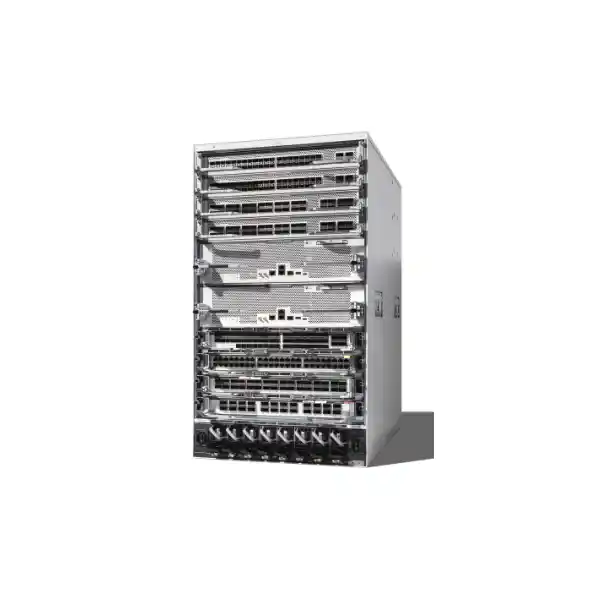
Cisco C9610R Smart Switch
The Cisco C9610R is a 10-slot modular smart switching platform built for organizations that need very high port density, redundant control-plane architecture, multi-speed Ethernet from 1G-class campus connectivity through 400G backbone links, and a chassis design that can grow with demanding core and distribution workloads. For Dubai enterprises, government environments, universities, hospitals, large commercial campuses, transportation networks, financial institutions and multi-building facilities, the platform provides a structured migration path from older chassis-based switching toward a modern Cisco IOS XE operational model.
Direct answer
Choose the C9610R when a fixed switch cannot deliver the required interface mix, forwarding scale, redundancy or growth headroom. Its eight line-card slots allow architects to combine copper, SFP56, QSFP28, QSFP56 and QSFP-DD connectivity while preserving dedicated supervisor redundancy and modular power.
Chassis
10 slots / 18 RU
Two supervisor slots and eight line-card slots in a front-serviceable modular chassis.
Core density
Up to 448 native SFP56-class ports
High-density 10G, 25G and 50G designs with compatible line cards and optics.
High-speed uplinks
100G to 400G options
QSFP28, QSFP56 and QSFP-DD choices support campus, aggregation and backbone interconnects.
Resiliency
Dual supervisors + modular power
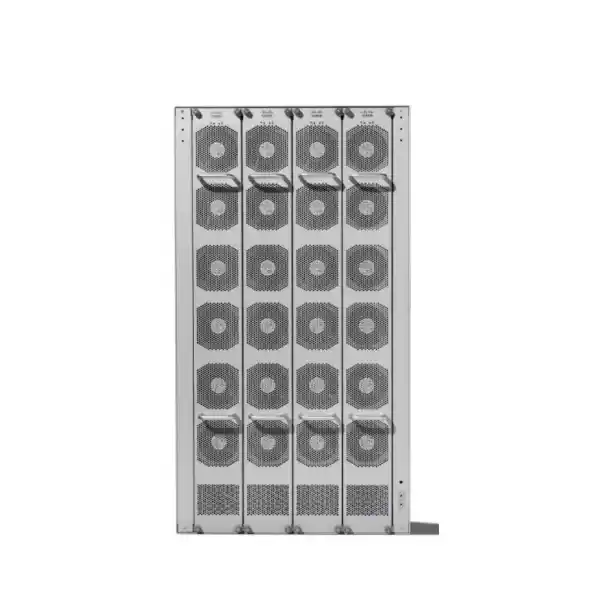
Redundant control, multiple PSU operating modes and four hot-swappable fan trays.
What the Cisco C9610R is designed to do
The C9610R belongs in the architectural layer where bandwidth concentration, routing scale, resiliency and operational continuity matter more than low port-count economics. It is not simply a larger access switch. The chassis is intended to act as a high-capacity aggregation or core system in which dozens or hundreds of downstream links, routed interfaces, distribution uplinks, services networks and high-speed interconnects converge. The modular format allows the physical interface design to be matched to the actual campus: some organizations need dense 10G copper handoffs, others need hundreds of 25G fiber links, and others need a smaller number of 100G or 400G backbone connections. The C9610R can be configured around those requirements rather than forcing the network to conform to a single fixed-port shape.
A fully assembled platform requires the chassis, at least one supported supervisor engine, at least one line card for network connectivity, four fan trays and at least four power supplies when using the 3000-watt supplies. In a production core, most organizations will architect more redundancy than the bare functional minimum. That usually means two supervisors, an intentional power redundancy mode, enough installed supplies to tolerate the agreed failure scenario, duplicated uplinks to independent peer systems, and an optics plan that matches both distance and fiber type. FourTeck treats the C9610R as a solution-level design rather than a chassis-only purchase because the business outcome depends on correct choices for supervisors, line cards, software subscription, transceivers, rack depth, power circuits, cable management and migration sequencing.
The platform is also significant for customers refreshing long-lived chassis networks. Core switches frequently remain in service far longer than access switches because they carry large route tables, VLAN boundaries, inter-building trunks, routing adjacencies, security policy dependencies and operational tooling integrations. A replacement therefore has to be evaluated for forwarding performance, control-plane behavior, route scale, quality of service, link aggregation, multicast, high availability, automation, software lifecycle and supportability. The C9610R creates a modern Cisco platform for that refresh while still supporting a broad range of familiar campus topologies.
Cisco C9610R chassis specifications for planning
Supervisor architecture: C9610-SUP-3 and C9610-SUP-3XL
The supervisor is the control and system-management heart of a modular switching chassis. Cisco supports the C9610-SUP-3 and C9610-SUP-3XL supervisor options in the C9610R. The correct choice should not be made by naming convention alone. Core network architects should map supervisor capability to route scale, policy scale, telemetry requirements, service features, expected software lifecycle and the growth model of the campus. A design that appears adequate when measured only by day-one interfaces can become constrained later by larger routing tables, more segmentation, additional VRFs, denser fabric deployment or richer monitoring. The XL option should therefore be evaluated wherever scale and service expansion are expected to be material over the platform life.
For availability, the C9610R provides two dedicated supervisor slots. Dual supervisors are strongly preferred for core and major distribution roles because they reduce the operational impact of a supervisor fault and permit high-availability behaviors supported by the software and selected design. Redundant supervisors do not eliminate the need for network-level redundancy. A resilient campus core normally uses two physical chassis or two logical core systems, dual-homed downstream distribution blocks, diverse fiber paths where available, and routing or port-channel designs that prevent a single chassis event from isolating the campus. Supervisor redundancy protects inside one chassis; topology redundancy protects the service when an entire chassis, rack, power domain or room is affected.
FourTeck validates supervisor selection against the intended role before quotation. The design review covers routing protocol use, expected numbers of Layer 3 interfaces, VRFs and prefixes, multicast requirements, ACL and security policy complexity, telemetry, automation, software feature dependencies and the planned line-card population. This avoids the common procurement mistake of specifying only the chassis SKU and leaving critical capacity assumptions unresolved until installation.
Line-card choices and how they change the network design
C9610-LC-32CD
Designed for high-speed aggregation: thirty QSFP28 ports supporting 100G/40G plus two QSFP-DD ports supporting up to 400G-class connectivity. It is a strong candidate for large routed cores, distribution aggregation and high-speed inter-building designs.
C9610-LC-40YL4CD
Combines forty SFP56 ports for 50G/25G/10G with high-speed QSFP56 and QSFP-DD uplinks. This is useful when a core must aggregate many fiber-facing distribution links while retaining 100G- and 400G-class backbone capacity.
Selected Catalyst 9600 family cards
With the supported C9610 line-card adapter, the chassis can use selected Catalyst 9600 family line cards including dense 10G copper and high-density fiber options. Compatibility must be checked against the intended Cisco IOS XE release and module combination before ordering.
Mixed-speed planning
Do not size only by physical port count. Consider the speed mix, breakout behavior, optics type, oversubscription target, cable volume, peer interface availability and migration sequencing. A lower-density 100G design can move more traffic than a much denser 10G design.
Line-card selection is where the C9610R becomes a tailored core rather than a generic chassis. A university may populate multiple SFP56 cards because dozens of buildings arrive over 10G or 25G fiber. A financial campus may prefer 100G routed links between resilient distribution blocks and 400G links between core systems. A data-rich research environment may combine large 100G aggregation cards with selected 400G interfaces. A legacy migration may require 10G copper for a transitional period while fiber modernization proceeds. Each case leads to a different port map, power draw, optic quantity and cabling plan.
Port-count claims also need to be interpreted carefully. Cisco publishes high chassis-scale density figures such as up to 448 native 10G, 25G or 50G SFP56 Ethernet ports, up to 256 native 40G or 100G QSFP28 interfaces, and up to 16 native 400G QSFP-DD ports depending on the selected card population. These are architecture ceilings, not a promise that every speed can be simultaneously combined at those maxima. A bill of materials must be calculated from the chosen modules, slot availability, software support and practical topology requirements.
How to size a Cisco C9610R core correctly
A defensible sizing exercise begins with traffic concentration, not with a preferred chassis SKU. Start by documenting every downstream block that will connect to the new core: building distribution switches, data-center handoffs, firewall clusters, WAN routers, internet edges, wireless controllers where applicable, management networks, server aggregation, storage or research networks, and out-of-band systems. Record present interface speed, sustained traffic, peak traffic, expected growth, redundancy method and desired future interface speed. This produces an interface inventory that can be translated into line-card quantities and a slot map.
Next, calculate failure-state capacity. A core should not be sized only for normal operation with every link and chassis available. If the architecture uses two C9610R systems and traffic normally splits across both, determine whether one chassis is expected to carry the full critical load during maintenance or failure. The same principle applies inside the chassis. If the power design uses N+1 or N+N redundancy, verify that the remaining supplies can sustain the required configuration when one power domain is unavailable. If dual supervisors are installed, define expected switchover behavior and ensure operational procedures account for software upgrades, state synchronization and maintenance windows.
Then evaluate scale. Count anticipated VLANs, routed interfaces, VRFs, routing adjacencies, route prefixes, multicast groups, MAC addresses, ACL entries, policy objects and telemetry requirements. These control-plane and forwarding-table dimensions influence supervisor selection and long-term headroom. Organizations commonly underestimate growth in segmentation because new compliance boundaries, tenant networks, IoT zones, OT networks, guest services and acquired business units all add logical scale even when physical port count changes little.
Finally, reserve expansion capacity. FourTeck generally recommends avoiding a day-one design that consumes every line-card slot or every high-speed interface. Spare capacity gives the network team room to add a building, increase uplink speeds, introduce a new firewall pair or migrate from 25G to 100G without replacing the chassis. The appropriate reserve depends on budget and growth certainty, but documenting the intended headroom is better than treating future expansion as an undefined assumption.
High availability beyond the chassis
The C9610R is built for redundant component choices, but enterprise availability is achieved by combining component redundancy with topology redundancy and disciplined operations. Two supervisor modules protect the control plane inside the chassis. Multiple power supplies protect against individual supply failure and, depending on power mode and circuit design, can protect against a feed or PDU failure. Four independent fan trays allow cooling components to be serviced without treating the fan system as a single replaceable unit. Hot-swappable modules improve maintainability, but they should be backed by monitored alarms, spare strategy and a support contract appropriate to the business impact of an outage.
At the network layer, two core systems should normally be deployed in independent failure domains. When possible, place them on separate rack PDUs, separate upstream electrical feeds and diverse fiber routes. Downstream distribution should be dual-homed using the appropriate Layer 2 or Layer 3 design. Modern campus designs often prefer routed links or well-defined multi-chassis connectivity patterns because they reduce spanning-tree dependency and make failure behavior easier to reason about. The exact topology depends on existing standards, supported features and operational maturity.
Software maintenance is part of availability engineering. Cisco publishes release guidance and supports in-service software upgrade capabilities in defined release combinations, but upgrade eligibility and disruption characteristics must always be checked for the precise source and target versions, supervisors, line cards and feature set. FourTeck can stage the platform, align it to a recommended software train, verify module recognition, run diagnostics, apply the intended configuration and perform a controlled migration plan rather than introducing an untested chassis directly into production.
Power architecture for Dubai data rooms
The C9610R provides eight power-supply bays and supports 3000W AC, 2000W AC and 2000W DC power-supply options. Cisco recommends using 3kW supplies with 220V input when the design objective is the highest efficiency and redundancy. That recommendation is particularly relevant in the UAE, where enterprise data rooms commonly have 220–240V power available and where cooling and electrical efficiency directly affect operating cost. The switch supports combined, N+1 and N+N power modes. These terms describe how installed power supplies share load and how reserve capacity is allocated; the right choice depends on the number of supplies, input feeds and the organization’s tolerance for a power-domain failure.
Power sizing must be calculated from the actual chassis build. A configuration with high-density optical line cards, multiple supervisors and many transceivers has a different power profile from a lightly populated chassis. The electrical design should account for normal draw, worst-case draw, redundancy state, PDU ratings, breaker ratings, connector type, UPS capacity, generator backing and the thermal load that the power becomes inside the room. The C9610R can generate a substantial heat load when fully configured, so treating it like a small fixed switch can create avoidable rack and cooling problems.
FourTeck’s quotation process can include a power worksheet that identifies selected PSU models, quantity, input voltage assumptions, redundancy mode, required power cords and recommended A/B feed distribution. For brownfield Dubai installations, this step often reveals whether the existing cabinet has enough high-current outlets and whether UPS capacity needs to be extended before the switch arrives.
Cooling, rack depth and physical deployment
The C9610R is an 18RU chassis measuring approximately 79.93 cm high, 44.20 cm wide and 66.29 cm deep. The bare chassis is heavy, and a fully assembled unit with eight 3000W AC supplies and four fan trays is approximately 120.7 kg. Physical planning therefore needs to address more than available rack units. Confirm cabinet static load rating, installation method, rack depth, front and rear door clearance, cable-management clearance, equipment lifting procedures and the availability of enough technicians for safe mounting. A chassis of this size should not be scheduled for installation without a site-readiness review.
Airflow runs from front to back. In a conventional data room, the front of the switch should face the cold aisle and the rear exhaust should face the hot aisle. Blank panels in unused module and PSU positions are operationally important because they help preserve designed airflow and electromagnetic containment. Rear-serviceable fan trays also require sufficient maintenance clearance. If a rack is located against a wall or has restricted rear access, fan service becomes more difficult even though the trays are hot-swappable.
Dubai environmental conditions make the building cooling system especially important. Although the switch operates within Cisco’s specified ambient ranges, the outside climate can expose poorly designed equipment rooms to high thermal stress during HVAC failures. Facilities teams should verify room cooling redundancy, UPS-backed HVAC where required, temperature monitoring, humidity control and alarm escalation. Network resilience is undermined if both core chassis share one overloaded cooling unit or one unmonitored utility circuit.
Cisco IOS XE, licensing and management model
The Cisco C9610 Series uses Cisco IOS XE software and a unified licensing approach through Cisco Networking Subscription. Current Cisco licensing information identifies the C9610 Series with the Switching Advantage Core Modular license and a minimum three-year subscription term for a new subscription. This is different from older Catalyst purchasing habits in which customers may have thought primarily in terms of a chassis, a perpetual network license and a separate DNA term. For the C9610R, licensing should be treated as a mandatory line item in the bill of materials and aligned to the Smart Account and support model before deployment.
Management can be integrated with Cisco’s enterprise management platforms such as Catalyst Center according to supported versions and feature matrices. This enables organizations to move beyond device-by-device command-line operations toward software image management, health visibility, automation, assurance and policy workflows. Mature network teams may still use CLI, APIs, configuration management systems and telemetry platforms; the value of the C9610R is that it fits both traditional operational practices and more automated campus architectures.
Licensing should be verified during quotation because subscription term, support coverage, Smart Account ownership and procurement entity can affect activation and lifecycle management. FourTeck helps customers map the hardware order to the correct subscription SKUs and avoid a handover in which the chassis is physically installed but license ownership or support entitlement is unclear.
Routing, segmentation and enterprise policy
A high-end core switch earns its place by combining forwarding capacity with a robust services architecture. In a typical enterprise deployment, the C9610R may act as the routing boundary between distribution blocks, data-center services, firewall zones, WAN routers and shared infrastructure. Layer 3 designs can use dynamic routing to make failures converge predictably and to reduce the size of Layer 2 fault domains. The actual protocol set should reflect the organization’s standards, interoperability requirements and operational skill. OSPF and BGP are common in larger enterprise cores, while other protocols may remain in brownfield networks during migration.
Segmentation is equally important. VRFs allow multiple routing domains to share the same physical core while remaining logically separated. That can be used for corporate users, guest services, building management, CCTV, OT systems, research networks, tenants or regulated workloads. VLANs, routed interfaces, access control policy and security services then enforce the intended boundary at the appropriate layer. As segmentation grows, the network team must monitor scale values and avoid uncontrolled policy sprawl. The design should define which policies live on the core, which belong on firewalls and which are applied at the access edge.
For customers building security architectures around dedicated next-generation firewalls, FourTeck can coordinate the switching design with its Firewall Dubai practice so that routed handoffs, VLAN trunks, high-availability links and transceiver choices are agreed before installation. This prevents common mismatches such as ordering 100G optics on one side and an incompatible breakout or fiber type on the other.
Security capabilities and trusted platform considerations
Security in a campus core is not limited to packet filtering. The chassis participates in the trust model of the overall network. Cisco documents an ACT2 Trust Anchor module for authenticity across supported supervisors, line cards and fan trays. This platform-level trust helps organizations validate hardware integrity as part of a broader secure supply-chain and secure-boot posture. At the software and feature layer, the Switching Advantage tier enables advanced capabilities that should be mapped to the actual policy model rather than enabled without architectural intent.
Operational security should include controlled administrative access, authenticated management sessions, centralized AAA, secure logging, configuration backup, role-based privilege, change tracking, time synchronization and software vulnerability management. Core devices should sit in a protected management network with out-of-band access where business criticality justifies it. SNMP and telemetry should be configured with the minimum required exposure, and legacy insecure protocols should be disabled. The network team should also define how emergency access works during an identity-platform or WAN outage.
Because the core sees traffic from many business zones, monitoring is valuable even when traffic inspection occurs elsewhere. Interface counters, queue statistics, routing events, environmental alarms, power status, fan status, optical diagnostics and system logs provide early warning of faults that could become outages. FourTeck can integrate the core rollout with broader IT Services UAE requirements such as monitoring, documentation, backup and post-deployment operational handover.
Optics and cabling: where many core projects succeed or fail
A chassis quotation that excludes optics is incomplete. The C9610R supports interface families that can be paired with a wide range of optical transceivers, DACs, AOCs and breakout assemblies depending on speed, distance and module support. Each link should be engineered from both ends. Record the local port type, remote port type, required speed, fiber type, connector type, distance, patch-panel path and redundancy path. Then select transceivers that are supported on both platforms and appropriate for the installed cabling plant.
For short intra-rack or adjacent-rack connections, direct-attach copper or active optical cabling may simplify deployment and reduce transceiver count. For building-to-building links, single-mode fiber is common because distance and future speed growth favor it. Existing multimode fiber can still be useful for defined distances and standards, but the network team should not assume that a link running 10G today will support 100G or 400G tomorrow over the same path. Fiber grade, connector loss, patching, polarity and modal bandwidth matter.
Breakout can improve port economics, but it introduces operational complexity. A single high-speed QSFP or QSFP-DD interface may be divided into lower-speed child interfaces where supported, which changes port numbering, cabling and fault isolation. Engineers should document the breakout map in the as-built diagram and label both ends clearly. Avoid using breakout simply to maximize a marketing port count; use it where the topology and cabling plan benefit.
FourTeck can provide a complete optics matrix with the switch bill of materials. This is especially useful in UAE campus projects where links may cross multiple buildings and contractors may own different parts of the fiber plant. A written matrix establishes responsibility for patch cords, cassettes, transceivers and remote-side compatibility before the migration window.
Typical C9610R deployment patterns in the UAE
Large enterprise campus core
Two C9610R chassis form the resilient core for multiple office towers, warehouses or buildings. Distribution switches connect through dual 40G, 100G or higher-speed routed links. Firewalls, WAN routers and shared services connect redundantly to both core systems.
University or education network
Dense fiber-facing line cards aggregate many faculties, laboratories, residence buildings and wireless distribution blocks. VRFs and policy separate academic, administrative, research, guest and facilities networks while high-speed uplinks preserve backbone capacity.
Government or municipal campus
The core is designed around deterministic redundancy, controlled change windows, segmented services and detailed lifecycle documentation. Dual supervisors, redundant power and independent core chassis reduce maintenance and component-failure risk.
High-density commercial facility
A multi-building commercial property can aggregate tenant, security, CCTV, building-management and corporate networks while maintaining logical separation. The chassis offers room to increase building uplinks from 10G or 25G toward 100G as demand grows.
For UAE-wide organizations, FourTeck can coordinate design and supply through its UAE technology practice, while multinational or cross-border projects can use the FourTeck global site as the broader engagement point. The core design principles remain the same, but support logistics, spares strategy, installation scheduling and carrier handoffs can differ by country and facility.
Migration from an older chassis core
Replacing a legacy core is not a forklift hardware task; it is a dependency migration. The first step is discovery. Export configurations, routing tables, VLAN databases, spanning-tree state, VRF definitions, port-channel membership, interface descriptions, ACLs, multicast configuration, first-hop redundancy configuration, QoS policy, management-plane settings and monitoring integrations. Compare configured state with actual usage. Old cores often contain abandoned VLANs, shutdown interfaces, stale static routes and policy that no longer has an owner. Migrating every historical line without validation can transfer technical debt directly into the new platform.
Next, build a dependency map. Identify every downstream and upstream device, link speed, optic type, addressing scheme, routing adjacency and maintenance owner. Determine which links can be moved individually and which require a coordinated outage. If the old and new cores can run in parallel, a phased migration may reduce risk: establish a temporary routed interconnect, move distribution blocks one at a time, validate reachability and telemetry, then retire the legacy core after all services are transferred. Parallel operation also gives teams a rollback path for early waves.
A new C9610R design is a good opportunity to simplify architecture. Large legacy campuses may have stretched Layer 2 VLANs that can be converted to routed distribution, inconsistent trunking that can be standardized, or old 10G port channels that can be replaced with 40G/100G links. However, modernization should be intentional. Combining a hardware migration with a complete routing redesign, addressing change, security policy rewrite and management-platform replacement in one window increases the number of variables. FourTeck can separate the work into controlled phases so each change can be tested and accepted.
Before cutover, stage the new chassis off-network where possible. Install supervisors, line cards, fan trays and power supplies; confirm module inventory; load the selected software release; configure management; apply licensing; run diagnostics; test representative optics; and verify configuration templates. A staged core reduces time spent troubleshooting basic hardware or licensing issues during the production maintenance window.
Designing the bill of materials
The C9610R chassis SKU is only the starting point. A production bill of materials should identify the chassis, supervisor quantity and type, each line card, any required line-card adapters, fan trays, power supplies, power cords, rack kit, blanks, storage options if required, software subscription, support service and every transceiver or cable needed for connected links. Spares can include one or more power supplies, fan trays and optics depending on support response time and the organization’s tolerance for degraded operation.
Supervisors are selected according to scale and service requirements. Line cards are selected from the port map. Power supplies are then sized against the full hardware population and redundancy model. Optics are selected link by link. Licensing is aligned to the C9610R’s current unified subscription requirements. Rack accessories are chosen based on cabinet type. Finally, support level is matched to business criticality. This sequence prevents circular decisions and helps procurement understand why each line item exists.
For organizations that require a formal tender or request for quotation, FourTeck can provide a structured compliance response. The customer should specify required port counts by speed, supervisor redundancy, number of chassis, desired power redundancy, rack type, software term, support term, optic distances and required installation services. Where exact optical distances are unknown, the bill of materials can be divided into base switching hardware and a provisional optics schedule to be finalized after a fiber survey.
The most common quotation errors are under-ordering power supplies, omitting a second supervisor, selecting optics without checking the remote platform, overlooking rack depth, failing to include mandatory subscription licensing or assuming that a legacy line card can be inserted without a supported adapter. A design-led quotation avoids these issues before purchase order release.
C9610R port-density scenarios
A dense 25G or 50G campus backbone can use SFP56-oriented cards to aggregate many distribution blocks. If forty lower-speed interfaces are available on a card alongside high-speed uplinks, the architect can dedicate the SFP56 ports to building links while reserving QSFP56 or QSFP-DD ports for core interconnects and service aggregation. This creates a clean separation between fan-in interfaces and backbone interfaces. The practical limit is determined by card count, slot capacity, forwarding support and the number of ports required for redundancy.
A 100G-heavy core uses QSFP28-rich cards. Thirty 100G-class ports on a line card provide substantial aggregation density, while the QSFP-DD positions can connect 400G backbones or other high-capacity services. This is attractive for enterprises consolidating multiple 10G or 40G bundles into fewer 100G links. Fewer higher-speed links can simplify cabling and reduce port-channel complexity, but they also concentrate traffic, so redundancy must be preserved across separate links, line cards or chassis as appropriate.
A mixed legacy-modernization design may include 10G copper for existing appliances or local services alongside fiber cards for new campus links. This can be a sensible transitional architecture, but it should have an exit plan. Core chassis ports are valuable, and using large numbers of high-capacity slots for legacy copper indefinitely may be less efficient than moving local servers or appliances to dedicated aggregation switches. FourTeck can model both approaches and show which design reduces cost or operational complexity over the planned lifecycle.
When considering the headline density of up to 448 native SFP56-class ports, remember that a fully populated chassis with hundreds of optical links implies hundreds of transceivers, a large cable-management requirement, significant patching documentation and substantial downstream capacity. Physical density should therefore be matched by operational discipline. Labels, port descriptions, rack elevations, fiber schedules and monitoring templates are essential at this scale.
Capacity planning for 400G
The presence of 400G ports does not mean every enterprise needs to deploy 400G immediately. Their value is that they create an upgrade path and high-capacity interconnect option. A pair of core systems might use 400G links for inter-core traffic while downstream buildings remain on 25G or 100G. A large campus can aggregate many 100G links and still maintain a higher-speed backbone between core locations. Organizations with substantial east-west traffic, data-intensive research, private cloud interconnects or high-speed data-center handoffs may use 400G earlier than conventional office campuses.
400G planning increases attention to optics, fiber and loss budget. Connector cleanliness, patch-panel count, fiber type and distance become critical. Engineers should validate transceiver support on the selected line card and software release, check the remote device’s supported 400G optic types and confirm whether the existing fiber route can carry the chosen optical technology. Procurement should avoid generic “400G optic” descriptions because multiple standards can use the same nominal speed while requiring different fiber or connector arrangements.
Bandwidth architecture should be expressed as traffic flows rather than interface speeds alone. If a 400G inter-core link carries the aggregate load of many 100G downstream links, model expected peak concurrency and failure-state behavior. If traffic normally splits across two 400G links, verify whether one can carry critical traffic when the other is unavailable. The same reasoning applies to 100G and 25G designs; 400G simply raises the magnitude of the consequences.
Operations and lifecycle management
A core chassis should be operated as critical infrastructure. Establish a documented baseline immediately after deployment: installed modules, serial numbers, software version, license state, power mode, fan status, environmental readings, routing neighbors, interface utilization, optical receive/transmit levels and configuration checksum. Store the baseline in the organization’s documentation system and update it after approved hardware changes. This makes troubleshooting faster because engineers can distinguish normal conditions from recent change.
Monitor both traffic and hardware health. Interface errors, discards, queue drops and utilization reveal congestion or physical-layer problems. Optical diagnostics reveal degrading fiber or dirty connectors. Power alarms and fan alarms reveal component issues before redundancy is exhausted. CPU, memory and control-plane telemetry reveal abnormal protocol or management activity. Routing adjacency churn can indicate unstable links even when users have not yet reported outages. A mature monitoring platform should correlate these signals and escalate critical changes to the network team.
Software lifecycle is equally important. Maintain an approved release policy that considers Cisco recommended releases, security advisories, feature needs, interoperability and ISSU support. Do not upgrade a core simply because a newer train exists, but do not leave it indefinitely on an obsolete release either. Lab validation or staged validation is strongly recommended for major changes. Keep configuration backups and document rollback procedures before every upgrade.
Spares strategy depends on support coverage and business impact. Hot-swappable design lowers repair time only if a replacement component is available. Some organizations maintain local spare optics and PSUs while relying on support logistics for supervisors and line cards. Others with 24×7 critical operations hold more inventory. The decision should be documented against the maximum acceptable time the core can run in a degraded state.
Installation and commissioning sequence
A controlled C9610R implementation begins before the equipment reaches the rack. Confirm the cabinet, mounting kit, RU allocation, PDU outlets, breaker capacity, A/B feeds, grounding point, cold-aisle orientation and rear maintenance clearance. Verify that the planned fiber trunks and patch panels are present and tested. Prepare labels for every core link and reserve patch cords in the correct type and length. Network drawings should show each destination, interface speed and redundant path.
During physical installation, follow Cisco’s installation guidance for safe handling and grounding. Install required fan trays, power supplies, supervisors and line cards; ensure ejector levers are fully seated; keep blanks installed in unused positions; and verify front-to-back airflow is unobstructed. The chassis is heavy enough that lifting and mounting should be treated as a facilities task with appropriate manpower and equipment rather than an informal rack change.
Initial power-on should include hardware inventory verification and diagnostics. Cisco states that the system performs boot diagnostics and can take a substantial amount of time during startup. Engineers should allow the platform to complete its boot sequence, then verify supervisor status, line-card status, fan trays, power supplies and environmental sensors. Apply the selected software release, register or configure licensing as required, and test management reachability before connecting production links.
Commissioning then progresses through staged connectivity. Bring up inter-core links first, validate routing and redundancy, then connect upstream services and downstream distribution blocks according to the migration plan. After each wave, check routing tables, ARP or neighbor state, reachability, monitoring, application health and interface errors. Record actual port mappings in the as-built documentation before the team moves to the next wave.
Why a C9610R project needs architecture validation
The C9610R is powerful enough that it is easy to overbuy or misconfigure. Buying maximum line-card density without understanding traffic patterns can lock budget into unused interfaces. Buying too little supervisor or power headroom can create constraints that are expensive to fix later. A validated architecture balances performance, availability, growth, operations and cost. FourTeck’s role is to convert business and network requirements into a bill of materials that can be defended technically and commercially.
Validation begins with a requirements workshop: number of locations, present core, current uplink speeds, target uplink speeds, expected growth, routing protocols, segmentation, maintenance expectations, rack environment, power availability and support requirements. The resulting high-level design identifies how many chassis are needed, where they sit, which line cards serve which functions and how redundancy is achieved. A detailed low-level design then defines interface mappings, IP addressing, routing, policy and migration steps.
This approach is especially valuable in Dubai procurement, where equipment may be ordered through separate purchasing, facilities and IT teams. A shared design document prevents each team from making independent assumptions. Facilities understands the electrical and rack load; procurement understands mandatory and optional components; the network team understands topology and software; and management understands the redundancy model being purchased.
Important note on published bandwidth figures
Cisco architecture material describes higher hardware-capable bandwidth per line-card slot for the C9610R, while the current product data sheet lists a lower maximum bandwidth scalability figure for supported operation with the available supervisors. For procurement and production capacity planning, FourTeck recommends sizing to the capability that Cisco lists as currently supported in the target software release and module combination, not to a value marked as hardware-capable for future software enablement.
This distinction matters in long-life chassis projects. Hardware may be designed with future headroom, but a customer should not base an SLA or traffic-engineering assumption on a feature that is not enabled in the software release they intend to deploy. During design validation, FourTeck checks the latest Cisco data sheet, architecture documentation, release notes and compatibility information for the proposed configuration.
UAE procurement, warranty and support considerations
Enterprise switching procurement should establish the supply channel, support entitlement, serial-number ownership, software subscription and Smart Account relationship before shipment. Chassis-based systems also benefit from clearly defined return-material authorization and spare procedures because modules may be replaced independently. The customer should know who opens Cisco support cases, which contract covers the serial number and how a failed component reaches the data room during an emergency.
Delivery planning matters because the chassis and accessories are large and heavy. Confirm loading-bay access, building security requirements, delivery hours, lift capacity and the path from receiving to the data room. For high-security sites, pre-register technicians and serial-numbered equipment where required. For free-zone, government or regulated environments, procurement documents may need additional legal or logistics detail.
FourTeck can provide supply, configuration, staging and deployment as one project or work with the customer’s existing integrator. The objective is to keep technical responsibility clear: the hardware list must align with the design, and the design must align with the real site. Customers can review broader UAE capabilities through FourTeck UAE and coordinate security-specific requirements through the dedicated Dubai firewall team.
C9610R versus a fixed-form-factor core
Fixed switches are excellent when the required port mix and scale fit comfortably inside one or two compact systems. They use less rack space, are usually simpler to power and can be cost-effective for medium-sized campuses. The C9610R becomes attractive when the network needs more interfaces than fixed platforms provide, when multiple speed types must coexist, when field-replaceable modular components are important, or when the core is expected to grow substantially over many years.
A modular chassis also changes maintenance economics. A line card can be replaced or upgraded without replacing the entire switching system. New link speeds can be introduced by adding appropriate cards while existing cards remain in service. Dual supervisors and multiple power supplies create internal redundancy options that are difficult to match in a small fixed switch. On the other hand, the chassis consumes more rack space and power, and its bill of materials is more complex. That is why a C9610R should be justified by architecture, not by prestige.
FourTeck can compare a dual-fixed-core design with a dual-C9610R design using the same traffic inventory. The comparison can include day-one port count, five-year growth, rack space, optics, support, power, software term and migration impact. This gives the customer a decision based on lifecycle value rather than purchase price alone.
Frequently asked technical questions
How many line-card slots does the Cisco C9610R have?
Eight line-card slots are available. Slots 5 and 6 are dedicated to supervisors, leaving slots 1 through 4 and 7 through 10 for line cards.
How many supervisors can be installed?
The chassis supports two supervisors and Cisco lists C9610-SUP-3 and C9610-SUP-3XL as supported supervisor options. Dual supervisors are recommended for high-availability core designs.
Does the C9610R support 400G?
Yes. Compatible QSFP-DD ports on supported line cards provide 400G-class connectivity. Final optic and port capability must be checked against the selected module and Cisco IOS XE release.
Can it use Catalyst 9600 line cards?
Cisco documents support for selected Catalyst 9600 family line cards when used with the C9610-LC-ADPT adapter. Compatibility is specific, so every intended line card must be validated rather than assuming universal Catalyst 9600 compatibility.
How many power supplies are required?
Cisco states that a fully assembled system requires at least four power supplies when using the 3000W power-supply option. Production designs should be calculated for the chosen hardware load and desired combined, N+1 or N+N redundancy mode.
What is the airflow direction?
Airflow is front to back. Rack orientation should place the chassis intake toward the cold aisle and exhaust toward the hot aisle in standard data-room layouts.
What license is required?
The C9610 Series uses Cisco Networking Subscription with the Switching Advantage Core Modular tier. Current Cisco ordering guidance indicates a minimum three-year term for a new subscription.
Can FourTeck supply optics and deployment services?
Yes. A complete project can include the chassis, supervisors, line cards, power supplies, transceivers, cabling, licensing, rack planning, staging, configuration, migration and post-installation documentation.
Detailed sizing worksheet for enterprise architects
Before requesting a final quotation, create a row for every physical connection that will terminate on the core. Record source device, source port type, destination C9610R port speed, primary or secondary path, required optic, fiber type, approximate distance and planned migration date. Sum the required interfaces by speed, then add a growth allowance. This translates a conceptual topology into line-card demand. If multiple links can be combined into a higher-speed interface, compare both designs rather than automatically carrying old port-channel structures forward.
After physical ports, document logical scale. Count routed interfaces, VRFs, VLANs, routing neighbors, expected routes, multicast usage and ACL complexity. Identify features that rely on the Advantage license and management platforms that need software compatibility. This informs supervisor and software choices. For a brownfield migration, compare these figures with the current core and add headroom for at least the expected platform life.
Next document resiliency assumptions. Will there be one C9610R or two? Are both located in the same room or separate rooms? Can every downstream block reach both? Are power feeds independent? Is the UPS shared? Are fiber paths diverse? What service impact is acceptable during a single supervisor, PSU, line card, chassis or room failure? The answer determines whether the network is genuinely redundant or merely contains redundant parts.
Then calculate facilities requirements. Reserve 18 RU per chassis plus cable-management space. Confirm cabinet depth exceeds the chassis depth while allowing bend radius and rear service clearance. Verify rack load capacity for a fully configured chassis. Map each PSU to a PDU outlet and confirm breaker headroom. Estimate heat output for the proposed configuration and verify room cooling. Determine whether maintenance staff can access both front and rear without moving other equipment.
Finally document lifecycle assumptions: software release policy, support level, spare components, maintenance windows, configuration backup system, monitoring platform and ownership. A core design is complete only when the organization knows how it will be operated after the installation team leaves.
Recommended design principles for Dubai deployments
- Use dual C9610R core systems for business-critical campuses when the outage impact justifies chassis-level redundancy.
- Use dual supervisors in each core chassis where high availability is required, and validate switchover behavior in the chosen software release.
- Size power for failure state, not only for normal state. Distribute PSUs across independent A/B feeds where the facility supports it.
- Keep front-to-back airflow unobstructed and reserve rear maintenance clearance for fan-tray replacement.
- Standardize optics by speed and reach when possible to simplify spares, troubleshooting and procurement.
- Prefer routed distribution or other well-defined resilient topologies where appropriate rather than extending unnecessary Layer 2 fault domains.
- Reserve line-card and port capacity for growth instead of filling every slot on day one.
- Validate Cisco IOS XE release, supervisor, line-card, optic and feature compatibility before purchase order approval.
- Stage the chassis, licensing and representative links before the production cutover so the maintenance window is used for migration rather than basic commissioning.
FourTeck deployment scope
FourTeck can support the C9610R lifecycle from presales architecture through operational handover. Presales services can include current-state discovery, requirement validation, topology review, port-density modeling, supervisor selection, power calculation, optics selection, licensing alignment and bill-of-material preparation. Where the customer already has a design, FourTeck can perform a validation review against the intended hardware and software combination.
Staging services can include hardware assembly, software loading, base configuration, management configuration, license readiness, module diagnostics, optics validation and configuration-template checks. Deployment services can include rack installation, grounding coordination, patching, core interconnection, routing turn-up, migration waves, verification and rollback support. The precise responsibility split is agreed with the customer and any incumbent integrator or facilities contractor.
After deployment, FourTeck can provide as-built documentation, port maps, configuration backups, support handover and monitoring integration. Organizations that need broader managed technology assistance can coordinate through FourTeck IT Services UAE. This keeps the switching project connected to the larger operational environment rather than treating the core as an isolated hardware purchase.
Technical decision recap
Choose C9610R when
You need modular scale, eight line-card slots, dual supervisors, dense multi-speed interfaces, strong internal redundancy and a long-term path from 10G/25G aggregation toward 100G/400G backbone connectivity.
Validate before ordering
Supervisor type, line-card compatibility, port map, optics, power redundancy, rack depth, airflow, software release, unified subscription licensing and support coverage.
Design for failure
Confirm that surviving chassis, supervisors, links, power feeds and cooling can carry critical services during maintenance or failure. Redundancy should be tested as a system, not assumed from component count.
Plan the lifecycle
Define software policy, monitoring, backups, spare components, support escalation and change control from day one so the core remains supportable throughout its service life.
Quotation input checklist
Network requirements
Number of chassis, present core model, required 10G/25G/40G/50G/100G/200G/400G ports, routing protocols, VRFs, multicast, security zones, expected growth and target cutover date.
Physical requirements
Rack type and depth, available RU, A/B power feeds, input voltage, PDU outlet type, UPS capacity, cold/hot aisle direction, grounding and rear service clearance.
Optics requirements
Remote device model, remote interface, fiber type, distance, connector type, existing patch panels, breakout requirements and whether spare transceivers are required.
Commercial requirements
Cisco Smart Account, subscription term, support term, delivery location, installation scope, staging scope, after-hours migration, documentation requirements and local spare strategy.
Request a Cisco C9610R design and quotation for Dubai
Send FourTeck your required port speeds, current core model, number of buildings or distribution blocks, redundancy preference and target migration window. The engineering team can turn those inputs into a validated C9610R chassis, supervisor, line-card, power, optics and licensing bill of materials.
For multi-country requirements, the same architecture can be adapted to regional logistics and support needs through FourTeck’s broader enterprise networking practice. A structured design review reduces procurement risk and gives your operations team a clear migration and lifecycle plan.
Include in your request
Port counts • link distances • rack details • power feeds • supervisor redundancy • support term • migration scope

Reviews
There are no reviews yet.