
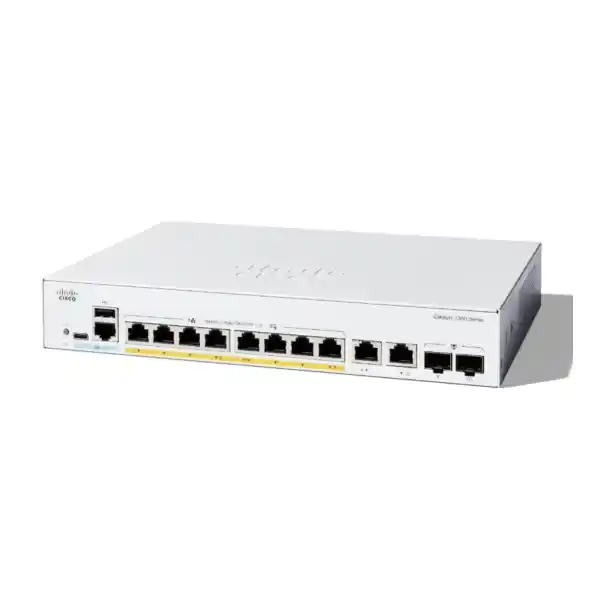
Cisco Catalyst C1300-8P-E-2G Network Switch in Dubai, UAE
The C1300-8P-E-2G is an 8-port Gigabit PoE+ managed switch with a 67W shared PoE budget and two 1G copper/SFP combo uplinks. It is aimed at business edge networks that need compact Cisco switching, VLAN control, Layer 3 capability, secure management and quiet fanless operation without moving to a larger 16-, 24- or 48-port platform.
67W total PoE budget
2 × 1G copper/SFP combo uplinks
20Gbps switching capacity
Fanless compact chassis
Direct answer for business buyers
What exactly is it? The Cisco Catalyst C1300-8P-E-2G is a compact managed Gigabit Ethernet access switch in the Catalyst 1300 family. The model combines eight 10/100/1000 copper ports capable of PoE+ with two Gigabit copper/SFP combo uplinks, giving a total of ten Gigabit system interfaces while keeping the desktop or edge-cabinet footprint small.
What is it mainly used for? It is well suited to connecting and powering a small group of Ethernet endpoints such as IP phones, wireless access points, surveillance cameras, door controllers, workstations and other branch devices while enforcing VLAN, QoS, access-control and management policies.
Who should consider it? Buyers who need up to eight powered edge ports, business-grade management and Gigabit uplinks should shortlist it, especially where fanless operation and compact dimensions matter. It is a more capable choice than an unmanaged PoE switch when segmentation, visibility, controlled access or Layer 3 features are required.
What is the most important factor to confirm? Confirm the PoE power requirement, not only the number of PoE devices. The switch provides a 67W total PoE budget across eight PoE+ ports. A design can therefore be within the eight-port count yet exceed the total available power if several endpoints draw high wattage simultaneously.
What can FourTeck help determine? FourTeck can map device count, endpoint wattage, VLANs, uplink media, SFP choice, routing requirements, installation location, migration needs and growth expectations to the correct Catalyst 1300 model and quotation.
Where the C1300-8P-E-2G fits in a business network
The C1300-8P-E-2G sits in a useful middle ground between very simple plug-and-play switching and larger campus-class access platforms. It gives a small site the controls that are commonly required in a professionally managed network without forcing the buyer into a 24- or 48-port chassis. That distinction matters in Dubai offices, retail branches, clinics, classrooms, hospitality back offices, small warehouses and distributed enterprise locations where eight powered edge connections may be sufficient but the network still needs predictable policies and remote administration.
The switch is especially relevant where the Ethernet edge carries multiple device types. A typical small branch may have three or four IP phones, one or two wireless access points, a camera, a printer and several user devices. The physical port count alone does not describe the network requirement: voice, corporate data, guest access, surveillance and management traffic may need different VLANs, priorities and security treatment. A managed Catalyst platform lets the network administrator separate those roles more cleanly than a basic PoE switch.
Its two combo uplinks are another reason the model deserves careful positioning. Each combo interface can use the copper or SFP side of that interface, which gives flexibility when the upstream device is nearby on copper or when fibre is preferred for distance, electrical isolation or cabling architecture. The buyer should not interpret two combo uplinks as four simultaneously active uplink ports. The copper and SFP sides are paired resources; uplink planning must be based on how those combo interfaces will actually be used.
The compact chassis also makes the C1300-8P-E-2G attractive outside a traditional full-size wiring closet. Cisco lists dimensions of approximately 268 × 185 × 43.94 mm and a unit weight of about 1.72 kg. The model uses an external universal 100–240V, 50–60Hz power supply and is fanless. That can be valuable in quiet office spaces, reception areas, meeting-room cabinets or other locations where acoustic noise from active cooling would be undesirable. Compact does not mean installation conditions can be ignored: ventilation, power placement, cable strain, environmental temperature and access for maintenance still need to be considered.
Best fit
Small managed edge networks with up to eight Gigabit powered devices, moderate total PoE demand, a need for business VLAN and security controls, and 1G upstream connectivity.
Check carefully
Sites using multiple high-draw PoE devices. Eight PoE+ ports are available, but the shared 67W budget can become the limiting factor before the physical port count is exhausted.
Consider a larger model
Projects needing more than eight access ports, a larger PoE reserve, 10G uplinks, multigigabit edge ports or hardware stacking should compare other Catalyst 1300 or Catalyst 1300X SKUs.
Verified C1300-8P-E-2G specifications that affect buying decisions
| Specification | C1300-8P-E-2G detail | Buyer relevance |
|---|---|---|
| Access ports | 8 × 10/100/1000 Gigabit Ethernet RJ-45 | Suitable for compact edge deployments; count every wired endpoint that requires a dedicated port. |
| PoE support | 8 PoE+ capable ports, up to 30W per supported port, 67W total switch PoE budget | Total simultaneous endpoint draw must fit the shared budget; the aggregate 67W figure is the critical sizing value. |
| Uplinks | 2 × Gigabit copper/SFP combo interfaces | Offers copper or fibre choice per combo interface; compatible SFP optics are selected separately when fibre is required. |
| Forwarding performance | 14.88 mpps at 64-byte packets | Appropriate to the ten-port Gigabit architecture and useful when checking that the switch is designed for wire-speed nonblocking operation. |
| Switching capacity | 20 Gbps | Matches the intended compact Gigabit access role; buyers needing 10G access or faster uplinks should compare other models. |
| MAC address table | 16,000 addresses for Catalyst 1300 1G SKUs | Provides ample Layer 2 address-learning scale for typical small business and branch access designs. |
| Packet buffer | 1.5 MB aggregate, dynamically shared | Relevant to burst handling; application design and uplink oversubscription still matter more than the buffer number in isolation. |
| Jumbo frame support | Up to 9000-byte frames; default MTU 2000 bytes | Useful for environments that intentionally standardize larger frames, but MTU must be planned consistently across the traffic path. |
| Dimensions | 268 × 185 × 43.94 mm | Compact enough for space-constrained installations, provided ventilation, power and cabling are handled correctly. |
| Weight | Approximately 1.72 kg | Useful when planning wall shelves, compact cabinets and physical support. |
| Power input | External universal 100–240V AC, 50–60Hz supply | The external adapter and available power socket need to be included in cabinet and UPS planning. |
| Cooling | Fanless | A good fit for noise-sensitive environments; passive cooling still requires sensible airflow and temperature control. |
| Operating range | -5°C to 50°C operating range; 0°C minimum ambient for cold start | Important for non-office cabinets, warehouses and utility spaces where ambient temperature can be higher or lower than normal conditioned rooms. |
Eight PoE+ ports: why the 67W budget matters more than the port count
A common purchasing mistake is to see eight PoE+ ports and assume the switch can continuously supply the maximum PoE+ power to eight devices at once. PoE+ defines what an individual port can support, but this model has a 67W total PoE budget shared across its eight powered ports. That means the design must look at the actual or worst-case draw of connected endpoints and the total power allocation, not just whether each device is technically compatible with PoE+.
Consider a simple voice deployment. Eight desk phones that each require modest power may fit comfortably within 67W, especially if the phones do not drive power-hungry expansion modules. A mixed branch can also fit: for example, several phones plus a low-to-medium-power access point and one or two cameras. However, a project using multiple higher-performance wireless access points, pan-tilt-zoom cameras, video phones, access-control peripherals or USB-powered phone accessories can push the total requirement beyond 67W even while several switch ports remain physically free.
The correct PoE calculation should start from the exact endpoint models. For each powered device, identify the expected IEEE class or vendor-specified maximum draw, then total the simultaneous requirement. Add practical headroom rather than designing the switch to run at its absolute aggregate ceiling. Headroom is useful for firmware changes, endpoint replacement, a future camera with an illuminator, an access point that enables additional radios, or a phone that later receives an expansion console.
PoE scheduling can also support operational efficiency in environments where some devices do not need power around the clock. Catalyst 1300 features include time-based PoE operation, allowing power to be enabled or disabled according to defined schedules. This can be useful for selected endpoints, but it should not be treated as a substitute for correct power sizing. Critical devices such as core access points, essential phones, security cameras or door-control hardware may need continuous service, so their requirement belongs in the baseline budget.
Persistent PoE is another useful capability in this family. It is intended to maintain PoE power during a switch reboot, helping powered endpoints avoid unnecessary restarts during certain maintenance events. This feature can reduce disruption, but operational behaviour should still be validated in the final configuration and change plan. Firmware updates, power loss, adapter replacement and other events can still interrupt service.
If the PoE calculation approaches or exceeds the budget, the answer is usually not to hope that devices draw less in production. Compare the C1300-8FP-2G, which keeps the same basic eight-port Gigabit format but offers a 120W PoE budget, or consider a larger port-count model if growth is also expected. That comparison is one of the most important reasons to request a requirement-based quotation rather than choosing only from headline port counts.
Planning the two Gigabit copper/SFP combo uplinks
The C1300-8P-E-2G has two Gigabit combo interfaces. A combo interface provides two physical media choices that correspond to one logical interface: copper RJ-45 or an SFP slot. This is useful because the switch can be connected upstream by ordinary copper Ethernet when the distribution device is nearby, or by fibre when distance, pathway, electrical isolation or structured-cabling standards make fibre preferable. The key procurement point is that each combo pair is used as one interface at a time. It should not be counted as one copper plus one fibre port operating independently.
For copper uplinks, Category 5e or better cabling supports 1000BASE-T. In real projects, cable quality, length, termination and patching still matter. A small switch placed in a meeting room or branch cabinet may have a short copper run to a router or firewall, while a switch in a detached building or distant floor area may be better served by fibre to reduce distance and grounding concerns.
For fibre, the SFP module is a separate design item. Buyers should specify the fibre type, connector type, required distance and the optic at the far end. Single-mode and multimode are not interchangeable planning labels; the installed fibre plant and the matching transceivers at both endpoints need to agree. The switch’s Gigabit SFP capability also means that a buyer who requires 10Gbps upstream bandwidth should evaluate a different Catalyst 1300 model with SFP+ uplinks rather than expecting a 1G SFP slot to provide 10G performance.
The presence of two uplinks is useful for topology design, redundancy at Layer 2, link aggregation in appropriate designs, or separate upstream connectivity, but the network architecture must determine how they are configured. Redundancy is not created automatically by plugging both cables into two upstream devices. Spanning-tree design, link aggregation, gateway placement, upstream switch compatibility and failure behaviour should be defined so that a second cable improves resilience instead of creating a loop.
VLAN, Layer 2 and multicast capabilities for a controlled edge
A major reason to choose a managed Catalyst 1300 switch over an unmanaged alternative is the depth of Layer 2 control. The family supports IEEE 802.1Q VLAN tagging and up to 4094 VLAN identifiers, with a portion reserved internally. For an eight-port branch switch, the practical requirement is usually far smaller, but the feature set allows the C1300-8P-E-2G to participate in enterprise segmentation schemes rather than forcing all attached devices into a single broadcast domain.
A small site might carry a corporate user VLAN, a voice VLAN, a guest or wireless VLAN, a camera VLAN and a dedicated management VLAN. The switch can assign traffic by port and can work with dynamic VLAN assignment through RADIUS in environments using 802.1X authentication. Voice VLAN functionality can identify and handle voice endpoints with the appropriate service treatment, which is useful when IP phones share access cabling with user devices or when voice needs predictable priority.
Spanning Tree Protocol support includes traditional STP, Rapid Spanning Tree and Multiple Spanning Tree, as well as Cisco-oriented per-VLAN variants in the Catalyst 1300 feature set. These mechanisms protect Layer 2 networks from accidental loops and provide controlled convergence when redundant links exist. An edge switch should be configured consistently with the upstream topology; simply leaving every setting at default may not match the organization’s root-bridge, portfast or loop-protection policy.
Link aggregation using LACP is supported in the family, with multiple groups and member ports available. For a compact switch, this can be useful when bundling links to a compatible upstream device or server, but the benefit depends on traffic distribution and the available interfaces. Two 1G links in an aggregate do not turn every single flow into a 2Gbps flow; hashing typically distributes different flows across member links. This distinction matters when a buyer expects a specific application session to exceed 1Gbps.
Multicast controls also matter in video, IPTV, conferencing and some discovery-heavy environments. IGMP snooping limits multicast forwarding to ports that need the stream, helping prevent unnecessary traffic from flooding the access network. The Catalyst 1300 1G SKUs support up to 2000 multicast groups according to Cisco’s current family data. IGMP querier and proxy capabilities provide additional tools for suitable Layer 2 and Layer 3 designs.
These features are valuable because they reduce the need to treat a small branch as a simplistic network. A company can apply the same broad segmentation and operational principles used at larger sites, scaled to the local port requirement. The final configuration should still be based on the actual corporate design: VLAN IDs, trunk allowed lists, native VLAN conventions, spanning-tree roles, discovery protocols and multicast settings should be documented before rollout.
Layer 3 routing: useful capability, with clear model boundaries
Cisco positions the Catalyst 1300 family with advanced Layer 3 traffic management, including wire-speed IPv4 and IPv6 routing. On the 1G Catalyst 1300 SKUs, Cisco lists support for up to 990 combined dynamic and static IPv4 routes and up to 128 IP interfaces. The family also supports Layer 3 interfaces on physical ports, link-aggregation groups, VLAN interfaces and loopbacks. For a small branch, this can allow selected inter-VLAN routing to occur on the switch instead of sending every local subnet transition to a separate router.
RIP v2 and policy-based routing are part of the Catalyst 1300 feature set. Policy-based routing can direct selected IPv4 or IPv6 traffic to a different next hop based on access-control logic, which can be useful in designs with specific path requirements. DHCP server and relay functions are also available in the family, although many organizations will continue to centralize DHCP on servers, firewalls or dedicated services for governance and consistency.
An important boundary is OSPF. Cisco lists OSPF v2 and v3 for Catalyst 1300X SKUs, not for the regular Catalyst 1300 models such as the C1300-8P-E-2G. A buyer who specifically requires OSPF should therefore not assume that every switch carrying the Catalyst 1300 name has the same routing protocol set. Model-level confirmation matters whenever routing is a selection criterion.
Another boundary is hardware stacking. Cisco’s current data lists specific Catalyst 1300 models that support hardware stacking, and the C1300-8P-E-2G is not in that stackable SKU list. It can still participate in a normal switched network and be centrally administered through supported management methods, but it should not be purchased on the assumption that several C1300-8P-E-2G units can form the same hardware stack described for designated 4X, multigigabit, 10G and C1300X models.
For many small sites, neither OSPF nor hardware stacking is necessary. The value is in recognizing the boundary before purchase. If the network standard explicitly calls for OSPF-based route exchange, a unified hardware stack, 10G stack interconnects or a larger port system managed as a single switching entity, compare a supported higher model instead of trying to force the compact 8P-E-2G into a role it was not specified to perform.
Security controls for a business access layer
802.1X and identity-aware access
Catalyst 1300 supports 802.1X authentication with RADIUS, guest and unauthenticated VLAN behaviour, multiple host/session modes, time-based controls, dynamic VLAN assignment and MAC authentication. This lets a small edge switch participate in an organization’s network-access policy rather than relying only on physical possession of an Ethernet socket.
DHCP snooping, source guard and ARP inspection
DHCP snooping can block unexpected DHCP sources, IP Source Guard can filter traffic when source addressing does not match learned or configured bindings, and Dynamic ARP Inspection can validate ARP behaviour. Together, these controls reduce common local-network risks such as rogue addressing services, spoofing and certain man-in-the-middle techniques.
Port and VLAN isolation
Private VLAN and protected-port functions can isolate devices that share Layer 2 infrastructure. This is useful in guest, IoT, hospitality or shared-device environments where endpoints need upstream access but should not communicate directly with neighbouring devices on the same switch.
Management protection
SSH, HTTPS, SNMPv3, RADIUS and TACACS+ support provide options for encrypted management and centralized administrator authentication. Security depends on configuration: insecure legacy services should not remain enabled merely because they are available for compatibility.
The switch also supports access-control lists, port security, storm control, denial-of-service prevention, BPDU Guard, Root Guard and loopback protection features. Cisco lists up to 1024 ACL rules for Catalyst 1300 1G SKUs. For buyers, the practical point is not to count security features as a replacement for a firewall. The switch protects and segments the local access layer; perimeter inspection, internet security, application control, VPN and threat prevention still belong on the appropriate firewall or security platform. FourTeck’s Firewall Dubai specialist site is relevant when the switching project also includes firewall design or secure branch connectivity.
QoS for IP phones, wireless, video and business applications
Quality of Service is useful on a compact switch because small branches often combine traffic types on the same uplink. Voice packets may share the path with cloud backups, software downloads, camera streams and general user traffic. Catalyst 1300 provides eight hardware queues, strict-priority and weighted round-robin scheduling, classification using Layer 2 and Layer 3 markings, and traffic shaping or policing options. These functions allow the network to preserve service quality for latency-sensitive traffic when congestion occurs.
A voice VLAN is particularly useful when the switch powers Cisco or third-party IP phones. LLDP-MED and Cisco Discovery Protocol can help exchange endpoint information, while voice-specific VLAN treatment and QoS can keep telephony separate from ordinary workstation traffic. However, QoS is an end-to-end behaviour. Marking a packet on this switch has limited value if the firewall, router, WAN service or upstream switches ignore or rewrite the classification.
For wireless access points, the key question is often whether 1Gbps edge connectivity is sufficient. Many business AP deployments remain suitable on Gigabit Ethernet, but newer high-throughput APs may support or benefit from 2.5G or higher multigigabit ports and may draw more PoE power. If the chosen AP has a multigigabit Ethernet interface or a high PoE requirement, compare the C1300-8MGP-2X or another multigigabit model rather than automatically pairing it with the C1300-8P-E-2G.
For surveillance, both bandwidth and power should be assessed. A few standard IP cameras can fit comfortably, while multiple high-resolution cameras with high frame rates, continuous recording, analytics, heaters or PTZ mechanisms can increase both traffic and PoE demand. Camera design should therefore include codec, bitrate assumptions, retention architecture, recording destination and uplink capacity instead of relying only on camera count.
Management and monitoring options
The Catalyst 1300 family is designed for hands-on local management as well as integration into broader administration workflows. The built-in web interface provides browser-based configuration and monitoring with simple and advanced modes, wizards, dashboards and maintenance tools. This can be practical for small organizations that want a graphical interface but still need enterprise-style features such as VLANs, routing, ACLs and QoS.
SNMP versions 1, 2c and 3 are supported, with traps and SNMPv3 user-based security. For production networks, SNMPv3 is typically preferable when the monitoring platform supports it because it can provide stronger authentication and privacy than older community-string methods. Syslog, time synchronization and other standard management services should be aligned with the organization’s logging and operational policy so alerts can be correlated across switches, firewalls, servers and wireless infrastructure.
Cisco Business Dashboard support and Cisco Business mobile management are also listed for the family. Cisco Network Plug and Play can assist with simplified provisioning for branch rollouts. The value of these tools depends on the operational model: a single-site buyer may prefer direct web management, while a distributed organization may prioritize repeatable configuration templates, remote visibility and centralized change control.
There is also an important security distinction between being able to manage a switch remotely and exposing its management plane broadly. Management should normally be restricted to dedicated administrative networks, trusted IP ranges or secure remote-access paths. Default credentials must be changed, management access should use encrypted protocols, and configuration backups should be stored securely. These operational basics create more security value than simply enabling every feature the switch offers.
Physical deployment, power and environmental planning in the UAE
The C1300-8P-E-2G is compact and fanless, which makes it convenient for small cabinets and quiet spaces, but passive cooling places more responsibility on the installation environment. Cisco specifies an operating range from -5°C to 50°C, with a minimum 0°C ambient temperature for cold start. In Dubai and across the UAE, indoor air-conditioned rooms are normally straightforward, while unconditioned cabinets, ceiling spaces, warehouses, guard rooms and outdoor enclosures can experience temperatures that require additional thermal planning.
The external power supply should be treated as part of the installation footprint. A compact switch may fit on a small shelf, yet the power adapter, AC socket, UPS connection and bend radius of power and network cables can consume more space than expected. Avoid positioning the adapter where heat accumulates or where cable strain can pull against the connector. If the switch is mounted in a small enclosure, make sure the enclosure itself does not trap heat around the device and power supply.
Cisco’s current family data lists worst-case switch system consumption for this model at approximately 13.04W on 110V and 13.33W on 220V without PoE load, while consumption with PoE can reach approximately 87.89W on 110V or 84.86W on 220V in the referenced test values. For UPS sizing, use the complete deployed system rather than the switch logic alone. The UPS may also support a firewall, router, optical network terminal, wireless controller, NVR or other equipment, and the required runtime affects battery sizing substantially.
The unit measures approximately 268mm wide, 185mm deep and 43.94mm high. Although Cisco describes it as rack-mountable, current package-content information notes that the 19-inch mounting brackets are included only with 24- and 48-port models. Buyers planning a rack installation of this 8-port SKU should therefore confirm the exact mounting accessory arrangement and package contents in the quotation rather than assuming full-size rack ears are included.
Cabling should also be included in deployment scope. Gigabit copper requires Category 5e or better; new installations commonly use higher categories based on corporate standards and future-proofing requirements. Fibre uplinks require compatible SFP modules and patch leads. Labeling, port documentation, patch-panel mapping and configuration backups are small tasks that make later troubleshooting much faster, especially at remote branches where local technical staff may not be available.
Five practical deployment patterns
1. Small office voice and data edge
A branch with several IP phones and desktops can use the switch to power phones, separate voice and data VLANs and apply QoS. The design should calculate phone wattage, especially if color displays, video, Bluetooth accessories or expansion modules are used. A Gigabit uplink to the firewall or distribution switch is often sufficient for a small office, but internet circuit speed and internal server traffic should be checked.
2. Retail or hospitality branch
The switch can connect POS terminals, phones, an access point, a printer and selected IoT devices while keeping sensitive payment or corporate traffic separate from guest or operational networks. Port security, VLAN policy and upstream firewall rules become more important than raw switching throughput. Remote logging and standardized configuration are useful when the branch has no full-time IT staff.
3. Small surveillance aggregation point
A handful of PoE cameras can connect to the switch and forward traffic toward an NVR or central recorder. Power budget, camera bitrate and uplink utilization must be calculated together. Higher-draw PTZ cameras or multiple analytics-enabled cameras can make the 67W budget or 1G uplink more restrictive than the eight physical access ports.
4. Wireless edge for one or two APs
The switch can power compatible Gigabit-connected access points and provide VLAN trunks for corporate, guest and IoT SSIDs. The AP model should be checked before purchase because modern high-performance APs may require more than 1Gbps Ethernet or higher PoE classes. If multigigabit access is part of the WLAN design, a multigigabit Catalyst 1300 model is a better comparison.
5. Quiet meeting-room or departmental switch
Fanless operation and compact dimensions make the C1300-8P-E-2G useful where a switch must sit near users. A small departmental deployment can connect phones, room-control devices and wired equipment while uplinking to the main network over copper or fibre. Physical security still matters because an accessible switch can be unplugged or tampered with more easily than equipment in a locked communications room.
A practical PoE sizing method before you request a quote
Start with a list of every device that will receive power from the switch. Record its exact model, expected number of units and maximum PoE requirement. Avoid using a generic label such as “IP phone” or “camera” when the endpoint model is known, because devices in the same category can differ significantly in power draw. A basic phone can require far less power than a video phone with an expansion module; a fixed camera can use less than a PTZ camera with infrared illumination; and a modern Wi-Fi access point can require substantially more power than an older entry-level unit.
Next, total the maximum simultaneous draw for devices that must remain active at the same time. Compare that total with the 67W available budget. The design should preserve sensible headroom. If the calculated requirement is already close to 67W on day one, the project has little room for replacement devices or expansion. Selecting the 120W C1300-8FP-2G may then be more economical than replacing the switch later.
Do not assume that an endpoint’s external power adapter rating equals its actual PoE requirement. Use the manufacturer’s PoE specification or IEEE class where possible. Also verify whether optional features change consumption. Wireless radios, USB accessories, camera heaters, infrared lighting and phone expansion units can influence the figure.
After power, check data interfaces. Eight powered devices fit physically only if none requires an additional dedicated connection and if the two combo interfaces are reserved appropriately for uplinks. If the site needs seven endpoints today and has credible growth planned, buying exactly eight access ports may create a near-term expansion problem even when PoE power is adequate.
Finally, include UPS runtime in the same conversation. A PoE switch keeps endpoints alive only while the switch and its external power supply have electricity. If IP phones, cameras or access points must remain operational during mains interruptions, the UPS must be sized for the combined switch and endpoint load for the required runtime. This is one reason infrastructure power planning should be based on the deployed system, not just the switch chassis consumption.
Migrating from Cisco Business 350 small managed switches
Cisco’s current end-of-sale material for selected CBS350 models identifies the C1300-8P-E-2G as the replacement for several CBS350 8-port PoE models, including CBS350-8P-2G regional variants and CBS350-8P-E-2G variants. That makes the C1300-8P-E-2G a natural model to evaluate when refreshing an older small Cisco Business 350 deployment.
A replacement mapping does not mean the new switch should be installed by copying assumptions from the old device. Review the current configuration, VLANs, trunks, spanning-tree behaviour, PoE allocation, access-control lists, authentication, management IP design, SNMP, syslog and firmware policy. Feature names and command or GUI workflows can differ between product generations, and a migration is a good opportunity to remove obsolete settings rather than carrying them forward automatically.
Physical differences also matter. Confirm power-supply arrangement, rack or shelf mounting, cable reach and uplink optic compatibility. Existing SFP modules should not be assumed compatible solely because they are physically SFP form factor. The final optic choice should be checked against Cisco support information, fibre type and the upstream device.
For multi-site refresh projects, a pilot branch is often valuable. Validate the template on one representative location, confirm endpoint power behaviour and monitoring, document the rollback path, then repeat the proven method. This reduces the chance of discovering a configuration or power dependency across many branches at the same time.
Compare nearby Catalyst 1300 options before selecting this model
| Model | Key difference | When to evaluate it |
|---|---|---|
| C1300-8T-E-2G | Eight 1G access ports and two 1G combo uplinks, without PoE. | Choose this comparison when every endpoint has its own power source and paying for PoE provides no operational benefit. |
| C1300-8P-E-2G | Eight 1G PoE+ ports with a 67W budget and two 1G combo uplinks. | Strong fit when eight powered ports are enough and aggregate PoE demand remains comfortably inside 67W. |
| C1300-8FP-2G | Same eight 1G PoE+ access-port count and two 1G combo uplinks, but a 120W PoE budget. | Evaluate when device count fits in eight ports but the total PoE draw is too high or too close to the limit on the 67W model. |
| C1300-16P-2G | Sixteen 1G PoE+ ports, 120W PoE budget and two Gigabit SFP uplinks. | Compare when eight access ports provide too little growth headroom or the branch is likely to add more phones, cameras or wired users. |
| C1300-8MGP-2X | Four 2.5G plus four 1G access ports with PoE and two 10G SFP+ uplinks, with a 120W PoE budget. | Evaluate for high-performance wireless or other edge devices that need multigigabit Ethernet, faster upstream links or supported hardware stacking capabilities. |
The right comparison is driven by the first constraint the current model cannot satisfy. If the issue is PoE watts but not port count, C1300-8FP-2G is the closest step. If the issue is port growth, move to a 16-port or larger model. If the issue is wireless throughput, 10G uplinks or stacking, compare the multigigabit and SFP+ variants. This approach avoids paying for features the site will not use while protecting against an undersized purchase.
Licensing, subscriptions and support considerations
Switch procurement should distinguish between the capabilities built into the device, optional management services and the support level the organization expects. The Catalyst 1300 product family is positioned for small and medium business networks with extensive switching, routing, security and management functions, and Cisco’s current data sheet references a limited lifetime warranty with return-to-factory replacement as well as one-year access to the Small Business Support Center. Exact support entitlements, regional availability and service terms should still be confirmed in the commercial quotation.
If the buyer intends to use Cisco Business Dashboard, mobile management, Plug and Play or third-party monitoring, clarify whether the intended operating model requires any separate software, hosted service, account, connector or management infrastructure. Do not assume that every management option has identical commercial or deployment requirements simply because it is listed as compatible with the switch family.
The same principle applies to optics and accessories. The two SFP uplinks provide capability, but the fibre transceivers themselves must be selected for the deployed medium and distance. Rack or shelf accessories for this compact 8-port model should be confirmed based on the intended installation. Spare external power supplies, patch leads, fibre adapters and UPS hardware may be important operational items even though they are not part of the switch’s headline specification.
For procurement teams, the safest quote request specifies whether pricing should cover hardware only, installation, configuration, migration, testing, support, structured cabling, SFPs and any required accessories. A hardware-only quote can look cheaper while leaving the actual deployment incomplete. An accurately scoped quote is more useful than a low number that excludes essential implementation items.
What to verify before ordering C1300-8P-E-2G in Dubai
Endpoint count
List all current wired devices and realistic near-term additions. Eight access ports can be consumed quickly when phones, APs, cameras, printers and room devices share one switch.
PoE load
Provide exact endpoint models or maximum wattage. The 67W total budget is often a more decisive limit than the eight PoE+ port count.
Uplink media
State whether the upstream connection is copper or fibre, the fibre type and distance, and what interface exists on the router, firewall or distribution switch.
Routing requirements
Confirm whether simple inter-VLAN routing, RIP or policy-based routing is enough. If OSPF is mandatory, compare Catalyst 1300X rather than this regular C1300 SKU.
Installation method
Confirm shelf, cabinet, wall or rack placement; adapter space; cable routing; airflow; UPS power; mounting accessories and access for maintenance.
Growth and resilience
If the project expects significantly more ports, multigigabit access, 10G uplinks or hardware stacking, shortlist a larger Catalyst 1300 or Catalyst 1300X model now.
Procurement guidance for UAE organizations
A business switch purchase should be quoted around the deployment requirement rather than only the model name. For the C1300-8P-E-2G, state the quantity, destination, required delivery schedule, whether each site needs installation, and whether configuration is standardized or unique. Multi-branch projects benefit from a repeatable bill of materials that identifies the switch, power arrangement, optics, patching, mounting and UPS requirements per site.
If fibre is involved, include details that allow the transceiver to be selected correctly. Useful information includes single-mode or multimode fibre, connector type, link distance and the make and model of the upstream interface. If existing optics are expected to be reused, identify them precisely so compatibility can be checked rather than assumed.
If the switch is replacing an existing unit, send the current model and a high-level description of the active configuration. A configuration export is even better when secure handling is available. Important migration inputs include VLAN IDs, access and trunk ports, voice VLAN settings, PoE device mapping, management addressing, authentication servers, SNMP destination, syslog destination, NTP, access-control lists, link aggregation and any local routing.
For new branches, include the firewall or router model, WAN bandwidth, wireless design, phone system and expected device types. This helps determine whether Gigabit uplinks and a 67W PoE budget remain appropriate. The FourTeck IT Services UAE resource is useful when the project also includes network rollout, infrastructure support or broader implementation services.
Availability and pricing can change with distribution stock, regional part numbers, accessories and project quantities. For that reason, this page focuses on technical fit rather than making a fixed stock or price promise. A current quotation should confirm exact supply, lead time, warranty route, included accessories and implementation scope for the requested UAE location.
Frequently asked buyer questions
Does C1300-8P-E-2G provide PoE+ on all eight access ports?
Yes. Cisco lists eight 10/100/1000 PoE+ ports for this model. The switch can support up to 30W on a supported port, but the important aggregate limit is the 67W total PoE budget shared across the switch. A design with eight low-power phones can be practical, while eight higher-draw devices may exceed the total available wattage.
Are the two combo uplinks four separate ports?
No. Each combo interface offers a copper RJ-45 path and an SFP path for the same logical interface. You choose the appropriate media for that combo connection. The design should count two uplink interfaces, not two copper plus two SFP interfaces operating independently at the same time.
Can this switch use 10G SFP+ transceivers?
The C1300-8P-E-2G is specified with Gigabit copper/SFP combo uplinks. If the project requires 10Gbps uplinks, select a Catalyst 1300 model designed with SFP+ interfaces. Buying a 10G optic does not convert a 1G SFP interface into a 10G port.
Is the C1300-8P-E-2G stackable?
Cisco lists hardware stacking only on specific Catalyst 1300 and Catalyst 1300X SKUs. The C1300-8P-E-2G is not in the current hardware-stacking model list. If a unified hardware stack is mandatory, compare a supported 4X, multigigabit, 10G or Catalyst 1300X model.
Does it support Layer 3 routing?
Yes. The regular Catalyst 1300 family supports IPv4 and IPv6 routing, Layer 3 interfaces, RIP v2, policy-based routing, DHCP server and relay functions. Cisco lists up to 990 combined dynamic and static IPv4 routes and up to 128 IP interfaces for the 1G C1300 SKUs.
Does it support OSPF?
Cisco specifies OSPF v2 and v3 for Catalyst 1300X SKUs, not for the standard Catalyst 1300 family model C1300-8P-E-2G. If OSPF is part of the branch routing standard, that requirement should drive evaluation of an appropriate C1300X model.
Is it suitable for IP cameras?
It can be, especially for a small number of standard PoE cameras. Confirm each camera’s maximum power draw, expected bitrate and the recording architecture. PTZ units, heaters, high-resolution streams and analytics can increase both PoE and bandwidth requirements, so camera count alone is not enough for sizing.
Is it a good switch for Wi-Fi access points?
It is suitable for compatible APs that use Gigabit Ethernet and fit the available PoE budget. For newer APs with 2.5G or higher Ethernet interfaces, or higher power requirements, compare a multigigabit PoE model so the switch does not become the performance or power bottleneck.
Is the switch silent?
Cisco lists the C1300-8P-E-2G as fanless, so there is no fan noise from the switch itself. That makes it attractive in quiet spaces, although the installation still needs adequate ventilation and a controlled environment because passive cooling relies on heat dissipation through the chassis and surrounding air.
What should be included in a complete quote?
A useful quote should identify the switch quantity, delivery location, power arrangement, any SFP optics, fibre or copper patching, mounting accessories, UPS requirement, configuration, migration, testing and support scope. When these items are separated clearly, the buyer can compare proposals on equivalent implementation scope rather than hardware price alone.
Why this model can be a strong fit — and when it is not
The C1300-8P-E-2G is compelling when a business needs a small number of powered Gigabit access ports but does not want to sacrifice managed switching functions. It gives the site VLAN segmentation, Layer 2 resiliency tools, QoS, access controls, IPv4/IPv6 Layer 3 capability, multiple management options and flexible copper or fibre Gigabit uplinks in a compact fanless platform. That combination can be more appropriate than deploying a larger switch with many unused ports in a small branch.
The model is less suitable when the growth curve is obvious. A branch that already needs seven or eight access ports has almost no physical expansion room. A high-end wireless design can outgrow the 1G access and uplink architecture. Several high-draw PoE endpoints can exceed the 67W shared budget. A network standard requiring OSPF or hardware stacking points to other models. These are not flaws in the product; they are boundaries that define the intended use case.
The most cost-effective switch is therefore not always the lowest-priced unit. It is the model that meets the current design with reasonable headroom and does not force premature replacement. In some sites that is the C1300-8P-E-2G. In others, spending more for the 120W C1300-8FP-2G, a 16-port model or a multigigabit/SFP+ variant can reduce total project cost over the deployment lifecycle.
For UAE buyers comparing Cisco switching with firewall, wireless, voice or server infrastructure, FourTeck provides a broader reference point for solution capability. The procurement decision should remain requirement-led: port count, PoE load, uplink speed, management, routing, resilience and deployment environment should determine the shortlist.
Decision recap
What FourTeck needs from you for an accurate quotation
A short but precise requirement produces a much better quotation than a model name alone. Send the information below where it is relevant. If some details are unknown, provide the current equipment models and intended use so the design can be checked.
Number of switches, branch locations and any delivery schedule constraints.
Exact phones, APs, cameras, controllers or other PoE endpoints, including expected future additions.
Maximum power per endpoint or device model so the 67W budget can be validated.
Copper or fibre, fibre type, distance, connector and upstream switch, router or firewall model.
VLANs, trunks, routing, DHCP, QoS, 802.1X, ACLs, monitoring and management standards.
Hardware only, configuration, onsite installation, migration, testing, documentation, support and UPS or cabling requirements.
Plan the C1300-8P-E-2G around your real PoE and uplink requirements
For a small UAE branch, the Cisco Catalyst C1300-8P-E-2G can provide a strong balance of compact size, eight PoE+ Gigabit access ports, advanced managed-switch features and flexible 1G copper or fibre uplinks. The buying decision should confirm the 67W PoE budget, future port growth, required uplink speed, routing protocol expectations and installation method before the order is placed.
FourTeck can prepare a quotation that separates the switch, optics, accessories, configuration, installation and support scope so the final bill of materials matches the deployment rather than only the chassis. You can also review FourTeck UAE for broader infrastructure solutions and use the specialist resources above when security or managed IT services are part of the project.

Reviews
There are no reviews yet.