
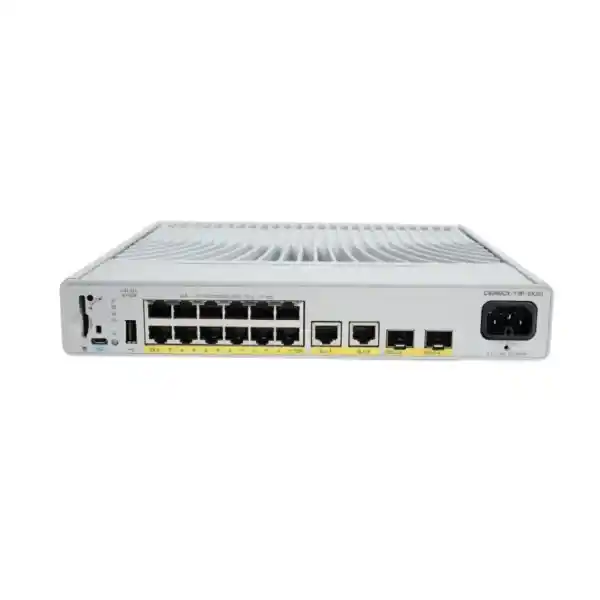
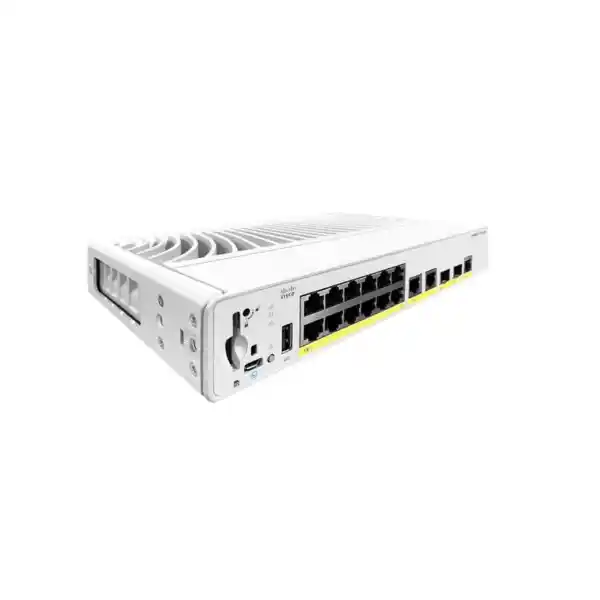
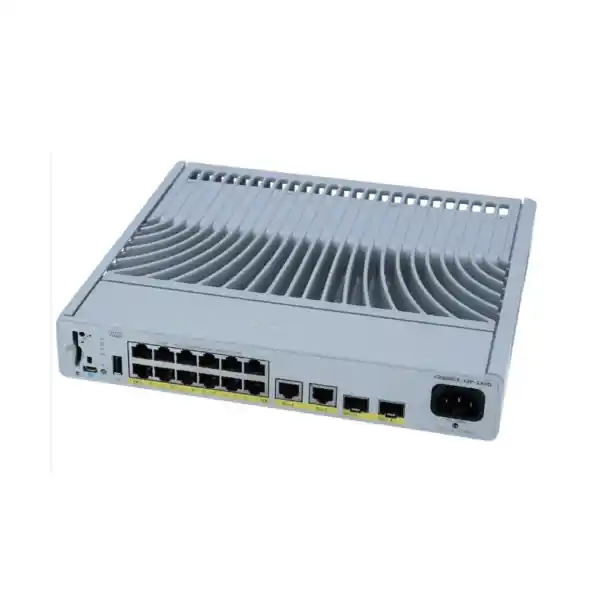
Cisco Catalyst C9200CX-12P-2X2G Network Switch
The Cisco Catalyst C9200CX-12P-2X2G brings Catalyst 9000-class operational consistency into compact rooms, distributed work areas and branch locations that need enterprise switching without the acoustic and physical overhead of a full-width access switch. Twelve 1G PoE+ ports, two 10G SFP+ uplinks, two 1G copper uplinks, a 240 W PoE budget and fanless operation make it especially practical for UAE offices, retail floors, hospitality spaces, education facilities and smart-building deployments.
FourTeck helps UAE buyers validate licensing, optics, PoE load, uplink design, mounting method, software lifecycle and deployment requirements before quotation so the selected switch fits the actual network rather than only matching a port-count checklist.
What the C9200CX-12P-2X2G is designed to do
The C9200CX-12P-2X2G is a fixed-configuration compact access switch in the Cisco Catalyst 9200CX family. Its purpose is not to replace a dense 24-port or 48-port wiring-closet switch. Instead, it addresses the many enterprise locations where network services are required close to users, cameras, wireless access points, phones, room systems, building controls and other powered Ethernet endpoints, but where rack depth, acoustics, local power distribution or cabling distance make a conventional access layer inconvenient. It is a particularly strong fit for distributed access architectures in which fiber or high-speed copper is extended from an aggregation layer to small local zones, and the compact switch provides the final Gigabit Ethernet and PoE+ handoff.
The model provides twelve 10/100/1000 Ethernet downlink ports with PoE+ capability, two fixed 10G SFP+ uplink ports and two fixed 1G copper uplink ports. Cisco specifies a 315 W internal AC power supply and a maximum PoE budget of 240 W for this switch. That combination creates useful headroom for mixed powered-device populations without implying that every port can draw the full 30 W PoE+ maximum simultaneously. In real deployments, the engineering task is to total the expected steady-state and peak draw of all endpoints, reserve contingency capacity, and account for future additions rather than dividing 240 W by twelve and treating the result as a guaranteed per-device allocation.
Because the chassis is fanless, it can be placed in environments where acoustic output matters, such as executive areas, meeting suites, classrooms, healthcare consultation rooms, hotel service spaces and open-office zones. Fanless operation also removes a moving component from the enclosure, although it does not eliminate thermal design requirements. The switch still needs the clearances, orientation and ambient conditions specified for installation; compact should never be interpreted as permission to enclose the unit without airflow around its heat-dissipating surfaces.
Verified hardware and forwarding profile
Access interfaces
Twelve 1 Gigabit Ethernet RJ-45 downlink ports provide the local access layer. The PoE+ capability is suited to common IEEE-powered enterprise endpoints such as IP phones, security cameras, wireless access points, room controllers, badge readers and selected IoT or building devices, subject to each endpoint’s negotiated power requirements.
Uplink interfaces
Two fixed 10G SFP+ uplinks allow high-speed fiber or supported direct-attach connectivity toward distribution or aggregation, while two additional fixed 1G copper uplinks give designers practical options for management, legacy aggregation, local handoff, backup paths or topologies that do not require optical media on every uplink.
Switching performance
Cisco lists 68 Gbps switching capacity and a 50.59 Mpps forwarding rate for the C9200CX-12P-2X2G. Those values align the platform with its compact access role: the switch is engineered to forward access traffic at enterprise speeds while providing substantially faster uplink capacity than a simple small-office unmanaged switch.
Memory and scale
For C9200CX platforms, Cisco specifies 4 GB DRAM, 8 GB flash, 6 MB packet buffers, up to 32,000 MAC addresses, 4,000 IPv4 routing entries, 2,000 IPv6 routing entries, 4094 VLAN IDs, 512 switched virtual interfaces, 16,000 Flexible NetFlow entries, and jumbo frames up to 9198 bytes.
Physical format
The C9200CX-12P-2X2G measures approximately 1.73 × 10.6 × 9.6 inches, or 4.4 × 26.9 × 24.4 cm, and weighs about 6.6 lb or 2.99 kg. Its shallow compact footprint is useful for wall, cabinet, shelf and distributed telecom installations where a full-size rack switch would consume excessive space.
Power and acoustics
A fixed 315 W AC internal power supply supports a 240 W maximum PoE budget. The switch is fanless, which is a major differentiator for occupied-area deployments. The AC input is auto-ranging from 100 to 240 VAC, making the platform compatible with standard UAE mains environments when the correct Cisco power cord and installation practice are used.
UADP 2.0 Mini architecture: why it matters at the compact edge
The defining difference between a compact Catalyst 9200CX and an ordinary small managed switch is the architecture behind the front-panel port count. Cisco builds the 9200CX family around its UADP 2.0 Mini architecture, integrating the data-plane functions and embedded CPU resources needed to run IOS XE features in a small, fanless form factor. For network architects, this matters because branch and distributed-edge sites increasingly require the same segmentation, policy, telemetry, authentication and operations model as a main campus. A compact switch that behaves like a separate management island can create more operational cost than it saves in hardware.
The C9200CX design maps the twelve access ports and fixed uplinks through the platform’s ASIC resources, allowing forwarding, access-control and quality-of-service behavior to be implemented in hardware rather than treating the unit as a low-end software-forwarding appliance. The programmable pipeline approach supports flexible allocation of Layer 2 and Layer 3 forwarding resources, ACLs and QoS entries. In practice, this gives engineers a better foundation for standardized enterprise templates: VLAN design, voice and video prioritization, endpoint policing, security ACLs, route interfaces and telemetry can be built using the same operational concepts used elsewhere in the Catalyst estate.
The embedded CPU complex is backed by 4 GB of DRAM and 8 GB of flash on C9200CX models. Those resources are not simply headline numbers; they support the IOS XE software environment, configuration storage, logging, programmability and platform services. Cisco also documents support for model-driven programmability and streaming telemetry, which is useful when a network team wants to move beyond periodic SNMP polling toward structured monitoring and automation. A distributed switch estate can therefore be integrated into configuration pipelines, assurance workflows and inventory systems rather than maintained as a collection of individually administered edge devices.
For UAE enterprises with multiple branches, clinics, showrooms, hotels, schools or project offices, architectural consistency is often more valuable than theoretical feature density. The ability to deploy a compact switch while retaining Cisco IOS XE operational patterns can reduce training variance, simplify troubleshooting and keep change-control procedures consistent. It also helps organizations that already use Catalyst Center, Cisco ISE or structured Cisco configurations extend policy to small locations without selecting an unrelated small-business switching family solely because of physical size.
Port design and uplink engineering
A twelve-port access switch can be deceptively simple to size. The C9200CX-12P-2X2G offers enough interface flexibility that the best design depends on what the ports are expected to carry and how the site connects upstream. The twelve downlinks are 1G Ethernet ports. For conventional office endpoints, phones, printers, cameras and many building systems, that speed is appropriate and predictable. The two 10G SFP+ uplinks are the key to avoiding an upstream bottleneck when several downlink ports are active simultaneously. They can be used for a primary and secondary fiber path, parallel logical uplinks, a routed access design, or other supported topology depending on the campus architecture.
When fiber is selected, the transceiver and fiber plant must be engineered as one system. The distance, fiber type, connector presentation, optical budget, patch-panel path and supported Cisco optic all matter. A short multimode run inside a building has different requirements from a single-mode connection between buildings or across a large campus. Procurement should therefore avoid treating “10G SFP+” as a complete bill of materials. The switch provides the socket; the correct transceiver, fiber type, patch leads and upstream port compatibility complete the link.
The two 1G copper uplinks are valuable where fiber is unnecessary or where an additional local Ethernet handoff improves topology flexibility. They can support designs in which the 10G ports carry primary distribution traffic while copper is reserved for a secondary path, a local router or firewall connection, a management segment or migration from an older access design. The exact use should be validated against the intended Layer 2 or Layer 3 configuration rather than assuming all four uplink interfaces must be active.
It is equally important to understand what the switch does not provide. C9200CX models do not support Cisco StackWise physical stacking. A network team should not design two compact units as if they become one StackWise control plane. Redundancy must instead be created through the broader network topology, using appropriate upstream paths, first-hop redundancy, routing, spanning-tree design, link aggregation where supported by both ends, or distribution-layer architecture. This distinction matters in branch designs because it changes the failure domain and management model.
For organizations refreshing older 1G access switches, the C9200CX-12P-2X2G is often best understood as a compact high-quality edge node with strong uplink options, not as a miniature stack member. Correctly positioned, it can reduce local copper home-runs, keep powered devices close to their access switch and provide fast fiber aggregation back to the main network.
PoE+ planning: use the 240 W budget intelligently
Power over Ethernet is one of the strongest reasons to choose the C9200CX-12P-2X2G. The switch supports PoE+ on all twelve access ports and has a maximum available PoE budget of 240 W. PoE+ can deliver up to 30 W at the PSE side for a compatible endpoint, but the system-level power budget means that not every port can simultaneously consume the maximum. For this reason, a professional design starts with the actual endpoint inventory rather than assuming a uniform wattage per port.
Consider a realistic branch example: four desk phones may draw modest power, three fixed cameras may require higher draw during infrared operation, two wireless access points may use significantly more than the phones, and a video room controller or environmental sensor may add further load. The average may appear comfortably below 240 W, but commissioning and peak conditions can raise demand. Some cameras increase consumption at night when illuminators activate. Access points can draw more under higher radio utilization. A device may negotiate a higher class than its typical steady consumption. Good engineering therefore includes reserve capacity instead of sizing to the last watt.
Cisco provides per-port power controls and visibility into PoE consumption. These features are useful for operational governance. An administrator can set limits where appropriate, monitor actual draw and identify unexpected changes. This can help reveal an endpoint replacement that consumes more power than the original device, a failing powered device, or a branch that has grown beyond its planned load. The PoE MIB and IOS XE monitoring options can also feed a centralized management approach so facilities and network teams are not relying on manual checks.
Cable quality affects powered-device reliability. A compliant copper installation using appropriate category cabling, terminations and length is important for both data integrity and voltage delivery. Excessive resistance, poor patch leads, substandard conductors or damaged terminations can lead to intermittent endpoints that appear to be switch failures. For UAE installations, ceiling spaces, risers and service areas may also experience higher temperatures than occupied rooms; cable and pathway selection should account for the actual environment and local project requirements.
The fixed 315 W internal AC supply means there is no field-swappable redundant PSU architecture on this compact model. If site availability requires continued service through a local power-supply or utility event, redundancy should be considered at the system level: suitable UPS coverage, redundant upstream network paths, dual-switch designs for critical devices where endpoint capability permits, and clear replacement procedures. The switch is designed for a compact role, so availability engineering must reflect that role instead of borrowing assumptions from larger modular or dual-PSU access platforms.
FourTeck can assist with PoE sizing as part of the procurement scope through FourTeck IT Services UAE, particularly where the bill of materials includes access points, cameras, IP telephony, structured cabling, UPS systems and fiber uplinks that need to be validated together rather than ordered independently.
Layer 2 scale, segmentation and campus access behavior
At the access layer, the operational quality of a switch is determined by more than raw bandwidth. Enterprise networks need predictable VLAN behavior, spanning-tree controls, storm protection, endpoint authentication, traffic classification, multicast handling and clean integration with the upstream design. Cisco specifies support for up to 4094 VLAN IDs on C9200CX, 128 PVST instances, substantial spanning-tree virtual-port scale and up to 512 switched virtual interfaces. Those platform values give the compact switch enough logical scale for sophisticated branch segmentation, although the practical configuration should remain as simple as the business requirement allows.
A typical UAE branch may separate corporate clients, voice endpoints, wireless infrastructure, guest services, CCTV, building-management systems, printers and contractor devices. The twelve physical downlinks do not prevent the switch from participating in a more structured segmentation model. Trunks can carry multiple VLANs upstream, access ports can be assigned by device role, voice VLANs can be applied to phone deployments, and policy can be enforced through ACLs and identity mechanisms. The benefit is a small local footprint without collapsing every endpoint into one flat broadcast domain.
The platform’s 32,000 MAC-address scale is far beyond the number of locally attached ports because a switch may learn many MAC addresses over its uplinks as part of the wider Layer 2 topology. Similarly, 6 MB of packet buffer supports the forwarding pipeline when traffic arrives in bursts. Buffer capacity should not be mistaken for a substitute for good QoS or uplink sizing; it is one element of the overall forwarding design. If several 1G devices burst toward a single constrained destination, the network still needs appropriate traffic engineering and congestion management.
For voice, video and other latency-sensitive services, QoS classification and queuing should be built around an end-to-end policy. Marking traffic at the edge only helps if the upstream switches, routers, firewalls and WAN service preserve or intentionally rewrite those markings. The C9200CX platform supports enterprise QoS resources, but a branch QoS policy should still be based on application requirements, trust boundaries and WAN behavior. Blindly copying a large campus template into every site can make troubleshooting unnecessarily complex.
The compact switch also supports jumbo frames up to 9198 bytes. Jumbo frames can be valuable in specific application or infrastructure designs, but they must be consistent across the complete path. Enabling larger MTUs on one switch does not make an end-to-end jumbo path. For ordinary office access traffic, standard MTU behavior remains appropriate unless the application architecture explicitly requires otherwise.
Layer 3 capabilities and routed access considerations
The Catalyst 9200CX family is capable of more than Layer 2 access. Cisco IOS XE provides Layer 3 functions that can support routed access, branch segmentation and resilient campus designs. Cisco documents static routing, RIP-family protocols and OSPF capabilities in the Network Essentials stack, with additional advanced routing capabilities tied to the relevant software level. Cisco also notes that C9200CX supports basic BGP beginning with IOS XE 17.13.1, which can expand design choices for selected edge and distributed architectures.
The platform scale includes 14,000 total IPv4 routes when ARP plus learned routes are counted, 4,000 IPv4 routing entries and 2,000 IPv6 routing entries. These are useful technical limits, but they should not be interpreted as a recommendation to turn a compact twelve-port access switch into a core router. The value is flexibility. A branch may terminate selected VLAN interfaces locally, run a routed uplink to eliminate unnecessary Layer 2 failure domains, participate in an OSPF area or use other supported protocols as part of a standardized routed-access strategy.
Routed access can be particularly attractive where the enterprise wants deterministic convergence and smaller broadcast domains. Instead of extending many VLANs across a campus or between buildings, the network can route close to the access layer and advertise local subnets upstream. Whether that is appropriate depends on services such as DHCP relay, wireless architecture, security policy, first-hop redundancy, multicast and operational skills. The C9200CX provides the technical foundation, but the best topology is the one that matches the organization’s support model.
IPv6 capability is relevant even for organizations that are still predominantly IPv4. New cloud, service-provider and IoT environments increasingly expose dual-stack requirements. Building access switches on a platform with IPv6 routing and monitoring support reduces the risk of creating a future replacement requirement solely because the access layer was designed too narrowly. The same principle applies to multicast. Cisco documents PIM sparse mode and Source-Specific Multicast support in the Catalyst 9200 feature set, which can be useful for video distribution, selected surveillance designs and enterprise applications that use multicast delivery.
When a design requires dynamic routing, the exact license, IOS XE release, feature support and organizational standards must be validated before purchase. FourTeck quotations should therefore identify whether the requested configuration is Network Essentials or Network Advantage and whether a Cisco subscription is needed for the intended operational model rather than treating the base hardware name as a complete software entitlement.
Security architecture for a distributed access edge
Access switches sit at a sensitive trust boundary because they are where end devices enter the enterprise network. A compact switch in a meeting room, retail back office, clinic, classroom or remote branch may be physically closer to end users than equipment in a locked data center. Security therefore needs to cover device access, endpoint admission, segmentation, control-plane protection, link confidentiality and operational visibility. The Catalyst 9200CX platform is designed to participate in Cisco’s enterprise security model rather than functioning as an isolated Layer 2 box.
Cisco specifies AES-256 MACsec capability for C9200CX models. MACsec, when implemented on compatible interfaces and with the correct design, can protect Ethernet frames on a link against unauthorized observation or manipulation. This is valuable where traffic crosses less-trusted physical pathways or where an organization requires encryption within the campus. MACsec deployment should be engineered end to end: the peer device, key-management method, software release, license and interface compatibility must all align. The presence of MACsec support on the platform is not equivalent to automatic encryption of every port.
Identity-based access is another major control point. Cisco Catalyst access networks commonly integrate with Cisco Identity Services Engine for 802.1X, MAB and policy assignment. A practical deployment may authenticate managed laptops through 802.1X, place phones into a voice role, classify printers or cameras through controlled fallback methods, and apply guest or remediation access when a device fails posture or identity checks. The value of an enterprise switch is the ability to make access policy systematic rather than relying exclusively on static VLAN assignments.
The C9200CX platform also offers ACL scale and Cisco security features that support segmentation and trustworthy infrastructure design. ACLs can control traffic between subnets or endpoint categories, but they should be used as part of a documented policy. Overly complex access lists copied without ownership can create outages and hidden exceptions. A better model defines which device groups need to communicate, where enforcement belongs, how changes are approved and how logs or telemetry are reviewed. The switch then becomes an enforcement point in a wider security architecture.
At the Layer 2 edge, features such as DHCP snooping, Dynamic ARP Inspection, port security and related control mechanisms are commonly important in Cisco campus designs. Their purpose is to reduce spoofing, rogue DHCP activity and unauthorized attachment. They must be deployed carefully because legitimate infrastructure ports and special devices may need trust configuration or exceptions. A well-designed template separates user-facing ports, infrastructure trunks, access points, cameras and uplinks so security controls are applied according to role rather than as a single blanket configuration.
Operational security also depends on management-plane discipline. Use secure administrative protocols, centralized AAA where appropriate, role-based access, controlled configuration backups and software maintenance. The switch supports IOS XE and can fit into Cisco management workflows, allowing network teams to standardize software versions and detect configuration drift. A branch switch should not remain on an arbitrary image simply because it appears stable; it should follow the enterprise’s validated release train and vulnerability-management process.
For security architectures that combine switching and perimeter controls, FourTeck’s Firewall Dubai practice can help align local VLANs, uplink routing and firewall policy so segmentation is preserved beyond the access switch instead of disappearing at the branch gateway.
Cisco IOS XE operations, WebUI, telemetry and automation
Cisco IOS XE is central to the operational value of the Catalyst 9200CX family. Organizations that already run Catalyst 9000 platforms gain a familiar CLI, configuration model and management ecosystem in a compact switch. This matters for repeatability. A branch deployed in Dubai can use the same naming standards, AAA approach, logging destinations, NTP design, monitoring conventions and automation pipelines as a larger office in Abu Dhabi, Sharjah or another region.
For teams that prefer a graphical workflow for initial provisioning or localized troubleshooting, Cisco provides an embedded WebUI. Cisco states that WebUI ships with the default software image and can be used to build configurations, monitor and troubleshoot the device. A GUI can simplify occasional administration, but enterprise environments should still establish a source of truth for configuration. Mixing ad hoc local changes with automation or central management can cause drift. The most effective operating model defines which system is authoritative and how emergency local changes are reconciled afterward.
Model-driven programmability and streaming telemetry allow the switch to participate in more modern network operations. Rather than relying only on command-line screen scraping, automation platforms can use structured models and APIs where supported. Telemetry can provide more frequent and machine-readable operational data than conventional polling alone. For multi-site UAE networks, this supports central visibility into interface states, errors, device health and potentially policy behavior without requiring technicians to visit each branch for basic diagnostics.
Cisco also documents support for Bluetooth connectivity through a compatible dongle, which can present a wireless management interface for configuration and troubleshooting. This can be useful during deployment when physical access to the console port is inconvenient. It should nevertheless be treated as a managed administrative capability with the same security expectations as any other management interface. Enable only what the operating procedure requires and control access according to the organization’s security policy.
The C9200CX provides a Micro-USB console option and supports additional local storage through Micro-SD up to the platform-supported capacity. A front blue beacon LED can assist technicians in identifying the correct switch in a dense or visually similar installation. Small operational details such as device identification, standardized labels, photographed cabling and documented uplinks often make a meaningful difference when remote teams are guiding local hands through troubleshooting.
For broader UAE network modernization, FourTeck UAE can coordinate switching, wireless, security, cabling and implementation requirements so the C9200CX is treated as part of an architecture rather than as an isolated hardware purchase.
Licensing: Network Essentials, Network Advantage and subscriptions
Cisco sells the C9200CX-12P-2X2G in licensing variants, including Network Essentials and Network Advantage base options. The ordering designations are commonly represented by model suffixes such as C9200CX-12P-2X2G-E for Network Essentials and C9200CX-12P-2X2G-A for Network Advantage. Buyers should therefore avoid issuing a purchase request with only the hardware family name when specific Layer 3, segmentation, automation or management features are required. The intended feature set should determine the exact orderable SKU.
Cisco’s licensing model has evolved, and current Catalyst 9200 documentation describes options involving unified switching licenses through Cisco Networking Subscription as well as Cisco DNA licensing models. The commercial choice can affect entitlement periods, management capabilities and renewal planning. Because licensing policies and available subscriptions can change over the product lifecycle, a quotation should be based on the current Cisco ordering guide and the customer’s actual operational requirements rather than a historical assumption about what was bundled with an earlier Catalyst generation.
For a straightforward Layer 2 access design with limited routing requirements, Network Essentials may be sufficient. For more advanced routing or enterprise features, Network Advantage may be necessary. The exact answer depends on the required protocols and feature set. If the organization is using Catalyst Center, SD-Access, advanced assurance, cloud management or other subscription-dependent capabilities, those requirements should be stated during design so the bill of materials includes the correct software level and term.
License selection is also an operational decision. A network with dozens of compact switches across multiple sites benefits from consistency. Mixing Essentials and Advantage randomly can create troubleshooting surprises when a configuration template works at one site but fails at another because the entitlement differs. Standardize a small number of approved branch profiles, record license levels in inventory and align renewal dates where possible. This reduces administrative overhead and supports predictable feature availability.
When requesting a FourTeck quote, include whether the project is new deployment, replacement, expansion or spares; the required software tier; subscription term if already specified by policy; and whether the organization has an existing Cisco Enterprise Agreement or Smart Account structure. Those details help prevent a hardware-only quote that later requires commercial correction.
Management choices: local CLI, Catalyst Center and cloud-managed operations
Cisco positions the Catalyst 9200 family with multiple operational choices. Traditional IOS XE CLI remains available for organizations that manage configurations directly. Cisco Catalyst Center can provide on-premises automation, assurance and policy workflows. Cisco also supports cloud management and monitoring paths through the Meraki dashboard for supported Catalyst deployments. The right model depends on organizational maturity, site count, security requirements, existing tooling and where the network team wants configuration authority to reside.
Local CLI management offers maximum familiarity and control for experienced Cisco teams. It works well when the enterprise already has configuration templates, Ansible or other automation, central AAA, syslog, SNMP or telemetry collection, and software lifecycle processes. The risk is not the CLI itself; the risk is unmanaged variance. If each branch engineer configures ports differently, a standardized platform can still become operationally fragmented.
Catalyst Center is attractive where the organization wants centralized provisioning, assurance and software image management. For distributed sites, it can reduce manual configuration and provide network-health context beyond raw interface status. If Cisco ISE and SD-Access are part of the architecture, Catalyst Center becomes even more relevant because policy and fabric workflows can be coordinated centrally. However, the design must be planned around supported releases, licensing and reachability to management systems.
Cisco’s cloud management options give organizations another path. Current Cisco documentation describes the ability to onboard Catalyst 9200 platforms into the Meraki dashboard, with choices around whether configuration remains device-sourced or is managed from the cloud, depending on supported mode and release. This can be valuable for companies that want centralized visibility across many small sites without maintaining a large on-premises management stack. As with any cloud management decision, assess data governance, change control, Internet dependency, role separation and operational ownership.
The platform therefore supports a progressive operating model. A customer can start with standard IOS XE management and later adopt more centralized workflows, provided licensing and software support align. That flexibility helps protect investment when an organization is consolidating multiple network-management practices after mergers, branch growth or a shift toward managed services.
Where the C9200CX-12P-2X2G fits best in UAE environments
Distributed office zones
Large offices sometimes have clusters of users or devices far from the main telecom room. A compact fanless switch can be installed in a suitable local cabinet or technical area, fed by a 10G fiber uplink, and used to serve nearby phones, PCs, access points and printers. This can reduce long horizontal copper runs and simplify future moves, provided structured-cabling standards and local power protection are maintained.
Retail and showroom networks
Retail locations often need a mix of POS terminals, phones, cameras, digital signage controllers, access points and back-office devices but do not justify a 48-port switch. The C9200CX offers enterprise security and management in a footprint that can fit controlled back-office spaces. VLAN segmentation can separate payment, corporate, guest and surveillance traffic while 10G uplinks support central services.
Hospitality and meeting facilities
Hotels, conference rooms and premium meeting suites benefit from fanless switching because network equipment may be physically close to occupied spaces. PoE+ can power room phones, cameras, wireless access points and selected AV control endpoints. Centralized Cisco operations help keep many distributed closets or service areas consistent across a property.
Education and training rooms
Classrooms, labs and training suites can use compact access switching to support instructor stations, phones, access points, AV controllers and cameras. VLANs and identity policy can separate staff, student, guest and infrastructure devices. Quiet operation matters where switches are installed near teaching areas, while centralized configuration reduces differences between rooms or buildings.
Security and surveillance zones
The 240 W PoE budget can support a carefully sized group of IP cameras and related devices. Fiber uplinks are useful when camera zones are physically distant from the main network. Designers should calculate day and night camera draw, environmental conditions, storage traffic, multicast requirements and failover strategy rather than selecting only by camera count.
Smart-building access
Building systems increasingly use Ethernet and PoE for sensors, controllers, access systems and operational technology gateways. A compact Catalyst switch can extend enterprise policy into these areas. Segmentation is especially important because building devices may have different patch cycles and risk profiles from managed corporate endpoints, making controlled VLANs and ACLs preferable to a flat network.
UAE deployment engineering: heat, space, power and cabling
A compact fanless switch is attractive in the UAE, but local environmental reality deserves careful attention. Fanless does not mean heatless. The chassis is designed to dissipate heat passively, so placement must allow the enclosure to radiate and convect heat as Cisco intends. Avoid tightly sealed cabinets without thermal assessment, surfaces exposed to direct solar heating, ceiling voids with unknown temperature, or service spaces adjacent to heat-generating equipment. A room that feels comfortable at desk height may have significantly higher temperature inside an enclosed telecom cabinet.
Power quality also matters. The internal AC supply supports the standard voltage range used in UAE facilities, but network uptime depends on more than nominal input voltage. Branch switches serving phones, Wi-Fi and cameras are often considered “small loads” and omitted from UPS planning. That can create disproportionate business impact during a brief power disturbance. Where continuity matters, size the UPS for the switch plus its PoE load, include conversion losses and battery aging, and validate runtime expectations under realistic endpoint consumption.
Structured cabling should be documented with port labels that map clearly between the switch, patch panel, outlet and endpoint. This is especially important when a compact switch is installed outside a traditional main distribution frame. Without disciplined labeling, distributed access can become difficult to support. Use suitable category cabling for Gigabit Ethernet, keep channel lengths within standards, test installed links, and separate data pathways from sources of electromagnetic interference according to project practice.
Fiber uplinks need equally disciplined documentation. Record optic type, wavelength, fiber mode, patch-panel identifiers, strand numbers and upstream switch ports. If redundant paths are used, ensure the physical routes are genuinely diverse where resilience is required. Two uplinks in the same cable tray, passing through the same patch panel and terminating on the same upstream device may protect against a port failure but not against a pathway or distribution-switch outage.
Physical security should not be overlooked simply because the switch is compact. A wall-mounted unit in a public or shared back-of-house area can be easier to access than equipment in a locked rack. Use a controlled enclosure or secure technical space when the connected network carries sensitive business, payment, surveillance or building-management traffic. Document who can access the cabinet and how emergency replacement is performed.
For projects that extend beyond the UAE, FourTeck can coordinate broader enterprise requirements through FourTeck Global, helping keep switching standards, licensing assumptions and deployment documentation consistent across regional locations.
Designing a resilient topology without StackWise
Because Cisco explicitly states that stacking is not available on C9200CX switches, resilience should be designed at the network level. This is not a weakness when the platform is used for its intended distributed-access role; it simply means the failure model differs from a stack of larger wiring-closet switches. A single compact switch is one fault domain. If all twelve endpoints depend on it, a hardware failure affects those endpoints until service is restored or devices are moved.
For ordinary offices, that fault domain may be acceptable because the business impact is limited and spare replacement can be quick. For critical environments, designers can use two compact switches serving different endpoint groups, connect them to separate upstream devices, or distribute redundant endpoint links where the endpoint supports dual NICs or multiple network paths. Wireless access points can be divided between switches to preserve partial coverage during maintenance. Cameras covering the same critical area can be split across switches. Phones and workstation ports can be distributed by zone rather than placing every important service on one device.
Uplink resilience should be selected according to Layer 2 or Layer 3 design. A pair of 10G uplinks may connect to a suitable upstream architecture, but simply plugging two cables into different switches does not automatically create a supported or loop-free topology. Spanning Tree, link aggregation, multi-chassis behavior on the upstream side, routed interfaces and first-hop design all influence the result. The exact configuration must reflect the capabilities of the distribution layer.
Maintenance planning is another form of resilience. Standardize configuration backups, keep approved software images and licenses documented, maintain spare optics and patch leads, and consider holding a compatible spare switch for locations where replacement lead time would be costly. A compact access switch is comparatively straightforward to swap if its configuration, VLAN mapping and uplink optics are known in advance. The recovery delay is often created by missing documentation rather than by the physical replacement itself.
Finally, avoid designing every small site to a data-center availability standard unless the business case supports it. Resilience has cost, complexity and management overhead. The right target is a measured design in which the expected impact of a switch, power or uplink failure is understood and matched to the site’s business criticality.
Performance interpretation: 68 Gbps switching and 50.59 Mpps forwarding
Cisco lists 68 Gbps switching capacity and 50.59 million packets per second forwarding for the C9200CX-12P-2X2G. These numbers are useful when validating the hardware platform, but they should be interpreted in the context of the port map and real traffic. The aggregate theoretical bandwidth of access and uplink interfaces is different from the amount of traffic an application produces. Many office endpoints are bursty; a phone uses only a small fraction of a Gigabit port, while a workstation may occasionally generate large backup or file-transfer bursts.
The dual 10G SFP+ uplinks are particularly important because they create far more upstream bandwidth than a single 1G uplink. In a distributed zone with twelve access ports, a 10G aggregation path can prevent the uplink from becoming the obvious bottleneck during concurrent activity. Whether one or both 10G ports are used depends on resiliency and topology, not on a requirement to consume every interface. An engineered design may prefer one 10G primary and one 10G secondary, or may use logical aggregation when supported by the peer and architecture.
Packet forwarding rate becomes relevant for workloads dominated by small frames, where packets per second can stress a forwarding platform before raw bandwidth is exhausted. The listed 50.59 Mpps capacity provides substantial headroom for the switch’s intended access role. In most branch designs, application behavior, uplink congestion, WAN limits, firewall throughput and Internet circuits will be more visible constraints than the C9200CX data plane itself.
The 6 MB packet buffer helps absorb short traffic bursts, but sustained oversubscription still requires QoS and capacity planning. For example, several endpoints transferring data toward a 1G server path can create congestion even if the switch’s internal fabric is not saturated. Engineers should therefore examine the complete path: endpoint NIC, access port, uplink, distribution switch, firewall, server port and WAN. A fast access switch cannot compensate for a constrained service elsewhere.
Performance validation should also include error counters, duplex negotiation, optic levels and cabling health. A 10G fiber link with poor optical margin or a copper channel with physical-layer errors can create application complaints that resemble software or switching problems. Baseline the healthy network after installation so future deviations can be identified quickly.
Wireless, voice, video and collaboration edge use
The C9200CX-12P-2X2G is well suited to edge environments where multiple real-time and powered-device services converge. Wireless access points, IP phones, collaboration endpoints and surveillance cameras each impose different requirements. The switch can power many such endpoints, but the design should treat power, data rate, VLANs and QoS separately. A device that fits within the PoE budget may still need a specific VLAN, security policy or uplink path.
For wireless, remember that the twelve downlinks on this particular model are 1G. If a modern access point requires multigigabit Ethernet to realize its full wired-side performance, another C9200CX variant with mGig interfaces may be a better fit. The C9200CX-12P-2X2G remains appropriate for access points whose Ethernet requirement is satisfied by 1G and whose power requirement falls within PoE+ support. This distinction should be checked against the exact AP model rather than assumed from Wi-Fi generation alone.
For voice, PoE simplifies installation because phones can receive power from the switch and can remain operational through a correctly sized centralized UPS. Voice VLANs, QoS markings, DHCP options and call-control reachability should be validated during deployment. If phones provide a PC pass-through port, the access policy must account for both voice and data devices on one physical switchport.
Video collaboration and room systems can generate burstier traffic than voice. Cameras may stream continuously, while conference systems can create high upstream and downstream bandwidth during meetings. QoS should prioritize delay-sensitive media without starving critical business applications. The 10G uplink options provide useful aggregation capacity, but end-to-end service quality still depends on WAN, firewall and conferencing architecture.
For surveillance, calculate both PoE and transport demand. Twelve high-bitrate cameras can create a continuous stream toward recording infrastructure. The switch can handle substantial access traffic, but the storage network and recorder must also be sized. If cameras use multicast or specialized discovery protocols, test those behaviors with the intended VLAN and security policies before full rollout.
Sizing methodology before you order
A reliable switch quotation starts with a small design exercise. First count endpoints, but classify them instead of recording only a total. Separate user devices, phones, cameras, access points, printers, building systems, uplinks and spare ports. Determine which endpoints need PoE, their maximum draw, their data speed and whether they are considered critical. This produces a usable port-and-power matrix rather than a simple statement such as “we need twelve ports.”
Second, reserve growth. If a site needs exactly twelve access ports on day one, this model may provide no local expansion without another switch. In a stable retail kiosk that may be acceptable. In a growing office, selecting a larger platform may be more economical than adding a second compact switch within months. Conversely, buying a 48-port switch for a fixed eight-device location wastes space and power. Match density to credible growth, not vague future possibility.
Third, calculate the PoE budget using endpoint datasheets. Sum maximum expected draw, add design margin and identify whether any devices require standards beyond PoE+. The C9200CX-12P-2X2G is a PoE+ platform. If endpoints require UPOE or higher powered profiles, a different C9200CX model may be appropriate. Do not assume that every RJ-45 port labeled PoE behaves identically across the Catalyst family.
Fourth, design the uplink. Specify speed, media, optic, distance, upstream switch port, redundancy and VLAN or routing behavior. For fiber, identify single-mode or multimode plant and connector details. For copper, validate distance and category. If both 10G uplinks are needed for resilience, confirm the distribution design supports the intended topology.
Fifth, select licensing and management. State whether the network requires advanced routing, SD-Access, Catalyst Center integration, cloud management, specific telemetry or subscription services. This prevents the common procurement mistake of ordering the lowest hardware SKU and discovering during commissioning that the required software entitlement differs.
Sixth, document physical installation. Confirm mounting location, available power outlet, UPS capacity, grounding practice, cabinet dimensions, cable entry, service clearance and temperature. The switch’s compact dimensions solve many space constraints, but they do not remove the need for a professional installation plan.
Finally, decide the support and spare strategy. Record required warranty or support level, replacement expectations, software lifecycle owner and whether a local spare is justified. Organizations with many identical sites can often reduce downtime by keeping standardized spare stock rather than relying on emergency one-off procurement.
C9200CX-12P-2X2G versus larger Catalyst access switches
The strongest reason to buy the C9200CX-12P-2X2G is not that it is a smaller version of every Catalyst 9200. It is that it is deliberately optimized for compact, fanless, fixed-uplink access. Larger Catalyst 9200 and 9200L models provide higher port density and, depending on model, different stacking, power-supply, fan and uplink options. Those features can be more appropriate in a conventional wiring closet serving dozens of users.
The C9200CX does not offer StackWise stacking. Larger C9200 models can support StackWise-160 and C9200L models can support StackWise-80, depending on model and configuration. If the design requirement includes a multi-member stack with one management and control plane, a larger model family should be evaluated. If the requirement is a quiet twelve-port node near endpoints with fiber aggregation, the compact model is often a better physical and operational match.
Power architecture also differs. The C9200CX-12P-2X2G has a fixed internal 315 W AC supply. Larger access switches may offer field-replaceable power supplies and redundant power options. A network architect should therefore decide whether local power-supply redundancy is a requirement or whether system-level resilience through UPS, topology and spare replacement is sufficient.
Port density has cost implications beyond hardware. A 48-port switch can be efficient when a telecom room already serves many outlets. In a distributed building, forcing every endpoint back to a central closet may require more copper, larger pathways and longer installation labor. Compact switches can reduce those costs in selected designs by moving the access edge closer to endpoint clusters. The correct economic comparison should include cabling, optics, cabinets, UPS, labor and support—not only switch list price.
For a mixed network, both form factors can coexist. High-density Catalyst switches can serve the main closets while C9200CX units extend standardized Cisco access to remote zones. This hybrid approach preserves operational consistency while allowing physical design to follow the building.
Procurement details FourTeck recommends confirming
For a coordinated bill of materials and deployment scope, FourTeck can combine switching, optics, security, cabling and support through its UAE and regional delivery teams rather than forcing customers to reconcile separate quotations after purchase.
Implementation sequence for a controlled rollout
A well-planned rollout begins before the switch arrives onsite. Create the intended configuration from an approved template, reserve management addressing, define VLANs, identify uplink interfaces and document the port role for every known endpoint. If centralized AAA, syslog, NTP, DNS, SNMP, telemetry or Catalyst Center is used, confirm network reachability and credentials before the maintenance window.
At staging, record serial numbers, asset tags, license information and software versions. Upgrade to the organization’s approved IOS XE release if required, then apply the baseline configuration. Validate local console access and a recovery procedure. Test management reachability, authentication and logging before connecting production endpoints. If automation is used, ensure the device is registered in the source-of-truth system with the correct site variables.
Next, validate uplinks. Check optic compatibility, receive and transmit levels where applicable, speed, errors, VLAN trunks or routed adjacency, spanning-tree state and path redundancy. A clean uplink should be established before migrating endpoints. If two uplinks are part of the design, simulate the loss of each path and confirm traffic behavior rather than assuming redundancy works because both interfaces show link.
Migrate powered devices in controlled groups. After each group, verify PoE negotiation, interface errors, VLAN assignment, DHCP, DNS, application reachability and QoS marking. Watch the total PoE draw as cameras, APs and phones come online. This is the moment to identify devices that consume more power than expected or ports that need a different access policy.
After migration, capture a healthy baseline: interface status, PoE consumption, CPU and memory state, uplink counters, routing neighbors where used, spanning-tree roles, MAC address distribution and environmental readings. Store the final configuration and update documentation. These records significantly shorten future troubleshooting because engineers can compare abnormal behavior to the post-install state.
A final handover should identify the device owner, support contact, backup location, software policy, replacement procedure and any open risks. Compact network devices are often deployed quickly and then forgotten; disciplined handover prevents them from becoming unmanaged infrastructure.
Troubleshooting priorities for the C9200CX access layer
When an endpoint fails, start with the physical and power layers before changing configuration. Check whether the switch sees link, whether the port is err-disabled, whether PoE was negotiated, and whether the endpoint is drawing expected power. Review interface counters for CRC errors, drops or flaps. A cable fault can present as an application issue, and an overloaded or damaged powered device can appear to be a switch problem.
For authentication failures, determine whether the endpoint is failing 802.1X, MAB, DHCP or policy assignment. Check AAA reachability and time synchronization because certificate and identity workflows can fail when clocks are incorrect. Confirm that the port template matches the device type; a camera connected to a user-authentication profile may behave differently from a managed laptop.
For uplink problems, check both sides of the link. On fiber, inspect optic type, wavelength, receive level, patching and polarity. On copper, verify speed, duplex and cabling. If a redundant uplink is unexpectedly blocking or forwarding, inspect spanning-tree or routing design rather than forcing the interface state manually. The network should converge according to architecture, not technician intervention.
For performance complaints, examine utilization and drops at each hop. A 1G access port may be healthy while a WAN circuit is saturated. A 10G uplink may be underutilized while a firewall interface is congested. Flexible NetFlow and telemetry can help identify traffic sources, but interpretation still requires understanding the application path. Avoid concluding that the access switch is undersized simply because users report slowness.
For thermal concerns, verify the installation environment and clearance. Fanless hardware relies on passive cooling, so dust accumulation, blocked surfaces or an enclosed unventilated box can affect temperature. Correct the physical environment rather than attempting to compensate through software. Good access-layer reliability is the result of both network engineering and appropriate installation practice.
Frequently asked technical questions
Does every access port support PoE+?
Yes. The C9200CX-12P-2X2G provides twelve 1G PoE+ access ports. The important design limit is the switch-wide maximum PoE budget of 240 W, so the total connected-device requirement must be calculated.
Can the switch be stacked with StackWise?
No. Cisco states that stacking is not available on C9200CX switches. If physical stacking is mandatory, evaluate appropriate C9200 or C9200L models and their supported StackWise options.
Are the 10G uplinks modular?
They are fixed SFP+ uplink interfaces on this compact model. Select supported optics based on fiber type, distance and the upstream peer. The switch also includes two fixed 1G copper uplinks.
Is the switch silent?
The platform is fanless, which removes fan noise and makes it suitable for many occupied-area installations. Installation still needs suitable thermal clearance and environmental conditions.
What is the switching capacity?
Cisco specifies 68 Gbps switching capacity with a 50.59 Mpps forwarding rate for the C9200CX-12P-2X2G, appropriate for its twelve-port compact enterprise access role.
Which license should we buy?
Choose based on required features and management model. Cisco offers Network Essentials and Network Advantage variants, and current subscription requirements should be confirmed against the intended feature set and ordering guide.
Can it be used for routed access?
Yes, the Catalyst 9200CX family supports Layer 3 capabilities. The exact protocol and scale depend on software and licensing. Cisco also documents basic BGP support for C9200CX from IOS XE 17.13.1.
Is it suitable for modern Wi-Fi access points?
It is suitable when the AP requires no more than 1G Ethernet and compatible PoE+. For APs that need multigigabit Ethernet or higher power, evaluate a mGig/UPOE C9200CX variant instead.
Technical selection notes for architects and procurement teams
The model name C9200CX-12P-2X2G encodes important design clues. “12P” identifies the twelve-port PoE+ access profile, while the uplink designation points to the combination of higher-speed SFP+ and Gigabit uplink interfaces. Procurement teams should still use the exact Cisco orderable SKU with its license suffix because the generic model name does not fully describe the software entitlement. That distinction should appear in purchase orders, asset records and support documentation.
From an architecture perspective, the switch is best when compactness and enterprise features are both mandatory. If the only requirement is a handful of unmanaged Ethernet ports, the Catalyst platform may be more capable than necessary. If the requirement is 24 or 48 local users, full stack redundancy or field-replaceable dual power supplies, a larger access model is usually more appropriate. The C9200CX occupies the valuable middle ground: small enough for distributed locations, but built for managed enterprise networks.
From a security perspective, the platform can participate in identity, segmentation and encrypted-link designs, but these controls require architecture. Buying a capable switch does not automatically create a secure access layer. Define AAA, VLANs, ACLs, endpoint trust, management-plane policy and software maintenance. Test the template with the actual endpoint mix before rolling it to many branches.
From a facilities perspective, validate wall or cabinet mounting, service access, ambient temperature, AC outlet availability and UPS support. A fanless switch is particularly useful near occupied areas, but passive cooling relies on a suitable installation environment. Keep the chassis free from blocked ventilation surfaces and avoid unapproved enclosures that trap heat.
From a lifecycle perspective, standardization pays dividends. If an organization deploys the same C9200CX profile across many sites, maintain one approved bill of materials with switch SKU, software level, optics, mounting kit, power components and support coverage. Maintain a matching configuration template and acceptance-test checklist. This reduces procurement variance and accelerates replacement.
FourTeck can supply the C9200CX-12P-2X2G as part of a complete network scope, and customers can review broader networking and infrastructure capabilities through the approved FourTeck service channels linked on this page.
Decision recap: when this Cisco Catalyst switch is the right choice
Choose the C9200CX-12P-2X2G when
You need twelve managed 1G PoE+ access ports in a compact, fanless chassis; the site benefits from 10G fiber aggregation; the PoE load fits within 240 W; Cisco IOS XE consistency matters; and the network does not require physical StackWise stacking at this access node. It is particularly effective for distributed enterprise zones, branch rooms, retail, hospitality, education, security and smart-building networks.
Evaluate another model when
You need more than twelve local access ports, multigigabit downlinks, UPOE requirements beyond this PoE+ profile, StackWise stacking, redundant field-replaceable power supplies, or a much higher density wiring-closet design. In those cases a different C9200CX variant or a larger Catalyst 9200/9200L platform may better align with the technical requirement.
The strongest procurement outcome comes from matching model, license, software, optics, power and installation to the site. FourTeck can validate those dependencies before order placement so the delivered hardware arrives as part of a deployable solution rather than as an incomplete component list.
Quotation input checklist for UAE customers
To receive an accurate commercial and technical quotation for the Cisco Catalyst C9200CX-12P-2X2G, provide as many of the following inputs as possible. This lets the engineering team validate the complete solution instead of quoting only the switch chassis.
Number of switches and deployment locations such as Dubai, Abu Dhabi, Sharjah or other UAE emirates.
Network Essentials or Network Advantage, plus any current Cisco subscription requirements or enterprise agreement context.
Models and quantities of access points, cameras, phones, controllers or other PoE endpoints, including maximum power where known.
10G SFP+ or 1G copper, number of paths, upstream switch model, fiber type and approximate distance.
CLI, Catalyst Center, cloud management, managed service, telemetry or automation expectations.
VLAN count, routed access, OSPF or other routing needs, identity integration, ACL policy and security requirements.
Rack, wall, shelf or cabinet location, temperature conditions, available depth and any mounting accessories required.
UPS requirement, desired runtime, redundant network path expectations and whether spare stock is required.
Plan the C9200CX-12P-2X2G as a complete access solution
The Cisco Catalyst C9200CX-12P-2X2G is most valuable when its compact hardware, 240 W PoE budget, 10G uplinks, IOS XE software and enterprise security capabilities are designed as one system. A correct deployment includes the switch, the right license tier, supported optics, clean structured cabling, protected power, defined VLAN and routing policy, management integration, software lifecycle planning and accurate documentation.
For UAE buyers, FourTeck can help convert a port requirement into a validated network bill of materials. That may include Cisco switching, uplink transceivers, patching, UPS sizing, security integration, configuration, testing and support. This approach is especially useful for branch rollouts where small differences between sites can otherwise lead to repeated design changes and inconsistent configurations.
Use the consultation request to share your endpoint count, PoE devices, fiber distance, upstream switch model and preferred licensing level. The engineering team can then determine whether the C9200CX-12P-2X2G is the correct platform or whether a different Catalyst model would better satisfy density, power, multigigabit or stacking requirements.

Reviews
There are no reviews yet.