
Enterprise Access Switching • UAE
Cisco Catalyst C9200L-48T-4X Network Switch
A 48-port Gigabit Ethernet data switch with four fixed 1/10G SFP+ uplinks, StackWise-80 support and Cisco IOS XE for secure, resilient enterprise access networks.
The Cisco Catalyst C9200L-48T-4X is designed for organizations that need high-density wired access without Power over Ethernet. It provides forty-eight 10/100/1000 Ethernet downlink ports for user devices, printers, servers, security appliances, industrial endpoints and other data-only equipment, while four fixed SFP+ uplinks support 1 Gigabit or 10 Gigabit optical or copper uplink designs. The platform is part of the Catalyst 9200L fixed-uplink family and uses Cisco’s UADP 2.0 mini programmable data-plane architecture. It is suited to branch offices, campus access layers, retail networks, education environments, government departments, logistics sites and enterprise wiring closets across Dubai, Abu Dhabi, Sharjah and the wider UAE where predictable access switching, simplified operations and strong software control are required.
Direct answer: who should choose the C9200L-48T-4X?
Choose the C9200L-48T-4X when your access layer needs forty-eight copper Gigabit Ethernet data ports, you do not need PoE from the switch, and you want up to four 10G uplinks without purchasing a modular uplink network module. This combination is especially efficient for floor distribution closets populated mainly by desktop PCs, workstations, printers, thin clients, non-PoE cameras with local power, storage appliances, hypervisor management interfaces, building controllers and dedicated network appliances. Because the uplinks are fixed, the bill of materials is simple: select suitable SFP or SFP+ transceivers, fiber type or supported direct-attach connectivity, stacking accessories if a stack is required, the appropriate license tier and any optional secondary power supply.
This is not the right model when the same access ports must power IP phones, wireless access points or PoE cameras. In those cases, a C9200L PoE model is generally more appropriate. The C9200L-48T-4X also differs from the 4G version because the 4X model provides four uplinks capable of 1G or 10G operation, making it significantly better suited to modern aggregation designs where several dozen 1G access ports share resilient high-speed uplinks. In a typical enterprise access layer, two 10G uplinks can be combined or distributed across redundant aggregation switches while the remaining uplink ports provide flexibility for additional paths, services or future expansion.
For UAE buyers, the practical decision should be based on endpoint power requirements, access-port count, expected northbound traffic, fiber reach, redundancy policy, Cisco license requirements, rack environment and the intended lifecycle of the network. FourTeck can combine the switch with structured cabling, optics, firewall integration, server connectivity and migration support through its UAE technology portfolio and enterprise IT services.
Verified hardware profile and port map
48 data downlinks
Forty-eight 10/100/1000BASE-T copper access interfaces for data connectivity. The T designation indicates a data-only model rather than a PoE access switch.
4 fixed SFP+ uplinks
Four fixed uplink interfaces support 1G or 10G operation, providing a practical path to redundant 10G aggregation without a separate uplink module.
StackWise-80
The C9200L fixed-uplink family supports StackWise-80, allowing multiple compatible switches to operate with a unified management and control experience.
UADP 2.0 mini
Cisco’s programmable UADP 2.0 mini ASIC provides the hardware forwarding foundation for switching, policy, security and telemetry functions.
176 Gbps switching
Cisco specifies 176 Gbps standalone switching capacity for the C9200L-48T-4X, appropriate for forty-eight Gigabit downlinks and four 10G uplink interfaces.
130.95 Mpps forwarding
The published standalone forwarding rate is 130.95 million packets per second, with higher aggregate figures available when the platform is considered with stacking.
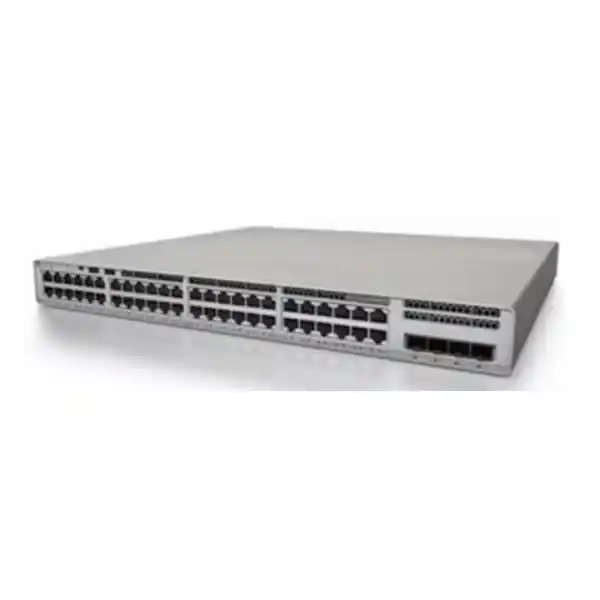
The physical port map is deliberately straightforward. Forty-eight RJ45 access ports handle standard Ethernet endpoints, while the four SFP+ positions form the northbound connectivity plane. In a conventional campus closet, ports 1 through 48 are assigned to endpoint VLANs and service segments, while one or more SFP+ links connect to distribution or core switches. An organization can use separate uplinks for resiliency, deploy EtherChannel where the upstream design supports it, reserve an interface for a local server or appliance, or use spare 10G capacity for staged migration. Because the uplinks are fixed, there is no ambiguity about which network module must be ordered for 10G operation.
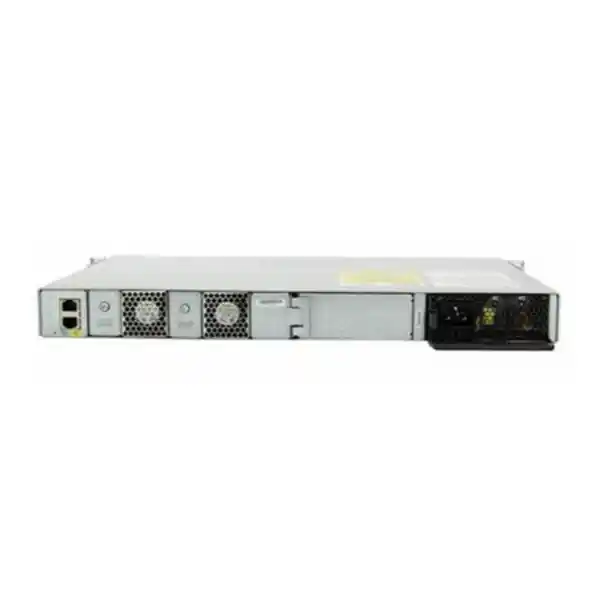
Cisco lists two power-supply slots and two fixed fans for this model. The default primary power supply for the C9200L-48T-4X is a 125W AC unit. A second supported power supply can be planned where power redundancy is part of the site standard. The 1RU form factor is suitable for standard enterprise racks, and Cisco publishes a chassis height of approximately 1.73 inches and width of 17.5 inches. The fixed-uplink C9200L chassis is compact relative to many modular access platforms, which can be valuable in crowded UAE telecom rooms where usable rack depth, cable bend radius and airflow must all be considered before installation.
Performance engineering: 176 Gbps switching and 130.95 Mpps forwarding
Switch performance should be interpreted in the context of the complete access design rather than as an isolated headline number. The C9200L-48T-4X offers 176 Gbps of published switching capacity and a 130.95 Mpps forwarding rate in standalone operation. Those values align with its role as a forty-eight-port Gigabit access switch with four 10G uplinks. A fully populated access switch rarely drives all edge ports at sustained line rate simultaneously in a typical office, but the underlying capacity matters because short traffic bursts, east-west transfers, backups, application updates, imaging processes and storage activity can create demanding concurrency.
For sizing, start with realistic traffic classes. Office productivity endpoints generally create bursty flows. Engineering workstations, media teams and local backup systems may create sustained transfers. Virtualization hosts or storage nodes attached to 1G ports can maintain high utilization for longer periods. Security appliances and local servers can aggregate traffic from many users. If forty-eight 1G access ports are present, four 10G uplinks give the designer several ways to build northbound capacity. Two 10G links may be used as a resilient logical channel to a supported upstream pair or stack, while additional interfaces remain available for alternate paths. In another design, all four uplinks can be used for greater aggregate capacity where the topology and upstream platform support the intended bundle or independent paths.
Packet forwarding rate becomes important for traffic dominated by small frames. Large-file transfers are more bandwidth-oriented, while transaction-heavy and security-sensitive environments can generate large packet counts even when raw bandwidth appears moderate. The stated 130.95 Mpps rate provides a useful engineering reference for the standalone unit. Designers should still validate feature interactions, software release support, access-control policy, telemetry configuration and any routing scale requirements because platform behavior is shaped by both forwarding hardware and the enabled software feature set.
The most effective UAE deployments avoid oversimplified oversubscription ratios. A ratio that is acceptable for a general office may be unsuitable for a CAD team, call recording cluster, video production floor, trading environment, AI workstation group or backup segment. FourTeck engineers therefore size access switching by endpoint role, uplink topology, utilization history, failure mode and growth assumptions rather than by port count alone.
StackWise-80: scaling access ports with one operational system
Cisco Catalyst 9200L fixed-uplink models support StackWise-80 stacking. A stack allows multiple compatible switches to be administered as a single logical switching system, simplifying many operational tasks compared with managing each access switch independently. Cisco documents support for up to eight members in the relevant stack family, subject to model and license compatibility rules. In a forty-eight-port design, that can create a large access domain while retaining a unified management plane and coordinated control behavior.
Stacking is useful for more than configuration convenience. It can improve uplink design because links from different physical members can participate in a resilient topology. Endpoint connections remain local to the access switch on which they are cabled, but the stack can present a single operational entity to the network team. This can simplify VLAN administration, software management, monitoring, configuration templates and troubleshooting. Where the upstream switches support compatible port-channel designs, uplinks can be distributed across separate stack members so that a single member failure does not automatically remove every northbound path.
A stack must still be engineered carefully. Stack cables, stack adapters or kits, physical member order, rack placement, power feeds, software version consistency and license tier alignment should be documented before commissioning. The stack ring should be completed according to Cisco guidance rather than left in a fragile chain. Spare parts strategy also changes: an organization may choose to hold a compatible cold spare with matching license capability and tested software so a failed access member can be replaced rapidly. Configuration archives and documented stack priorities can reduce recovery time during maintenance.
StackWise-80 also introduces failure-domain considerations. Combining many access switches into one logical system can simplify operations, but it concentrates more ports under a shared stack control structure. For critical facilities, network architects should decide whether one large stack, multiple smaller stacks or standalone switches with independent uplinks best matches the required blast radius. Different floors, departments, security zones or tenant areas may justify separate stacks even when one larger stack is technically possible.
In UAE projects with multiple wiring closets, stacking is commonly evaluated alongside dual power feeds, redundant upstream switching, fiber path diversity and firewall high availability. The goal is not simply to make several switches look like one; it is to create a predictable access architecture that remains manageable during maintenance and behaves cleanly during failures.
UADP 2.0 mini architecture and why it matters
The C9200L-48T-4X is based on Cisco’s UADP 2.0 mini architecture. UADP, or Unified Access Data Plane, is Cisco’s programmable switching ASIC approach for Catalyst enterprise platforms. For buyers, the important point is that key forwarding and policy functions are handled in purpose-built switching hardware rather than depending on a general-purpose CPU for normal packet forwarding. This is a central reason Catalyst 9000 platforms can combine enterprise switching, segmentation, security and telemetry features while preserving predictable access-layer performance.
A programmable data plane also provides architectural headroom for software evolution. Cisco IOS XE can expose new capabilities, automation interfaces and operational models while the underlying ASIC pipeline supports feature processing in hardware where designed. This is different from treating a switch as a simple unmanaged forwarding device. The C9200L participates in a broader enterprise operating model with policy, identity, monitoring, streaming telemetry, model-driven interfaces and centralized lifecycle management options.
For a network architect, the distinction matters during feature planning. VLAN forwarding, access control, quality of service, routing, security classification and telemetry all consume platform resources in different ways. The correct design therefore considers more than raw port density. It looks at the number of routed interfaces, policy objects, authentication sessions, monitoring requirements, expected multicast behavior and the chosen software tier. Cisco publishes platform scale guidance and release-specific feature support, and production deployments should be validated against the intended IOS XE release rather than assuming every possible Catalyst feature is available at identical scale on every model.
This model is positioned as cost-effective enterprise access rather than as a high-end campus core switch. That positioning is useful: the C9200L-48T-4X gives organizations a robust access-layer foundation without paying for modular uplinks or capabilities intended for much larger aggregation systems. The four fixed 10G uplinks, programmable data plane, stacking and IOS XE toolset address the core requirements of a modern wiring closet while keeping the hardware role clear.
Layer 2 access design: VLANs, trunks, spanning tree and endpoint segmentation
At Layer 2, the C9200L-48T-4X can form the foundation of a structured enterprise access policy. Physical ports can be assigned to separate VLANs for corporate users, printers, building-management systems, security devices, guest infrastructure, server management networks and other service classes. Trunk links can carry multiple VLANs toward upstream distribution switches, firewalls or service appliances. The most important design principle is to avoid treating all forty-eight ports as one flat broadcast domain merely because the hardware can provide simple connectivity. Segmentation should reflect trust level, application role, operational ownership and failure containment.
Spanning Tree design remains relevant even in networks that use routed distribution or port channels. Access switches may receive accidental loops from patching errors, unmanaged desktop switches or misconnected equipment. A disciplined configuration uses appropriate spanning-tree modes, root placement, edge-port protections and loop-guarding features to limit disruption. Edge interfaces connected to known endpoint devices should be treated differently from uplinks or inter-switch links. Controls such as BPDU Guard and storm-control policies can help stop a local mistake from propagating across a larger campus.
EtherChannel can be used where multiple physical links need to operate as one logical uplink and the topology supports the design. LACP provides standards-based negotiation and can reduce operational errors compared with static bundling. A pair of 10G SFP+ interfaces can provide substantial northbound bandwidth for a general enterprise floor, and distributing links across resilient upstream infrastructure can improve availability. The exact channel configuration must match the upstream system, especially when the far end is a stack, virtual chassis, chassis pair or independent switches.
Quality of Service should be based on traffic behavior, not merely on the presence of a priority application. Even though this model does not provide PoE for phones or access points, it may still carry voice, video, virtual desktop, transaction, backup and management traffic from externally powered devices or downstream equipment. Trust boundaries, classification, queueing and policing should be documented so high-volume flows do not overwhelm latency-sensitive services. A data-only access switch can still be part of a converged network.
The practical result is a clean access fabric where every port has an intended role, a documented security posture and a predictable path toward the distribution layer. This is particularly important in multi-tenant buildings and fast-growing UAE offices where patching changes happen frequently and undocumented exceptions can accumulate over time.
Layer 3 capabilities and the Network Essentials versus Network Advantage decision
The Catalyst 9200 family supports Layer 3 operation, but feature availability depends on the selected network license tier and software release. Cisco positions Network Essentials as the foundational tier for switching, basic routing, automation, visibility and security, while Network Advantage adds more advanced routing, segmentation and related enterprise capabilities. This distinction should be decided during architecture design rather than after installation because it affects both feature planning and procurement.
Network Essentials is appropriate for many conventional access-layer deployments where the switch primarily performs Layer 2 switching and uses static or foundational dynamic routing functions permitted by the tier. Cisco’s current licensing matrix lists Layer 2 fundamentals, static routing, routed access functions, OSPF at defined scale, policy-based routing and several security and automation features within Essentials. Network Advantage adds advanced switching and routing capabilities such as broader dynamic routing, VRF-based segmentation and additional enterprise services. Because Cisco periodically updates software packaging and feature matrices, the ordered license and intended IOS XE release should be checked together for the exact production requirement.
A common access architecture keeps default gateways at the distribution layer, making the C9200L primarily a Layer 2 access switch. This can simplify policy and reduce routing complexity in individual closets. Another design uses routed access, where Layer 3 boundaries move closer to endpoints. Routed access can reduce dependence on spanning tree across uplinks and can improve failure isolation, but it requires appropriate routing design, addressing, route convergence planning and license support. Neither approach is universally correct; the choice depends on campus scale, team skill set, segmentation requirements and the upstream architecture.
When the switch connects directly to firewalls, server networks or branch WAN equipment, Layer 3 capabilities may be used for transit segments, management routes or local inter-VLAN functions. In those designs, network architects should document which device owns each default gateway, where security inspection occurs, how asymmetric paths are prevented and whether policy should be enforced on the access switch or at a centralized firewall. FourTeck’s firewall and secure-network practice can align switching segmentation with perimeter and internal security controls.
The licensing choice is therefore an architectural choice. A switch purchased only by port count can become restrictive if advanced segmentation or routing is required later. Conversely, an organization that uses a straightforward Layer 2 access design should not automatically assume it needs the highest software tier. The correct bill of materials maps business requirements to specific functions and validates those functions against Cisco’s current licensing matrix.
Identity, access security and MACsec
Modern access security starts by treating a switch port as a policy enforcement point rather than a passive cable termination. The Catalyst 9200 platform supports 802.1X-based access control, allowing organizations to authenticate compatible endpoints before placing them into production network segments. Depending on the broader identity architecture, policies can differentiate managed corporate devices, contractors, printers, phones, building systems and unknown equipment. This helps reduce reliance on physical port location as the only indicator of trust.
802.1X is most effective when integrated with a complete identity service and a staged deployment process. Networks often contain non-802.1X devices, so authentication designs may include controlled fallback methods, profiling and exception policies. The switch configuration should define what happens when authentication services are temporarily unavailable, how reauthentication is handled, how guest or remediation access works and which logs are retained for troubleshooting. A poorly planned identity rollout can create unnecessary outages; a staged policy with monitoring and clear exception handling provides much better operational results.
Cisco also supports MACsec capabilities on Catalyst 9200 platforms. MACsec, based on IEEE 802.1AE, provides link-layer protection for supported Ethernet links. Cisco documentation describes MKA-based MACsec for host-facing and switch-to-switch scenarios, subject to platform, interface and release rules. For security-sensitive organizations, MACsec can protect traffic on selected wired links where encryption at the link layer is required. It should be designed alongside key management, authentication, compatibility and operational monitoring rather than enabled as an isolated checkbox.
Other foundational protections are equally important. DHCP snooping, Dynamic ARP Inspection, IP source-related controls, control-plane protection, port-security techniques and ACLs can help reduce common campus attack paths when they are correctly implemented. First-hop security prevents rogue or malformed behavior near the edge. Control Plane Policing protects device management and routing processes from excessive traffic. Secure management should use SSH, authenticated administrative access, role separation, secure SNMP practices or modern telemetry methods, and central logging. Unused interfaces should be disabled and placed into a non-production configuration state.
Security policy should also consider the physical environment. Many UAE sites have shared risers, landlord-controlled telecom spaces or distributed branch closets. Rack locks, patch-panel documentation, console access control, UPS design and environmental monitoring remain part of network security because physical access can bypass logical assumptions. The C9200L-48T-4X gives the technical foundation, but secure operation depends on disciplined configuration and facility controls around it.
Cisco IOS XE, automation and model-driven operations
Cisco IOS XE gives the C9200L-48T-4X a much broader operational model than a traditional fixed-function access switch. Administrators can use the familiar Cisco command-line interface, but the platform also supports model-driven automation capabilities such as NETCONF, RESTCONF and YANG-based configuration and state models where supported by the software package and release. These interfaces allow network teams to manage switches through structured automation rather than relying exclusively on manual CLI sessions.
For a single branch, manual configuration may appear sufficient. At fifty, one hundred or several hundred switches, manual variance becomes a serious operational risk. Templates, version-controlled configuration snippets and automated validation can ensure that VLANs, authentication policy, SNMP or telemetry settings, NTP, logging, management ACLs and uplink standards are applied consistently. Automation is not only about speed; it is a method of reducing configuration drift and making changes repeatable.
Model-driven telemetry can also improve monitoring. Traditional polling asks devices for information at intervals, while streaming and structured telemetry approaches can provide richer state data to monitoring and assurance platforms. Network teams can observe interface utilization, errors, client behavior, environmental status and control-plane events in a more systematic way. The exact telemetry stack depends on the organization’s Cisco ecosystem, third-party monitoring tools and license choices.
Cisco Catalyst Center can provide centralized automation, assurance and lifecycle management for supported Catalyst environments. Cisco also offers cloud-monitoring options for Catalyst through the Meraki dashboard in supported scenarios. The correct management model depends on scale and operational maturity. Some organizations prefer CLI and conventional monitoring, while others need central templates, software-image management, assurance workflows and policy integration. The C9200L can participate in either approach.
For UAE enterprises with multiple branches, automation can materially reduce travel and after-hours intervention. A standardized access-switch template lets engineers stage hardware, validate software, apply site-specific variables and perform remote commissioning with fewer manual steps. This is particularly useful where sites are distributed across emirates or where support windows are tightly controlled.
Management, observability and troubleshooting workflow
A production access switch must be easy to diagnose at 2:00 a.m., not merely easy to configure during installation. The C9200L-48T-4X supports the operational tooling expected from Cisco’s enterprise access portfolio: CLI-based diagnostics, logs, interface counters, span capabilities, telemetry and centralized management integration. These tools are valuable only when a monitoring strategy defines what should be collected and which conditions trigger action.
At the interface level, operations teams should baseline utilization, input and output errors, discards, speed and duplex state, link flaps and transceiver diagnostics where supported. A port with intermittent physical errors can create application complaints long before it fails completely. Monitoring uplinks is even more important because one degraded 10G link can affect many downstream users. Optical power levels, patching quality, fiber cleanliness and transceiver compatibility should be included in the troubleshooting process rather than assuming every issue is a software problem.
Authentication logs and endpoint visibility help diagnose access failures. If an 802.1X session fails, the team should be able to determine whether the issue is credentials, supplicant behavior, certificate validity, RADIUS reachability, policy selection, VLAN assignment or a local cabling problem. Time synchronization is critical because logs from switches, firewalls, identity servers and endpoint systems are difficult to correlate when clocks differ. NTP should therefore be treated as a core network service, not an optional housekeeping item.
Configuration backups should be automated and tested. A backup is useful only if the organization knows which version is authoritative and can restore service cleanly after hardware replacement. Software images, license records, stack member details, serial numbers, uplink optics, circuit identifiers and patch-panel references should be tied to an asset record. In high-change environments, a simple port description standard can dramatically shorten troubleshooting by recording the connected room, rack, endpoint or service.
A well-operated Catalyst network therefore combines device capability with process discipline: consistent software, documented standards, central authentication, clean monitoring, configuration versioning and tested recovery procedures. FourTeck can support this lifecycle through design, deployment and ongoing IT infrastructure services in the UAE.
Deployment patterns for enterprise networks
Office floor access
A single C9200L-48T-4X can serve a floor where desktop devices, printers and locally powered endpoints dominate. Two or more 10G uplinks can connect to redundant distribution infrastructure while VLANs separate user groups and services. This is a strong fit when phones and access points receive power from another source or use separate PoE switches.
Branch aggregation
In larger branches, the switch can aggregate data-only devices and local appliances before forwarding traffic to a firewall, WAN edge or regional core. The four SFP+ uplinks provide flexibility for firewall handoff, server connectivity and redundant campus paths, subject to interface compatibility and the complete topology.
Server and management access
Although not a data-center top-of-rack platform, the switch can provide 1G management or service connectivity for servers, hypervisors, storage management ports, out-of-band appliances and rack controllers. Where server estates are part of the project, FourTeck’s server infrastructure practice can align compute and switching requirements.
Campus stack
Multiple compatible C9200L switches can be stacked for a unified access block. This works well in high-density wiring closets where many data ports are required and operational consistency is a priority. Uplinks can be engineered across members to reduce the impact of a single switch failure.
A fifth pattern is a segmented infrastructure closet where the C9200L is dedicated to non-user systems. Examples include access-control panels, digital signage controllers, industrial gateways, building management systems, NVR management interfaces, environmental sensors with external power and other Ethernet-enabled infrastructure. Keeping these devices on a dedicated access switch can simplify maintenance windows and security policy. It can also prevent high-risk or long-lifecycle building systems from sharing the same physical access hardware as employee endpoints.
Another useful design is mixed-switch access: deploy PoE-capable Catalyst models for wireless access points, IP phones and cameras, while using the C9200L-48T-4X for desktops and non-powered equipment. This avoids paying for unused PoE capacity on every port while preserving a consistent Catalyst operational model. The decision is site-specific; in some closets, a single PoE model is simpler, while in high-density deployments separate data-only and PoE access blocks can improve budget control and power planning.
SFP+ uplinks, optics and cabling design
The four fixed 1/10G SFP+ uplinks are one of the most important reasons to select the 4X variant. Uplink design begins with distance and medium. Short in-rack or adjacent-rack links may use supported direct-attach or short-reach options where appropriate. Multimode fiber is common inside buildings and campuses for shorter distances, while single-mode fiber is typically selected for longer runs, inter-building links or infrastructure where future reach and flexibility matter. The actual transceiver must be supported by the intended switch software and match the far-end optical specification.
Do not choose optics only by connector shape. The two ends must agree on Ethernet speed, optical wavelength, fiber type, distance class and transceiver standard. The installed fiber plant also needs correct polarity, connector cleanliness and loss budget. A 10G link that is marginal because of contaminated connectors may work intermittently, produce errors or fail during environmental changes. Proper commissioning therefore includes optical inspection, cleaning, test results where required and documentation of the path between racks.
The ability to run the uplink ports at 1G can be useful during migration. An organization can install the switch into an older distribution environment that currently supports 1G optics, then move to 10G uplinks when the core is upgraded. This provides a cleaner migration path than purchasing a 1G-only access platform that would later need replacement. However, the design should avoid running a forty-eight-port high-density access block through a single 1G uplink unless traffic requirements clearly justify that constraint.
When two or more uplinks are bundled, all members should be engineered consistently. Speed, duplex, VLAN trunk policy, native VLAN handling, LACP mode, MTU and allowed VLAN lists must match the upstream design. Mixed configurations can cause individual links to suspend or create subtle forwarding problems. Uplink descriptions should identify the far-end device and port so maintenance engineers can trace the physical path without relying on memory.
In UAE commercial buildings, fiber routes often cross risers, meet-me rooms and landlord-managed pathways. Project planning should confirm who owns each fiber segment, which patch panels are accessible, whether spare strands exist and whether diverse routing is genuinely diverse. Two uplinks installed in the same tray through the same riser may provide device redundancy but not physical-path redundancy. Critical sites should distinguish those two concepts.
Power, cooling and rack planning
The C9200L-48T-4X is a data-only switch, so its power planning is simpler than a PoE access model. Cisco specifies a 125W AC primary power supply for this SKU and provides two power-supply slots. The absence of a PoE load means the switch does not need to budget hundreds of watts for endpoint power. This can reduce UPS demand and heat compared with a fully loaded PoE switch, although actual facility planning should still use Cisco’s current power-consumption guidance and the complete installed configuration.
A second supported power supply may be used where redundant switch power is required. True power-path resilience also depends on how the supplies are fed. Connecting two supplies to the same PDU, breaker or UPS does not protect against every upstream electrical failure. Critical installations may use separate rack PDUs and independent UPS-backed circuits where building infrastructure permits. The required level of redundancy should match the business impact of a closet outage.
Cisco lists fixed redundant fans for the C9200L platform rather than field-replaceable fan modules on this SKU class. Airflow must remain unobstructed, and front, side and rear clearances should follow installation guidance. Cable bundles should not block exhaust paths. In hot telecom rooms, environmental conditions are particularly important because elevated temperature can reduce hardware reliability even when the switch itself is operating within specification.
Rack planning should account for 1RU switch height, power-cord routing, fiber bend radius, stack cables, patch-panel placement and service access. Dense copper patching can become difficult if horizontal and vertical cable management are undersized. A clean rack layout reduces accidental disconnections and makes fault isolation much faster. For new UAE offices, it is usually more cost-effective to design proper rack and cable management at project stage than to correct a congested cabinet after occupancy.
UAE procurement and deployment considerations
Purchasing an enterprise switch in the UAE involves more than choosing a SKU from a price list. A production-ready order should define the switch license tier, subscription requirements for the chosen management model, uplink transceivers, stacking accessories if required, secondary power supplies, power cords, rack hardware, support coverage and any spares. Missing one small component can delay commissioning even when the main switch is already on site.
For Dubai and Abu Dhabi projects, delivery timing often needs to align with fit-out schedules, structured cabling completion, rack handover and change windows. The switch should ideally be staged before the installation date. Staging can include serial-number capture, software-image validation, license readiness, baseline configuration, management addressing, authentication settings and an uplink test with the intended optics. Pre-staging reduces the number of unknowns during a restricted maintenance window.
Support strategy should reflect business criticality. An organization with one small office may accept standard replacement processes, while a 24×7 logistics site or critical operations center may require more aggressive service coverage and local spares. The C9200L-48T-4X is often deployed in multiples, so maintaining one compatible spare can be cost-effective when several sites use the same standard. The spare should be kept at a known software baseline and its license and accessories should be documented so replacement does not stall during an incident.
Environmental factors vary widely across UAE facilities. Modern data rooms may have excellent cooling and power, while older branch closets can have limited ventilation, dust exposure or shared electrical circuits. A site survey should confirm rack depth, available RU space, grounding, PDU outlets, UPS runtime, room temperature, fiber availability and copper certification. Network hardware cannot compensate for poor physical infrastructure.
Organizations operating across the GCC or Africa should also standardize naming, configuration templates and spare strategy so a switch deployed in Dubai follows the same operational pattern as equipment in other regions. FourTeck can provide broader infrastructure sourcing and integration through its UAE operations while maintaining a consistent technical design across multiple locations.
Before purchase, request a quotation that clearly lists the exact hardware SKU, license level, subscription term, included and optional power supplies, optics, stacking items and support. This prevents comparison between incomplete quotations that appear cheaper only because required components are omitted.
Migration from older Catalyst access switches
The C9200L-48T-4X is frequently considered when refreshing aging access-layer switches that have limited uplink bandwidth, older software trains or declining support coverage. A successful migration begins by auditing the existing switch, not by copying its configuration blindly. Old configurations often contain unused VLANs, obsolete ACL entries, abandoned port descriptions, legacy spanning-tree assumptions and temporary workarounds that should not be carried into a new platform.
Inventory every active interface and identify endpoint type, VLAN, authentication state, speed, utilization and any special settings. Confirm which trunks are truly required and which VLANs they need to carry. Record the current spanning-tree root relationships and EtherChannel design. If the old switch is part of a stack, document member numbering and uplink distribution. If it connects to a firewall or router using routed interfaces, capture addressing and routing behavior before the maintenance window.
Software migration also requires planning. Cisco IOS XE syntax will be familiar to Cisco administrators, but feature behavior, licensing and defaults can differ from older Catalyst generations. The new configuration should be built from a validated standard, then tested on the target software release. Authentication, monitoring, SNMP or telemetry, syslog, NTP, DNS, TACACS or RADIUS, management ACLs and backup access should be verified before user cables are moved.
Uplink migration is an opportunity to move from 1G to 10G. If the existing distribution layer supports SFP+ interfaces, the new C9200L-48T-4X can often increase northbound capacity without changing access cabling. The fiber type and optics must still be verified. If the current uplink uses old multimode fiber over a distance near the limit, an optical test may be prudent before relying on it for 10G service.
A cutover plan should define rollback criteria. Keep the old switch configuration and cable map available, label patch leads, preconfigure the new switch and test management reachability before moving users. For large port counts, move services in logical groups and verify critical applications rather than relocating all forty-eight links without checkpoints. If a problem emerges, the team should know whether to troubleshoot forward or restore the previous state.
Post-migration validation should include endpoint reachability, VLAN placement, routing, DNS, DHCP, authentication, uplink redundancy, monitoring, logging and any business-critical application tests. The change is complete only when the new switch is visible to operational systems, backed up and documented.
Sizing methodology: how many C9200L-48T-4X switches do you need?
The simplest calculation divides the number of required data ports by forty-eight, but a production design needs more margin. Start with the current endpoint inventory, add known near-term projects, then reserve capacity for moves, additions and unexpected devices. A switch filled to forty-eight ports on day one leaves no convenient capacity for new staff, temporary equipment or troubleshooting. Many enterprises therefore design with spare ports at each closet rather than maximizing utilization immediately.
Separate data-only and PoE requirements before counting switches. A desktop PC can use the C9200L-48T-4X, while a PoE access point or phone cannot receive power from this model. If a site has 70 data-only endpoints and 30 PoE devices, the optimal design may combine C9200L data models with a smaller number of PoE-capable Catalyst switches. This can improve cost efficiency, but it also creates two hardware profiles to manage. The tradeoff should be intentional.
Next, calculate uplink demand. Port count and bandwidth are separate dimensions. Forty desktops running ordinary office applications may fit comfortably behind a modest uplink design, while twenty engineering workstations can create more sustained traffic. Review historical interface data where available. Estimate backup windows, software distribution, cloud synchronization, local server traffic and failure scenarios. If one uplink fails, determine whether the remaining links can carry the expected load without severe congestion.
Then decide stack size. Stacking can simplify management and allow uplink distribution, but very large stacks create a larger shared operational domain. Some enterprises prefer two four-member stacks instead of one eight-member stack to reduce impact during major maintenance. Others prioritize a single logical access block. Rack layout and fiber availability may also influence the decision.
Finally, include spares and growth. For standardized multi-site deployments, one spare for a group of identical switches may be more efficient than overprovisioning every branch. The correct quantity is therefore a result of endpoint count, PoE split, uplink demand, stack architecture, operational risk and growth horizon—not a simple forty-eight-port arithmetic exercise.
C9200L-48T-4X versus nearby Catalyst 9200L choices
| Model type | Access ports | Uplinks | Best fit |
|---|---|---|---|
| C9200L-48T-4X | 48x 1G data | 4x 1/10G SFP+ | High-density data-only access with 10G uplinks |
| C9200L-48T-4G | 48x 1G data | 4x 1G SFP | Data-only access where 1G uplinks are sufficient |
| C9200L-24T-4X | 24x 1G data | 4x 1/10G SFP+ | Smaller closets needing 10G uplink flexibility |
| C9200L-48P-4X | 48x 1G PoE+ | 4x 1/10G SFP+ | Phones, APs, cameras and powered endpoints |
The central distinction is power and uplink speed. If endpoints need PoE, select a PoE-capable SKU. If the environment is data-only but still needs fast northbound links, the C9200L-48T-4X is the natural fit. If 10G uplinks are unnecessary and budget is the dominant constraint, the 4G model may be sufficient. If only twenty-four access ports are needed, the 24T-4X can reduce unused port density while retaining the same style of 10G uplink design.
There is also a broader distinction between C9200L and modular-uplink C9200 models. The C9200L uses fixed uplinks and StackWise-80, while C9200 modular-uplink models provide different uplink flexibility and higher stack bandwidth. Organizations that expect to change uplink media or speed requirements substantially over the platform lifecycle should compare both families. The C9200L is attractive when the required interface mix is already clear and four fixed SFP+ uplinks match the design.
Implementation blueprint for a resilient 48-port access block
A robust implementation can be built around a simple principle: every access port should have a known identity, every uplink should have a documented failure role and every management dependency should be redundant enough for the site’s business impact. Start by assigning management addressing, device naming, NTP, DNS, syslog, authentication servers and configuration backup. Then build the Layer 2 or routed-access template, including VLANs, trunks, spanning-tree policy, endpoint edge protections and any quality-of-service rules.
For endpoint ports, standardize descriptions and access policy. Corporate workstations may use 802.1X with a production VLAN, printers may use a controlled device policy, and infrastructure endpoints may be placed into dedicated restricted segments. Disable unused ports. Where operational practice requires pre-provisioned ports, place them in an isolated state until needed. This prevents an unused wall jack from becoming an uncontrolled path into the production network.
For uplinks, use at least two physical paths where the upstream architecture and business requirement justify resilience. Connect them to distinct upstream members or devices when possible. Validate LACP, trunk VLANs, MTU, spanning-tree role and optical levels. Test a single-uplink failure under load so the team knows whether convergence and remaining capacity are acceptable. A design that is theoretically redundant but has never been tested can still fail unexpectedly during a real incident.
If stacking is used, install a complete stack topology and document member numbering. Spread critical uplinks across members. Consider how the stack behaves if the active control role changes or a member loses power. Keep software versions consistent and schedule upgrades with stack behavior in mind. For critical sites, maintain console access and out-of-band recovery options that do not depend entirely on the production data path.
After configuration, perform acceptance testing. Confirm all expected VLANs, DHCP behavior, DNS reachability, authentication, routing, firewall path, application access, monitoring and backup. Validate that logs arrive centrally and that alerting detects uplink loss or major hardware events. Record serial numbers, license status, software image, power-supply configuration, stack details and transceiver part numbers. This documentation should be part of handover, not an afterthought.
For a multi-site rollout, turn the validated configuration into a reusable standard with site variables. This reduces engineering effort and ensures each new branch inherits the same security and monitoring baseline. FourTeck can deliver the switch as part of a wider LAN refresh, firewall deployment, server modernization or managed infrastructure project rather than as an isolated box shipment.
Operational lifecycle: software, licenses, backups and change control
Enterprise switching is a lifecycle platform. The most important operational decisions happen after the first successful ping. Cisco IOS XE releases evolve over time, adding features, fixes and security updates. Production networks should therefore use an intentional software policy. Rather than upgrading every time a new release appears, organizations should select a supported release based on Cisco guidance, feature requirements, vulnerability posture and internal testing. A lab or pilot switch can validate the release before broad deployment.
License administration should be included in the asset lifecycle. Cisco uses Smart Licensing mechanisms and supports Network Essentials and Network Advantage tiers alongside subscription-based software options. The selected tier should match the features actually required. Maintain a record of purchased entitlements, associated Smart Account information, subscription dates and device assignments. Licensing problems are much easier to resolve when procurement and engineering records are linked.
Configuration backup is another basic control that is frequently underestimated. Back up running and intended configurations automatically after approved changes. Store them in a controlled system with version history. A text file on an engineer’s laptop is not a sufficient enterprise backup. When a configuration change causes a problem, version history makes it possible to compare the current state with the last known good state and identify exactly what changed.
Change control should be proportional to risk. A single access-port VLAN change may use a lightweight process, while stack upgrades, routing modifications or uplink redesigns need a defined maintenance window and rollback plan. The switch supports sophisticated features, but operational quality depends on disciplined execution. Standard prechecks and postchecks reduce human error: verify stack health, power supplies, uplinks, CPU state, logging, configuration save status and monitoring before and after major work.
End-of-life planning should also be tracked. Hardware refresh is easier when organizations know purchase dates, support status, software support and spare availability. A standardized C9200L fleet can simplify this process because common software, optics, spares and templates can be reused across sites.
Frequently asked technical questions
Does the C9200L-48T-4X provide PoE?
No. This is a data-only T model. If phones, access points, cameras or other powered devices need power from the access switch, select an appropriate C9200L PoE model instead.
How many 10G uplinks are available?
There are four fixed SFP+ uplink interfaces. Cisco specifies them as 1G/10G capable, which allows the switch to operate with compatible 1G or 10G optics according to the intended design.
Can the switch be stacked?
Yes. The C9200L fixed-uplink family supports StackWise-80. Cisco documents stacking of compatible members, with license-level and model-family compatibility requirements that should be validated during design.
What is the switching capacity?
Cisco publishes 176 Gbps standalone switching capacity and 130.95 Mpps standalone forwarding for the C9200L-48T-4X.
Can it perform Layer 3 routing?
Yes, within the feature set supported by the selected network license and IOS XE release. Network Essentials includes foundational routing capabilities, while Network Advantage adds broader advanced routing and segmentation functions.
Does it support 802.1X?
Yes. 802.1X is part of Cisco’s enterprise access security capabilities and can be integrated with an identity service for authenticated network access.
Can it use MACsec?
The Catalyst 9200 platform supports MACsec capabilities, including MKA-based scenarios documented by Cisco. Exact interface, scale and release requirements should be validated against the intended software version.
What power supply is standard?
Cisco lists a 125W AC primary power supply for the C9200L-48T-4X and provides two power-supply slots, allowing a supported secondary unit to be planned for redundancy.
Is it suitable for server access?
It can provide 1G data connectivity for server management, appliances and selected server-facing use cases, but it is not positioned as a high-density data-center top-of-rack switch. Server traffic requirements should be assessed carefully before using any campus access platform in a compute-heavy role.
Can FourTeck supply installation and integration?
Yes. FourTeck can scope switching, optics, structured network integration, firewall connectivity, server-side requirements, configuration, migration and operational handover as part of a UAE infrastructure project.
Decision recap: when the C9200L-48T-4X is the correct fit
Strong fit
Forty-eight data-only Gigabit ports are required, 10G uplinks are desired, stacking is useful, Cisco IOS XE is already part of the operational standard, and endpoint power is provided separately or not needed.
Reconsider the model
A large share of endpoints require PoE, multigigabit access is required, 25G uplinks are mandatory, or the switch must serve as a high-scale core or data-center aggregation platform.
Plan before ordering
Confirm license tier, optics, stack accessories, secondary power supply, support coverage, software standard, fiber type, rack power and how the switch connects to distribution or firewall infrastructure.
Plan for lifecycle
Define monitoring, configuration backup, authentication, software maintenance, spare strategy and documentation standards before commissioning so the device remains supportable throughout its operating life.
The C9200L-48T-4X is particularly compelling when an organization wants a modern Catalyst access standard without paying for unused PoE capacity. The fixed four-port SFP+ uplink block gives straightforward 10G connectivity, and StackWise-80 offers an established way to scale access density. Cisco IOS XE and UADP architecture bring automation, security and observability features that allow the switch to participate in larger enterprise operating models instead of functioning as an isolated access device.
The strongest procurement outcome comes from matching the model to the actual endpoint mix. If a closet contains mostly powered phones, access points and cameras, a PoE model is more logical. If the closet contains desktops, printers, appliances and management ports, the data-only C9200L-48T-4X can be a cleaner and more power-efficient choice. Mixed environments can use both model types under one Catalyst architecture.
Quotation input checklist
For an accurate UAE quotation and deployment bill of materials, provide the information below. This prevents omitted optics, incorrect license assumptions or avoidable changes after equipment arrives.
Number of sites, switches per site, target installation dates and whether a spare unit is required.
Current data-only ports, expected growth, special endpoints and confirmation that PoE is not required on these ports.
1G or 10G speed, multimode or single-mode fiber, link distances, far-end switch model and required number of uplinks.
Standalone or StackWise-80 deployment, number of members per stack and required stacking accessories.
Network Essentials or Network Advantage requirements and any desired Cisco subscription or centralized management capabilities.
Single or dual power-supply requirement, rack PDU arrangement, UPS design and available electrical circuits.
Supply only, staging, configuration, migration, rack installation, testing, documentation, training or managed support.
Current switches, distribution/core models, firewall platform, VLAN count, authentication method and routing design.
Plan the C9200L-48T-4X as part of the complete access architecture
A production switch purchase should answer four questions at the same time: what connects at the edge, how traffic reaches the core, how failures are contained and how the network will be operated for the next several years. The Cisco Catalyst C9200L-48T-4X addresses the high-density data-access role with forty-eight Gigabit copper ports, four 1/10G SFP+ uplinks, StackWise-80 support, IOS XE software and enterprise policy capabilities. The remaining work is to align optics, licenses, power, stacking, security and migration with the site-specific design.
FourTeck can prepare a UAE bill of materials, validate the access and uplink topology, coordinate firewall and server-side dependencies, stage the switch configuration and support migration from older Catalyst platforms. For wider infrastructure requirements, review the FourTeck UAE portfolio, Firewall Dubai, Server Dubai and IT Services UAE.
Send the number of switches, required uplink distances, fiber type, license preference, stacking requirement and desired support level to receive a technically aligned quotation for Dubai, Abu Dhabi, Sharjah or other UAE locations.

Reviews
There are no reviews yet.