
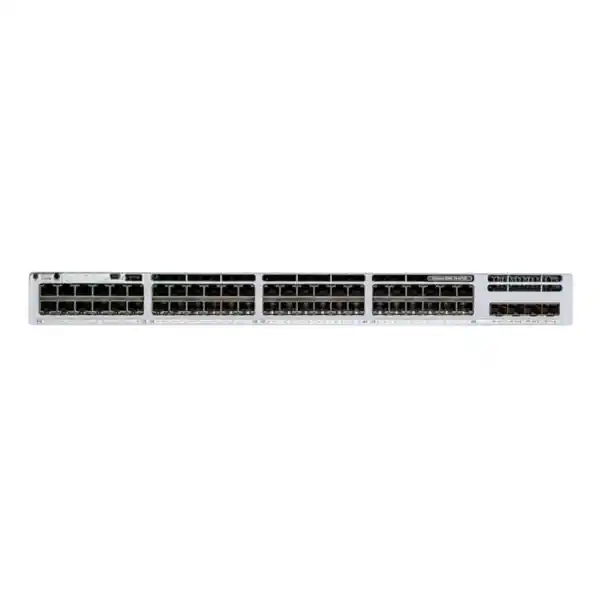
Cisco Catalyst C9300LM-48UX-4Y Network Switch
A compact, high-density Cisco enterprise access platform for organizations that need forty-eight UPOE copper interfaces, eight 10G-capable multigigabit access ports, four fixed 25G fiber uplinks and the operational consistency of Cisco IOS XE. The C9300LM-48UX-4Y is especially relevant to UAE campus refresh projects where Wi-Fi 6/6E/7 access points, collaboration endpoints, intelligent building systems and edge devices are pushing both copper bandwidth and PoE requirements beyond conventional 1G PoE+ designs.
Choose the C9300LM-48UX-4Y when a 48-port access layer must deliver UPOE to every copper port, provide up to 10Gbps on eight multigigabit access interfaces, aggregate through four fixed 25G uplinks and fit into a shallower rack footprint than many traditional enterprise switches.
C9300LM-48UX-4Y at a glance
Why the C9300LM-48UX-4Y matters in a modern access network
The enterprise access layer is no longer a simple concentration point for 1Gbps desktop PCs. A current switching design may need to power high-performance wireless access points, connect collaboration rooms, carry multiple real-time media streams, segment building-management devices, enforce identity-based access policy, expose telemetry to operations systems and maintain deterministic uplink capacity even during large software distributions or backup windows. The Cisco Catalyst C9300LM-48UX-4Y is designed for precisely this transition. Rather than forcing every port to operate at multigigabit speed, it places higher-bandwidth copper where it is most likely to be needed while retaining forty conventional 1G access interfaces for the majority of wired devices. This creates a practical balance between port density, access bandwidth, power delivery and uplink capacity.
For many UAE organizations, the eight multigigabit interfaces can be reserved for ceiling-mounted wireless APs, media workstations, high-throughput edge appliances or devices that have already moved beyond 1Gbps. The remaining forty 1G UPOE interfaces can support phones, cameras, thin clients, printers, access-control controllers, room systems, sensors and standard workstations. This allocation avoids paying the power, cabling and optics cost of an all-10G access environment while still removing the 1Gbps bottleneck from the devices that generate the most traffic.
The four fixed 25G uplinks are equally important. A switch with eight possible 10G downlinks can create short bursts far above a conventional 10G aggregation link. Four 25G uplinks allow designers to build high-capacity port-channels, dual-home access blocks to redundant distribution switches, or reserve uplink interfaces for staged migration. The result is a platform that can serve as a premium access switch in a large campus, a compact aggregation-capable switch in a branch, or a high-power edge platform in a telecom room where rack depth is constrained.
Verified model-specific technical profile
| Parameter | C9300LM-48UX-4Y | Design significance |
|---|---|---|
| Copper access | 48 Cisco UPOE ports | High-density powered access for endpoint and wireless convergence. |
| Multigigabit ports | 8 ports: 100M/1G/2.5G/5G/10G | Designed for APs and high-throughput edge devices without immediate fiber conversion. |
| Standard copper | 40 ports: 10M/100M/1G | Efficient density for typical office, voice, camera and IoT loads. |
| Fixed uplinks | 4 × 25G | Provides substantial northbound capacity and resilient dual-distribution designs. |
| Forwarding architecture | Cisco UADP 2.0 | Programmable hardware forwarding for enterprise policy and segmentation. |
| Switching capacity | 440 Gbps standalone; 760 Gbps with stacking | Supports demanding access and aggregation traffic profiles. |
| Forwarding rate | 327.36 Mpps standalone; 565.44 Mpps with stacking | Relevant to packet-intensive traffic, not only large-frame throughput. |
| Stacking | Optional StackWise-320; up to 8 members | Simplifies resilient access blocks and logical management. |
| Default PSU | PWR-C6-1KWAC, 1000W AC | High-power baseline suitable for UPOE-heavy deployments. |
| Available PoE budget with default PSU | 790W | Must be sized against the real endpoint power draw, not simply port count. |
| Chassis depth | Approx. 33.1 cm with default PSU | Useful in shallow wall cabinets and space-constrained IDFs. |
| Weight | Approx. 5.45 kg with default PSU | Supports practical handling and distributed closet deployment. |
Final BOM design should always validate the ordered license suffix, power-supply combination, fan/airflow requirements, optics, stacking kit, cabling and software release against the current Cisco ordering documentation.
Port architecture: eight 10G multigigabit interfaces plus forty 1G interfaces
The access-port mix is the defining characteristic of the C9300LM-48UX-4Y. Eight copper interfaces can negotiate across 100Mbps, 1Gbps, 2.5Gbps, 5Gbps and 10Gbps. That range is valuable because enterprise Wi-Fi equipment does not always consume a full 10Gbps Ethernet connection, yet many current access points can exceed the usable throughput of a single 1Gbps link under dense-client conditions. A multigigabit switch port allows the wired side of the AP to increase to 2.5G or 5G, and to 10G when supported, without forcing an immediate migration to fiber at every ceiling location.
The forty standard copper ports remain highly relevant. Most user endpoints do not sustain more than 1Gbps, and many building systems operate far below that rate. A correctly designed access layer therefore benefits from matching interface capability to endpoint behavior. Assign multigigabit ports to wireless APs, high-end engineering workstations, content-creation stations, local edge appliances or unusually heavy east-west users. Assign the 1G ports to IP phones, standard desktops, printers, access control, CCTV devices that fit the bandwidth envelope, environmental sensors and other conventional edge systems. This strategy makes the eight premium ports a deliberate resource rather than an incidental feature.
Cabling quality becomes important as copper speeds rise. Existing Category 5e infrastructure may support some multigigabit rates depending on distance, installation quality, bundling and electromagnetic conditions, while 10GBASE-T normally calls for more careful cabling design. A migration project should therefore include cable certification rather than assuming that an endpoint negotiated at 1G yesterday will run reliably at 5G or 10G tomorrow. In UAE buildings where structured cabling may share pathways with electrical systems, cooling infrastructure or dense service routes, the physical-layer survey can be as important as the switch selection.
The C9300LM-48UX-4Y also gives network teams a practical way to stage migration. A project can deploy the switch first, keep the majority of endpoints at 1G, move selected APs to 2.5G or 5G, and later use 10G copper where a clear application need appears. The switch therefore acts as an access-layer bridge between conventional gigabit estates and higher-speed edge requirements. This is often financially preferable to installing an all-multigigabit platform where only a small proportion of ports would use the additional bandwidth during the first several years.
Port planning should be documented before installation. A useful schedule marks each interface by endpoint class, required data rate, expected PoE draw, VLAN or security group, QoS profile and redundancy requirement. This prevents the eight multigigabit interfaces from being consumed by low-bandwidth devices simply because those patch leads were installed first. It also makes future AP upgrades easier because reserved high-speed ports and appropriate cabling can be identified before maintenance windows begin.
25G uplinks: designing the northbound path correctly
Four fixed 25G uplinks distinguish the 9300LM architecture from lower-capacity fixed-uplink access switches. A designer can use these interfaces individually, combine them in EtherChannel where the topology permits, or split them across redundant aggregation switches. The correct choice depends on oversubscription targets, failure domains and the amount of east-west traffic that must leave the access switch. A 48-port access block rarely requires every access port to transmit at line rate simultaneously, but wireless aggregation, video traffic, software deployment, virtual-desktop access and local backup flows can produce sharp peaks. High-capacity uplinks reduce the chance that the access layer becomes the hidden bottleneck.
In a resilient campus design, two uplinks can terminate on one distribution node and two on another, subject to the supported logical design and the capabilities of the upstream platform. Where a single logical distribution pair is presented, link aggregation can provide bandwidth scaling and physical redundancy. Where Layer 3 routed access is preferred, multiple point-to-point uplinks can create independent routing paths and reduce spanning-tree dependency. The C9300LM-48UX-4Y does not dictate the campus architecture; its four 25G interfaces give the designer enough bandwidth and port count to implement a range of modern access-to-distribution patterns.
Optics must be treated as part of the engineered solution. Transceiver type, fiber mode, connector presentation, path loss, distance, patch-panel count and upstream interface compatibility should be validated together. A 25G port does not guarantee that every SFP28 transceiver or passive cable combination is supported. The final bill of materials should therefore pair the switch with Cisco-supported optics or cables for the intended software release and topology. For projects spanning multiple buildings, the fiber audit should verify whether existing OM3/OM4 multimode or single-mode infrastructure matches the reach and future upgrade plan.
The uplink design also affects failure behavior. If the switch serves 48 powered endpoints, losing a single uplink should not reduce available bandwidth below the business requirement. Calculate normal-state and degraded-state utilization separately. A design that operates at 70 percent of a two-link bundle during normal conditions may become congested when one link fails. The four-uplink layout allows additional margin, but that margin must be intentionally configured and monitored.
Cisco UPOE and power-budget engineering
Every copper access port on the C9300LM-48UX-4Y supports Cisco UPOE capability, with Cisco positioning the model for up to 60W-class powered access. This matters when the switch is expected to support devices that exceed traditional 15.4W PoE or 30W PoE+ envelopes. High-performance wireless APs, multi-radio units, smart displays, compact computing devices, advanced cameras and building automation endpoints may request substantially more power than legacy edge hardware. A high-power switch simplifies these deployments by carrying data and power over the same structured cabling plant.
However, port capability and total chassis power budget are different quantities. Cisco lists a 1000W AC primary supply for this model and approximately 790W of available PoE power with the default supply. That means a network cannot simply multiply 48 ports by a maximum per-port wattage and assume the result is available. The engineering process must inventory the actual or maximum negotiated power requirements of the endpoints. A realistic worksheet should contain endpoint model, quantity, power class, expected draw, worst-case draw, redundancy target and growth reserve. The sum of these values becomes the PoE budget that the switch and its power supplies must sustain.
Consider an access closet supporting eight wireless APs, twenty IP phones, twelve cameras and several room-control devices. The APs may dominate the budget even though they occupy only a small share of ports. If future AP models are expected to require more power, reserve budget now rather than sizing exactly to today’s draw. The same rule applies to pan-tilt-zoom cameras, access-control equipment with peripherals, or devices that supply downstream USB power. A switch can have free Ethernet interfaces but still be unable to power new endpoints if the PoE budget is exhausted.
Redundant power adds another dimension. Cisco documents secondary power-supply options that can increase available PoE capacity, but the correct redundancy model should be chosen deliberately. In an N+1 style design, the network must continue powering critical endpoints after a power-supply failure. It is therefore not enough that two supplies provide a large combined PoE budget under healthy conditions; the remaining supply or supplies must support the critical load after a failure. Where all 48 ports are business critical, test the worst-case failure condition against the required wattage. Where only some endpoints are critical, configure power priorities so phones, APs and safety-related devices remain energized ahead of nonessential loads.
Power planning should also include the upstream electrical environment. UAE enterprise closets frequently rely on UPS systems sized years before modern high-power PoE loads were introduced. Replacing a low-power switch with a UPOE platform can materially increase rack power draw and UPS discharge rate when large endpoint populations are attached. The project team should validate circuit rating, PDU capacity, UPS runtime, heat output and generator-backed coverage. A high-density PoE deployment is a combined network-and-facilities project, not merely a switch swap.
For operational visibility, record expected PoE draw at commissioning and compare it with live values after devices are connected. Unexpected consumption can identify configuration errors, endpoint changes or capacity risk before a new deployment fails. This discipline turns UPOE from a convenience feature into a predictable infrastructure service.
UADP 2.0, forwarding capacity and why packet rate matters
The C9300LM family is based on Cisco’s UADP 2.0 ASIC architecture. In practical terms, the switch performs key forwarding, policy, QoS and table-lookup functions in dedicated hardware rather than asking the general-purpose CPU to process ordinary production traffic. Cisco’s programmable pipeline approach also allows resources to be allocated through supported templates for different Layer 2, Layer 3, access-control and quality-of-service requirements. This flexibility is valuable because a user-access network and a route-heavy branch aggregation network may consume forwarding-table resources differently even when they use the same physical switch model.
Cisco specifies 440Gbps switching capacity and 327.36 million packets per second of forwarding for the standalone C9300LM-48UX-4Y. When stacking is included, Cisco lists 760Gbps switching capacity and 565.44Mpps. These numbers should be interpreted correctly. Switching capacity describes aggregate bandwidth available through the switching architecture; packet-forwarding rate measures how quickly the platform can handle packets, which becomes particularly important when frames are small. A device that performs well with large file transfers can still be challenged by very high packets-per-second workloads if its forwarding architecture is weak. The C9300LM’s published packet rate indicates that it is designed for enterprise access loads where traffic can include voice, control traffic, microservices, telemetry and numerous small flows alongside large data transfers.
Performance sizing is still a workload exercise. Eight 10G-capable access ports and four 25G uplinks do not mean the switch will see every interface saturated at once. In most enterprise networks, oversubscription is expected and economically desirable. The engineering question is whether the chosen oversubscription ratio remains acceptable during peak events and failure states. Wireless access points can be bursty, while desktop utilization is often low. CCTV streams are steadier but may be more predictable. Backup traffic can be scheduled. Understanding this mix allows the network team to judge whether the switch’s uplink design and aggregation layer are appropriately sized.
Hardware scale is another consideration. Cisco lists 32,000 MAC addresses for Catalyst 9300L/LM fixed-uplink models, together with 32,000 total IPv4 routes, 16,000 IPv6 routing entries, 8,000 multicast routing scale and 5,120 QoS scale entries for the family profile. These limits are far above the needs of many access closets, but they matter when the device is used for routed access, large segmentation designs, dense multicast environments or branches with substantial local routing. Do not size purely by port count; include route scale, neighbor scale, ACL usage, multicast state and QoS policy complexity in the architecture review.
Cisco IOS XE and UADP together provide the separation network teams expect from a modern enterprise switch: hardware does the high-volume forwarding work, while software supplies control-plane protocols, programmability, telemetry and lifecycle operations. That combination is one reason the Catalyst 9300 family is used as a strategic campus access platform rather than simply an unmanaged high-port-count Ethernet device.
StackWise-320 resilience for access-layer continuity
Cisco supports optional StackWise-320 on Catalyst 9300LM fixed-uplink models, using the appropriate stacking kit, with up to eight supported members in a stack according to the platform data. Stacking is not merely a way to make multiple switches look like one larger switch. In a carefully designed access block, it can simplify management, create a common logical control context and allow link aggregation across physical members so endpoint and uplink connectivity can survive specific member or link failures.
The operational benefit can be significant in buildings that require several 48-port switches per IDF. Without stacking, each switch is an independent device with its own management, uplink topology and failure behavior. With a supported stack, multiple members can be operated as a coordinated system. This can reduce the number of management touchpoints and simplify uplink design. It also allows edge devices that have dual network interfaces to connect across different physical members while participating in a single logical switching environment, where the topology supports that approach.
Stacking still needs engineering discipline. A StackWise ring should be cabled correctly, stack-member priorities should be planned, software versions must be consistent, and the physical cable path should avoid unnecessary stress. The stack is also not a substitute for all forms of redundancy. A common electrical feed, common cooling failure or physical rack incident can still affect every member. For high-availability sites, combine switch-level resilience with dual power feeds where supported by the site, UPS redundancy, diverse uplink paths and appropriately redundant distribution/core systems.
Compatibility should be verified before mixing models. Cisco states that C9300LM platforms can participate in StackWise-320 with compatible Catalyst 9300L and 9300LM models at the same license level, subject to the published rules and correct stack kit. The bill of materials must therefore include the correct C9300L-STACK-KIT2 or currently supported equivalent for the intended configuration rather than assuming stacking hardware is included in the base switch.
For maintenance, stacking can make software upgrades and member replacement more manageable, but change procedures should still include configuration backup, compatibility checks, boot-variable verification, post-upgrade validation and a documented rollback path. Treat the stack as a production system whose resiliency depends on both hardware topology and operational process.
Layer 2, Layer 3 and segmentation scale
The C9300LM-48UX-4Y can serve more than a simple Layer 2 access role. Cisco’s Catalyst 9300 platform supports enterprise switching and routing functions under Cisco IOS XE, with feature availability depending on the selected Network Essentials or Network Advantage licensing and the software release. This lets architects choose traditional switched access, routed access, or policy-driven campus designs according to operational preference and license requirements.
At Layer 2, Cisco lists up to 4,094 VLAN IDs and 1,000 switched virtual interfaces for the Catalyst 9300 family profile represented by the fixed-uplink models, along with support for jumbo frames up to 9,198 bytes. These figures are more than adequate for most access environments, but the more important design principle is to avoid excessive broadcast-domain sprawl. VLANs should align with security boundaries, operational requirements and failure domains rather than being created for every organizational label. Modern segmentation increasingly relies on identity, policy and routed boundaries instead of extremely large Layer 2 domains.
At Layer 3, the 32,000 total IPv4 route scale and 16,000 IPv6 routing entries published for Catalyst 9300L/LM fixed-uplink models give architects room for routed access and sizeable branch topologies. The exact feature set for dynamic routing protocols must be checked against the ordered license. When routed access is used, point-to-point Layer 3 uplinks can reduce spanning-tree scope and provide fast convergence with an appropriate routing design. This is attractive in larger UAE campuses where access closets are distributed across floors or buildings and network teams want clear routed failure boundaries.
IPv6 readiness is increasingly relevant even in networks that remain predominantly IPv4. Cisco’s hardware supports IPv6 forwarding and dual-stack operation, allowing organizations to introduce IPv6 without replacing the access hardware solely for protocol reasons. A sensible transition plan includes IPv6 addressing, first-hop security, routing policy, DNS behavior, monitoring and endpoint readiness. Simply enabling IPv6 without matching security controls can create visibility gaps, so the switching platform should be integrated into a broader dual-stack governance process.
Segmentation may combine VLANs, VRF-aware architecture, access control, identity information and Cisco campus policy tools depending on licensing and design. The switch’s role is to provide the hardware enforcement and forwarding foundation. The policy model must still be designed around business trust zones: corporate users, guests, IoT, voice, cameras, building systems, privileged administration and infrastructure management should not share unrestricted reachability merely because they terminate on the same physical access switch.
Access security, identity controls and operational telemetry
A switch at the user edge is a security enforcement point. It sees device attachment events, MAC addresses, authentication requests, VLAN assignments, DHCP traffic and the first-hop relationship between endpoints and the routed network. The C9300LM-48UX-4Y therefore belongs inside the security architecture, not outside it. Cisco IOS XE supports a broad campus security framework whose exact capabilities depend on software and licensing, including 802.1X-based access control, MAC Authentication Bypass for devices that cannot perform 802.1X, role or policy integration, port-security mechanisms, DHCP-related protections, dynamic ARP controls, access lists and control-plane protections.
The recommended design begins with identity. User laptops and managed devices should authenticate where practical, while non-802.1X devices such as cameras, printers and building controllers need a controlled alternative onboarding method. Authentication failure behavior must be explicit; placing every failed device into a broad production VLAN undermines the point of access control. Guest, remediation and critical-auth states should be designed according to business requirements and tested before rollout.
First-hop security is equally important. Rogue DHCP services, spoofed addresses and unmanaged bridging can turn a physically secure office into an insecure network. Features such as DHCP Snooping, Dynamic ARP Inspection and IP Source Guard can help establish trust relationships on access ports when configured correctly. These controls require careful VLAN and uplink trust configuration, because an overly aggressive deployment can interrupt legitimate services. Pilot the policy in a limited area, validate device behavior and expand using templates.
Telemetry transforms these controls from static configuration into operational evidence. Cisco’s platform supports Flexible NetFlow and other visibility mechanisms, with feature depth influenced by licensing. Flow telemetry can identify unusual traffic patterns, unexpected east-west communication, overloaded applications and bandwidth concentration without capturing every packet. Interface counters, PoE status, environmental data, authentication events, syslog and streaming telemetry can feed monitoring systems so operations teams detect degradation before end users open support tickets.
Management-plane security should be separated from production user traffic. Use dedicated management addressing, AAA integration, encrypted management protocols, role-based administrative access and centralized logging. Disable unused services, control source addresses permitted to reach the management plane and maintain an emergency access process that is audited. Switch configuration backups should be versioned, protected and recoverable. These are operational disciplines, but they materially affect the security value of the hardware.
For UAE customers operating under internal governance, sector regulations or international standards, the C9300LM-48UX-4Y can be incorporated into a documented control framework. The switch itself does not create compliance; the organization must map authentication, segmentation, logging, software maintenance and privileged access controls to its obligations. FourTeck can align the switching design with broader network and security services through the FourTeck IT Services UAE practice when the requirement extends beyond hardware supply.
QoS for voice, video, wireless and business applications
Enterprise access networks carry traffic with very different sensitivity to delay, loss and jitter. A large file transfer can slow down briefly without obvious user impact; a voice call or interactive meeting cannot. The C9300LM-48UX-4Y provides hardware QoS capabilities through the UADP architecture, and Cisco lists 5,120 QoS scale entries for the Catalyst 9300L/LM fixed-uplink profile. The objective is not to mark everything as high priority. Good QoS establishes a limited number of classes, validates trust boundaries and protects real-time traffic specifically when congestion occurs.
At the access edge, decide whether the endpoint is trusted to mark its own traffic. Managed IP phones may participate in a defined trust model, while general user devices should not automatically be allowed to claim the highest priority. Wireless traffic may arrive from APs with established QoS markings that need to map correctly into the wired campus. Cameras can generate continuous traffic but do not necessarily require the same low-latency class as voice. Backup and bulk transfer traffic can be deprioritized during contention.
The multigigabit interfaces reduce local port congestion for high-performance APs, but they do not eliminate the need for end-to-end QoS. If eight APs feed a distribution layer through an oversubscribed path, congestion can still occur upstream. Class definitions and markings should therefore remain consistent across access, distribution, core, WAN and internet-edge devices. The switch is one hop in a service-quality policy that must span the full path.
Commissioning should include real traffic tests: place calls while transferring large files, run meeting traffic under controlled congestion, validate markings, inspect queue counters and confirm that low-priority traffic yields before critical flows. This produces a much more reliable deployment than enabling a generic QoS template without verifying the application behavior.
A strong wired foundation for high-density enterprise Wi-Fi
The C9300LM-48UX-4Y is particularly attractive as the wired underlay for modern wireless deployments. The eight multigigabit access ports address a common problem: a new AP may deliver aggregate wireless throughput that exceeds a 1Gbps Ethernet uplink, yet replacing every copper run with fiber is unnecessary or impractical. Multigigabit Ethernet allows existing compatible twisted-pair infrastructure to carry more than 1Gbps, while UPOE provides the power headroom needed by feature-rich APs with multiple radios, USB peripherals, IoT capabilities or advanced scanning functions.
A wireless design should still start with radio requirements, not switch ports. Determine AP count and placement from predictive design and site survey results. Then map each AP to a switch port, calculate negotiated Ethernet speed and power draw, and confirm that the uplink architecture can absorb aggregate wireless demand. Eight multigigabit ports per switch may be ideal for one floor and insufficient for another. If a floor requires more than eight high-speed AP connections, use additional compatible access switches or select a model with greater multigigabit density.
Power redundancy is important because a single switch can energize multiple APs. A switch failure or loss of PoE can therefore remove wireless coverage from a significant area even if the wireless controllers and internet connection remain healthy. Where Wi-Fi is business critical, distribute APs intelligently across switches, consider redundant power supplies and UPS protection, and avoid placing every AP serving one critical zone on the same physical failure domain.
The four 25G uplinks provide useful headroom when wireless density is high. Instead of treating each access switch as a low-bandwidth endpoint concentrator, the design can support substantial aggregate AP traffic toward the distribution layer. This is especially relevant in conference spaces, educational campuses, hospitality venues, healthcare environments and high-density offices where wireless has become the primary user access method.
Shallow-depth chassis: a practical advantage in UAE IDFs and distributed racks
The LM designation is important because Cisco positions these models as shallow-depth Catalyst 9300 platforms. Cisco lists the C9300LM-48UX-4Y at approximately 1.73 inches high, 17.5 inches wide and 13.03 inches deep with the default power supply, or roughly 4.3 × 44.4 × 33.1cm. Weight with the default supply is listed around 5.45kg. This footprint can solve a real deployment problem in older buildings, retail sites, education facilities, hospitality back-of-house areas and distributed office closets where full-depth datacenter racks are not available.
Rack depth should nevertheless be measured before purchase. The switch chassis may be shallow, but installers must also allow for front patch leads, bend radius, rear power cords, stacking connections, airflow clearance and PDU placement. A cabinet that is nominally deep enough for the chassis can still become unusable once cable-management hardware and door clearance are considered. The survey should record usable rail-to-door depth, not only the manufacturer’s cabinet dimension.
Thermal design is equally important in the Gulf climate. Enterprise switches are intended for controlled environments, and a closed wall cabinet in an unconditioned service area can experience temperatures far above the ambient conditions seen in the occupied office. High PoE loads add heat because the switch is delivering substantial electrical power to endpoints. Confirm room cooling, cabinet ventilation, dust control and airflow path. Avoid placing heat-producing equipment directly against blocked exhaust paths.
Power quality should be part of the site survey. Verify grounded outlets, UPS capacity, PDU rating and the availability of separate electrical feeds if power redundancy is required. A shallow switch can fit physically in a cabinet yet still overload the existing UPS when hundreds of watts of PoE are added. Facilities data and network data should be brought into the same deployment worksheet.
Where a broader server-room modernization is required, FourTeck can coordinate switching with rack, compute and infrastructure planning through the Server Dubai infrastructure team, helping ensure that network hardware, power, cooling and physical layout are sized as one system.
Deployment architecture 1: resilient campus access block
In a multi-floor office or campus building, the C9300LM-48UX-4Y can serve as a high-performance access switch in each IDF. Endpoints connect to the forty 1G UPOE ports, while high-capacity APs and selected devices use the eight multigigabit ports. Two or more switches can be deployed per closet when port count or AP density demands it. Optional StackWise-320 can create a coordinated access block where the design benefits from stacked operation.
The four 25G uplinks allow each access block to connect to a redundant distribution pair with significant bandwidth. In a routed-access design, uplinks can participate in dynamic routing and equal-cost paths according to the selected license and campus architecture. In a switched-access design, uplinks can be aggregated toward the distribution layer subject to the topology. The correct pattern depends on the organization’s operational model, but the hardware provides enough uplink density to avoid a single low-capacity dependency.
This architecture suits large commercial offices, universities, hospitals and government or enterprise campuses where the access layer must be resilient, centrally operated and ready for higher-speed wireless. The C9300LM’s shallow depth is especially useful when some IDFs are smaller than the main data room.
Deployment architecture 2: premium branch and regional office
A regional office may not have a separate access and distribution layer. In that environment, the C9300LM-48UX-4Y can combine high-density endpoint access with local Layer 3 services and high-speed fiber connectivity to servers, WAN edge equipment or a small core pair. The 48 copper interfaces reduce the need for multiple switch models, while UPOE can power the office’s phones, APs, cameras and room systems from one managed platform.
The branch design should pay close attention to failure concentration. A single 48-port switch can support a large proportion of the office. If the site is critical, deploy a second switch, distribute important endpoints and APs across members, and provide redundant power and uplink paths where appropriate. Optional stacking can simplify the logical design while retaining multiple physical switch members.
For UAE companies with operations extending into East Africa or other regions, a standardized Catalyst access design can simplify spare strategy, configuration templates and support processes across multiple sites. FourTeck’s Africa technology coverage can be relevant when a UAE headquarters wants consistent network architecture across regional offices.
Deployment architecture 3: hospitality, healthcare and smart-building edge
Hospitality and healthcare environments often combine conventional user access with a large number of powered operational devices. Wireless APs, IP phones, surveillance cameras, access-control readers, room systems, nurse-call integrations, building sensors and digital signage may all share the physical switching layer while requiring strict logical separation. UPOE capability and forty-eight powered ports make the C9300LM-48UX-4Y attractive for this converged edge, but segmentation and power engineering become essential.
Create device classes and map each class to authentication, VLAN or policy, QoS, multicast and reachability requirements. A guest-room or patient-area device should not gain unrestricted access to infrastructure management merely because both are connected to the same switch. Similarly, CCTV traffic may require deterministic uplink capacity, while voice traffic needs latency protection and building systems may depend on long device lifecycles. The switch can enforce multiple controls, but only if the architecture defines them explicitly.
The shallow chassis helps in distributed telecom rooms that may have limited cabinet depth. Yet high device density can also increase PoE draw and heat, so these deployments should include strong facilities validation and documented spare-power margin.
How to size the C9300LM-48UX-4Y correctly
A reliable switch design starts with four separate capacity calculations: port count, bandwidth, PoE and scale. Port count is simplest. Count every endpoint, add planned APs, cameras and building devices, then include a realistic growth reserve. A 48-port switch should not be considered fully available merely because only 44 ports are currently patched; operationally, spare ports are needed for faults, moves, temporary devices and growth. Decide whether the project wants approximately 10, 15 or 20 percent spare capacity and calculate switch quantity accordingly.
Next, identify how many endpoints genuinely require multigigabit connectivity. The C9300LM-48UX-4Y provides eight such ports. If a floor requires twelve multigigabit AP connections, one switch is not enough even if total endpoint count is below 48. The designer must either add another switch, redistribute APs, or select a different Catalyst model with greater mGig density. This is one of the most important distinctions between total port count and high-speed port count.
Third, calculate PoE. Create a spreadsheet of powered devices and record both normal and maximum expected wattage. Use the higher value for capacity planning unless a documented power-management policy justifies another approach. Sum the devices assigned to each switch, then compare the result with Cisco’s available PoE budget for the intended power-supply configuration. Include reserve for endpoint upgrades. If redundant power is required, repeat the calculation with one PSU failed and confirm that critical endpoints remain supported.
Fourth, estimate bandwidth. For each endpoint class, use realistic utilization rather than interface speed alone. A phone connected at 1G may consume less than a few hundred kilobits during a call, while a wireless AP connected at 5G may generate several gigabits in bursts. Cameras can provide predictable continuous streams. Workstations may be bursty. Build normal and peak estimates, then compare aggregate traffic with the available 25G uplinks in both healthy and degraded states. Keep sufficient margin for software distribution, backups and future application changes.
Scale analysis comes last but should not be ignored. Count VLANs, SVIs, MAC addresses, routes, multicast groups, access-control entries and QoS complexity. Most office access networks will sit comfortably within platform limits, but large routed or highly segmented campuses should validate the intended SDM or forwarding template. The C9300LM/9300L fixed-uplink family supports substantial scale, yet no hardware platform has unlimited table space.
Environmental capacity is the fifth practical dimension. Verify rack depth, RU availability, cable management, cooling, UPS power and electrical feeds. Shallow depth reduces one common constraint but does not eliminate heat or power requirements. High PoE output means the electrical and cooling design should be based on actual planned endpoint load rather than the idle switch draw.
Finally, size operational capacity. Ask whether the network team can manage IOS XE upgrades, configuration templates, certificate renewal, AAA integration, telemetry, backup and incident response. A powerful switch deployed without lifecycle discipline can become more difficult to operate than a simpler platform. Standardize software trains, maintenance procedures and monitoring dashboards so the hardware’s enterprise capabilities translate into measurable service reliability.
FourTeck can assist with this sizing process for UAE projects through the FourTeck UAE team, including switch quantity, PoE budgeting, optics, stacking accessories and deployment planning.
Licensing: Network Essentials versus Network Advantage
Cisco lists the C9300LM-48UX-4Y with both Network Essentials and Network Advantage ordering variants. The hardware base is similar, but the licensed network feature set differs. The correct license should therefore be chosen from the required routing, segmentation, automation, visibility and advanced campus functions rather than from hardware port requirements alone. A procurement team should avoid ordering the lowest license by default and discovering later that an architectural feature requires a higher tier.
Network Essentials is generally aligned to foundational enterprise access requirements, while Network Advantage enables broader advanced capabilities. Cisco’s licensing model and associated subscription packages evolve over time, so the exact entitlement, term and management requirements should be validated against the current Cisco ordering guide at quotation. This page deliberately avoids assuming a specific subscription term because the correct commercial structure depends on the current program, software release and customer entitlement position.
Create a feature checklist before selecting the suffix. Include Layer 3 protocol requirements, advanced telemetry, policy and segmentation, automation platform integration, high-availability design and any Cisco Catalyst Center functions required by the operational team. Mark each feature as mandatory, desirable or future. Then map those requirements to the current Cisco license matrix.
Licensing should also be considered in a stack. Cisco’s published stacking guidance references compatible license levels, so mixed-license assumptions should not be made without checking the current support rules. Standardizing the license tier across a stack or deployment block usually simplifies operations and reduces unexpected feature mismatches.
Cisco IOS XE operations, automation and lifecycle management
The C9300LM-48UX-4Y operates within the Cisco IOS XE ecosystem, giving teams a familiar enterprise switching environment with CLI-based administration, programmable interfaces, telemetry and integration with Cisco management platforms. The value of IOS XE is not simply feature count. Standardized software across an estate can reduce training requirements, enable reusable configuration templates and make software lifecycle management more consistent across buildings and sites.
Automation should start with repeatable configuration rather than complex orchestration. Define standard templates for management access, AAA, NTP, DNS, syslog, SNMP or streaming telemetry, VLAN conventions, uplink configuration, authentication, QoS and interface defaults. Store templates in version control. Use automation tools to render or validate configuration when appropriate. The goal is to minimize one-off differences that make troubleshooting difficult months later.
Software lifecycle planning is equally important. Select a supported IOS XE release according to Cisco guidance and the organization’s feature requirements. Validate the release against optics, stacking hardware, authentication systems and management integrations. Before upgrades, back up configuration, capture current health data and confirm available flash and boot variables. After upgrades, verify stack state, uplinks, routing neighbors, PoE, authentication, AP connectivity, monitoring and endpoint reachability.
Telemetry can be used to establish a baseline. Record CPU and memory trends, interface utilization, errors, discards, PoE consumption, environmental sensors, route or neighbor state and authentication failure rates. A baseline allows the operations team to distinguish a real anomaly from normal behavior. For example, a 25G uplink running at 3Gbps may be perfectly healthy, while repeated microbursts and queue drops during the same period can still affect voice or application performance.
Treat configuration and observability as part of the product deployment, not as tasks deferred until an incident. The switch is most valuable when its data can be used proactively to protect service quality.
Migration from older Catalyst access switches
Replacing an older access switch with the C9300LM-48UX-4Y should not be treated as a direct copy-and-paste exercise. Legacy configurations often contain obsolete commands, historical VLANs, unused trunks, inconsistent port descriptions, permissive security settings and QoS policies built for applications that no longer exist. A refresh is an opportunity to simplify the access layer while moving to higher-speed uplinks, stronger authentication and a documented PoE model.
Begin with discovery. Export current configurations and collect interface status, MAC address tables, LLDP/CDP neighbors, PoE consumption, uplink utilization, spanning-tree role, routing state and error counters. Map patch-panel labels to actual endpoints where possible. This data reveals which legacy ports are active, which devices require special VLAN or voice settings and where cabling errors exist. It also helps identify APs or servers that should be moved to the eight multigigabit interfaces.
Next, create a target configuration using current standards. Do not reproduce every old command. Rebuild management, AAA, time, logging, interface templates, uplinks, VLANs, QoS and security controls deliberately. Validate the old and new feature syntax against the chosen IOS XE release. If the project introduces 802.1X, stage authentication gradually so unknown endpoint types can be catalogued before enforcement becomes strict.
The physical migration should sequence critical devices carefully. Pre-stage optics, stack kits and power supplies. Label patch leads. Validate that the rack has sufficient depth and power. If the existing switch supplies PoE to phones or cameras, moving cables will cause endpoint power cycles, so maintenance-window communication must reflect the actual outage. For wireless-heavy sites, preserve temporary coverage or move APs in controlled groups.
After cutover, compare the live environment with the pre-change baseline. Check PoE draw, link speeds, duplex, errors, uplink load, spanning-tree or routing state, authentication, voice registration, AP join status and monitoring visibility. Keep the rollback plan until the network has passed business validation.
UAE procurement: what should be included in the bill of materials
A correct C9300LM-48UX-4Y quotation is more than a single switch line item. The base hardware must be paired with the right network license, power configuration, optics, stacking accessories, patching and support coverage. Missing one component can delay a deployment even when the switch itself is in stock. The procurement process should therefore begin with an engineered bill of materials rather than a generic price request.
The first choice is the license suffix. Cisco lists C9300LM-48UX-4Y-E for Network Essentials and C9300LM-48UX-4Y-A for Network Advantage. Select the suffix from the required features and current Cisco licensing structure. The second choice is power. The model uses the C6 power-supply family, with a 1000W AC unit listed as the default for this SKU. If redundant power or a larger aggregate PoE budget is required, include the supported secondary supply and verify the failure-state power design.
Third, specify uplink media. Four fixed 25G interfaces require compatible transceivers or direct-attach cabling based on distance and the upstream switch. Confirm whether the path is single-mode, multimode or within-rack copper/direct-attach. Check fiber connector type, patch panels and optical budget. If the upstream switch only supports 10G, validate the supported interface and transceiver behavior rather than assuming automatic backward compatibility in every combination.
Fourth, decide whether stacking is required. The appropriate StackWise-320 kit and cables are separate considerations for fixed-uplink 9300L/LM models. Cable length should match rack placement. Stacking should be included in the original BOM when it is part of the high-availability design, because deploying a stack later may require another maintenance window.
Fifth, include practical deployment items: rack hardware, patch leads, console or management accessories where required, labels, cable management and UPS/PDU upgrades if the site survey identifies a need. For multigigabit ports, certify the relevant copper runs. For PoE-heavy installations, verify that structured cabling and patch panels are appropriate for the electrical load and installation standards.
Finally, align delivery and support with project timing. Enterprise switching projects often depend on access points, optics, firewalls, servers or structured cabling arriving together. A single missing optic can block an otherwise complete floor. FourTeck can coordinate the network component of the project through its UAE supply and integration practice, and broader enterprise security requirements can be coordinated with the Firewall Dubai solutions team.
Before issuing a purchase order, confirm the exact Cisco part numbers, warranty or support entitlement, license terms, power cords appropriate for the deployment, optics and desired delivery dates. Product programs change, so the quotation should reflect the current Cisco ordering framework rather than a historical BOM copied from a previous project.
When this model is the right choice — and when it is not
Choose C9300LM-48UX-4Y when
You need forty-eight powered copper ports, up to eight 10G multigigabit edge connections, substantial UPOE capacity, four 25G uplinks, a shallow-depth 1RU chassis and optional StackWise-320. It is a particularly strong fit for high-density wireless, converged office access, hospitality, healthcare, education and branches where rack depth is constrained but enterprise switching capabilities are required.
Consider a different model when
You need more than eight multigigabit copper ports per switch, modular rather than fixed uplinks, 100G uplink options, higher routing scale, different stacking architecture, data-only access without PoE, or a lower-cost platform for simple 1G edge connectivity. The right switch is determined by the port, power, uplink, scale and licensing profile — not by the Catalyst family name alone.
For example, an office with six high-performance APs and forty conventional endpoints may align very well with the C9300LM-48UX-4Y. A floor with twenty-four multigigabit APs would likely need a different port-density strategy. A warehouse with mostly low-bandwidth scanners and no high-power endpoints may not need this model’s premium mGig and UPOE capability. A compact branch that expects 25G aggregation and large PoE demand may find it ideal. Matching the model to actual workload is more important than selecting the most feature-rich switch.
Engineering FAQ
Does every copper port support 10Gbps?
No. Eight ports are multigigabit interfaces supporting up to 10Gbps. The other forty copper ports support up to 1Gbps. All forty-eight are UPOE-capable access ports.
Are the uplinks modular?
No. The C9300LM-48UX-4Y uses four fixed 25G uplinks. This keeps the shallow platform compact but means the uplink format must match the design from the beginning.
Does the base switch include stacking hardware?
StackWise-320 is optional for the 9300LM family. The correct stacking kit and cable should be included separately in the engineered BOM when stacking is required.
How much PoE power is available?
Cisco lists approximately 790W of available PoE power with the default 1000W AC supply. Additional supported power-supply configurations can change the available budget, so size the final design against endpoint demand and redundancy requirements.
Can it be used for routed access?
Yes, the Catalyst 9300 platform supports Layer 3 capabilities under IOS XE. The exact routing features depend on the selected software and license tier, so the intended protocol set should be checked before ordering.
Why is shallow depth important?
The approximately 33.1cm chassis depth with the default power supply helps in distributed IDFs and wall cabinets where conventional enterprise switches may be physically difficult to install.
Decision recap for network architects
The Cisco Catalyst C9300LM-48UX-4Y is best understood as a high-power, high-uplink, shallow-depth access switch rather than simply a 48-port Catalyst. Its value comes from combining four specific characteristics in one chassis: all forty-eight copper ports can provide UPOE; eight of those ports can operate at multigigabit rates up to 10Gbps; four fixed uplinks provide up to 25Gbps each; and optional StackWise-320 supports resilient multi-switch designs. This combination targets environments where wireless and powered edge devices are growing faster than conventional 1G access architectures can comfortably support.
The strongest use case is a floor or branch with a modest number of high-throughput devices and a larger population of conventional endpoints. The eight mGig interfaces can be reserved for APs or heavy users, while the forty 1G interfaces carry ordinary edge traffic. The four 25G uplinks then provide enough northbound bandwidth to prevent the access layer from becoming trapped behind a legacy 10G bottleneck. UPOE supports demanding devices, while the compact chassis expands deployment options in shallow cabinets.
The main sizing risks are equally clear. Do not assume all 48 ports can draw maximum UPOE power simultaneously from the default supply; calculate the PoE budget. Do not assume eight mGig ports are enough merely because total port count fits; count high-speed endpoints separately. Do not assume four 25G uplinks automatically deliver resilience; design healthy-state and failure-state capacity. Do not assume every Catalyst feature is included in every license; map the required feature set to Network Essentials or Network Advantage and current subscription rules. Finally, do not ignore facilities: UPS capacity, cooling and rack clearance are part of a successful PoE-heavy access deployment.
Quotation input checklist
A precise quotation is faster and safer when the technical inputs are known. Provide the following details so the hardware, licensing and accessories can be matched to the project rather than quoted as an isolated chassis:
Plan the complete C9300LM-48UX-4Y solution, not just the switch
For a production deployment, FourTeck can align the Cisco Catalyst C9300LM-48UX-4Y with the license tier, 25G optics, stack kit, redundant power, PoE budget, rack constraints, VLAN/routing design, access security and cutover plan. This is especially useful when an existing 1G/10G campus is being migrated to multigigabit access and higher-speed aggregation without replacing every endpoint or copper run at once.
A well-built BOM should answer five questions before purchase: how many high-speed edge devices exist, how much PoE is required in the worst failure state, how much uplink capacity remains after a link failure, which licensed features are mandatory, and whether the physical closet can power and cool the final configuration. Once those values are known, the C9300LM-48UX-4Y can be evaluated objectively against alternative Catalyst models.
Recommended consultation scope
- Port and multigigabit density
- UPOE and PSU sizing
- 25G optics and fiber paths
- StackWise-320 topology
- Network Essentials vs Advantage
- Rack, UPS and thermal validation
- Migration and post-cutover testing

Reviews
There are no reviews yet.