
Enterprise Core & Distribution Switching | UAE
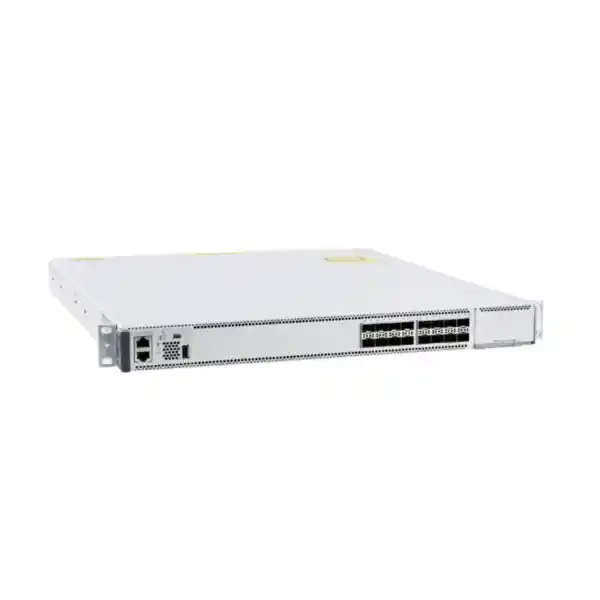
Cisco Catalyst C9500-16X Network Switch
A high-performance 1RU enterprise switching platform with 16 native 1/10 Gigabit Ethernet SFP/SFP+ ports, modular uplink flexibility, Cisco IOS XE, advanced routing, hardware-assisted security, resilient virtualization and deep operational tooling for campus core, distribution, aggregation and routed backbone designs.
Direct answer: where the C9500-16X fits in a modern network
The Cisco Catalyst C9500-16X is best suited to organizations that need a compact, enterprise-grade core or distribution switch with a strong 10 Gigabit Ethernet profile, advanced Layer 3 services and high availability without moving immediately to very high-density 25G, 40G or 100G chassis designs. Its 16 front-panel 1/10GbE SFP/SFP+ ports make it particularly practical for medium-size campus cores, branch aggregation hubs, education networks, healthcare sites, hospitality campuses, industrial facilities and enterprise buildings where the dominant backbone links are still 1GbE and 10GbE fiber. Because the platform can also accept either an eight-port 1/10GbE network module or a two-port 40GbE QSFP+ module, the design can reserve native ports for distribution blocks while using modular uplinks for data-center, WAN-edge or inter-building aggregation.
For UAE customers, the value of this model is not simply port count. The C9500-16X is positioned as an enterprise core switch, so the more important design questions are routing scale, resiliency, optics, segmentation, software licensing, upgrade strategy, traffic growth and operational integration. A campus core frequently carries every critical service at once: user access, wireless controllers, server VLANs, voice, CCTV, building systems, guest traffic, cloud connectivity and internet-edge routing. In that context, an apparently modest 16-port core can still be the correct choice if those ports aggregate high-value fiber links rather than endpoint access ports.
FourTeck approaches the C9500-16X as a network design component rather than a stand-alone appliance. UAE deployments can be planned around redundant core pairs, StackWise Virtual, dual power supplies, matched optics, structured migration windows, routing policy validation and post-cutover monitoring. Organizations that need broader infrastructure sourcing can also use the FourTeck UAE portfolio for enterprise networking projects and the FourTeck IT Services UAE practice for implementation, migration and ongoing support.
Port profile
16 native SFP/SFP+ ports supporting 1 Gigabit and 10 Gigabit Ethernet for flexible fiber aggregation and routed uplinks.
Modular expansion
Optional C9500-NM-8X adds eight 1/10GbE interfaces, while C9500-NM-2Q provides two 40GbE QSFP+ interfaces.
Core resiliency
StackWise Virtual, Stateful Switchover and multichassis EtherChannel options support highly available collapsed-core and distribution designs.
Enterprise services
IOS XE feature support spans advanced IPv4/IPv6 routing, MPLS services, QoS, multicast, telemetry, automation and security controls.
Hardware architecture and forwarding foundation
The C9500-16X uses Cisco’s UADP 2.0 architecture, an application-specific integrated circuit platform built for enterprise switching and routing. In a core switch, the forwarding ASIC is significant because it determines how consistently the device can process Layer 2 switching, Layer 3 routing, access-control entries, QoS classification, NetFlow records, multicast and other services at hardware speed. The C9500-16X is specified for switching capacity up to 480 Gbps and forwarding performance up to 360 million packets per second. Those figures provide useful design headroom for a 16-port 10GbE platform, especially when a deployment is intended to aggregate multiple access or distribution blocks rather than operate every interface continuously at full bidirectional load.
Hardware scale matters as much as throughput. Cisco publishes platform values for up to 64,000 MAC addresses, up to 64,000 indirect IPv4 routes, up to 80,000 IPv4 host routes, up to 32,000 indirect IPv6 routes and up to 40,000 IPv6 host routes, subject to feature configuration and resource allocation. The platform also supports large access-control and flow-monitoring scales, including substantial security and QoS ACL capacity and Flexible NetFlow resources. These numbers are important when the switch acts as a campus core for many VLANs, virtual routing and forwarding instances, dynamic routing peers, connected networks and policy domains.
The system includes 16 GB of DRAM and 16 GB of flash according to Cisco’s published performance specifications. That storage and memory platform supports IOS XE software, operational databases, logs, packages and feature processes while maintaining the service-oriented software architecture used across Catalyst 9000 platforms. Rather than treating the switch as a simple forwarding box, network teams should view it as a programmable network system where configuration, state, telemetry, automation and security functions coexist with packet forwarding.
The key sizing principle is therefore to evaluate aggregate traffic, route scale, policy scale and failure behavior together. A C9500-16X pair may comfortably serve a campus with far more than sixteen access switches if those access layers are hierarchically aggregated or connected through distribution blocks. Conversely, a site with fewer uplinks can still require a larger platform if it needs 25GbE server links, 100GbE backbone connectivity, unusually large routing tables or substantial future expansion. FourTeck’s design process maps these business requirements to interface speeds, route tables and redundancy objectives before determining whether the C9500-16X is the optimal model.
Cisco Catalyst C9500-16X key technical specifications
| Specification | C9500-16X detail | Design relevance |
|---|---|---|
| Native interfaces | 16 × 1/10GbE SFP/SFP+ | Ideal for fiber aggregation and 10GbE campus backbones |
| Optional network module | 8 × 1/10GbE or 2 × 40GbE | Adds port density or higher-speed uplink capability |
| ASIC | UADP 2.0 | Hardware forwarding for enterprise switching, routing and policy |
| Switching capacity | Up to 480 Gbps | Provides high aggregate throughput for a 10GbE-centric core |
| Forwarding rate | Up to 360 Mpps | Supports high packet-rate routed and switched workloads |
| Memory | 16 GB DRAM / 16 GB flash | Supports IOS XE services, packages and operational state |
| VLAN IDs | 4,094 | Supports large segmented campus environments |
| Form factor | 1 rack unit | Compact core footprint for enterprise racks |
| Software | Cisco IOS XE | Common enterprise operating model across Catalyst 9000 |
Port architecture, optics and uplink planning
The sixteen native ports on the C9500-16X accept SFP and SFP+ form factors for 1GbE and 10GbE connectivity. This makes the switch practical in environments where existing fiber plant already uses 1G LX/SX optics or 10G SR/LR optics and the organization wants to migrate incrementally. A core upgrade does not necessarily require every downstream switch to be replaced on day one. Legacy 1GbE fiber links can remain in service while higher-priority access stacks or distribution nodes are upgraded to 10GbE, provided the exact transceiver, fiber type, wavelength, distance and IOS XE compatibility are validated.
The optional C9500-NM-8X extends the same 1/10GbE interface model by eight ports. That can raise the standalone device’s 1G or 10G density to twenty-four interfaces and is useful when the core must terminate more distribution blocks, firewalls, wireless controllers or server aggregation links without moving to a larger chassis. The alternative C9500-NM-2Q provides two 40GbE QSFP+ interfaces. Those ports are commonly considered for high-speed inter-core connectivity, data-center handoff, aggregation to a larger backbone, or StackWise Virtual designs depending on the validated Cisco configuration and overall topology.
Optics selection deserves disciplined engineering. A transceiver is not chosen solely by speed. The team should document whether each circuit uses multimode or single-mode fiber, the fiber grade, patch-panel path, connector type, estimated optical loss, required reach and whether the link traverses buildings or external ducts. For multimode runs inside a building, 10GBASE-SR may be appropriate when distances and fiber grade support it. For longer campus or metro connections, single-mode optics such as 10GBASE-LR may be more appropriate. Exact Cisco-supported transceivers should be matched to the switch software release and the physical plant.
For procurement, the port map should be prepared before the bill of materials. Each port should have a defined role such as distribution block A uplink, distribution block B uplink, firewall inside interface, wireless controller, WAN router, server aggregation, management services or inter-core link. The map should identify active and standby paths, expected speed and optical medium. This prevents a common deployment problem in which the switch itself is correctly purchased but the project stalls because the optics, patch leads or network module do not match the actual cabling.
Where a Cisco core connects to server infrastructure, FourTeck can coordinate the switching scope with the Server Dubai infrastructure portfolio so NIC speeds, bonding modes, virtualization uplinks and rack design are considered with the core network rather than treated as unrelated purchases.
C9500-NM-8X
Adds eight 1/10 Gigabit Ethernet SFP/SFP+ interfaces. Best when the requirement is additional fiber terminations at familiar 1G or 10G speeds.
C9500-NM-2Q
Adds two 40 Gigabit Ethernet QSFP+ interfaces. Best when a compact C9500-16X needs higher-speed aggregation or interconnection points.
Layer 3 routing for campus core and aggregation
A core switch must do more than move VLAN frames. In many enterprise networks the core terminates switched virtual interfaces, runs first-hop redundancy, exchanges routes with firewalls and WAN routers, performs route summarization, carries multiple VRFs and participates in dynamic routing. The Catalyst 9500 family supports enterprise IPv4 and IPv6 routing protocols and services under IOS XE, including OSPF, BGP and other platform-supported capabilities. The exact feature entitlement depends on the software license level and release, so routing design should be matched to the ordered license rather than assumed from hardware alone.
The published route scale of the C9500-16X gives it substantial capacity for campus use. Up to 64,000 indirect IPv4 routes and up to 80,000 IPv4 host routes provide room for large internal routing domains, while IPv6 resources include up to 32,000 indirect routes and up to 40,000 host routes. Actual usable scale depends on the selected forwarding profile and the mix of features because hardware resources are shared. This matters if the switch is asked to hold large route tables while simultaneously supporting extensive ACL, multicast, segmentation and telemetry policies.
For a medium campus, a common design is to make the C9500-16X pair the Layer 3 boundary for access or distribution blocks. Each downstream block has redundant routed uplinks, and the core advertises summarized prefixes toward the WAN or firewall. A routed-access architecture reduces spanning-tree scope and can produce deterministic convergence because each link participates in routing rather than Layer 2 loop prevention. A traditional Layer 2 access design can also be used where operational requirements or application constraints favor extended VLANs, but the failure domain and spanning-tree topology should then be designed explicitly.
VRF segmentation is useful when separate business units, guest environments, building systems, OT networks or management domains must share the same physical core without sharing a routing table. VRFs can maintain separate forwarding contexts, while controlled route leaking or firewall traversal can be applied where communication is required. This architecture is more robust than relying only on VLAN IDs because the segmentation boundary exists at Layer 3 and can be combined with routing policy, security groups and access controls.
When connecting the core to internet firewalls, the preferred handoff is often routed point-to-point links or dedicated transit VLANs. Routing adjacency, default-route behavior, asymmetric traffic, firewall HA state and failover timers should be validated together. For organizations building a secure perimeter around the Catalyst core, the Firewall Dubai practice can be used to align firewall sizing and segmentation with the switching architecture.
Sizing note for routing scale
Published maximum route and policy values should be treated as platform ceilings, not planning targets. Production designs should include headroom for growth, route churn, software features, maintenance conditions and failure scenarios. If a project approaches a hardware scale boundary, resource profiles and release-specific limits should be validated before purchase.
High availability with StackWise Virtual
Cisco StackWise Virtual is one of the most important capabilities of the Catalyst 9500 family for campus core deployments. It allows two physical switches to operate with a simplified control and management model while retaining physical redundancy. From the perspective of downstream devices, links can be distributed across both core switches in a multichassis EtherChannel, reducing dependence on spanning-tree blocked links and allowing both physical paths to carry traffic. This model can simplify aggregation while improving resiliency.
In a StackWise Virtual design, the inter-switch virtual link and dual-active detection mechanism must be engineered carefully. The virtual link carries control and synchronization traffic and can also carry data traffic depending on forwarding topology. It therefore needs adequate bandwidth, resilience and a supported physical design. Dual-active detection exists to identify a condition in which both members incorrectly believe they are active after a communication failure. The exact ports, optics and configuration used for these functions should follow Cisco’s validated guidance for the selected IOS XE release.
The platform supports Stateful Switchover in the StackWise Virtual context and provides mechanisms intended to preserve forwarding and control-plane continuity during certain failure events. Cisco also lists in-service software upgrade support with StackWise Virtual, though maintenance planning should always confirm release-specific prerequisites, feature interactions and documented restrictions. Even when an upgrade mechanism is designed for reduced disruption, the production change should include a rollback path and application-level validation.
A high-availability architecture should remove more than one failure point. Each switch should have properly designed power redundancy, and the rack should ideally provide diverse power feeds where the facility supports them. Downstream access or distribution switches should connect to both core members. Firewalls and WAN routers should likewise have redundant paths where business continuity requirements justify them. Fiber routes should avoid sharing a single physical duct or patch panel when geographic diversity is required. High availability is therefore an end-to-end property, not a checkbox on the core switch.
For organizations that prefer two independently managed core switches rather than a virtualized pair, conventional Layer 3 routing with equal-cost multipath can be an effective alternative. The correct model depends on operational preference, failure-domain design, staff skills, protocol architecture and application behavior. FourTeck can compare StackWise Virtual, routed-core and hybrid designs during the solution phase.
Failure domain
Model switch failure, power failure, uplink loss, optical failure and split-brain conditions before finalizing the redundant topology.
Path diversity
Use physically diverse power, fiber and patching where the service continuity target requires protection from infrastructure faults.
Change resilience
Validate software compatibility, maintenance procedure, rollback options and application reachability before every core upgrade.
Operational simplicity
Choose virtualization or routed independence according to staff skills and troubleshooting preference, not only theoretical convergence speed.
Security architecture: trustworthy platform, MACsec and policy controls
Security at the campus core has two dimensions: protecting the switch itself and protecting traffic that crosses the switch. The Catalyst 9500 platform incorporates Cisco trustworthy-system capabilities such as image signing, Secure Boot and the Cisco Trust Anchor Module. These mechanisms are intended to help establish platform integrity and reduce the risk of unauthorized software. They complement operational controls such as AAA, role-based administration, secure management protocols, logging, time synchronization and configuration management.
For data-plane confidentiality, the Catalyst 9500 family supports 256-bit MACsec using AES-GCM. MACsec can protect Ethernet traffic on supported links, which is valuable for inter-building fiber, metro Ethernet handoffs or other connections where sensitive data crosses shared or less trusted physical paths. A MACsec deployment requires compatible peer devices and careful key-management planning. Teams should also check transceiver and release compatibility because encryption features can interact with port mode, speed and topology.
Access-control lists provide another layer of security. In a core design, ACLs may be used to restrict infrastructure management, limit lateral movement, protect routing protocols or enforce simple inter-segment policy. The C9500-16X has substantial hardware ACL capacity, but large rule sets should still be engineered for clarity and resource efficiency. When a network requires application-aware policy, identity integration, threat prevention or stateful inspection, the core switch should steer traffic toward a firewall rather than trying to reproduce firewall behavior through enormous stateless ACL sets.
Cisco TrustSec and security-group concepts can be incorporated in environments that use identity-based segmentation. Instead of defining policy only by subnets and IP addresses, security-group information can represent business roles or device classes. This can simplify segmentation in large environments where users and workloads move between network locations. The design still needs a clear policy model and integration with the wider Cisco identity and fabric architecture, but the Catalyst core can participate as part of that enforcement framework.
A strong management-plane baseline should disable unnecessary services, use SSH rather than insecure remote access methods, centralize authentication, restrict management traffic to dedicated subnets or VRFs, synchronize time with trusted NTP sources, export logs to a security platform, maintain configuration backups and use change control for privileged actions. The core should never depend on a single local administrator account as the only recovery path; break-glass credentials should be controlled and tested.
MPLS, EVPN/VXLAN and advanced service roles
The Catalyst 9500 family supports advanced services beyond conventional campus routing. Cisco documents MPLS Layer 3 VPN, Ethernet over MPLS, VPLS, MPLS over GRE and MPLS traffic engineering capabilities on the Catalyst 9500 platform, with feature availability and licensing subject to software release. These features allow the switch to participate in more sophisticated enterprise transport or service-provider-like architectures where multiple logical networks must share a common physical backbone.
MPLS Layer 3 VPN can be useful in large enterprises that want provider-style VRF isolation across a routed core. EoMPLS or VPLS can extend Layer 2 services where applications require them, though extending Layer 2 domains should always be justified because it increases failure-domain and troubleshooting complexity. MPLS traffic engineering can provide controlled path selection in networks with specific bandwidth or latency requirements. These are specialist designs and should be validated against the exact Catalyst 9500 feature matrix rather than assumed to be identical to service-provider router platforms.
Cisco also documents BGP EVPN with VXLAN functions on the Catalyst 9500 family, including spine, leaf and border roles, Layer 2 and Layer 3 VNIs, distributed anycast gateway and other EVPN functions. This makes the platform relevant to certain fabric designs, but architecture choice should be deliberate. A conventional campus with a few dozen VLANs and stable routing may gain little from adding EVPN complexity. A multi-building or segmentation-intensive environment with automation goals may benefit more, especially when consistency and scalable overlay control are major requirements.
The practical recommendation is to start with the business need and operational model. Advanced protocols should solve a defined problem such as tenant separation, scalable segmentation, Layer 2 extension, deterministic transport or fabric automation. They should not be enabled merely because the switch supports them. Every additional control plane increases documentation, monitoring and staff training requirements.
Quality of Service for voice, video and critical applications
Core switches often transport traffic from every application class at once. Voice, video meetings, surveillance streams, transactional applications, backups, software distribution and general internet traffic can all converge on the same uplinks. Quality of Service provides tools to classify, mark, queue and police traffic so congestion does not affect every service equally. The Catalyst 9500 platform supports Modular QoS CLI, strict-priority queuing, weighted fair queuing and policing mechanisms appropriate to enterprise designs.
A good QoS policy is end-to-end. Markings created at access ports should be trusted or rewritten according to device identity, carried through distribution and core switches, and mapped consistently at WAN or firewall boundaries. If only the core has a QoS policy while access switches and WAN routers use unrelated classification schemes, the policy will not deliver predictable outcomes. The design should therefore define traffic classes, DSCP values, queue behavior and congestion actions across the path.
Strict priority should be reserved for genuinely latency-sensitive traffic and sized conservatively. Overusing priority queues can starve other applications during congestion. Video may require significant bandwidth but is not always appropriate for the same strict-priority treatment as voice bearer traffic. Backup and bulk-transfer traffic can usually tolerate delay and may be placed in lower-priority queues. Network control traffic should also receive explicit protection so routing and management remain stable when interfaces are congested.
QoS design on a 10GbE core is sometimes ignored because links appear fast. That assumption can fail during backup windows, data-center replication, major software rollouts or partial-outage conditions when traffic reconverges onto fewer links. A simple, well-engineered QoS policy is therefore valuable even when normal utilization is low.
Multicast for IPTV, surveillance and enterprise distribution
Multicast is common in hospitality, education, financial data distribution, industrial networks, media environments and some surveillance architectures. The Catalyst 9500 supports enterprise multicast functions including PIM Sparse Mode, Source-Specific Multicast and Bidirectional PIM on the Catalyst 9500 platform. The correct protocol depends on the application and network architecture. PIM-SM is widely used for general multicast routing, while SSM simplifies source selection when receivers know the desired source. Bidirectional PIM can suit many-to-many applications under appropriate design conditions.
A multicast core must be sized for route scale and failure behavior, not just bandwidth. Source and group counts should be estimated, especially for CCTV or IPTV systems with many channels. Redundant rendezvous-point design, Anycast RP where applicable, IGMP behavior at access layers and pruning across the routed core should all be documented. Poor multicast configuration can create flooding or unexpected traffic concentration, so testing should include receiver joins, leaves, source failure and core failover.
When surveillance cameras generate continuous high-bitrate streams, the network plan should calculate aggregate traffic from camera edge to recording servers. The C9500-16X may have adequate switching capacity while individual 10GbE uplinks become the practical bottleneck. Link aggregation, distribution placement and storage connectivity then become part of the solution rather than simply core-switch sizing.
Telemetry, Flexible NetFlow and operational visibility
Operational visibility is essential at the core because a fault or congestion event there can affect the entire campus. The C9500-16X supports Flexible NetFlow with significant entry scale, allowing network teams to collect flow records that describe who is communicating, which applications or protocols are consuming bandwidth and where traffic is moving. NetFlow is especially useful when an interface shows high utilization but SNMP counters alone cannot explain the source of the traffic.
IOS XE also supports model-driven programmability and telemetry mechanisms that can feed modern monitoring and automation platforms. Streaming telemetry can provide structured operational data at intervals that are more useful than traditional slow polling. The exact transport and model choice depends on the monitoring platform, but the principle is to collect health, interface, routing and environmental data in a way that supports trend analysis and rapid troubleshooting.
A production monitoring baseline should include interface utilization, errors, discards, optical power where exposed by supported transceivers, CPU, memory, temperature, fan state, power-supply state, routing-neighbor status, StackWise Virtual health, EtherChannel member state and key protocol events. Alert thresholds should be tuned to the environment rather than copied from defaults. For example, a 10GbE uplink that frequently runs at 75 percent may require capacity planning even if it never triggers a generic 90-percent alert.
Configuration management is equally important. Backups should occur automatically after approved changes, and differences between intended and actual configuration should be visible. Software versions, licenses, optics and hardware serials should be inventoried. A troubleshooting runbook should document where logs are stored, how to identify the active StackWise Virtual member, how to validate uplink bundles and how to confirm routing convergence during failure events.
FourTeck can integrate these operational requirements into the project scope so the handover includes not only a working switch but also the monitoring, documentation and administrative controls needed for production ownership.
Automation and Cisco IOS XE management model
Cisco IOS XE provides a modular software architecture and supports network programmability through modern interfaces in addition to traditional CLI management. For organizations operating several campuses, automation can reduce configuration drift and make repeated tasks such as VLAN creation, routing policy updates, interface templates, software compliance checks and configuration backups more consistent. Automation does not eliminate the need for change control; it makes controlled changes repeatable.
A practical automation journey often begins with inventory and read-only validation. Engineers can collect software versions, interface status, route counts and configuration snippets across devices, compare them with standards, and only later progress to automated changes. This approach reduces risk and helps the team establish reliable source-of-truth data. Where APIs or NETCONF/YANG models are used, release compatibility and model support should be validated for the installed IOS XE train.
Templates should distinguish global settings from site-specific variables. Global settings may include AAA, NTP, logging, management-plane ACLs and telemetry destinations. Site variables may include interface descriptions, IP addresses, VRF names, routing neighbors and local VLANs. Separating these elements keeps configuration generation understandable and allows peer review. Secrets should be handled through a secure credential system rather than stored in plaintext automation files.
Organizations using Cisco management platforms can also integrate the Catalyst 9500 into broader assurance, inventory and software-lifecycle processes. The selected architecture should match the operational maturity of the IT team. A stable, well-documented CLI configuration is better than an automation system that no one can maintain; conversely, large multi-site estates benefit substantially from programmatic consistency.
Licensing: Network Essentials, Network Advantage and subscription considerations
The C9500-16X is available in orderable variants associated with Network Essentials and Network Advantage feature levels, including C9500-16X-E and C9500-16X-A. Cisco also lists bundled variants with the two-port 40GbE network module. The exact software entitlement required depends on the planned routing, segmentation, fabric and advanced-service features. A procurement team should therefore avoid selecting the lower-cost license automatically without checking the network design.
Network Essentials can be appropriate for environments that need mainstream enterprise switching and routing capabilities without the full set of advanced functions. Network Advantage is typically selected where richer routing, segmentation or advanced enterprise services are required. Cisco’s licensing portfolio has evolved over time and now includes unified licensing options and subscription models for eligible platforms, so quotations should be checked against the current Cisco ordering guide and contract framework at the time of purchase.
Software support is another procurement dimension. A core switch may remain in service for many years, so the project should account for software updates, security fixes, technical support and hardware replacement coverage. The organization should know who is authorized to open support cases, where entitlement records are stored, how replacement hardware will be configured and what spare strategy exists for critical sites.
Licensing should be finalized only after features are mapped to requirements. If the planned design includes advanced routing, MPLS, EVPN/VXLAN, fabric integration or other sophisticated functions, the exact entitlement must be validated. This prevents a situation in which the physical switch is delivered but the intended configuration cannot be deployed under the purchased software level.
Quotation tip for UAE buyers
Request the full Cisco part-number stack in the quotation: chassis/license SKU, required network module, each optical transceiver, power-supply configuration, power cords, support entitlement and any software subscription. Treating the switch as a single line item can hide critical dependencies that only become visible during installation.
Power, rack and environmental planning
The C9500-16X is a 1RU switch designed for standard enterprise racks and includes two power-supply slots. Cisco publishes support for 90 to 264 VAC input ranges on the relevant power configurations, but the final power design should use the exact ordered power-supply SKU and facility standard. Two power supplies are normally used when resiliency is required. Ideally, each supply connects to a different PDU and, where the building supports it, a separate electrical feed or UPS path.
Rack planning should reserve enough depth for the chassis, cable bend radius and rear airflow. Fiber patch cords require careful management because excessive bending can create optical loss or physical damage. Power leads should not block airflow. The rack elevation should keep core switching accessible for maintenance while avoiding locations where technicians are likely to disturb high-value uplinks during unrelated work.
Cisco’s environmental specifications for the platform include standard enterprise operating ranges, but UAE deployments should consider the actual room rather than only the equipment limit. Network rooms in warehouses, remote branches or partially conditioned facilities can experience heat and dust levels far above a data-center standard. The safest design is a controlled environment with monitored temperature, suitable filtration and reliable cooling. If a room frequently approaches the upper operating limit, the network is already running with reduced environmental margin.
UPS sizing should include both core switches, optics, management devices and any related routers or firewalls that must remain online through a power event. Runtime should be based on the business requirement: enough for generator transfer, for a controlled shutdown, or for prolonged operation. Redundant switches connected to the same single UPS still share a major failure point, so the electrical topology should be reviewed alongside the network topology.
Environmental monitoring can be integrated into operational dashboards. Temperature trends, fan alarms and power-supply events should be treated as predictive maintenance signals rather than waiting for a hard shutdown. In critical UAE sites, spare optics and known-good patch leads should be stored locally because these small components can restore service faster than a full hardware replacement.
Campus core deployment topology
A classic deployment uses two C9500-16X switches in the main distribution frame as the campus core. Each building or floor distribution switch connects redundantly to both core members through 10GbE fiber. The core then connects to a firewall pair, WAN routers, wireless infrastructure and data-center or server aggregation. If StackWise Virtual is selected, downstream dual-homed links can be built as multichassis EtherChannels. If independent cores are selected, downstream links can use routed point-to-point interfaces with dynamic routing.
For a collapsed-core design, the C9500-16X performs both core and distribution roles. This is common in medium organizations with one main equipment room and several access stacks. The collapsed model reduces hardware and configuration layers, but it concentrates functions, so redundancy becomes especially important. Core maintenance may affect the entire site if the topology does not provide alternate forwarding paths.
For multi-building campuses, the C9500-16X can aggregate building distribution switches over single-mode fiber. Each building should ideally have diverse fiber paths where criticality warrants. Route summarization by building can keep the core routing table easier to understand. The design should define whether building networks remain local during WAN or core failures and whether essential services such as DHCP, DNS, telephony and authentication have local redundancy.
Where the campus is growing toward 25GbE or 100GbE aggregation, the C9500-16X should be evaluated against newer or higher-density Catalyst models before purchase. It remains a strong fit for 10GbE-centric designs, but future backbone speed should be part of the business case. Replacing a core early because uplinks outgrow 10GbE can cost more than selecting the next platform tier initially.
Collapsed core
Best for medium sites that want fewer layers. The C9500 pair aggregates access switches and provides central routing, policy and northbound connectivity.
Three-tier campus
Best when separate access, distribution and core functions improve scale, fault isolation and organizational clarity across buildings or departments.
Routed aggregation
Best when deterministic convergence and reduced Layer 2 failure domains are priorities. Dynamic routing carries reachability between blocks.
Fabric role
Best when a broader Cisco fabric architecture requires supported border, control or overlay functions and the operational team is prepared for fabric management.
Migration from an existing core switch
Core migrations succeed when discovery is more detailed than configuration copying. Before replacing an existing core, the implementation team should capture interface status, descriptions, VLANs, SVIs, routing tables, ARP tables, MAC tables, spanning-tree state, EtherChannels, DHCP relay settings, multicast configuration, ACLs, QoS policies, first-hop redundancy, NTP, logging, AAA and management routes. Unused configuration should be identified rather than blindly transferred to the new platform.
Dependencies are often hidden. A legacy VLAN may appear unused until a building-management controller sends a packet every few hours. A static route may support a payroll server or remote CCTV recorder that no longer appears in network diagrams. A firewall may have asymmetric routes that work only because the old core chooses a specific next hop. Discovery should therefore combine configuration review with traffic observation and stakeholder confirmation.
The migration plan should divide services into logical groups and define verification tests for each group. Examples include user internet access, internal applications, Wi-Fi authentication, IP telephony, printer reachability, CCTV recording, server management, VPN access, WAN branches and monitoring. Each test should have an owner and an expected result. This is much more reliable than a generic post-cutover statement that the network looks up.
A pre-stage can load the target IOS XE release, establish licenses, configure management access, create baseline VLANs and routing, and validate optics before the production window. If new fiber or patching is required, it should be tested independently. During cutover, physical moves should follow a labelled port map so troubleshooting can distinguish cabling errors from configuration errors.
Rollback criteria should be explicit. The team should define how long a major application outage can persist before service is restored to the previous core, which cables must move back, how routing changes are reversed and who has authority to call rollback. Without this decision framework, teams may spend too long troubleshooting under business pressure.
After successful migration, the old core should remain available for an agreed stabilization period where practical, then be securely wiped or repurposed according to policy. Final documentation should reflect the as-built topology rather than the original design assumptions.
Capacity planning and oversubscription methodology
Port count alone does not determine whether a core is large enough. Capacity planning begins with traffic patterns. A campus with twenty access switches may still have low north-south utilization if most users access cloud services through a few internet links. Another campus with only eight distribution switches may generate very high east-west traffic because of large video systems, virtualization clusters or storage workflows. The core should be sized for the latter workload rather than the number of boxes connected.
Start by measuring current peak utilization on uplinks and identifying predictable growth such as new access points, Wi-Fi 7 adoption, camera expansion, cloud backup, virtual desktop rollout or additional buildings. Then model failure conditions. If two 10GbE links normally share traffic and one fails, the remaining link must absorb the load. A design that is safe at 40 percent normal utilization may become congested if all traffic reconverges onto one member.
Oversubscription is acceptable when it is understood. Access layers are often oversubscribed because users do not transmit at line rate simultaneously. Core interconnects require more conservative ratios because traffic from many domains converges there. The correct ratio depends on applications and service objectives, not a universal industry number. Monitoring historical 95th-percentile utilization and short-term bursts provides a better basis for planning than interface speed alone.
Buffer behavior and packet size also matter. Small packets can stress packet-per-second forwarding even when bandwidth appears moderate. Burst traffic can cause transient drops that are invisible in five-minute graphs. QoS counters, queue drops and high-resolution telemetry can reveal these conditions. When a link is regularly congested, increasing speed is usually more sustainable than trying to solve persistent capacity shortage through complex queuing.
The C9500-16X offers strong performance for a 10GbE-centric network, but projects expecting rapid migration to 25GbE access uplinks or multiple 100GbE core connections should evaluate a higher-speed Catalyst model. Platform selection should cover the expected service life, not only today’s topology.
UAE procurement, delivery and implementation considerations
Enterprise network procurement in the UAE should align technical scope with delivery logistics. A complete order may include the C9500-16X chassis, Network Essentials or Network Advantage entitlement, network modules, redundant power supplies, region-appropriate power cords, optical transceivers, patch leads, support coverage and professional services. If any of these items are omitted, the deployment date can be delayed even though the main switch arrives on schedule.
Lead time should be considered for every component, especially optics and specialized network modules. A project should not schedule a migration window until all required hardware is physically available and validated. Serial numbers, part numbers and licenses should be checked against the purchase order at goods receipt. Where hardware support is included, entitlement should be confirmed before the network enters production.
For Dubai and other UAE sites, onsite readiness includes rack space, PDU outlets, UPS capacity, cooling, grounding, fiber availability and patch-panel labeling. If the equipment room is shared with other building services, physical security and environmental controls should be assessed. Core switches should not be installed in an uncontrolled cupboard merely because it is close to the fiber termination.
Implementation services can include discovery, low-level design, configuration, staging, migration, testing and documentation. The scope should state whether the provider is responsible for firewall changes, WAN routing, wireless integration and application validation, because these tasks often cross vendor or team boundaries. A single integrated change plan reduces the risk of each team assuming another party owns the dependency.
Where a project includes multiple technology domains or future regional expansion, customers can also coordinate requirements through FourTeck Global for broader solution planning while maintaining a UAE deployment focus.
Operational hardening checklist after deployment
Once the C9500-16X is forwarding production traffic, the final task is to make the environment supportable. Administrative access should be limited to approved management networks. Central AAA should be tested, but a controlled recovery account should also exist for authentication outages. Syslog and NTP destinations should be reachable through redundant paths. SNMP or telemetry credentials should use secure mechanisms and be stored in the organization’s credential-management platform.
Interface descriptions should identify both the remote device and remote port when possible. EtherChannel members should have consistent speed, optics and configuration. Unused physical interfaces should be administratively disabled. VLAN trunks should permit only necessary VLANs rather than relying on broad defaults. Routed links should use appropriately sized point-to-point networks and infrastructure ACLs where required.
Routing protocols should authenticate neighbors where the design supports it, and passive-interface behavior should be used to avoid unexpected adjacencies. Default routes and summaries should be documented with their intent. Redistribution should be minimized and controlled with explicit route maps or policies. A core network becomes difficult to troubleshoot when routes are redistributed between multiple protocols without clear ownership.
Software lifecycle policy should specify the approved IOS XE train, maintenance cadence and testing process. The newest release is not automatically the best production choice; stability, bug advisories, security fixes, feature needs and vendor recommendations should be reviewed. Configuration backups should be tied to change events and periodically tested for restoration.
Finally, a handover package should include the rack diagram, physical port map, logical topology, IP addressing, VLAN/VRF list, routing design, StackWise Virtual details if used, software version, license information, optics inventory, support entitlement, administrator access process and rollback notes. This turns the deployment from an engineer-dependent configuration into an operational asset that another qualified team can support.
When the C9500-16X is the right choice — and when it is not
Choose the C9500-16X when the network is fundamentally a 1GbE/10GbE fiber environment, the core needs advanced enterprise routing and resiliency, and sixteen native ports plus optional modular expansion provide sufficient density. It is especially attractive when a customer already operates Cisco Catalyst access switches and wants a consistent IOS XE operational model, standardized telemetry and familiar enterprise features at the core.
It is also a strong choice for compact redundant designs. Two 1RU switches can provide a powerful campus core without the rack space or complexity of a modular chassis. StackWise Virtual can simplify downstream dual-homing, while routed alternatives remain available if the organization prefers independent control planes. The optional 40GbE module creates a path to higher-speed interconnection without changing every native port.
Do not choose the model merely because today’s links are 10GbE if the roadmap clearly requires dense 25GbE or 100GbE connectivity. In that situation, a higher-performance Catalyst 9500 variant may provide better lifecycle value. Similarly, very large route tables, extensive EVPN fabrics or extremely high east-west traffic may justify a platform with greater scale and port bandwidth. The purchase decision should look at a three-to-five-year architecture horizon.
The C9500-16X is also not an access switch replacement. It uses SFP/SFP+ interfaces and is designed for backbone roles rather than large numbers of copper user ports or PoE endpoints. Access-layer requirements such as PoE budgets, multigigabit Wi-Fi uplinks and desk-phone connectivity belong on appropriate Catalyst access platforms, which then uplink to the C9500 core.
A good architecture therefore uses each layer for its intended role: access switches connect endpoints, the Catalyst 9500 aggregates and routes high-value backbone traffic, firewalls enforce stateful security at trust boundaries, and WAN or SD-WAN platforms connect remote sites and cloud services. The C9500-16X is most effective when deployed as one component of that layered design.
Decision recap for IT managers and network architects
Performance fit
Up to 480 Gbps switching and 360 Mpps forwarding make the C9500-16X suitable for demanding 10GbE-centric campus aggregation and core workloads.
Interface fit
Sixteen native 1/10GbE ports plus optional 8×1/10GbE or 2×40GbE modules provide flexible fiber design without excessive unused density.
Resiliency fit
StackWise Virtual, SSO and multichassis EtherChannel support redundant collapsed-core designs with simplified downstream connectivity.
Feature fit
Advanced routing, MPLS, multicast, segmentation, MACsec, QoS, telemetry and automation support demanding enterprise service roles.
Lifecycle fit
Strong choice when the next several years remain centered on 10GbE. Re-evaluate if dense 25G/100G growth is already on the roadmap.
Operational fit
Best for teams that want Cisco IOS XE consistency, structured monitoring, documented change control and enterprise support workflows.
Quotation input checklist
Provide the following information with your request so the switch, optics, modules, licenses and services can be sized as one complete solution rather than separate line items.
Existing switch model, software version, port utilization and known limitations.
Number of 1G, 10G and 40G links, including future expansion and standby paths.
Multimode or single-mode, approximate distances, connector types and existing optic standards.
Single switch, dual independent core, or StackWise Virtual pair with dual-homed downstream devices.
OSPF, BGP, IPv6, VRFs, MPLS, EVPN/VXLAN, multicast and any route-scale requirements.
MACsec, management hardening, segmentation, ACL scale, TrustSec and firewall integration.
Rack location, PDU types, UPS design, power-feed diversity and environmental conditions.
Hardware supply only, staging, migration, onsite cutover, documentation, monitoring and support.
FourTeck consultation for Cisco Catalyst C9500-16X in the UAE
A successful core-switch purchase should answer five questions before a quote is approved: Is the port density sufficient? Are the optics correct for every fiber path? Does the software entitlement cover the intended routing and security features? Is the high-availability topology resilient to real facility failures? And can the migration be executed with a tested rollback path?
FourTeck can help UAE organizations turn those questions into a complete bill of materials and implementation plan. The engagement can cover hardware sizing, optics, network modules, power redundancy, IOS XE and license requirements, StackWise Virtual design, IP routing, segmentation, firewall handoff, migration sequencing, acceptance testing and operational handover.
For the fastest technical review, share the existing core model, approximate number of uplinks, required link speeds, fiber type, key routing protocols and whether the target design is a single switch or redundant pair. That information is enough to build an initial C9500-16X suitability assessment and identify any reason a higher-speed Catalyst platform should be considered instead.
Recommended next step
Send your uplink count, speeds, fiber type and redundancy requirement for a solution-focused quotation.

Reviews
There are no reviews yet.