
Cisco Secure Firewall 3120 in Dubai, UAE
A 1RU threat-focused firewall for midsize organisations that need high inspection performance, millions of concurrent sessions, flexible copper and 10 Gigabit fibre connectivity, resilient power options, and a migration path that can support either Cisco Firewall Threat Defense or ASA software.
Direct answer: what the Cisco Secure Firewall 3120 is and when it fits
The Cisco Secure Firewall 3120 is a mid-range physical firewall appliance in the Cisco Secure Firewall 3100 Series. It is designed for organisations that need more capacity than entry enterprise platforms but do not require the higher 25/40 Gigabit expansion options of the 3130 or 3140. With Firewall Threat Defense software, Cisco publishes up to 21 Gbps for firewall plus application visibility and control plus intrusion prevention in its 1024-byte test profile. The same data sheet lists up to 4 million concurrent sessions with AVC, 170,000 new connections per second with AVC, 6.7 Gbps TLS inspection and 10 Gbps IPsec VPN throughput in the stated baseline test profile.
It is mainly used at internet edges, WAN aggregation points, campus boundaries, data-centre perimeters, secure service zones and other places where an organisation needs policy enforcement, intrusion prevention, application visibility, VPN, segmentation and centralised operational control. It should be considered by midsize enterprises, larger branch environments, multi-site organisations, education groups, healthcare networks, hospitality operators, professional-services firms, logistics businesses and other UAE organisations whose measured traffic, session rates and inspection requirements align with the appliance rather than merely with its headline firewall number.
The most important factor to confirm is not the internet circuit speed alone. A correct design must account for the inspection services that will actually be enabled, encrypted-traffic handling, packet-size mix, connection rates, VPN load, expected growth, HA design, interface media, routing architecture and management model. FourTeck can help determine whether the 3120 has enough real operating headroom, whether a 3110 is sufficient, whether a 3130 is more appropriate, which licences and terms are required, which SFP/SFP+ optics and network modules fit the design, and what migration or installation work belongs in the quotation.
Why the 3120 occupies a useful middle position in the 3100 family
The 3120 is useful precisely because it does not sit at either extreme of the family. Cisco positions the 3110 and 3120 for midsize enterprises, while the 3130 and 3140 move into higher-performance territory with faster integrated fibre interfaces and broader network-module choices. That family position matters during procurement. Many firewall projects fail to distinguish between a platform that is technically capable of forwarding the present traffic and a platform that still has sensible headroom after security services, TLS inspection, site-to-site VPN, remote-access use, software evolution and three to five years of traffic growth are considered.
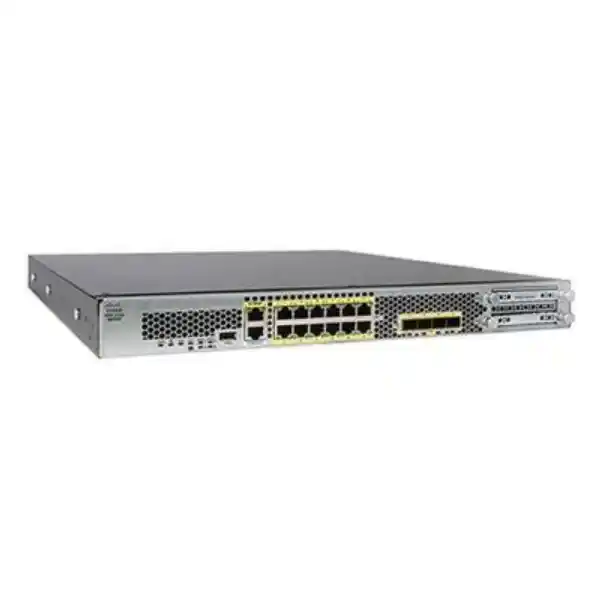
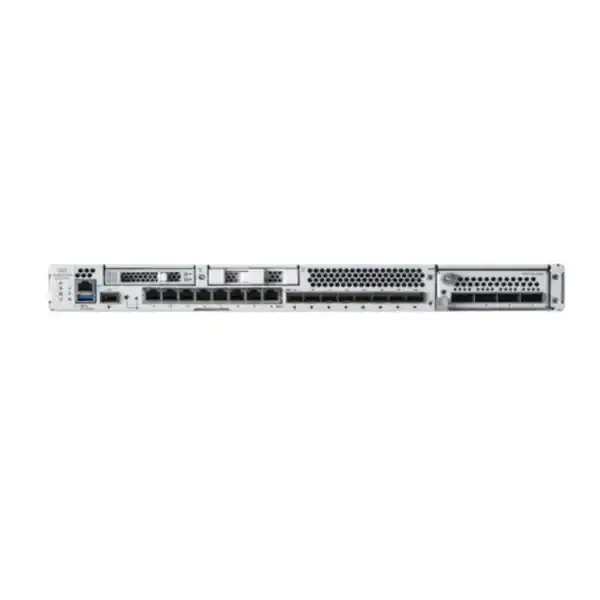
For a network whose realistic protected throughput falls comfortably below the 3120’s tested ceilings, the appliance can provide a strong balance of processing capacity and interface density without forcing the buyer into the larger models. Its eight copper Gigabit ports are useful for direct connections to routers, handoff devices, management or service networks, while eight integrated 1/10G SFP interfaces provide fibre or higher-speed Ethernet options. An optional eight-port 1/10G network module can take the platform to as many as 24 Ethernet data interfaces. That can be valuable in designs that need multiple routed zones or diverse aggregation links without adding an external switch simply to obtain more firewall-facing ports.
The limitation is equally important. Cisco’s current installation guidance states that the 40G FPR-X-NM-4X40G and the 1/10/25G FPR-X-NM-8X25G modules are only recognised on the 3130 and 3140; they are not supported on the 3105, 3110 or 3120. A buyer who expects the firewall to terminate native 25G or 40G links should therefore evaluate the 3130/3140 class or redesign the upstream and downstream connectivity. Buying a 3120 on throughput alone and discovering later that the required interface type is unavailable is exactly the kind of procurement error that a model-specific page should prevent.
Cisco Secure Firewall 3120 verified specification snapshot
| Specification | Cisco Secure Firewall 3120 detail |
|---|---|
| Form factor | 1RU; approximately 1.75 × 17 × 20 inches |
| FTD FW + AVC + IPS | Up to 21.0 Gbps in Cisco’s 1024-byte test profile |
| Concurrent sessions with AVC | Maximum 4 million |
| New connections per second | Maximum 170,000 with AVC |
| TLS inspection | 6.7 Gbps in Cisco’s published TLS methodology |
| IPsec VPN throughput, FTD | 10 Gbps baseline 1024-byte TCP fastpath figure |
| Integrated data I/O | 8 × 10M/100M/1GBASE-T RJ45 and 8 × 1/10G SFP Ethernet |
| Optional network module | 8 × 1/10G option; 25G/40G network modules are not supported on the 3120 |
| Maximum Ethernet ports | Up to 24 |
| Management | 1 × 1/10G SFP management port |
| Storage | 1 × 900 GB installed storage with one spare slot listed by Cisco |
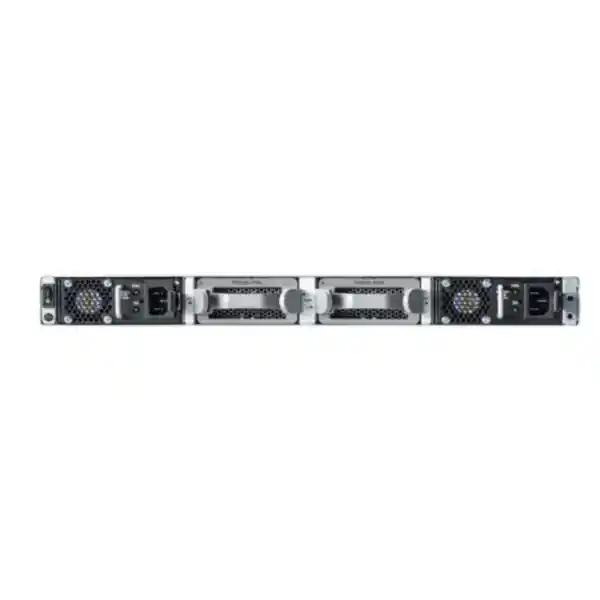
| Power and cooling | 400W AC or DC options; dual supplies can provide 1+1 redundancy; two hot-swappable fan modules |
Performance figures are vendor test results, not guaranteed application throughput for every deployment. Cisco notes that realised performance varies with enabled features, protocol mix, packet size and software release.
Understanding 21 Gbps correctly
The most frequently misunderstood specification on a modern firewall is throughput. A buyer sees a 21 Gbps FW+AVC+IPS result and may assume that a 20 Gbps internet connection is automatically a safe design. That is too simplistic. Cisco’s figures are generated using defined laboratory traffic profiles. Real enterprise traffic includes small packets, long and short sessions, SaaS applications, video, voice, DNS, file transfers, application APIs, backup flows, branch tunnels and an increasing proportion of encrypted sessions. The policy can also include intrusion rules, identity logic, URL controls, malware inspection, connection logging and decryption. Each element changes the workload.
For that reason, the 3120 should be sized from the protected workload backwards. Start with the true peak traffic seen at the intended enforcement point, not the ISP package speed printed on an invoice. Then identify how much of that traffic is encrypted, what proportion will actually be decrypted, whether east-west traffic crosses the firewall, whether site-to-site VPN is used, and whether the organisation expects a major increase in cloud, backup or application traffic during the lifecycle. Add the session rate and connection burst characteristics. A company with 5 Gbps of highly interactive application traffic may stress a firewall differently from an environment that transfers large sequential files at the same bandwidth.
Headroom should be deliberate. A firewall that spends ordinary business hours near its design ceiling leaves little room for unexpected bursts, new inspection features, incident response or growth. It can also make software upgrades and policy changes more difficult to assess. In many projects, the correct question is therefore not whether the Cisco 3120 can pass current traffic but whether it can enforce intended policy under peak conditions while retaining comfortable operating margin throughout the planned service life.
Interfaces: flexibility with a clear boundary
The integrated interface mix is one of the strongest practical reasons to consider the 3120. Eight 10M/100M/1GBASE-T RJ45 ports support standard copper Ethernet connections. Eight additional 1/10G SFP ports can be used for suitable supported fibre or copper transceiver options depending on design. This combination is useful where the firewall sits between multiple switching domains, internet routers, WAN services, DMZ networks and core infrastructure.
The optional eight-port 1/10G network module is important for interface-dense deployments. With the module, Cisco lists up to 24 total Ethernet ports. However, the buyer must still decide whether that many directly attached firewall interfaces are the best architecture. A large number of physical ports can be useful for segmentation, but many networks are cleaner when VLAN trunks and resilient switching carry multiple logical zones to a smaller number of high-speed firewall links.
Optics are a quotation dependency. The presence of SFP interfaces does not mean the required SFP/SFP+ transceivers are automatically included for every topology. The link speed, fibre type, distance, connector standard and peer device must be known before optics are selected. A 10G short-range multimode link, a long-range single-mode link and a copper handoff require different components.
The hard boundary is 25/40G expansion. Cisco’s current hardware guide is explicit that the 1/10/25G eight-port module and 40G four-port module are only recognised on the 3130 and 3140. They are not supported on the 3120. If a data-centre refresh is moving to native 25G or 40G firewall links, the 3120 may be the wrong platform even if its processing capacity looks sufficient.
FTD or ASA: choose the operating model before the bill of materials
Cisco Secure Firewall 3100 appliances can run Firewall Threat Defense or ASA software. The hardware name alone therefore does not describe the complete security solution. For new deployments that need modern threat prevention, application visibility, intrusion prevention, malware-related controls, URL filtering and integration with Cisco’s current firewall management approaches, Firewall Threat Defense is normally the mode that receives the most attention. ASA remains relevant in organisations that rely on established ASA capabilities, operational processes, configuration constructs or migration requirements.
The difference changes licensing, management and migration planning. Cisco’s current getting-started documentation identifies an Essentials requirement for Firewall Threat Defense when managed with Firewall Management Center and lists optional licences such as IPS, Malware Defense, URL Filtering and Cisco Secure Client. Cisco publishes an FPR3120 term licence family for the combined IPS, malware defence and URL package, with one-, three- and five-year term options. Exact commercial packaging can evolve, so active ordering structure should be confirmed when the quotation is created.
ASA licensing follows a different capability model. If the project is a migration from an existing ASA, the operational objective must be defined first: preserve ASA behaviour, move to FTD in the same project, or stage the migration in phases. That choice affects configuration conversion, testing, change windows, administrator training and how the organisation intends to manage the firewall after go-live.
Management architecture is part of the product decision
A firewall appliance is only one component of the operational system. The 3120 must be paired with a management approach that matches the organisation’s scale and governance. Cisco documents Firewall Device Manager for local management scenarios and Firewall Management Center-based workflows for centralised policy, logging and monitoring. The correct choice depends on how many firewalls are being operated, whether policies must be consistent across sites, how change control is performed, where logs need to reside, and which security teams need visibility.
A single appliance can sometimes be managed locally, but a multi-site UAE organisation often gains more operational consistency from centralised management. Central policy can reduce configuration drift, simplify common rule deployment and give the security team a unified view of events. The trade-off is that the management platform itself becomes part of the architecture and licensing/operations plan. Network reachability, administrator access, backup, upgrade sequencing, integration and logging retention must be designed rather than added later.
When an existing Cisco estate is already managed centrally, the new 3120 should be checked against the management platform version before migration. Software compatibility between firewall and management releases matters. A project should not assume that a new appliance can simply be registered to an old management environment without an upgrade path.
Security subscriptions: map paid capabilities to actual policy
IPS
Intrusion-prevention licensing is relevant where the 3120 is expected to inspect traffic against threat signatures and prevention rules. The buyer should define which network paths are inspected, what policy level is appropriate and whether the environment needs tuning for business applications.
Malware Defense
Malware-focused capabilities matter when file inspection, detection, blocking, tracking or related analysis is part of the security objective. Decide which traffic can be inspected, what happens to suspicious files and how incidents are escalated.
URL Filtering
URL controls can support acceptable-use policy, category-based restriction and risk reduction for web access. Identify user groups, exceptions, identity requirements and remote or branch traffic paths before licensing.
Cisco Secure Client
Remote-access requirements should be separated from site-to-site VPN. User count, authentication, MFA integration, endpoint platforms and concurrency all influence design and licensing.
Term planning
Cisco publishes one-, three- and five-year term PIDs for the 3120 threat subscription family. The suitable term depends on procurement policy, support strategy and budget treatment.
TLS decryption deserves its own sizing discussion
Encrypted traffic is dominant in many enterprise networks, so TLS inspection can become one of the decisive sizing variables. Cisco publishes a 6.7 Gbps TLS result for the 3120 using its defined methodology. That figure should not be conflated with the 21 Gbps FW+AVC+IPS figure. Decryption and re-encryption require cryptographic work, certificate handling and policy decisions that can materially change resource utilisation. If the organisation intends to decrypt a large share of outbound web traffic, internal application flows or inbound services, expected decrypted bandwidth and connection behaviour should be estimated separately.
Policy exclusions also matter. Some traffic may be excluded for privacy, legal, technical or application-compatibility reasons. Certificate-pinned applications, certain financial or healthcare destinations, software update mechanisms and unmanaged endpoints can complicate decryption. A practical design maps traffic into decrypt, do-not-decrypt and bypass decisions, tests critical applications and measures the resulting load.
For UAE organisations planning an aggressive encrypted-traffic visibility programme, the difference between headline inspection and TLS performance can be the point that moves a project from 3120 to 3130. It is better to discover that during sizing than during post-deployment troubleshooting.
VPN capacity: separate site-to-site design from remote-user experience
The 3120 can serve as a substantial VPN termination point, but VPN sizing should be built from tunnel type and traffic behaviour. Cisco’s data sheet lists 10 Gbps IPsec VPN throughput for FTD in its baseline 1024-byte TCP fastpath test. The number is useful for family comparison, but it should not be interpreted as a guarantee for every encryption suite, packet pattern or topology.
For site-to-site VPN, identify the number of branch, cloud and partner tunnels, expected peak traffic by tunnel, routing method, dynamic-routing requirements, redundancy, encryption domains and failover behaviour. A headquarters firewall can become a bandwidth aggregation point even when individual branches are small. Backup jobs, cloud replication or central internet breakout may create peaks that are invisible in average utilisation reports.
For remote access, look beyond aggregate throughput. Concurrent user count, authentication latency, endpoint posture, SaaS routing, voice/video experience, split tunnelling and DNS behaviour can affect usability. If remote users terminate on the same 3120 that protects internet-edge traffic, the combined peak must fit within the same appliance resources.
High availability: treat resilience as a complete path, not two boxes
Where the firewall protects a critical internet or data-centre path, a second appliance is commonly considered for high availability. The engineering objective is service continuity, not hardware duplication. Two correctly configured firewalls can still sit behind a single non-redundant ISP router, share one access switch, rely on one power circuit or depend on a single management path. The HA design should therefore be reviewed end-to-end: upstream routing, downstream switching, power feeds, transceivers, cabling, failover links, software versions, licensing, monitoring and operational procedures.
Power supply selection is another layer. Cisco lists a single 400W AC configuration for the 3120 with dual AC optional, and dual supplies support 1+1 redundancy and hot-swap. In a dual-firewall deployment, dual supplies per appliance are often considered when uptime justifies the cost, with feeds distributed across appropriate power sources.
HA also changes maintenance planning. Software upgrades, policy deployment and physical service procedures need documented sequence and rollback criteria. Failover should be tested under controlled conditions. Session behaviour, routing convergence, VPN state, monitoring alerts and application recovery must be observed.
Practical deployment patterns
Midsize enterprise internet edge
A head office with multi-gigabit internet access can use the 3120 for application-aware policy, intrusion prevention, URL control, VPN and segmentation, provided real inspected peaks remain within design margin. Dual ISP routing, HA and TLS policy are usually decisive.
Campus security boundary
Universities, schools or large office campuses may use the platform between user networks, internet/WAN services and server zones. Session scale can be more important than average bandwidth because thousands of endpoints produce many short-lived web and cloud connections.
Data-centre perimeter
The 3120 can protect server and service zones where 10G interfaces are sufficient. If the data-centre roadmap requires native 25G or 40G firewall connectivity, the 3130/3140 family position becomes more relevant.
Regional VPN hub
A UAE headquarters can aggregate branch and cloud IPsec tunnels, but the design should model the sum of simultaneous traffic, encryption policy and internet-edge inspection load.
Secure service segmentation
The available copper, fibre and optional 1/10G module interfaces can support multiple routed security zones. Logical segmentation through VLANs may reduce physical-port requirements while preserving policy boundaries.
ASA refresh with staged modernisation
Organisations with established ASA estates can evaluate the 3120 as new hardware while deciding whether to preserve ASA operations temporarily or migrate to FTD. Make software mode and policy-conversion scope explicit before implementation.
A sensible sizing workflow for UAE buyers
- Measure present traffic. Collect peak and average bandwidth from the actual enforcement point over a representative period.
- Characterise sessions and applications. Estimate concurrent sessions, new connection rates and applications producing bursts.
- Define enabled security services. State whether IPS, malware controls, URL filtering, application policy and TLS decryption will be enabled and on which flows.
- Model encrypted traffic. Estimate the percentage of TLS traffic and the subset that policy will actually decrypt.
- Add VPN demand. Include branch tunnels, cloud VPNs, partner connectivity and remote users.
- Validate interfaces. Confirm every link speed, medium, connector, optic and network-module requirement.
- Choose resilience. Decide whether a single appliance is acceptable or an HA pair is required, and whether each chassis needs dual power.
- Apply growth headroom. Add expected circuit upgrades, user growth, cloud adoption and policy expansion.
- Confirm software and management. Determine FTD versus ASA, management method, subscriptions and support before finalising the BOM.
Installation planning: rack, power, cabling and environment
The 3120 is a 1RU appliance, approximately 17 inches wide and 20 inches deep. Cisco documents rack-mount procedures using included rails for a four-post EIA-310-D rack and optional fixed brackets for relevant two-post arrangements. Rack depth, rail compatibility, front/rear access and cable management should be checked before the installation window.
Standard operating temperature is documented at 0 to 40°C under normal conditions. UAE data rooms are typically climate controlled, but the environmental requirement still matters during HVAC faults, temporary relocations, construction phases or deployments in edge cabinets. The appliance is not a substitute for proper rack cooling.
Power planning should confirm AC or DC requirements at order time. For enterprise data rooms, dual AC supplies may be selected where 1+1 power-module redundancy is justified. Those supplies should be connected to appropriately separated power feeds when the site supports them.
Cabling preparation should include every data interface, HA/failover path, management link and console access method. Cisco notes that fixed SFP ports require relevant SFP/SFP+ modules. A deployment engineer should arrive with confirmed optics, patch leads and labelled port mapping rather than a generic expectation that fibre will fit.
Migration from an existing firewall
A successful firewall replacement starts with discovery, not configuration entry. Inventory interfaces, VLANs, IP addressing, routing, NAT, access rules, objects, groups, site-to-site VPNs, remote-access services, authentication, certificates, identity integrations, high-availability settings, logging destinations, monitoring systems, DNS dependencies and special inspection behaviours. Old policies often contain stale rules or workarounds that should not be copied blindly.
If the source device is another Cisco platform, migration can still require careful interpretation. ASA and FTD policy models are not identical in every operational detail. Where the source is another vendor, the work is not a line-by-line translation. Security intent should be extracted and rebuilt using the target platform’s policy model.
Routing deserves separate validation because a firewall cutover can change adjacency, route preference or convergence. Projects using BGP, OSPF, static tracking, policy-based routing or multiple ISP links should document expected pre- and post-cutover routes. NAT testing should include inbound publishing, outbound identity, partner exceptions and applications that embed IP addresses.
The rollback plan must be operationally realistic. It should state the decision point for rollback, how cabling is restored, how routing and ARP states recover, and how teams communicate the change. Change-window timing should allow both validation and rollback before business impact becomes unacceptable.
Operational readiness after deployment
A firewall project is not complete when traffic first passes. The operations team needs a known process for policy requests, emergency changes, software updates, security intelligence, backup, monitoring and incident investigation. Rule ownership should be documented so access does not accumulate without review.
Software lifecycle planning is particularly important. Cisco publishes field notices, software releases and upgrade guidance for the Secure Firewall family. Administrators should track recommended releases and product advisories rather than leaving the appliance on its initial image indefinitely. Management Center and managed-device compatibility must be checked as part of every upgrade.
Capacity should also be monitored over time. CPU, memory, connection counts, interface utilisation, dropped traffic, inspection events, VPN load and TLS behaviour can reveal when a design assumption is changing. That operational data is useful when considering circuit upgrades or a future platform refresh.
When the Cisco 3120 may be too small, too large or the wrong fit
The 3120 may be too small when expected inspected traffic approaches its tested performance envelope after realistic policy overhead and growth headroom are included. Heavy TLS decryption is a common reason to move upward because the relevant decryption figure is lower than headline inspection throughput. Very high new-connection rates, large VPN aggregation, or a data-centre roadmap built around 25/40G links can also justify evaluating the 3130 or 3140.
It may be larger than necessary for a branch or office whose protected traffic, session counts and expansion plans fit comfortably on a smaller platform. Overbuying ties up budget that could be used for HA, better subscriptions, logging infrastructure, professional services or a longer support term.
The 3120 can also be the wrong fit when the organisation’s operational model is built around a different security ecosystem, when required integrations are unsupported, or when the project depends on a feature that belongs to another platform class. Product selection should begin with security and operational requirements, then identify the hardware that satisfies them.
3120 versus nearby Cisco Secure Firewall 3100 models
| Model | FTD FW+AVC+IPS | Sessions with AVC | Integrated fibre | Why compare |
|---|---|---|---|---|
| 3110 | 17 Gbps | 2 million | 8 × 1/10G | Lower demand with enough 17 Gbps-class inspection headroom. |
| 3120 | 21 Gbps | 4 million | 8 × 1/10G | Balanced mid-range option where 10G interface architecture is sufficient. |
| 3130 | 38 Gbps | 6 million | 8 × 1/10/25G | Higher inspection demand or native 25/40G expansion needs. |
| 3140 | 45 Gbps | 10 million | 8 × 1/10/25G | Largest 3100-series workloads and strongest growth margin in this family. |
The correct model is not automatically the largest. It is the smallest platform that safely meets the full workload, interface, resilience and lifecycle requirements with appropriate headroom. Sometimes moving one step up prevents an early replacement; sometimes choosing the 3120 preserves budget for the second HA node, subscriptions, optics and implementation quality.
Procurement: what an accurate Cisco 3120 quotation should resolve
A quotation that lists only Cisco Secure Firewall 3120 is usually incomplete. The appliance is the centre of a solution that may also require a second chassis for HA, power-supply choices, the optional network module, SFP/SFP+ optics, software subscriptions, management entitlements or capacity, support coverage, rack/cabling accessories and professional services. The bill of materials should reflect the final topology.
Subscription term is a budget and governance choice. Cisco’s published 3120 threat licence family includes one-, three- and five-year options for the combined IPS, Malware Defense and URL package in the referenced ordering structure. Organisations should align the term with internal procurement cycles and planned device lifecycle. Current commercial availability and exact PIDs should be validated at quote time.
Support should be specified rather than assumed. Hardware replacement expectations, technical support access, software entitlement and response requirements depend on the service arrangement. The quotation should also separate product supply from installation, migration and post-deployment support so stakeholders can see what is included.
Lead time can vary by hardware and accessory. An appliance may be available while a particular optic or module is delayed. For projects with a fixed cutover date, all dependencies should be ordered and checked together.
Dubai and UAE deployment considerations
UAE firewall projects often span more than one site and more than one connectivity provider. A Dubai headquarters may connect to Abu Dhabi offices, free-zone facilities, warehouses, cloud environments and international branches. The 3120 can be evaluated as the central security point for such designs, but topology should account for provider handoffs, route diversity, remote-site tunnel aggregation and local breakout.
Data-room preparation is also practical. Verify rack type, available rack depth, power-feed type, UPS/PDU capacity and fibre presentation before installation. UAE facilities are generally designed for controlled environments, but branch communications rooms can vary widely. Cooling, dust control and cable organisation still affect reliability.
For broader requirements, FourTeck UAE supports local technology projects, while FourTeck IT Services UAE is relevant for infrastructure and support. International organisations can also reference FourTeck, alongside the specialist Firewall Dubai by FourTeck resource.
Implementation journey
Common buyer questions
Is the Cisco 3120 a 21 Gbps firewall?
Cisco publishes 21 Gbps for FW+AVC and FW+AVC+IPS in a 1024-byte FTD test profile. Real throughput varies with packet size, traffic mix, software and features. TLS decryption has its own published 6.7 Gbps result.
How many sessions can it handle?
Cisco lists up to 4 million concurrent sessions with AVC and 170,000 new connections per second with AVC for FTD.
Does it have 10 Gigabit ports?
Yes. It includes eight integrated 1/10G SFP data interfaces plus eight copper Gigabit RJ45 interfaces. The correct SFP/SFP+ optics must be selected separately where required.
Can the 3120 use 25G or 40G modules?
No. Cisco’s hardware guidance states those network-module options are recognised only on the 3130 and 3140, not the 3120.
Does it support redundant power?
Yes. Dual 400W AC is an available option and dual supplies support 1+1 redundancy and hot-swap.
Can it run ASA?
Yes. Cisco documents ASA and Firewall Threat Defense on the 3100 Series. The choice changes feature model, licensing, management and migration work.
Is it suitable for a 10 Gbps internet circuit?
Potentially, but circuit speed alone is insufficient. TLS decryption, inspection policy, VPN load, traffic mix, sessions and growth margin must be evaluated.
When should I evaluate the 3130?
Compare the 3130 when substantially higher inspection headroom, stronger TLS/VPN performance, greater session margin or native 25G/40G expansion is required.
Logging, monitoring and incident response
A threat-focused firewall can generate substantial event data. Before enabling broad logging everywhere, decide what information the security team will actually use, where it will be retained and how quickly it must be searchable. Connection events, intrusion events, URL activity, authentication logs, VPN events and system health serve different purposes. Excessive logging can increase storage and analysis burden, while insufficient logging can leave investigators without evidence during an incident.
Integration with a SIEM or monitoring system should be designed with event volume in mind. The firewall should not become the only place where critical evidence exists. Time synchronisation is equally fundamental: logs from firewalls, servers, endpoints and identity systems need consistent timestamps to reconstruct events. NTP, DNS and management reachability are basic dependencies that deserve validation in staging.
System-health monitoring should detect more than interface-down states. Resource utilisation, dropped packets, HA state, power-supply condition, fan status, tunnel state, management connectivity and licence/subscription condition can all affect service.
Security policy design: use the hardware capacity to enforce clear intent
Good firewall performance does not compensate for poor policy. Access rules should be structured around business need, least privilege and clear ownership. Broad any-to-any rules may reduce troubleshooting effort during a rushed migration, but they weaken the security purpose of the new platform. A better process identifies required applications, source groups, destinations, services and exceptions, then uses logging to validate behaviour.
Application visibility can improve policy precision, but it should be introduced carefully where legacy systems depend on unusual traffic patterns. Intrusion-prevention policies should be tuned to the environment. URL controls need exception governance. Decryption policy needs privacy and compatibility review. The most secure design is one the organisation can understand, monitor and maintain consistently.
Segmentation is another area where the 3120’s interfaces and performance can add value. Internet edge, guest, server, user, management and partner zones can be separated logically or physically according to risk. Traffic-flow diagrams are useful because they make these decisions visible to networking and security teams.
Lifecycle and upgrade planning
The Secure Firewall 3100 Series remains an actively documented Cisco platform, with the hardware installation guide updated in 2026. That does not mean every deployment should run the newest software immediately. Organisations should establish a release strategy that considers Cisco recommendations, security fixes, field notices, feature needs and compatibility with the management platform.
A lifecycle plan should record hardware serials, support dates, licence terms, software versions, management dependencies, backup procedures and the next capacity-review point. If internet circuits are expected to double during the next contract term, that event should already be visible in the firewall lifecycle plan. The platform may have enough processing headroom but lack future interface speed, or vice versa.
Spare and replacement strategy also depends on business criticality. Some organisations rely on vendor support replacement, while others maintain local spares for remote sites. An HA pair reduces outage risk but does not eliminate the need for support if a failed unit must be replaced.
What FourTeck should confirm before finalising a 3120 proposal
A technically sound proposal should begin by confirming the exact enforcement role. Is the appliance protecting one internet edge, acting as a regional VPN hub, segmenting a data centre, replacing an ASA pair, or combining several functions? Each role changes the relevant performance and licensing questions. The proposal should then connect measured traffic to Cisco’s published performance categories and document the safety margin used.
The physical design should identify every interface speed and medium, required SFP/SFP+ optics, whether the optional eight-port 1/10G network module is needed, and whether a future move to 25/40G is expected. If so, the proposal should explain why a 3130 or 3140 may be a better long-term choice. Power-supply quantity and HA chassis quantity should be tied to availability requirements.
Finally, the proposal should state software mode, management method, security subscriptions and term, support coverage, staging assumptions, migration scope, on-site activities, documentation and post-cutover assistance.
Decision recap
Use peak protected traffic and enabled services, not internet-circuit speed alone. Keep headroom for bursts and growth.
Model decryption separately. The 6.7 Gbps published TLS figure differs materially from the 21 Gbps inspection benchmark.
Eight copper and eight 1/10G SFP ports are integrated, with optional 1/10G expansion. Native 25/40G expansion points to larger models.
Define IPS, Malware Defense, URL Filtering, Secure Client and term requirements according to actual security policy.
Align HA, dual power, routing, switching and carrier paths to the same uptime objective.
Inventory routing, NAT, access rules, VPNs, identity, certificates, logging and rollback requirements.
What FourTeck needs from the buyer
Single appliance, pair, and resilience objective.
Peak bandwidth, users/devices, connection rates and growth.
IPS, malware, URL filtering, TLS decryption and remote access.
Link speeds, copper/fibre, distances and network-module need.
FTD or ASA, management platform and software versions.
Required security bundle and term.
AC/DC, redundant supply, rack and PDU arrangement.
Current firewall, VPN/rule complexity, change window and installation scope.
Plan the Cisco Secure Firewall 3120 around your real traffic, not a generic bundle
The 3120 can be an excellent mid-range enterprise firewall when its 21 Gbps-class threat-inspection performance, four-million-session scale and 1/10G interface architecture match the deployment. The safest buying process confirms decryption demand, VPN load, interface media, HA, subscriptions, management and migration before the purchase order. Share your current topology and target circuit speeds, and FourTeck can help turn those requirements into a model comparison and bill of materials.

Reviews
There are no reviews yet.