
DrayTek Vigor2927 Dual-WAN VPN Firewall Router
Built for organizations that cannot afford an avoidable internet outage, the DrayTek Vigor2927 combines dual Gigabit Ethernet WAN connectivity, load balancing, automatic failover, policy routing, enterprise-style VPN, segmentation, bandwidth control and centralized management in a compact platform sized for demanding small and midsize networks.
Key platform figures
*Maximum manufacturer laboratory figures under stated acceleration and test conditions; real deployment performance depends on traffic mix, enabled services, packet size, ISP characteristics and configuration.
What the DrayTek Vigor2927 is designed to solve
For many UAE businesses, the router is not simply the device that shares an internet connection. It is the control point where internet resilience, security policy, branch connectivity, voice traffic, cloud application performance, user segmentation and operational visibility converge. A single inexpensive broadband router may be sufficient for a home office, but it becomes a weak design choice when dozens of employees depend on Microsoft 365, cloud ERP, IP telephony, remote desktop, SaaS platforms, hosted cameras, VPN access and real-time collaboration at the same time. The Vigor2927 addresses that gap by giving administrators a purpose-built dual-WAN routing and firewall platform with enough policy depth to treat multiple circuits, networks and traffic classes differently.
The first practical advantage is continuity. With two Ethernet WAN interfaces available, a business can connect separate internet services and decide whether they should operate in load-balancing mode, active/standby failover, policy-routed separation or a hybrid design. That matters in Dubai offices where one circuit may be dedicated to normal user traffic while another is held for backup, voice, a hosted service or a specific department. The router can monitor WAN reachability and move traffic according to configured failure criteria rather than relying on employees to notice an outage and manually change cabling. This is especially valuable at reception desks, retail points of sale, small clinics, warehouses, training centers and branch offices where there may be no full-time network engineer on site.
The second advantage is control. Vigor2927 combines routing, NAT, firewall rules, VLANs, QoS, session management, VPN and management functions in one policy plane. That makes it possible to build a structured network instead of a flat LAN where every device competes for bandwidth and can potentially communicate with every other device. The platform is therefore suitable not only as an internet edge router but also as a segmentation gateway for staff, servers, guest access, IP phones, cameras, building systems and administration networks. FourTeck can integrate the router into a wider network design that includes switching, Wi-Fi and managed IT services through FourTeck UAE and related specialist services.
Hardware architecture and interface design
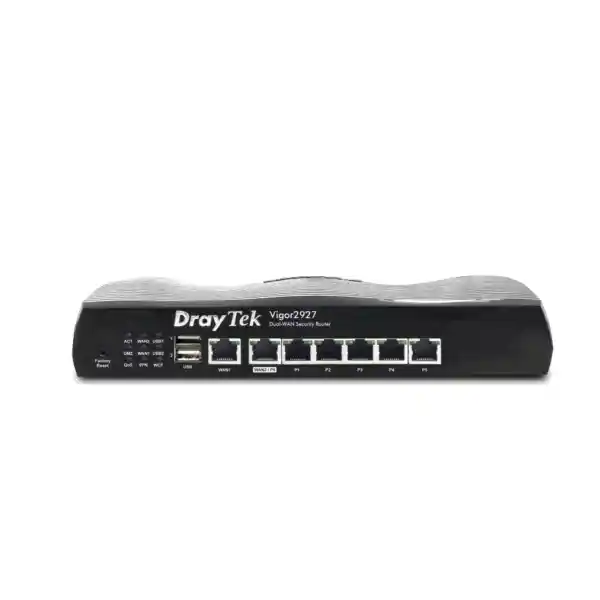
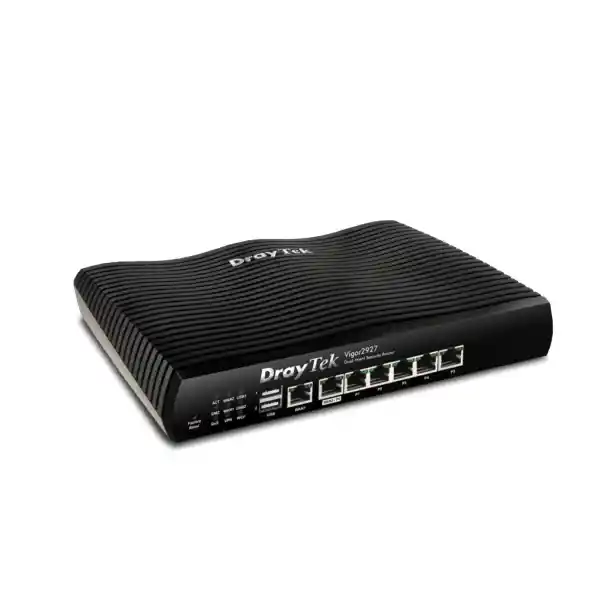
The wired DrayTek Vigor2927 is built around Gigabit Ethernet rather than an integrated xDSL modem or embedded wireless radio. That is an important distinction when sizing the model. The base unit is intended to sit behind Ethernet handoffs, ONTs, modems or upstream provider devices and focus on routing, firewall, VPN and policy functions. It provides one fixed Gigabit Ethernet WAN port and a second Gigabit interface that can be used as WAN or LAN according to the deployment. On the internal side, five fixed Gigabit RJ-45 LAN interfaces support direct device connections or uplinks to access/distribution switches. Two USB 2.0 interfaces provide supported peripheral options such as selected cellular modems, storage, printer or environmental accessory use cases depending on firmware support and regional compatibility.
The router’s hardware acceleration engine is significant because it allows selected forwarding, QoS and IPsec workloads to be processed more efficiently than a purely software-forwarded path. DrayTek specifies up to 940 Mbps firewall performance on a single WAN with hardware acceleration and up to 1.8 Gbps combined across dual WAN under its test conditions. The company also specifies hardware-accelerated IPsec performance up to 800 Mbps, with acceleration available to a defined number of simultaneous IPsec tunnels. These values should be treated as engineering ceilings, not guaranteed application throughput. Real results vary with frame size, symmetric versus asymmetric flows, encryption choices, NAT state, QoS classification, inspection features, VPN profile, latency and the performance of remote peers.
For network designers, the useful question is not simply whether the specification says “Gigabit.” The correct question is which traffic path will be used and which features are enabled at the same time. A branch performing basic NAT to a 500 Mbps internet circuit places a different workload on the platform than a site carrying multiple encrypted tunnels, hundreds of simultaneous cloud sessions, application classification, inter-VLAN traffic and traffic shaping. Hardware acceleration makes the Vigor2927 a stronger fit for high-speed business broadband than earlier generations, but sizing should still be based on the feature combination that will run during peak hour.
Physical deployment is straightforward. The chassis measures approximately 241 × 165 × 44 mm and is powered from a 12 V DC supply. The specified operating temperature range is 0 to 45°C, with non-condensing operating humidity of 10 to 90 percent. In UAE installations, the most important environmental consideration is not outdoor temperature but the actual temperature inside the cabinet, reception counter, ceiling enclosure or communications room. The router should be installed in a ventilated indoor location with clean power, adequate airflow and sensible cable management. If it is placed inside a closed cabinet with a PoE switch, NVR, UPS and other heat-producing equipment, cabinet temperature can rise significantly above normal room temperature.
Port map and practical deployment role
A sound design normally uses the Vigor2927 as the security and routing boundary, then connects one or more managed switches behind it. Directly attaching every endpoint to the router is rarely the best long-term topology. Managed switching enables cleaner VLAN distribution, PoE for phones and access points, easier expansion and clearer fault isolation.
Dual-WAN load balancing, failover and business continuity
Dual WAN is the defining capability of the Vigor2927. The router can distribute sessions across more than one internet connection, steer selected traffic to a preferred circuit and fail traffic away from a failed path. This is useful because business continuity is not achieved simply by ordering two ISP links. The network must also have a decision engine that identifies path failure and moves appropriate traffic without creating new operational problems. The Vigor2927 provides multiple connection-detection methods, including link and reachability mechanisms, so a site can avoid treating a physically connected but upstream-broken service as healthy.
In a load-balanced design, sessions can be spread by rules or balancing logic so that both WANs contribute useful capacity. This is different from bonding. A single ordinary session does not magically become the sum of both WAN speeds; instead, independent sessions can be directed across available links. A 300 Mbps ISP and a 500 Mbps ISP may therefore support an aggregate workload greater than either circuit alone, even though one individual download typically remains bound to one path. This model works well for offices with many users because browsers, cloud clients and collaboration tools create numerous simultaneous flows.
Policy-based routing makes dual-WAN deployments more predictable. Administrators can build rules based on source, destination, service or other available matching criteria. For example, guest internet can be sent through WAN2 while corporate application traffic prefers WAN1. A hosted voice platform can use the circuit with lower jitter. Backup uploads can be directed to a lower-priority path. A remote site-to-site VPN can be pinned to a WAN with the correct public addressing. Country- or domain-aware route policies can also be considered where appropriate to business requirements and firmware capabilities.
Failover design deserves equal attention. If the primary circuit fails, new sessions can be moved to the secondary circuit according to policy. Existing sessions may still need to be re-established because public source addresses change. Cloud services generally recover quickly, but inbound services, site-to-site VPNs and allow-listed applications may need specific dual-WAN planning. If an application provider only permits one fixed public address, a second ISP alone does not automatically deliver transparent failover. FourTeck engineers can account for DNS, VPN, public IP and application restrictions during the design stage instead of discovering them after an outage.
For additional resilience, a compatible USB cellular modem may be usable as an alternate access option depending on supported modem models, firmware and operator compatibility. This should be validated before procurement. The standard Vigor2927 does not contain an integrated LTE modem or SIM slot; customers needing embedded cellular should compare the appropriate Vigor2927 LTE family member rather than assuming the base wired model includes cellular hardware.
VPN architecture for branches, remote users and cloud-connected operations
The Vigor2927 supports up to 50 VPN tunnels and is designed for both site-to-site and remote-access use cases. Supported VPN technologies include IPsec, IKEv2, SSL VPN, OpenVPN, WireGuard, L2TP over IPsec and additional legacy protocols for interoperability. In a modern deployment, protocol choice should be driven by security policy, endpoint support, operational simplicity and remote peer requirements rather than by the longest protocol list. IPsec remains common for branch-to-branch connectivity and firewall interoperability, while WireGuard and OpenVPN may be useful where supported client workflows make them appropriate.
DrayTek specifies standard AES-256 IPsec throughput around 250 Mbps in its published table and hardware-assisted IPsec performance up to 800 Mbps under qualifying conditions. SSL VPN throughput is specified up to 120 Mbps, and WireGuard performance is listed separately at a lower tested figure for the base platform. These numbers illustrate an important sizing principle: “VPN throughput” is not one universal figure. Encryption protocol, cipher, packet size, acceleration path and tunnel behavior all matter. If a Dubai head office needs to terminate high-volume encrypted links from multiple branches, the aggregate encrypted workload should be estimated rather than assuming every tunnel can simultaneously run at the maximum headline number.
For site-to-site VPN, the Vigor2927 can connect branch subnets over encrypted tunnels so that systems in different offices communicate using private addressing. Route design should avoid overlapping IP ranges. Two branches both using 192.168.1.0/24 create unnecessary complexity when they later need to be joined. A planned addressing scheme with distinct VLANs and subnets per location makes VPN routing, firewall policy and troubleshooting much easier. Where businesses are expanding across the GCC or Africa, addressing should be planned before rollout rather than improvised one branch at a time.
VPN trunk functions can be used for redundancy or load distribution between suitable tunnel paths. This becomes valuable when both ends have multiple internet circuits. A branch can retain connectivity when one ISP or one tunnel endpoint becomes unavailable, subject to the selected topology. NAT traversal is also available for cases where a VPN peer sits behind address translation. IKE authentication options include pre-shared key and X.509 certificate approaches, while user authentication can integrate with local accounts and supported external mechanisms such as RADIUS, LDAP or TACACS+ depending on the function and configuration.
Remote-access policy should be designed with least privilege. A teleworker VPN does not always need unrestricted access to every internal subnet. Separate user groups, firewall rules and routes can restrict remote users to the applications they require. Administrators should also plan credential protection, MFA options where supported in the chosen client and identity design, certificate lifecycle and logging. A router can provide the technical tunnel, but secure remote work depends on endpoint security, account policy and application access controls as well.
Firewall policy, NAT and content control
The Vigor2927 uses stateful firewall and NAT functions to control traffic between WAN, LAN and routed segments. Administrators can create IP-based firewall policies, implement port redirection and open-port rules for specific inbound services, configure DMZ-host behavior where absolutely necessary, and use supported application layer gateways for services such as SIP, RTSP, FTP and H.323. The safest design is generally to expose as little as possible. Broad inbound forwarding should be replaced with VPN or tightly scoped rules whenever the application permits it.
Denial-of-service and spoofing defenses add another layer of edge protection against malformed or abusive traffic patterns. These features should not be described as a replacement for a full enterprise intrusion-prevention platform; the Vigor2927 is a feature-rich SMB router/firewall rather than a high-end next-generation threat inspection appliance. Its strength is combining practical stateful firewall policy, segmentation, content controls, routing and bandwidth management in a cost-efficient device. Organizations requiring sandboxing, advanced malware analysis or continuously updated enterprise IPS should scope those requirements separately.
Content filtering can use application, URL keyword, DNS keyword and web-feature controls. Category-based filtering is available with the appropriate subscription where required. This distinction matters during procurement because not every content-control feature is necessarily perpetual or subscription-free. A quotation should therefore state whether the requirement is simple URL/domain blocking, application policy or subscription-backed category filtering. For schools, guest networks and shared office environments, policy requirements may differ from those of a conventional business LAN.
NAT and port forwarding should be documented. It is common for older installations to accumulate rules created for temporary cameras, test servers, remote desktops or vendor support sessions. Over time, nobody remembers why they exist. When FourTeck replaces or reconfigures an edge router, these rules can be reviewed and reduced rather than blindly copied. The result is easier troubleshooting and a smaller exposed attack surface. For specialist firewall integration and edge-network support, organizations can also reference the FourTeck Firewall Dubai resource.
Administrators should disable unnecessary remote management services, prefer HTTPS and SSH over insecure management channels, restrict management source addresses, maintain current firmware and use configuration backups. SNMP, syslog, NetFlow/IPFIX and alert mechanisms can provide operational visibility, but these should also be secured. A management protocol that is useful internally can become risky if carelessly exposed to the public internet.
VLAN segmentation and internal network architecture
The Vigor2927 supports both 802.1Q tag-based VLANs and port-based VLAN concepts, with up to 16 VLANs in the published platform specification and support for multiple LAN subnets. This is one of the most valuable capabilities in a business router because it allows a single physical switching infrastructure to carry separate logical networks. A well-designed office might have a corporate user VLAN, voice VLAN, guest VLAN, camera VLAN, server VLAN and management VLAN, each with a dedicated subnet and controlled routing policy.
Segmentation improves both security and operations. Guests should not be able to browse printers, servers or surveillance systems. Cameras usually need to reach an NVR and selected management hosts, not employee laptops. IP phones may need access to their call platform and DNS/NTP services but not to sensitive file shares. Building automation or IoT systems should be isolated from business workstations. By placing these device classes into separate VLANs and applying firewall policy between them, the Vigor2927 can act as the routing and enforcement point for smaller sites.
The router also supports inter-VLAN routing, static IPv4 and IPv6 routes, policy routes, RIP and BGP according to its published feature table. BGP support should be understood in the context of the platform: it is useful for specific SMB and branch routing scenarios, but organizations planning complex service-provider-scale routing should size a platform designed for that purpose. For a multi-branch corporate environment, static routing and policy routing may be sufficient, while dynamic routing can simplify more complex topologies.
DHCP functions can serve multiple internal networks with custom options and IP-to-MAC binding. Local DNS and conditional forwarding can help resolve internal names or forward selected domains to appropriate resolvers. Wired 802.1X support can be incorporated where compatible switching and authentication infrastructure are available. Port mirroring provides a troubleshooting mechanism when administrators need to observe traffic using an analyzer on an appropriate interface.
VLAN deployment requires compatible switching. A VLAN defined on the router is not automatically carried correctly through an unmanaged switch. Trunks and access ports must be configured consistently across the router and managed switches. If wireless access points broadcast staff and guest SSIDs, their uplink ports must carry the associated tagged VLANs. FourTeck can design this across router, switch and access-point layers so the logical segmentation is implemented end to end rather than only configured at the edge.
QoS, bandwidth management and application experience
Internet capacity does not automatically guarantee a good user experience. A 500 Mbps circuit can still deliver poor voice quality if large uploads fill the upstream queue, and a remote desktop session can feel unresponsive when backup traffic introduces latency and loss. The Vigor2927 includes IP-based bandwidth limits, session limits, application QoS and classification using mechanisms such as DSCP, 802.1p, IP address, port and application criteria. This allows administrators to prioritize delay-sensitive traffic and prevent one device or workload from consuming a disproportionate share of the connection.
VoIP prioritization is particularly relevant to UAE offices using hosted PBX, SIP trunks or cloud collaboration platforms. The router can recognize and prioritize configured voice traffic so large file transfers or guest browsing do not unnecessarily degrade call quality. However, QoS only controls the queues the organization owns. It cannot eliminate congestion deep inside an ISP network or a remote cloud service. Good voice design therefore considers LAN switching, WAN QoS, ISP quality, jitter, packet loss, DNS and the call provider end to end.
Session limits can protect shared environments from devices that create excessive concurrent connections. This may matter in guest networks, poorly behaved applications or compromised endpoints. Bandwidth limits can also provide fairness for tenants, departments or public users. For example, guest users can be given enough bandwidth for normal browsing without allowing a small number of video downloads to consume the whole backup circuit. Corporate traffic can retain a defined priority class while unused reserved capacity remains available to lower-priority flows when conditions permit.
QoS policy should be simple enough to operate. Overly detailed classification often becomes difficult to maintain as cloud applications change. A practical deployment usually defines a few meaningful classes—voice and real time, critical business applications, normal user traffic and low-priority bulk traffic—then verifies results with monitoring. The Vigor2927’s hardware QoS acceleration helps maintain performance while policy features are active, but every network should still be tested under realistic load after implementation.
Routing, IPv6, multicast and advanced network services
Beyond ordinary NAT routing, the Vigor2927 provides static IPv4 and IPv6 routes, policy routing, inter-VLAN routing and support for dynamic routing protocols listed by DrayTek, including RIP v1/v2 and BGP. This gives the platform flexibility in branch networks that have multiple internal paths, private WANs, site-to-site tunnels or upstream routers. Policy routing is often the most immediately useful capability because it allows traffic to follow business rules instead of relying only on the destination-based routing table.
IPv6 capabilities should be planned rather than simply enabled. The router supports multiple IPv6 connection and tunneling methods, and an organization can deploy IPv6 alongside IPv4 where the ISP and internal security policy permit it. The key operational point is that IPv6 requires firewall policy just as IPv4 does. Administrators sometimes focus heavily on NAT as a security boundary and overlook that globally routable IPv6 addresses change the addressing model. Stateful firewall rules, DNS, endpoint readiness and monitoring should therefore be reviewed as part of IPv6 activation.
IGMP v2/v3, IGMP proxy, snooping and fast-leave functions help in networks carrying multicast services. These may be relevant for IPTV, some collaboration systems, digital signage or specialized enterprise applications. Multicast should be enabled only where required and validated across switches, because an improperly designed multicast domain can create unnecessary flooding. Where VigorSwitch infrastructure is used, coordinated configuration can simplify the overall design.
DNSSEC support, local DNS functions, dynamic DNS and DrayDDNS features add useful service options. Dynamic DNS can help smaller environments where a WAN address changes, but it should not be confused with a static IP guarantee. Applications that depend on source-IP allowlisting, inbound firewall rules or strict tunnel identification may still require fixed addressing or a different architecture. The correct choice depends on the service and the ISP contract.
Central management with VigorACS, AP management and switch management
The Vigor2927 is more than a standalone router when deployed within a DrayTek ecosystem. It can centrally manage compatible VigorAP access points and VigorSwitch devices, giving administrators a consolidated topology and control point for smaller networks. Central AP management can support discovery, provisioning, monitoring and operational tasks, while switch management can simplify VLAN deployment and device visibility. This is particularly useful for organizations that want centralized control without deploying a separate on-premises wireless controller.
The router’s published capacity includes management of multiple access points and switches, with the exact supported counts depending on model and firmware. For larger estates, VigorACS provides centralized management, provisioning and monitoring across distributed DrayTek devices. Features associated with the management platform can include zero-touch provisioning, auto-VPN workflows, interface quality monitoring, application visibility, SD-WAN policy assistance and hotspot management, subject to current software version, licensing and model support.
For a company opening branches, centralized provisioning reduces configuration drift. Instead of treating each router as a completely isolated box, administrators can standardize WAN rules, LAN addressing, VPN templates, firmware policies and alerting. This lowers the risk that one branch remains on an old firmware release or uses a different firewall rule set simply because it was configured at a different time. It also gives support teams a better starting point when troubleshooting remote sites.
Management data should be integrated into operational processes. SNMP can feed network monitoring systems. Syslog can centralize events. NetFlow v5/v9 and IPFIX support can provide traffic-flow visibility to compatible collectors. SMS and email notifications can provide alerts in supported scenarios. Configuration backup and restore should be part of change management, especially before firmware upgrades or major policy modifications. A router that is well configured but never backed up creates avoidable downtime if hardware replacement is required.
FourTeck can include the Vigor2927 within broader managed infrastructure services, including switching, wireless, endpoint connectivity and remote support. Organizations seeking ongoing operational assistance can review FourTeck IT Services UAE for related service capabilities.
Sizing the Vigor2927 correctly
Router selection should begin with traffic and feature requirements, not only user count. DrayTek positions the Vigor2927 for a network of roughly 50 hosts in its general product guidance, but that figure is only a planning reference. Fifty office workers running browser-based SaaS and email can produce a lighter workload than twenty users running intensive site-to-site backup, encrypted remote desktop, cloud synchronization and dozens of IoT devices. Conversely, a retail branch with many connected devices may generate modest traffic despite a high device count.
The 60,000-session capacity provides useful headroom for modern applications that open many parallel connections. Administrators should still investigate unusual session growth. A malware-infected host, peer-to-peer application or misconfigured camera system can create disproportionate session use. Session count is therefore both a capacity metric and a troubleshooting signal. Monitoring during peak hours provides a more reliable view of real demand than counting employees from an organization chart.
WAN speed is another dimension. If the site has a 100 or 250 Mbps circuit, the Vigor2927 has considerable forwarding headroom. At near-Gigabit rates, hardware acceleration becomes more important and feature combinations should be checked carefully. If the organization expects multi-gigabit internet on a single interface, the Vigor2927’s Gigabit Ethernet ports become a physical limit and a newer multi-gigabit platform should be considered. The router can deliver combined throughput across dual WAN paths, but no individual 1 GbE interface can exceed its Ethernet line rate.
VPN workload should be specified separately from internet workload. A site may have a 1 Gbps internet connection but only need 100 Mbps of branch VPN traffic. Another site may back up large datasets across encrypted tunnels every night and therefore care much more about IPsec performance. SSL VPN and WireGuard also have different published throughput figures than hardware-accelerated IPsec, so the chosen remote-access technology affects sizing.
Finally, consider lifecycle. A router that is adequate today should still fit planned branches, VLANs, ISP upgrades and cloud migration. If a business expects a near-term move to 2.5 GbE or 10 GbE WAN connectivity, or requires enterprise threat inspection, the Vigor2927 may not be the right long-term platform. Good procurement avoids both under-buying and paying for unused enterprise capacity.
Common Dubai and UAE deployment scenarios
Professional office
Use WAN1 for the primary business connection and WAN2 for a second ISP. Separate staff, guest Wi-Fi, VoIP and cameras into VLANs. Prioritize Teams, Zoom and voice traffic while limiting guest bandwidth. Terminate remote-user VPN for administrators and selected staff.
Retail or branch site
Keep POS and business systems isolated from guest devices. Use automatic failover so cloud POS, inventory and payment support systems retain internet access when the primary link fails. Build a site-to-site VPN to headquarters for internal services.
Clinic or service center
Create separate networks for business workstations, guest access, phones and building systems. Restrict inter-VLAN access so only approved services cross security boundaries. Use logs and remote management to support a location without full-time IT staff.
Multi-site SME
Connect offices through IPsec or another appropriate VPN protocol, standardize address plans and use central monitoring. Apply per-site WAN policies while maintaining common security and configuration templates across branches.
Warehouse and logistics
Segment handheld scanners, office users, cameras and guest devices. Use QoS to protect operational applications from bulk camera or backup traffic, and maintain a backup WAN for cloud inventory and dispatch systems.
Training center or education site
Separate administration, instructors, labs and guest users. Enforce content and bandwidth policy, protect administrative systems from student networks and use managed access points and switches for consistent VLAN delivery.
Technical specification summary for the wired Vigor2927
| WAN interfaces | 2 × 1 Gigabit Ethernet RJ-45 WAN-capable interfaces; one fixed WAN and one switchable WAN/LAN role |
| Fixed LAN | 5 × Gigabit Ethernet RJ-45 |
| USB | 2 × USB 2.0 |
| NAT sessions | Up to 60,000 |
| Maximum NAT without hardware acceleration | Published figure up to 700 Mbps |
| Accelerated firewall / NAT | Up to 940 Mbps on single WAN and up to 1.8 Gbps combined across dual WAN under manufacturer test conditions |
| VPN tunnels | Up to 50 |
| OpenVPN + SSL VPN tunnels | Up to 25 published for the platform |
| IPsec performance | Up to 250 Mbps AES-256 software-path figure; up to 800 Mbps with hardware acceleration under qualifying conditions |
| SSL VPN performance | Up to 120 Mbps published single-directional figure |
| WireGuard performance | Up to 80 Mbps published single-directional figure |
| VLAN | 802.1Q tag-based and port-based VLAN; up to 16 VLANs |
| LAN subnets | Up to 8 |
| Routing | IPv4/IPv6 static route, policy route, inter-VLAN routing, RIP v1/v2, BGP |
| VPN protocols | PPTP, L2TP, IPsec, L2TP over IPsec, SSL, GRE, IKEv2, IKEv2-EAP, IPsec-XAuth, OpenVPN and WireGuard |
| Management services | HTTP/HTTPS, Telnet, SSH v2, FTP, TR-069, SNMP, syslog, NetFlow/IPFIX, firmware and configuration tools |
| Dimensions | Approx. 241 × 165 × 44 mm |
| Power | 12 V DC; published maximum consumption approximately 21.6 W for base 2927 |
| Operating environment | 0 to 45°C; 10 to 90% non-condensing humidity |
Specifications can vary by firmware, hardware revision and regional product package. Confirm current firmware support and exact bundle at quotation stage.
Base Vigor2927 versus wireless and LTE family variants
The name Vigor2927 refers to a family as well as the specific wired base model, which can create confusion during procurement. The standard Vigor2927 discussed on this page does not include built-in Wi-Fi. Customers who need integrated wireless should compare the Vigor2927ac or Vigor2927ax variants, while environments requiring integrated 4G/LTE should consider a Vigor2927 LTE family model. The Vac model combines wireless with voice gateway functions, and the Vigor2927F is designed around a fiber SFP WAN option rather than the same all-copper WAN layout.
For many business deployments, choosing the non-Wi-Fi Vigor2927 is actually an advantage. Dedicated ceiling-mounted access points typically provide better coverage, channel planning, roaming and scalability than a router placed in a communications cabinet. The wired router can remain in the rack while one or more access points are positioned where radio coverage is needed. This design also allows Wi-Fi hardware to be upgraded independently of the edge router.
The same logic applies to LTE. An integrated cellular modem is convenient when LTE is a primary design requirement, but an external modem may provide more placement flexibility or allow easier carrier changes. The correct choice depends on whether cellular is occasional backup, permanent WAN, or part of a mobile deployment. SIM support, carrier bands, modem model and antenna placement should all be verified rather than assumed from the Vigor2927 family name.
A quotation should therefore identify the exact model suffix. “Vigor2927” is the wired base model; “Vigor2927ax” and other suffixes represent different hardware capabilities. FourTeck can match the variant to the actual requirement so customers do not pay for integrated radios they will not use or accidentally order a model without the interfaces they expect.
Secure deployment and commissioning methodology
A professional Vigor2927 rollout begins before the device is connected to the production network. The first stage is discovery: document ISP handoff type, authentication method, public addressing, VLAN requirements, DNS, existing subnets, inbound services, VPN peers and business-critical traffic. If two WANs are present, record which one should be preferred for normal traffic and which applications have external IP restrictions. This avoids building a generic configuration that later conflicts with provider or application requirements.
The second stage is base hardening. Update to an approved stable firmware release, set strong administrative credentials, restrict management sources, disable unneeded services and back up the initial configuration. WAN interfaces are then configured and tested independently. Failure detection should be tuned so temporary latency does not cause unnecessary flapping but genuine upstream failures are identified quickly. Where PPPoE or tagged WAN services are used, MTU and VLAN settings must match the provider design.
The third stage is LAN segmentation. Create VLANs and subnets based on device role rather than arbitrary port numbers. Define DHCP scopes, reserved addresses, DNS behavior and inter-VLAN firewall rules. Managed switch trunks and access ports are then aligned with the router’s VLAN definitions. Guest access should have internet access without lateral reach into corporate networks. Management interfaces should be reachable only from trusted administration subnets wherever practical.
The fourth stage is application policy. Create QoS classes for voice and other critical applications, bandwidth limits for guest or bulk traffic, route policies for WAN selection and VPN profiles for branches or remote staff. Port forwards should be minimized and documented. Content-filtering policies should be matched to organizational requirements, with any subscription-dependent category filtering confirmed before handover.
The final stage is validation. Test each WAN, then deliberately disconnect the primary service and verify failover behavior. Test DNS, cloud applications, voice calls, VPN, inter-VLAN restrictions, guest isolation and inbound services. Review logs and monitoring counters during the test. Restore the primary WAN and verify stable recovery. A saved configuration and network diagram should then become part of the site’s documentation. This process turns a capable router into a reliable network service rather than simply placing hardware on a shelf.
Organizations seeking wider infrastructure planning can also explore FourTeck’s global network and technology portfolio at FourTeck Global, while UAE projects can be coordinated locally through the FourTeck team.
Monitoring, maintenance and lifecycle operations
A business router should not be treated as a configure-once appliance. Firmware updates address security issues, interoperability changes and feature improvements. Configuration should be backed up after meaningful changes, and release notes should be reviewed before upgrades. In multi-site deployments, maintenance should be staged rather than updating every branch simultaneously. A pilot device or lower-risk location can reveal unexpected behavior before a wider rollout.
Operational monitoring should cover more than whether the router responds to ping. WAN latency, packet loss, interface utilization, session count, VPN status, CPU or resource indicators available through the management platform, and significant firewall events can all provide early warning. NetFlow or IPFIX data can help identify which hosts and applications use bandwidth. Syslog provides a historical event trail. SNMP can integrate with standard network monitoring platforms. VigorACS can add fleet-level visibility for supported DrayTek environments.
Backup strategy should include both configuration files and documentation. A binary or router-native backup may be useful for rapid replacement, while a human-readable record of WAN credentials, VLANs, public IPs and VPN peers helps engineers rebuild or migrate to a different model when necessary. Passwords and private keys should be stored securely rather than embedded in ordinary documents or email threads.
Periodic policy review is equally important. Remove old administrator accounts, stale VPN users and obsolete port forwards. Confirm that guest networks still have appropriate restrictions. Review WAN failover by scheduled testing rather than discovering during an outage that the backup circuit has expired, been disconnected or no longer receives a valid address. Verify UPS battery condition where the router depends on backup power; redundant ISP links offer little benefit if the router and ONTs all lose power simultaneously.
Lifecycle planning should track support status, firmware availability and bandwidth growth. The Vigor2927 is a Gigabit-class platform. If WAN requirements move to multi-gigabit speeds, if the network becomes substantially larger, or if security requirements expand toward advanced intrusion prevention and cloud sandboxing, migration should be planned before the existing router becomes a bottleneck. The best lifecycle strategy is proactive replacement based on requirements, not emergency replacement after a failure.
Important procurement notes for Dubai and UAE buyers
When requesting a Vigor2927 quotation, specify the exact model and intended use. The wired Vigor2927, Vigor2927ac, Vigor2927ax, Vigor2927Vac, Vigor2927F and LTE-related variants are not interchangeable. The correct unit depends on whether you need built-in Wi-Fi, voice interfaces, SFP, or integrated LTE. Confirm power adapter type, warranty, local stock, firmware region and accessory requirements as part of the purchase.
ISP details are equally important. State whether the provider hands off Ethernet directly, uses PPPoE, requires a tagged VLAN or provides a managed CPE that must remain in place. If you need two ISPs, provide the speed and addressing details of both. For inbound services or site-to-site VPN, confirm whether each ISP supplies a static public IPv4 address and whether any service sits behind carrier-grade NAT. CGNAT can prevent straightforward inbound connectivity even though ordinary browsing works normally.
If the router will connect branches, provide the number of sites, each site’s subnet, desired VPN protocol and approximate encrypted throughput. If remote users will connect directly, specify user count and endpoint operating systems. If category-based web filtering is required, include that in the quotation so subscription needs can be evaluated. If central management is required, describe the number of routers, access points and switches so the management architecture can be sized correctly.
Businesses should also consider installation scope. A router replacement may involve after-hours cutover, ISP coordination, firewall rule migration, VPN reconfiguration, DNS changes and application testing. The hardware itself is only one element of the project. A properly planned migration reduces downtime and avoids situations where internet access returns but voice, remote access or a critical hosted service remains unavailable because a hidden dependency was missed.
For UAE procurement, integration and consultation, FourTeck can combine router supply with configuration, network segmentation, VPN setup, managed switching and wireless integration. This approach is particularly useful when replacing a legacy edge router that has accumulated undocumented rules over several years.
Frequently asked technical questions
Does the Vigor2927 have Wi-Fi?
The base Vigor2927 is a wired model without integrated Wi-Fi. Wireless capability is available in other Vigor2927 family variants, or you can use dedicated managed access points behind the wired router.
Can it use two internet providers at once?
Yes. The two Gigabit WAN-capable Ethernet interfaces can be used for load balancing, policy routing and failover. Individual sessions usually remain on one WAN; dual WAN is not the same as bonding two links into one larger single flow.
Is 1.8 Gbps available on one port?
No. The 1.8 Gbps figure is a combined dual-WAN hardware-accelerated result published by DrayTek. Each Ethernet interface is Gigabit, so a single physical port remains limited by its link rate and protocol overhead.
How many VPN tunnels can it support?
The platform specification lists up to 50 VPN tunnels, with protocol-specific performance and some separate concurrent-tunnel limits for SSL/OpenVPN use. Sizing should consider aggregate encrypted throughput as well as tunnel count.
Can it segment staff, guests and cameras?
Yes. It supports 802.1Q VLANs, multiple subnets, inter-VLAN routing and firewall policy. Managed switches and access points must be configured consistently so VLAN tags are carried correctly end to end.
Does it include integrated LTE?
The standard wired Vigor2927 does not include an integrated LTE modem or SIM slot. LTE capability belongs to dedicated Vigor2927 LTE variants or may be provided through compatible external USB modem options, subject to support validation.
Is web-category filtering free?
Basic URL, DNS and application controls are separate from category-based filtering. DrayTek notes that web-category filtering requires a subscription, so the required filtering level should be identified during quotation.
Can it manage DrayTek access points and switches?
Yes, the platform supports central AP and switch management for compatible Vigor devices. Larger multi-site estates can use VigorACS for centralized provisioning, visibility and management workflows.
Decision recap: when the Vigor2927 is a strong fit
The DrayTek Vigor2927 is a strong fit for an organization that needs resilient dual-WAN routing, practical business firewall controls, VLAN segmentation, robust VPN capability and centralized network-management functions on Gigabit Ethernet. It is particularly attractive for SMB offices and branches where one device must coordinate multiple internet circuits and multiple internal networks without the cost or complexity of a large enterprise security appliance.
Quotation input checklist
To receive an accurate DrayTek Vigor2927 quotation and implementation scope for Dubai or elsewhere in the UAE, provide as many of the following details as possible. These inputs help distinguish a straightforward hardware supply from a complete dual-WAN, VPN and segmented-network project.
Consult FourTeck for Vigor2927 supply, configuration and deployment
FourTeck can help scope the DrayTek Vigor2927 as part of a complete edge-network solution, including dual-ISP design, failover policy, VLAN segmentation, site-to-site VPN, remote-access VPN, QoS, managed switching, Wi-Fi integration and ongoing support. The objective is to align the router configuration with the business application and continuity requirements rather than deploying a generic default template.
For multi-site environments, FourTeck can also help standardize IP addressing, VPN topology and branch configuration so future locations can be added consistently. Procurement can be coordinated with installation and handover documentation, reducing the gap between buying the hardware and operating it successfully.
What a technical consultation can cover
• Dual-WAN topology and failure behavior
• ISP handoff and public IP requirements
• VLAN and subnet design
• VPN protocol and throughput sizing
• QoS and voice optimization
• Migration, testing, backup and support
Technical figures on this page are based on published DrayTek Vigor2927 platform information available at the time of preparation. Manufacturer test results are maximum values measured under specific laboratory conditions and should not be interpreted as guaranteed real-world application throughput. Firmware features, subscriptions, supported accessories and regional packages may change. Confirm exact model, firmware, warranty, licensing and compatibility at the time of quotation.


Reviews
There are no reviews yet.