
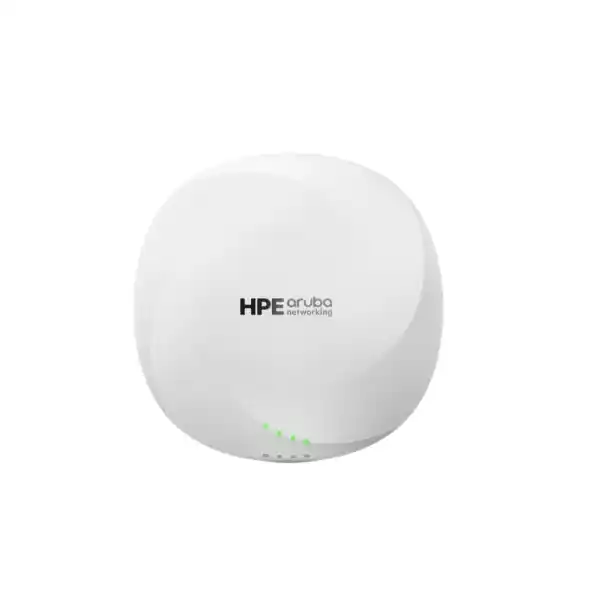
Enterprise Wi-Fi 6E campus access point
HPE Aruba Networking AP-635 in Dubai, UAE
The AP-635 is designed for organisations planning a modern indoor wireless network with simultaneous 2.4 GHz, 5 GHz and 6 GHz operation. It combines tri-radio 2×2 Wi-Fi 6E, dual HPE Smart Rate Ethernet ports, integrated antennas and enterprise management options in a ceiling-oriented campus access point. For a UAE project, the buying decision should go beyond the model name: the regulatory-domain orderable SKU, PoE design, wired uplinks, software management choice, mounting hardware and actual 6 GHz rules at the deployment location all need to be checked before purchase.

Useful at quotation stage
Share the site type, number of users and devices, floor plans, PoE switch model, preferred management platform and quantity. FourTeck can then help validate the bill of materials rather than quoting the access point in isolation.
Direct answer: what is the AP-635?
HPE Aruba Networking AP-635 is an indoor campus wireless access point in the 630 Series. It uses three concurrent 802.11ax radios for the 2.4 GHz, 5 GHz and 6 GHz bands and is intended for organisations moving to Wi-Fi 6E while retaining service for existing Wi-Fi clients. It is most relevant where wireless capacity, modern client density, application responsiveness and resilient wired connectivity matter. A buyer should confirm the correct regional orderable part number, whether 6 GHz operation is permitted for the deployment country, the available PoE class, switch-port speed, mounting requirements, management software and any subscription requirements before placing an order.
What the AP-635 does in a business network
The AP-635 provides managed indoor wireless access across three frequency bands. The 6 GHz radio gives compatible Wi-Fi 6E devices access to newer spectrum, while 5 GHz and 2.4 GHz continue to support a broad installed base of enterprise endpoints. This separation is useful in organisations where newer laptops, collaboration devices and mobile clients are introduced gradually rather than all at once.
The access point also links the wireless edge to the wired network through two HPE Smart Rate Ethernet interfaces that can operate at up to 2.5 Gbps. Those ports can be used for redundancy and link aggregation, subject to the overall design. Integrated BLE 5.0 and Zigbee support, a GNSS receiver and enterprise security components expand its role beyond basic Wi-Fi, although the value of those functions depends on the software architecture and use case.
Who should consider this model
The AP-635 can suit medium and large organisations building or refreshing managed indoor WLANs: corporate offices, universities, schools, healthcare facilities, hotels, public-sector buildings, distributed enterprise branches and other environments where device density and application use are outgrowing older Wi-Fi designs. It is particularly relevant when the organisation has a growing population of Wi-Fi 6E-capable clients and wants to plan for 6 GHz rather than replacing access points again when endpoint adoption increases.
It is not automatically the right choice for every site. Outdoor deployments need outdoor-rated hardware. Spaces requiring directional or specialised external antennas may call for a different access point design. Very small sites may not need its resilience or tri-band capacity. Buyers should match the model to RF conditions, client mix, wired infrastructure and management requirements instead of selecting it only because Wi-Fi 6E is newer than Wi-Fi 6.
Business challenges the AP-635 can help address
Crowded legacy spectrum
When many clients compete in 2.4 GHz and 5 GHz, a 6 GHz-capable design can create additional spectrum options for compatible endpoints. The benefit depends on client capability, local regulation and RF planning; older devices do not gain 6 GHz simply because the AP supports it.
High-bandwidth user workflows
Video, cloud collaboration, large file transfers, VDI and other demanding applications can expose the limitations of narrow channels and oversubscribed access points. The 630 Series supports wider channel choices in 6 GHz and a peak aggregate rate of up to 3.9 Gbps, while real throughput remains dependent on client, channel, interference and network conditions.
Single-uplink dependency
Dual 2.5 Gbps-capable Ethernet ports provide design options for link and power resilience. HPE documents hitless failover capabilities for data and power, but the switches, cabling, PoE sources and configuration must support the intended redundancy model.
Mixed client generations
Enterprises rarely replace every endpoint at the same time. Tri-band operation lets the WLAN serve traditional 2.4/5 GHz clients while introducing 6 GHz for Wi-Fi 6E clients. Band steering, roaming and client behaviour still need to be validated during design and testing.
Core capabilities at a glance
2.4 GHz, 5 GHz and 6 GHz 802.11ax radios operate concurrently, each using a 2×2 MIMO architecture.
HPE lists a maximum aggregate wireless data rate of 3.9 Gbps across the three radios; this is a peak PHY figure rather than guaranteed user throughput.
Two RJ-45 ports support 100/1000/2500BASE-T, with LACP support and options for resilient data and power architecture.
The AP-635 uses integrated down-tilt omnidirectional antennas optimised for horizontal ceiling mounting.
AP-635 suitability matrix
| Requirement | Suitable when | Confirm before ordering |
|---|---|---|
| Wi-Fi 6E adoption | The organisation is introducing 6 GHz-capable endpoints and wants a tri-band campus WLAN. | Client capability, local 6 GHz regulation and correct regional SKU. |
| Dense indoor coverage | Capacity and channel reuse are important across offices, classrooms or other busy indoor spaces. | Site survey, AP spacing, channel plan and expected concurrency. |
| Resilient wired edge | The network design benefits from dual Ethernet and power-source failover. | Switch topology, cabling, LACP design and PoE availability. |
| Ceiling-mounted internal antennas | Standard enterprise ceiling coverage is appropriate. | Ceiling type, mount kit and whether directional/external antennas are needed. |
| Centralised management | The organisation wants cloud, controller-based or controllerless operations supported by the Aruba platform. | Chosen operating architecture, software version, Central license tier and term where applicable. |
Verified technical information for HPE Aruba Networking AP-635
The table below focuses on AP-635 facts that are documented by HPE. Regional orderable part numbers and some capabilities remain dependent on country, hardware revision, software and configuration.
| Brand | HPE Aruba Networking |
|---|---|
| Model | AP-635 |
| Regulatory model | APIN0635 |
| Product family | HPE Aruba Networking 630 Series Campus Access Points |
| Orderable part number | Region dependent. Current HPE QuickSpecs list multiple AP-635 variants including EG, IL, JP, RW, US and ID orders, plus TAA variants. Confirm the UAE-compatible SKU with FourTeck. |
| Access point type | Indoor, low-power indoor class, tri-radio campus AP |
| Wireless standard | 802.11ax Wi-Fi 6E, with support for earlier 802.11 a/b/g/n/ac client standards where applicable |
| Radio architecture | Three concurrent radios: 2.4 GHz, 5 GHz and 6 GHz; 2×2 MIMO |
| Peak wireless data rates | Up to 574 Mbps on 2.4 GHz, 1.201 Gbps on 5 GHz and 2.402 Gbps on 6 GHz, with a maximum aggregate peak of about 3.9 Gbps under supported channel and client conditions |
| Channel width | 802.11ax HE20/40/80/160 supported; 160 MHz operation applies to the 6 GHz design where regulation and client capability permit |
| Internal antennas | Integrated down-tilt omnidirectional antennas for 2×2 MIMO; HPE lists peak antenna gain of 4.6 dBi at 2.4 GHz, 7.0 dBi at 5 GHz and 6.3 dBi at 6 GHz |
| Ethernet ports | Two RJ-45 ports, auto-sensing 100/1000/2500BASE-T, NBase-T / 802.3bz compliant at 2.5 Gbps |
| Link aggregation | LACP support across both Ethernet ports for redundancy and increased capacity |
| PoE input | 802.3at/bt PoE, Class 4 or higher. HPE states 802.3bt Class 5 or DC enables unrestricted operation; 802.3at Class 4 can impose a USB restriction when IPM is disabled. |
| DC input | 12 Vdc nominal, ±5% |
| USB | USB 2.0 Type-A host, up to 1A / 5W to attached device when supported by the power budget |
| IoT radios | Bluetooth Low Energy 5.0 and Zigbee 802.15.4 |
| Location receiver | GNSS L1 receiver supporting GPS, Galileo, GLONASS and BeiDou signals |
| Security hardware | Built-in Trusted Platform Module (TPM) |
| Maximum power consumption | HPE lists up to 20.7W DC / 23.8W PoE without a USB load, or 26.4W DC / 29.4W PoE with up to 5W supplied to USB |
| Dimensions | 220 mm x 220 mm x 51 mm, excluding mount bracket |
| Weight | Approximately 1.3 kg, excluding mount bracket |
| Operating environment | 0°C to 50°C; 5% to 95% relative humidity; plenum rated for air-handling spaces |
| Minimum software noted by HPE | HPE Aruba Networking Wireless Operating System / Instant OS 8.9.0.0 and Wireless Operating System 10.4.0.0 for AP-635; confirm currently supported software for the planned architecture |
| Hardware revision note | HPE states Ultra Tri-Band filtering was not supported on initial AP-635 hardware and was introduced in a later revision. Confirm revision requirements when this feature matters to the design. |
| Warranty guidance | HPE documentation lists a hardware limited lifetime warranty for the 630 Series. Applicable regional terms, exclusions and support service requirements should be confirmed for the quoted product. |
Configuration, regional and licensing dependencies
The AP-635 model name does not by itself define the complete bill of materials. HPE publishes different orderable SKUs for regulatory domains and certain procurement requirements. A part number intended for another country should not be assumed to be suitable for a UAE deployment. The quotation should therefore identify the exact regional SKU, quantity, mounting accessories, power method and management architecture. This is especially important for Wi-Fi 6E because use of the 6 GHz band follows country-specific regulation and certification.
Management is another purchasing dependency. HPE describes cloud, controller and controllerless operating models for the 630 Series. If HPE Aruba Networking Central is chosen, the organisation should confirm the required AP license tier and subscription term. Central licensing is not interchangeable with switch or gateway licensing, and subscription capabilities vary by tier. Buyers moving from an existing Aruba WLAN should also confirm software versions and migration requirements rather than assuming an AP-635 can simply replace any older access point without controller or operating-system changes.
Power planning deserves equal attention. The AP can operate from DC or PoE, and HPE documents unrestricted operation with DC or 802.3bt Class 5 PoE. With 802.3at Class 4 and Intelligent Power Monitoring disabled, the USB interface is disabled while other main radio functions remain available. Older 802.3af power is only supported for staging without radios enabled. The design team should therefore check switch PoE class, per-port budget and overall chassis budget, particularly when many APs are deployed on the same access switch.
A practical purchase and deployment journey
Estimate concurrent clients, device types, application mix, floor area, coverage expectations and whether 6 GHz-capable endpoints are already present.
Review floor plans, ceiling construction, existing AP locations, Cat6/6A cabling and switch port speeds. A predictive or on-site survey may be appropriate.
Select the correct regional AP-635 SKU, mount kits, PoE approach, licenses, support options and any integration services required.
Prepare software versions, network groups, SSIDs, authentication, radio settings, VLANs and monitoring before physical rollout.
Check coverage, roaming, client distribution, power state, uplinks, application behaviour and 6 GHz operation on supported devices.
Tri-band capacity without abandoning existing clients
One of the strongest reasons to evaluate AP-635 is its simultaneous use of 2.4 GHz, 5 GHz and 6 GHz. This matters because an enterprise wireless network usually has a mixed endpoint population. New laptops and premium mobile devices may support Wi-Fi 6E, while scanners, printers, IoT devices and older corporate endpoints continue to rely on 2.4 GHz or 5 GHz. A tri-band design lets the network introduce 6 GHz capacity without treating the migration as an all-or-nothing change.
HPE specifies 2×2 MIMO on all three bands. The peak radio rates are different because the allowed channel widths differ: 6 GHz can use HE160, 5 GHz can use HE80, and 2.4 GHz can use HE40. The combined 3.9 Gbps figure is useful for comparing platform capability, but buyers should not interpret it as a single-client speed or guaranteed aggregate application throughput. Real performance is shaped by channel plan, client radio capability, signal quality, interference, airtime use, protocol overhead, switching capacity and the WAN or application path.
For a business deciding whether Wi-Fi 6E is worthwhile, the practical question is therefore not simply “is 6 GHz faster?” It is whether the client roadmap, user density and applications justify adding a cleaner band and wider-channel options. Where most endpoints are legacy devices and the wired network cannot support multigigabit uplinks, the value may be limited. Where newer devices, video collaboration and high-density workflows are increasing, AP-635 can form part of a more forward-looking campus refresh.
Wired resilience, multigigabit uplinks and power design
Wireless performance depends on the wired edge. The AP-635 includes two Ethernet ports capable of 100 Mbps, 1 Gbps and 2.5 Gbps operation. That gives network designers more headroom than a single 1 Gbps uplink and makes the platform relevant to campuses where aggregate wireless traffic could exceed legacy access-switch interfaces. HPE also documents LACP between the two ports, allowing redundancy and increased capacity where the switching design supports it.
The two interfaces also support power-resiliency designs. When PoE is supplied to both Ethernet ports, either can be configured as the active power source and the standby source can support hitless failover. This capability can reduce dependence on one switch port or one power path, but it should be engineered deliberately. Redundant AP links do not create end-to-end resilience if both connections terminate on the same failure domain without appropriate switch architecture, or if upstream gateways, controllers and authentication services remain single points of failure.
For procurement teams, PoE is a frequent hidden cost in wireless refresh projects. An existing switch may technically power an older AP but lack sufficient Class 5 budget for unrestricted AP-635 operation across dozens of ports. The site may also have older cabling that has never been tested for stable 2.5 Gbps operation. A complete quotation should therefore consider switching, optics where relevant, UPS capacity, patching and cabling certification in addition to the access points themselves.
Management, roaming and operational control
Enterprise access points are valuable when they can be operated consistently at scale. HPE positions the 630 Series for cloud, controller and controllerless deployments. The most suitable choice depends on the existing Aruba architecture, the organisation’s operational model and whether features are needed across one site or a distributed estate. HPE Aruba Networking Central can provide cloud-based configuration and monitoring, while organisations with established controller environments may prefer to integrate the APs into that architecture after verifying software support.
The platform also includes capabilities such as ClientMatch and AirMatch in supported architectures. ClientMatch is designed to steer clients toward a more appropriate AP or radio and reduce sticky-client behaviour. AirMatch automates RF management functions such as channel and power decisions. These technologies can help operations teams, but they do not remove the need for sound RF design. Poor AP placement, excessive transmit power, weak cabling or inappropriate SSID design can still cause poor outcomes.
If Central is part of the plan, licensing should be treated as part of the lifecycle cost rather than a last-minute line item. HPE offers AP subscription licenses with fixed terms and different capability tiers. A buyer should confirm the current tier, term, renewal model and feature needs at the time of quotation. FourTeck can help map the access-point quantity and management requirement to a bill of materials so hardware and subscriptions are evaluated together.
Ideal environments and use cases
Corporate offices
Useful for office floors with modern laptops, voice and video collaboration, guest access and growing cloud application traffic. Floor plans and meeting-room density should guide AP placement rather than a simple area-per-AP estimate.
Education
Can support classrooms, lecture spaces and campus buildings where many client devices gather at predictable times. Capacity planning should consider concurrent devices per student, exam periods and streaming or collaboration workloads.
Healthcare and clinical spaces
Relevant to indoor healthcare WLANs where staff mobility, secure access and reliable roaming matter. Medical device compatibility, RF coexistence, security policy and change-control requirements should be assessed before deployment.
Hospitality and guest environments
Appropriate where guest devices, staff systems and operational IoT share the same wireless estate. The design should separate services through policy, VLANs and authentication rather than relying only on radio capacity.
Integration and operational considerations
An AP-635 deployment should be integrated with the wider access network. Check whether the switch ports support 2.5 Gbps, the required PoE class, LLDP and the planned redundancy design. Verify that VLANs, DHCP, DNS, RADIUS or other identity services, firewall policies and upstream routing can support any new SSIDs or segmentation. If the WLAN uses certificate-based authentication, confirm certificate enrolment and device onboarding before changing the production SSID design.
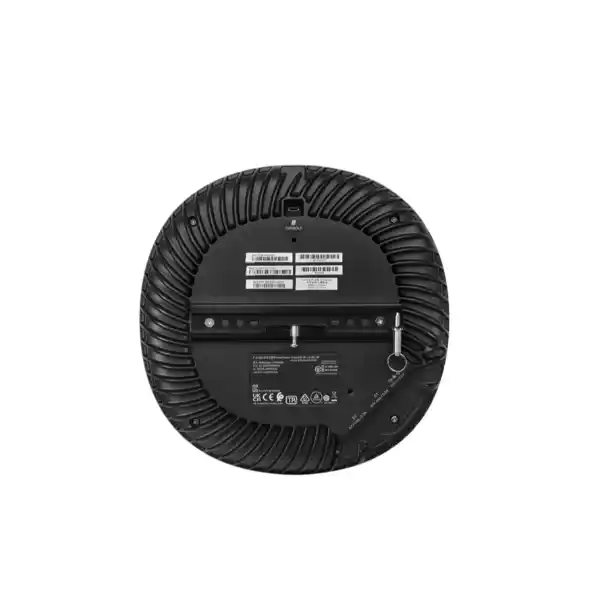
Physical installation also affects RF results. AP-635 internal antennas are optimised for horizontal ceiling mounting. Placing the unit vertically on a wall or above a reflective ceiling may alter the expected coverage pattern. The mounting kit is sold separately, so the ceiling type and installation method should be identified during procurement. In heritage buildings, open ceilings, warehouses or unusual corridors, an AP with external antennas or a different form factor may be a better match.
Finally, create an operational plan for software upgrades, monitoring, configuration backups, alerting and license renewals. The access point is one component in a service that also depends on switches, management systems, authentication, WAN connectivity and client behaviour. A stable WLAN comes from managing those dependencies together.
Buyer questions to resolve before requesting a quotation
Use floor plans, wall materials, user density and application requirements. Do not size only by square metres.
HPE publishes multiple AP-635 orderable variants. Confirm the UAE-compatible order and 6 GHz status before purchase.
Check 802.3bt/at capability, total PoE budget, 2.5 Gbps ports and cabling quality.
Confirm cloud, controller or controllerless architecture and any Central subscription tier and term.
The AP has a preinstalled bracket interface, but the appropriate mount kit is sold separately.
Decide whether the quotation should cover survey, installation, staging, configuration, migration, testing, documentation or support.
AP-635 procurement checklist
✓ Confirm the exact HPE regional orderable SKU for the deployment country.
✓ Confirm the required quantity and whether spare units are needed.
✓ Provide floor plans and expected concurrent client counts.
✓ Identify the number of Wi-Fi 6E-capable client devices.
✓ Check access-switch port speed and PoE class.
✓ Confirm cabling can support the intended 2.5 Gbps uplinks.
✓ Select the correct mounting kit for the ceiling or structure.
✓ Define Central, controller or controllerless management.
✓ Confirm license tier and subscription term where cloud management is required.
✓ Review software compatibility for an existing Aruba environment.
✓ Decide whether installation, configuration and post-deployment validation are in scope.
✓ Confirm warranty terms, support option, delivery destination and project timeline in the final quotation.
How FourTeck can support AP-635 planning
FourTeck can help turn a model request into a project-ready bill of materials. That may include clarifying the regulatory-domain part number, checking the expected client and application load, reviewing switch PoE and uplink requirements, identifying mounting accessories, discussing HPE Aruba Networking Central licensing, and defining installation or configuration scope. For larger WLAN projects, a floor-plan review or wireless survey can help determine whether AP-635 is the right model and how many units are appropriate.
If you are comparing this access point as part of a broader network refresh, FourTeck can also help review related switching, security and support requirements. Visit the FourTeck technology products section or discuss deployment assistance through our network and technology services. The final recommendation should reflect the actual site rather than a generic access-point count.
UAE availability and support guidance
Contact FourTeck to confirm current UAE availability for the HPE Aruba Networking AP-635. Availability can depend on the exact regional model, quantity, vendor lead time, regulatory status and required accessories or licenses. The quotation should identify the correct UAE-compatible orderable SKU rather than relying on a part number copied from another market. Delivery and project coordination can be discussed after the destination, quantity and required timeline are known. If installation, staging, WLAN configuration, migration or post-deployment testing is required, include that scope in the quotation so hardware and services can be planned together. FourTeck can also help check whether the existing switches provide sufficient PoE and multigigabit connectivity before the access points are ordered.
Dubai, Abu Dhabi, Sharjah and Ajman project coverage
For organisations planning AP-635 deployments in Dubai, Abu Dhabi, Sharjah and Ajman, FourTeck can coordinate requirement review, quotation preparation and project-scope discussions from one engagement. Multi-site buyers should provide a site list, floor plans where available, approximate client counts, current switch models and preferred deployment schedule. This helps separate sites that can reuse existing PoE and cabling from locations that may require switching or infrastructure changes. Installation and configuration requirements can also vary by site, so the scope should identify ceiling access, working-hour restrictions, change windows, testing expectations and any handover documentation needed. Current product availability and service scheduling should be confirmed for the specific project rather than assumed across all locations.
GCC Availability
FourTeck can assist GCC organisations evaluating the AP-635 for offices, education, hospitality, healthcare and other indoor campus networks. Requirement review can cover the correct regional access-point variant, quantity, Wi-Fi 6E client profile, PoE switching, management approach, licensing, mounting accessories, installation planning and support expectations. Projects in the United Arab Emirates, Saudi Arabia, Kuwait, Qatar, Bahrain or Oman should not assume that one regulatory-domain SKU applies across every destination. Product availability, 6 GHz permissions, license applicability, delivery schedules, vendor lead times and on-site service scope can differ by country, model and quantity. Share the destination country, deployment location, required quantity, preferred management model, license term and target schedule so FourTeck can prepare suitable quotation guidance. For broader regional technology coordination, buyers can also review FourTeck regional technology support where relevant to the project.
Africa Availability
Organisations planning AP-635 deployments in Africa can contact FourTeck for product evaluation, bill-of-material review, license guidance, accessory planning and deployment-scope coordination. The correct hardware order depends on destination, regulatory domain, model availability, quantity and local 6 GHz conditions, while project readiness also depends on power, cabling, switching and support arrangements at the site. For East African or multi-country projects, provide the destination country, number of locations, access-point quantity, current WLAN platform and any installation or configuration requirements. Shipping arrangements, vendor lead time and local project conditions can vary and should be confirmed during quotation. FourTeck does not assume identical availability across countries. Buyers can explore FourTeck Africa technology services, Kenya project support or Uganda technology assistance when those locations match the deployment plan.
Related options and project components
AP-634 external-antenna model
Consider the AP-634 family when the deployment requires external antennas or a coverage pattern that the AP-635 integrated antennas do not suit. Regional and software requirements differ, so confirm the exact use case.
HPE Aruba Networking Central
Cloud-based management may be part of the operating model. Confirm the current AP license tier, feature needs and subscription term separately from the hardware.
Multigigabit PoE switching
An AP refresh may require switch ports that can provide the right PoE class and 2.5 Gbps connectivity. Review switch capacity before finalising the AP quantity.
Wireless survey and RF planning
Predictive design or on-site validation can help determine AP placement, expected coverage and capacity in offices, classrooms, hotels and other complex indoor spaces.
Installation and configuration
Staging, mounting, SSID creation, authentication integration, policy configuration and post-installation testing can be scoped as services when required.
Newer campus Wi-Fi platforms
If the project is at the start of a long lifecycle and client hardware is moving toward newer standards, compare current HPE Aruba Networking campus options before locking the bill of materials.
Why businesses contact FourTeck for this requirement
A product request such as “AP-635” can hide several procurement decisions. FourTeck can help clarify which regional SKU should be quoted, whether the intended ceiling and mounting method suit the internal-antenna model, what PoE and uplink capability the access switches need, and whether cloud management subscriptions or existing controller software affect the bill of materials. That reduces the risk of buying access points that arrive without required mounts, cannot use the expected 6 GHz configuration in the destination, or expose switch-power limitations during installation.
FourTeck can also coordinate the commercial and technical sides of the project: quotation, quantity planning, compatible infrastructure review, installation scope, configuration requirements and support discussion. Learn more about FourTeck’s technology focus or use the UAE contact channel to share a multi-site or project requirement.
What buyers commonly compare before choosing AP-635
A buyer researching AP-635 is usually trying to answer more than one question at the same time. The first is whether Wi-Fi 6E is useful now or merely a future feature. The answer depends on the endpoint estate. If a meaningful number of laptops and mobile devices already support 6 GHz, the new band can provide additional channel choices and move capable clients away from congested legacy spectrum. If almost every endpoint is limited to 2.4 GHz or 5 GHz, the organisation may still gain from the access point’s newer platform and management capabilities, but the business case for 6 GHz should be weighed against cost, switching upgrades and lifecycle plans.
AP-635 versus an older Wi-Fi 6 AP
The major architectural difference is the dedicated 6 GHz radio. That can increase available spectrum for compatible clients and support wider channels without forcing the 5 GHz band to carry every high-performance endpoint. The decision should consider client refresh timing, not only the access-point specification.
AP-635 versus AP-634
AP-635 uses integrated antennas and is optimised for horizontal ceiling mounting. AP-634 is the external-antenna model in the same series. Sites needing specialised directional coverage should evaluate the external-antenna approach instead of assuming the integrated model can solve every RF geometry.
The second common comparison is wired infrastructure. An AP can have a high wireless PHY rate but still be limited by a 1 Gbps switch port, an undersized PoE budget or cabling that does not reliably support multigigabit Ethernet. AP-635 includes two ports up to 2.5 Gbps and supports 802.3at/bt PoE. That does not mean every project must use both ports or dual 2.5 Gbps links; it means the switching design should be chosen deliberately. A business replacing a large fleet of older access points should calculate the total PoE demand per switch and confirm whether existing access-layer hardware can support the intended configuration.
The third decision is management. Buyers often ask whether a Central license is mandatory. HPE supports more than one operating model for the 630 Series, so the answer depends on the architecture. If HPE Aruba Networking Central is selected, subscription licensing is part of the design and should be quoted for the required term and feature tier. Organisations already using Aruba controllers or an Instant-style architecture should verify the supported migration path and software version before ordering. A hardware quote without the management decision can be incomplete.
Prepare one document with the destination country, number of sites, floor plans, AP quantity estimate, current switch models, PoE class, expected client count, percentage of Wi-Fi 6E clients, management preference and required services. This gives the supplier enough context to validate the orderable SKU and identify missing infrastructure before a final quote is issued.
Buyers also search for “AP-635 price” and “AP-635 availability,” but those questions cannot be separated from the exact part number and project scope. Regional SKUs, volume, support, subscriptions and delivery destination can materially change a quotation. A public price from another market may refer to a US, EG, JP, IL or other variant and may not be appropriate for a UAE deployment. The more reliable approach is to use public pricing only as a reference and request a quote for the correct regional order with the required licenses and accessories.
Finally, compare lifecycle fit. AP-635 is a Wi-Fi 6E platform. For projects that will operate for many years, it can be useful to compare it with current Wi-Fi 7 campus options, especially if the organisation expects rapid endpoint upgrades. That does not make AP-635 unsuitable; Wi-Fi 6E may be a better cost, compatibility or standardisation choice in an existing Aruba estate. The right decision is the one that aligns endpoint capability, application demand, infrastructure readiness, management model and refresh schedule.
Questions that shape the final AP-635 design
Will every user benefit from 6 GHz immediately?
No. Only compatible Wi-Fi 6E clients can use 6 GHz. Older clients continue to use 2.4 GHz or 5 GHz. The design benefit comes from giving capable devices new spectrum and reducing pressure on older bands, provided local regulation allows 6 GHz operation and the client population justifies it.
Should the project use one or two Ethernet ports?
One port may be sufficient for many installations, while two ports can support LACP, added capacity and resilient data or power designs. The correct choice depends on switch architecture, failure-domain requirements, cabling availability and the amount of traffic expected from each access point.
Is an 802.3at switch enough?
The AP supports 802.3at Class 4, but HPE documents unrestricted operation with 802.3bt Class 5 or DC. With Class 4 and Intelligent Power Monitoring disabled, USB is disabled. For a new design, check the desired feature set and total switch PoE budget rather than evaluating only whether the AP powers on.
Can an existing Aruba WLAN accept AP-635 directly?
It depends on the operating architecture and software version. HPE publishes minimum software levels for AP-635, but an organisation should validate the currently supported release, controller platform, configuration model and planned features. A software upgrade or migration may be required before the access point is introduced.
How should a buyer estimate AP quantity?
Start with coverage and capacity together. Wall construction, ceiling height, interference, client density, application demand and roaming expectations matter. A simple “one AP per room” or “one AP per square metre range” rule can overbuild some areas and underbuild high-density spaces. Floor-plan modelling and validation are preferable for business-critical sites.
What information produces a more accurate quote?
Provide the deployment country, quantity, floor plans, client count, switch models, PoE capability, management preference, subscription term, mounting details and any services required. This allows FourTeck to confirm the regional part number and build a quotation that includes dependencies rather than only the AP hardware.
Frequently asked questions
Is HPE Aruba Networking AP-635 a Wi-Fi 6E access point?
Yes. AP-635 is a tri-radio 802.11ax Wi-Fi 6E campus access point with concurrent 2.4 GHz, 5 GHz and 6 GHz radios. Use of 6 GHz still depends on the deployment country’s regulatory rules and a compatible regional SKU.
What is the maximum aggregate data rate of AP-635?
HPE lists a maximum aggregate peak of about 3.9 Gbps across its three radios. This is a PHY-rate figure and should not be treated as guaranteed application throughput for a single client or the whole site.
Does AP-635 require 802.3bt PoE?
HPE states that 802.3bt Class 5 PoE or DC provides unrestricted operation. The AP also supports 802.3at Class 4, with a documented USB restriction when Intelligent Power Monitoring is disabled. Check the intended feature set and switch power budget before deployment.
Does the AP-635 include a mounting kit?
A mounting bracket interface is preinstalled on the access point, but the appropriate mount kit is sold separately. The quotation should include the correct kit for the ceiling or mounting surface.
Does AP-635 need an HPE Aruba Networking Central license?
A Central subscription is required when the access point is managed through the relevant HPE Aruba Networking Central licensing model. HPE also supports controller and controllerless operating approaches, so the required license depends on the chosen architecture.
Which AP-635 part number should be ordered for the UAE?
HPE publishes multiple AP-635 regulatory-domain orderable SKUs. The correct UAE-compatible SKU should be confirmed at quotation stage based on current HPE regional ordering and 6 GHz rules. Do not assume a US, JP, EG, IL or other market SKU is interchangeable.
Can AP-635 use two Ethernet connections?
Yes. It has two 100/1000/2500BASE-T ports and supports LACP between them. HPE also documents data and power failover capabilities. The switching and cabling design must support the intended topology.
Is AP-635 suitable for wall mounting?
The integrated antennas are optimised for horizontal ceiling mounting. Wall mounting may change the intended coverage pattern, so the RF design should be reviewed. Where a specialised pattern is required, another model or external-antenna design may be more appropriate.
How can I request AP-635 pricing and availability in Dubai?
Send FourTeck the quantity, deployment country, site details, management preference, switch and PoE information, required mounting accessories and service scope. FourTeck can then confirm the appropriate SKU, current UAE availability and quotation details.
Plan the AP-635 as a complete wireless requirement
For a useful quotation, include the number of locations, estimated access-point quantity, floor plans, client population, current switch models, PoE capability, management choice and any installation or configuration requirements. FourTeck can help confirm the correct regional product and related bill of materials before ordering.

Reviews
There are no reviews yet.