
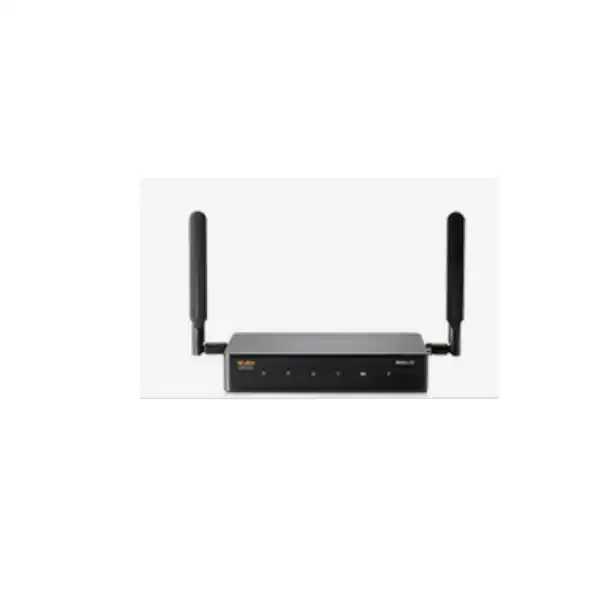
HPE Aruba Networking 9004-LTE Gateway Dubai
A compact branch gateway for organizations that want wired WAN connectivity, integrated 4G LTE resilience, SD-WAN control, role-aware security and centralized operations in a single fanless appliance.
Direct answer for business buyers
The HPE Aruba Networking 9004-LTE Gateway is a branch network edge appliance in the 9000 Series that combines four Gigabit Ethernet interfaces with an integrated global Category 12 4G LTE module. It is mainly used to connect branch offices to corporate, cloud and internet services while applying SD-WAN, routing, segmentation and security policy under centralized management. It is worth considering for distributed offices, retail locations, clinics, professional services branches, temporary sites and other locations where a fixed WAN connection should be backed by cellular connectivity or where LTE may be used as a dedicated uplink. The most important factor to confirm is not simply the headline throughput; buyers must validate the exact regional hardware code, local cellular bands and carrier service, Aruba Central subscription and operating mode, antenna placement, port count and expected application load. FourTeck can help map those dependencies to a UAE branch design and determine whether the 9004-LTE, the non-LTE 9004, the larger 9012 or another architecture is the better fit.
Best fit
Small and mid-sized branches that want an integrated LTE path without adding a separate external cellular router.
Main design question
Whether four 1GbE ports, the LTE radio design and the licensed management feature set align with the real branch requirement.
Important limitation
Two nano-SIM slots are supported, but only one SIM can be active at a time and automatic failover between the two SIMs is not supported.
Regional check
For Dubai and the wider UAE, confirm the correct Rest-of-World ordering code, regulatory status, mobile operator compatibility and selected antenna arrangement.
Where the 9004-LTE sits in the branch architecture
The 9004-LTE is not simply a conventional router with a modem added to it. HPE positions the 9000 Series as an edge platform for branch networking, SD-WAN and security. In a distributed organization, that means the device can sit between local users, access points and wired systems on one side and one or more WAN services on the other. Central policy can then determine how traffic is forwarded, which applications receive priority, how users or devices are segmented, and how the branch behaves when the preferred uplink is degraded.
The LTE version is especially relevant when business continuity matters but deploying a second fixed circuit is expensive, slow or operationally difficult. A branch can use Ethernet for its primary path while keeping the integrated cellular connection available as a redundant WAN uplink, or it can use LTE as a dedicated path in designs where that is appropriate. The practical value is reduced dependence on an external LTE appliance, fewer power supplies and fewer boxes to manage at the branch edge.
That integration does not remove the need for WAN planning. Cellular performance depends on the mobile operator, local signal quality, building construction, antenna orientation, radio congestion and the subscribed service. A Cat 12 modem may support a high theoretical radio rate, but the experienced throughput in a Dubai office will be determined by the actual mobile network conditions. The gateway therefore needs to be selected as part of a complete branch design rather than as a guarantee of a particular LTE speed.
Why integrated LTE matters
HPE specifies an integrated Category 12 LTE module with nominal downlink/uplink capability of up to 600/150 Mbps at the radio level. The module supports worldwide LTE-A and UMTS/HSPA+ coverage across a broad range of bands, but real-world service is always carrier and location dependent.
Use LTE as a secondary WAN option when the fixed circuit is unavailable or impaired.
LTE can help a new or temporary location establish connectivity while fixed services are being delivered.
The cellular modem is built into the gateway, reducing the need for a separate USB dongle or standalone modem.
LTE and SIM behavior: a detail that affects resilience planning
The 9004-LTE has two nano-SIM slots, which is useful when an organization wants the option of provisioning service from different mobile providers. However, HPE documentation is explicit that only one SIM can be active at a time because the gateway has one set of cellular radios. HPE also states that automatic failover between the two SIM cards is not supported; switching between them must be configured manually. This distinction matters because dual-SIM hardware does not equal simultaneous dual-carrier operation.
If the branch continuity plan depends on automatic carrier diversity, that requirement should be addressed at the architecture level rather than assumed from the presence of two SIM slots. An organization may instead use Ethernet plus LTE for automated WAN path resilience, place another independent cellular device in the design, or adopt a different platform that explicitly meets the dual-carrier requirement.
SIM cards can be inserted, removed or swapped without powering the gateway down, although traffic will not pass until the mobile connection initializes. This is operationally convenient during carrier changes or troubleshooting. For Dubai deployments, APN settings, SIM provisioning, data plans, public or private addressing requirements and any carrier-side restrictions should be collected before commissioning.
Antennas, GPS and placement
Cellular performance is strongly influenced by physical placement. The gateway provides SMA connectors for LTE main and diversity antennas and a separate GPS antenna connection. HPE notes that additional indoor or outdoor antennas can be used to improve reception. A Dubai branch inside a concrete building, warehouse, basement, mall service area or deep office floor may have significantly different signal conditions from a branch near an exterior window, so the antenna plan should be based on site conditions rather than assumption.
The gateway also includes GPS functionality. HPE documentation states that an external antenna is required to improve GPS accuracy and that the GPS antenna is not shipped with the product. The R4Y94A indoor antenna is identified by HPE as an available accessory, and an extender can be useful when the appliance must remain inside a rack or communications room where satellite reception is poor.
The USB port should not be treated as a fallback path for an external LTE dongle. HPE specifically states that the 9004-LTE does not support an external USB LTE dongle. That makes correct internal modem coverage and antenna design more important when LTE is part of the business continuity plan.
SD-WAN, segmentation and policy control
In an SD-WAN deployment, the 9004-LTE can participate in a centrally managed branch fabric where traffic policy is based on more than destination IP addresses. HPE describes role-based policy enforcement, application visibility and path control as core capabilities of the 9000 Series. This is useful when branches run a mix of cloud applications, voice and video, corporate SaaS, guest access and IoT devices that should not all receive the same treatment.
Dynamic Segmentation is particularly relevant to organizations that want consistent policy across wired and wireless access. Rather than building a large number of static VLANs and access-control lists independently at every location, policy can follow defined user and device roles. HPE’s Policy Enforcement Firewall operates at Layer 4 through Layer 7 and is intended to provide common user, device and application awareness across WLAN, LAN and WAN. When combined with HPE Aruba Networking ClearPass Policy Manager, identity and role information can be used to strengthen policy consistency.
Application visibility and control use deep packet inspection to classify and apply quality-of-service policy to thousands of applications. For buyers, the relevance is practical: a branch can prioritize business-critical collaboration or transaction traffic while controlling less important flows. HPE also documents integration with Microsoft environments for visibility into call-quality metrics such as latency, jitter and packet loss. These capabilities should still be sized against the intended software release, licensed feature set and traffic profile; headline platform specifications are not a substitute for a design based on actual branch behavior.
HPE Aruba Networking Central and licensing
The 9000 Series is designed to be configured and managed with HPE Aruba Networking Central, and HPE associates WLAN and SD-WAN deployments with Central subscription licensing. The required subscription is therefore a core procurement dependency, not an optional afterthought. Buyers should define whether the gateway will operate as an SD-WAN branch gateway, a WLAN gateway under AOS-10, or another supported architecture and then select the correct subscription term and feature set.
A quotation that includes only the appliance can be incomplete if the project expects cloud management, orchestration, security services or support entitlements. License duration, renewal policy, tenant ownership and operational responsibility should be decided before deployment, especially when multiple branches will be onboarded over time.
Software mode is a design decision
Current HPE data lists AOS 10.4 as the minimum supported AOS-10 version for the 9004-LTE. The same current data identifies AOS-8 as not supported for the 9004-LTE while showing AOS-8 support for other 9000 Series models. This is a model-specific distinction that can affect migration plans from older controller environments.
A branch modernization project should therefore confirm the target software architecture before the hardware is ordered. If the existing network is built around an older AOS-8 design, the 9004-LTE should not be treated as a drop-in replacement without validating the intended transition path. The benefit of doing this early is avoiding a purchase that fits the physical branch but conflicts with the software and management strategy.
Sizing the 9004-LTE for a real branch
Traffic profile
Measure typical and peak internet, SaaS, voice, video, backup and inter-site flows. The 4 Gbps firewall figure should be compared with the features enabled and the expected traffic mix.
Port requirements
The appliance has four 1GbE ports and no integrated PoE. If the branch needs more routed ports, higher-speed interfaces or direct PoE delivery, an external switch or a different gateway may be more suitable.
Client and AP scale
Current AOS-10 data lists up to 2K clients and 128 AP devices per gateway. Real sizing should include growth, policy complexity and cluster design rather than using the maximum as a target.
LTE expectations
The Cat 12 modem capability does not guarantee branch throughput. Carrier service, radio conditions, antenna placement and data-plan policy remain the limiting factors in many installations.
A common sizing mistake is to match the gateway only to the internet circuit speed. A 500 Mbps branch circuit, for example, does not automatically mean any appliance above 500 Mbps will be suitable. The gateway may also process encrypted tunnels, segmentation policy, application inspection and multiple concurrent WAN paths. It may need to support a growing number of clients or access points, or join a resilient design with another gateway. Conversely, a small office with light traffic and a simple WAN requirement may not need the full feature set of an integrated SD-Branch gateway. The correct choice comes from understanding the operational requirement, not from selecting the largest published number.
Dubai and UAE deployment considerations
The HPE ordering family includes specific regional variants such as US, Japan, Israel, Egypt and Rest-of-World. HPE identifies the non-TAA Rest-of-World 9004-LTE ordering code as R3V90A. For a UAE project, the Rest-of-World variant is the logical model to evaluate, but the final order should still be checked against current HPE regional availability, regulatory requirements and the chosen mobile operator. Hardware availability and ordering rules can change over a product lifecycle, so the exact part number should be validated at quotation time.
Carrier compatibility should be treated as a deployment input. The gateway supports a broad set of LTE FDD and TDD bands, yet that does not remove the need to verify the bands and services used by the selected UAE provider at the branch location. Business data plans may also differ in public IP availability, private APN support, inbound connectivity, roaming behavior and usage policy. These details can matter for remote management, site-to-site VPNs and failover operations.
Environmental placement is another practical factor in Dubai. HPE specifies an operating range of 0°C to 40°C and non-condensing humidity limits. The gateway should therefore be installed in an appropriate indoor IT environment rather than exposed to direct heat, dust or unconditioned rooftop/warehouse conditions. If the best LTE signal is away from the communications cabinet, the solution may require suitable approved antennas or extension arrangements while keeping the appliance itself in a protected location.
Power and rack planning are simple but should not be ignored. The unit uses an external 12V DC adapter and is fanless. An optional mounting tray can place two 9004-family gateways side by side in 1RU, which is useful for neat branch racks or resilient pairs. Where the site uses UPS protection, both the gateway and any connected switches or access infrastructure should be included in the runtime calculation so WAN failover does not remain operational while the local network loses power.
9004-LTE versus nearby 9000 Series choices
| Decision point | 9004 | 9004-LTE | 9012 |
|---|---|---|---|
| Ethernet interfaces | 4 × GbE | 4 × GbE | 12 × GbE |
| Integrated LTE | No | Yes, Cat 12 | No integrated LTE in the compared 9012 data |
| Firewall throughput | 4 Gbps | 4 Gbps | 6 Gbps |
| PoE | No integrated PoE | No integrated PoE | Up to 120W across six PoE+ ports in the specified configuration |
| When to evaluate | When LTE is not required and four ports are enough. | When integrated cellular WAN is an important requirement. | When more Ethernet ports, PoE and higher firewall throughput are priorities. |
The 9004-LTE is not automatically the best 9000 Series choice just because it includes cellular connectivity. If the branch already has a managed carrier router, dual fixed circuits or an external SD-WAN edge with cellular capability, the non-LTE 9004 may be sufficient. If the site needs more local ports, integrated PoE for connected devices or additional performance headroom, the 9012 deserves comparison. The best shortlist should reflect the complete branch topology and not only the availability of LTE.
High availability and business continuity
HPE documents high-availability options for the 9000 Series, including N+1 or NxN redundancy and clustering capabilities depending on deployment mode. For a branch where the gateway itself is a single point of failure, integrated LTE alone does not provide full resilience. LTE protects against a WAN-path problem; it does not protect against appliance failure, power loss or a failed local switch.
A higher-availability design may therefore use two gateways, separate power protection and appropriately redundant switching. The decision depends on the cost of downtime. A small sales office may accept a single edge device, while a revenue-generating branch, healthcare site or operational facility may justify a paired design. The important point is to distinguish uplink resilience from device resilience.
Installation and migration planning
A clean deployment starts with configuration and ownership decisions before hardware reaches the site. The Central tenant, license assignment, branch group, WAN addressing, VLANs, routing, security policy, VPN destinations and LTE profile should be prepared centrally where possible. HPE supports zero-touch onboarding over LTE with an active SIM, which can be valuable for sites without a ready fixed circuit.
Migration should also account for the existing firewall or router. If the 9004-LTE is replacing another edge device, document public addressing, NAT rules, VPN peers, DHCP services, DNS behavior, QoS, monitoring and any application-specific exceptions. If it will be added alongside an existing firewall, define clearly which platform owns routing, security policy and WAN failover. Ambiguous responsibilities at the network edge are a frequent source of troubleshooting difficulty.
Procurement details that should be confirmed before ordering
Confirm the current RW/UAE-suitable hardware code, TAA requirement if any, availability and lifecycle status.
Define the management and feature subscription required, including term length and renewal responsibility.
Provide operator, APN, IP addressing requirements, data-plan expectations and whether LTE is primary or backup.
Determine whether standard placement is adequate or indoor/outdoor antennas and extension accessories are needed.
Confirm desktop or rack installation, optional tray, power adapter requirements and UPS coverage.
Select the required support entitlement, response expectations and any professional deployment services.
Buyer questions about the HPE Aruba Networking 9004-LTE
Can LTE replace a fixed business circuit?
It can be used as a dedicated WAN uplink, but whether it should replace a fixed circuit depends on carrier coverage, performance consistency, data-plan policy, public addressing and business continuity expectations. Many organizations use the integrated LTE path primarily for resilience.
Does dual SIM mean dual active LTE?
No. The gateway accepts two nano-SIM cards but only one can be active at a time. Automatic failover from one SIM to the other is not supported according to HPE documentation.
Can I connect an external USB LTE modem?
No. HPE states that the 9004-LTE does not support an external USB LTE dongle. Use the integrated modem and supported antenna options or design a separate external cellular architecture.
Is HPE Aruba Networking Central required?
The platform is designed around Central management, and HPE links WLAN and SD-WAN deployments to Central subscription licensing. The exact subscription and deployment mode should be part of the quote.
How many clients can it support?
Current AOS-10 specifications list up to 2K clients per 9004-LTE gateway. This is a platform limit, not a recommended design target; actual sizing must consider traffic, features, AP count and growth.
What should I compare before buying?
Compare the 9004-LTE with the non-LTE 9004 if cellular is unnecessary, and with the 9012 when additional Ethernet ports, PoE capability or higher firewall throughput would materially improve the branch design.
Decision recap
Choose it when integrated LTE provides clear operational value and four GbE interfaces are sufficient.
Validate branch traffic and features against the 4 Gbps firewall specification, client scale and expected growth.
Include the correct HPE Aruba Networking Central subscription and support entitlement in the commercial scope.
Confirm the regional hardware code, mobile carrier service, SIM/APN settings, software architecture and antenna needs.
Remember that two SIM slots do not provide two active cellular links or automatic inter-SIM failover.
Evaluate the 9004 when LTE is unnecessary and the 9012 when more ports, PoE or performance headroom is required.
What FourTeck needs for an accurate Dubai quotation
A useful quotation should reflect the intended branch design rather than list hardware in isolation. Providing the details below allows the gateway, licensing and deployment scope to be checked together and reduces the risk of missing accessories or ordering the wrong regional variant.
Plan the 9004-LTE around the branch, not just the appliance
For a Dubai or UAE deployment, the strongest result comes from matching the gateway to the WAN circuits, cellular service, software mode, Central licensing, security policy, antenna conditions and resilience target. Share your branch requirements and FourTeck can help define the correct 9004-LTE configuration or identify a more suitable alternative before the order is placed.

Reviews
There are no reviews yet.