
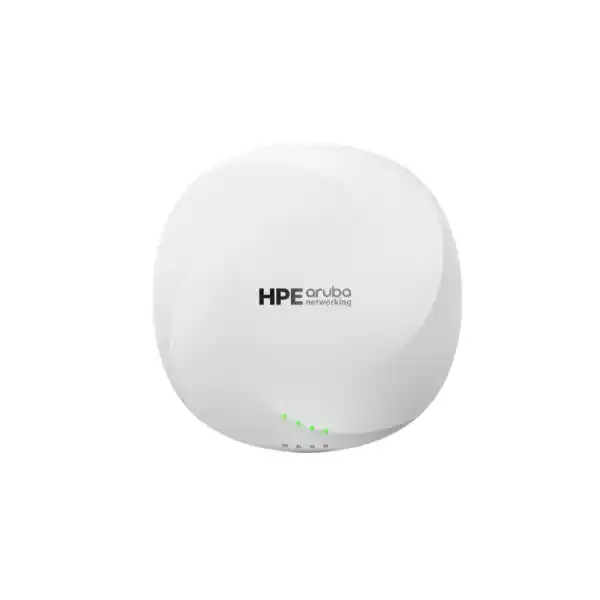
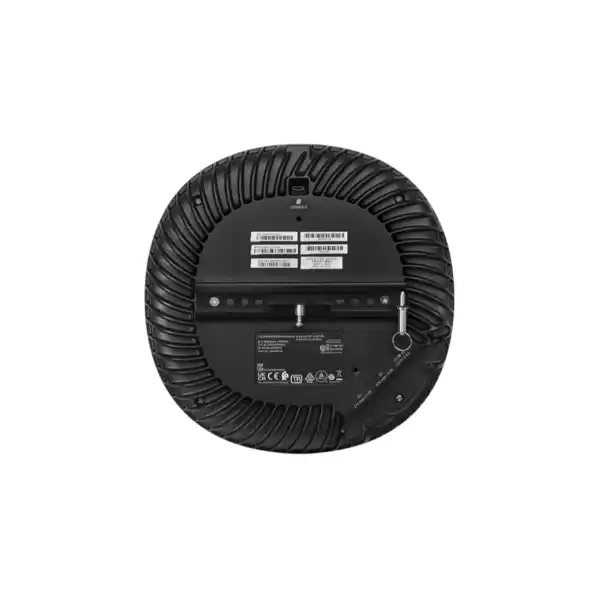

Indoor Wi-Fi 6E / 802.11ax
Concurrent 2.4, 5 and 6 GHz capability
Dual Smart Rate Ethernet up to 2.5Gbps
802.3at/bt; Class 5 is the full-power reference
Supported in HPE Aruba Networking Central
Direct answer for buyers
HPE Aruba Networking AP-635A is an enterprise indoor Wi-Fi 6E access point in the 630 Series. It is mainly used to provide managed wireless connectivity in business environments that need modern Wi-Fi 6 efficiency and a path to 6 GHz capacity. It is worth considering for organisations modernising campus or office wireless infrastructure, especially where Wi-Fi 6E-capable client devices, multi-gigabit switching and centralised network operations are part of the design. Before proceeding, confirm the AP-635A regional regulatory variant, whether 6 GHz operation is permitted for the intended country, the required Aruba operating software, PoE capacity, switch-port speed, mounting kit, management or licensing requirements, and the final bill of materials.
What the AP-635A does
The AP-635A provides enterprise wireless access for indoor spaces using the 802.11ax standard and the 2.4 GHz, 5 GHz and 6 GHz radio bands, subject to the regulatory rules that apply in the deployment country. HPE’s current 630 Series documentation describes the family as a tri-radio Wi-Fi 6E platform intended to increase usable wireless capacity while supporting modern high-efficiency features such as OFDMA. In practical terms, the access point is positioned for environments where older dual-band designs may become constrained by growing client counts, cloud traffic, video collaboration and newer 6 GHz-capable endpoints.
The AP-635A also participates in a broader Aruba architecture rather than operating as an isolated consumer Wi-Fi device. Current Aruba documentation lists it as a supported access point in HPE Aruba Networking Central. This matters because buyers planning a multi-site or centrally governed WLAN normally evaluate the device together with management, software version, policy, switching, authentication, segmentation and support requirements.
Who it suits
The AP-635A is most relevant to medium and large organisations, distributed businesses and technology-led environments that want enterprise WLAN control and the additional spectrum potential of Wi-Fi 6E. Typical buyers include IT managers refreshing office wireless networks, systems integrators building campus coverage, procurement teams standardising an Aruba estate, and project owners preparing new sites with multi-gigabit switching.
It is not automatically the right choice simply because it supports 6 GHz. A site with mostly legacy clients, limited PoE capacity, 1Gbps-only edge switching, unsupported management software or a regulatory environment where 6 GHz is not enabled may receive less value from the platform. A short technical review before quotation can prevent buying a device that is technically capable but operationally mismatched to the existing network.
Business problems this access point can help address
Congested wireless airtime
In offices where many users compete for 2.4 GHz and 5 GHz airtime, a Wi-Fi 6E design can create additional capacity by introducing the 6 GHz band for compatible clients. The value depends on local 6 GHz rules and actual client support, so device inventories and regulatory settings should be reviewed before expecting a capacity improvement.
Multi-gigabit edge requirements
The 630 Series uses dual HPE Smart Rate Ethernet interfaces that support 100/1000/2500BASE-T. This can be useful where wireless traffic may exceed the practical headroom of a single traditional gigabit uplink. The switch, cabling, link configuration and PoE budget must be designed as part of the same decision.
Resilience at the access layer
Dual Ethernet and power options can support more resilient designs. HPE documents link aggregation and the ability to use PoE on either Ethernet port, with standby power behavior depending on configuration. Buyers should decide whether the project genuinely requires redundant uplinks and power, because that affects switch-port allocation, cabling and configuration.
Centralised WLAN operations
The AP-635A is supported in HPE Aruba Networking Central, helping organisations manage it as part of a wider Aruba environment. Management subscriptions, operating model, software version and existing Aruba architecture should be confirmed rather than assuming every function is included with the hardware itself.
AP-635A suitability matrix
| Requirement | Suitable when | Confirm before ordering |
|---|---|---|
| Wi-Fi 6E adoption | The organisation has or expects 6 GHz-capable client devices and wants additional spectrum options. | Country regulatory support, client compatibility and channel planning. |
| High client density | The WLAN serves collaboration, cloud and business applications across many simultaneous users. | RF survey, expected concurrency, application mix and AP placement. |
| Multi-gigabit switching | The access layer can provide Smart Rate or 2.5Gbps connectivity. | Switch model, port speed, cabling quality and uplink configuration. |
| PoE deployment | The switch or injector can provide the required PoE level. | 802.3bt Class 5 for unrestricted reference operation, or expected restrictions under lower power. |
| Aruba management | The business already uses or plans HPE Aruba Networking Central or a supported Aruba operating model. | Software release, subscriptions, existing gateways/controllers and migration path. |
| Indoor ceiling deployment | The RF design calls for indoor APs with integrated antennas. | Mount kit, ceiling type, cable path, environmental conditions and final installation position. |
Verified product and platform information
The table below separates confirmed AP-635A facts from 630 Series family characteristics and highlights where the final quotation must remain configuration or region dependent. HPE’s current installation guide explicitly covers AP-635A hardware and identifies its regulatory model as APIN0635A. Current Aruba software documentation lists AP-635A support in Central from AOS 10.7.2.0, while current AOS 8 documentation places AP-635A support at 8.13.0.x. The detailed 630 Series data sheet provides family-level radio and interface specifications; use the exact regional ordering guide when finalising an AP-635A bill of materials.
Compatibility and dependency notice
An AP-635A purchase should be treated as a system decision, not just a hardware order. The access point’s 6 GHz capability is subject to regulatory approval and downloadable regulatory tables for the destination country. The presence of a 6 GHz radio therefore does not mean every country, deployment mode or software release will expose the same channels. Buyers should confirm the exact destination and intended operating mode before committing to a large quantity.
Power is another dependency. HPE’s 630 Series documentation supports 802.3at and 802.3bt sources, but the feature set can be affected by the available power budget. For full reference operation, plan for adequate 802.3bt Class 5 power or verify how Intelligent Power Monitoring and specific feature restrictions will behave in the intended design. If the switch estate provides only older 802.3af power, that is not a normal operating design for this family.
Software compatibility also needs confirmation. AP-635A support arrived later than the original AP-635, so an environment running an older Aruba release may require an upgrade or migration plan. Current Central documentation identifies AOS 10.7.2.0 as the minimum AOS 10 release for this model, and current AOS 8 documentation lists AP-635A from 8.13.0.x. This is particularly important for refresh projects where new AP-635A units are introduced into an installed estate of older controllers, gateways or management systems.
A practical purchase and deployment journey
Define the wireless requirement
Document coverage areas, expected user density, application types, Wi-Fi 6E client adoption, roaming needs and whether the project is a new build or a refresh. A floor plan and current WLAN pain points make the quotation more useful than a model-only request.
Check switching and power
Confirm the available switch models, PoE class, port speed and cabling. The AP-635A can make better use of a multi-gigabit edge when the switching infrastructure is designed for it. If the switch cannot supply the expected PoE budget, decide whether the switch, injector or power design needs to change.
Validate software and management
Review Aruba Central, AOS release, controller or gateway architecture and any subscriptions or feature dependencies. Do this before procurement, particularly when AP-635A units will join an existing Aruba estate.
Confirm regulatory and SKU details
The exact orderable part number must match the destination and regulatory requirements. Ask FourTeck to confirm the current UAE-suitable ordering option instead of using a US, rest-of-world or other regional SKU found on an unrelated online listing.
Build the complete BOM
Include AP quantities, mounting kits, power requirements, switch ports, licenses or subscriptions where applicable, and installation or configuration services. A complete bill of materials reduces last-minute gaps during deployment.
Install, test and hand over
After installation, validate AP adoption, firmware, channel plans, client connectivity, roaming, authentication, segmentation and application behavior. If the project includes professional services, define test criteria and documentation expectations before implementation.
Capability focus: tri-band capacity without treating 6 GHz as a shortcut
The headline attraction of the 630 Series is access to 6 GHz spectrum in addition to the familiar 2.4 GHz and 5 GHz bands. HPE describes the family as three-radio Wi-Fi 6E infrastructure, and its published platform data shows an aggregate peak rate of up to 3.9 Gbps across the three bands. That number is a radio capability reference, not an application throughput promise. Real performance depends on client capabilities, channel width, interference, signal levels, wired uplink capacity, airtime demand and the design of the broader LAN.
For a buyer, the more useful question is whether the extra band improves the specific environment. 6 GHz can give compatible clients access to wider and generally less congested channels, which is valuable for high-throughput or latency-sensitive applications. But a company with a largely Wi-Fi 5 or early Wi-Fi 6 client estate may see most users remain on 2.4 GHz and 5 GHz. In that case, a Wi-Fi 6E project is partly an investment in future client refresh, not an instant capacity conversion for every endpoint.
HPE also highlights Ultra Tri-Band filtering in the 630 Series family to reduce interference between adjacent 5 GHz and 6 GHz operation. This is relevant because the two bands sit close to each other in frequency. Buyers should still carry out proper RF design; filtering does not eliminate the need to plan channel reuse, AP placement, transmit power and roaming behavior. In dense offices, too many APs at excessive power can create a worse user experience than a carefully designed smaller deployment.
The right procurement approach is therefore to size the AP-635A from the environment outward. Start with users, devices, applications, floor plan and regulatory domain, then select AP counts and channel strategy. FourTeck can help translate those inputs into a quotation that accounts for switching, management and mounting requirements rather than treating the access point as an isolated line item.
Capability focus: resilient wired connectivity and PoE planning
The AP-635A belongs to a 630 Series hardware design with two Smart Rate Ethernet ports supporting 100Mbps, 1Gbps and 2.5Gbps links. HPE documents link aggregation capability across the two ports and also supports PoE on either interface. For organisations that value resilience, this creates design options beyond the traditional single-cable AP. The benefit is not automatic, because redundancy requires spare switch ports, appropriate cabling, compatible switch configuration and an architecture that justifies the extra complexity.
Power deserves equal attention. The AP supports 802.3at and 802.3bt sources, while Ethernet Alliance certification identifies AP-635A as a Class 5 powered device. HPE’s 630 Series documentation describes unrestricted operation with a Class 5 802.3bt source and specific restrictions under Class 4 802.3at conditions, particularly around the USB interface when Intelligent Power Monitoring is not being used. This is why a procurement sheet that only says “PoE switch available” is not enough. The exact switch, port power budget and other powered devices sharing that switch must be checked.
For a new building, it is sensible to look at access switching and wireless as one capacity plan. Multi-gigabit AP ports provide little value if the wired edge is fixed at 1Gbps and the switch has no power headroom. Conversely, replacing every switch solely because an AP has a 2.5Gbps port may be unnecessary if application demand is modest. The design should reflect expected traffic rather than specification matching for its own sake.
FourTeck can review the proposed AP quantity against available switch ports, PoE budget and uplink capacity, then include any required network upgrades in the discussion. This is especially useful in phased refresh projects where some floors or branches are upgraded before others.
Capability focus: management, software lifecycle and policy consistency
Enterprise WLAN purchases often fail when hardware and software are treated as separate decisions. AP-635A is supported in HPE Aruba Networking Central, but the model entered the supported software matrix later than the original AP-635. Current Central documentation lists AOS 10.7.2.0 as the minimum release for AP-634A and AP-635A. Current AOS 8 documentation lists AP-635A support in the 8.13.0.x train. This means a project that adds AP-635A units to an older Aruba environment may need software changes before the access points can be deployed as planned.
Centralised management can simplify configuration consistency, monitoring and policy across multiple access points, but subscription scope and the broader architecture should be confirmed for the customer’s use case. A business using gateways, ClearPass, role-based access, dynamic segmentation or other Aruba features should review the dependencies of those services rather than assuming they are all inherent capabilities of the AP hardware.
This is also important for lifecycle planning. An access point may remain physically serviceable for years while management practices, software support and security expectations continue to evolve. Buyers should document the intended software track, upgrade policy, support responsibility and configuration ownership at the start of the project. A clear handover avoids a situation where a new AP estate is installed but nobody has defined who manages firmware, RF optimization, policy changes or incident troubleshooting.
For multi-site businesses, FourTeck can help structure the requirement around hardware, management, configuration and rollout phases. Where licensing or subscriptions are required, they should be confirmed against the chosen management architecture and term rather than assumed from the access point model name.
Ideal business environments and use cases
Corporate offices
Useful for office floors where video meetings, cloud applications, managed devices and growing Wi-Fi client counts create demand for efficient airtime. 6 GHz can help newer clients when the regulatory domain allows it, while 2.4 and 5 GHz remain important for compatibility.
Education campuses
Relevant to classrooms, libraries and administrative areas with high concurrency and roaming. Capacity planning should account for student device density, learning applications, authentication design and the distribution of Wi-Fi 6E-capable clients.
Healthcare and clinics
Can form part of a managed indoor wireless design, but healthcare buyers should validate device compatibility, clinical application behavior, security segmentation and regulatory requirements before migration. Do not assume every legacy medical or IoT device can use newer bands.
Hospitality and public-facing spaces
Suitable where guest and operational networks must coexist, provided the RF design and policy architecture are sized for peak occupancy. Guest access, staff devices, IoT endpoints and back-office traffic should be considered separately.
Technology and engineering workplaces
Well suited to environments with newer laptops and phones that can use Wi-Fi 6E, large cloud transfers, testing labs or collaboration workloads. Wired uplink and PoE design become especially important when AP traffic is expected to approach multi-gigabit levels.
Phased campus refreshes
A practical option when an organisation wants to introduce newer APs over time. The critical task is validating software interoperability, management version, switch readiness and the migration sequence so new and existing access points can be operated coherently.
Integration and operational considerations
Wireless performance is created by the interaction of the access point, wired LAN, identity services, client devices and RF environment. Start by confirming how users authenticate, whether guest access is required, which VLAN or role model is in use and whether policy enforcement depends on gateways, ClearPass or other network services. A new AP model can expose hidden dependencies in a legacy architecture, especially when software must be upgraded to support the hardware.
Next, review DNS, DHCP, routing, firewall rules and internet breakout design for the networks that will use the APs. Adding 6 GHz capacity does not fix congestion upstream. If branch circuits, firewall inspection, cloud gateways or WAN links are the real bottleneck, those components may need attention before additional wireless capacity can benefit applications.
RF planning should consider more than coverage heat maps. Client density, wall materials, ceiling height, neighbouring WLANs, roaming patterns and application latency can all affect the design. 6 GHz propagation differs from lower-frequency bands, so a layout designed around old 2.4 GHz assumptions should not simply be reused. In many offices, 5 GHz remains the practical anchor while 6 GHz is introduced for compatible devices.
Finally, define operational ownership. Decide who monitors AP health, responds to alerts, approves firmware updates, maintains configuration standards and coordinates changes during office moves or expansions. FourTeck’s technology services can be discussed alongside the hardware requirement when installation, configuration or migration assistance is needed.
Questions to resolve before requesting the quotation
Share floor plans, approximate floor area, user counts and any existing survey information instead of choosing quantity only by square metres.
The regulatory domain affects available radio bands and channels, so the destination is essential for selecting the correct orderable SKU.
AP-635A has later minimum software requirements than AP-635. Include Central, controller, gateway and AOS version details where applicable.
Provide switch models and free-port counts. Full operation is best planned around the documented Class 5 power reference.
Mounting hardware is a separate planning item. Ceiling grid, hard ceiling, wall and specialist mounting situations can require different kits.
State whether the quotation should include survey, installation, configuration, migration, testing, documentation or post-install support.
Procurement checklist for AP-635A
✓ Confirm the exact AP-635A model and regional orderable SKU.
✓ Record the required quantity and spare-unit policy.
✓ Confirm destination country and 6 GHz regulatory support.
✓ Verify HPE Aruba Networking Central or AOS software release compatibility.
✓ Check switch models, 2.5Gbps capability and free port count.
✓ Confirm PoE class and total switch power budget.
✓ Identify required mounting kits for each ceiling or wall type.
✓ Confirm whether redundant Ethernet or power is part of the design.
✓ Review client mix and expected Wi-Fi 6E adoption.
✓ Define authentication, guest, segmentation and policy requirements.
✓ Clarify license or subscription requirements for the chosen management model.
✓ State whether installation, configuration or migration services are required.
✓ Confirm warranty and support terms in the final quotation.
✓ Agree delivery coordination and desired project schedule after availability is confirmed.
How FourTeck can support the AP-635A decision
FourTeck can help turn a model request into a complete procurement scope. That may include confirming the correct regional AP-635A SKU, reviewing intended quantities, identifying mount and power requirements, checking whether the existing switches can provide appropriate Smart Rate connectivity and PoE, and discussing the management platform that will operate the access points. This is particularly useful when the project combines new wireless hardware with an older Aruba estate that may require a software upgrade.
Where the requirement includes professional services, the quotation can be structured around the actual work expected: site assessment, installation, AP adoption, configuration, policy integration, migration, testing and handover. The scope should be explicit because a hardware supply quotation and a managed deployment are different commercial requirements. Buyers can review other business technology products or discuss broader network requirements through the FourTeck contact team.
UAE availability and support guidance
For UAE projects, contact FourTeck to confirm current AP-635A availability, the appropriate regulatory SKU, required quantity and expected vendor lead time. Availability can change by model, region and order volume, so the product should not be assumed to be immediately available based on an overseas online listing. If the project needs mount kits, power accessories, switching, software subscriptions, installation or configuration, include those items in the request so the quotation reflects the complete requirement. Delivery and project coordination can be discussed after the exact bill of materials has been confirmed. FourTeck can also help identify whether the intended Aruba software release supports AP-635A and whether any network changes should be planned before deployment.
Dubai, Abu Dhabi, Sharjah and Ajman coverage
Businesses planning AP-635A deployments across Dubai, Abu Dhabi, Sharjah and Ajman can consolidate the requirement around a single technical brief covering sites, quantities, floor plans, existing Aruba infrastructure and target schedule. This helps separate what can be standardised across all offices from what must be site specific, such as AP counts, mounting conditions, cabling routes or switch capacity. FourTeck can coordinate quotation and project discussions after the exact hardware, software and service scope is understood. For multi-site projects, identifying the rollout sequence and site readiness early also makes it easier to plan deliveries, installation windows and configuration standards without making unsupported assumptions about stock or fixed deployment dates.
GCC Availability
FourTeck can assist organisations evaluating HPE Aruba Networking AP-635A requirements across GCC projects where procurement, software support and regulatory-domain planning must be coordinated carefully. Businesses operating in the United Arab Emirates, Saudi Arabia, Kuwait, Qatar, Bahrain or Oman should confirm the destination country before finalising an order because available radio channels, 6 GHz operation, regional SKUs and vendor lead times can vary. The quotation request should include the exact product model, quantity, intended Aruba management platform, license or subscription requirement where applicable, mounting needs, switch and PoE environment, deployment location and expected project timeline. FourTeck can review the requirement, help identify gaps in the bill of materials and coordinate installation or configuration scope when requested. Product availability, licensing, delivery schedules, service visits and vendor lead times remain country, quantity and project dependent, so they should be confirmed for each requirement rather than inferred from another GCC market.
Africa Availability
Organisations planning Aruba wireless projects in Africa can ask FourTeck to review AP-635A hardware, management, license, accessory and deployment requirements before procurement. Regional planning is especially important for Wi-Fi 6E because the availability of 6 GHz operation and applicable regulatory rules can differ by destination. For projects in East Africa, including Kenya and Uganda, or in other African regions, share the destination country, exact model, quantity, required delivery window, existing Aruba software, PoE switching environment and any installation or support expectations. FourTeck can help assess whether the requested model aligns with the planned architecture and can coordinate quotation and deployment-scope discussions. Availability and fulfilment may depend on destination, product model, quantity, licensing region, power and regulatory requirements, shipping arrangements, vendor lead time and local project conditions. No assumption should be made about local inventory, customs outcomes or guaranteed onsite coverage without a project-specific confirmation.
What buyers usually need to know before choosing AP-635A
AP-635A versus AP-635: why the suffix matters
Buyers commonly encounter both AP-635 and AP-635A references and assume the difference is cosmetic. It should not be treated that way during procurement. Current Aruba software matrices list AP-635A separately, with a later minimum software release than the original AP-635. The current 630 Series installation guide also identifies AP-635A with its own regulatory model, APIN0635A. This means the exact model name should be preserved in the quotation, migration plan and compatibility review. If an existing network was designed around AP-635, confirm whether the software version that manages those units also supports AP-635A before mixing models in the same rollout.
Does every AP-635A deployment get 6 GHz?
No buyer should assume identical 6 GHz availability worldwide. HPE uses downloadable regulatory tables and country-specific rules to control allowed bands and channels. The AP family is technically designed for Wi-Fi 6E, but the enabled spectrum depends on the country and current regulatory support. For a Dubai or UAE project, ask for a country-appropriate SKU and confirm the software and regulatory table used at deployment. The practical benefit of 6 GHz also depends on client devices: only compatible endpoints can connect to that band, so older laptops, handhelds and IoT equipment continue to rely on 2.4 or 5 GHz.
Will 2.5Gbps Ethernet automatically improve Wi-Fi speed?
A multi-gigabit AP uplink removes one potential bottleneck, but it does not create performance on its own. Users experience the combined result of RF quality, client capability, channel width, airtime demand, authentication, switching, routing, security inspection and WAN capacity. A 2.5Gbps switch port is most valuable when the wireless side can generate enough sustained traffic to benefit from it. During a refresh, review both current usage and expected growth rather than replacing every access switch solely to match the AP’s maximum port speed.
What does the PoE class mean in a real project?
Ethernet Alliance certification lists the AP-635A as a Class 5 powered device. HPE’s 630 Series documentation explains how the platform behaves under different PoE levels. A full-power design should therefore be checked against the switch’s per-port output and total chassis budget. If many APs share one access switch, simply confirming that “PoE is supported” can be misleading because the switch may not have enough aggregate power for all connected devices. For existing switches, provide the exact model and power-supply configuration when requesting a design review.
How many access points should a floor use?
There is no reliable one-size-fits-all AP-per-square-metre rule. Office partitions, ceiling materials, client density, application mix, roaming expectations and neighbouring interference all change the answer. 6 GHz design may also require different placement assumptions because propagation is not identical to 2.4 GHz. For a new building or a high-density floor, a survey-based approach is more defensible than ordering from a rough floor-area estimate. For smaller offices, floor plans and user counts can still improve initial sizing before a formal survey is arranged.
What should be in an AP-635A quotation request?
A useful quotation request includes destination country, quantity, site count, floor plans if available, existing Aruba platform, current software version, switch models, PoE budget, preferred management method, mounting conditions and whether services are required. Also state whether the project is replacing existing APs or building a new WLAN. This information allows the supplier to identify likely accessory, software and migration dependencies instead of quoting the access point alone and discovering gaps later.
A useful way to evaluate the AP-635A
Treat the AP-635A as one component of a wireless architecture. First ask whether the client population and regulatory environment can benefit from Wi-Fi 6E. Then test whether the existing LAN can support the desired AP power and uplink speed. After that, verify the Aruba software and management model. Finally, build the commercial scope around hardware, mounts, licenses, configuration and rollout services. This sequence keeps the evaluation grounded in business need and reduces the risk of buying a technically capable AP that cannot be used as intended on day one.
Buyer questions that change the final design
Can I add AP-635A to an older Aruba network without upgrading?
Not necessarily. AP-635A has specific minimum software requirements. Current Aruba Central documentation lists AOS 10.7.2.0 as the minimum for this model, and current AOS 8 documentation lists it from 8.13.0.x. If the existing estate is below those levels, a software upgrade or architecture review may be required before the AP can be adopted. Check controller, gateway, Central and operational dependencies before the hardware arrives.
Do I need a new PoE switch?
Only after reviewing the exact switch. The AP supports 802.3at and 802.3bt, with Class 5 being the full-power reference. Some existing switches may already provide sufficient power and 2.5Gbps Smart Rate connectivity, while others may be limited by per-port power, total PoE budget or 1Gbps-only access ports. Share the switch model and power supply configuration to determine whether replacement is actually necessary.
Does a 6 GHz-capable AP mean all users move to 6 GHz?
No. Only clients that support the relevant Wi-Fi 6E operation and are permitted by local regulatory settings can use 6 GHz. Many printers, scanners, IoT devices and older laptops will continue on 2.4 or 5 GHz. A mixed-client design should therefore retain good coverage and capacity in the legacy bands while giving newer devices the opportunity to use 6 GHz.
Should I order mount kits separately?
Yes, mounting should be treated as a separate bill-of-material item unless the final order documentation explicitly says otherwise. HPE’s 630 Series installation material notes that compatible mount kits are sold separately. The correct kit depends on the ceiling or wall condition. Standardising the mount choice before shipment prevents installers from arriving with APs that cannot be physically fitted.
Is the AP-635A appropriate for outdoor use?
No. The 630 Series AP-635A is an indoor access point. Outdoor spaces, warehouses exposed to harsh environmental conditions or external building areas should be evaluated with an outdoor-rated Aruba platform instead. Do not place an indoor AP in an outdoor enclosure and assume the result is equivalent to a purpose-built outdoor model without a qualified design review.
What should procurement confirm beyond price?
Confirm exact model, regional SKU, quantity, software compatibility, PoE requirement, mount kit, licenses or subscriptions, warranty terms, delivery lead time and service scope. A lower unit price can be misleading if accessories or software are omitted. Ask for the quote to identify included and excluded items clearly so competing offers can be compared on the same basis.
Related options and services to consider
HPE Aruba Networking 630 Series planning
Compare AP-635A requirements with other 630 Series variants where antenna type, regional model or deployment conditions differ. Do not assume one family member can substitute for another without checking software and regulatory details.
PoE and Smart Rate switching
Review access-switch capacity when existing ports cannot provide the intended PoE class or multi-gigabit link speed. The switch choice should be sized around total AP quantity, other powered devices and uplink requirements.
Aruba management and licensing
Confirm the management platform, software release and subscription scope for the desired architecture. Hardware, software and operational ownership should be documented together.
Wireless installation and configuration
For projects needing more than hardware delivery, FourTeck can discuss survey, installation, AP adoption, configuration, migration, testing and handover scope. Visit the services section for broader assistance.
Why businesses contact FourTeck for Aruba wireless projects
The value of a supplier review is practical: it can expose missing items before a purchase order is raised. FourTeck can help clarify the requested model, confirm the regional procurement requirement, review likely mount and power needs, and ask the software-compatibility questions that matter when AP-635A is added to an existing Aruba environment. For larger projects, the same discussion can cover bill-of-material consistency across sites, installation responsibilities, migration sequencing and testing expectations.
This approach is useful for both technical and procurement teams. IT receives a clearer architecture discussion, while purchasing receives a better-defined scope for comparing quotations. FourTeck does not need to assume that every project requires the same services; hardware-only supply, assisted deployment and broader network refreshes can be scoped differently. Learn more about FourTeck or visit FourTeck UAE for wider technology information.
Frequently asked questions about HPE Aruba Networking AP-635A
1. What is the HPE Aruba Networking AP-635A?
It is an indoor enterprise Wi-Fi 6E access point in the 630 Series. HPE documentation covers the model for tri-band 802.11ax operation and identifies it as APIN0635A for regulatory purposes. It is designed for managed business WLAN deployments rather than consumer home networking.
2. Does AP-635A support 6 GHz Wi-Fi?
The platform is a Wi-Fi 6E access point designed for 6 GHz in addition to 2.4 and 5 GHz, but enabled bands and channels depend on the regulatory rules and downloadable regulatory table for the destination country. Confirm the UAE deployment requirements before ordering.
3. What software version is required for AP-635A?
Current HPE Aruba Networking Central documentation lists AP-635A support from AOS 10.7.2.0. Current AOS 8 documentation lists AP-635A in the 8.13.0.x support train. An existing environment running older releases should be reviewed before deployment.
4. What PoE does the AP-635A need?
The 630 Series supports 802.3at and 802.3bt power, and Ethernet Alliance certification lists AP-635A as a Class 5 powered device. HPE documents full reference operation with Class 5 power and specific restrictions under lower power conditions. Confirm the actual switch PoE budget.
5. Does the AP-635A have 2.5Gbps Ethernet?
Yes. HPE’s current 630 Series installation documentation shows two Ethernet ports supporting 100/1000/2500BASE-T. Whether both ports are used depends on the design, switch capacity, redundancy requirement and configuration.
6. Are mounting kits included with AP-635A?
Do not assume the required site-specific mount kit is included. HPE’s installation guidance states that the AP bracket interfaces with mount kits that are sold separately. Confirm the ceiling or wall type and include compatible mounting hardware in the final bill of materials.
7. Can AP-635A be managed in HPE Aruba Networking Central?
Yes. AP-635A is listed as a supported access point in current HPE Aruba Networking Central documentation. The required software release and any subscription or architecture dependencies should still be confirmed for the customer’s deployment.
8. Is AP-635A suitable for outdoor installation?
No. It is an indoor access point. Outdoor or harsh-environment requirements should be matched to an appropriately rated Aruba outdoor model rather than relying on an indoor device in an improvised enclosure.
9. What information should I send for an AP-635A quotation?
Send the destination country, quantity, site details, existing Aruba management and software version, switch model, PoE capability, mounting requirement, desired rollout timing and whether installation or configuration services are needed. Floor plans and user-density information are useful for sizing discussions.
10. How can I confirm AP-635A availability in Dubai?
Contact FourTeck with the exact model and quantity. Current availability, regional SKU, lead time, warranty terms and any service scope should be confirmed at quotation stage. Do not rely on overseas stock indicators because regional variants and procurement conditions can differ.
Ready to confirm the AP-635A requirement?
Share your quantity, deployment location, existing Aruba platform, switch and PoE details, mounting needs and preferred project timeline. FourTeck can review the request, confirm the current UAE-suitable ordering path and prepare a quotation aligned to the actual deployment scope.

Reviews
There are no reviews yet.