
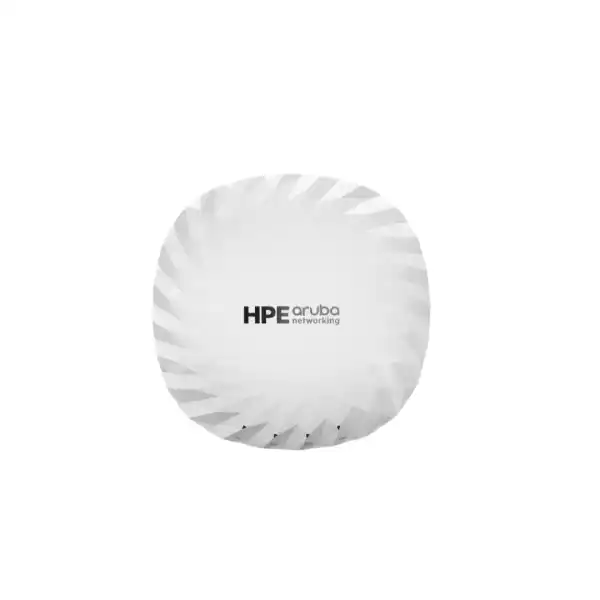
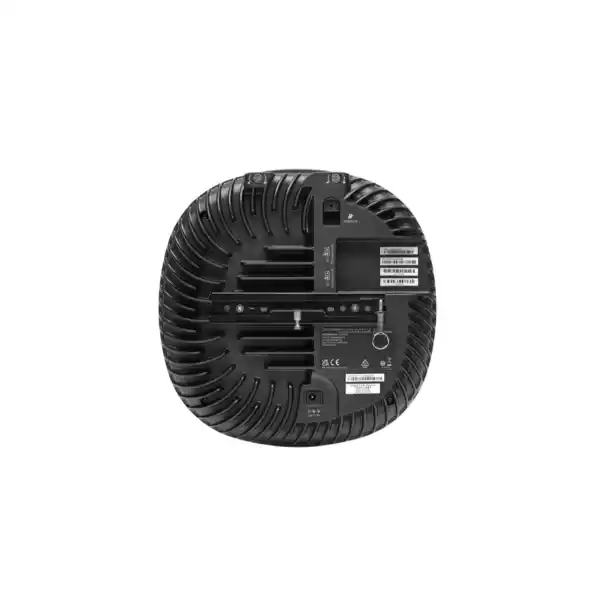
HPE Aruba Networking AP-734 Wi-Fi 7 Campus Access Point
An external-antenna member of the HPE Aruba Networking 730 Series for indoor enterprise wireless deployments that need Wi-Fi 7, 6 GHz capacity, multi-gigabit uplinks and more control over antenna design.
IEEE 802.11be Wi-Fi 7
Tri-radio 2×2 MIMO
External RP-SMA antennas
Dual 5 GbE Smart Rate
AOS-10 with Aruba Central
What is the HPE Aruba Networking AP-734?
The AP-734 is an indoor HPE Aruba Networking 730 Series campus access point built around Wi-Fi 7 and external antennas. It is mainly used to provide managed enterprise wireless coverage across 2.4 GHz, 5 GHz and 6 GHz where RF planners want the flexibility to select antenna type and placement for the site. It is relevant to offices, campuses, healthcare, education, retail and other environments preparing for higher-capacity Wi-Fi and modern 6 GHz clients. The most important items to confirm before proceeding are the UAE-appropriate regulatory variant, antenna design, power source, switching capacity and Aruba Central license. FourTeck can review these dependencies and help turn the wireless requirement into a suitable bill of materials and quotation.
What the AP-734 Does
The AP-734 uses three concurrent 2×2 MIMO radios for 2.4 GHz, 5 GHz and 6 GHz. HPE specifies up to 688 Mbps on 2.4 GHz with 40 MHz channels, up to 2.9 Gbps on 5 GHz with 160 MHz channels and up to 5.8 Gbps on 6 GHz with 320 MHz channels, producing up to 9.3 Gbps maximum aggregate tri-band data rate. These are peak physical-layer figures rather than guaranteed application throughput; real performance depends on client capability, channel plan, interference, regulatory domain, switch uplinks and deployment density.
Wi-Fi 7 capabilities include 320 MHz channel support in 6 GHz, 4096-QAM and multi-link operation. HPE also documents optional dual-5 GHz and dual-6 GHz radio modes with higher aggregate capacity as future-software features, so these modes should not be treated as a present deployment assumption unless the installed software release explicitly supports them.
Verified Technical Highlights
| Item | HPE Aruba Networking AP-734 |
|---|---|
| Product type | Indoor external-antenna campus access point |
| Wireless platform | IEEE 802.11be Wi-Fi 7, tri-radio concurrent 2.4/5/6 GHz, 2×2 MIMO |
| Maximum tri-band aggregate rate | Up to 9.3 Gbps |
| Peak radio rates | 2.4 GHz: up to 688 Mbps; 5 GHz: up to 2.9 Gbps; 6 GHz: up to 5.8 Gbps |
| Channel widths | Up to 40 MHz at 2.4 GHz, 160 MHz at 5 GHz and 320 MHz at 6 GHz |
| Client association scale | Up to 512 associated clients per radio; up to 16 BSSIDs per radio |
| External antenna connectors | Two sets of two female RP-SMA connectors for 2.4/5 GHz and 6 GHz radio chains |
| Ethernet | 2 x RJ-45 HPE Smart Rate ports; 100/1000/2500/5000BASE-T with LACP support |
| Power | 12 VDC or PoE on E0/E1; 802.3bt Class 5 for unrestricted operation, 802.3at Class 4 with restrictions when IPM is disabled |
| Worst-case power consumption | PoE: 24 W without USB / 36 W with USB; DC: 20 W without USB / 31 W with USB |
| USB | 2 x USB 2.0 Type-A host interfaces, up to 10 W total attached-device power |
| IoT radios | Dual integrated Bluetooth 5.4 / 802.15.4 capability with Zigbee support |
| Location features | Integrated GNSS receiver and barometric pressure sensor |
| Minimum AOS version | AOS 10.7.0.0 |
| Regulatory model number | APIN0734 |
External Antennas: The Main AP-734 Buying Decision
The AP-734 differs from the AP-735 primarily in antenna architecture: AP-734 uses external antennas, while AP-735 uses integrated antennas. That makes the AP-734 a stronger candidate when the RF design calls for a particular antenna pattern, gain, mounting position or cable arrangement. HPE lists compatible tri-band antenna options including direct-mount omni, cabled omni and directional panel designs. Antennas are not something to select by model name alone; room geometry, ceiling height, client distribution, construction materials, desired coverage boundaries and applicable local radio rules should be considered.
Wired Uplinks, Redundancy and Power
Two multi-gigabit HPE Smart Rate Ethernet ports allow the AP-734 to connect at 100 Mbps, 1 Gbps, 2.5 Gbps or 5 Gbps. LACP can combine the wired links for redundancy and additional capacity. HPE also supports redundant PoE arrangements so an inactive power source can provide failover. For a new design, the switch should be checked for the required multi-gigabit port speed, PoE class, available power budget and uplink capacity.
For unrestricted operation, HPE specifies 802.3bt Class 5 PoE or supported DC power. With 802.3at Class 4 and Intelligent Power Monitoring disabled, the USB interfaces are disabled. 802.3af is not supported for normal radio operation and is limited to staging. This makes switch power planning a procurement issue, not simply an installation detail.
Aruba Central Licensing and Management
HPE states that 730 Series access points require HPE Aruba Networking Central subscription-based licensing purchased per device. Available subscription terms include 1, 3, 5, 7 and 10 years, with Foundation and Advanced options listed by HPE. AOS-10 is included with the subscription. The correct tier should be selected according to the required management, assurance, security and operational capabilities rather than simply choosing the longest term.
Before quotation, confirm whether the deployment will be cloud-managed or use an applicable Central on-premises option, how many APs require licensing, the desired term, and whether surrounding Aruba gateways, switches or policy services are part of the architecture.
Where the AP-734 May Fit
| Requirement | Suitable when | Confirm before ordering |
|---|---|---|
| Flexible RF coverage | External antennas are needed to shape coverage or support a specific mounting design. | Antenna model, connector plan, cable loss and regulatory limits. |
| Wi-Fi 7 migration | The organization is introducing 6 GHz-capable clients and multi-gigabit WLAN capacity. | Client mix, channel plan and UAE 6 GHz availability. |
| Resilient access layer | Dual Ethernet and power-path options are useful for critical areas. | Switch design, LACP configuration and PoE source redundancy. |
| IoT convergence | BLE, Zigbee/802.15.4 or USB-attached IoT integrations are part of the plan. | Application support, Central services and device integration requirements. |
When Another Option Should Be Evaluated
Choose the AP-734 because the external-antenna design solves a real RF requirement. If a standard indoor ceiling deployment can be served by integrated antennas, the AP-735 may simplify the bill of materials and installation. A different access-point family may also be more appropriate when Wi-Fi 7 or 6 GHz is not required, when the switching infrastructure cannot provide suitable multi-gigabit connectivity and power, or when the intended installation is outdoors or in an environmental condition not covered by this indoor campus model.
Deployment and Compatibility Checks
- Validate the RF plan before choosing external omni or directional antennas.
- Confirm the regional AP variant and allowed 2.4/5/6 GHz channels for the UAE deployment.
- Check that the access switch provides 2.5/5 GbE where required and sufficient PoE budget.
- Select a compatible HPE Aruba AP mount kit; the AP bracket connects to the separately ordered mount kit.
- Plan Aruba Central subscription quantity, tier and term for the installed AP count.
- Verify AOS software compatibility with the wider WLAN architecture and gateways.
- Assess whether dual Ethernet, redundant power, USB IoT devices or LACP are actually needed at each location.
Information to Prepare for an Accurate Quote
FourTeck Support for AP-734 Projects
FourTeck can help UAE organizations review the AP-734 against coverage, capacity, antenna and switching requirements before a bill of materials is finalized. Assistance can include model and regional-variant checks, compatible antenna and mount selection, Aruba Central subscription planning, PoE and multi-gigabit switching review, quotation coordination, installation planning and configuration scope. For broader wireless or infrastructure requirements, see FourTeck technology products, installation and configuration services, or contact FourTeck with your site requirements.
UAE Availability
Contact FourTeck to confirm current UAE availability for the required AP-734 regional model, quantity, antennas, mount kits, power accessories and Aruba Central subscriptions. Availability and lead time can vary by exact model, regulatory domain, quantity and vendor supply. Installation and configuration scope can be included in the quotation when required.
Frequently Asked Questions
Does the AP-734 include internal Wi-Fi antennas?
No. The AP-734 is the external-antenna model in the 730 Series and uses RP-SMA connectors. The antenna type should be selected for the RF design.
Does the AP-734 support 6 GHz?
Yes. It has a dedicated 6 GHz 2×2 radio supporting channel widths up to 320 MHz, subject to the configured regulatory domain and client support.
What is the maximum aggregate wireless data rate?
HPE specifies up to 9.3 Gbps for normal tri-band operation. Optional dual-band radio modes with higher aggregate figures are documented as future-software features and should be verified before relying on them.
Does it require Aruba Central licensing?
Yes. HPE states that 730 Series APs require Aruba Central subscription-based licensing per device, with multiple term lengths and Foundation or Advanced options.
Can the AP-734 use standard PoE?
For unrestricted operation, HPE specifies 802.3bt Class 5 PoE or supported DC power. 802.3at Class 4 can operate with restrictions, while 802.3af is limited to staging.
What should be confirmed for a Dubai deployment?
Confirm the correct regional variant, permitted 6 GHz operation, antenna and mount selection, switch port and PoE capability, Central license term, quantity and installation scope.
Plan the AP-734 Around Your Site, Not Just the Datasheet
Send FourTeck your AP quantity, floor plan, client profile, switch and PoE details, and preferred Aruba Central term for a more accurate UAE bill of materials and quotation.

Reviews
There are no reviews yet.