
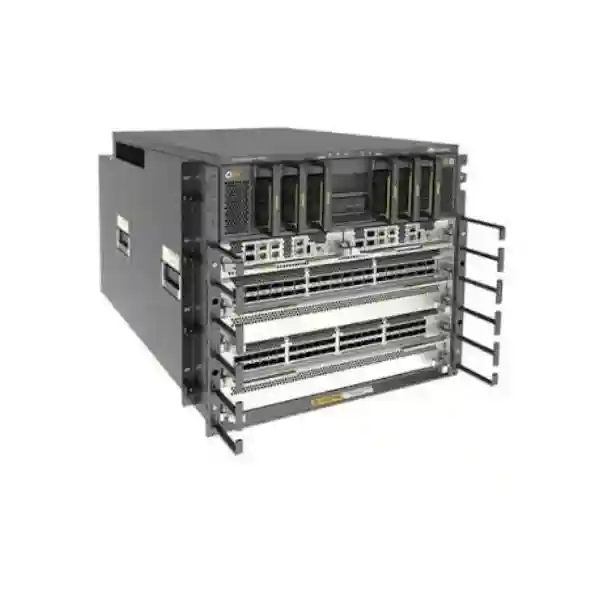
CloudEngine 16800 • Modular Data Center Switching
Huawei CloudEngine CE16804
The Huawei CloudEngine CE16804 is a four-service-slot chassis switch intended for demanding data center networks that need high switching capacity, resilient fabric design, scalable Ethernet interfaces and modern virtualization. Huawei currently lists 45 Tbps switching capacity, nine switching-fabric module slots, Clos architecture with cell switching and VoQ, strict front-to-back airflow, and support for technologies including M-LAG, VS, CSS and VXLAN. FourTeck can help buyers translate these platform capabilities into a complete, supportable bill of materials rather than purchasing a chassis without the cards, optics, software and power design required by the actual project.
Direct answer for buyers
Use CE16804 when the requirement calls for a modular data center switching platform and four service slots are appropriate for the intended port density, growth path and redundancy model. Final suitability depends on line-card selection, interface speeds, transceivers, software release, fabric population, routing and VXLAN design, rack power, cooling, support entitlement and lifecycle planning.
Huawei-listed switching capacity for CE16804.
Modular service-card design for planned interface mixes.
Fabric capacity and redundancy should be engineered for the chosen configuration.
Card options in the CloudEngine 16800 family support high-speed data center evolution.
What the Huawei CloudEngine CE16804 is designed to do
CE16804 belongs to Huawei’s CloudEngine 16800 data center switching family. The platform is built around a backplane-free Clos fabric approach and is positioned for high-capacity Ethernet fabrics where organizations may need spine, core or aggregation roles. The value of a chassis platform is not simply a large throughput figure. It is the ability to select service cards, fabric modules, control components, power configuration and optical interfaces around a defined architecture, then operate the result with standardized routing, virtualization, telemetry and automation practices.
For technical buyers, the important starting point is the network design. Record the number and speed of uplinks, server-facing or leaf-facing connections, redundancy model, oversubscription target, east-west traffic pattern, VXLAN requirements, routing protocols, multicast needs, automation tools, management network, monitoring system and growth horizon. These inputs determine whether CE16804 is the right chassis size and which supported line cards and fabric population should be proposed.
For procurement teams, the product name alone is not enough to request an accurate price. Huawei ordering information distinguishes chassis and power variants, and the final system may also require main processing units, switching fabric units, service cards, optical transceivers, cables, licenses or support items. FourTeck therefore treats a CE16804 enquiry as a configuration exercise first and a quotation exercise second.
Verified Huawei CloudEngine CE16804 specifications and buyer notes
| Item | Huawei-published information | Procurement implication |
|---|---|---|
| Product family | CloudEngine 16800 data center switches | Confirm the exact CE16804 chassis and supported component generation. |
| Switching capacity | 45 Tbps | Use as a vendor platform figure; design around required traffic, cards and redundancy. |
| Service slots | 4 | Map each desired interface group to an approved service card and leave suitable growth margin. |
| Switching-fabric module slots | 9 | Fabric population must match performance and resilience requirements. |
| Fabric architecture | Clos architecture, cell switching, VoQ | Relevant for scalable, non-blocking data center designs and predictable buffering behavior. |
| Airflow | Strict front-to-back airflow | Rack row orientation and hot/cold aisle design should be checked before installation. |
| Virtualization / fabric features | M-LAG, VS, CSS, VXLAN and VXLAN bridging, QinQ access VXLAN | Validate exact software version, interoperability and design assumptions for the intended topology. |
| Layer 2 / Layer 3 | VLAN, STP, LACP; static routing and IPv4/IPv6 dynamic routing support | Define the exact protocols, feature licenses and operational standards before cutover. |
Published values should be confirmed against the exact Huawei software release, card generation and bill of materials proposed at quotation time. Do not combine maximum values from different CloudEngine 16800 and CloudEngine 16800-X generations.
Selection, configuration and compatibility questions
List every required 25GE, 40GE, 100GE or 400GE connection, fiber type, reach, connector, breakout requirement and peer-device capability. Optical compatibility should be confirmed for the exact line card and software release rather than assumed from interface speed alone.
Decide the required failure tolerance for control, switching fabric, power and uplinks. Redundancy should be designed end to end, including peer switches, routing convergence, M-LAG or CSS choices, power feeds and upstream/downstream path diversity.
Document the intended underlay and overlay, VTEP roles, EVPN or other control-plane expectations, tenant segmentation, gateway placement, address plan, routing policy and interoperability requirements before selecting final software and feature options.
Plan telemetry, NETCONF or automation workflows, configuration backup, AAA, logging, NTP, monitoring, change control and out-of-band management. A data center switch should enter production with an operating model, not only a working configuration.
Search-led buyer intent for Huawei CloudEngine CE16804
Commercial searches around this model commonly combine the exact model with supplier, price, quote, datasheet, specification, dealer, distributor, availability and support language. Technical searches add terms such as data center switch, 100GE, 400GE, VXLAN, core switch, spine switch, line card, chassis and optical transceiver. Conversational buyer questions tend to be more complete: “Is CE16804 suitable for my data center core?”, “Which line cards are required?”, “How many 100GE or 400GE ports can I build?”, “Does it support VXLAN?”, “What power and rack requirements should I plan?”, and “What should be included in a CE16804 quotation?”
This page answers those needs directly while avoiding unsupported claims about local stock, pricing, warranty or delivery. The working keyword set includes Huawei CloudEngine CE16804 data center switch, Huawei CE16804 supplier, Huawei CE16804 price, CE16804 quotation, CE16804 Dubai, CE16804 UAE, Huawei data center switch, CE16804 400GE, CE16804 VXLAN and CloudEngine 16800 chassis.
Huawei CloudEngine CE16804 Dubai
Organizations searching for Huawei CloudEngine CE16804 Dubai are usually not looking for a simple access switch. The enquiry normally comes from a data center refresh, enterprise core upgrade, private cloud project, service-provider environment, large campus backbone or high-density server network where resilience and high-speed Ethernet are central design requirements. In Dubai, the practical first step is to identify whether the project needs the CE16804 chassis specifically or whether another CloudEngine size better matches the number of line cards, interfaces and future growth expected. A four-service-slot chassis can be attractive where modularity is required without moving immediately to a larger eight- or sixteen-slot platform, but that choice should be justified by a port map and traffic plan.
For a Dubai deployment, buyers should prepare rack location, hot-aisle/cold-aisle orientation, available rack units, power feeds, grounding, upstream and downstream fiber routes, transceiver reaches, patch-panel design and maintenance access. The CE16804 uses strict front-to-back airflow, so rack placement should not conflict with the facility’s cooling direction. High-speed optics also need a clean procurement plan: port speed alone is insufficient because form factor, wavelength, fiber type, distance, connector and peer compatibility all affect the final bill of materials.
Network architects should also document whether CE16804 will operate as a spine, core, aggregation switch or part of a paired resilient design. If VXLAN is required, define underlay routing, overlay control, gateway location, segmentation, route policy and interoperability with existing leaf switches. If the environment uses firewall segmentation at the data center edge, coordinate the switch design with the security architecture rather than treating each platform separately. FourTeck’s perimeter firewall planning guidance can help teams identify the handoff and segmentation questions that should be settled between switching and security layers.
For a useful Huawei CE16804 Dubai quotation, share the exact chassis preference, desired port counts, interface speeds, optics, redundant component expectations, software requirements, installation location and whether configuration or migration is in scope. FourTeck can then coordinate a bill-of-material discussion rather than quoting an incomplete chassis. UAE buyers can also review broader FourTeck enterprise technology services in the UAE when the project includes servers, networking, security or integration beyond the switch itself.
Huawei CloudEngine CE16804 UAE
A Huawei CloudEngine CE16804 UAE requirement often spans more than one site or stakeholder. Headquarters may be in Dubai or Abu Dhabi, while the data center, disaster-recovery site or hosting environment is located elsewhere. That makes standardization especially important. Before procurement, define whether both primary and recovery locations will use the same chassis, card and software baseline, whether spare components are shared, and whether configurations follow the same routing, VLAN, VXLAN, logging and authentication standards. Standardization reduces operational ambiguity, but it should not force identical hardware where traffic or port requirements are materially different.
UAE buyers should distinguish the chassis from a complete operational system. Huawei ordering information includes CE16804 AC/HVDC and DC chassis variants, while bundles and component combinations may differ. The correct choice depends on facility power, redundancy requirements and the exact component generation. Do not assume that a chassis price automatically includes every main processing unit, switching fabric module, line card, fan, power module, optic, cable, software entitlement or support service needed for production. Ask for a structured bill of materials with each item identified.
Compatibility also deserves attention when CE16804 is introduced into an existing multivendor data center. Document neighbor devices, routing protocols, LACP design, MTU, VLAN and QinQ requirements, VXLAN behavior, multicast, QoS, telemetry collectors, automation systems, authentication and management tools. Where firewalls sit north-south or between security zones, define link aggregation, routing adjacency, failure behavior and change ownership. FourTeck’s network-security service planning page gives procurement and IT teams a useful way to describe implementation scope around the security handoff.
For UAE procurement, the most useful request includes quantity, chassis power variant, port-speed matrix, optics and cable distances, required resiliency, software baseline, support expectation, delivery destination and implementation scope. If lifecycle standardization matters, include the intended service period and upgrade policy so the proposed configuration can be reviewed against current Huawei support information before order placement.
Huawei CloudEngine CE16804 Uganda
Buyers searching for Huawei CloudEngine CE16804 Uganda are commonly planning a central data center, telecom environment, government platform, financial-services core, education network or large enterprise backbone where switching must support concentrated server and uplink traffic. The important decision is whether the scale of the deployment justifies a modular CE16804 rather than a smaller fixed switch or a larger chassis. Start by mapping present connections and a realistic expansion horizon. Count high-speed leaf, aggregation, firewall, router, storage or inter-site links and group them by required interface speed.
Power and facility readiness are particularly important for chassis-class equipment. Confirm the data center’s power type, redundant feeds, UPS and generator strategy, rack depth and load, front-to-back cooling direction, environmental monitoring and maintenance access. Optical design should be documented by path, not by guesswork. A 100GE or 400GE requirement still needs fiber mode, wavelength, distance, connector and peer capability. If links run between rooms, floors or buildings, include the actual fiber route and patching plan in the bill-of-material review.
Operational support should also be part of the Uganda CE16804 decision. Define who will manage VRP-based switching, who owns software upgrades, how configurations are backed up, which telemetry and logging systems are used, how administrator access is controlled and how changes are approved. If VXLAN or advanced virtualization is planned, make sure local operations teams receive a documented underlay/overlay design rather than only the final configuration. FourTeck’s Uganda technology portal can be used as a regional contact path for broader infrastructure enquiries.
When requesting a Huawei CE16804 Uganda quote, provide the destination, quantity, chassis power preference, service-card requirement, fabric and control redundancy expectations, optics, cables, software needs and whether staging, configuration, installation or migration should be priced separately. This information improves quotation quality and makes it easier to compare proposals on the same technical basis instead of comparing incomplete chassis prices.
Huawei CloudEngine CE16804 Kampala
A Huawei CloudEngine CE16804 Kampala project may serve as the central switching platform for an organization whose users, branches and applications extend well beyond the city. That changes the design emphasis. Instead of evaluating only rack-level port density, the architect should identify how branch WAN links, internet gateways, private cloud platforms, application clusters, backup systems and disaster-recovery connections converge on the data center. The CE16804 can participate in a high-capacity core or spine design, but the right card mix depends on the actual traffic relationships between these systems.
For Kampala data centers and enterprise server rooms, a useful readiness review includes dual power feeds, rack layout, cooling, cable management, out-of-band management, console access and physical labeling. Chassis systems concentrate multiple dependencies, so documentation should identify which service card connects to which network zone, which uplinks are redundant, which transceivers are installed and what failure is expected if a fabric or power component is removed. This is also the right stage to decide whether the design uses M-LAG, CSS, routed links or another resiliency model.
Procurement teams in Kampala should ask suppliers to separate hardware, optics, software/support and professional services in the quotation. This prevents the common problem of comparing one proposal that includes a complete switch with another that includes mainly the chassis. The requested line cards must match the intended 25GE, 40GE, 100GE or 400GE topology, and optics should be verified for distance and fiber plant. Installation scope should state whether it includes rack mounting, power connection, software initialization, configuration, routing, VXLAN, migration, testing and handover.
For organizations upgrading an existing core in Kampala, a migration plan should record current VLANs, SVIs or routed interfaces, routing neighbors, LACP groups, MTU, QoS, ACLs, monitoring, management addressing and rollback steps. A staged migration reduces the risk of moving hidden legacy dependencies blindly. FourTeck can use this information to prepare a CE16804 configuration discussion that is more precise than a generic price request.
Huawei CloudEngine CE16804 Arua
Huawei CloudEngine CE16804 Arua searches are more specialized because the platform is intended for data center-class switching rather than routine office access. An Arua organization considering CE16804 should first confirm the role of the system: centralized application hosting, regional service aggregation, telecom infrastructure, institutional data processing, disaster-recovery connectivity or another high-capacity use case. If the requirement is only a modest campus distribution layer, a smaller platform may be more appropriate. If the site concentrates many high-speed services, modular chassis design can provide a clearer growth and resilience path.
Site infrastructure deserves extra attention before equipment is ordered. Validate rack dimensions and weight capacity, redundant power sources, UPS runtime, generator transition behavior, grounding, cooling direction, ambient operating conditions, dust control, fiber termination quality and access for maintenance. The CE16804’s front-to-back airflow must fit the rack and room cooling plan. High-speed switching also makes cable discipline important; every 100GE or 400GE link should have an identified peer, optic, fiber type, connector, distance and labeling convention.
Where remote support is expected, design the management plane so engineers can diagnose problems without depending on the production data path. Out-of-band access, protected administrative authentication, logging, NTP, configuration backup, telemetry and documented escalation details should be considered from the beginning. Spare strategy can also matter for sites where replacement logistics may require more planning. The correct spare list depends on the final hardware configuration and support arrangement; it should be agreed commercially rather than assumed.
An Arua quote request should therefore include more than “CE16804 price.” Provide the site role, port counts, interface speeds, expected growth, redundancy objectives, power type, optical distances, existing network vendors, software features and installation scope. With those details, the final proposal can identify whether the four-slot CE16804 is appropriate and what components are required to make it production-ready.
Huawei CloudEngine CE16804 Mbarara
A Huawei CloudEngine CE16804 Mbarara enquiry is likely to come from an organization consolidating core services, building a private-cloud environment, improving a campus backbone or creating a resilient regional data center. The main buying question is not whether 45 Tbps sounds large; it is whether the chassis, cards and software can be configured to match the required connectivity with sensible headroom. Buyers should create a port schedule showing current and future links, speed, media, purpose, redundancy pair and expected traffic. That schedule becomes the basis for selecting service cards and optics.
Mbarara deployments that aggregate remote branches or institutional sites should also account for WAN and security boundaries. Determine which networks terminate on routers or firewalls, which remain Layer 2, which use Layer 3 routing and where segmentation policy is enforced. If the core uses VXLAN, document the overlay and underlay clearly. If the network remains traditional VLAN and routed-core architecture, verify spanning-tree scope, LACP, routing protocols, first-hop gateway placement and failure behavior. The CE16804 supports a broad feature set, but only the features required by the chosen architecture should drive configuration and support planning.
Operational simplicity matters after deployment. Standardize interface descriptions, device names, VLAN naming, routing policy, administrator roles, logging targets, NTP, SNMP or telemetry and backup processes. Record serial numbers and installed module locations in the asset register. A chassis switch can remain manageable for years when documentation is kept aligned with physical and logical changes; without that discipline, troubleshooting becomes slower as cards, optics and links are added.
For a Huawei CE16804 Mbarara quotation, include the quantity, intended topology, port matrix, optics, power arrangement, resilience target, software version policy and support expectations. If professional services are required, state whether FourTeck should include staging, baseline configuration, migration, onsite coordination, testing, documentation or administrator handover as separate line items.
Huawei CloudEngine CE16804 Gulu
Organizations researching Huawei CloudEngine CE16804 Gulu should treat the platform as a data center infrastructure decision rather than a single-box purchase. The CE16804 is modular, and the useful question is what complete system supports the site’s applications, users, branches and growth. Define the desired role first: core, spine, high-capacity aggregation, private-cloud fabric or another central function. Then map every connected system, including leaf switches, firewalls, routers, storage networks, virtualization hosts, backup platforms and inter-site transport.
For regional facilities, business continuity planning is particularly valuable. Decide what should happen if one uplink fails, one power feed is lost, a fabric component is removed for maintenance, a peer switch is unavailable or the main WAN path goes down. The hardware redundancy model should be matched by logical redundancy in routing and link design. A pair of chassis switches does not create resilience automatically if both depend on the same power source, cable path or upstream device. Failure-domain mapping should therefore be part of the architecture review.
Support readiness is another procurement factor. Ensure the organization knows who can authorize changes, who can access the device, how configurations are backed up, where logs are stored and how software upgrades are tested. If centralized management or automation is planned, validate API or NETCONF workflows against the selected release. If remote troubleshooting is important, include a secure out-of-band route that remains reachable when the production network has a fault.
When asking for CE16804 supply in Gulu, provide the full technical requirement rather than only a model number. Port counts, speed, optics, power, resilience, routing and VXLAN needs, site conditions and service scope give the supplier enough information to prepare a complete bill of materials. This also helps the buyer identify optional items and compare quotations fairly.
Huawei CloudEngine CE16804 Kenya
Huawei CloudEngine CE16804 Kenya buyers may include enterprises, financial institutions, hosting providers, education networks, government environments and service providers modernizing a data center core or spine. These projects often combine capacity growth with virtualization, cloud platforms and stronger operational visibility. CE16804 can be evaluated where four service slots provide the right balance between modularity and chassis size, but architecture should begin with a port and traffic model rather than with the chassis name.
For Nairobi or other Kenyan data center deployments, confirm how the switch interacts with existing leaf switches, routers, firewalls and cloud platforms. If the design uses VXLAN, document the underlay protocol, overlay control plane, VTEP placement, anycast gateway approach, segmentation and interconnection to security devices. If the environment uses conventional Layer 2/Layer 3 design, verify VLAN scale, LACP, spanning-tree boundaries, IPv4/IPv6 routing, route policy and MTU. The CE16804’s capabilities are broad, but the production design should enable only what is required and operationally supportable.
Kenyan procurement teams should also request a complete list of components. Huawei documentation distinguishes chassis variants and shows separate categories for processing units, switching fabric and service cards. High-speed optics and cables can represent a significant part of project complexity, so every connection should be specified. Power, rack and cooling requirements should be reviewed with the data center facilities team before the order is finalized. FourTeck’s Kenya technology site provides a regional route for discussing wider infrastructure requirements.
A strong CE16804 Kenya RFQ includes chassis quantity, power type, proposed line cards, port counts by speed, optics, redundancy model, software baseline, support term, installation location and service scope. Include migration and testing requirements if the platform is replacing an existing core. This allows pricing to reflect the actual system instead of an incomplete chassis-only comparison.
Huawei CloudEngine CE16804 Kuwait
A Huawei CloudEngine CE16804 Kuwait deployment is likely to be considered for enterprise data centers, oil and gas support environments, government networks, financial services, telecom infrastructure or large private-cloud platforms that require modular high-speed switching. Facility and environmental planning should be integrated with the network design. Confirm rack dimensions, front-to-back cooling alignment, power-feed type, redundant power paths, UPS capacity, grounding and the physical route for high-speed fiber. Chassis equipment should be reviewed with facilities teams before procurement, not after delivery.
Kuwait buyers should also define how the platform will scale. The CE16804 has four service slots, so the port-density plan should show which cards are populated initially and which expansion is expected later. Leave headroom deliberately rather than assuming any unused slot will support any future interface requirement. Card support and port capabilities depend on product generation and software. The same caution applies to optics: confirm supported transceiver types, cable reach, breakout behavior and peer compatibility for every link.
Where strict operational governance applies, build the management plan into the project. Define administrator authentication, role separation, logging, telemetry, configuration backup, change approval, software maintenance windows and rollback procedures. A high-capacity core switch can affect many applications simultaneously, so upgrade and change processes should be rehearsed and documented. If the CE16804 connects directly to data center firewalls, document routing, link aggregation, MTU, failover and ownership boundaries between network and security teams.
For Huawei CE16804 Kuwait pricing, send the complete requirement: chassis and power preference, line-card and fabric expectations, optics, quantity, software features, support term, rack destination and required professional services. Regional buyers can use FourTeck Kuwait as a contact route for infrastructure and procurement coordination. Current availability and final configuration should always be confirmed at quotation time.
Huawei CloudEngine CE16804 Ghana
Huawei CloudEngine CE16804 Ghana searches commonly indicate a buyer evaluating enterprise or service-provider data center switching rather than ordinary office networking. In Accra or other Ghanaian locations, the CE16804 should be assessed against the application and traffic architecture: virtualization clusters, storage, internet edge, branch aggregation, cloud on-ramp, security zones and disaster-recovery connectivity. A four-slot chassis can be a strong fit when the project needs modular service cards and high-speed interfaces with room for planned growth, but the port plan should be completed before hardware is selected.
For Ghana deployments, resilience planning should include local facility realities and network dependencies. Identify dual power paths, UPS and generator support, cooling direction, rack capacity, fiber routes and out-of-band access. Then map logical redundancy: paired switches, independent uplinks, routing convergence, link aggregation and firewall connections. Do not treat chassis redundancy as a substitute for end-to-end design. A single shared fiber path or upstream router can still become the failure point even when the switch itself has redundant components.
Procurement should separate hardware configuration from services. Ask for the chassis, control modules, fabric modules, service cards, power items, optics, cables, software/support and implementation to be identified clearly. If installation is needed, specify whether the scope covers staging, software baseline, configuration, physical installation, migration, testing, documentation and training. This makes commercial evaluation easier and prevents hidden dependencies from appearing late in the project.
Ghanaian organizations with wider regional infrastructure requirements can also review FourTeck Africa for broader technology coordination. For the CE16804 itself, share the expected port speeds, link distances, VXLAN or routing needs, redundancy level, power environment and support expectations so the proposed configuration can be checked against current Huawei information before an order is placed.
Huawei CloudEngine CE16804 Nigeria
Huawei CloudEngine CE16804 Nigeria buyers may be planning data center modernization in financial services, telecom, government, cloud hosting, energy, education or large enterprise environments. These networks can have demanding east-west traffic, multiple security zones and significant branch or internet connectivity. The CE16804 can be evaluated as a modular core or spine platform when four service slots align with port-density and growth requirements. The decision should be based on actual traffic and topology, not on a generic “high-capacity” label.
Nigeria projects should define facility resilience together with network resilience. For each chassis, identify the rack, power feeds, UPS/generator strategy, airflow direction and maintenance access. For each critical link, identify the peer device, optic, fiber path and redundant route. Where two switches form a resilient pair, check whether their uplinks and power sources are physically diverse. High availability should survive realistic faults, not only a software simulation.
If CE16804 is part of a VXLAN fabric, document the underlay and overlay in enough detail for operations teams to support it. Define route reflectors or controllers if used, VTEP placement, gateway design, tenant segmentation, MTU, multicast or ingress replication approach, route policy and firewall integration. If the deployment is a traditional routed core, define routing protocols, summarization, ECMP, convergence expectations, VLAN boundaries, LACP and ACL ownership. Testing should include link failure, peer failure, routing reconvergence and management access.
For a Huawei CE16804 Nigeria quotation, procurement teams should send a complete bill-of-material request including chassis variant, cards, optics, cables, software/support, quantity and service scope. Ask the supplier to identify assumptions and exclusions. This helps compare proposals fairly and makes it clear whether staging, configuration, onsite coordination, migration and handover are included or separate. Regional technology enquiries can also be coordinated through FourTeck’s Africa network where appropriate.
Huawei CloudEngine CE16804 Seychelles
A Huawei CloudEngine CE16804 Seychelles requirement is likely to be tied to a concentrated data center, telecom, government, financial-services, hospitality group or critical enterprise environment where equipment selection must account for both technical fit and support logistics. Because Seychelles is an island market, complete bill-of-material planning is especially valuable. Missing optics, cables, power components or supported modules can delay commissioning more than in markets where replacements are locally abundant. Buyers should therefore validate the complete system before shipment.
Start with a detailed interface matrix. List every connection, port speed, peer device, fiber type, distance, connector and redundancy relationship. Then select supported service cards and optics around that matrix. Include reasonable expansion capacity without buying arbitrary components that may never be used. Confirm software and feature compatibility for VXLAN, routing, virtualization, telemetry and automation requirements. If a second data center or recovery site is involved, define how traffic fails over and which components must remain independent.
Facility planning should confirm rack space, front-to-back cooling, electrical supply, redundant power paths, environmental monitoring, grounding and maintenance access. It is also wise to agree a spare and support strategy based on criticality and the final component list. Spare planning should be specific: the most useful spare is the one that addresses a credible failure in the deployed configuration, not a generic box purchased without relation to the installed hardware.
For CE16804 procurement in Seychelles, send FourTeck the destination, quantity, required chassis power type, port-speed matrix, card and fabric expectations, optics, support requirements and deployment scope. Ask that the quotation identify each line item and any assumptions. If remote commissioning or operational handover is required, include out-of-band management, documentation, configuration backups and test procedures so the system can be supported effectively after go-live.
Deployment planning: from chassis to production network
A successful CE16804 project can be organized into five practical phases: requirements, bill of materials, staging, migration and operational handover. Requirements define topology, port speeds, resilience, routing and VXLAN. The bill of materials converts those needs into exact chassis, processing, fabric, service-card, optic, cable, power, software and support items. Staging validates hardware inventory, software baseline and configuration before the production change window. Migration moves services with rollback plans and acceptance tests. Handover records the final state, backups, support details and operational responsibilities.
Where the project also includes firewall changes, review FourTeck’s firewall deployment planning so routing, VLAN, security-zone and cutover dependencies are handled together. The goal is not to sell unrelated products; it is to prevent a switch migration from being planned independently of the devices that exchange traffic with it.
Related network-security and data-center edge resources
Useful when CE16804 connects to internet-edge or segmentation firewalls and the project needs a coordinated switching/security handoff.
Relevant for architects evaluating high-speed firewall boundaries next to the data center switching fabric.
A branch-class reference that illustrates why edge firewall sizing and core switching are different design exercises.
Useful as a branch-security contrast when planning a larger multi-site architecture around a central CE16804 data center.
A data-center-class firewall reference for teams planning high-throughput security adjacent to chassis switching.
Send the network diagram, port matrix and required bill of materials for a scoped CE16804 quotation discussion.
Frequently asked questions
What is Huawei CloudEngine CE16804?
It is a modular data center switch in Huawei’s CloudEngine 16800 family. Huawei lists four service slots, nine switching-fabric module slots, 45 Tbps switching capacity, Clos/cell-switching/VoQ architecture and support for modern data center networking features.
Does CE16804 support VXLAN?
Huawei lists VXLAN and VXLAN bridging capabilities for the CE16800 family. The exact overlay design, control plane, software version, interoperability and licenses should be validated for the proposed deployment.
How many service slots does CE16804 have?
Huawei lists four service slots. The available port count depends on the supported service cards chosen for the exact hardware and software generation.
Can I request only the CE16804 chassis?
You can request a chassis quotation, but a production system normally needs additional components. Ask for a complete bill of materials that identifies processing, fabric, service cards, power, optics, cables, software/support and services required by the design.
What should I provide for an accurate CE16804 quote?
Provide quantity, deployment country and city, chassis power preference, number of ports by speed, optic distances, desired redundancy, routing and VXLAN requirements, peer equipment, software/support expectations and whether staging, installation, migration or configuration is required.
Is CE16804 suitable for a data center core?
It is positioned as a data center switch and can be considered for core, spine or high-capacity aggregation roles when the four-slot chassis, supported cards and software match the network design. Suitability should be confirmed through topology, capacity and resilience analysis.
Does the CE16804 use front-to-back airflow?
Yes. Huawei lists strict front-to-back airflow for the CE16800 family. Rack orientation and hot/cold aisle layout should therefore be checked before installation.
Are 400GE options available?
Huawei’s current CloudEngine 16800 portfolio materials show 400GE line-card options and describe the family as supporting evolution to 400GE. Confirm the exact supported line card, fabric requirement, optic and software release for the proposed CE16804 configuration.
Decision recap
CE16804 is worth evaluating when you need a modular CloudEngine 16800 data center chassis and four service slots fit the required port density. The strongest buying process begins with topology and interface requirements, then validates cards, optics, fabric, power, software and support.
Do not compare suppliers by chassis price alone. Compare equivalent complete bills of materials and make assumptions visible.
Quotation checklist
- Country, city, quantity and target deployment date
- Chassis power preference and redundancy requirement
- Port counts grouped by 25GE, 40GE, 100GE and 400GE
- Optic type, fiber mode, distance and peer device for every high-speed link
- Routing, VXLAN, M-LAG/CSS and segmentation requirements
- Software, support, staging, configuration and migration scope
- Rack, airflow, power-feed and operational handover requirements
Why contact FourTeck for Huawei CloudEngine CE16804
A useful CE16804 purchase requires coordination between procurement, data center facilities, network architecture and operations. FourTeck can help structure the requirement so a quotation reflects the complete system rather than an isolated chassis. The discussion can cover port mapping, supported card choices, optics, power, redundancy, software, integration with routing and security, migration scope and documentation expectations.
FourTeck does not assume stock, delivery, warranty or final component compatibility without confirmation. Current commercial availability and the final supported configuration should be verified in the formal quotation.
Ready to scope your CE16804 bill of materials?
Send FourTeck your port matrix, topology, optics, power and support requirements. The more complete the input, the easier it is to build a technically comparable quotation and identify missing dependencies before procurement.

Reviews
There are no reviews yet.