
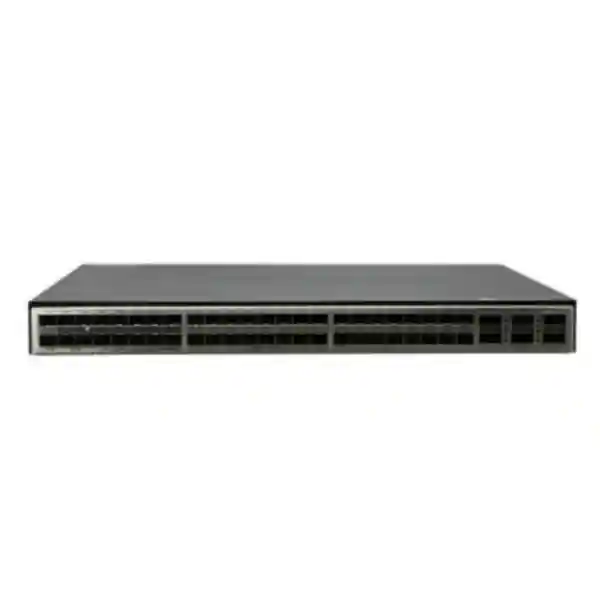
Huawei CloudEngine S5736-S24UM4XC in Dubai, UAE
The Huawei CloudEngine S5736-S24UM4XC is engineered for enterprise access layers that have outgrown conventional 1 Gigabit Ethernet. Its 24 copper multi-gigabit interfaces can operate across 100M, 1G, 2.5G, 5G and 10G speeds, while four fixed 10GE SFP+ ports provide optical uplink capacity and an expansion slot opens a path to additional 10GE, 25GE or 40GE connectivity. The platform is especially relevant for modern UAE campuses where Wi-Fi 6 access points, high-resolution cameras, IP endpoints, engineering workstations, edge compute nodes and converged building systems increasingly share the same structured cabling plant.
Multi-rate RJ45 access supports gradual upgrades without replacing every horizontal cable run at once.
High-power endpoint support is suitable for advanced WLAN access points and other power-intensive edge devices, subject to system PoE budget.
Fixed SFP+ uplinks plus an expansion bay allow the aggregation design to scale with traffic growth and redundancy needs.
The platform supports enterprise segmentation, routing, resiliency and IPv6 features for demanding campus architectures.
Why the S5736-S24UM4XC fits modern UAE campus networks
Enterprise access switching has changed substantially as wireless throughput, endpoint density and power requirements have increased. A traditional access switch with 1G copper downlinks and a small number of 10G uplinks can become a bottleneck when several Wi-Fi 6 radios, high-frame-rate cameras, media workstations and local servers converge on the same wiring closet. The Huawei CloudEngine S5736-S24UM4XC addresses this transition by providing a copper edge that is not locked to a single access speed. Each multi-gigabit port can accommodate devices operating at different negotiated rates, allowing IT teams to migrate from legacy endpoints to 2.5G, 5G or 10G devices on a port-by-port basis.
For organizations in Dubai, Abu Dhabi, Sharjah and other UAE locations, this is particularly useful when a network refresh must coexist with an existing Category 5e, Category 6 or Category 6A cabling estate. A multi-rate access design gives engineers more choices: keep conventional 1G for printers and ordinary desktops, allocate 2.5G or 5G where access points and high-bandwidth users need additional headroom, and use 10GBase-T where validated cabling length, transceiver design and endpoint capability support it. The result is a staged modernization path rather than an all-or-nothing edge replacement.
The switch is also relevant to converged facilities. Hospitality, education, healthcare, retail, logistics, corporate headquarters and large residential or mixed-use projects increasingly combine data, WLAN, voice, surveillance and IoT on managed Ethernet. Consolidation makes port performance, segmentation and power budgeting more important. The S5736-S24UM4XC provides high-capacity switching and routing features while supporting PoE++, enabling a single access platform to serve endpoint categories that previously required separate switching tiers. A well-designed deployment still requires VLAN policy, QoS, redundancy, thermal planning and endpoint power calculations, but the hardware provides the headroom needed to make those designs practical.
FourTeck positions this model as part of a complete campus architecture rather than as an isolated box. For UAE projects, our network team can align the switch with structured cabling, optics, access points, firewall segmentation, IP telephony, surveillance and upstream aggregation. Customers can also review broader enterprise networking and infrastructure services through FourTeck UAE, where switching is planned alongside the rest of the production environment.
Port architecture: 24 adaptive Multi-GE access interfaces
The defining characteristic of the CloudEngine S5736-S24UM4XC is its set of 24 copper Ethernet access ports. Huawei specifies these interfaces for 100M, 1G, 2.5G, 5G and 10GBase-T operation. That range allows one switch to support several generations of endpoint technology simultaneously. In a typical enterprise rack, an IT team might connect older 1G desktops, new 2.5G Wi-Fi access points, 5G multimedia devices and selected 10G workstations to the same access platform without creating separate switch islands for every speed class.
This flexibility matters because endpoint refresh cycles are rarely synchronized. Wireless infrastructure may be renewed every three to five years, whereas cabling can remain in service for a decade or longer. Likewise, design workstations or local storage appliances may be upgraded ahead of office PCs. A multi-gigabit switch lets the physical network absorb those asynchronous changes. It is still essential to validate the negotiated speed and cabling quality; 10GBase-T in particular has stricter channel characteristics than ordinary 1G. But the presence of multiple selectable rates helps the network operate at the highest stable speed supported by the end-to-end copper path.
Huawei also uses a Right-To-Use licensing model for flexible access-speed activation on this series. Historical and current documentation describe port-rate upgrades in groups, allowing organizations to scale access capability as demand grows. Procurement teams should therefore avoid assuming that every possible data rate is automatically enabled on every port in every commercial bundle. FourTeck can review the exact base configuration, required RTU entitlement, software release and intended endpoint speeds before quotation so the delivered switch matches the deployment plan.
From a design perspective, that licensing approach can be valuable when the network has an immediate requirement for high port density but only a subset of endpoints needs multi-gigabit performance at project launch. Rather than overspecifying the entire access layer, the organization can build a chassis footprint with growth potential and activate additional bandwidth in line with WLAN, client or application upgrades. This creates a clearer capacity roadmap and helps budget owners separate hardware investment from staged performance expansion.
Uplink design: four 10GE SFP+ ports plus an expansion path
Fixed optical uplinks
Four fixed 10GE SFP+ interfaces give the S5736-S24UM4XC a strong baseline for connecting to aggregation or core switches. Depending on topology, those ports can be used for redundant uplinks, link aggregation, separate service paths or high-speed connectivity to nearby network systems. Optical 10GE is especially useful in UAE campuses where riser distances, electrical isolation and building-to-building links make fiber preferable to copper.
When sizing uplinks, the objective is not merely to total all access-port line rates. Most campus endpoints do not transmit at peak simultaneously. Engineers instead evaluate oversubscription, WLAN concurrency, traffic locality, application mix and failure scenarios. Two 10G uplinks in an aggregation group may be sufficient for one closet, while another environment with dense wireless traffic or workstation-heavy floors may justify more uplink capacity.
Expansion-slot options
Huawei lists one extended slot for the model, supporting expansion choices that can provide 2 × 25GE SFP28, 8 × 10GE SFP+ or 4 × 40GE QSFP+ connectivity depending on the compatible card and software combination. This means the access switch can participate in higher-bandwidth aggregation designs without replacing the base chassis.
The expansion bay also gives architects more freedom when standardizing access hardware across sites. Smaller closets can rely on the fixed uplinks while larger floors can install higher-capacity modules. That reduces the number of switch families an operations team must support. Before ordering, the chosen card, optics, cable type and target topology should be validated against the Huawei hardware compatibility information and the actual network release in use.
Switching performance and what the numbers mean
For the international S5736-S24UM4XC specification, Huawei publishes forwarding performance of 480 Mpps and switching capacity figures of 880 Gbit/s for the device and 2.72 Tbit/s for the system context. These numbers indicate that the platform is built for substantially more traffic than conventional gigabit access switches. They should be interpreted as hardware capability indicators rather than direct predictions of application throughput. Real network performance also depends on frame sizes, protocol mix, access port activation, uplink topology, congestion, policy features, endpoint behavior and the distribution of traffic across the fabric.
For an architect, the practical question is whether the switch can forward traffic at the required scale while enforcing segmentation and resilience policies. A 24-port multi-gigabit access layer can theoretically accumulate a very large ingress rate. In most office networks, actual concurrency is much lower, but wireless aggregation, imaging systems and local server workflows can generate bursts that exceed the comfort zone of older 1G access hardware. The S5736-S24UM4XC provides a performance envelope designed for these newer workloads.
The switch also provides a 32K MAC address table according to Huawei’s international product specification. That capacity is more than sufficient for ordinary access closets and supports larger Layer 2 domains where many wired, wireless and virtualized endpoints may be visible through the device. Good campus design should still avoid making broadcast domains unnecessarily large. VLAN segmentation, routed boundaries and security policy generally provide better fault isolation than relying on a single extensive Layer 2 segment.
When comparing quotations, buyers should be cautious about specification values copied from mainland-China product pages, older brochures or reseller records because published performance values can differ by regional model interpretation, software generation or documentation revision. For UAE procurement, FourTeck aligns the bill of materials with the international-market model and can confirm the exact hardware part number and supported software release applicable to the proposed shipment.
PoE++ engineering: power at the access layer is a design discipline
Huawei specifies PoE++ support on the S5736-S24UM4XC with up to 90 W available on a supported individual port. High per-port capability is important for modern access points with multiple radios, pan-tilt-zoom cameras, building systems, compact edge devices and other equipment that can exceed classic PoE power levels. However, the phrase “up to 90 W per port” should never be interpreted as meaning that every port can always deliver 90 W simultaneously. The total PoE budget is determined by installed power modules, redundancy mode, input power conditions, system consumption and configured operating policy.
Huawei documentation for this chassis lists pluggable PoE power options, including AC and DC variants, with system support for two power slots. Published maximum system consumption under a full PoE load is much higher than the non-PoE chassis draw because the switch must supply attached powered devices in addition to its own electronics. This is why the electrical design of a PoE++ access closet cannot be treated as an afterthought. Engineers should calculate connected load, desired redundancy, circuit capacity, UPS runtime, PDU rating, heat dissipation and future port growth before choosing the power-module combination.
A sensible method starts with an endpoint schedule. List every powered device, its expected classification and worst-case draw. Add growth margin rather than sizing to today’s exact total. Decide whether N+1 or 1+1 power resilience is required and whether PoE must remain available during a module failure. Then verify the available AC or DC service at the rack. In UAE offices and campuses, high ambient conditions outside controlled rooms make reliable cooling particularly important; network closets carrying large PoE loads should be treated as active equipment spaces with monitored temperature, not as simple passive cable rooms.
FourTeck can build the PoE worksheet as part of the switch quotation so the chassis, power supplies and UPS assumptions are consistent. This reduces a common deployment risk: purchasing a high-power-capable switch but under-sizing the actual power modules or rack electrical feed needed for the intended endpoint population.
Built for Wi-Fi 6 and high-density wireless access
The S5736-S family is positioned by Huawei as a multi-gigabit access platform for the Wi-Fi 6 era. That positioning is technically logical because modern enterprise access points can generate more than 1 Gbit/s of aggregate traffic under favorable radio conditions and may need higher-power PoE classes. A 1G access port can become the wired bottleneck even when the wireless side is capable of more. Multi-GE copper solves that problem without requiring fiber directly to every access point.
For a high-density office, university, hotel or public venue, the switch can provide 2.5G or 5G connectivity to access points where that is appropriate, reserving 10G for the most demanding devices or future upgrades. The exact wired speed should be selected from actual radio design, client mix and traffic measurements rather than simply configuring the maximum everywhere. Wireless networks are shared media systems; adding a 10G Ethernet uplink to an access point does not automatically produce 10G of useful client throughput. Nevertheless, giving the AP enough wired headroom prevents Ethernet from becoming the first constraint as radio generations improve.
Power is equally important. Newer access points may enable additional radios, spatial streams, USB peripherals or IoT functions that increase demand. PoE++ capability provides a broader electrical envelope, while the switch’s network features can enforce VLANs, QoS and routing policies for SSIDs mapped into different enterprise services. Proper deployment should coordinate WLAN controllers, DHCP, authentication, firewall policy and switching configuration so the wired and wireless layers behave as one architecture.
For organizations combining wireless refreshes with firewall or Internet-edge projects, FourTeck can also coordinate security design through Firewall Dubai. This matters because faster access switching only creates business value when upstream security inspection, WAN links and core services are sized to carry the resulting traffic.
Layer 2 segmentation and campus control
Huawei lists support for up to 4094 VLANs on the S5736-S24UM4XC, together with guest VLAN, voice VLAN, GVRP, MUX VLAN and several methods of VLAN assignment. These capabilities allow network teams to build structured segmentation policies rather than treating the access layer as a flat collection of ports. A corporate user VLAN can be separated from IP phones, cameras, printers, guest access, building systems and wireless infrastructure even when those devices share the same physical switch.
Policy-based and attribute-based VLAN assignment can be useful where endpoint identity is more important than the wall socket. The platform documentation also references assignment based on MAC address, protocol, IP subnet, policy and port. In practice, organizations should select the simplest mechanism that meets security and operational requirements. Port-based VLANs are easy to troubleshoot, while dynamic assignment may be preferable in larger environments with centralized authentication and mobile users.
Voice VLAN support is valuable for unified communications deployments where IP phones need predictable QoS and isolation from ordinary data traffic. Guest VLAN mechanisms can provide a controlled path for unknown or unauthenticated devices, subject to the organization’s access-control design. MUX VLAN can help isolate endpoints within the same broader service group where direct peer communication is not required. These controls are especially relevant for hospitality, education and shared-office networks that must prevent one tenant or guest endpoint from reaching another.
The switch also supports Huawei interoperability mechanisms such as VBST, which is designed for compatibility with common per-VLAN spanning-tree environments, along with LNP and VCMP features that serve roles similar to widely used link-type and VLAN management approaches. In mixed-vendor networks, compatibility should be tested against the exact neighboring platforms and desired spanning-tree mode rather than assumed from feature names alone. FourTeck can map existing Cisco, Aruba, HPE, Huawei or other switch configurations into a migration plan that minimizes topology surprises.
Layer 3 routing for resilient access and aggregation roles
Huawei’s international specification lists a broad Layer 3 feature set for the S5736-S24UM4XC, including static routing, RIP and RIPng, OSPF and OSPFv3, ECMP, IS-IS and IS-ISv6, BGP and BGP4+, plus VRRP and VRRP6. This makes the platform suitable not only for Layer 2 access but also for routed access or smaller aggregation scenarios where a distribution layer is designed around dynamic routing rather than large spanning-tree domains.
Routed access can improve failure isolation by moving Layer 3 boundaries closer to users and reducing the amount of Layer 2 topology that spans multiple closets. OSPF is often a practical choice for enterprise campus routing because it supports fast convergence and scalable area design. ECMP can distribute traffic across equal-cost paths where the topology supports it. BGP may be relevant in larger campuses, data-center-edge use cases or designs that use EVPN-based control planes, although the precise feature entitlement and scale should always be validated for the installed software license and release.
VRRP and VRRP6 provide first-hop redundancy options when multiple Layer 3 devices share gateway responsibilities. A resilient access design may combine dual uplinks, link aggregation and dynamic routing with redundant gateways so a single cable, optic or upstream switch failure does not isolate the floor. The correct approach depends on the core architecture; simply enabling every redundancy feature can create unnecessary complexity. Good design chooses a small number of mechanisms and documents the expected behavior during each failure mode.
IPv6 maturity is also increasingly relevant in UAE enterprise and service-provider environments. The S5736-S platform’s IPv6 routing and redundancy support helps organizations operate dual-stack networks without treating IPv6 as a secondary overlay. Address planning, ACL policy, monitoring and security inspection should be designed consistently across IPv4 and IPv6 so an organization does not accidentally create a less-controlled parallel path.
Operations, management and automation
A high-performance access switch only becomes manageable at scale when it integrates with monitoring, configuration and automation tools. Huawei’s S5736-S family is based on the Versatile Routing Platform and supports standard management approaches including CLI access, SNMP, HTTPS and programmable mechanisms such as NETCONF/YANG in the documented feature set. These options allow the switch to participate in both traditional NOC workflows and more automated campus operations.
For small environments, engineers may still prefer direct CLI configuration because it is transparent and easy to audit. In larger estates, however, manual per-switch changes can become an operational risk. Template-driven configuration reduces drift, and telemetry or centralized management can identify port errors, bandwidth pressure and device-health problems before users report them. When multiple access switches are deployed across floors or branches, standardized naming, VLAN definitions, uplink policy and management addressing are as important as the hardware itself.
The physical management interfaces include a dedicated Ethernet management port and an RJ45 console interface according to published hardware information, while USB support can assist certain maintenance workflows. Separating the management plane from ordinary production traffic is recommended where the network design permits it. Administrators should also enforce role-based access, secure management protocols, centralized logging, accurate NTP and configuration backups. These controls reduce troubleshooting time and improve accountability during change windows.
FourTeck can integrate switching deployment with broader IT operations through FourTeck IT Services UAE. For customers without an in-house network engineering team, this can include staging, baseline configuration, migration assistance, monitoring integration and post-installation documentation so the switch enters service as part of an operationally supportable environment.
Hardware, rack, thermal and power planning
| Design item | Published / planning value | Engineering implication |
|---|---|---|
| Chassis height | 1U | Fits standard rack layouts but requires depth and rear-clearance checks. |
| Base dimensions | Approx. 43.6 × 442 × 420 mm | Use a rack deep enough for chassis, connectors, bend radius and cable management. |
| Power slots | 2 | Allows redundant power design subject to compatible modules and PoE target. |
| Cooling | Pluggable fans / forced air | Avoid blocked intake or exhaust; maintain conditioned-room airflow. |
| Typical chassis draw | Published around 117 W | Actual draw rises with optics, cards, traffic and powered devices. |
The chassis is a full-width enterprise switch rather than a compact desktop unit. Rack planning should include the maximum physical depth once power modules and protruding connectors are installed, not only the nominal metal enclosure. Patch cords must have a comfortable bend radius, particularly for fiber uplinks. Cable managers should prevent dense copper bundles from blocking airflow. In high-density PoE deployments, the rack’s thermal load can become dominated by attached powered devices because the switch is effectively acting as a centralized DC power source over Ethernet.
Published operating ranges vary by altitude and hardware documentation revision, with long-term operation commonly specified around -5°C to +45°C at lower altitude for this model family. In practical UAE deployments, the recommended strategy is still to operate well inside those limits with stable air conditioning and environmental monitoring. Running continuously near a maximum specification reduces thermal margin and can shorten the service life of surrounding equipment, UPS batteries and optics even if the switch itself remains within its formal range.
Structured cabling considerations for 2.5G, 5G and 10G access
Multi-gigabit switching often allows organizations to extract more value from installed copper cabling, but it does not remove the need for cabling standards. 2.5G and 5G Ethernet were created in part to deliver higher data rates over existing twisted-pair channels commonly used for wireless access points. In many installations, they can operate over cabling that would not be the first choice for 10GBase-T across a full channel. That makes them practical intermediate speeds for brownfield campus upgrades.
For 10G access, Category 6A is typically the preferred enterprise design because it provides a more predictable 10G channel, especially over longer distances and in dense bundles. Existing Category 6 installations may support 10G over shorter distances depending on channel conditions, alien crosstalk and certification results. Category 5e should not be casually assumed to deliver 10G simply because the switch port advertises that speed. The correct method is to certify the actual link and configure a rate that the entire channel can sustain reliably.
PoE adds another cabling consideration: heat. Large bundles carrying significant DC current can experience temperature rise, which affects insertion loss and overall link performance. Patch panels, connectors and cable gauge should be suitable for the planned PoE class. For high-power devices, installation quality matters as much as cable category. Poor terminations increase resistance and localized heating, while low-quality patch cords can undermine an otherwise compliant permanent link.
FourTeck can therefore scope the S5736-S24UM4XC together with cable certification and port-speed planning rather than assuming every outlet should operate at the highest possible rate. This produces a more stable deployment and avoids unnecessary troubleshooting after the switch is installed.
Security architecture at the access switch
The access layer is where users and devices first enter the enterprise network, so switch design has a direct influence on security. Segmentation is the starting point: corporate endpoints, voice systems, CCTV, guests, IoT and infrastructure should not all exist in one unrestricted VLAN. The S5736-S24UM4XC provides the VLAN scale and policy controls needed to create these boundaries, while Layer 3 functions can move selected gateway roles closer to the edge when the architecture calls for routed access.
Security is not achieved by VLANs alone. A complete campus design should combine authentication, DHCP protections, MAC controls, ACLs, secure management, logging and upstream firewall policy. Where 802.1X or centralized NAC is deployed, device identity can drive access decisions more reliably than static wall-port assignment. Guest and unknown devices should receive limited network reachability until successfully authenticated or explicitly authorized. Infrastructure interfaces should use management ACLs so they are not directly reachable from ordinary user segments.
The switch’s routing capability should also be reflected in firewall architecture. If inter-VLAN traffic is routed locally, some east-west flows may never cross a perimeter firewall unless the network is deliberately designed to steer them through inspection points. Conversely, routing everything through a central firewall can create unnecessary hairpin traffic and throughput pressure. The right design determines which traffic requires security inspection and which can be controlled efficiently with switch ACLs and segmentation.
Faster access bandwidth magnifies the importance of these decisions. A compromised 10G-capable endpoint can move data or scan internal services far more quickly than a legacy device. Performance and security therefore need to be planned together, not as separate procurement categories.
Resiliency and stacking strategy
Huawei promotes large stack bandwidth for the S5736-S family, with documentation describing up to 480 Gbit/s of stack bandwidth when appropriate 40GE expansion connectivity and multi-GE ports are used. Stacking can simplify operations by allowing multiple physical switches to behave as a more unified logical system for configuration and uplink design. It can also support link aggregation across members, reducing the impact of a single-switch failure on upstream connectivity.
Whether stacking is the right choice depends on the operational model. A stack can make access-layer management easier because VLANs, uplinks and policies are administered as one unit. At the same time, software upgrades, control-plane behavior and fault domains become interconnected. Some enterprises prefer independent switches with routed uplinks so each device fails separately and maintenance windows are easier to isolate. Both approaches can be valid.
For a Dubai office with two access switches in one rack, a stack may provide a clean architecture when paired with redundant uplinks to a core or firewall pair. For a larger campus with many closets, routed access may offer better scale and fault containment. The decision should consider network-team skill, existing standards, required maintenance behavior and the compatibility of upstream systems.
Redundancy must also include power. Two switch members connected to the same single UPS circuit do not provide full resilience. A robust design can split redundant power supplies across independent PDUs or UPS feeds where facility infrastructure supports it. Likewise, dual fiber uplinks should follow diverse physical paths if the business requirement includes protection against riser or patch-panel failures. Logical redundancy is only as strong as the physical diversity underneath it.
Use cases across Dubai and the wider UAE
Corporate headquarters
Supports mixed 1G and multi-gigabit desktops, Wi-Fi access points, IP phones, meeting-room systems and local high-speed users while keeping growth available for future endpoint refreshes.
Hotels and hospitality
High-density WLAN, VoIP, IPTV support systems, cameras and building devices can share an access platform while being separated into dedicated VLAN and policy domains.
Education campuses
Lecture halls and labs can combine wireless density with high-bandwidth wired clients, while Layer 3 capability helps segment departments, student networks and infrastructure services.
Healthcare facilities
Clinical wireless, administrative systems, cameras and IP communications benefit from reliable power, segmentation and high-speed uplinks, subject to the organization’s cybersecurity and compliance design.
Retail and warehousing
Wireless scanners, cameras, edge systems, kiosks and office endpoints can be served from one managed access platform with differentiated QoS and security treatment.
Media and technical teams
Selected 5G or 10G copper ports can accelerate workstation access to shared storage or local processing resources without converting every desk to optical Ethernet.
Sizing methodology: how many S5736-S24UM4XC switches should a project use?
The simplest sizing method—divide the number of devices by 24—is rarely sufficient for a production network. A better approach starts by separating endpoint categories. Count ordinary data ports, Wi-Fi access points, cameras, phones, building systems and high-speed workstations. Then identify which ports require PoE and the maximum power draw of each attached device. Reserve spare ports for growth and operations. In many enterprise projects, maintaining 10 to 20 percent physical port headroom makes future changes easier and avoids filling a switch to its last interface on day one.
Next, map bandwidth expectations. A closet with 20 office PCs and four access points has a very different traffic profile from one with video-editing workstations and local NAS systems. Estimate uplink concurrency and decide whether 10G fixed uplinks are sufficient or whether the expansion slot should be included in the initial design. If redundancy is required, calculate capacity after the loss of one uplink, not only under normal conditions.
The third step is PoE budgeting. Sum the worst-case endpoint draw, add realistic growth, and decide what power level must remain available during a power-module failure. This determines the appropriate PSU combination and may influence how powered devices are distributed across switches. If two switches share a closet, placing half of the critical access points on each can improve service continuity.
Finally, evaluate rack space, cooling, UPS runtime and cable paths. A switch with significant PoE output increases both electrical load and heat within the telecom room. UPS sizing should consider the complete rack, not only the switch chassis. If business operations require one hour of network uptime during an outage, the battery calculation must include powered access points, phones or cameras that depend on the switch.
FourTeck can turn these inputs into a bill of materials that includes the base switch, compatible power modules, expansion card where required, SFP+/SFP28/QSFP+ optics, patching, stacking or direct-attach components and support services. For multinational projects using the same network standard across regions, customers can also reference FourTeck Global for broader infrastructure coordination.
Licensing and RTU planning
One of the most important commercial details of the S5736-S24UM4XC is the relationship between physical port capability and licensed operating rates. Huawei documentation describes flexible port-speed control using electronic Right-To-Use licenses, commonly organized in twelve-port groups for this model generation. The platform is physically capable of multi-gigabit operation, but the exact rate available to each group depends on the purchased base entitlement and upgrade licenses.
This is a useful pay-as-you-grow mechanism when understood correctly. An enterprise may deploy the switch initially for a large number of 1G endpoints while enabling higher rates only where new Wi-Fi access points or workstations need them. As requirements increase, additional entitlements can be added rather than replacing the hardware. The commercial advantage is a closer match between expenditure and actual utilization.
The risk comes from vague quotations that list the hardware model without identifying the intended port-speed activation. A buyer may compare two offers that appear to contain the same switch but actually include different RTU rights, software bundles, power modules or support terms. FourTeck quotations therefore aim to state the required access speeds and associated license assumptions explicitly. If the project needs all 24 copper ports capable of a particular multi-gigabit rate from day one, that requirement should be written into the bill of materials.
Software feature licensing should receive the same attention. Basic Layer 2 and Layer 3 capabilities may be included with a standard software package, while advanced functions can depend on software version or license tier. Network designs should be validated against the exact Huawei software documentation applicable to the ordered unit rather than relying on a generic series brochure.
Optics and uplink media selection
The four SFP+ uplinks can support a range of 10GE optical or direct-attach media depending on the approved transceiver list. Selecting the correct optic starts with distance and fiber type. Short-range multimode optics are appropriate inside buildings where OM3 or OM4 fiber is available, while single-mode optics are used for longer campus or inter-building runs. Direct-attach copper can be cost-effective for very short switch-to-switch links within the same rack or adjacent rack, provided the cable is supported and cable-management constraints are acceptable.
When the expansion slot is used for 25GE or 40GE, the media plan becomes even more important. 25GE SFP28 can provide an efficient step up from 10GE while maintaining a compact transceiver form factor. 40GE QSFP+ may be suitable for high-bandwidth aggregation or stacking use cases. Engineers should verify whether breakout configurations are required and whether the upstream switch supports the corresponding optic, FEC behavior and interface mode.
Optical budgets should be checked rather than chosen only by nominal distance. Connector loss, splice loss, patch panels and fiber quality all contribute to attenuation. For long links, the received-power window should include engineering margin. In new UAE buildings, documenting fiber cores and patch-panel labels at installation time prevents a common later problem: high-capacity switches are deployed, but teams cannot confidently identify which riser pairs connect to which floor.
FourTeck can supply the switch and optics as one validated bundle, reducing the risk of unsupported third-party modules or mismatched wavelength and fiber choices. The quotation can also identify spare optics for critical sites, which is often a low-cost way to reduce recovery time after a transceiver failure.
Migration from legacy 1G access switches
Replacing an existing 1G access layer with the S5736-S24UM4XC should be treated as a controlled migration, not simply a hardware swap. The first task is to export and review the current configuration: VLANs, trunks, spanning tree, voice settings, DHCP relay, ACLs, link aggregation, management addresses and monitoring credentials. Legacy configurations often contain years of accumulated changes, including unused VLANs and exception rules. A refresh is an opportunity to clean the design before translating it to the new platform.
Next, map physical ports. Identify each endpoint and whether it needs data only, PoE, voice VLAN, multi-gigabit speed or special policy. For critical devices, confirm maintenance-window behavior and rollback steps. If the new switch uses different optic types or uplink aggregation, stage those changes in advance. The access network should be migrated in a sequence that preserves management access and avoids creating temporary loops.
During cutover, begin with known low-risk endpoints and validate basic connectivity, DHCP, DNS and policy. Then migrate wireless access points and verify controller adoption, PoE level, negotiated Ethernet speed and client traffic. High-bandwidth devices should be tested with realistic application flows rather than a single speed-test result. Uplink utilization, errors and drops should be monitored during the first production period.
For mixed-vendor environments, spanning-tree priorities and link-aggregation behavior deserve special attention. The new switch may have different defaults from the outgoing platform. Explicit configuration is safer than relying on automatic negotiation for critical trunks. A structured migration plan allows the organization to benefit from multi-gigabit capacity without introducing instability during the transition.
Lifecycle operations and support planning
Enterprise switching should be purchased with the operating lifecycle in mind. Hardware selection is only the first stage; software maintenance, security updates, backups, spares and replacement procedures determine how dependable the network remains over several years. The S5736-S24UM4XC is a feature-rich platform, and that capability should be matched with disciplined change management.
Before production deployment, record the chassis serial number, hardware part number, power-supply models, expansion cards, optics and software version. Store a baseline configuration and a diagram showing uplinks, VLANs and management addresses. Configure centralized logs and monitoring thresholds for interface errors, utilization, temperature and power events. These records reduce mean time to repair because support teams do not need to rediscover the environment during an outage.
Software upgrades should be tested against features in use, particularly if the network depends on stacking, dynamic routing, advanced VLAN behavior or third-party interoperability. A good upgrade plan includes backup, compatibility validation, maintenance window, rollback image and post-change health checks. For critical sites, keeping a compatible spare power module, fan or optic can be more useful than maintaining a complete spare chassis, while very high-availability operations may choose to hold an entire pre-staged switch.
Procurement should also confirm warranty and support entitlement. The same hardware can be sold with different service levels, response times and regional coverage. FourTeck can align commercial support options with the customer’s internal SLA so the purchased service is appropriate for the operational importance of the site.
Decision recap: when this Huawei switch is a strong architectural match
The CloudEngine S5736-S24UM4XC is most compelling when an organization needs significantly more capability than a conventional gigabit access switch but does not want to abandon copper edge connectivity. Its 24 multi-gigabit ports make it appropriate for environments where endpoint speeds vary and are expected to increase over time. The four fixed 10GE SFP+ ports provide immediate fiber uplink capacity, while the expansion slot gives architects a path to denser 10GE, 25GE or 40GE connectivity. PoE++ extends the platform beyond ordinary phones and cameras to newer high-power edge devices.
It is also a good match for teams that want access switching with substantial Layer 3 capability. Static routing, OSPF, IS-IS, BGP, ECMP and VRRP support allow the same hardware family to operate in Layer 2 access, routed access or selected aggregation roles. That flexibility can simplify standardization across sites with different topologies.
The switch requires careful planning in three areas. First is licensing: confirm the exact RTU rights needed for the target multi-gigabit port speeds. Second is power: calculate the PoE budget and electrical feed rather than assuming every port can simultaneously draw the maximum. Third is uplink architecture: choose fixed or expansion connectivity based on actual traffic, redundancy and growth. When these details are resolved before purchase, the S5736-S24UM4XC provides a strong foundation for a high-performance campus edge.
For Dubai and UAE customers, FourTeck can combine the switch with enterprise network design, implementation, testing and documentation. This is particularly valuable where the project spans multiple disciplines—WLAN, firewall, servers, IP telephony or structured cabling—and one design team needs to coordinate all dependencies.
Quotation input checklist
A precise quotation is easiest when the technical requirements are stated before the bill of materials is built. The following checklist helps FourTeck size the S5736-S24UM4XC correctly and reduces the chance of missing licenses, optics or power modules.
UAE procurement and deployment guidance
For an enterprise switch of this class, the base chassis price is only one component of the final project cost. A complete UAE bill of materials may include power modules, RTU licenses, expansion cards, optics, direct-attach cables, rack accessories, installation, configuration and support. Comparing only the chassis SKU can create false savings if a lower-priced offer excludes the licenses or PSUs needed to meet the actual design.
FourTeck therefore recommends a solution-based quotation. The customer describes endpoint count, port-speed requirements, PoE devices, uplink distances, redundancy and existing core platform. The engineering team then maps those requirements to hardware and software. This approach is more reliable for both greenfield and refresh projects because dependencies are documented before equipment arrives on site.
Lead time should also be considered early when a project needs a specific hardware revision or expansion card. Optics and PSUs may have different availability from the base switch. For multi-site rollouts, staging a complete first-site kit and validating configuration before bulk deployment can reduce installation risk. A standardized template can then be adapted for each branch while preserving VLAN, monitoring and security policy.
Customers planning related infrastructure can coordinate switching with server, firewall, WLAN and communications requirements through FourTeck’s UAE and global technical teams. The objective is a deployable architecture, not a collection of independently purchased components.
Plan the Huawei CloudEngine S5736-S24UM4XC as a complete campus solution
Before ordering, confirm four essentials: the required multi-gigabit activation level, total PoE load, uplink bandwidth and redundancy design. Those inputs determine whether the proposed bill of materials will perform as expected on day one and whether it has enough headroom for growth. FourTeck can review an existing network diagram or build the access design from endpoint counts and floor plans.
For migration projects, provide the current switch model, VLAN list, uplink arrangement and approximate powered-device inventory. For new projects, provide the number of users, access points, phones, cameras and high-speed wired devices per floor. We can then recommend the appropriate S5736-S24UM4XC quantity, power modules, RTU licensing, optics and expansion options.
A technically complete quotation gives procurement teams a clearer basis for comparison and gives deployment teams fewer surprises during cutover. It also creates a documented design that can be reused for additional floors or branches as the UAE network expands.
Send these details
Huawei CloudEngine S5736-S24UM4XC Dubai: technical summary
The Huawei CloudEngine S5736-S24UM4XC combines 24 multi-rate copper interfaces, four fixed 10GE SFP+ uplinks, expansion capability, PoE++ and enterprise Layer 3 features in a 1U campus switching platform. It is designed for networks where gigabit access is no longer sufficient for every endpoint but a complete move to fiber at the edge would be unnecessary or expensive.
Its strongest deployment scenarios include Wi-Fi 6 access layers, high-density enterprise floors, converged voice/video/security networks and technical environments that need selected 5G or 10G copper endpoints. The platform can also support routed access architectures and resilient uplink designs, giving network teams flexibility as the campus evolves.
FourTeck supplies and designs enterprise networking solutions across the UAE, with switch sizing, PoE planning, optics selection, configuration and migration support. The recommended purchase process is to validate the exact hardware part number, software entitlement, RTU requirement, power-module combination and uplink media against the final design before order placement.

Reviews
There are no reviews yet.