
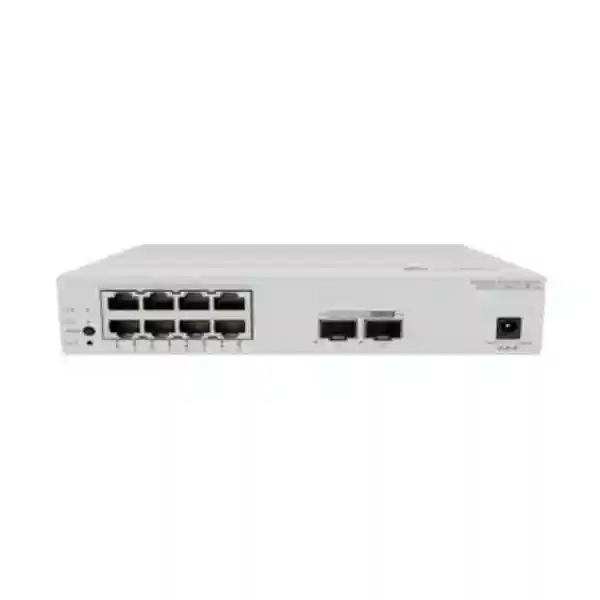
Huawei CloudEngine S5751-L24P2PN2X-RUA
The Huawei CloudEngine S5751-L24P2PN2X-RUA is designed for campus access environments that use Huawei remote-unit architecture to extend ports closer to users and powered endpoints. According to Huawei’s current CloudEngine S5751-L documentation, this model combines PoE+ access, two multi-rate copper interfaces that can reach 2.5GE, two 10GE SFP+ uplinks, a 400 W PoE budget, built-in AC power, 98 Gbps switching capacity, and 73.5 Mpps forwarding performance. For buyers, the practical question is not only whether the switch has enough ports; it is whether the complete design matches the intended Huawei central switch, optical or copper uplink plan, PoE demand, endpoint mix, rack or cabinet layout, and future expansion strategy.
Best suited to projects where a Huawei streamlined campus design, PoE+ endpoint access, multi-rate copper connectivity, and 10GE uplinks are being evaluated together. FourTeck can help translate a bill of materials into practical questions about switch role, central-switch compatibility, optics, cabling, power budget, installation, and regional procurement.
Verified Huawei specifications that matter before purchase
Huawei identifies the S5751-L series as 10GE-uplink remote-unit switches intended for simplified campus networking with compatible Huawei S5700/S6700-series central switches. For the Huawei CloudEngine S5751-L24P2PN2X-RUA, Huawei lists 98 Gbps switching capacity and 73.5 Mpps forwarding performance. The current brochure lists 24 10/100/1000BASE-T access interfaces, with 22 identified as PoE+, two 10/100/1000/2.5GBASE-T Combo PoE+ interfaces, two 10GE SFP+ uplinks, a 400 W PoE budget, and built-in AC power. These figures are useful for initial qualification, but they should be considered together with the exact topology, endpoint power draw, transceiver choice, software release, and the central switch planned for the deployment.
Huawei-listed switching capacity for this model.
Huawei-listed forwarding performance.
PoE budget stated in Huawei’s S5751-L brochure.
SFP+ uplinks for higher-speed upstream connectivity.
Why the remote-unit role is important
A remote-unit switch should not be selected as though it were simply an isolated 24-port access switch. Huawei positions the S5751-L family as part of a streamlined architecture in which remote units extend access from a compatible central-switch design. That affects how buyers should think about software, uplinks, optics, topology, management responsibility, fault isolation, and future growth. A quote request should therefore identify the planned central switch or existing Huawei campus platform rather than listing only the remote-unit model.
PoE planning comes before port counting
Twenty-plus powered endpoints can fit numerically while still exceeding a power budget if cameras, wireless access points, phones, sensors, or other devices have high peak demand. Buyers should record the maximum power requirement of each endpoint, reserve sensible headroom, and confirm whether any device needs a higher PoE class than this model supports. The 400 W figure is a system-planning input, not a promise that every connected device can draw its maximum simultaneously.
2.5GE and 10GE should solve a real bottleneck
The two multi-rate copper interfaces and two 10GE SFP+ uplinks are most valuable when the cabling, endpoint capability, and upstream design can use them. For example, a high-throughput access point may justify multi-gigabit copper, while aggregation traffic may justify 10GE fiber. Before procurement, verify cable category, distance, optical module type, fiber type, upstream port compatibility, and the expected traffic profile rather than assuming a faster port automatically improves the whole network.
Where FourTeck fits into the buying process
Customers researching the Huawei CloudEngine S5751-L24P2PN2X-RUA typically move from model identification to compatibility, then to bill-of-material validation, regional sourcing, deployment planning, and support expectations. FourTeck’s broader UAE IT and networking portfolio can help UAE buyers frame the switch as part of a complete access, cabling, wireless, security, and infrastructure requirement rather than as a standalone box. Regional projects can also reference the FourTeck Uganda technology site, FourTeck Kenya technology site, FourTeck Kuwait technology site, and FourTeck Africa regional technology site when project coordination spans multiple markets. The purpose of these links is to give buyers a relevant regional path without making unverified claims about local stock, warehouses, engineers, or delivery commitments.
Huawei CloudEngine S5751-L24P2PN2X-RUA selection guide
A strong procurement request should describe the network outcome as clearly as the product code. State how many powered and non-powered endpoints will connect, which devices need 2.5GE, what uplink speed and media are expected, whether the site already uses a compatible Huawei central switch, and whether the project is a new build, branch expansion, floor refresh, or replacement. Add cable distances, fiber type, rack or cabinet constraints, power availability, environmental requirements, preferred software release, and any maintenance or handover expectations. This prevents the common problem of obtaining a price for the correct model but an incomplete deployment.
For Wi-Fi projects, note the exact access-point models and their negotiated Ethernet rates. For surveillance, list camera models and maximum PoE demand, not only camera quantity. For hospitality or education, separate guest, staff, operational, and security traffic requirements so VLAN and uplink planning can be reviewed. For branch offices, indicate whether the remote unit will serve a single wiring zone or multiple functional areas. If the site already has Huawei switching, provide the central-switch model and software information so compatibility can be checked against current Huawei documentation before order placement.
Commercial questions should remain separate from technical facts. Price, lead time, stock status, warranty terms, installation scope, commissioning, transceivers, patch cords, racks, UPS capacity, cabling, and on-site services vary by quote and region. Ask for these explicitly. A technically accurate model page cannot substitute for a project-specific quotation, especially where a remote-unit design depends on the upstream Huawei architecture.
Regional buying guidance
Huawei CloudEngine S5751-L24P2PN2X-RUA Dubai
Buyers searching for the Huawei CloudEngine S5751-L24P2PN2X-RUA Dubai are usually trying to confirm more than a model number. In a Dubai project, the switch may sit inside an office tower, hotel, school, clinic, retail environment, warehouse, or mixed-use facility where floor-by-floor access, PoE endpoint density, fiber risers, and structured cabling are part of the same design. The S5751-L24P2PN2X-RUA is relevant where a Huawei remote-unit architecture is being considered and where powered edge devices need to be aggregated through a streamlined campus design. Before requesting a quote, document whether the switch is for a new deployment or an extension of an existing Huawei network, because the planned central switch and uplink architecture can affect the complete bill of materials.
For Dubai offices and commercial sites, PoE planning should start with the endpoints. Count wireless access points, IP phones, cameras, door controllers, sensors, or other powered devices, then record each device’s maximum power requirement. Compare that total with the Huawei-listed 400 W PoE budget and keep reasonable engineering headroom. The two copper interfaces capable of up to 2.5GE can be useful for selected higher-throughput endpoints, while the two 10GE SFP+ uplinks can support faster upstream connectivity when the central switch, optics, fiber type, and distance are compatible. Buyers should request the correct transceivers separately if they are not part of the quoted switch package.
Dubai procurement teams should also clarify rack position, patch-panel design, cable category, fiber termination, UPS sizing, labeling standards, and maintenance access. A switch that fits the logical topology can still create installation friction if the cabinet lacks power, cooling clearance, cable management, or an appropriate upstream path. If the project includes Wi-Fi, CCTV, IP telephony, and security segmentation, provide the complete endpoint schedule so VLAN and uplink requirements can be reviewed together. This is especially important in high-density environments where a few multi-gigabit devices can produce disproportionate upstream traffic.
When asking FourTeck for the Huawei CloudEngine S5751-L24P2PN2X-RUA in Dubai, include the quantity, central-switch model, required uplink media, desired optics, endpoint PoE schedule, project location, target installation window, and whether configuration or installation support is required. Ask the sales team to confirm current commercial details such as availability, lead time, warranty terms, accessories, and service scope in the formal quote. This keeps the purchasing decision tied to verified technical requirements while leaving time-sensitive commercial commitments to the quotation process.
Huawei CloudEngine S5751-L24P2PN2X-RUA UAE
A search for Huawei CloudEngine S5751-L24P2PN2X-RUA UAE often comes from organizations comparing a common switching standard across more than one emirate or branch. In that situation, consistency matters as much as the individual switch specification. A buyer may want the same remote-unit model in headquarters, branch offices, clinics, classrooms, hospitality spaces, or operational sites so endpoint connectivity and support procedures remain predictable. The model’s Huawei-listed 98 Gbps switching capacity, 73.5 Mpps forwarding performance, PoE+ access, two multi-rate copper interfaces, two 10GE SFP+ uplinks, and 400 W PoE budget make it a candidate for designs where the architecture and endpoint demand fit these capabilities.
For UAE-wide deployments, standardize the information collected from every site. Record endpoint count, powered-device load, Wi-Fi access-point type, camera type, uplink distance, fiber type, cabinet size, available electrical supply, UPS provision, and the Huawei central-switch model. This prevents a national purchase from being based on the assumption that every branch has identical infrastructure. One branch may have short multimode-fiber runs, another may need different optics, and a third may need cabling remediation before a 2.5GE endpoint can operate as intended. A common SKU is useful only when the surrounding site design is also understood.
Procurement teams should ask whether optics, rack accessories, patch cords, power protection, configuration, documentation, and commissioning are included or separate. They should also identify who owns the central-switch configuration and how remote units will be brought into service. Because Huawei positions the S5751-L series within a streamlined campus architecture, it is sensible to confirm compatibility against the current Huawei software and hardware documentation rather than treating the product as a generic unmanaged edge switch. If a site is being migrated from another topology, document the cutover sequence and any temporary coexistence requirements.
For a UAE quotation, specify whether the purchase is a single-site order, phased rollout, framework requirement, or expansion of an existing Huawei campus. Include the expected quantities by location and the target deployment dates, but rely on the formal quotation for current availability and lead time. FourTeck can use that information to discuss a more complete bill of materials and help separate confirmed manufacturer specifications from project-dependent items such as optics, support scope, installation, and commercial terms.
Huawei CloudEngine S5751-L24P2PN2X-RUA Uganda
Customers researching Huawei CloudEngine S5751-L24P2PN2X-RUA Uganda may be planning enterprise, education, hospitality, healthcare, government, NGO, retail, or multi-branch connectivity where a central switching platform needs to extend access closer to users. The strongest starting point is to confirm whether the proposed network actually follows the Huawei remote-unit architecture for which the S5751-L series is designed. Huawei describes these switches as remote units used with compatible Huawei S5700/S6700-series central switches. That means the upstream design, software compatibility, fiber path, and management approach should be identified before the device is purchased.
Uganda projects can span very different site conditions, so the bill of materials should be based on a site-specific survey or reliable infrastructure schedule. Record how many devices require PoE+, which devices may use the 2.5GE-capable copper interfaces, and whether the two 10GE SFP+ uplinks will use multimode fiber, single-mode fiber, or another supported media design. Confirm cable routes and distances before selecting optics. If the remote unit will power cameras, access points, or phones, calculate the maximum combined power rather than relying on average consumption. The Huawei-listed 400 W PoE budget should be checked against peak endpoint requirements with suitable spare capacity.
For Kampala headquarters and regional branches, buyers may also need a standardized template for racks, UPS systems, grounding, patch panels, labeling, spares, and documentation. In locations outside the primary data center, resilience can depend on practical details such as protected power, clean cabinet installation, correct fiber handling, and clear remote-support documentation. Those are project considerations rather than inherent switch features, but they strongly influence the success of the deployment. Where the network supports Wi-Fi, surveillance, voice, and business data together, define traffic separation and upstream capacity requirements in advance.
A useful Uganda quote request should list the switch quantity by city or site, Huawei central-switch model, desired uplink type, optics requirements, PoE endpoint schedule, rack and power needs, configuration scope, and whether installation or commissioning support is required. Current price, stock, delivery timing, warranty, and service coverage should be confirmed in the formal quotation rather than assumed from a product page. This produces a procurement decision based on validated architecture and current commercial information.
Huawei CloudEngine S5751-L24P2PN2X-RUA Kampala
For a Huawei CloudEngine S5751-L24P2PN2X-RUA Kampala requirement, the most common planning challenge is matching edge-device density to the building’s actual cabling and switching topology. Kampala offices, campuses, hotels, clinics, schools, retail environments, and institutional sites may have multiple floors or blocks with a central communications room and smaller distribution points. A remote-unit design can be attractive when the project is intentionally built around compatible Huawei central switching, but the design should be verified before procurement. The S5751-L24P2PN2X-RUA should be treated as a component in that architecture, not as an automatic substitute for every conventional access switch.
Start by mapping endpoints by floor or zone. Separate wireless access points, IP cameras, phones, access-control devices, user data ports, printers, and other networked equipment. Note which endpoints require PoE+ and which could benefit from 2.5GE. Then calculate the peak powered-device load against the 400 W PoE budget stated by Huawei. The two 10GE SFP+ uplinks can help carry aggregated traffic upstream, but only when the optical modules, fiber path, upstream ports, and configuration are compatible. Include these items in the design review so the purchase order does not omit essential transceivers or patching components.
Power continuity is another practical consideration. The switch has built-in AC power, so the site plan should identify protected electrical supply and appropriate UPS strategy where continuity is important. Cabinet space, grounding, patch-panel layout, fiber management, labeling, and physical security should also be documented. For business-critical Kampala sites, consider how an administrator will identify a failed endpoint, uplink, power event, or cabling fault and what documentation will be available to remote or on-site support teams. Good operational planning often contributes as much to serviceability as the switch specification itself.
When requesting a Kampala quotation, provide the central-switch model, current software environment if known, switch quantity, endpoint schedule, cable and fiber details, required optics, PoE calculation, cabinet and UPS requirements, and whether the project needs installation, configuration, testing, or handover documentation. Ask the supplier to confirm commercial terms, stock, lead time, warranty, and service scope in writing. This keeps the technical selection tied to Huawei documentation while allowing the quotation to reflect current Kampala project requirements.
Huawei CloudEngine S5751-L24P2PN2X-RUA Arua
A Huawei CloudEngine S5751-L24P2PN2X-RUA Arua project should be planned around site maintainability as well as port requirements. Organizations in Arua may be extending a main network into a branch, school, healthcare facility, hospitality property, office, NGO site, or operational location where technical resources and replacement logistics need to be considered in advance. If the wider organization already uses a compatible Huawei campus platform, a remote-unit approach may help standardize edge access, but the central-switch relationship and software compatibility should be checked against current Huawei documentation before the unit is ordered.
The local bill of materials should identify every powered endpoint and its maximum PoE requirement. This is especially important where the switch may supply surveillance cameras or wireless access points across a site. Huawei lists a 400 W PoE budget for the S5751-L24P2PN2X-RUA, yet the usable design still depends on the endpoint mix and appropriate power headroom. If high-throughput access points or other devices need more than 1GE, plan whether the two copper interfaces supporting up to 2.5GE are sufficient. If the upstream link will use 10GE fiber, confirm fiber type, distance, connector path, transceiver compatibility, and spare fibers.
Arua deployments benefit from careful documentation. Label ports, patch panels, cables, fiber cores, uplinks, UPS circuits, and connected endpoints so troubleshooting can be performed without guesswork. Keep a site diagram showing the central switch, remote unit, uplinks, VLAN intent, powered devices, and any critical dependencies. If the network supports cameras, voice, wireless, and data, document which services are operationally critical and how they should be restored after a fault. These steps do not change the switch specification, but they make support more predictable when assistance is being coordinated across locations.
For an Arua procurement request, include the precise quantity, project type, central-switch model, uplink plan, optics, endpoint list, PoE load estimate, cabinet and UPS requirements, and the preferred scope for configuration or installation. Do not assume online marketplace stock or delivery claims apply to the project. Request a current FourTeck quotation that states commercial terms, availability, warranty arrangements, accessories, and support scope. That approach provides a clearer basis for purchasing and reduces the risk of receiving the correct switch without the components required to deploy it.
Huawei CloudEngine S5751-L24P2PN2X-RUA Mbarara
Organizations evaluating the Huawei CloudEngine S5751-L24P2PN2X-RUA Mbarara may be upgrading a campus, branch, hospitality site, school, clinic, retail operation, office, or other facility where powered edge devices are increasing. A common reason to revisit the access layer is the growth of wireless and surveillance infrastructure. The S5751-L24P2PN2X-RUA brings PoE+ access, two multi-rate copper interfaces that can reach 2.5GE, and two 10GE SFP+ uplinks within Huawei’s remote-unit architecture. Those capabilities are useful only when they align with the central switching platform and the physical network already present at the site.
For Mbarara Wi-Fi refreshes, list the exact access-point models, their Ethernet interface speeds, and maximum power draw. A multi-gigabit port is most valuable when the access point and cabling can negotiate above 1GE and when upstream capacity is sufficient. For CCTV, record camera count, codec or traffic expectations where available, and maximum PoE demand. For IP telephony, note whether phones share desktop data connections and whether voice VLAN policies are already standardized. This device schedule should be reviewed together rather than as separate purchases because all services compete for switch resources and uplink capacity.
Physical infrastructure deserves equal attention. Confirm cabinet depth and access, patch-panel condition, fiber termination, power sockets, UPS capacity, grounding, cable category, and labeling. If the site uses long cable runs or older copper plant, test whether the existing cabling can support the desired link rates. If 10GE fiber is planned, choose optics based on the real distance and fiber type rather than buying transceivers by connector appearance alone. A complete quote should therefore cover the surrounding deployment components as well as the switch.
When contacting FourTeck for a Mbarara requirement, provide the central-switch information, switch quantity, endpoint schedule, PoE calculation, uplink design, optics, cabling status, rack and UPS needs, and expected implementation scope. Ask for current confirmation of availability, commercial terms, warranty, and any installation or configuration services. Avoid assuming that a global online price or delivery promise reflects the Mbarara project. A project-specific quotation is the right place to validate time-sensitive purchasing details.
Huawei CloudEngine S5751-L24P2PN2X-RUA Gulu
A Huawei CloudEngine S5751-L24P2PN2X-RUA Gulu requirement often benefits from a lifecycle view rather than a one-time hardware purchase. If the switch will serve a branch, institution, campus, healthcare environment, hospitality property, retail operation, or office, the buyer should consider how it will be installed, documented, monitored, supported, and eventually expanded. Huawei positions the S5751-L family as remote units within a streamlined campus architecture. The central-switch relationship is therefore a key qualification item, especially where a project is extending an existing Huawei environment rather than building a completely new access layer.
Gulu buyers should develop a clear endpoint and power schedule. Identify every camera, access point, phone, controller, or other device that needs PoE+, then record maximum power demand and expected network speed. Compare the aggregate requirement with the model’s Huawei-listed 400 W PoE budget. The two multi-rate copper interfaces may be reserved for devices that can genuinely use up to 2.5GE, while the remaining access interfaces serve standard Ethernet endpoints. The two 10GE SFP+ uplinks should be planned with the correct fiber and optics for the actual path back to the compatible upstream design.
For sites where technical visits may require coordination, invest in clear labeling and documentation from day one. The cabinet should show port identifiers, cable destinations, uplink paths, power sources, and connected critical devices. Maintain a basic network diagram and bill of materials, including optic models and spare components where the organization chooses to hold them. A remote troubleshooting session is far more efficient when local staff can identify the correct port or fiber using a consistent label rather than tracing cables under pressure.
A Gulu request for quotation should state whether the project is an expansion, replacement, or new site; list the central Huawei switch; specify the quantity of S5751-L24P2PN2X-RUA units; describe the PoE and 2.5GE endpoints; identify the 10GE uplink media; and define requirements for racks, UPS, optics, configuration, testing, and handover. Ask FourTeck to confirm current availability, pricing, lead time, warranty, and service terms in the quote. This separates stable technical facts from commercial conditions that can change over time.
Huawei CloudEngine S5751-L24P2PN2X-RUA Kenya
Buyers searching for Huawei CloudEngine S5751-L24P2PN2X-RUA Kenya may be standardizing access switching for corporate offices, education, hospitality, healthcare, retail, branch networks, or other distributed environments. The model belongs to Huawei’s CloudEngine S5751-L remote-unit family, so architecture should be confirmed before commercial comparison begins. Huawei describes the series as remote units paired with compatible S5700/S6700-series central switches for streamlined campus networking. If a Kenyan organization is extending an existing Huawei network, the central-switch model and software environment should be provided during technical review to confirm the intended relationship.
PoE and uplink design are the next major buying questions. Huawei lists a 400 W PoE budget, two copper interfaces capable of up to 2.5GE, and two 10GE SFP+ uplinks for the S5751-L24P2PN2X-RUA. Build an endpoint schedule that identifies access points, cameras, phones, controllers, or other powered devices, with maximum power draw and link speed. This reveals whether the PoE budget has adequate headroom and whether only two multi-gigabit copper interfaces are sufficient. For 10GE fiber, verify the upstream port, optic type, fiber type, connector path, and distance before selecting transceivers.
For projects spanning Nairobi and other Kenyan locations, use a standard site-data sheet. Capture rack capacity, UPS provision, electrical supply, grounding, patch-panel status, cable category, fiber availability, endpoint count, VLAN requirements, uplink path, and operational support expectations. Standardization reduces surprises when the same switch is deployed into buildings with different physical conditions. It also makes quotations easier to compare because required accessories and services are visible instead of hidden behind a single hardware line item.
When requesting the Huawei CloudEngine S5751-L24P2PN2X-RUA in Kenya, specify quantity by site, central-switch model, uplink design, optics, endpoint PoE schedule, rack and UPS needs, configuration scope, and expected commissioning or documentation. Use the formal quotation to confirm current price, stock, delivery timing, warranty, and service coverage. This is more reliable than assuming that marketplace availability or pricing in another country applies directly to a Kenyan project.
Huawei CloudEngine S5751-L24P2PN2X-RUA Kuwait
A Huawei CloudEngine S5751-L24P2PN2X-RUA Kuwait project should start with architectural fit, especially when the switch is intended for a corporate office, hospitality environment, healthcare facility, education campus, retail site, or distributed branch network. Huawei classifies the S5751-L family as remote-unit switches designed for use with compatible Huawei S5700/S6700-series central switches. A buyer should therefore identify the planned central switch and software environment before treating the model as a generic 24-port PoE switch. This matters for both new builds and expansions of an installed Huawei campus network.
Kuwait deployments frequently place strong emphasis on reliable indoor infrastructure, and the access-switch bill of materials should include more than the chassis. Confirm cabinet location, protected AC power, UPS strategy, structured cabling, patching, grounding, fiber routing, and any spare-fiber requirements. For PoE, calculate the peak demand of access points, cameras, phones, and other powered devices against Huawei’s listed 400 W budget. If the project has high-performance Wi-Fi or other multi-gigabit endpoints, decide deliberately which two devices will use the 2.5GE-capable copper interfaces and confirm that the cabling supports the desired rates.
The two 10GE SFP+ uplinks can support higher-speed aggregation, but optics must be selected according to the real fiber type and distance. Provide the upstream-switch port information to reduce compatibility ambiguity. For organizations with multiple Kuwait sites, document a repeatable template covering VLANs, port profiles, endpoint naming, cable labels, optic types, UPS capacity, and handover records. Consistent documentation simplifies future changes and helps support teams distinguish switch faults from cabling, endpoint, optic, or power problems.
A Kuwait request for quotation should include switch quantity, central-switch model, uplink type, optics, endpoint schedule, PoE calculation, installation location, rack and power requirements, and any need for configuration, testing, or commissioning. Ask FourTeck to confirm current stock, lead time, pricing, warranty terms, accessories, and service scope in writing. These items are time-sensitive and should not be inferred from a static product description. A complete quote gives the procurement team a clearer view of total deployment requirements rather than just the device price.
Huawei CloudEngine S5751-L24P2PN2X-RUA Ghana
Customers researching Huawei CloudEngine S5751-L24P2PN2X-RUA Ghana may be planning access networks for business offices, campuses, education, healthcare, hospitality, retail, branch operations, or multi-site organizations. The first technical check is whether the project is intended to use Huawei’s streamlined remote-unit architecture. Huawei positions the S5751-L series as remote units associated with compatible S5700/S6700-series central switches. Buyers should identify the central switching platform before order placement so the remote unit, uplink strategy, software, and management approach can be reviewed as one design rather than as separate equipment.
For Ghana sites, create a structured endpoint schedule. List every access point, camera, IP phone, access controller, and other PoE device with its peak power draw and required Ethernet speed. The S5751-L24P2PN2X-RUA has a Huawei-listed 400 W PoE budget and two copper interfaces that can reach 2.5GE, so this schedule helps determine whether power headroom is sufficient and which endpoints should receive multi-gigabit access. The two 10GE SFP+ uplinks should then be matched to the correct optics and fiber path, including real distance and upstream-port compatibility.
A multi-site Ghana rollout should not assume every building has the same cabling or power quality. Collect rack dimensions, UPS information, cable category, patch-panel condition, grounding, fiber type, spare cores, and environmental constraints at each site. Where support may be coordinated remotely, consistent port and cable labels can reduce troubleshooting time. Keep a diagram showing how the remote unit connects to the central switch and which services depend on each uplink. If the switch is serving business data, voice, surveillance, and Wi-Fi, document traffic-segmentation requirements and expected uplink load.
A Ghana quote request should state quantity, project locations, central Huawei switch, uplink media, required optics, endpoint and PoE schedule, rack and UPS needs, configuration scope, and any installation or commissioning requirement. Current availability, commercial pricing, delivery timing, warranty, and service coverage should be confirmed in the supplier’s formal quote. This avoids copying commercial claims from unrelated markets and keeps the purchase anchored to the actual Ghana project.
Huawei CloudEngine S5751-L24P2PN2X-RUA Nigeria
A Huawei CloudEngine S5751-L24P2PN2X-RUA Nigeria requirement can range from a single office refresh to a distributed enterprise, education, hospitality, healthcare, retail, financial, or operational network. The scale of the country makes standardized design documentation particularly valuable for organizations with multiple sites. The S5751-L24P2PN2X-RUA is part of Huawei’s remote-unit family, and Huawei describes the series as working with compatible S5700/S6700-series central switches in a streamlined campus architecture. The central-switch platform should therefore be identified before technical and commercial approval.
For Nigerian branch networks, build a repeatable worksheet covering powered endpoint count, maximum PoE draw, device link speeds, uplink distance, fiber type, rack size, power source, UPS, patch panels, cable category, grounding, and local support contacts. Compare the powered-device total with the 400 W PoE budget stated by Huawei. Reserve the two 2.5GE-capable copper interfaces for devices that can use the extra bandwidth. Plan the two 10GE SFP+ uplinks around actual traffic and physical media rather than selecting optics after the hardware has already shipped.
Operational resilience should be part of the design. Where a site supports transaction systems, business applications, Wi-Fi, voice, or video surveillance, document which endpoints and uplinks are critical and how a fault will be isolated. Clear labels and as-built diagrams help central IT teams coordinate with local staff. If a deployment is phased across cities, use a common naming standard for ports, VLANs, optics, racks, and device roles. This does not remove site differences, but it creates a predictable baseline for support and future expansion.
For a Nigeria quotation, specify quantity by location, central-switch details, software context if known, endpoint schedule, PoE calculation, uplink media, optics, rack and UPS needs, and whether supply only, configuration, installation, testing, or documentation is required. Ask FourTeck to confirm current pricing, availability, lead time, warranty, and service scope in writing. Do not assume prices or stock displayed by overseas marketplaces translate directly to a Nigerian enterprise procurement. The formal quote should define both the hardware and the surrounding deployment responsibilities.
Huawei CloudEngine S5751-L24P2PN2X-RUA Seychelles
A Huawei CloudEngine S5751-L24P2PN2X-RUA Seychelles deployment may be considered for hospitality, corporate, education, healthcare, government, retail, or other island-based facilities where the access network must be planned carefully around building layout and logistics. The model belongs to Huawei’s CloudEngine S5751-L remote-unit family, and Huawei positions these devices within a streamlined campus design using compatible S5700/S6700-series central switches. Before procurement, confirm that the planned network follows this architecture and that the upstream switch, software, optics, and fiber path are suitable for the remote unit.
For hotels, resorts, offices, and institutional sites, powered endpoints can include Wi-Fi access points, cameras, phones, access-control devices, and operational sensors. Record maximum PoE demand for every endpoint and compare the total with the Huawei-listed 400 W PoE budget. Identify whether any high-throughput wireless device needs one of the two copper interfaces capable of up to 2.5GE. The two 10GE SFP+ uplinks can provide higher upstream capacity, but the transceivers must match the actual fiber type and distance. Where spare parts or additional optics may take time to procure, buyers may choose to plan spares as a separate commercial decision.
Island deployments also benefit from strong installation records. Document rack layout, UPS capacity, circuit source, grounding, patch panels, fiber cores, optic models, cable labels, VLAN purpose, and endpoint assignments. This makes remote support more effective and helps local staff identify the correct component during troubleshooting. For hospitality environments in particular, guest Wi-Fi, staff systems, surveillance, and operational services may share the physical switching platform while requiring distinct logical segmentation and performance planning. Define those requirements before the configuration stage.
A Seychelles quote request should include the destination site, quantity, central Huawei switch, endpoint and PoE schedule, uplink media, optics, rack and UPS requirements, and whether the requirement includes configuration, installation, testing, or handover documentation. Ask for current confirmation of stock, lead time, pricing, warranty, shipping terms, and service scope in the formal quotation. That is the appropriate place to capture logistics-sensitive commitments while the product page remains focused on stable, verified technical information and sound buying guidance.
Frequently asked questions
Is the S5751-L24P2PN2X-RUA a normal standalone access switch?
Huawei presents the S5751-L family as remote-unit switches used in a streamlined campus architecture with compatible Huawei S5700/S6700-series central switches. Buyers should therefore confirm the intended central-switch relationship and current compatibility documentation before procurement.
What is the PoE budget?
Huawei’s S5751-L brochure lists a 400 W PoE budget for the S5751-L24P2PN2X-RUA. A deployment should still calculate the maximum combined power draw of all planned endpoints and retain appropriate design headroom.
Does it support 2.5GE?
Huawei lists two 10/100/1000/2.5GBASE-T Combo PoE+ interfaces on this model. Confirm endpoint capability and cable quality before expecting a device to negotiate at 2.5GE.
What are the uplinks?
Huawei lists two 100M/1/2.5/10GE SFP+ uplink ports for the S5751-L24P2PN2X-RUA. The correct optic depends on the upstream port, fiber type, distance, and supported transceiver options for the deployment.
What should be sent with a quote request?
Send quantity, location, central-switch model, endpoint schedule, PoE load estimate, uplink media and distance, optic requirements, rack and UPS details, software context if known, and the required supply, configuration, installation, or commissioning scope.
Can price and stock be confirmed from this page?
No static page should be treated as confirmation of current stock, price, warranty, delivery, or project services. Ask FourTeck for a formal quotation that reflects the destination, quantity, accessories, and current commercial conditions.
Decision recap
The Huawei CloudEngine S5751-L24P2PN2X-RUA is a strong candidate when the project specifically calls for a Huawei remote-unit access design with PoE+, selected 2.5GE copper access, and 10GE SFP+ uplinks. Its suitability depends on more than port count: confirm the central-switch architecture, software compatibility, endpoint power needs, uplink optics, cabling, rack and power design, and operational support model. The verified Huawei figures provide the technical baseline; the final procurement decision should be based on a project-specific bill of materials and current quotation.
The network is intentionally designed around compatible Huawei central switching and requires the model’s combination of PoE+, multi-rate access, and 10GE uplinks.
Central-switch compatibility, software release, optics, fiber distance, endpoint link rates, cable category, and peak PoE draw.
Current price, stock, lead time, warranty, accessories, shipping, installation, configuration, and regional service scope.
Quotation checklist
To receive a more useful commercial response, send the information below with the inquiry. A complete request reduces back-and-forth and helps distinguish the switch itself from the optics, power, cabling, and service items that may be required around it.
Talk to FourTeck about the complete access design
A well-specified Huawei CloudEngine S5751-L24P2PN2X-RUA project should arrive at procurement with its central-switch relationship, PoE schedule, uplink optics, cabling, power, rack, and service scope already understood. Send those details to FourTeck for a project-specific review and quotation. The sales response can then confirm current commercial terms and identify any additional components required for a deployable solution.

Reviews
There are no reviews yet.