
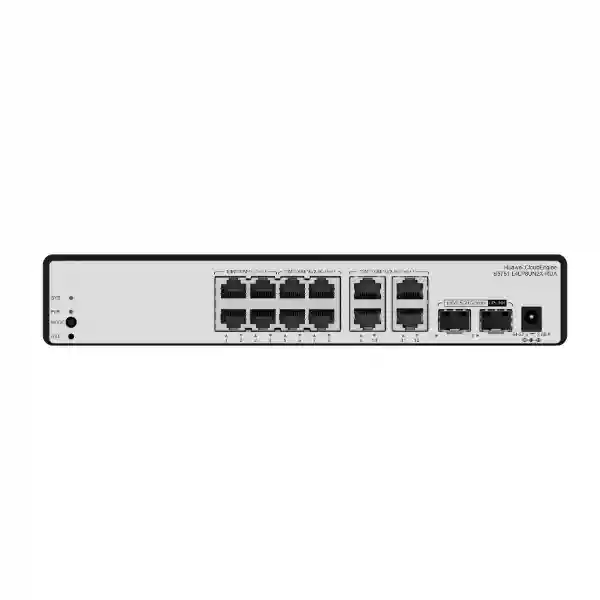
Huawei CloudEngine S5751-L4LP8UN2X-RUA
Huawei CloudEngine S5751-L4LP8UN2X-RUA is a compact remote-unit switch for simplified campus access designs where organizations want high-speed copper access, PoE for edge devices and fiber uplinks back to a compatible Huawei central switch. Huawei lists 66 Mpps forwarding performance, 98 Gbps switching capacity, two SFP+ uplinks supporting up to 10GE, four Gigabit PoE+ downlinks and eight 10/100/1000/2.5G copper downlinks, including four PoE+ and four PoE++ ports. The model uses an external power adapter and is documented as fanless, making it relevant to office, education, hospitality and healthcare access deployments where compact placement and quiet operation can matter.
Forwarding: 66 Mpps
Switching capacity: 98 Gbps
Uplinks: 2 × 100M/1/2.5/10GE SFP+
PoE: PoE+ / PoE++
Form: Compact, fanless remote unit
What the S5751-L4LP8UN2X-RUA is designed to do
This model belongs to Huawei’s CloudEngine S5751-L remote-unit family. In Huawei’s simplified campus architecture, a remote unit is not treated as an isolated switch that must be planned and operated in the same way as a conventional standalone access switch. It acts as a port-expansion element for a compatible central switch, allowing the central device to provide unified management to remote access points in the network. That architectural role should be confirmed before purchase because the central-switch model, software release, optics, fiber path, PoE demand and physical placement all influence whether the design is appropriate.
The port mix is aimed at modern edge requirements. Four 10/100/1000BASE-T ports support PoE+, while eight additional copper ports support 10/100/1000/2.5G access; within those eight, four are PoE+ and four are PoE++. Two SFP+ uplinks support 100M, 1GE, 2.5GE and 10GE rates. This gives network designers a useful combination for Wi-Fi access points, IP cameras, IP phones, workstations and other Ethernet endpoints while preserving higher-speed fiber connectivity toward the central switch.
Buyers should treat the published performance and port specifications as design inputs rather than a complete bill of materials. Transceivers, fiber type, central-switch compatibility, power adapter, cabling category, endpoint PoE classes, mounting location and operational software requirements should be checked against the intended deployment. FourTeck can help turn those requirements into a clearer quotation scope without assuming stock, price, delivery time or warranty terms until they are confirmed for the actual order.
Verified technical profile
Access ports
4 × 10/100/1000BASE-T PoE+ ports plus 8 × 10/100/1000/2.5GBASE-T ports, of which four support PoE+ and four support PoE++.
Fiber uplinks
2 × SFP+ uplink ports supporting 100M, 1GE, 2.5GE and 10GE rates for flexible optical connectivity to the upstream design.
Performance
Huawei publishes 66 Mpps forwarding performance and 98 Gbps switching capacity for the S5751-L4LP8UN2X-RUA.
Power and acoustics
The model uses a power adapter. Huawei’s current brochure describes a 128 W PoE configuration and fanless natural heat dissipation for this model.
Physical dimensions
Huawei lists 43.6 × 250 × 180 mm without packaging, with a weight of approximately 2.02 kg, and desk or wall mounting.
Environment
Huawei documents an operating range of -5°C to +45°C and 5% to 95% non-condensing relative humidity for the model.
Compatibility comes before quotation
The S5751-L4LP8UN2X-RUA is part of a simplified Huawei campus architecture. Before ordering, confirm the intended central switch and software release, uplink optics, fiber distances, PoE endpoint requirements and whether the remote-unit operating model matches your network standards. Huawei states that supported CloudEngine central-switch families can work with remote modules when running suitable software versions. The exact combination should be validated against the current Huawei compatibility information for the project rather than inferred from a product family name alone.
Where this model can fit
In an office, the combination of Gigabit and 2.5G downlinks can support a mix of user devices, phones, cameras and newer wireless access points. In education, remote units can help distribute access ports to classrooms, laboratories, libraries and administrative spaces while keeping control concentrated at the central switch. In hotels, the compact design can suit floor or zone distribution where guest Wi-Fi, IP phones, cameras and back-office devices need structured Ethernet access. In healthcare, the same architecture can support distributed endpoints while maintaining centralized management principles, subject to the organization’s security and change-control requirements.
The model is especially relevant when a project needs multi-gigabit copper access and PoE++ in a compact remote location but wants to avoid creating many independently managed access switches. It is not automatically the correct choice for every branch or standalone site. Buyers who require a conventional autonomous switch, specific local management behavior, a different PoE budget or a different port density should compare the design requirement before locking the bill of materials.
Huawei CloudEngine S5751-L4LP8UN2X-RUA Dubai
Customers searching for Huawei CloudEngine S5751-L4LP8UN2X-RUA Dubai are commonly trying to solve a campus access requirement rather than simply buy another Ethernet switch. Dubai offices, hotels, schools, clinics, retail spaces and mixed-use facilities frequently combine Wi-Fi access points, IP telephony, CCTV and user endpoints in the same structured cabling environment. In that context, the model’s eight multi-gigabit copper ports and PoE++ capability can be important where newer Wi-Fi access points or other powered devices need more than a basic Gigabit PoE connection. The two SFP+ uplinks add flexibility for fiber-based distribution, while the remote-unit architecture can reduce the number of independently managed devices when deployed with a compatible Huawei central switch.
For a Dubai project, procurement should start with the network drawing and endpoint schedule. Count the powered devices, note their PoE class, identify which endpoints actually need 2.5G access, and confirm the expected fiber path back to the central switch. The S5751-L4LP8UN2X-RUA has a published 128 W PoE configuration, so the project should not be sized by port count alone. A set of high-power access points can consume a PoE budget differently from phones or cameras. The switch location also matters: although Huawei documents fanless operation and an operating temperature range up to 45°C, equipment should still be installed in a suitable ventilated indoor environment with appropriate power protection and structured cabling practices.
Dubai buyers may also need to coordinate the switch with firewalls, WAN routers, wireless controllers or campus management systems. FourTeck’s broader UAE enterprise IT and networking resources can help procurement teams frame the switch as part of the complete network rather than as an isolated line item. When asking for a Huawei CloudEngine S5751-L4LP8UN2X-RUA Dubai quote, include quantity, central-switch model, software version if known, optics requirement, fiber type, endpoint list, PoE demand, installation location and whether configuration or deployment assistance is required.
Huawei CloudEngine S5751-L4LP8UN2X-RUA UAE
For UAE organizations comparing the Huawei CloudEngine S5751-L4LP8UN2X-RUA, the strongest use case is a distributed campus access design where centralized operation, fiber uplinks, multi-gigabit copper and PoE must work together. A corporate office in Abu Dhabi, a school in Sharjah, a hospitality property in Ras Al Khaimah or a warehouse in Ajman may have very different endpoint mixes, yet each can benefit from planning around port speed, power, fiber reach and centralized network control. The product’s four Gigabit PoE+ ports and eight multi-gigabit ports provide twelve powered-access opportunities across different PoE capabilities, but the total PoE budget still needs to be checked against the actual devices being connected.
UAE procurement teams should verify more than the model string. Confirm the central CloudEngine switch that will manage the remote unit, the software version on the central platform, the type and distance of the fiber uplink, SFP/SFP+ compatibility, power adapter requirements and the installation environment. If the project includes Wi-Fi 6 or Wi-Fi 7 access points, determine whether 2.5G and PoE++ are needed at every location or only selected points. If the project includes IP cameras or phones, separate those loads from the higher-power wireless endpoints. This produces a clearer PoE design and prevents overestimating what can be powered simultaneously.
The UAE market also includes organizations with multiple branches and mixed network brands. In those environments, the S5751-L remote-unit approach should be assessed against existing operational standards, monitoring tools and change procedures. A remote unit designed around Huawei’s simplified architecture may be valuable when the central campus is already aligned with compatible Huawei switching, while a conventional standalone switch may be better in a site that needs autonomous operation. FourTeck can review those practical constraints before quotation. Share the bill of materials, branch count, existing switch family, uplink topology, PoE endpoint schedule and any migration requirements so the commercial request reflects the actual UAE deployment rather than only the product name.
Huawei CloudEngine S5751-L4LP8UN2X-RUA Uganda
Organizations searching for Huawei CloudEngine S5751-L4LP8UN2X-RUA Uganda may be planning new office networks, school campuses, healthcare facilities, hospitality sites or multi-building business environments. The remote-unit design can be useful where access ports are needed closer to users and devices but the organization wants centralized switching control. In a Uganda deployment, the planning conversation should begin with site topology: identify the main equipment location, remote floors or buildings, fiber routes, endpoint density and the type of powered devices at each access zone. This is more useful than selecting the model only because it offers PoE and 10GE-capable uplinks.
The S5751-L4LP8UN2X-RUA offers four Gigabit PoE+ ports, eight multi-gigabit ports with a mix of PoE+ and PoE++, and two SFP+ uplinks. That combination can support wireless access points, IP phones, cameras and wired clients, but deployment teams should calculate the 128 W published PoE configuration against the real load. A high-power wireless AP and a phone have different power requirements; a camera may also need additional budget for heaters, illumination or pan-tilt-zoom functions depending on its design. The safest approach is to collect device model numbers and PoE classes before deciding how many endpoints each remote unit will power.
For projects spanning Kampala and regional towns, resilience and maintenance logistics can be as important as headline speed. Document fiber type, spare uplink components, power conditioning, central-switch software and replacement procedures. Huawei describes remote units as centrally managed port expansion, so operations staff should understand how replacement, version alignment and monitoring are handled through the central switch. Buyers can use FourTeck Uganda technology resources to frame networking requirements locally. When requesting a Uganda quotation, include quantity, city or site, central switch, optics, cabling, PoE device list and installation scope so the request can be reviewed accurately.
Huawei CloudEngine S5751-L4LP8UN2X-RUA Kampala
A Huawei CloudEngine S5751-L4LP8UN2X-RUA Kampala requirement often begins with a dense office, education, hospitality or institutional access network where many edge devices need both Ethernet and power. Kampala projects can include multi-floor buildings, mixed old and new cabling, centralized server rooms and growing Wi-Fi demand. The S5751-L4LP8UN2X-RUA can be considered when the design already uses, or is being planned around, a compatible Huawei central switch. Its remote-unit role lets the network distribute access ports nearer to endpoint clusters while keeping management concentrated upstream.
The most important Kampala sizing question is not simply whether twelve copper access ports are enough. Determine how many endpoints need 2.5G, how many require PoE++, how many need only Gigabit PoE+, and how much total power they can draw. Four of the multi-gigabit ports support PoE++, which can be useful for higher-power access points, while the other PoE+ ports can serve phones, cameras or standard wireless devices. The published PoE configuration is finite, so assigning every port as if it can simultaneously provide maximum power would be poor planning. A port-and-power matrix makes the procurement decision much clearer.
Kampala sites should also review fiber routes between the central switch and remote units. Confirm whether the building uses single-mode or multimode fiber, the required optical distance, connector type and approved transceivers. If the project is a retrofit, inspect pathway capacity and cabinet locations rather than assuming the remote unit can be placed wherever convenient. Its fanless design can suit quiet occupied areas, but equipment still needs secure mounting, ventilation, protected power and service access. For quotation, provide the exact building or project context, current Huawei central-switch model, number of remote units, optics, endpoint schedule and whether migration from an existing switch fabric is required. That level of detail helps a Kampala buyer avoid a quote that omits essential deployment components.
Huawei CloudEngine S5751-L4LP8UN2X-RUA Arua
For an Arua deployment, the Huawei CloudEngine S5751-L4LP8UN2X-RUA can be relevant to organizations that need structured access networking across offices, schools, healthcare locations, hospitality buildings or operational sites with distributed endpoint clusters. The model’s remote-unit architecture can reduce the number of separately managed access devices, but only when the upstream Huawei campus design supports it. Arua buyers should therefore begin by identifying the central-switch platform and software, not by ordering the remote unit in isolation. This prevents a common procurement gap in which a device’s physical ports match the need but its operating architecture does not match the existing network.
The practical value of this model is its mix of Gigabit and 2.5G copper with PoE+ and PoE++. An Arua site upgrading wireless coverage may need selected 2.5G links for newer access points while retaining ordinary Gigabit connectivity for phones, cameras, printers or desktop devices. The two SFP+ uplinks can support fiber-based distribution, which is useful where remote equipment areas are separated from the main network room. For each location, document fiber distance, optics, patching, power availability and how the remote unit will be mounted. Huawei lists desk or wall mounting, so the physical plan can be flexible without implying that any uncontrolled environment is suitable.
Power continuity deserves particular attention where the switch is feeding communications or security endpoints. The PoE budget should be mapped device by device, and the local power adapter should be included in the power-protection strategy. If the connected access points, cameras or phones are business-critical, consider how UPS capacity, replacement spares and fault isolation will be handled as part of the wider project. Because the device is fanless, routine dust management and clean airflow around the enclosure are still sensible operational practices. When requesting an Arua quote, share quantities, central-switch details, endpoint models, PoE classes, fiber type, desired uplink speed and any installation or configuration requirement so the procurement discussion covers the complete solution.
Huawei CloudEngine S5751-L4LP8UN2X-RUA Mbarara
Mbarara organizations considering the Huawei CloudEngine S5751-L4LP8UN2X-RUA may be working on campus upgrades, new business premises, educational networks, healthcare connectivity or hospitality infrastructure. The device’s combination of multi-gigabit access and PoE can help consolidate edge connectivity for wireless APs, cameras, phones and user devices, while its SFP+ uplinks provide a fiber path toward a compatible central switch. The procurement decision should be linked to a simplified campus design, because Huawei positions the S5751-L family as remote units controlled through the central switching layer.
For a Mbarara project, prepare two schedules before requesting pricing: a port schedule and a power schedule. The port schedule should identify which endpoints need Gigabit, which need 2.5G and which require PoE++. The power schedule should list the maximum PoE demand of each connected device and compare the total against the remote unit’s available PoE configuration. This is particularly useful in Wi-Fi refresh projects where a new access point may negotiate multi-gigabit Ethernet and draw more power than the older AP it replaces. It also prevents spare ports from being treated as spare power capacity when the total budget is already heavily allocated.
The fiber and operational design is equally important. Verify the distance from the central network room to each remote unit, the optical module type, fiber core availability, patching standard and the intended uplink rate. If multiple buildings are involved, document the pathway and grounding practices around the wider cabling infrastructure. If the project must remain maintainable by a small IT team, plan naming, documentation, monitoring and replacement procedures around Huawei’s centralized remote-unit workflow. A well-prepared Mbarara quotation request should include central-switch model and software, SFP/SFP+ requirements, remote-unit quantity, endpoint list, installation location and support scope. That produces a more useful commercial response than asking for a unit price without context.
Huawei CloudEngine S5751-L4LP8UN2X-RUA Gulu
A Huawei CloudEngine S5751-L4LP8UN2X-RUA Gulu project may involve a compact access layer for offices, schools, clinics, hotels or multi-building organizations that need centralized control and fiber-connected edge ports. The model is attractive when some endpoints require ordinary Gigabit PoE while others require 2.5G and PoE++. That mixed profile can reduce the need to install different access-switch types for different endpoint classes, but the total design still has to respect the PoE budget, central-switch compatibility and Huawei’s remote-unit architecture.
In Gulu, start by mapping where powered devices will actually be located. A classroom block may prioritize Wi-Fi APs and phones, a healthcare area may combine wireless with cameras and administrative terminals, and a hotel floor may have APs, phones, cameras and back-office devices. The S5751-L4LP8UN2X-RUA gives twelve copper access ports across Gigabit and multi-gigabit capabilities, but only four of the multi-gigabit ports provide PoE++. If a project needs more high-power endpoints than that in one zone, the architecture should be adjusted instead of assuming all ports are equivalent. Similarly, the 128 W published PoE configuration should be checked against maximum endpoint draw.
The uplink plan should include the two SFP+ ports, desired line rate, approved optical modules and the fiber path back to the central switch. Confirm the central platform’s supported software release before procurement. Operationally, keep a record of remote-unit location, connected endpoint, cable label, PoE class and upstream fiber connection. This makes future troubleshooting far faster, especially when several remote units are deployed across a campus. Gulu buyers should also state whether they need hardware supply only or assistance with design review, configuration and deployment planning. A detailed request allows FourTeck to discuss the correct scope without making assumptions about local inventory, lead time or warranty terms.
Huawei CloudEngine S5751-L4LP8UN2X-RUA Kenya
Kenya buyers looking for the Huawei CloudEngine S5751-L4LP8UN2X-RUA are often dealing with an access-network refresh in a corporate campus, university, hospital, hotel, retail operation or distributed business environment. The model supports a useful mix of 1G and 2.5G copper access, PoE+ and PoE++, plus two SFP+ uplinks capable of 10GE. Those capabilities can help when an organization is moving to higher-performance wireless while still supporting conventional phones, cameras and user devices. However, the S5751-L family is intended to operate as a remote unit in Huawei’s simplified campus architecture, so the central switch and software relationship should be confirmed before the unit is treated as a normal standalone access switch.
For Kenya projects, especially those spanning Nairobi and other locations, standardization can be as important as individual device performance. Decide whether remote units will be used across every site or only at larger campuses where a central-switch architecture makes sense. Record the required uplink distance and fiber type, the number of 2.5G endpoints, the PoE class of each powered device and expected growth. The model’s 128 W published PoE configuration must be planned across all connected powered devices; a few high-power APs can change the available headroom for cameras or phones even when copper ports remain unused.
Procurement teams can review broader local technology context through FourTeck Kenya. For the switch quotation itself, send the exact model, quantity, central-switch model, software release if known, optics requirements, fiber distances, endpoint models and whether installation or configuration support is part of the scope. If the project is migrating from another brand, include the current VLAN design, uplink topology and management requirements. This gives the technical review enough information to identify dependencies before commercial terms are finalized and helps avoid a quotation that includes the remote unit but omits transceivers, power planning or central-switch compatibility.
Huawei CloudEngine S5751-L4LP8UN2X-RUA Kuwait
A Huawei CloudEngine S5751-L4LP8UN2X-RUA Kuwait requirement can fit office towers, education, hospitality, healthcare and enterprise campuses where high-density wireless and powered edge devices need structured access. The device combines fanless operation with multi-gigabit copper, PoE+/PoE++ and 10GE-capable SFP+ uplinks. For occupied areas where acoustic noise is a concern, the fanless design may be useful, but thermal planning still matters. Equipment should be placed in an appropriate indoor environment with airflow, protected power and accessible cabling rather than hidden in an unsuitable enclosure simply because no fan is present.
Kuwait buyers should evaluate the remote unit as part of a complete campus topology. The central Huawei switch and software need to support the intended remote-unit design. The fiber path between central and remote equipment should be confirmed for distance, transceiver type, connector format and desired speed. At the edge, list Wi-Fi APs, IP phones, cameras and other PoE devices together with their maximum power requirements. The S5751-L4LP8UN2X-RUA provides a published 128 W PoE configuration, so simultaneous power draw—not just port availability—determines how many endpoints can be supported safely with headroom.
For procurement planning, FourTeck Kuwait provides local business IT context covering networking and related infrastructure. A useful quote request should specify quantity, delivery area, project type, central switch, optics, fiber length, endpoint models, PoE load and any required configuration or deployment assistance. If the switch is part of a new Wi-Fi rollout, include the access-point model and count. If it is a replacement, include the existing access switch and uplink design. This allows compatibility and scope to be reviewed before availability, lead time, warranty and commercial terms are confirmed for the actual Kuwait order.
Huawei CloudEngine S5751-L4LP8UN2X-RUA Ghana
Ghana organizations considering the Huawei CloudEngine S5751-L4LP8UN2X-RUA may be building or modernizing access networks for offices, universities, hospitals, hotels, retail facilities or multi-building operations. Its strongest technical appeal is the combination of multi-gigabit copper ports, several PoE capability levels and fiber uplinks in a compact remote-unit platform. That can be useful where wireless access points are becoming faster and more power-hungry while phones, cameras and traditional wired devices still need dependable Gigabit connectivity.
The design should begin with the campus architecture. Huawei positions the S5751-L family as remote units managed through a compatible central switch, so Ghana buyers should verify that the existing or proposed upstream CloudEngine platform and software release support the intended deployment. Next, build a port map. Mark every endpoint that needs 2.5G, every endpoint that requires PoE++ and all devices that can operate on standard PoE+. Then calculate the total expected power draw against the published PoE configuration. This avoids the common mistake of counting twelve copper ports and assuming twelve maximum-power devices can be connected simultaneously.
Where sites are connected by fiber, verify whether single-mode or multimode optics are required and document the physical route, patch panels and spare cores. Centralized architecture can simplify operations, but good labeling and maintenance documentation remain essential. Organizations planning multi-country or West African infrastructure can review FourTeck Africa for broader technology context. When requesting a Ghana quote, include the exact switch model, quantity, central-switch details, optics, endpoint list, PoE classes, installation location and project timescale. Commercial details such as stock, delivery and warranty should then be confirmed against the specific sourcing requirement rather than assumed from a generic product description.
Huawei CloudEngine S5751-L4LP8UN2X-RUA Nigeria
Nigeria buyers searching for Huawei CloudEngine S5751-L4LP8UN2X-RUA may be evaluating access switching for large offices, universities, healthcare groups, hospitality facilities, financial-service environments, industrial sites or other campuses with significant Wi-Fi and PoE requirements. The model provides a mix of 1G and 2.5G copper ports, multiple PoE classes and dual SFP+ uplinks. That makes it useful when a site needs to support high-performance wireless APs alongside phones, cameras and user endpoints without moving every copper port to a more expensive speed class.
The device should be assessed in the context of Huawei’s simplified campus architecture. A central switch manages the remote unit, so central-platform compatibility and software version are core procurement checks. For multi-floor or multi-building Nigerian projects, the fiber topology deserves equal attention. Record the distance between the central switch and each remote unit, the required optical speed, fiber type and spare capacity. If the design will use both SFP+ uplinks, state whether this is for redundancy, aggregation or another supported topology and verify the implementation against current Huawei guidance.
Power planning is especially important in wireless-heavy deployments. Four of the multi-gigabit ports support PoE++, while other powered ports support PoE+. The total published PoE configuration must be distributed across all active powered endpoints. List each access point, camera or phone by model and maximum PoE requirement before finalizing the switch count. Also plan UPS capacity and protected power for the external adapter if the connected services require continuity during local power interruptions. A complete Nigeria quotation request should include quantity, site city, central switch, software level, optics, fiber distances, endpoint models, PoE load, mounting requirement and support scope. This allows a technically grounded quotation without unsupported assumptions about immediate stock or delivery.
Huawei CloudEngine S5751-L4LP8UN2X-RUA Seychelles
A Huawei CloudEngine S5751-L4LP8UN2X-RUA Seychelles project can be relevant to hospitality, government, education, healthcare and business networks where access devices are distributed across rooms, floors or buildings and fiber is used to reach remote network zones. Hotels and resorts in particular may combine high-density Wi-Fi, IP phones, surveillance and back-office devices in the same property. The model’s 2.5G copper capability and PoE++ ports can help support newer wireless access points, while the Gigabit PoE+ ports can serve lower-bandwidth powered endpoints. Two SFP+ uplinks provide a flexible optical path to the central switching layer.
Seychelles procurement should pay close attention to spares, compatibility and the completeness of the bill of materials. A remote unit should not be ordered without confirming the central Huawei switch, software support, correct optics, fiber type and power adapter requirement. If the site is on a separate island or has limited maintenance access, identify which spare optics, adapters or remote units should be held locally according to the organization’s operational policy. The model’s fanless design reduces moving parts at the remote location, but it does not remove the need for controlled installation, clean cabling, power protection and adequate ventilation.
Before requesting a Seychelles quotation, create a room-by-room or zone-by-zone endpoint list. Mark Wi-Fi APs that need 2.5G and PoE++, cameras requiring PoE+, phones, wired user ports and any special devices. Add the maximum expected power draw so the 128 W published PoE configuration can be checked with operating headroom. For fiber, include link distances and desired uplink rate. If the network spans several buildings, include a simple topology diagram showing the central switch and each remote unit. This helps FourTeck review whether the requested quantity and accessories form a coherent solution and makes it easier to discuss delivery, support and commercial scope for Seychelles without relying on assumptions.
Deployment checklist before you buy
1. Confirm the central switch
Record the exact Huawei central-switch model and software release. Validate remote-unit support against current Huawei documentation before procurement.
2. Build the endpoint schedule
List APs, phones, cameras and wired devices. Mark required Ethernet speed and PoE class for each endpoint.
3. Calculate PoE demand
Compare simultaneous endpoint power requirements with the published PoE configuration and retain sensible headroom.
4. Verify optics and fiber
Confirm fiber type, length, connector format, SFP/SFP+ compatibility and intended uplink speed for every remote link.
5. Plan power and mounting
Document adapter requirements, UPS strategy, wall or desk placement, ventilation, physical security and service access.
6. Define support scope
State whether the request is for supply only, design validation, configuration, installation, migration, documentation or ongoing support.
Why PoE planning matters on this model
The S5751-L4LP8UN2X-RUA is attractive because it combines several powered port types, but that versatility can lead to poor assumptions if procurement focuses only on the number of PoE-capable ports. A PoE++ wireless access point can consume substantially more power than an IP phone. Multiple cameras may also create a different peak-load profile from normal operation. The right approach is to calculate worst-case or vendor-specified maximum draw for each endpoint, consider startup behavior where relevant, and preserve margin rather than allocating the published budget to its absolute limit.
If a future Wi-Fi upgrade is expected, reserve both multi-gigabit ports and PoE headroom for that change. A network can have enough unused Ethernet ports yet still lack enough power capacity for new endpoints. Including the AP or camera model numbers in the quotation request helps prevent this mismatch and allows the remote-unit count to be evaluated as part of the complete campus design.
Fiber uplink and optics guidance
Huawei specifies two SFP+ uplinks supporting 100M, 1GE, 2.5GE and 10GE rates. The presence of an SFP+ cage does not mean every optical module or every fiber link is automatically supported. Choose optics according to distance, fiber media, wavelength, connector format, software support and the central-switch interface. Where a building has existing fiber, inspect the installed media and patching rather than assuming a new 10GE link can be created simply by changing transceivers.
For new builds, document the central-to-remote topology before ordering. For retrofits, include measured or documented fiber distance, available cores and any intermediate patch panels. If redundancy is required, define how the two uplinks are intended to be used and validate that topology in the supported design. This avoids buying optics before the logical and physical uplink plan is settled.
Regional procurement through FourTeck
FourTeck works with business customers that need product sourcing to connect with practical infrastructure requirements. For the Huawei CloudEngine S5751-L4LP8UN2X-RUA, the useful discussion includes central-switch compatibility, software, optics, PoE endpoints, fiber, mounting, power and deployment scope. A strong request can therefore be reviewed as a solution rather than only as a model number.
If your requirement is part of a wider network-security project, you can also review FourTeck Firewall Dubai. The remote-unit switch still needs its own compatibility review, but firewalls, routing, VLAN architecture, wireless access and switching often affect one another in the final network design.
Frequently asked questions
Is the Huawei CloudEngine S5751-L4LP8UN2X-RUA a standalone access switch?
Huawei positions the S5751-L series as remote units in a simplified campus architecture. They operate as port-expansion devices under a compatible central switch. Confirm the central-switch and software requirements for the intended deployment before ordering.
How many 2.5G copper ports does this model provide?
Huawei specifies eight 10/100/1000/2.5GBASE-T downlink ports. Four of those are PoE+ and four are PoE++. The model also has four additional 10/100/1000BASE-T PoE+ ports.
Does it support 10GE uplinks?
Yes. Huawei lists two SFP+ uplinks supporting 100M, 1GE, 2.5GE and 10GE rates. The correct transceiver and fiber selection still need to be validated for the central switch and link distance.
What is the published forwarding performance?
Huawei lists 66 Mpps forwarding performance and 98 Gbps switching capacity for the S5751-L4LP8UN2X-RUA.
Is the switch fanless?
Huawei’s current S5751-L brochure describes the S5751-L4LP8UN2X-RUA as fanless with natural heat dissipation. It should still be installed in a suitable environment with adequate ventilation and within the documented operating limits.
What should I send for a quotation?
Send the exact model, quantity, destination, central-switch model, software release if known, endpoint list, PoE requirements, optics, fiber distances and required support scope. If you have a bill of materials or topology diagram, include it.
Can I ask for price and availability?
Yes. Price, availability, delivery, warranty and sourcing details should be confirmed for the specific order because they can vary by quantity, destination and supply conditions. This page does not make a fixed stock or delivery promise.
Quotation checklist
• Exact model and required quantity
• Country, city and project site
• Huawei central-switch model and software
• SFP/SFP+ optics and fiber distance
• AP, camera, phone and endpoint models
• PoE classes and maximum expected load
• Supply, configuration, installation or migration scope
Decision recap
Choose the S5751-L4LP8UN2X-RUA when the project genuinely benefits from Huawei’s remote-unit architecture, needs a compact fanless access device, requires selected 2.5G copper and PoE++, and can use 10GE-capable SFP+ uplinks to a compatible central switch.
Recheck the design when you need autonomous standalone switching, more PoE headroom, different port density, a different management model or compatibility with an upstream platform that has not been validated for this remote unit.
Talk to FourTeck about the complete Huawei access requirement
A productive sales request contains enough technical context to check the model against the real network. Send the central switch, endpoint list, PoE demand, optics, fiber distances, quantity and deployment scope. FourTeck can then discuss the requested Huawei CloudEngine S5751-L4LP8UN2X-RUA together with the accessories and services that the project actually needs.
For regional projects, keep the topology and endpoint schedule consistent across sites where possible. Standardized bills of materials can simplify operations, but each location should still be reviewed for fiber distance, power, environment and endpoint density before final quantities are fixed.

Reviews
There are no reviews yet.