
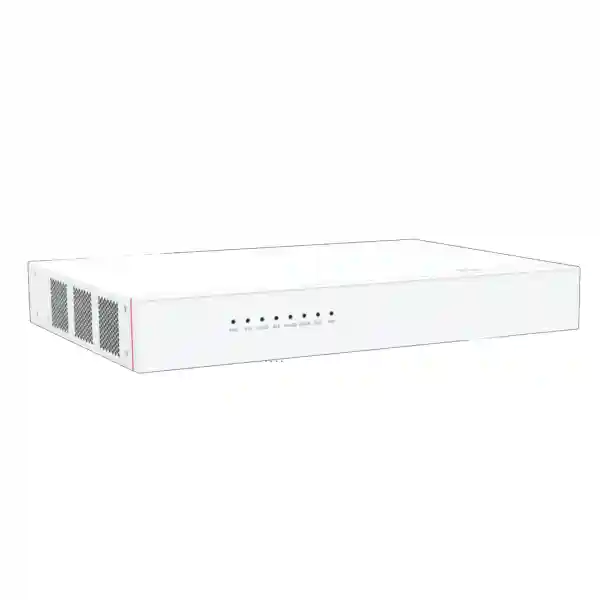
Huawei HiSecEngine USG6530F-DPL Next-Generation Firewall
A compact 10GE-enabled, LTE-capable and PoE-equipped security gateway for branch offices and distributed enterprise edges that require firewalling, encrypted connectivity, application-aware controls, intrusion prevention, antivirus, web filtering, bandwidth policy and secure SD-WAN from one managed appliance.
At-a-glance platform fit
Form factor: Desktop, 320 × 220 × 43.6 mm
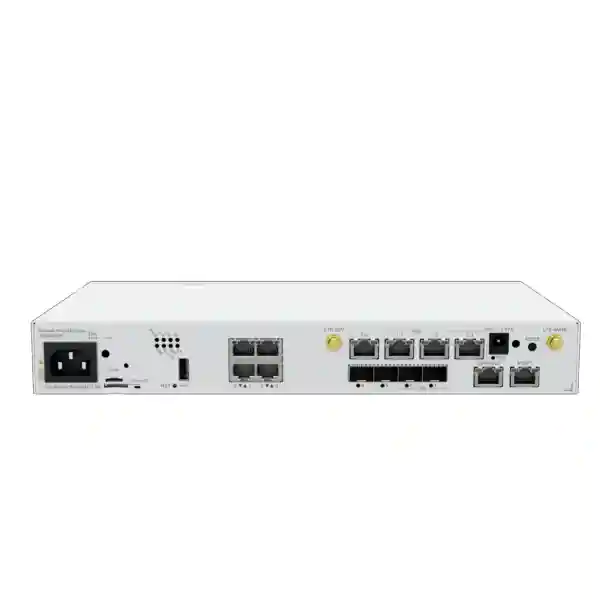
Interfaces: 2×10GE SFP+, 2×GE SFP, 8×GE RJ45, LTE
PoE: Four supported PoE ports
Firewall throughput: Up to 12 Gbps for 1518/512-byte IPv4/IPv6 UDP test profiles
Primary role: Secure branch edge, WAN aggregation, VPN gateway and NGFW enforcement
Direct answer: what is the Huawei HiSecEngine USG6530F-DPL?
The Huawei HiSecEngine USG6530F-DPL is a desktop next-generation firewall in Huawei’s USG6500F family. It is designed for sites that need more than a basic internet gateway but do not want the footprint of a larger rack firewall. The model combines stateful firewalling with application identification, intrusion prevention, antivirus, URL filtering, bandwidth control, Anti-DDoS functions, VPN services, secure SD-WAN capabilities and centralized policy operation. Its physical interface mix is particularly useful for modern branches: two 10GE SFP+ ports support high-speed fiber uplinks or aggregation, two GE SFP ports accommodate additional optical circuits, eight GE RJ45 interfaces serve copper-connected LAN or WAN segments, integrated LTE provides an option for cellular connectivity, and four Ethernet ports support PoE for suitable edge devices.
For UAE organizations, that combination makes the USG6530F-DPL relevant to retail, healthcare, professional services, education, hospitality, logistics, construction offices, warehouses and enterprise branches that need a security edge with flexible carrier connectivity. A typical deployment can place the firewall between one or more ISP circuits and the internal switching environment, create isolated zones for users, servers, guest access, IoT and management systems, terminate IPsec VPNs to headquarters or cloud networks, enforce application and web access policy, and use LTE as an alternate path when a wired WAN is unavailable or being restored.
The model should be sized against inspected traffic, encrypted traffic, session volume, new connection rates, WAN design and subscription requirements rather than headline firewall throughput alone. The 12 Gbps firewall figure describes specific packet-size test conditions; real production throughput depends on the features enabled and the traffic mix. For a security-policy workload with intrusion prevention, antivirus and application awareness, Huawei publishes lower NGFW and threat-protection figures, which are the more useful references for projects that intend to enable full inspection.
USG6530F-DPL verified performance and capacity profile
IPv4 / IPv6 firewall
Published for 1518-byte and 512-byte UDP test cases. The small-packet result is 3.6 Gbps, which is important when evaluating packet-rate-intensive traffic.
NGFW enterprise mix
A more practical planning metric where firewall, service awareness and IPS are enabled and traffic resembles a mixed enterprise workload.
Threat protection mix
Published enterprise-mix threat-protection performance with firewall, service awareness, IPS and antivirus functions in the test profile.
Concurrent sessions
A substantial state table for a compact branch platform, useful where many endpoints, cloud applications and short-lived web connections operate simultaneously.
| Metric | Published value | Sizing interpretation |
|---|---|---|
| IPv4 firewall throughput | 12 / 12 / 3.6 Gbps | 1518 / 512 / 64-byte UDP test profiles; do not equate with full security inspection throughput. |
| IPv6 firewall throughput | 12 / 12 / 3.6 Gbps | 1518 / 512 / 84-byte UDP test profiles. |
| Firewall packet rate | 5.4 Mpps | Useful for designs with many smaller packets and high connection activity. |
| FW + service awareness | 2.2 Gbps | Application-aware inspection introduces processing beyond pure forwarding. |
| NGFW, HTTP 100K | 1.8 Gbps | Huawei test profile with firewall, service awareness and IPS enabled. |
| NGFW, enterprise mix | 1.2 Gbps | Better starting point for mixed SaaS, web, collaboration and business traffic. |
| Threat protection, HTTP 100K | 1.5 Gbps | Firewall, service awareness, IPS and antivirus are active in the published test. |
| Threat protection, enterprise mix | 1 Gbps | Strong planning reference for inspected branch internet traffic. |
| New IPv4 sessions | 50,000 per second | Supports busy web and cloud usage with rapid session churn. |
| IPv6 new sessions | 30,000 per second | Relevant for dual-stack and IPv6-forward enterprise designs. |
| IPsec VPN throughput | 3.7 Gbps | Published with AES-256 + SHA256 and 1420-byte packets. |
| Maximum IPsec tunnels | 2,000 | Applies to gateway/client-to-gateway tunnel scale in current series data. |
| SSL inspection | 1.3 Gbps | Current R25C10 series figure; verify software release and feature combination during final sizing. |
| SSL VPN throughput | 300 Mbps | Suitable for remote-user access designs where SSL VPN is required. |
| SSL VPN users | 100 default / 1,000 maximum | Maximum entitlement may require licensing; confirm exact subscription and release. |
Why the DPL interface design matters at a UAE branch edge
Branch firewall selection is often constrained by interfaces before it is constrained by raw throughput. The USG6530F-DPL addresses this by combining fiber, copper, cellular and PoE capabilities in one desktop chassis. Two 10GE SFP+ ports can be used for high-speed uplinks toward an aggregation switch, a capable ISP handoff or a server/security segment. The additional two GE SFP ports are useful for service-provider Ethernet, longer-distance building links or fiber-connected internal zones. Eight GE RJ45 interfaces provide conventional copper connectivity for WAN handoffs, LAN trunks, isolated devices or dedicated security zones. Integrated LTE gives architects a path for backup WAN, temporary connectivity or out-of-band-style resilience depending on the final design and carrier service.
The DPL suffix is especially relevant where PoE reduces the number of edge components. Four supported PoE ports can supply compatible network devices without requiring an additional small PoE switch for every design. In practice, this can simplify a small office, remote kiosk, site cabin, retail location or branch where a handful of IP endpoints need power and connectivity near the security gateway. Whether a particular access point, camera, phone or other device should be powered directly from the firewall depends on its PoE class, total power budget, segmentation requirements and redundancy design. For larger endpoint counts, a managed PoE switch remains the better architectural choice because it provides broader port density, switching functions and power budgeting.
The physical platform is 320 mm wide, 220 mm deep and 43.6 mm high, with a published weight of approximately 2.6 kg. It uses a single AC power supply rated for 100 V to 240 V, 50/60 Hz, and Huawei publishes a maximum appliance power consumption of 35.7 W for the USG6530F-DPL. The operating environmental range is 0°C to 45°C with 5% to 95% non-condensing humidity. In Dubai and the wider UAE, that specification reinforces a critical deployment rule: the firewall belongs in a cooled, ventilated indoor communications area, not in an uncontrolled external cabinet exposed to summer heat, solar load, dust accumulation or condensation risk.
Security functions in an integrated branch platform
Stateful firewall and zone control
The foundation is stateful traffic enforcement between security zones. Administrators can define trust boundaries around user networks, server segments, voice, guest Wi-Fi, management systems, CCTV/IoT environments, WAN circuits and VPN connections. A well-designed rule base follows business flows rather than simply permitting broad subnets. This reduces lateral movement paths and makes policy review easier when staff, SaaS platforms and branch applications change.
Application identification and control
Huawei describes support for identifying more than 6,000 applications, with policy granularity that can extend to application functions. This lets the firewall distinguish business application use from generic port numbers and apply controls that better reflect how modern cloud traffic behaves. Application awareness can be combined with intrusion prevention, antivirus and data-oriented controls to improve enforcement context.
Intrusion prevention and antivirus
IPS inspects traffic for known exploit patterns and vulnerability-related attack behavior, while antivirus functions inspect supported traffic for malicious content. The value is not merely enabling both features; the practical objective is to apply them to the right policies, keep signatures and security services current, understand encrypted-traffic visibility, monitor blocks and exceptions, and tune enforcement around legitimate business applications.
URL filtering and bandwidth governance
Web categories and bandwidth controls help organizations manage acceptable use, reduce exposure to risky destinations and protect critical applications from congestion. The policy should be aligned to user groups, department requirements, guest access and business hours rather than applying one universal restriction. Bandwidth policy is especially useful at branches where video, backups or large downloads could consume a constrained WAN link.
Secure SD-WAN for multi-link branch connectivity
The USG6530F-DPL supports secure SD-WAN capabilities intended to combine connectivity and security policy at the edge. Huawei publishes secure SD-WAN throughput of 6 Gbps for the model family under the stated 1400/512-byte UDP test profile and up to 200 SD-WAN EVPN tunnels. These values indicate that the appliance can support substantial overlay connectivity, but production design still depends on WAN circuit speeds, encryption, path-selection policy, quality objectives and the number of branches participating in the overlay.
In a two-carrier UAE branch design, one wired circuit can serve as the preferred path while a second broadband, DIA, MPLS handoff or LTE service provides diversity. SD-WAN policy can then steer traffic based on application importance and measured path characteristics rather than relying only on a static default route. Voice, ERP, point-of-sale, VDI or collaboration traffic can be treated differently from software updates, social traffic or guest internet access. The objective is predictable user experience during both normal and degraded conditions.
Secure SD-WAN does not eliminate the need for disciplined underlay design. Separate physical carriers may still share building entry routes, last-mile ducts or upstream infrastructure. LTE backup may have coverage limitations inside reinforced concrete structures, and mobile data plans can impose limits that affect failover behavior. For critical branches, FourTeck recommends documenting path diversity, testing failover under realistic load, validating DNS and session behavior, and confirming whether cloud security or private application routes remain reachable when the preferred link is unavailable.
Organizations using a wider Huawei enterprise networking stack can incorporate the firewall into centralized operational workflows. When planning multi-site deployments, define a standard site template covering addressing, zones, VLANs, WAN naming, VPN objects, NAT, policy order, logging and monitoring. A repeatable standard reduces configuration drift and makes it easier to onboard additional branches across Dubai, Abu Dhabi, Sharjah and other UAE locations.
IPsec VPN design: 3.7 Gbps encrypted throughput and up to 2,000 tunnels
Huawei publishes 3.7 Gbps IPsec VPN throughput for the USG6530F-DPL using AES-256 with SHA256 and 1420-byte packets, plus support for up to 2,000 IPsec VPN tunnels in the listed gateway/client-to-gateway scale. These are strong figures for a compact branch appliance, but the usable encrypted throughput in a real network will depend on packet size, traffic direction, enabled security inspection, tunnel count, routing design and WAN characteristics. A 1 Gbps internet circuit does not automatically imply 1 Gbps of application throughput through every inspection layer; each enabled function contributes processing and sometimes protocol overhead.
For site-to-site VPN, the design starts with route ownership. Decide whether the firewall will exchange routes dynamically, use static routes, or participate in an overlay model. Define cryptographic proposals consistently across peers, set tunnel monitoring, establish failover behavior for multiple WAN links and choose NAT exemptions carefully. Organizations connecting to public-cloud VPN gateways should also compare the cloud provider’s tunnel and throughput limits because the remote endpoint may become the bottleneck before the branch firewall does.
Segmentation across the VPN is equally important. A branch-to-head-office tunnel should not imply unrestricted any-to-any access between entire address spaces. Policy can restrict finance systems, management interfaces, domain services, backup traffic, voice services and user subnets according to actual dependencies. This is especially important after mergers, temporary site deployments or third-party access projects where overlapping networks and broad legacy ACLs frequently create risk.
When migrating from an older firewall, preserve the business intent of the rules rather than copying the configuration line by line. Inventory peer addresses, proposals, PFS settings, routing, tunnel health checks, NAT behavior, certificate dependencies and overlapping subnets. Then test the new VPN under planned failover and rekey events. FourTeck’s UAE implementation team can assist with staged cutover planning through FourTeck IT Services UAE when the project includes configuration, migration or post-deployment validation.
SSL inspection: size for encrypted reality, not clear-text assumptions
Most enterprise web traffic is encrypted, which means next-generation firewall sizing has to consider SSL/TLS inspection rather than treating it as an optional afterthought. Huawei’s current R25C10 data publishes 1.3 Gbps SSL inspection throughput for the USG6530F-DL/DPL group under the vendor’s defined test conditions. That is significantly below the headline 12 Gbps firewall figure because decrypting, inspecting and re-encrypting sessions requires considerably more processing than simple stateful forwarding.
A sound SSL inspection project starts by identifying which traffic should be decrypted. Some categories may be excluded for privacy, legal, certificate-pinning or application compatibility reasons, while business applications and web browsing that benefit from threat inspection can be included. Endpoint trust deployment is essential because managed devices need to trust the enterprise inspection certificate. Unmanaged guest devices, BYOD endpoints and certain IoT systems may need different handling.
Capacity planning should examine peak encrypted bandwidth, concurrent sessions, new sessions per second, certificate-handshake behavior and the security profiles applied after decryption. For a branch with a 500 Mbps internet circuit and ordinary office SaaS use, the USG6530F-DPL may have comfortable headroom; for a site expecting sustained multi-gigabit inspected internet, a larger platform could be more appropriate even though pure firewall forwarding is much higher. The difference illustrates why procurement should begin with workload requirements rather than a single data-sheet number.
Operationally, certificate lifecycle matters as much as throughput. Inspection CA certificates require secure storage, controlled deployment and planned renewal. Exceptions should be documented rather than accumulated informally. Administrators should monitor decryption failures, unsupported cipher behavior, application breakage and bypass rules so the effective inspection coverage does not silently decline over time.
Hardware, power and environmental specifications
Chassis and storage
The USG6530F-DPL is a desktop unit measuring 320 × 220 × 43.6 mm and weighing about 2.6 kg. It is not a conventional 19-inch rack appliance, so rack deployments should use a suitable shelf with safe cable routing and ventilation clearance.
Huawei lists an optional 64 GB microSD card. Where local storage is part of logging or operational requirements, confirm the exact role of the card for the selected software release and determine whether logs should instead be exported to a centralized platform or SIEM for retention and correlation.
Power and operating conditions
The appliance accepts 100–240 V AC at 50/60 Hz and uses a single power supply. Maximum published appliance consumption is 35.7 W. A UPS is recommended for controlled runtime and protection from short interruptions, but the UPS itself should be sized for the complete branch network stack rather than only the firewall.
The operating range is 0°C to 45°C and 5% to 95% relative humidity, non-condensing. UAE installations should provide stable cooling, dust management and enough airflow around the device, particularly in small wall cabinets where switches, routers and PoE loads can create significant local heat.
Port-by-port planning for the USG6530F-DPL
The two 10GE SFP+ interfaces are the highest-capacity fixed ports and should be reserved for roles where their bandwidth and optical flexibility provide value. One common approach is to use a 10GE connection to a core or distribution switch and retain the second for a high-speed WAN, DMZ aggregation switch, server/security segment or future growth. If the branch currently uses only 1 Gbps access switching, the 10GE uplink still provides an upgrade path and can prevent the firewall-to-LAN interconnect from becoming a bottleneck as users, Wi-Fi and local services grow.
The two GE SFP interfaces are useful when the service provider hands off fiber at 1 Gbps, where copper reach is insufficient, or where electrical isolation between buildings is desired. Optics must match the link on speed, wavelength, fiber type and connector requirements. Single-mode and multimode designs are not interchangeable without appropriate transceivers and cabling. For external building links, fiber is often preferred because it avoids copper grounding differences and supports longer distances.
The eight GE RJ45 interfaces can be allocated as routed ports, WAN handoffs or zone interfaces according to design. However, using every firewall port as a separate LAN connection is not automatically best practice. In larger branches, a managed switch should normally provide endpoint density, VLAN access and redundancy while the firewall enforces policy at routed or trunk boundaries. This keeps the security gateway focused on inspection and routing and makes access-layer troubleshooting more manageable.
Four PoE-capable ports can power compatible devices, which may be useful for a small number of endpoints. Before relying on them, verify the PoE power budget, endpoint standard and startup draw. Wireless access points with multiple radios or advanced cameras can consume more power than basic devices. If uptime is critical, consider whether power from a single-supply firewall creates an undesirable dependency. A dedicated PoE switch connected to a UPS may provide a stronger design for larger sites.
The LTE interface should be planned with signal quality, antenna placement, carrier coverage, SIM management and data-plan policy in mind. An LTE circuit can provide valuable backup connectivity, but it should not be assumed equivalent to a wired circuit for latency, public addressing, inbound reachability or unlimited usage. Test actual coverage at the final installation point and confirm how failover traffic will be prioritized when the mobile path becomes active.
Deployment architecture examples for Dubai and UAE sites
Professional office branch
A 100–250 user office can connect dual WAN services to the firewall, use 10GE toward a managed access/core switch, segment corporate, guest, voice, server and management VLANs, and establish IPsec connectivity to headquarters or cloud environments. Security profiles can be applied by user group and destination, while bandwidth controls prevent guest or update traffic from crowding out collaboration and business systems.
Retail and point-of-sale site
Retail locations can isolate POS terminals from staff devices, guest Wi-Fi, digital signage, CCTV and building systems. Primary broadband or Ethernet can be backed by LTE, and VPN policy can restrict access to payment, inventory and corporate services. Logging should make changes and denied flows visible without exposing cardholder or sensitive information beyond operational requirements.
Clinic or healthcare branch
Healthcare sites can place clinical devices, business workstations, guest Wi-Fi, voice and administration into separate security zones. VPNs connect approved clinical and administrative systems to centralized services. SSL inspection and web filtering need to be designed with application compatibility and privacy obligations in mind, while detailed logging supports operational review.
Warehouse or remote operations
Warehouses and temporary operations sites may use wired WAN as primary with LTE failover, separating handheld scanners, office users, CCTV, access control and industrial/IoT equipment. A 10GE uplink to a local switch can aggregate multiple VLANs while the firewall enforces inter-zone rules and routes selected services through private VPN paths.
Sizing methodology: how FourTeck determines whether USG6530F-DPL is the right model
Correct sizing begins with the security workload. A firewall passing uninspected traffic can forward far more than a firewall decrypting TLS, identifying applications, scanning for malware and running intrusion prevention on the same flows. For that reason, FourTeck normally starts with the intended security policy set: stateful firewall only, application control, IPS, antivirus, URL filtering, SSL inspection, VPN, SD-WAN or a combination. The enterprise-mix NGFW and threat-protection figures provide a more realistic baseline than raw firewall throughput where full security is required.
The second input is bandwidth, but not just the ISP’s contracted speed. Measure or estimate sustained and peak traffic in each direction. Consider future upgrades, SaaS migration, cloud backups, video meetings, guest internet, software deployment and wireless growth. An office with a 1 Gbps circuit that currently peaks at 250 Mbps has a different requirement from a media branch sustaining 900 Mbps with heavy SSL inspection. The firewall should retain operational headroom for bursts, failover and signature growth rather than running permanently near its measured limit.
Session behavior is the third dimension. The USG6530F-DPL supports up to one million concurrent sessions and 50,000 new IPv4 HTTP sessions per second in Huawei’s current data. Those figures are generous for many branches, but large guest networks, NAT-heavy environments, software distribution, short-lived API connections and automated systems can create different patterns from simple user counts. During replacement projects, current firewall statistics provide an excellent sizing input: peak concurrent sessions, new sessions, CPU, memory, inspected bandwidth and policy hit counts should be collected before the migration window.
Encrypted traffic is the fourth dimension. If SSL inspection is planned, compare projected inspected bandwidth with the published SSL inspection capacity and leave margin. If site-to-site IPsec is dominant, compare expected encrypted throughput with the 3.7 Gbps IPsec figure while accounting for the performance of remote peers and WAN circuits. If SSL VPN is required for many remote users, check both the 300 Mbps SSL VPN throughput and user licensing rather than assuming the platform’s firewall throughput applies to remote-access VPN.
Finally, review physical and operational constraints: number and type of WAN handoffs, fiber versus copper, PoE needs, LTE requirement, cabinet size, power resilience, log-retention design, support entitlement and centralized management. If any of those constraints exceed the DPL platform, moving to a larger model can be preferable to forcing the design onto a device that is comfortable only in the lab. For broader UAE infrastructure procurement, FourTeck’s UAE technology portfolio can be used to align the firewall with switching, wireless, server and service requirements.
Firewall policy design for a clean, auditable rule base
A powerful firewall can still become difficult to operate if the policy is not structured. Start with clear zone definitions and naming standards. Instead of broad labels such as LAN1 and LAN2, use names that reflect security intent: CORP-USERS, SERVERS, POS, GUEST, VOICE, CCTV, MGMT, WAN1, WAN2 and VPN-HQ. Address objects should follow the same convention so administrators can understand a policy without opening every object. Consistency is particularly valuable when the same firewall template is deployed across several branches.
Rules should be as specific as practical while still being maintainable. For example, POS terminals may need DNS, time synchronization, payment gateway access and a small set of corporate services, not unrestricted internet and broad access to user networks. Guest Wi-Fi may need only internet egress with client isolation. Management interfaces should be reachable only from designated IT subnets or secure VPN users. IoT devices should not have lateral access to corporate workstations unless a documented integration requires it.
Policy order matters because broad rules can shadow intended restrictions. Change control should include a description, owner, reason and review date for temporary access. Logging should focus on security-relevant and operationally useful events without overwhelming storage. Administrators should periodically review unused rules and objects, especially after application migrations, office moves and supplier changes.
The most effective migration projects combine configuration review with traffic observation. Rather than copying every old firewall rule, identify rules with no recent hits, duplicate objects, obsolete VPN peers and overly broad services. Build the new USG6530F-DPL policy around current application dependencies. This produces a smaller, clearer rule base and reduces the number of exceptions that future administrators have to interpret.
Application control, IPS and antivirus operational strategy
Application control is most useful when it reflects business policy. Blocking entire categories without understanding workflows can create support tickets, while allowing everything reduces the value of an application-aware firewall. Begin by identifying sanctioned collaboration, storage, remote-access, messaging and business platforms. Apply more restrictive controls to high-risk or non-business functions where appropriate, and monitor policy hits before enforcing disruptive changes.
IPS policy should protect exposed and internal services based on risk. Internet-bound user traffic, published servers, VPN-connected branches and internal segmentation flows do not necessarily need identical profiles. Signature severity, target operating systems and application context can be used to tune protection. False positives should be investigated and narrowed through exceptions rather than disabling broad protection. Keep the device’s security services current so new signatures and threat intelligence can be applied.
Antivirus adds another layer for supported traffic types, but it does not replace endpoint protection, email security or secure web controls. Network antivirus sees traffic that crosses the firewall and is visible to inspection; it cannot scan local activity that never traverses the appliance. The best design uses multiple layers: endpoint protection on managed devices, secure identity controls, patching, backups, mail and web protections, and firewall-based enforcement at the network edge.
When SSL/TLS inspection is enabled, application identification and threat inspection gain visibility into encrypted flows, but certificate management and privacy policy become critical. Define decryption exclusions intentionally, document them, and review them as application behavior changes. Monitoring should include blocked threats, high-risk applications, unusual destinations, repeated policy violations and any sudden increase in bypassed encrypted sessions.
High availability, resiliency and the single-power-supply consideration
The USG6530F-DPL hardware uses a single power supply, so branch resiliency must account for that physical characteristic. For non-critical sites, a single appliance connected to a properly sized UPS may be acceptable. For business-critical sites where firewall failure would stop operations, a resilient design can use two firewalls in an HA architecture if supported by the selected software and deployment model. The procurement quote should include the hardware, subscriptions and support required for both nodes rather than assuming one license covers the pair.
HA protects against appliance failure, but it does not solve every outage. Dual firewalls connected to a single access switch, single ISP, single UPS or single fiber path can still lose service when that shared component fails. A resilient branch design maps failure domains from users to applications: firewall, switching, power, ISP handoff, carrier path, DNS, DHCP, authentication, VPN peer and cloud service dependencies. The appropriate level of duplication depends on the business cost of downtime.
Operational testing is essential. Failover should be validated with representative traffic, not only by checking whether a standby device changes state. Test internet browsing, DNS, voice, critical SaaS, site-to-site VPN, inbound services and monitoring. Stateful sessions may behave differently from new connections. If LTE is the tertiary path, include it in the test and verify that high-volume nonessential traffic is restricted during mobile failover.
For branches that require redundant power within a single chassis rather than appliance-level redundancy, a larger firewall platform with dual power modules may be more appropriate. Hardware selection should reflect the resiliency objective from the beginning instead of treating redundancy as an accessory added after procurement.
UAE environmental and cabinet planning
Dubai and UAE deployments need careful thermal design. Outdoor temperatures can be far above the firewall’s 45°C operating limit, and even indoor utility spaces can become hot when air conditioning cycles off after business hours. Network cabinets also accumulate heat from PoE switches, UPS systems, routers and optical equipment. The safe design is a cooled communications room or cabinet location with continuous ventilation and a temperature profile that remains inside equipment limits throughout the day.
Dust is another practical factor. Construction sites, warehouses and poorly sealed rooms can accumulate fine particles that block ventilation openings and raise internal temperature. Site maintenance should include visual inspection and safe cleaning procedures. Equipment should not be placed directly on dusty floors or shelves where spilled liquids, cleaning chemicals or physical impact are likely.
Power quality and runtime need project-level planning. A UPS should support the firewall, WAN provider equipment, switching and any management device required to keep the branch online during short interruptions. If PoE endpoints depend directly on the USG6530F-DPL, their power draw also contributes to runtime. Where critical communications must continue during longer outages, coordinate UPS capacity with generator availability and facility procedures.
Cable management improves both reliability and troubleshooting. Label WAN circuits, optical modules, switch uplinks, HA links and management connections. Maintain enough bend radius for fiber, avoid placing power bricks over ventilation areas and document patching. These details are inexpensive compared with the cost of diagnosing an outage in an unlabeled cabinet during a high-pressure incident.
LTE backup: design considerations beyond inserting a SIM
Integrated LTE is one of the distinctive features of the USG6530F-DPL, but successful cellular backup depends on radio conditions and carrier policy. Signal quality should be measured at the installation location because coverage outside a building does not guarantee strong indoor service. Metal cabinets, low floors, dense walls and equipment rooms near the building core can reduce cellular performance. Antenna placement and approved accessories should be planned before deployment.
Addressing behavior must also be understood. Mobile carriers may use carrier-grade NAT, which can prevent inbound connections or make certain VPN designs more complex. If the LTE path is intended mainly for outbound internet and tunnel initiation to a known peer, that can be straightforward. If the business expects inbound public services over LTE, confirm carrier options and test them before relying on the design.
Traffic policy during failover should be deliberate. A branch that normally uses a 1 Gbps fixed circuit can quickly consume a mobile data allowance if backups, operating-system updates and guest streaming continue unchanged after failover. SD-WAN and firewall rules can prioritize business-critical flows and restrict lower-priority traffic while LTE is active. Operations staff should receive an alert when the site changes paths so a long-running failover does not go unnoticed.
Cellular backup is especially valuable for temporary offices, event spaces, construction cabins and branches waiting for fixed circuits. In those scenarios, the USG6530F-DPL can provide an initial path and later transition LTE into backup once the primary service is installed. The design should still account for antenna, signal, security, VPN reachability and data usage from day one.
Logging, monitoring and security operations
A firewall should produce actionable telemetry, not become a device that is checked only during outages. Define which events must be logged: policy allows and denies where useful, VPN status, administrator actions, security detections, configuration changes, system alarms, resource thresholds and WAN-state changes. Forwarding logs to a centralized platform protects history if the appliance is replaced or storage is exhausted and allows correlation across multiple branches.
Monitoring should include both availability and security indicators. CPU, memory, session count, new-session rate, interface utilization, errors, drops and VPN tunnel status help operations teams detect capacity problems. Threat alerts, blocked applications, unusual destinations and repeated deny events help security teams understand exposure. A sharp change in session behavior may indicate a legitimate application rollout, a malfunctioning device or malicious activity; context determines the response.
Configuration backups are part of resilience. Back up after approved changes and before major upgrades. Store copies securely with controlled access and clear device identifiers. Document software versions, subscription entitlements, optics, SIM details and WAN circuit references so replacement or disaster recovery does not depend on one administrator’s memory.
For organizations with broader infrastructure requirements, logging can be coordinated with servers, identity systems and other network equipment. FourTeck’s Server Dubai solutions can complement projects that need on-premises compute, virtualization or log-management infrastructure alongside the firewall deployment.
Software release and subscription planning
The feature set available on a next-generation firewall is shaped by both the base software and active subscriptions. Procurement should therefore specify more than the appliance part number. Identify whether the project requires IPS updates, antivirus, URL categorization, security intelligence, centralized management, remote-access user scale or other licensed services. The final quote should state the term, support level and renewal basis so operating costs are clear after the first year.
Software versions also matter because published performance values and feature behavior can change across releases. Huawei’s current hardware information references V600R025C10 for the USG6530F-DPL. Before production deployment, validate the recommended release for the customer environment, check interoperability with centralized management or other Huawei platforms, and review upgrade requirements. A firewall should not be upgraded casually during business hours; changes need backups, rollback planning and validation of VPNs, routing and security policy after reboot.
Subscription expiry should be monitored well ahead of renewal dates. A firewall can continue forwarding traffic in some scenarios even when security services are no longer current, but that is not the same security posture. The organization should know which protections depend on active update services and assign ownership for renewal. Procurement, finance and IT operations should agree on reminders so a critical license does not lapse because the original project owner changed roles.
For multi-site estates, standardizing license terms and support dates can simplify administration. Where possible, align renewal dates, maintain an inventory of serial numbers and support contracts, and document which branches use which security profiles. This reduces emergency purchasing and makes budget forecasting more predictable.
Migration from an existing firewall
A migration should begin with discovery. Export the current rule base, address objects, NAT rules, routes, VPN definitions, DHCP settings, interface assignments, certificates and administrative access settings. Gather live statistics such as policy hits, session peaks, interface utilization and VPN uptime. This distinguishes required configuration from years of accumulated legacy entries.
Build the USG6530F-DPL configuration in a controlled sequence. Establish management access and software baseline, define interfaces and zones, configure routing, recreate necessary objects, implement security policies, configure NAT, establish VPNs, add security profiles and then set logging/monitoring. If the design includes SD-WAN or multiple carriers, test path selection before the production cutover. This staged approach makes troubleshooting easier than applying a large configuration all at once.
Cutover planning should identify every service that depends on the current firewall. Public DNS records, inbound NAT, remote access, cloud IP allowlists, partner VPNs and provider routing can all be affected when a public address or edge device changes. Prepare validation tests for internal users, DNS, internet access, published services, SaaS, VPNs, voice and monitoring. Assign rollback criteria before the change starts so the team can make a controlled decision if an unexpected dependency appears.
After cutover, monitor session counts, policy denies, IPS/AV events, CPU, memory and interface errors. Keep the old firewall configuration available for reference during the stabilization period. Then remove temporary migration rules, update network diagrams and store a fresh configuration backup. A migration is complete only when documentation and monitoring reflect the new production state.
FourTeck can support product supply and project implementation through the Firewall Dubai practice, including requirement review, configuration planning, migration assistance and post-cutover validation for UAE branches.
USG6530F-DPL for retail, hospitality and distributed enterprises
Distributed enterprises often need a repeatable security template more than they need bespoke configuration at every location. The USG6530F-DPL lends itself to that model because the same platform can combine WAN termination, site-to-site encryption, segmentation, application control and local internet security. A retail chain can deploy consistent POS, guest, staff, CCTV and management zones; a hospitality group can separate guest, administration, back-office and operational devices; a professional-services firm can enforce the same SaaS and VPN policies across branches.
Consistency does not mean ignoring site differences. A flagship location may have two wired carriers and 10GE switching, while a smaller branch uses broadband plus LTE. The policy template can remain consistent while interface assignments and routing are adapted to each site. This reduces training demands and improves incident response because engineers see familiar object names, zones and rule structure wherever they connect.
The one-million-session capacity also provides room for environments where endpoint count is moderate but cloud applications create many simultaneous connections. Browsers, collaboration tools, endpoint agents, content delivery networks and SaaS applications can generate numerous sessions per user. Guest Wi-Fi can add unpredictable load during events or peak trading periods. Monitoring actual session use remains important, but the platform offers substantially more state capacity than simple small-office routers.
When the organization operates beyond the UAE, FourTeck can coordinate regional infrastructure requirements through its Africa technology operations for projects that extend into supported African markets. The device configuration itself should still be adapted to local carrier options, regulatory requirements and support logistics in each country.
Remote-access SSL VPN considerations
The USG6530F-DPL publishes 300 Mbps SSL VPN throughput, with 100 concurrent users as the default level and up to 1,000 as the maximum in current series data. The maximum user count may depend on licensing and software release, so it should be confirmed during quotation. User count alone is not a throughput calculation: 500 users checking email intermittently create a different load from 100 users transferring large engineering files through the tunnel.
Remote-access design should use strong authentication, preferably integrating centralized identity and multifactor authentication where the platform and environment support it. Access should be limited to the applications and subnets each user group requires. Contractors should not automatically receive the same network reach as permanent staff, and administrative access should be separated from general remote-user access.
Split tunneling is another design choice. Sending all remote-user traffic through the corporate firewall centralizes inspection and egress control but consumes additional WAN and firewall capacity. Split tunneling reduces backhaul but means internet traffic exits locally from the user device. The decision should reflect security policy, endpoint controls, application architecture and compliance requirements rather than convenience alone.
Capacity planning must include the branch or headquarters internet uplink. A firewall capable of 300 Mbps SSL VPN cannot deliver that to remote users if the site has a 100 Mbps upstream service. Conversely, a multi-gigabit internet link does not increase the model’s SSL VPN performance. Evaluate the end-to-end path, including user broadband, ISP peering, firewall inspection and application-side constraints.
Routing, NAT and segmentation strategy
At small branches, the firewall often acts as the Layer 3 gateway for many VLANs. That design places inter-VLAN flows through the security policy, providing strong visibility and control. At larger branches, a core switch may handle some internal routing while the firewall secures north-south and selected east-west boundaries. The correct model depends on traffic volume and security objectives. For example, high-volume backup traffic between trusted server VLANs may not need to traverse the branch firewall, while user-to-server or IoT-to-corporate flows often benefit from inspection.
Dynamic routing can simplify networks with multiple WAN paths, data centers or large branch estates, while static routing may be sufficient for a single-site internet edge. Whichever approach is chosen, route ownership should be documented clearly. Unexpected asymmetric routing can cause stateful firewall problems because one direction of a session may bypass the device that created the session state.
NAT policy deserves equal attention. Use source NAT for normal internet egress, specific destination NAT for approved published services, and avoid broad inbound exposure. If public services are critical, consider placing them in a dedicated DMZ zone rather than directly on user networks. VPN traffic may require NAT exemptions or specific translation based on overlapping-address situations.
IPv6 should not be ignored simply because the branch primarily uses IPv4. The platform publishes IPv6 firewall and session performance, which supports dual-stack planning. If IPv6 is enabled by an ISP or on internal clients, define explicit IPv6 security policy and monitoring rather than assuming IPv4 rules automatically protect it. A partially managed IPv6 deployment can create unexpected paths around IPv4-only controls.
Performance headroom and growth planning
A firewall should not be purchased to match today’s measured peak exactly. Security features become more demanding, user behavior changes and WAN circuits are upgraded. Growth planning should consider at least the expected service term of the appliance and subscriptions. If the branch intends to move from 500 Mbps broadband to 2 Gbps DIA within a year, and full threat inspection will be enabled, a device sized only for current traffic may require early replacement.
Headroom also helps during failover. In an active/standby environment, one device may need to handle the complete site load after a peer fails. In a multi-link SD-WAN design, traffic can concentrate on a remaining circuit when another path is lost. During security incidents, additional logging or inspection can increase resource use. A design with spare capacity gives engineers room to respond without immediately degrading user experience.
The USG6530F-DPL’s published 1.2 Gbps NGFW enterprise-mix and 1 Gbps threat-protection enterprise-mix values are especially important when estimating full-security internet use. If projected inspected traffic approaches those figures continuously, consider a larger platform. If typical traffic is well below them and brief peaks are manageable, the model may provide an efficient fit. Sizing is a workload decision, not a marketing-number comparison.
Future port requirements also matter. The model includes 10GE, but the overall fixed interface count and desktop format remain finite. Branch consolidation, new DMZs, additional carriers or dedicated security zones can consume ports over time. Where switching can safely aggregate VLANs, trunks preserve firewall interfaces. Where physical isolation is required, reserve enough ports from the beginning.
PoE use cases and design boundaries
The four PoE-capable ports can reduce infrastructure at a small edge location. A branch might power a management access point, a single IP phone, a compact camera or another supported Ethernet device directly from the firewall. This is particularly attractive at temporary offices or small kiosks where deploying a separate PoE switch for a few devices adds cost, space and power dependencies.
However, PoE should be treated as a convenience feature rather than a replacement for access switching in medium branches. Managed switches provide larger power budgets, many more ports, VLAN access configuration, spanning-tree controls, link aggregation, monitoring and often redundant uplinks. Using the firewall as a large endpoint switch would consume interfaces needed for WAN and security zones and make future expansion more difficult.
Power planning should verify the exact PoE requirements of endpoints. Device labels may state a maximum draw that differs from normal use, and wireless access points can consume more power when all radios and USB features are active. Where the firewall and PoE endpoint share a UPS, include both loads when calculating runtime. If the firewall reboots, directly powered endpoints will also restart, which can extend service recovery.
Segmentation remains necessary even when devices connect directly to PoE ports. A camera or access point should be placed in the correct security zone and have only the network permissions it needs. Physical power and logical trust are separate concepts; being powered by the firewall does not mean an endpoint should receive broad network access.
Procurement checklist for Huawei USG6530F-DPL in Dubai
A complete firewall order should include more than the base appliance. Confirm the exact USG6530F-DPL hardware part number, region and AC power option. Identify required optics for 10GE and GE fiber links, cabling, LTE accessories if applicable, microSD storage if required, rack shelf or cabinet accessories, UPS capacity, security subscriptions, support entitlement, remote-access requirements and any centralized management licenses.
Carrier information should be gathered before delivery. Record handoff media, public IP allocations, gateway addresses, VLAN tags, PPPoE details if used, MTU requirements, BGP information where applicable and provider support contacts. For LTE, confirm SIM format, APN, authentication and whether public addressing is required. This allows pre-configuration and reduces the chance that the cutover is delayed by missing service-provider details.
For migration projects, collect the existing configuration and network diagram early. A quote that includes professional services should define whether FourTeck is responsible for configuration conversion, on-site installation, remote support, after-hours cutover, testing and documentation. Clarifying scope prevents the common situation where hardware arrives but no one owns the migration plan.
For supply availability, lead-time, subscription term and implementation scope in the UAE, request a project-specific quotation. Exact commercial terms vary by distributor availability, licensing bundle and support period, so the final bill of materials should be built around the target network rather than copied from a generic appliance listing.
Why buy Huawei HiSecEngine USG6530F-DPL from FourTeck?
FourTeck approaches firewall supply as a network-security project rather than a box-only transaction. The appliance must fit the ISP circuits, VLAN architecture, user count, application mix, VPN requirements, inspection policy, cabinet environment and operational model. A technically correct bill of materials reduces the risk of under-sizing, missing subscriptions or discovering after delivery that the available ports do not match the site handoff.
For customers replacing an existing firewall, FourTeck can help translate current network dependencies into the Huawei platform, review WAN and LAN addressing, map security zones, plan VPN migration and prepare validation steps. For new branches, the design can be coordinated with switching, Wi-Fi, servers, voice and structured network services. This is particularly useful when a branch is being opened on a fixed timeline and multiple infrastructure components must be commissioned together.
The goal is to leave the customer with an operable system: documented interfaces, policy structure, support information, backup configuration and clear ownership for subscriptions and future updates. The best firewall is not the one with the largest data-sheet number; it is the one that meets performance requirements under the intended security features and can be maintained consistently by the operations team.
For wider cross-border requirements, customers can also review the FourTeck global site while UAE-specific supply and implementation remain coordinated through the local team.
Frequently asked technical questions
Does the USG6530F-DPL support 10 Gigabit Ethernet?
Yes. The fixed interface set includes two 10GE SFP+ ports, in addition to two GE SFP ports and eight GE RJ45 ports. Whether both 10GE interfaces should be used for LAN, WAN or DMZ purposes depends on the topology.
Does it include LTE?
Yes. LTE is part of the published USG6530F-DPL interface profile. Actual service requires a compatible carrier plan, suitable signal, SIM/APN configuration and final validation at the installation location.
How many PoE ports are supported?
Huawei lists support for four PoE ports on the DPL model. Confirm endpoint power requirements and the appliance PoE budget during design, especially if multiple higher-draw devices will be connected.
Is the 12 Gbps firewall figure the same as threat inspection?
No. The 12 Gbps value is the firewall throughput under specific UDP packet-size tests. Huawei publishes 1.2 Gbps NGFW enterprise-mix and 1 Gbps threat-protection enterprise-mix for the USG6530F-DL/DPL group, which are more relevant when multiple security functions are active.
What is the IPsec VPN performance?
Huawei publishes 3.7 Gbps IPsec throughput using AES-256 + SHA256 and 1420-byte packets, with up to 2,000 IPsec tunnels in the current series data. Production results depend on traffic and feature combination.
How many concurrent sessions are supported?
The model group is listed for one million IPv4 concurrent sessions and 500,000 IPv6 concurrent sessions, with 50,000 new IPv4 HTTP sessions per second and 30,000 new IPv6 HTTP sessions per second.
Can it be rack mounted?
The product is a desktop form factor rather than a native 19-inch rack chassis. It can be placed on a properly sized rack shelf with appropriate cable management and ventilation if the site standard requires rack installation.
Does it have redundant power?
No. The USG6530F-DPL uses a single power supply. Sites that require higher availability should consider UPS protection, appliance-level HA and elimination of other shared failure points, or select a larger model with dual-power options where appropriate.
Implementation sequence for a production deployment
1. Requirement capture: Document WAN circuits, expected bandwidth, user and device counts, VLANs, public services, VPN peers, SaaS dependencies, security services, authentication, log retention and availability targets. Include projected growth so the device is sized for the service period rather than only the installation day.
2. Physical design: Decide interface assignments for 10GE SFP+, GE SFP, GE RJ45, LTE and PoE. Confirm transceivers, cabling, rack shelf or desktop placement, UPS capacity, cooling and carrier handoff locations. Verify that fiber types and optics match end to end.
3. Logical design: Define zones, routing, VLANs, NAT, DNS/DHCP roles, SD-WAN path policy, site-to-site VPNs and remote-access requirements. Build a clear addressing plan and identify any overlapping networks before the first tunnel is configured.
4. Security policy: Create policy around business flows. Add application control, IPS, antivirus, URL filtering, SSL inspection and bandwidth controls according to risk and compatibility. Document exclusions and temporary rules so they can be reviewed later.
5. Pre-production validation: Test administration, routing, internet access, DNS, VPN, application access, security inspection, logging and WAN failover. Confirm that the expected security profiles are actually applied to traffic rather than merely configured on the appliance.
6. Cutover: Follow a timed plan with named owners for firewall, switching, ISP and applications. Validate critical services immediately after the transition, monitor errors and maintain a clearly defined rollback path until acceptance criteria are met.
7. Handover: Store backups, diagrams, support information, license records, monitoring thresholds and administrator procedures. Schedule firmware and subscription reviews. A firewall deployment is operationally complete only when the team responsible for it can understand, monitor and recover it.
Detailed decision guide: when USG6530F-DPL fits and when to size upward
The USG6530F-DPL is a strong candidate when a branch needs mixed fiber and copper interfaces, 10GE uplink capability, LTE, a small number of PoE endpoints, site-to-site VPN, secure SD-WAN and next-generation inspection at approximately the published enterprise-mix capacities. It is well aligned to branch environments where sustained inspected internet demand is around or below the 1 Gbps threat-protection range and where the one-million-session state table provides comfortable headroom.
Size upward when the branch expects sustained full-security throughput well above the model’s enterprise-mix inspection figures, requires more physical interfaces, needs native redundant power modules, has very high SSL decryption demand, or will aggregate many high-speed internal segments through the firewall. A larger appliance may also be appropriate when the site is becoming a regional hub rather than a branch and must terminate numerous WAN connections while providing data-center-style security services.
Do not size downward purely because today’s internet circuit is slow. If the network roadmap includes faster DIA, cloud migration, heavy collaboration, increased guest traffic or SSL inspection, the security workload may grow quickly. The incremental cost of appropriate capacity at procurement is often lower than replacing an undersized firewall during its support term.
Conversely, avoid overbuying without a requirement. If a small office has a modest broadband link, few users and no need for 10GE or advanced inspection, another model may deliver the required outcome more economically. The purpose of the sizing exercise is to match capabilities to business need, not to maximize specifications.
Decision recap for UAE buyers
Choose this platform when
You need a compact Huawei branch firewall with two 10GE SFP+ uplinks, mixed fiber and copper ports, integrated LTE, four PoE-capable ports, IPsec VPN, SSL VPN, secure SD-WAN and application-aware threat inspection in a desktop chassis.
Re-evaluate the model when
Your requirement depends on multi-gigabit full threat inspection, native dual power modules in one chassis, higher physical port density, unusually heavy SSL decryption, or hub/data-center workloads beyond a conventional branch security edge.
Key published numbers
12 Gbps firewall throughput for 1518/512-byte UDP tests, 1.2 Gbps NGFW enterprise mix, 1 Gbps threat protection enterprise mix, 3.7 Gbps IPsec, up to one million concurrent sessions, and 50,000 new IPv4 HTTP sessions per second.
Critical implementation details
Confirm subscriptions, optics, WAN handoffs, LTE carrier behavior, SSL inspection scope, remote-access licensing, UPS runtime, thermal conditions and migration dependencies before ordering. These determine whether the production result matches the data-sheet capability.
Quotation input checklist
To prepare an accurate Huawei HiSecEngine USG6530F-DPL quotation and deployment scope, provide the following information. A complete request helps avoid missing optics, subscriptions or services and allows the firewall to be sized against real traffic rather than assumptions.
Dubai/UAE location, number of users, total networked devices, guest users, expected growth and business-critical hours.
ISP names, circuit speeds, handoff type, public IP information, primary/secondary roles and whether LTE is required for backup.
IPS, antivirus, URL filtering, application control, SSL inspection, Anti-DDoS, bandwidth management and logging requirements.
Number of site-to-site peers, expected encrypted bandwidth, remote-access users, authentication method and cloud VPN endpoints.
10GE/GE fiber needs, RJ45 handoffs, fiber type, required transceivers, PoE endpoints and switch-uplink design.
Single or HA firewalls, UPS needs, installation timing, migration support, after-hours cutover, documentation and ongoing support expectations.
Consult FourTeck for Huawei USG6530F-DPL sizing, supply and deployment in Dubai
The Huawei HiSecEngine USG6530F-DPL combines a practical branch interface mix with substantial session scale, 10GE uplinks, LTE backup capability, PoE support and next-generation security services. The correct outcome depends on matching those capabilities to the site’s inspected throughput, VPN demand, WAN architecture, subscriptions and resiliency expectations. FourTeck can help translate a branch requirement into a complete bill of materials and implementation plan, including optics, licensing, migration and operational handover.
When requesting a quotation, include your ISP bandwidth, expected user/device count, security features, VPN peers, required optics and whether the firewall will operate as a single unit or as part of a resilient design. For replacement projects, include the current firewall model and approximate peak traffic so the new platform can be sized with meaningful headroom.


Reviews
There are no reviews yet.