
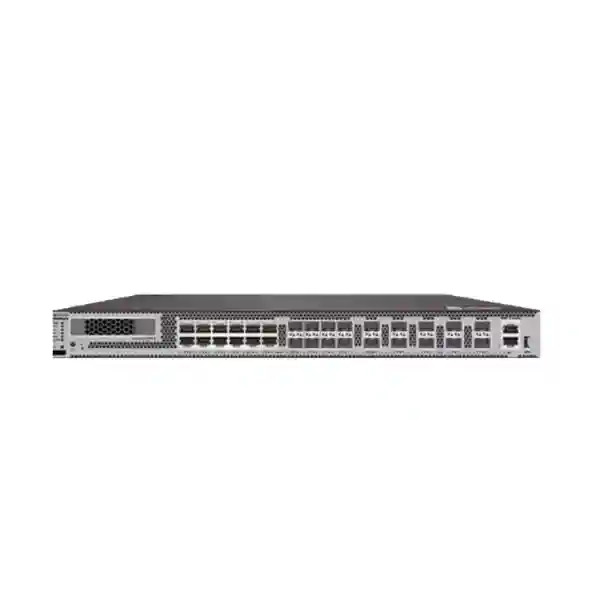
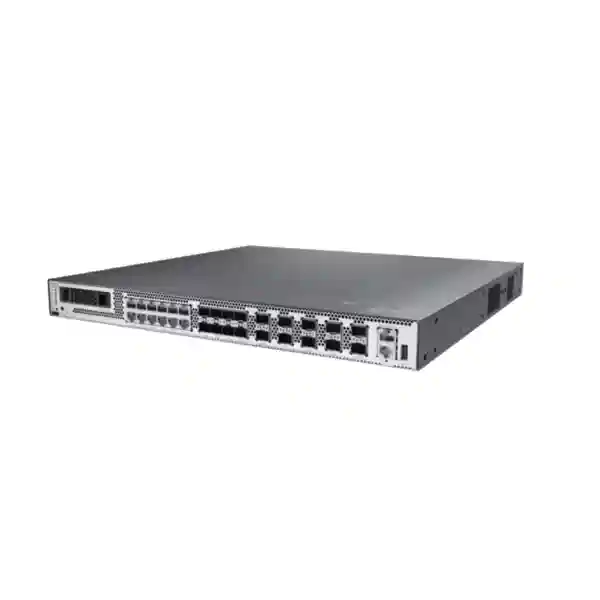
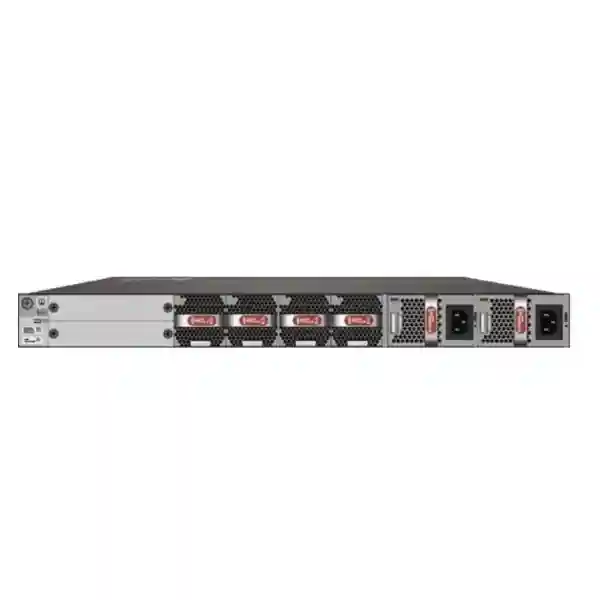
Huawei HiSecEngine USG6655F Firewall in Dubai, UAE
The Huawei HiSecEngine USG6655F is a fixed-configuration 1U enterprise security gateway built for high-throughput perimeter security, data-center segmentation, large campus edge protection, encrypted WAN connectivity, and secure SD-WAN. It combines multi-gigabit next-generation security performance with high session scale, ten 10GE SFP+ interfaces, extensive Gigabit Ethernet connectivity, redundant power, routing, high availability, virtual firewall capability, and centralized operations. For UAE organizations that need to consolidate firewall, intrusion prevention, antivirus, application visibility, URL controls, VPN, bandwidth policy, and branch connectivity on one platform, the USG6655F provides a strong balance of performance density and operational integration.
What the Huawei HiSecEngine USG6655F is designed to do
The USG6655F sits in Huawei’s fixed-configuration HiSecEngine enterprise firewall family and is intended for organizations that need significantly more scale than a conventional branch firewall without moving to a large modular chassis. Its role is not limited to packet filtering. In a properly designed security architecture it becomes an enforcement point where access rules, application control, threat prevention, URL policy, malware inspection, encrypted access, VPN, traffic steering, network address translation, routing, segmentation, logging, and operational telemetry can be coordinated. That consolidation is particularly useful at UAE headquarters, Internet edges, campus aggregation zones and data centers where security teams want fewer policy islands and a consistent control model.
The platform’s headline IPv4 firewall result reaches 50/50/40 Gbps for 1518-, 512- and 64-byte UDP benchmark traffic. IPv6 firewall performance is listed at 50/50/25 Gbps for 1518-, 512- and 84-byte UDP traffic. These numbers describe forwarding under controlled benchmark conditions; they should not be treated as a direct promise of application throughput in a live network. Production capacity depends on packet size, TLS usage, inspection depth, policy complexity, logging, IPS profiles, antivirus scanning, concurrent sessions, NAT, VPN encryption, routing services, redundancy mode, software release and traffic composition. FourTeck therefore sizes the appliance against the required security stack rather than simply matching an Internet circuit rate to a raw firewall number.
For security-enabled traffic, the current specification lists up to 26.5 Gbps for firewall plus service awareness, up to 25 Gbps NGFW throughput using a 100 KB HTTP test profile, 8.5 Gbps NGFW throughput under an enterprise-mix traffic model, up to 22.5 Gbps threat-protection throughput in the HTTP 100K profile, and 8 Gbps threat-protection throughput under an enterprise-mix model. The difference between laboratory profiles is important. Enterprise traffic contains smaller objects, more connections, diverse applications, encrypted sessions, bidirectional flows and state transitions that create a heavier workload than large-object synthetic HTTP tests. A responsible design should therefore use the enterprise-mix numbers and an additional growth margin when IPS, antivirus and application control are expected to remain active during peak business periods.
The platform is also attractive where session density is as important as bandwidth. Huawei specifies 20 million concurrent HTTP 1.1 sessions and 500,000 new sessions per second for the USG6655F. High session scale matters in large campuses, hospitality groups, service environments, public portals, software development organizations, cloud-connected enterprises and data centers where hundreds or thousands of users can create many short-lived connections. A firewall that has adequate gigabit throughput but insufficient session capacity can become unstable or restrictive during bursts. The USG6655F addresses both dimensions by combining high forwarding performance with substantial state-table capacity.
Current USG6655F technical specification overview
Performance data is based on manufacturer benchmark conditions and varies in real deployments. Software release, enabled inspection engines, packet distribution, TLS versions, signature sets, logging, policy design, storage, routing services and traffic behavior can change achievable throughput. FourTeck validates the target configuration and software train during quotation and implementation.
Security architecture: moving beyond port-and-protocol rules
Application-aware policy
Traditional firewalls make decisions primarily from source, destination and service. Modern enterprise traffic makes that insufficient because many applications share TCP 443 or use dynamic cloud endpoints. The USG6655F can combine identity and network context with application awareness so security teams can express rules around the business service rather than relying only on port numbers. This makes it possible to distinguish approved collaboration tools, enterprise SaaS, remote administration, file-sharing services, software updates and higher-risk application categories even when they traverse common transport ports.
Intrusion prevention
IPS inspection is designed to analyze traffic for exploit patterns, protocol abnormalities, known attack signatures and other indicators that should not be allowed simply because a connection was permitted by the access policy. On a UAE enterprise perimeter the IPS profile should be tuned to the actual server platforms, applications and exposure zones. A targeted profile reduces unnecessary processing and alert noise while keeping strong protection for Internet-facing services, remote-access traffic, user egress and sensitive east-west boundaries.
Antivirus and malicious content control
Antivirus inspection adds content-layer controls to policy enforcement. It is most useful when deployed with clear traffic scope and a realistic understanding of encryption. Because the majority of modern web traffic is encrypted, malware inspection strategy must be coordinated with TLS decryption policy, endpoint security and acceptable-use requirements. The objective is not to decrypt everything indiscriminately; it is to inspect the sessions that create meaningful risk while exempting categories where privacy, certificate pinning, regulation or business compatibility makes decryption inappropriate.
URL filtering and web governance
URL filtering can apply category-based browsing policy, reduce exposure to known malicious destinations and support acceptable-use controls. Huawei’s current family information describes more than 130 URL categories and a cloud URL database containing hundreds of millions of entries. In practice, the best policy is role-aware: general users, privileged IT administrators, guest networks, developers, production servers and contact-center systems frequently require different web access. A staged rollout with monitor-only reporting before blocking helps identify legitimate exceptions and minimizes business disruption.
SSL/TLS inspection
The USG6655F lists up to 4 Gbps SSL inspection throughput under the vendor’s defined IPS-enabled HTTPS benchmark. This is a critical sizing metric because TLS decryption is computationally heavier than plain firewall forwarding. Organizations planning broad outbound decryption should inventory the number of users, peak HTTPS demand, TLS versions, certificate requirements and applications that use certificate pinning. Decryption policy should be selective, legally reviewed where appropriate, and integrated with endpoint trust so managed devices can validate the enterprise inspection certificate chain.
Security intelligence and operations
A security gateway provides the most value when its logs become actionable. Firewall accepts and denies, IPS events, antivirus detections, application usage, authentication events, VPN activity, routing changes and system health should feed a defined operations workflow. The platform supports integration methods such as SNMP, SSH, Syslog and NETCONF-oriented interfaces in the broader ecosystem. FourTeck can align those outputs with a customer’s monitoring, SIEM, NOC or SOC process so alerts are not left isolated on the appliance.
Interface design and physical connectivity
The USG6655F provides a dense fixed-interface layout for a 1U appliance. The current hardware specification lists eight GE combo interfaces, four GE RJ45 interfaces and ten 10GE SFP+ interfaces, together with a USB 3.0 port and dedicated management/console functions depending on the exact hardware variant. A combo port typically allows one logical interface position to be used through either copper or optical media, not both simultaneously. That flexibility is useful when an installation must connect legacy copper circuits, local switches, ISP handoffs, out-of-band equipment and fiber aggregation links in the same chassis.
The ten 10GE SFP+ interfaces are particularly relevant to data-center and large-campus designs. They can be used for redundant uplinks toward core switches, separate inside and outside trunks, DMZ aggregation, dedicated inter-firewall high-availability links, server-zone segmentation, MPLS or carrier Ethernet handoffs, and high-speed connections to virtualization or storage-adjacent network zones. Actual optical transceiver selection must match distance, fiber type, wavelength, connector standard, switch compatibility and Huawei-supported module lists. When third-party optics are considered, the support implications should be checked before procurement rather than after the equipment arrives on site.
A common design error is to select a firewall by throughput and then discover that the port layout does not match the topology. For example, a customer may require two independent 10GbE ISP circuits, two 10GbE core connections, an HA synchronization link, two DMZ trunks and additional dedicated zone links. The USG6655F has enough 10GbE density for many such designs, but the port plan should still be documented before purchase. FourTeck creates a port map that identifies WAN, LAN, HA, management, DMZ, service-provider and future-reserve interfaces, along with speed, media, optics and LACP or redundancy requirements.
For projects that combine firewall refresh with switching, servers, virtualization or structured network services, customers can coordinate the wider UAE infrastructure scope through FourTeck UAE and the specialist FourTeck IT Services UAE team. Aligning the firewall and adjacent infrastructure during design reduces mismatches in VLAN tagging, LACP, routing, MTU, transceiver choice, redundancy and monitoring.
VPN and secure WAN capacity
The USG6655F lists 30 Gbps IPsec VPN throughput using AES-256 with SHA256 and 1420-byte test packets, plus support for as many as 20,000 IPsec VPN tunnels. Those figures make the appliance suitable for large hub sites, regional aggregation, encrypted data-center interconnect, partner connectivity and multi-branch deployments. The important engineering question is not how many tunnels are theoretically available but how many will be active at once, what encryption suites are required, what traffic will traverse them, whether routing runs across them, and how failover should behave when an ISP or peer becomes unavailable.
For branch connectivity, VPN design should include route ownership, tunnel monitoring, dead-peer detection, phase-1 and phase-2 lifetimes, certificate or pre-shared-key governance, NAT traversal, MTU and fragmentation, QoS, asymmetric-path prevention, overlapping networks and controlled access between branch zones. When many sites terminate on one hub, operational consistency becomes essential. Naming standards, address plans, policy templates, route summarization and centralized configuration reduce the risk that hundreds of individually configured tunnels drift apart over time.
Remote-access VPN has different requirements. The platform’s current data lists up to 3 Gbps SSL VPN throughput and a licensing-dependent user scale that can extend to 10,000 concurrent SSL VPN users. A remote-access architecture should define authentication, MFA integration, device trust, split-tunneling policy, DNS behavior, route injection, posture requirements, privileged-user separation and logging. The maximum licensed user number should not be confused with the number of users who can receive a good experience; real capacity depends heavily on application mix, file-transfer behavior, video traffic, security inspection, Internet bandwidth and simultaneous peak usage.
Huawei also lists secure SD-WAN EVPN performance for the model at up to 50 Gbps with 1400-byte traffic and up to 40 Gbps with 512-byte traffic, with up to 6,000 secure SD-WAN EVPN tunnels. In a multi-site UAE or regional topology, SD-WAN can add application-aware path selection, encrypted overlay connectivity and policy consistency across Internet, leased-line and carrier transport. Before adopting an SD-WAN architecture, FourTeck maps the underlay circuits, latency objectives, loss and jitter sensitivity, application classes, cloud egress patterns, branch resilience and management platform requirements so the overlay solves real WAN problems instead of simply adding another management layer.
High availability for UAE production networks
A firewall protecting a headquarters, e-commerce service, financial system, data center or large campus is normally a critical path device. For this reason the USG6655F should often be evaluated as a pair rather than as a single appliance. Huawei supports high-availability deployment approaches in the family, including active/standby and active/active scenarios. The appropriate mode depends on traffic symmetry, routing design, session synchronization requirements, Layer 2 or Layer 3 placement, upstream and downstream device behavior, and whether both units should forward production traffic simultaneously.
Active/standby is frequently chosen for simpler operational behavior. One firewall owns the primary forwarding role while the peer maintains synchronized state and becomes active when defined health conditions fail. The design should monitor more than chassis power. Useful failover triggers can include critical interfaces, upstream reachability, tracked routes and service dependencies so a firewall does not remain technically alive while isolated from the network. The switching and routing around the pair must also converge cleanly; firewall HA cannot compensate for an upstream topology that has no resilient path.
Active/active can improve resource usage or meet specific topology goals, but it requires more careful traffic engineering. Stateful inspection depends on seeing both directions of a flow and maintaining consistent session information. Asymmetric routing can create unpredictable results if one direction crosses a different node without the expected state. Before choosing active/active, FourTeck evaluates the customer’s L2 domains, dynamic routing, ECMP behavior, link aggregation, NAT, policy design, session synchronization, application persistence and failure domains.
Hardware resilience supports the HA strategy. The current USG6655F hardware specification describes dual AC power supplies with 100 to 240 V AC input. Each power module should be connected to an independent protected PDU or UPS path whenever the facility permits. Connecting both supplies to one PDU provides power-module redundancy but not upstream power-path redundancy. In data centers with A/B feeds, each supply should use a separate feed. Cable labeling, PDU load calculations and maintenance access should be included in the rack plan.
HA testing must be part of commissioning, not an assumption. FourTeck can test device failure, monitored-link failure, power-supply loss, WAN failure, core-switch path loss, routing reconvergence and planned role switching. During each test the implementation team records session impact, routing behavior, alarm generation and recovery time. The resulting runbook gives operations staff a known procedure for maintenance and troubleshooting rather than leaving failover behavior to be discovered during a real outage.
Routing, segmentation and virtual firewall design
Integrated routing at the security boundary
The HiSecEngine family supports common enterprise routing capabilities including static routes and dynamic protocols such as OSPF and BGP, with broader IPv4 and IPv6 routing options depending on software release. This allows the firewall to participate directly in routed WAN, campus and data-center designs instead of requiring static next hops everywhere. Dynamic routing is especially valuable when there are dual ISPs, multiple MPLS paths, redundant cores, cloud connections or many downstream network prefixes.
Routing on a security appliance should remain intentional. The security zone model, NAT, policy and route table must describe the same network reality. Route redistribution should be minimized and filtered to prevent accidental propagation of Internet or internal prefixes. BGP policies should control accepted and advertised routes. OSPF areas, cost and summarization should match the campus architecture. When default routes come from multiple providers, failover logic must also account for NAT and existing sessions.
Security zones and network segmentation
Segmentation turns the firewall from a perimeter-only device into an internal policy enforcement platform. Typical zones can include corporate users, guest access, servers, production, development, voice, CCTV, IoT, OT, management, DMZ, Internet, partners and remote access. Each inter-zone path can then be governed by least-privilege rules and inspected according to the risk of the traffic rather than assuming everything behind the perimeter is equally trusted.
The model’s VLAN and VLANIF scale supports large segmentation plans, but scale should never be an excuse for unmanaged complexity. FourTeck recommends a zone taxonomy, object naming convention, network-address inventory and policy ownership model. Those disciplines are more important to long-term security than the absolute number of VLANs. A clean object model makes changes safer, audits faster and incident response more reliable.
Virtual firewalls and administrative separation
Huawei lists a maximum of 2,048 virtual firewalls for the current model family specification. Virtualization can divide a physical security appliance into logically separated security contexts with their own policy and administration boundaries. This can be useful for managed-service environments, large groups with multiple subsidiaries, shared data centers, development and production separation, or departments that require administrative independence while sharing hardware.
The theoretical virtual-firewall count is not a deployment target. CPU, memory, session usage, interfaces, logs, route scale and operational complexity are shared physical resources. A design with dozens or hundreds of virtual contexts requires capacity governance and clear change ownership. FourTeck evaluates whether virtual firewalls simplify the customer’s operating model or whether dedicated physical or virtual appliances would create a cleaner failure boundary.
Performance sizing methodology for a real deployment
Selecting an enterprise firewall by ISP bandwidth alone is one of the most common procurement mistakes. A customer with a 5 Gbps Internet circuit might assume any firewall rated above 5 Gbps is sufficient. That ignores encrypted traffic, east-west inspection, VPN, concurrent sessions, packet size, threat prevention, logging and growth. Conversely, another customer may buy a device based on a 50 Gbps raw firewall figure even though the actual requirement is 7 Gbps of fully inspected enterprise traffic. In that case the enterprise-mix threat-protection result is the more useful reference point.
FourTeck starts with traffic paths. We identify Internet egress, inbound published services, private WAN, branch VPN, cloud connectivity, data-center inter-zone flows, remote access and management traffic. Each path is assigned a peak throughput requirement and a security profile. A branch VPN might need encryption and IPS but no antivirus. User Internet traffic might require application control, IPS, URL filtering, antivirus and selective TLS inspection. A trusted backup link may require only firewalling and routing. This produces a workload model instead of one undifferentiated bandwidth number.
The second step is concurrency. We estimate users, servers, IoT devices, guest clients and machine-generated connections, then compare expected concurrent sessions and connection creation rates with the platform limits. Applications with many short web transactions can stress new-session performance more than long-lived flows. Public websites, API gateways, proxies, DNS-heavy environments and large Wi-Fi deployments can therefore require substantial session-creation headroom even when throughput is modest.
The third step is encryption. IPsec has its own benchmark, while SSL inspection has a much lower figure because decrypting, inspecting and re-encrypting TLS is expensive. If a customer plans to decrypt a large percentage of outbound web traffic, FourTeck sizes around the TLS inspection workload and exception policy. If the primary use is a high-speed encrypted WAN, the IPsec figure may dominate. If the firewall mainly protects unencrypted internal segments, NGFW or threat-protection enterprise-mix values may be the best reference.
The fourth step is resilience and growth. An HA pair should be able to carry the required traffic when one member is unavailable. If a deployment depends on both appliances forwarding at full utilization, a single failure can create immediate congestion. For that reason we generally reserve enough headroom for failover, maintenance and expected business growth. Capacity planning should include at least the expected refresh horizon, new branches, cloud adoption, additional inspection, increased TLS use and higher Internet demand.
Finally, we validate physical and operational constraints: rack depth, power feeds, cooling, optics, cable management, management networks, licensing, support coverage, software version, upgrade path, centralized management, logging destinations and available staff skills. These details determine whether the firewall will remain supportable after installation. The outcome is a bill of materials and implementation scope tied to business requirements rather than a generic appliance sale.
Hardware, rack, power and environmental planning
The USG6655F uses a 1U chassis measuring approximately 43.6 mm high, 442 mm wide and 420 mm deep, with a listed weight of about 7.3 kg. Its relatively short 420 mm depth makes it practical for standard enterprise racks, but installers should still verify usable rail depth, front-to-back airflow, PDU placement and cable bend radius. SFP+ fiber patching can consume significant front space, so horizontal cable management and clear port labeling improve maintainability.
The current hardware specification lists 100 to 240 V AC input and dual AC power supplies, with maximum appliance power consumption of approximately 179.1 W in the latest R25C10 hardware table. Published values in earlier product documents can differ, so the final project bill of materials should be checked against the exact part number and software/hardware revision being supplied. Data-center teams should size PDU and UPS capacity using the current supported documentation for the specific unit rather than copying an older Internet datasheet.
Huawei lists an operating environment of 0°C to 45°C with 5% to 95% non-condensing humidity for the series hardware. That does not mean the firewall should be operated near 45°C continuously in a poorly ventilated cabinet. UAE facilities can experience high ambient temperatures, especially in telecom rooms, warehouses and edge locations where cooling is less controlled than in a data center. Stable conditioned airflow, clean filters, unobstructed intake and exhaust, temperature monitoring and sufficient rack spacing around high-heat neighboring equipment are important for long-term reliability.
Optional hot-swappable 2.5-inch SATA storage is supported in capacities that include 240 GB, 480 GB, 960 GB, 1.92 TB and 3.84 TB in current family documentation. Storage requirements depend on software functions, local log retention and the approved parts list. Customers that already centralize logs to a SIEM or log platform may not need the largest local drive. Others may value local retention for troubleshooting. The storage decision should be part of the logging architecture rather than an automatic add-on.
Where the firewall protects server infrastructure, FourTeck can coordinate the security layer with the customer’s compute platform through Server Dubai by FourTeck. This is useful for data-center refresh projects in which server NIC speeds, virtualization trunks, storage networks, top-of-rack switching and firewall interfaces all need to be aligned before migration.
Common deployment patterns for the USG6655F
Enterprise Internet edge
At a headquarters or major office, a redundant USG6655F pair can sit between one or more Internet service providers and the campus or data-center core. The firewalls provide NAT, inbound publishing, egress policy, application visibility, IPS, antivirus, URL policy, VPN and routing. Dual ISP designs can use dynamic or tracked routing to maintain connectivity during provider failures. The rule base should separate user Internet access, published services, partner traffic, remote access and administrative paths so each receives the correct inspection profile.
Data-center north-south firewall
In a data center, the platform can protect application environments from Internet, WAN and partner networks. The 10GbE interfaces provide enough density for multiple routed or trunked connections. Published services should normally be placed in DMZ or application zones rather than sharing a flat server segment. Reverse proxies, load balancers, web application firewalls and identity services can be integrated as separate controls where needed; a next-generation firewall is an important layer, but it does not replace every application-security function.
Internal segmentation
The firewall can enforce policy between high-value internal zones, such as users and servers, production and development, corporate IT and OT, or general networks and management interfaces. Internal segmentation reduces lateral movement and makes access explicit. The design must account for aggregate east-west throughput because traffic that previously stayed on a switching fabric may now traverse inspection. Large file transfers, backups and storage flows should be assessed carefully so security controls do not create an unexpected bottleneck.
SD-WAN regional hub
A UAE headquarters can act as a secure SD-WAN hub for branches across the Emirates or wider region. The hub terminates encrypted tunnels, applies route and security policy, and steers traffic according to application and path quality. For large branch counts, route summarization, standardized addressing and template-based configuration are essential. Direct cloud breakout at branches may reduce backhaul, while sensitive applications can continue to traverse the central hub.
Remote-access concentrator
Organizations with mobile users can use SSL VPN capabilities for controlled access to internal applications. The security architecture should integrate MFA and identity, enforce role-based access, protect privileged accounts, and log administrative sessions. Split tunneling can reduce bandwidth but changes the security model because Internet traffic may bypass the corporate inspection path. Full tunneling centralizes controls but increases concentrator and Internet bandwidth requirements.
Service provider or multi-tenant edge
Virtual firewall capability can support logical separation for multiple business units or tenants on shared hardware. Each tenant can receive distinct policies and routing domains within the platform’s supported architecture. This saves rack space but increases governance requirements. Resource limits, change windows, logging ownership, tenant onboarding and troubleshooting access must be documented so one tenant’s operational needs do not create risk for others.
Migration from an existing firewall
A firewall replacement is not just a hardware swap. Existing devices usually contain years of accumulated rules, objects, NAT statements, VPNs, routes, exclusions and temporary fixes. Directly converting every configuration line transfers old technical debt to the new platform. FourTeck begins with discovery: current interfaces, zones, address objects, service objects, NAT, security policies, VPNs, routing, authentication, certificates, high availability, logging, management access and dependencies are documented before a target configuration is built.
Rule cleanup is a major opportunity. Duplicate, shadowed, disabled and unused rules can often be removed after validation. Any-to-any rules should be examined for legitimate business need and narrowed where possible. Objects should follow a naming standard that reveals site, zone and purpose. Temporary rules should include owners and expiration dates. Migration is therefore both a technology project and a policy-governance exercise.
NAT migration requires particular care because published services may be referenced by public DNS, partner allowlists, payment gateways, SaaS providers or external APIs. FourTeck maps original and translated addresses, service translations, source NAT pools and policy dependencies. For public services, cutover planning can include DNS TTL reduction, provider coordination, health checks and a rollback path. The implementation team verifies each critical published service from an external test point after the change.
VPN migration should account for peer coordination. Site-to-site peers may belong to branches, customers, banks, carriers or third parties that require scheduled configuration changes. Encryption suites, peer IDs, traffic selectors, tunnel monitoring and route behavior are validated in advance. Where certificate authentication is used, certificate chains and validity periods must be checked before cutover. For remote access, client software distribution, user communication and MFA readiness should be planned as part of the migration.
A staged cutover minimizes risk. The new firewall pair is mounted, powered, licensed, upgraded to the approved software release, configured, backed up and pre-tested before production links are moved. Management and HA are validated first. Then WAN and LAN interfaces are connected according to the change plan. The team tests Internet access, DNS, core applications, published services, VPNs, routing, failover and logging. If acceptance criteria are not met, the rollback procedure returns traffic to the original device using documented cable and route steps.
After cutover, FourTeck recommends a stabilization period focused on denied traffic, CPU and memory, session counts, interface utilization, IPS events, VPN stability and route changes. Early monitoring catches legitimate traffic that was missed during discovery and helps tune inspection profiles without weakening the policy model. A post-migration review then captures the final configuration, diagrams, credentials handover process, backup procedure and operational runbook.
Licensing, subscriptions and support planning
Enterprise firewall capability is a combination of hardware, software entitlement, security subscriptions and support. The exact Huawei licensing model can vary with software release, bundle, market and feature set. A quotation should therefore identify which capabilities are included, which require subscriptions, the subscription term, support coverage, SSL VPN user entitlement, signature and intelligence updates, centralized management requirements and any optional storage or optics. Customers should not assume that every feature listed in a product family datasheet is enabled indefinitely by a base appliance purchase.
Security subscriptions matter because IPS, antivirus, URL categorization and threat intelligence depend on current content. A firewall with outdated signatures may still forward traffic but loses much of its ability to identify newer threats. Renewal planning should be treated as an operational requirement and entered into the customer’s asset or contract management system. Support expiry dates, license expiry dates and certificate expiry dates should be monitored separately because each can affect service in a different way.
Software lifecycle also matters. Features, performance optimization, hardware support and security fixes change across releases. FourTeck validates the recommended software version for the purchased part number and intended architecture rather than automatically installing the newest build on the day of deployment. In production networks, upgrades should follow release-note review, backup, compatibility checks, maintenance windows and rollback preparation. HA pairs can reduce downtime during upgrade, but stateful services and routing should still be observed carefully.
For procurement and commercial support in Dubai, customers can also review the dedicated Firewall Dubai resource. FourTeck can provide a bill of materials that separates base hardware, support, security services, transceivers, storage, implementation and optional managed services so the scope is clear before purchase.
Policy engineering and rule-base quality
The quality of a firewall deployment is determined as much by its rule base as by its appliance specification. A high-performance firewall can still provide weak security if policies are broad, undocumented and never reviewed. FourTeck uses a policy structure that favors explicit source zones, destination zones, address objects, services or applications, required security profiles, logging and business ownership. Rules are ordered to remain readable and to avoid accidental shadowing.
Internet egress policy can be designed by user group and device role. Corporate users may receive standard web and collaboration access. Administrators may require controlled access to vendor portals and remote-management services. Servers should rarely receive unrestricted outbound Internet access; they normally need only update repositories, APIs, DNS, NTP or defined destinations. Guest networks should remain isolated from corporate resources. IoT and CCTV devices should be limited to management, time, DNS and cloud endpoints that are genuinely required.
Inbound policies should be narrower still. Publishing a server should specify the destination public address, translated private service, allowed protocol and inspection profile. When the external source population is predictable, source restrictions can further reduce attack surface. Administrative protocols such as SSH, RDP and device web interfaces should not be broadly exposed to the Internet. Remote administration should use VPN, a jump host, zero-trust access mechanism or other controlled path with MFA and logging.
Policy comments and ownership are operational controls. A rule should identify why it exists, who requested it and where possible what application or ticket it supports. Temporary access should have an expiry date. This enables periodic review without forcing security staff to reverse-engineer business intent from IP addresses. When employees, applications or providers change, documented ownership makes cleanup faster.
Logging strategy should reflect risk. Denies, privileged administrative actions, VPN authentication, IPS detections, malware events, policy changes and critical system alarms generally deserve centralized retention. Logging every allowed low-risk packet at maximum detail can overwhelm storage without improving detection. FourTeck works with the customer’s SIEM or monitoring team to define useful log categories, retention, severity mapping and alert thresholds.
UAE deployment considerations
Dubai and wider UAE environments range from tiered data centers to office towers, retail branches, warehouses, construction facilities, schools, healthcare sites and industrial locations. The same firewall model can behave very differently across those facilities because power, cooling, carrier access and operational support vary. The USG6655F is a rack appliance, so the installation location should provide controlled power, adequate cooling, secure physical access and an appropriate rack. In small telecom rooms, environmental monitoring is strongly recommended because cooling failures can become a more immediate risk than the firewall itself.
Carrier diversity should be considered when Internet availability is important. Two ISP circuits only create resilience if their physical and upstream paths are sufficiently independent. If both circuits enter through the same building riser or provider infrastructure, one incident may affect both. FourTeck can design dual-provider routing, tracked static routes, BGP where appropriate, NAT behavior and failover testing. Customers should also verify public IP ownership, BGP ASN requirements and provider handoff media during procurement.
For multi-emirate operations, branch connectivity may combine Internet VPN, SD-WAN, MPLS or leased lines. Centralizing every branch session through Dubai can simplify inspection but increases hub bandwidth and latency. Local Internet breakout can improve SaaS performance but requires consistent branch security. The architecture should therefore be driven by application flows, cloud regions, compliance needs and operational capability rather than by a single topology template.
Procurement lead time for firewalls is only part of the project schedule. Optics, patch leads, rack accessories, support registration, subscriptions, public IP changes, ISP upgrades, maintenance approvals and peer VPN coordination can all affect readiness. FourTeck builds these dependencies into the project checklist so hardware delivery does not create the false impression that the site is ready for migration.
For organizations with offices or branches beyond the UAE, FourTeck’s broader regional resources are available through FourTeck Global. Regional standardization can be useful when the security team wants common models, naming, templates, logging and support processes across countries while still adapting WAN circuits and compliance to each location.
Management, monitoring and operational integration
A firewall is not a set-and-forget device. Its rule base changes, signatures update, certificates expire, VPN peers change, interface utilization grows and new applications appear. Operations should therefore include configuration backup, health monitoring, log review, signature updates, software lifecycle management, user and administrator review, policy recertification and capacity trending. These functions can be handled internally, through centralized Huawei platforms where applicable, or as part of a managed support arrangement.
SNMP monitoring can provide device health, interface state and utilization to a network management system. Syslog can forward security and system events to a SIEM or log collector. SSH supports controlled CLI administration, while NETCONF-oriented integration can support automation use cases. Administrative interfaces should remain on dedicated management networks where possible and should never be exposed broadly. Access should be restricted by source, authenticated strongly and logged.
Configuration backups must be protected because they contain sensitive topology and security information. Backups should occur after approved changes and on a defined schedule, with copies stored outside the appliance. The organization should know how to restore a replacement unit if hardware fails. An HA peer reduces downtime but is not a backup strategy; a configuration mistake or corrupted policy can synchronize to both members.
Capacity trends provide early warning. Interface utilization, concurrent sessions, new sessions per second, CPU, memory, VPN tunnel count and SSL VPN user count can all reveal whether the appliance is approaching operational limits. Spikes should be correlated with business events and security incidents. A sudden rise in new sessions may be legitimate, such as a software update or campaign, or it may indicate scanning, malware or application failure.
Policy review should be scheduled at least periodically and after major projects. The team should identify unused rules, obsolete objects, expired temporary access, old VPNs, disabled services, outdated certificates and administrative accounts that no longer belong. This continuous hygiene keeps the firewall comprehensible and makes future audits or migrations significantly easier.
Why benchmark methodology matters
Firewall datasheets contain several performance numbers because different security functions create different workloads. Raw firewall throughput measures packet forwarding and stateful inspection under controlled conditions. FW plus service-awareness throughput adds application-related classification. NGFW throughput adds IPS to the firewall and application stack. Threat-protection throughput adds antivirus. SSL inspection introduces decryption and re-encryption. IPsec performance measures encrypted tunnel traffic. These are not interchangeable figures.
Packet size has a major effect. At a given gigabit rate, small packets require the firewall to process far more packets per second than large packets. This is why the USG6655F’s raw firewall figures are shown as 50/50/40 Gbps across 1518-, 512- and 64-byte IPv4 tests. Production networks contain a mixture of packet sizes, so the smallest-packet number provides useful insight into processing pressure during high packet-per-second workloads.
Traffic model also matters. The current USG6655F data distinguishes a 25 Gbps NGFW result using 100 KB HTTP objects from an 8.5 Gbps enterprise-mix result. Likewise, threat-protection throughput is listed at up to 22.5 Gbps in the 100 KB HTTP profile but 8 Gbps under enterprise mix. This difference is not a contradiction; it shows why simplified large-file tests are easier to process than diverse enterprise traffic. For a typical corporate network, the enterprise-mix figures are usually the safer sizing reference.
SSL inspection has another distinct benchmark because cryptographic operations consume resources. The listed 4 Gbps result is measured under specified TLS and IPS conditions, not every possible cipher, key length or website behavior. Modern applications can use TLS 1.3, certificate pinning, mutual TLS, QUIC and other mechanisms that influence decryption feasibility. A pilot test with representative applications is therefore valuable before enabling broad TLS inspection.
FourTeck documents which benchmark is used in the sizing rationale. This creates an auditable connection between requirement and model selection. A decision based on the correct protected-throughput number is more defensible than one based on the largest number printed in a datasheet.
Security use cases in more detail
Protecting Internet-facing applications
The firewall can publish servers through destination NAT and apply inbound IPS, application and malware controls. The DMZ should remain separated from internal application and database tiers. Only required backend flows should cross from DMZ to internal zones. If the application is web-based and exposed to untrusted users, a dedicated web application firewall may still be appropriate because application-layer attacks such as business-logic abuse require different inspection than a network firewall provides. The USG6655F should be viewed as one layer in a defense-in-depth design.
Protecting users from malicious Internet destinations
User egress policy can combine URL category controls, DNS strategy, IPS, antivirus and selective TLS inspection. The policy should also restrict risky outbound services, unauthorized proxies and direct administrative protocols. Endpoint security remains essential because encrypted applications, removable media, phishing and local privilege abuse extend beyond the firewall’s view. Network and endpoint controls are complementary.
Controlling partner and supplier access
Site-to-site VPNs and dedicated partner links should terminate in isolated zones rather than being treated as extensions of the trusted LAN. Partner access can then be limited to the exact hosts, ports and applications required for the business service. Logs should make it easy to identify which partner generated a connection. If multiple suppliers use overlapping address ranges, NAT may be required to avoid routing conflicts.
Securing administrative access
Firewall management deserves stronger controls than ordinary user traffic. Administrators should connect from dedicated management networks or controlled jump hosts. Source restrictions, strong authentication and MFA should be applied wherever supported in the management workflow. Management services not in use should be disabled. Administrative changes should generate logs and, ideally, be linked to a change ticket or approval process.
Supporting cloud connectivity
Organizations using Azure, AWS, Google Cloud or other providers may connect through Internet IPsec, private carrier services or SD-WAN. Cloud route tables, overlapping networks, redundant tunnels and failover behavior should be designed together with the on-premises firewall. SaaS traffic may also be optimized through local Internet breakout rather than being sent through a central data center. FourTeck can map cloud and on-premises prefixes, routing ownership, NAT and security controls before implementing connectivity.
Implementation workflow used by FourTeck
Requirements and current-state review
We collect circuit speeds, traffic peaks, user counts, server zones, public services, VPN peers, routing, existing rules, security requirements, rack details, power feeds, optics and support expectations. The objective is to identify functional and capacity requirements before selecting accessories and licensing.
Topology, policy and bill of materials
We define HA mode, zones, interface assignments, VLANs, routing, NAT, VPN, security profiles, management access, logging and required subscriptions. A port map and bill of materials identify transceivers, storage and support so procurement matches the design.
Preconfiguration and validation
The firewall is prepared on an approved software release, base hardening is applied, HA is formed, interfaces and routing are configured, policies are built, VPNs are prepared, logs are connected and configuration backups are captured before the production window.
Controlled migration with rollback
WAN and LAN paths are moved according to the change plan. The team tests routing, DNS, user Internet, public services, VPNs, application access, logging and HA. A defined rollback remains available until acceptance criteria are met.
Monitoring and policy tuning
Denied sessions, utilization, IPS events, malware detections, route changes, VPN behavior and user reports are reviewed. Legitimate missed traffic is corrected through controlled policy updates rather than broad emergency rules.
Documentation and operations
The final configuration, network diagram, policy notes, backup process, support information, software version, licensing data and operational runbook are handed over so the customer’s team can support the environment confidently.
Frequently asked technical questions
Is 50 Gbps the throughput I should expect with every security feature enabled?
No. The 50 Gbps figure is the top IPv4 firewall benchmark for larger packet sizes. Security-enabled figures are lower because IPS, antivirus, application awareness and TLS decryption require additional processing. The current specification lists 8.5 Gbps NGFW and 8 Gbps threat-protection throughput under an enterprise-mix traffic model, which are more relevant for many fully inspected business environments.
Can the USG6655F support dual 10 Gbps Internet links?
The interface density and raw forwarding capacity can accommodate multiple 10GbE connections, but suitability depends on the required security stack, simultaneous utilization, packet mix, TLS inspection and HA design. If both 10 Gbps links can be saturated while threat protection remains enabled, sizing should use protected-throughput benchmarks and failure-state capacity rather than the raw firewall number.
Does the appliance support high availability?
Yes, the product family supports active/standby and active/active high-availability architectures. The correct design depends on routing, switching, traffic symmetry, session synchronization and operational requirements. FourTeck normally recommends purchasing and designing the firewalls as a pair for critical production sites.
How many 10GbE interfaces are available?
The current USG6655F hardware table lists ten 10GE SFP+ interfaces, in addition to eight GE combo interfaces and four GE RJ45 interfaces. Optics are selected according to distance, fiber type, switch or carrier handoff and Huawei compatibility requirements.
Can it be used as a VPN hub?
Yes. Huawei lists 30 Gbps IPsec VPN throughput and up to 20,000 IPsec tunnels for the model. Large hub designs still require route planning, tunnel templates, monitoring, HA and bandwidth calculations. A maximum tunnel count is not the same as a recommended active deployment size under every workload.
Can it inspect encrypted HTTPS traffic?
Yes, SSL inspection is supported, with a listed benchmark of up to 4 Gbps under specified TLS and IPS conditions. Decryption should be selectively designed because privacy, certificate pinning, mutual TLS, application compatibility and performance all affect real deployment results.
What is required for a quotation?
The most useful inputs are Internet and WAN speeds, expected protected throughput, number of users and sites, HA requirement, VPN counts, SSL VPN user target, port and optics needs, subscription term, support term, current firewall model, migration requirement, public services, rack location and desired project timeline. The checklist below can be used to prepare these details.
Decision recap: when the USG6655F is a strong fit
Choose the USG6655F when the requirement extends into multi-gigabit fully inspected enterprise traffic, high session counts, 10GbE aggregation and large VPN capacity. Size against NGFW, threat-protection and SSL inspection figures rather than the maximum raw firewall value.
The ten 10GE SFP+ ports plus GE combo and copper interfaces suit headquarters, data-center edge and large-campus designs that need several high-speed zones or provider handoffs in a compact 1U chassis.
Dual AC power and support for HA architectures make the platform appropriate for critical paths, provided upstream switching, routing, power and carrier connections are also designed without single points of failure.
The platform is suitable when an organization wants to consolidate firewall, application awareness, IPS, antivirus, URL controls, VPN, segmentation and traffic policy on one enterprise security gateway with centralized operational integration.
Quotation input checklist for Huawei USG6655F Dubai
Providing the following information allows FourTeck to return a more accurate bill of materials and implementation scope without unnecessary back-and-forth.
Internet providers, circuit speeds, WAN/MPLS links, cloud connections, handoff media, public IP ranges and whether BGP or static routing is used.
Required IPS, antivirus, URL filtering, application control, TLS inspection, inbound published services and internal segmentation traffic.
Site-to-site tunnel count, expected encrypted throughput, remote-access users, MFA platform and branch or partner peer details.
Single appliance or HA pair, preferred active/standby or active/active design, dual power feeds and upstream/downstream redundancy.
Number of 10GbE and 1GbE links, copper or fiber, single-mode or multimode, distances, connector types and switch or carrier models.
Required subscription term, support duration, implementation, migration, managed services, training, documentation and support SLA expectations.
Plan the USG6655F as an architecture, not just an appliance
For a reliable production deployment, the firewall model, licenses, optics, HA mode, routing, VPN, inspection profiles, rack power, logging and migration plan need to be designed together. FourTeck can support the complete lifecycle from pre-sales sizing and bill of materials through implementation, cutover, testing, documentation and ongoing operational support.
The most important sizing decision is to match the platform to the customer’s protected workload. A network that mainly needs high-speed IPsec aggregation has a different performance profile from one that decrypts large volumes of HTTPS traffic. A data center with heavy east-west segmentation differs from a headquarters focused on Internet security. A branch hub with thousands of tunnels differs from a public-service edge with high new-session rates. The USG6655F offers substantial headroom across these dimensions, but that headroom should be assigned deliberately.
Send the existing firewall model, circuit speeds, number of users and sites, expected VPN load, required security services, HA preference and interface requirements. FourTeck will use those inputs to define the appropriate USG6655F configuration and related project scope for Dubai or other UAE locations.
• HA and port-map design
• Optics and cabling list
• Security policy migration
• IPsec / SSL VPN configuration
• Routing and SD-WAN design
• IPS / AV / URL profiles
• SIEM and monitoring integration
• Cutover and rollback plan
• Acceptance testing
• As-built documentation
• Support and lifecycle planning

Reviews
There are no reviews yet.