
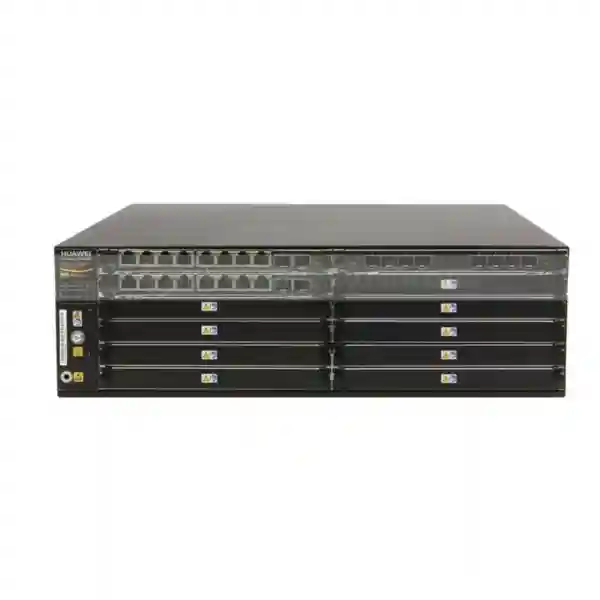
Huawei HiSecEngine USG6680F Firewall for High-Performance Enterprise Security
Build a resilient, application-aware perimeter and data-center security architecture with Huawei HiSecEngine technology, engineered for encrypted connectivity, threat prevention, segmentation, centralized operations, and high-availability deployment. FourTeck supports UAE organizations from technical discovery through bill-of-material validation, migration, installation, testing, and operational handover.
Huawei’s current public USG6600F family information lists models including USG6685F and USG6686F, while legacy USG6000 documentation lists USG6680 without an F suffix. This page preserves the requested product name, Huawei HiSecEngine USG6680F, but avoids treating unverified model-specific numbers as guaranteed. Confirm the exact part number, software release, subscriptions, power option, storage, interfaces, and optics before order placement.
What the Huawei HiSecEngine USG6680F is designed to solve
Modern UAE networks no longer have a clean distinction between an Internet edge, a private WAN, a remote-access zone, and a data-center perimeter. Business applications move between local server rooms, colocation facilities, public cloud platforms, SaaS environments, branch sites, contractor endpoints, and mobile users. At the same time, encryption is now common across web, application, API, and inter-site traffic. A next-generation firewall therefore has to do more than accept or deny sessions according to IP address and port. It needs to identify applications, understand users and security zones, inspect traffic at meaningful depth, enforce least-privilege policy, terminate or traverse encrypted tunnels, record useful telemetry, integrate with operational systems, and continue forwarding traffic when a component or path fails.
The Huawei HiSecEngine USG platform is built around this broader security role. Huawei describes the current USG6600F family as AI firewall platforms for next-generation data-center edge scenarios, with IPv4 and IPv6 dual-stack operation, firewalling, VPN, intrusion prevention, antivirus, bandwidth management, anti-DDoS capability, URL filtering, application identification, centralized operations, and threat-oriented visibility. For enterprises in Dubai, Abu Dhabi, Sharjah, Ajman, Ras Al Khaimah, Fujairah, and Umm Al Quwain, these functions can be combined into a single enforcement layer protecting Internet breakout, branch aggregation, partner connectivity, published applications, DMZ services, private-cloud segments, or selected east-west trust boundaries.
The operational value depends on architecture, not the appliance name alone. FourTeck therefore treats firewall procurement as a design exercise: determine inspected throughput rather than headline throughput, quantify encrypted traffic, model session concurrency and session creation rate, map physical and logical interfaces, confirm redundancy, define logging and retention, identify subscription dependencies, and establish change-control ownership. This approach is especially important for the requested USG6680F designation because current public Huawei family documentation and older USG6680 documentation use different model naming. The delivered solution should be tied to an exact manufacturer bill of materials and verified software release before implementation.
Perimeter Security
Control Internet-bound and inbound traffic using stateful policy, application identification, threat prevention, URL controls, address translation, anti-DDoS protections, and logging designed around business services rather than only port numbers.
Secure Connectivity
Build IPsec, SSL VPN, and GRE-based connectivity patterns for headquarters, branches, data centers, private clouds, service-provider links, and controlled remote access while planning crypto throughput and tunnel scale.
Segmentation
Separate user, server, guest, voice, management, OT, partner, and public-service zones with explicit policy, routable or VLAN-based boundaries, virtual firewall contexts where supported, and audited inter-zone access.
Operations & Visibility
Connect security policy to telemetry, threat events, traffic analysis, centralized administration, SNMP, Syslog, SSH, NETCONF-based integrations, monitoring, change control, and incident-response workflows.
Architecture-first sizing: why nominal firewall throughput is not enough
A firewall can process very different traffic profiles at very different rates. Large UDP packets forwarded with minimal inspection are computationally easier than a mixed production workload containing short web sessions, TLS negotiation, antivirus scanning, intrusion prevention, application control, URL classification, logging, policy lookups, NAT, and IPsec encryption. Procurement based only on a maximum Layer 3 forwarding figure can therefore produce a device that looks oversized on paper yet reaches an operational limit when full security services are enabled. The correct sizing target is the service combination that the organization will actually run during peak periods, with sufficient headroom for growth, failover, policy expansion, software updates, attack bursts, and temporary asymmetric events.
FourTeck normally starts by establishing measured or defensible peak traffic figures for each protected path. Internet utilization is separated into business browsing, SaaS traffic, public application publishing, cloud synchronization, large backups, voice and video, software updates, guest use, and remote-access flows. Inter-site traffic is evaluated separately because it may be encrypted by IPsec and may not require the same inspection stack as Internet traffic. Data-center segmentation introduces another dimension: east-west flows can be high bandwidth, can create many short-lived sessions, and can become sensitive to additional latency. The final design therefore considers aggregate throughput, packets per second, concurrent sessions, new sessions per second, VPN tunnel count, remote-user count, SSL inspection demand, interface capacity, routing scale, and log volume.
For the current Huawei USG6600F family, Huawei publishes multiple performance categories including IPv4 and IPv6 firewall throughput, NGFW throughput, enterprise-mix throughput, threat-protection throughput, IPsec VPN throughput, SSL inspection throughput, SSL VPN throughput, session scale, policy scale, virtual-firewall scale, and VLAN capacity. Those categories are more useful for engineering than a single marketing number because they reveal where a design may encounter a practical ceiling. The exact USG6680F designation should be matched to the correct official datasheet before any numeric performance promise is put into a quotation. During presales, the safer engineering method is to state the required workload first and then map it to the verified Huawei SKU and license bundle.
Application-aware policy and identity-oriented enforcement
Traditional ACLs allow or deny traffic according to addresses, protocols, and ports. That remains foundational, but modern applications frequently share TCP 443, use distributed cloud infrastructure, change endpoints dynamically, embed multiple functions in the same application family, or attempt to evade coarse port-based controls. Huawei states that its USG6600F platform can identify more than 6,000 applications and can apply control with granularity down to application functions. In practical terms, this allows security teams to move from a rule such as “allow HTTPS from users to Internet” toward a policy that distinguishes approved collaboration, business SaaS, software distribution, storage, social media, remote administration, anonymizers, file transfer, and other categories according to risk and business need.
Application control is most effective when the policy model is understandable. A large firewall with thousands of rules can become difficult to audit if rules are named inconsistently, objects are duplicated, service groups are overly broad, and historical exceptions are never removed. FourTeck therefore recommends a structured naming system for zones, address objects, service objects, applications, users, VPN peers, NAT objects, schedules, and security profiles. Rules should identify the business owner, source zone, source identity or subnet, destination zone, destination service, allowed application, required security inspection, logging level, and review date. Temporary rules should carry expiry dates. Broad any-to-any rules should be treated as exceptions requiring justification rather than default configuration.
User and device identity can further reduce dependence on IP addresses, but identity design must account for roaming, shared systems, service accounts, non-domain devices, guest users, and machine-to-machine traffic. In a UAE enterprise with Microsoft Entra ID, Active Directory, local authentication, or a mixture of identity systems, the firewall may form one enforcement point among several. The design objective is not to force every decision into the firewall; it is to ensure that the firewall receives enough context to enforce network trust boundaries consistently while upstream identity, endpoint, NAC, SIEM, and application platforms each perform their own controls.
Threat prevention: IPS, antivirus, web protection, and anti-DDoS controls
Huawei describes the USG6600F family as integrating intrusion prevention, antivirus, web protection, URL filtering, and DDoS attack mitigation. These controls serve different purposes and should be tuned individually. Intrusion prevention attempts to identify exploit patterns, protocol misuse, vulnerability-targeting traffic, and other malicious behavior. Antivirus scanning examines content for malicious files and variants. URL filtering applies policy according to web destinations and classifications. Web protection addresses attacks such as SQL injection and cross-site scripting patterns. Anti-DDoS functions observe abnormal connection or packet behavior and can apply source verification, reputation, fingerprinting, traffic limiting, or other mitigations depending on the enabled feature set and software release.
Enabling every signature at maximum sensitivity is not automatically the most secure operating model. Security policy must consider the protected asset, exposure, protocol, normal traffic profile, patch state, application architecture, acceptable false-positive rate, and incident-response capacity. A public e-commerce service, an ERP server accessible only over a site-to-site VPN, a user browsing zone, and an OT control network have different risk profiles. The firewall profiles should reflect those differences. High-confidence critical signatures can be placed in block mode. Lower-confidence signatures may initially be monitored to establish a baseline. Exceptions should be narrowly scoped to a specific source, destination, application, signature, and documented reason rather than disabling a protection category globally.
Threat prevention also depends on updates. Signature, reputation, URL-category, and malware-detection capabilities are only useful when subscriptions are valid and update connectivity is working. Operational monitoring should therefore include license expiry, signature age, failed update jobs, clock synchronization, DNS reachability, and connectivity to required update services. Change control is equally important: a security profile can be assigned correctly at deployment and later bypassed by a new policy added during troubleshooting. Regular rule review and configuration backup help detect this drift.
DDoS defense deserves particular care. A firewall can mitigate many protocol and connection attacks, but no on-premises device can stop an upstream volumetric flood that saturates the customer’s Internet circuit before traffic reaches the firewall. Organizations with high public exposure should combine local firewall controls with ISP filtering, upstream scrubbing, cloud DDoS services, resilient DNS, content delivery networks where appropriate, and tested incident escalation. The firewall remains important for connection-level defense and visibility, but it must be part of a layered availability strategy.
SSL/TLS inspection planning
Encrypted traffic protects confidentiality, but it also reduces visibility for network security controls. Where policy, law, privacy obligations, and application compatibility allow, TLS inspection can expose selected traffic to IPS, antivirus, application analysis, and URL policy. The design requires a trusted enterprise certificate authority, endpoint certificate deployment, clear bypass rules, user communication, privacy review, exception handling for certificate pinning, and capacity planning because decryption and re-encryption are compute-intensive.
Inspection should not be approached as “decrypt everything.” Financial services, healthcare portals, government services, personal communications, client-certificate applications, pinned applications, and regulated content may require bypass or special handling. A well-designed policy classifies traffic, selects what requires inspection, logs policy decisions, and measures the actual SSL inspection throughput requirement. Huawei publishes SSL inspection performance as a separate metric for current USG6600F models, reinforcing the need to size this feature independently of raw firewall forwarding.
IPsec and remote-access VPN design
VPN sizing combines encrypted throughput, tunnel count, peer diversity, routing design, failover expectations, authentication, and operational support. Site-to-site IPsec is commonly used between UAE offices, regional branches, cloud networks, partners, and disaster-recovery locations. Remote-access SSL VPN may support administrators, employees, contractors, or temporary project teams. Each use case should be separated by authentication method, user group, address pool, allowed resources, device posture where available, and logging requirements.
For branch connectivity, route-based VPN designs can simplify scaling and integration with dynamic routing, while policy-based designs may remain appropriate in smaller static environments. Crypto proposals should be standardized and reviewed for interoperability. Tunnel monitoring and dead-peer detection need to be tested, not assumed. Where the firewall pair operates in high availability, the team should verify the exact behavior of VPN state, tunnel renegotiation, asymmetric routing, and upstream/downstream path convergence during failover.
High availability and failure-domain engineering
A resilient firewall design is more than two appliances configured as a cluster. Real availability depends on the entire forwarding path: power feeds, rack PDUs, firewall nodes, interface cards, optics, patch panels, switches, carrier handoffs, routers, cross-connects, DNS, authentication services, management systems, and the upstream ISP or WAN. A firewall pair can remain healthy while the service fails because both nodes share the same access switch, the same power circuit, the same carrier router, or the same cross-connect. FourTeck therefore maps failure domains before selecting the HA cabling topology.
The desired failover behavior should be defined per service. Internet browsing may tolerate a brief session reset, while voice, payment applications, trading systems, healthcare workflows, or critical operational traffic may have stricter continuity requirements. Session synchronization, NAT state, VPN state, routing adjacency, ARP/ND behavior, link monitoring, BFD, dynamic routing timers, upstream switch convergence, and application retry behavior all influence what users actually experience. A successful firewall HA test must therefore include traffic tests, not just confirmation that the secondary node becomes active.
Power resilience matters in UAE data centers and on-premises server rooms. The verified Huawei BOM should specify whether the selected hardware includes dual power supplies and the required AC or DC modules. Each PSU should connect to an independent protected power source where the facility supports A/B feeds. Cabling should be labeled by device, interface, peer, circuit, and purpose. Spare optics and critical cables should be planned according to the organization’s support model. Configuration backups, software images, license files, implementation documents, and rollback instructions should be stored in an accessible operations repository rather than only on an engineer’s laptop.
Maintenance planning is part of availability. Security appliances require software updates for bug fixes, new functionality, security corrections, signature engines, and platform support. Before an upgrade, teams should validate the supported upgrade path, release notes, known issues, configuration compatibility, cluster behavior, license compatibility, transceiver support, management-platform compatibility, and rollback procedure. HA reduces outage risk, but only if the upgrade sequence and state synchronization are understood and tested.
Interfaces, optics, VLANs, and physical network integration
Interface planning must be tied to the exact hardware revision. Huawei’s current public USG6600F documentation shows that different models within the family use different combinations of GE copper, GE combo, SFP, 10GE SFP+, 25GE SFP28, 40GE QSFP+, and 100GE QSFP28 interfaces. The older USG6680 documentation describes a modular 3U system with expansion options and a different hardware architecture. Because the requested USG6680F designation does not map cleanly to the current public model list, the quotation should never assume a port layout from another model. FourTeck validates the chassis, included ports, expansion modules, transceiver types, fiber mode, connector type, and peer-device compatibility before finalizing the bill of materials.
Logical design is equally important. Firewalls may connect using access ports, 802.1Q trunks, routed links, link aggregation, subinterfaces, VLAN interfaces, or a mix of these methods. The choice affects troubleshooting and failure domains. A single high-capacity trunk can simplify cabling but concentrates many zones on one physical path. Dedicated interfaces can provide clearer physical separation but consume more ports and switch resources. Link aggregation increases link resilience and capacity when supported end to end, but member placement across switch stacks or MLAG pairs must be designed carefully to avoid split-brain or asymmetric forwarding problems.
Optics are a common source of deployment delays. A 10G interface does not by itself specify whether the project needs SR multimode, LR single-mode, direct-attach copper, active optical cable, or another medium. The correct choice depends on distance, patching infrastructure, connector type, transceiver support, data-center standards, and the peer switch. The same principle applies to 25G, 40G, and 100G interfaces. A complete firewall quotation should list every required optic and cable, including HA links, management links, console requirements, and spare units when the SLA justifies them.
VLAN scale is rarely the limiting factor in a normal enterprise, but design hygiene still matters. Avoid extending a broadcast domain through the firewall unless there is a specific requirement. Document which device owns the gateway IP, HSRP/VRRP equivalent, DHCP relay, routing adjacency, and first-hop security controls. Ensure that management interfaces reside on a protected administrative network and are not exposed directly to untrusted user or Internet zones. Out-of-band management is preferred for critical environments because it preserves access during production routing failures.
Routing, NAT, and multi-carrier Internet edge design
The firewall often becomes a routing participant as well as a security device. Small environments may use static routes and a default route toward a single ISP. Larger deployments may require OSPF, BGP, policy-based routing, equal-cost paths, route redistribution, or dynamic routing across IPsec tunnels. The decision should be made by network architecture rather than convenience. Static routing is predictable and easy to audit at small scale, while dynamic routing improves convergence and operational scalability where multiple sites, carriers, data centers, or internal routing domains are involved.
Dual-ISP designs require clarity about inbound and outbound traffic behavior. For outbound Internet access, policy-based routing or multiple routing tables may select a carrier according to source zone, application, link quality, or preference. For inbound published services, public IP ownership and DNS architecture determine whether traffic can move cleanly between carriers. Provider-independent address space and BGP may simplify some scenarios but introduce registry, routing-policy, and operational requirements. Provider-assigned addresses can be simpler, but failover of inbound services may depend on DNS changes, reverse proxies, cloud load balancers, or application-layer mechanisms rather than only firewall routing.
NAT should be documented as a security and application dependency, not treated as an afterthought. Source NAT pools can affect attribution, SaaS allowlists, geolocation, and connection scale. Destination NAT for published services should map to explicit security policies and should not automatically imply broad access. Hairpin traffic, overlapping private address space, partner VPNs, and cloud networks can create complex NAT requirements. The cleanest design minimizes translation where it is unnecessary, uses consistent objects, and records ownership for every public address.
IPv6 readiness deserves separate review. Huawei positions the current USG6600F family with IPv4/IPv6 dual-stack capability. An organization can have IPv6 enabled on endpoints or ISP links even if most applications still rely on IPv4. Security policy, RA handling, DHCPv6, DNS, routing, threat inspection, and logging should therefore be reviewed so that IPv6 does not become an unmanaged bypass around an otherwise well-controlled IPv4 design.
Operational visibility, logging, SIEM integration, and automation
Logs with purpose
Log denied traffic where it helps detect scanning, misconfiguration, policy violations, or attack activity, and log allowed traffic for sensitive zones where accountability is required. High-volume rules may need selective logging to control storage and SIEM cost. Time synchronization is mandatory so firewall events correlate with endpoint, identity, server, switch, and application logs.
Monitoring and health
Track CPU, memory, session utilization, interface errors, drops, bandwidth, VPN state, HA status, temperature, fan and power alarms, license status, signature update age, disk health where applicable, and policy hit counts. Monitoring should alert on trends before they become incidents, not only on total device failure.
Open integration
Huawei’s current family information references NETCONF interfaces and management integration through technologies such as SNMP, SSH, and Syslog. These interfaces can support configuration governance, inventory, event forwarding, and automation, provided access is restricted, credentials are protected, commands are tested, and changes remain subject to approval workflows.
Configuration governance
Maintain versioned backups, approval records, rollback plans, policy-owner information, and periodic rule reviews. Automation should reduce repetitive work without bypassing governance. Every automated action should have authentication controls, error handling, audit logs, and a defined boundary between read-only monitoring and configuration-changing privileges.
Security policy migration from an existing firewall
Replacing a firewall is rarely a simple export-and-import task. Object syntax, application databases, service definitions, NAT semantics, zone logic, VPN configuration, route behavior, certificate handling, security profiles, and high-availability mechanisms differ between vendors and generations. A direct one-to-one conversion can reproduce years of accumulated technical debt. FourTeck’s preferred migration process starts with discovery and normalization. Existing objects and policies are exported, duplicate and unused objects are identified, any-to-any rules are reviewed, expired temporary access is removed, and critical business flows are validated with application owners.
The new Huawei rulebase is then built according to a consistent object model. Rules are grouped by function or trust boundary rather than by the order in which tickets were historically received. NAT rules are mapped to public IP ownership and application publishing requirements. VPN configurations are reconstructed with standardized crypto settings and documented peer information. Routing is compared against the existing production state, including less obvious elements such as floating static routes, policy routes, route maps, DHCP relay, multicast requirements, or asymmetric return paths.
Cutover plans should include a traffic matrix and verification script. Test cases can cover DNS, DHCP where relevant, browsing, SaaS, email, ERP, VoIP, published websites, APIs, partner links, site-to-site VPNs, remote access, management access, backup traffic, monitoring, NTP, identity services, and application-specific ports. Each test has a responsible owner, expected outcome, and rollback threshold. Packet captures and firewall session tables are used to isolate issues quickly if an application fails after migration.
Rollback should be physically and logically realistic. If the migration involves re-cabling, public IP changes, switch VLAN changes, or routing changes, reversing the firewall configuration alone may not restore service. The rollback plan must include cable maps, previous switch configuration, ISP state, DNS changes, route changes, and application dependencies. A maintenance window is successful when the team can prove either that the new firewall meets acceptance criteria or that the old service can be restored within the agreed business window.
Where the Huawei HiSecEngine platform fits in a UAE enterprise
A large firewall platform can serve several architectural roles. At an enterprise Internet edge, it can enforce outbound application policy, inspect inbound published services, terminate VPNs, perform NAT, and feed security telemetry to centralized operations. At a data-center edge, it can separate server networks from WAN, Internet, partner, cloud, and management zones. At a branch or campus aggregation point, it can control inter-zone traffic between user, guest, server, voice, IoT, and operational networks. At a disaster-recovery site, it can replicate the security posture of the primary data center while providing independent Internet or WAN connectivity.
The ideal role depends on traffic direction and trust boundaries. A firewall is most effective when policy matches a meaningful change in trust. Placing every internal VLAN behind separate firewall interfaces may create excessive complexity and hairpin traffic. Placing the firewall only at the Internet edge may leave high-value east-west paths unsegmented. Architecture should therefore identify assets, users, applications, data flows, threat models, compliance requirements, and operational ownership before deciding where inspection boundaries belong.
For UAE companies with regional offices in the Middle East or Africa, the same platform can participate in a broader connectivity design. FourTeck can coordinate WAN, routing, security policy, site-to-site encryption, remote access, switching, wireless, servers, and managed IT services. Customers that need adjacent infrastructure can review the broader UAE portfolio at FourTeck UAE, specialist security resources at Firewall Dubai, operational support capabilities at FourTeck IT Services UAE, and cross-region coverage through FourTeck Africa.
Regional rollouts benefit from standardization but should not ignore local constraints. Carrier handoffs, IP addressing, data-center access procedures, customs lead times, spare strategy, support entitlement, power standards, fiber infrastructure, remote-hands capability, and maintenance windows may differ by site. A global template should therefore define a standard architecture with controlled site-specific exceptions rather than assuming every location is identical.
Hardware validation for the requested USG6680F designation
| Design item | What must be verified | Why it matters |
|---|---|---|
| Exact Huawei model / part number | Chassis code, BOM, revision, regional sales designation | Current public USG6600F documents list USG6685F and USG6686F, while older documents list USG6680. Exact identification prevents incorrect specification claims. |
| Software release | Supported release train, feature licenses, upgrade path | Feature availability, security fixes, UI behavior, integrations, and hardware support can vary by release. |
| Physical interfaces | Included copper/fiber ports, speed, combo behavior, expansion slots | Prevents last-minute shortages or use of an unsupported port-speed assumption. |
| Optics and cables | SFP/SFP+/SFP28/QSFP type, SR/LR, SM/MM, DAC/AOC, connector | A correct firewall chassis cannot connect if the physical media or transceivers are wrong. |
| Power and rack | AC/DC supplies, redundancy, plug type, rack units, depth, airflow | Ensures facility compatibility, A/B power design, and proper rack clearances. |
| Storage | Optional disk support, capacity, RAID behavior, hot swap where applicable | Local logging and storage options vary materially between legacy and current hardware families. |
| Security subscriptions | IPS, AV, URL, reputation, support entitlement, term length | Advanced detection depends on active services, updates, and appropriate licenses. |
| Performance profile | Threat protection, SSL inspection, IPsec, sessions, new sessions, packet mix | Real workload sizing must use the metric that corresponds to enabled services. |
Legacy USG6680 technical context versus the modern USG6600F family
The historical Huawei USG6680 was a 3U modular firewall platform. Older Huawei product materials describe a 442 mm wide, 470 mm deep, approximately 130.5 mm high chassis, optional hot-swappable SAS disks capable of RAID1 in supported configurations, redundant power options, modular interface capacity, and a high-end position within the USG6600 generation. Historical product portfolio material lists firewall throughput up to 40 Gbit/s, combined firewall plus security-awareness plus IPS throughput around 15 Gbit/s, firewall plus security-awareness plus antivirus around 13 Gbit/s, up to 12 million concurrent HTTP 1.1 sessions, up to 400,000 new HTTP 1.1 sessions per second, IPsec throughput around 18 Gbit/s under the stated test profile, and up to 1,000 virtual firewalls. Those figures describe the older USG6680 generation and should not be automatically assigned to a product labeled USG6680F.
The modern USG6600F family is architecturally different and uses a 1U form factor across the currently published family. Huawei’s 2025/2026 family information lists USG6615F, USG6625F, USG6635F, USG6655F, USG6685F, USG6636F, USG6656F, and USG6686F. Fixed interfaces and performance vary significantly across those models. Current family literature also publishes modern metrics such as enterprise-mix NGFW throughput, enterprise-mix threat-protection throughput, SSL inspection throughput, secure SD-WAN EVPN throughput for selected models, and large-scale VPN and virtual-firewall capacities.
This distinction matters commercially. If a customer intends to purchase a current 1U HiSecEngine USG6600F platform, the exact model may be USG6685F, USG6686F, or another family member depending on the required capacity and interface mix. If the customer is maintaining an installed legacy USG6680 estate, spare parts, software support, subscriptions, interface cards, and lifecycle status become the central questions. If “USG6680F” is a distributor or project shorthand, the purchase order should still reference the manufacturer-recognized SKU.
FourTeck can build the commercial offer around the customer’s exact intent without masking this naming issue. The presales outcome should be a validated BOM, a feature matrix, an interface and optic map, performance assumptions, subscription term, support level, and implementation scope. That documentation protects both the customer and the implementation team from discovering after delivery that the wrong physical model, wrong transceiver family, insufficient inspection capacity, or incomplete license bundle was ordered.
Licensing and lifecycle considerations
Enterprise firewalls typically combine perpetual platform functionality with time-based support and security services. Exact Huawei entitlements vary by product generation, sales region, bundle, and software release, so the proposal should list each license rather than use an ambiguous statement such as “full license.” The relevant questions include whether IPS signatures are included, whether antivirus scanning requires a subscription, how URL filtering and cloud URL databases are licensed, whether reputation feeds are included, how remote-access user scale is enabled, whether centralized management is part of the solution, and what vendor support term covers hardware replacement and software access.
Subscription expiry should be treated as an operational risk. A firewall may continue forwarding traffic when a security service expires, but the effectiveness of updated threat intelligence can degrade. Procurement teams should record start and end dates, renewal lead times, contract owners, and escalation paths. Where budgets permit, aligning support and subscription terms across an HA pair simplifies renewal management. For multi-site projects, co-termination can reduce administrative overhead, though the commercial terms should be confirmed at order time.
Hardware lifecycle is also important because the requested model name does not exactly match the current public USG6600F model list. If the requirement originates from an old tender, inherited network diagram, asset database, or third-party quote, the actual product may belong to an earlier generation. In that case, FourTeck can help determine whether the objective is like-for-like replacement, expansion, spare procurement, software support, or migration to a current HiSecEngine model. A current-model replacement may offer higher density or more modern inspection capacity, but it must be validated against existing interfaces, VPN peers, routing design, licensing, and management processes.
Supportability should be included in architecture scoring. A technically powerful device that cannot receive timely security updates, replacement hardware, or vendor support may not be appropriate for a new critical deployment. Conversely, a stable installed platform may remain suitable for a defined period if it is still supported and meets security requirements. The decision should be based on verified lifecycle status, business risk, migration cost, and planned infrastructure roadmap.
UAE deployment engineering: practical site-readiness factors
A firewall project can be delayed by facilities issues even when the network design is complete. Before installation, confirm rack space, rack depth, rail or mounting hardware, front and rear clearance, airflow direction, available A/B power feeds, PDU socket type, UPS capacity, grounding, equipment-room temperature, and cable pathways. If the firewall will be installed in a colocation facility, verify access procedures, remote-hands policy, cross-connect completion, shipment receiving process, labeling standards, and whether technicians need advance approval or work permits.
Carrier readiness should be confirmed independently of the firewall shipment. Record the circuit ID, handoff medium, VLAN tag, IP addressing, default gateway or BGP peer information, MTU, committed bandwidth, burst terms, DDoS service details, and support contacts. For dual carriers, determine whether they terminate in diverse meet-me rooms or merely use different logical services over the same local physical path. Physical diversity is particularly important for sites where Internet access, cloud applications, and remote work are business-critical.
Change windows in UAE enterprises often involve multiple stakeholders: customer network engineers, security teams, application owners, ISP NOC staff, data-center remote hands, third-party support providers, and management approvers. A concise runbook improves execution. It should define the command sequence, cable changes, expected routing state, application tests, decision points, escalation contacts, and rollback steps. Engineers should have offline copies of key configuration and addressing information in case management-plane access is temporarily lost.
Environmental conditions also influence support planning. Huawei publishes operating temperature and humidity ranges for each model family, but facilities should aim for stable data-center conditions rather than operating continuously near the hardware limits. Dust, blocked airflow, overfilled racks, hot-air recirculation, and overloaded PDUs can create failures that appear to be network problems. Routine operational checks should include interface error counters, fan and temperature alarms, power supply status, and visible cable condition.
Security architecture patterns
Pattern 1: Internet edge + DMZ
Separate inside, outside, DMZ, management, and VPN zones. Apply destination NAT only for explicitly published services. Use threat-prevention profiles on inbound services, application and URL controls on outbound user traffic, anti-spoofing at zone boundaries, and dedicated policy for management systems.
Pattern 2: Dual data-center perimeter
Deploy an HA pair at each site with routed connectivity between data centers. Keep security policy consistent while allowing site-specific public IP, carrier, and server differences. Test failure of a firewall node, upstream switch, WAN path, and application site independently.
Pattern 3: Branch VPN hub
Aggregate many IPsec branch tunnels at a central firewall with standardized tunnel templates, route design, monitoring, and failover. Size tunnel scale and aggregate encryption throughput separately from Internet browsing and security inspection load.
Pattern 4: Internal segmentation
Place high-value server, management, OT, payment, or regulated networks behind explicit trust boundaries. Start with observed traffic and a documented dependency map, then reduce broad access gradually to avoid breaking undocumented application flows.
Policy engineering for least privilege without operational disruption
Least privilege is an objective, not a one-time rule cleanup. Businesses change continuously: applications migrate to SaaS, server addresses change, partners are onboarded, temporary projects become permanent, administrators add troubleshooting exceptions, and users adopt new cloud tools. A policy that was restrictive on day one can become overly permissive over time. The firewall therefore needs an operating process that ties rule changes to ownership, purpose, expiry, logging, and periodic review.
A useful baseline is to classify rules by trust boundary and business function. Internet egress policies are separated from inbound publishing, branch connectivity, remote access, server-to-server traffic, infrastructure services, and administrative management. Shared infrastructure such as DNS, NTP, directory services, certificate services, backup, monitoring, and patch management can be grouped carefully, but those groups should not become universal exceptions that bypass segmentation. Administrative protocols such as SSH, RDP, HTTPS management, SNMP write access, and database consoles should come only from approved management networks or jump hosts.
Policy hit counts and traffic logs can identify unused rules, but absence of hits over a short period is not proof that a rule is unnecessary. Month-end processing, annual audits, disaster-recovery tests, vendor maintenance, and seasonal operations may activate only occasionally. Review should combine telemetry with business-owner confirmation. When a rule is suspected to be obsolete, disabling it temporarily with a monitored change window can be safer than immediate deletion, provided rollback is straightforward.
Documentation quality directly affects incident response. During a security event, analysts need to know whether a connection is expected, who owns the destination system, why a rule exists, and whether the source should be permitted. Clear policy names, ticket references, business-owner fields, and zone diagrams reduce time spent reconstructing intent. FourTeck can deliver a policy workbook alongside the firewall configuration so operations teams have a human-readable reference for ongoing governance.
Performance test methodology and acceptance criteria
Firewall datasheet numbers are useful for model selection, but production acceptance should focus on the customer’s own success criteria. Before cutover, establish the expected throughput range, critical application response, VPN stability, failover time, routing convergence, CPU and memory behavior, log generation, and management reachability. During testing, measure both normal operation and failure scenarios. A firewall that passes a single speed test may still fail an HA, routing, DNS, authentication, or application requirement.
Throughput tests should reflect the real path. Internet speed tests measure the entire ISP path and remote server, not only firewall capacity. Internal test tools can isolate firewall forwarding but may not reproduce threat inspection or encrypted Internet behavior. The most meaningful validation uses a combination of synthetic traffic, real applications, session-table observation, interface counters, policy logs, CPU metrics, and user acceptance. When TLS inspection is enabled, include representative browser and application traffic because certificate handling and pinned applications can expose compatibility issues that raw throughput tools will not show.
HA acceptance should include controlled failure of links and nodes. Test a monitored WAN link failure, LAN-side link failure, active-node failure, and restoration. Observe whether sessions continue or reset, how routing adjacencies behave, whether VPNs renegotiate, how long applications take to recover, and whether the cluster returns to a stable state. The goal is not necessarily zero packet loss; the goal is behavior that matches the agreed availability objective and does not create loops, black holes, or split-brain conditions.
Security acceptance can include policy verification, blocked-application tests, URL category tests, IPS test traffic in a controlled environment, antivirus test files approved for security validation, remote-access authentication, administrator role separation, logging to SIEM, NTP synchronization, configuration backup, and alerting. Every acceptance item should be recorded as pass, fail, or accepted exception with an owner. This turns commissioning from an informal “Internet works” check into auditable technical handover.
Management-plane hardening
The firewall’s own management plane is a high-value target. Administrative services should be reachable only from dedicated management networks, jump hosts, or secured out-of-band paths. Internet-facing management access should be avoided. Use role-based accounts, strong authentication, individual administrator identities, secure protocols, and centralized authentication where appropriate. Remove or disable unused services, restrict source addresses, and monitor failed administrative logins.
Management traffic should be included in the network’s resilience design. If the only management path traverses the same production routing that the firewall is responsible for, a routing error can remove access precisely when engineers need it most. Out-of-band management through a separate switch, console server, or management network provides a recovery path. Console credentials and access procedures should be protected but available to authorized responders.
Configuration backups should be automated where possible and protected as sensitive information. Firewall configurations can contain public IPs, internal addressing, VPN peer details, usernames, certificates, and other security-relevant data. Backup repositories require access control, encryption, retention policy, and versioning. A backup is only valuable if restoration is understood; periodic lab or spare-device validation can confirm that the team knows how to recover configuration and licenses.
Administrative changes should generate audit records. Integrating logs with a SIEM or centralized log system makes it easier to correlate configuration changes with incidents and outages. Emergency changes should still be documented after service restoration. The objective is not bureaucracy for its own sake; it is the ability to understand what changed, who changed it, why it changed, and how to reverse it when production behavior deviates from expectations.
Remote access and contractor security
Remote access should be segmented by user role rather than delivered as a generic “VPN into the LAN.” Employees may require access to internal applications, while vendors may need only a specific server, port, and maintenance window. Administrators may need management access through a jump host, and executives may require access to selected collaboration systems. Each group should receive the minimum reachable network scope, with authentication and logging appropriate to risk.
Multi-factor authentication should be considered wherever the selected Huawei solution and identity architecture support it. Password-only remote access is vulnerable to credential theft, reuse, phishing, and brute-force attacks. Authentication logs should be forwarded centrally, and unusual location, time, or volume patterns should be investigated. Shared VPN accounts make attribution difficult and should be avoided.
Remote-access address pools need routing and policy planning. Internal systems must know how to return traffic to VPN clients, and overlapping private address space can cause problems for users connecting from hotels, home networks, or customer sites. DNS behavior, split tunneling, full tunneling, proxy settings, and access to SaaS applications should be tested. Full tunneling centralizes inspection but increases firewall and Internet bandwidth usage; split tunneling reduces load but moves some traffic outside central inspection. The right choice depends on security objectives and endpoint controls.
Vendor access should be time-bound wherever possible. A maintenance account can be disabled outside an approved window, and the associated firewall rule can include a schedule. For sensitive systems, route vendor traffic through a monitored jump host or privileged-access platform rather than allowing direct access to production subnets. Record the business owner, vendor contact, allowed destination, approved protocol, expiry date, and incident escalation path.
Cloud and hybrid connectivity
UAE enterprises increasingly operate hybrid environments where users and servers consume resources in Microsoft Azure, AWS, Oracle Cloud, private cloud, colocation facilities, and SaaS platforms. The firewall can participate through IPsec tunnels, routed private connections, Internet inspection, or data-center aggregation. The key is to avoid forcing every cloud flow through an on-premises choke point unless there is a clear security or compliance reason. Network security should follow the application architecture.
Cloud IPsec connectivity needs coordination with cloud route tables, security groups, network ACLs, virtual gateways, BGP settings, and overlapping address space. The firewall policy is only one control plane. A tunnel can show “up” while applications fail because a cloud subnet lacks a return route, a security group blocks the port, or DNS resolves to an unreachable private address. Troubleshooting therefore requires visibility on both sides of the tunnel.
For high availability, consider whether both firewall nodes can maintain cloud tunnels, how failover changes public source IPs, whether the cloud peer accepts multiple tunnel endpoints, and whether dynamic routing is used. If a site has two ISPs, a cloud design may use multiple tunnels for path resilience. However, more tunnels add routing and monitoring complexity. The design should make the preferred and backup paths explicit.
SaaS traffic is different from private cloud connectivity. Applications such as Microsoft 365 may use large distributed address ranges and change endpoints over time. Static IP allowlists can become difficult to maintain. Application-aware policy and vendor-supported endpoint information can help, but the organization should avoid fragile rules that depend on obsolete address lists. Where direct local Internet breakout is appropriate, security policy, endpoint protection, identity controls, and DNS security work together rather than forcing all SaaS traffic through a central data center.
FourTeck implementation scope for Huawei firewall projects
FourTeck can support a firewall project as a supply-only engagement, a design-and-deploy project, a migration program, or an ongoing managed-support arrangement. The most reliable implementations define responsibilities early. Vendor support covers product-level defects and entitlement; FourTeck engineering covers architecture, configuration, migration, integration, and troubleshooting within the agreed scope; customer teams provide business requirements, change approvals, application validation, IP information, carrier coordination, and access to existing infrastructure.
A typical professional-services workflow includes discovery, traffic and policy assessment, high-level design, low-level design, BOM validation, licensing confirmation, pre-staging, software baseline selection, configuration build, lab or bench testing where practical, rack-and-stack coordination, cutover, application validation, HA testing, documentation, knowledge transfer, and post-change support. Complex projects may add policy recertification, multi-site templates, centralized management, SIEM integration, automation, cloud tunnels, BGP design, remote-access migration, certificate services, or staged decommissioning of the old platform.
Pre-staging is valuable because it moves many risks out of the maintenance window. Device inventory, serial numbers, licenses, firmware, interface modules, power supplies, optics, initial addressing, management access, HA pairing, objects, and base policy can be validated before the unit reaches production. This is particularly important for the USG6680F request because the exact model designation should be verified during BOM review rather than discovered at installation.
Documentation is delivered for operations, not only for project closure. A practical handover pack can include physical topology, logical topology, interface schedule, VLAN map, routing table summary, HA design, VPN inventory, NAT inventory, security-policy workbook, administrator access method, backup procedure, monitoring requirements, license list, software version, support information, acceptance-test results, and rollback notes. This reduces dependence on individual engineers and gives the customer a maintainable security baseline.
Frequently asked technical questions
Is USG6680F an officially listed current Huawei USG6600F model?
The current public Huawei USG6600F family information reviewed for this page lists USG6615F, USG6625F, USG6635F, USG6655F, USG6685F, USG6636F, USG6656F, and USG6686F. Older Huawei documentation lists a USG6680 in the previous USG6000 generation. Therefore, the exact USG6680F designation should be confirmed against the Huawei part number or distributor BOM before purchase.
Can FourTeck quote a current equivalent if the intended model is legacy?
Yes. The replacement should be selected from verified current models after comparing inspected throughput, SSL inspection, IPsec, session scale, interface mix, HA requirements, subscriptions, management integration, rack and power constraints, and migration compatibility. A simple name-based replacement can be misleading because newer appliances may use different port densities and performance categories.
Should sizing use firewall throughput or threat-protection throughput?
Use the metric that reflects the intended security services. If IPS, antivirus, application control, and TLS inspection will be enabled on a significant share of traffic, raw firewall throughput is not the correct sizing basis. Build a traffic profile and apply headroom for growth, failover, encrypted traffic, and burst conditions.
Can the firewall be used for site-to-site IPsec and remote users at the same time?
Huawei’s HiSecEngine family supports multiple VPN technologies, but the exact tunnel and remote-user scale depends on the selected model and licenses. Aggregate encrypted throughput, authentication design, routing, address pools, and HA behavior should be validated during sizing.
Do we need SSL inspection?
Not for every flow. SSL inspection is a risk-based control. It can improve visibility into encrypted web traffic but introduces privacy, certificate, compatibility, and performance considerations. Use it selectively according to business need, regulation, application behavior, and endpoint trust.
What information is needed for an accurate quotation?
Provide the exact requested model or manufacturer part number if available, Internet and WAN bandwidth, expected growth, enabled security services, number of sites, VPN users, tunnel count, critical applications, interface speeds, fiber types, HA requirement, routing protocols, public IP design, support term, subscription term, rack/power constraints, and whether migration or implementation services are required.
Decision recap: when this class of Huawei firewall is appropriate
Strong fit
Organizations that need a high-capacity enterprise security boundary with stateful firewalling, application control, threat prevention, encrypted connectivity, segmentation, centralized operations, and resilient deployment across Internet, data-center, branch, or hybrid-cloud paths.
Validate carefully
Projects with heavy TLS inspection, very high new-session rates, large VPN populations, multi-100G interfaces, extensive internal segmentation, unusual packet sizes, strict latency objectives, or legacy application dependencies should be modeled against the exact Huawei datasheet and software release.
Do not assume
Do not assume that the historical USG6680 and a requested USG6680F have the same chassis, ports, performance, storage, power, or licenses. The current USG6600F naming uses different published model numbers. Procurement must be tied to an exact BOM.
Operational priority
Select the platform that security and network teams can operate reliably. Policy quality, monitoring, updates, HA testing, documentation, support, and change governance determine long-term security value as much as headline hardware capacity.
Quotation input checklist for Huawei HiSecEngine USG6680F / validated equivalent
For a technically accurate UAE quotation, provide as many of the following items as possible. Missing values can be estimated during discovery, but clearly stated assumptions make the design safer and the commercial offer easier to compare.
Existing part number, tender model, photograph, serial family, or Huawei BOM if available.
Current bandwidth, peak utilization, future circuit upgrades, and whether traffic is symmetrical.
IPS, antivirus, URL filtering, application control, SSL inspection, anti-DDoS, sandbox or related requirements.
Number of site-to-site peers, remote users, expected encrypted throughput, authentication method, and cloud tunnels.
1G/10G/25G/40G/100G needs, copper vs fiber, SM/MM distance, connector type, and peer switch models.
Single appliance or HA pair, A/B power, dual switches, dual ISPs, session continuity expectations, and DR topology.
Static, OSPF, BGP, policy routing, carrier addressing, NAT pools, inbound services, and IPv6 requirements.
Supply only, pre-staging, rack installation, migration, policy conversion, VPN migration, testing, documentation, or managed support.
Consult FourTeck before locking the Huawei firewall BOM
The requested Huawei HiSecEngine USG6680F name should be validated against the actual Huawei SKU before purchase. FourTeck can compare the requirement with current HiSecEngine USG6600F options, legacy USG6680 context, interface density, inspection performance, VPN scale, power and rack constraints, subscriptions, and support terms. The result is a quotation that is technically traceable instead of relying on a model name alone.
For deployment projects, FourTeck can also convert existing policy, define the HA topology, select optics, coordinate carrier handoffs, stage the firewall, migrate VPNs, perform cutover testing, validate applications, document the environment, and hand over an operational baseline to the customer’s IT and security teams.

Reviews
There are no reviews yet.