
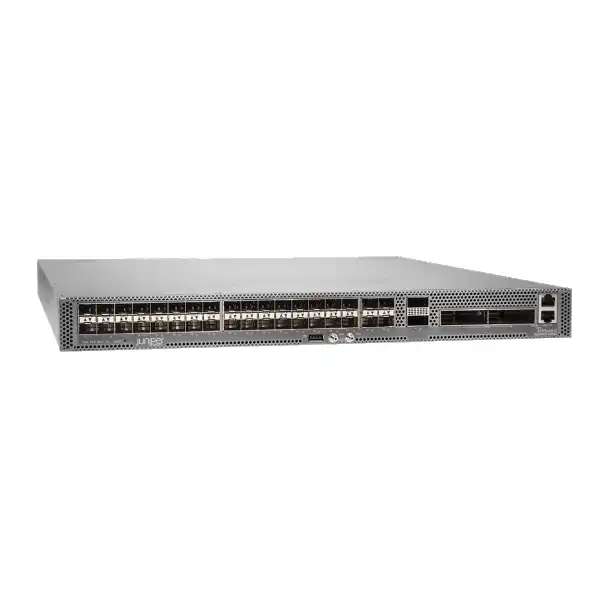
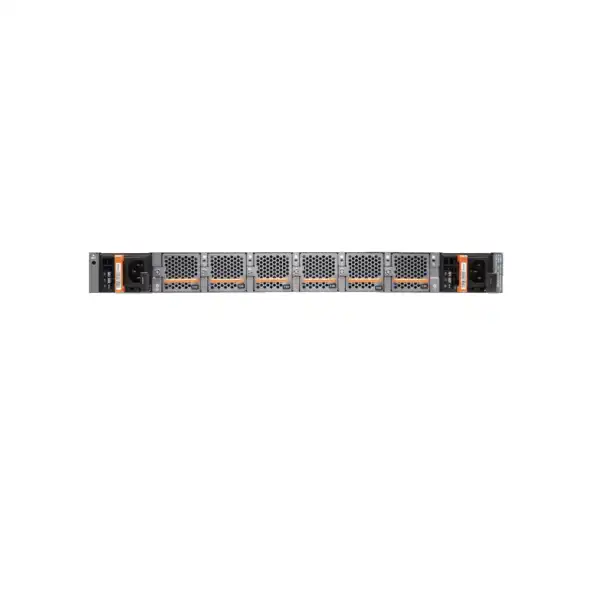
Juniper ACX5400 Universal Metro Router Dubai
A practical buying guide for UAE operators evaluating the ACX5448, ACX5448-M and ACX5448-D for dense 1/10GbE aggregation, 100GbE uplinks, secure metro transport and packet-optical convergence.
Direct answer: what is the Juniper ACX5400 and who is it for?
The Juniper ACX5400 is a family of compact 1U Universal Metro Routers designed for high-capacity Ethernet aggregation and IP/MPLS service delivery. It is mainly used where many 1GbE or 10GbE access links must be concentrated into 40GbE or 100GbE transport, and where operators need carrier-oriented routing, Ethernet services, traffic engineering, timing, operational automation or specialised transport functions in a small rack footprint.
Service providers, wholesale carriers, mobile transport teams, utility networks, large campuses, government networks and enterprises operating private metro infrastructure should consider the ACX5400 when the design sits between lower-speed access equipment and a higher-capacity core. The single most important factor to confirm is the exact ACX5400 variant, because ACX5448, ACX5448-M and ACX5448-D have different physical port mixes and are intended for different network roles.
FourTeck can help determine the right variant, airflow direction, AC or DC power supply configuration, optical transceivers, breakout requirements, coherent optics where relevant, software license level, support coverage, installation scope and migration plan. That validation matters because a quote based only on the label “ACX5400” can miss material differences in port count, MACsec capability, optical transport design and rack deployment.
Why the ACX5400 family matters in a metro network
Metro networks have a difficult job: they must aggregate large numbers of relatively modest access links while preserving service separation, predictable latency, operational visibility and enough headroom for rapid growth. A branch router or ordinary data-centre switch may provide Ethernet interfaces, but that does not automatically make it suitable for carrier aggregation. The ACX5400 family is positioned differently. It combines dense Ethernet connectivity with Junos OS routing and service-provider features so the aggregation layer can participate directly in Layer 2 services, Layer 3 services and MPLS-based transport rather than functioning only as a basic handoff device.
The family is especially relevant when access capacity is moving from 1GbE toward 10GbE while the aggregation and core layers are standardising on 100GbE. This transition creates a practical density problem: an operator may need dozens of 10GbE customer, cell-site, PON, enterprise or access-node links at one location, but wants to avoid consuming several rack units or building an additional switching tier. A 1U platform with a high concentration of SFP/SFP+ ports and multiple high-speed uplinks can simplify that physical design.
The three ACX5400 variants address different versions of that same challenge. The standard ACX5448 prioritises dense Ethernet aggregation. The ACX5448-M trades four access-facing ports for additional high-speed uplink capacity and MACsec support on its 1/10GbE interfaces. The ACX5448-D reduces the conventional access-port count further but adds coherent 100G/200G CFP2-DCO interfaces, allowing packet and optical functions to converge in locations where a separate transponder layer might otherwise be required. Treating these as interchangeable products would therefore be a procurement mistake.
For Dubai and wider UAE deployments, the attraction is not simply high port count. Space, cooling, power-feed architecture, optical reach, network resiliency and service activation processes all affect the real suitability of a metro platform. The correct evaluation considers the complete site and topology, not just headline throughput.
ACX5400 model selection: ACX5448 vs ACX5448-M vs ACX5448-D
ACX5448: dense Ethernet aggregation
The ACX5448 provides forty-eight 1GbE/10GbE SFP/SFP+ ports and four 100GbE QSFP28 ports, with the high-speed ports also supporting 40GbE operation and breakout options where supported by optics, cabling and configuration. It is the most straightforward member of the family for sites that need maximum conventional 1/10GbE fan-in without a requirement for line-side coherent optics or the ACX5448-M’s MACsec implementation.
A typical fit is a metro aggregation point collecting many enterprise, access-ring or mobile transport interfaces and forwarding them toward a 100GbE core. Buyers should still confirm whether four 100GbE-class uplink positions provide enough resilience and growth capacity for the intended topology.
ACX5448-M: MACsec-oriented aggregation
The ACX5448-M provides forty-four 1GbE/10GbE SFP/SFP+ ports and six 100GbE QSFP28 ports. Its distinguishing capability is MACsec on the forty-four 1/10GbE ports. That makes this model especially relevant when Ethernet links between trusted network devices traverse environments where link-layer encryption is required as part of the transport security design.
MACsec does not remove the need for a complete security architecture, and its usefulness depends on the peer devices, software release, key-management method and exact service design. Procurement should verify the end-to-end MACsec requirement rather than selecting the “M” model only because encryption appears desirable.
ACX5448-D: packet-optical convergence
The ACX5448-D provides thirty-six 1GbE/10GbE SFP/SFP+ ports, two 100GbE QSFP28 ports and two line-side 100G/200G CFP2-DCO coherent interfaces. It is intended for designs where the router can terminate coherent DWDM wavelengths directly and therefore reduce reliance on separate packet and optical appliances at selected sites.
This version requires a more detailed optical engineering conversation. Fibre route characteristics, wavelength plan, amplifier chain, dispersion, optical power budget, modulation choice and interoperability expectations matter. The correct quote must include compatible coherent modules and must be based on an actual optical path rather than only the required Ethernet bandwidth.
Core hardware specifications buyers should validate
| Specification | ACX5448 | ACX5448-M | ACX5448-D |
|---|---|---|---|
| Form factor | 1U | 1U | 1U |
| System throughput | Up to 800 Gbps | Up to 800 Gbps | Up to 800 Gbps family class; validate exact forwarding design and optical mode |
| 1/10GbE ports | 48 SFP/SFP+ | 44 SFP/SFP+ | 36 SFP/SFP+ |
| 100GbE-capable ports | 4 QSFP28 | 6 QSFP28 | 2 QSFP28 plus coherent line-side interfaces |
| Coherent line interfaces | No CFP2-DCO line-side ports | No CFP2-DCO line-side ports | 2 × 100G/200G CFP2-DCO |
| MACsec distinction | Not the family variant selected for MACsec capability | MACsec on the 44 × 1/10GbE ports | Not the family variant selected for MACsec capability |
| Power options | AC or DC orderable variants | AC or DC orderable variants | AC or DC orderable variants |
| Airflow | AFI or AFO orderable variants | AFI or AFO orderable variants | AFI or AFO orderable variants |
Physical dimensions and maximum power draw vary by model. Published family data places the products in a standard 1U rack class, but chassis depth differs significantly enough to matter in shallow cabinets, especially for the ACX5448-M. The standard ACX5448 is approximately 43.84 cm wide, 4.33 cm high and 55.41 cm deep with field-replaceable units; the family also supports AC and DC supply variants. A quotation should use the exact hardware part number rather than relying on a family-level dimension or power figure.
Port architecture, optics and breakout planning
The ACX5400’s port density is useful only when the physical interface plan is engineered correctly. On the ACX5448, the forty-eight front-panel SFP/SFP+ positions support 10GbE and can operate at 1GbE with appropriate SFP optics. Four QSFP28 ports provide 100GbE connectivity and can also support 40GbE with suitable QSFP+ optics. Juniper documents channelisation options that allow a 100GbE-class QSFP28 port to break into four 25GbE interfaces and a 40GbE configuration to break into four 10GbE interfaces. Those breakouts require compatible cables or optics plus the correct Junos configuration; they should not be assumed simply because the physical port is present.
The ACX5448-M follows the same general concept but has forty-four 1/10GbE SFP/SFP+ ports and six QSFP28 positions. For a design with unusually high upstream diversity, six high-speed ports can be attractive because two links might serve the normal core path, two a redundant or secondary core, and remaining ports another aggregation or peering function. That is only one example: actual topology, hashing, protection behaviour and failure domains determine whether additional uplink count creates meaningful resilience.
The ACX5448-D is fundamentally different. Its two CFP2-DCO ports are optical transport interfaces, not just another pair of short-reach Ethernet ports. Coherent modules can operate at 100G or 200G depending on configuration and modulation. Directly terminating a coherent wavelength in the router can remove a separate transponder from the design, reducing equipment count and patching, but it also brings optical engineering responsibility closer to the IP team. That is beneficial when the organisation has the design and operational maturity to manage it; it can be the wrong choice if the optical layer is owned by another provider or if a demarcated transponder system is operationally preferred.
Optics should therefore be quoted as a planned bill of materials rather than a generic accessory bundle. For each link, record speed, fibre type, connector type, distance, link budget, wavelength requirements, peer device, required standards and whether the link uses direct attach, breakout, grey optics or coherent DWDM. The UAE’s mix of campus fibre, carrier metro routes and data-centre interconnects means the same ACX5400 chassis can require a very different optical set from one project to another.
A final caution concerns port naming and operational documentation. Channelised interfaces create logical child interfaces that differ from the physical faceplate numbering. Operations teams should receive an as-built port map showing physical port, optical module, remote endpoint, configured speed, logical Junos interface and service purpose. That simple discipline prevents avoidable confusion during fault isolation and future capacity upgrades.
Routing, MPLS and service-delivery capabilities
The ACX5400 family runs Junos OS and is designed to do more than simple Ethernet concentration. Published ACX5000-family capabilities include common service-provider routing protocols such as OSPF, IS-IS and BGP, MPLS mechanisms such as LDP and RSVP, traffic-engineering functions, Layer 2 VPN services, VPLS, Layer 3 VPN, integrated routing and bridging, traffic filters and quality-of-service functions. Feature availability and scale remain dependent on software release and license tier, so this list should be used as a design starting point rather than as an assumption that every feature is automatically enabled in every commercial configuration.
For operators delivering business Ethernet, the value lies in being able to build standardised services at the aggregation layer. E-Line can suit point-to-point Ethernet services, while multipoint designs may use E-LAN or other Layer 2 constructs depending on the architecture. Layer 3 VPN services are relevant when the metro node is also participating in routed customer separation. A single platform family that can handle both access aggregation and service edges may reduce the number of device types the operations team must manage.
For mobile backhaul, routing convergence, timing and traffic prioritisation can matter as much as raw bandwidth. Transporting radio traffic through a congested or poorly engineered aggregation layer can affect service quality even when average utilisation looks acceptable. Design teams should model busy-hour traffic, failure-state traffic and queue behaviour, not merely total port speed. If two 100GbE links normally share traffic but one must carry the full load after a failure, the safe capacity target is based on the degraded state.
Segment routing and EVPN capabilities are also relevant to modern metro designs, but the precise support matrix can vary by hardware, Junos release and entitlement. Buyers planning an EVPN or segment-routing architecture should provide the target control-plane design and required scale during presales validation. This is more reliable than selecting a router first and checking feature coverage after procurement.
The right question is therefore not “Does ACX5400 support MPLS?” but “Does the chosen ACX5400 variant, Junos release and license tier support our exact service model at the required scale, with an approved migration path from the current network?” That framing turns a feature checklist into an engineering decision.
Software licensing: define the service set before the purchase order
Licensing is one of the most important ACX5400 quotation dependencies because routing and service functionality is not a single undifferentiated entitlement. Current Juniper licensing documentation lists Advanced and Premium tiers for ACX5448, ACX5448-D and ACX5448-M. Advanced metro licensing covers broad Layer 2 and Layer 3 service functions, routing protocols, timing, hierarchical quality of service, telemetry and related capabilities, while Premium expands scale and includes higher-tier functions such as pseudowire headend termination together with the available platform feature set except functions that require separate entitlement.
The commercial choice should follow the intended use case. An organisation buying the ACX5400 as a simple high-density routed aggregation platform should still map every needed protocol and service to the proposed entitlement. A carrier deploying VPN services, timing, EVPN or advanced QoS must be especially careful because the platform may physically forward the required bandwidth while the ordered software tier does not match the production design.
Subscription term also matters. Juniper licensing references one-, three- and five-year subscription terms as well as perpetual options for relevant ACX license families, with particular ordering rules depending on license generation and renewal. A price comparison between two quotes is not meaningful unless the entitlement type and duration match. One supplier may appear cheaper because it includes only base hardware while another includes a multi-year Advanced or Premium subscription and support.
Before ordering, build a short software requirements sheet. List routing protocols, MPLS use, Layer 2 VPN or Layer 3 VPN services, EVPN requirements, timing, segment routing, telemetry, hierarchical QoS, automation and any unusual service-scale expectations. Add the planned Junos train and the organisation’s support policy. Presales validation can then map that requirement to the correct entitlement rather than relying on broad product-family marketing terms.
Licensing should also be revisited during migration planning. A network may initially deploy the router for basic aggregation and later enable more sophisticated services. If that expansion is expected within the business horizon, comparing the cost and operational impact of the higher license tier from the beginning can be more efficient than treating software as an afterthought.
Timing and synchronisation for mobile and transport networks
Confirm the timing architecture
Juniper licensing information identifies SyncE and PTP timing functions within the Advanced metro feature set for ACX5448-class platforms. That makes the family relevant to mobile transport and other networks where frequency or phase synchronisation is part of the service requirement. The exact timing profile, reference source, boundary or transparent clock behaviour and release support must be verified for the target deployment.
Plan physical references
ACX5448-family hardware includes dedicated timing-related connectivity such as PPS and 10 MHz interfaces. Physical timing connectors are only one part of the system: the design must identify reference clocks, holdover expectations, upstream timing quality, transport path, redundancy and how alarms are monitored by the NOC.
Test failure states
Timing validation should include reference loss, path change and device reboot conditions. A network can appear synchronised in normal operation while failing to meet requirements after a topology event. Acceptance testing should therefore include the same resiliency scenarios used for routing and traffic engineering.
For buyers whose project does not use network timing, these capabilities may have little effect on model selection. For mobile operators, neutral-host providers and transport networks supporting time-sensitive radio services, however, timing can become a primary architecture criterion. It belongs in the initial requirements document, not in a late-stage implementation checklist.
MACsec on ACX5448-M: where it fits and where it does not
MACsec provides link-layer encryption for Ethernet communication between participating devices. On the ACX5448-M, Juniper identifies MACsec support on the forty-four 1GbE/10GbE SFP/SFP+ ports. This can be valuable when a metro Ethernet link crosses a location or transport segment where an operator wants cryptographic protection against passive interception or unauthorised manipulation at Layer 2.
The capability should not be interpreted as a general replacement for IPsec, application encryption or network segmentation. MACsec protects a specific Ethernet relationship and depends on compatible peer equipment and correct key-management design. If the service traverses devices that terminate and recreate Ethernet frames, the security boundary changes. If protection is required across routed or multi-operator paths, a higher-layer encryption design may still be needed.
A buyer evaluating ACX5448-M should document which physical links need encryption, what device exists at the far end, whether that device supports the required MACsec mode, how keys will be managed, whether the chosen Junos release has the required feature behaviour and how encrypted links will be monitored. The requirement must also be reconciled with the port plan because MACsec support is associated with the 1/10GbE ports rather than being a universal statement about every port on the chassis.
If MACsec is not required, the standard ACX5448 may provide a better balance of access-port density. If encryption is essential and the network needs six 100GbE uplink positions, ACX5448-M becomes particularly interesting. The choice should be driven by the actual protected-link topology, not by the assumption that the model with more security features is automatically the superior purchase.
ACX5448-D and packet-optical convergence
The ACX5448-D is the most specialised member of the family because its two CFP2-DCO slots allow the router to participate directly in coherent optical transport. Each installed coherent module creates an optical transport interface, and Juniper documents operation at 100G or 200G with supported modulation options. In practical terms, this can let a metro aggregation router launch a DWDM wavelength onto an optical line system without passing through a separate transponder shelf.
The economic case can be strong at the right sites. Removing an external transponder can reduce rack space, power, patch panels, short-reach client optics and the number of management touchpoints. It may also simplify fault correlation because the packet device has direct visibility into the line-side optic. Those savings are not automatic. If the optical route requires functions better handled by a dedicated transport platform, or if organisational boundaries separate IP and optical operations, a converged design may create more complexity rather than less.
Optical feasibility must be assessed from the fibre route. Engineers should know approximate route length, fibre type, connector and splice loss, amplifier sites, ROADM path, channel spacing, wavelength availability, expected optical signal-to-noise ratio and whether the link must interoperate with an existing line system. The modulation format selected for a coherent signal affects reach and tolerance; the fastest nominal mode is not always the correct mode for a longer or noisier path.
Operational processes also need adjustment. A traditional IP team may be comfortable monitoring packet loss, interface errors and routing adjacency state but less familiar with optical power, pre-FEC BER and coherent performance indicators. If ACX5448-D is used to collapse packet and optical layers, monitoring, escalation and staff training should reflect that change. The implementation plan should define who owns the wavelength and how optical degradation is diagnosed before it becomes a hard outage.
For a simple data-centre or campus uplink over standard grey optics, ACX5448-D can be unnecessary. Its value appears when coherent transport is genuinely part of the problem to solve. Buyers should compare the total architecture cost of the D variant plus coherent modules against the standard ACX5448 combined with an external optical platform, including power, spares, support and operational complexity over the expected lifecycle.
Six practical deployment patterns
1. Metro Ethernet aggregation
Aggregate many 1GbE and 10GbE business or access-network circuits into redundant 100GbE paths. The design focus is port density, service separation, QoS, protection behaviour and enough failure-state uplink capacity.
2. Mobile backhaul aggregation
Collect cell-site or intermediate transport links where routing convergence, timing, traffic prioritisation and fast restoration matter. Confirm SyncE/PTP requirements, scale and topology before selecting software and optics.
3. PON and broadband aggregation
The ACX5400 family is positioned for networks where growing GPON and other broadband access systems increase 10GbE aggregation demand. The router can consolidate access-node uplinks before traffic moves deeper into the metro core.
4. Secure private metro
ACX5448-M can serve private fibre environments where the organisation wants MACsec on selected 1/10GbE links. Peer compatibility and key-management operations must be included in the architecture.
5. Packet-optical edge
ACX5448-D can terminate coherent DWDM wavelengths directly at aggregation sites, potentially removing standalone transponders. Optical route engineering becomes part of router deployment.
6. Large enterprise or utility backbone
Organisations running their own fibre and metro routing can use carrier-oriented features for resilient inter-campus connectivity, segmented services and controlled migration from 10GbE to 100GbE aggregation.
These patterns are not interchangeable templates. A mobile transport node may prioritise timing and deterministic recovery, while a utility may prioritise long lifecycle, operational simplicity and resilient DC power. A wholesale carrier may focus on service scale and automation. The ACX5400 should be evaluated against the dominant operational constraint at each site.
Power, airflow, rack depth and UAE site readiness
A correct router model can still become an installation problem if the rack and environmental design are not checked. ACX5400 systems are offered with AC or DC power options and with different airflow directions, commonly identified as airflow-in and airflow-out orderable variants. Airflow must match the hot-aisle/cold-aisle strategy or the established front-to-back convention of the site. Mixing opposite airflow equipment in a dense rack can recirculate hot exhaust air and reduce cooling margin.
Rack depth deserves specific attention. The standard ACX5448 is approximately 55.4 cm deep with field-replaceable components, while family dimensions vary by model. The ACX5448-M is deeper than the base ACX5448, so a cabinet that comfortably accommodates one may be less forgiving for the other once rear cabling, bend radius and service clearance are included. Measure usable depth from mounting rail to rear obstruction rather than relying on the cabinet’s external dimensions.
Power planning should consider both feed architecture and worst-case load. Juniper publishes AC input ranges suitable for normal enterprise supply and DC variants for telco environments. Maximum draw depends on model and optics; published figures for ACX5448-class systems can reach several hundred watts. The site calculation should include both installed power supplies, optical modules, cooling overhead, upstream PDU capacity and the desired redundancy model. A dual-power router connected to two sockets on the same PDU does not provide the same resilience as feeds from independent protected power paths.
Dubai data centres are typically well controlled, but UAE deployments also include telecom rooms, industrial facilities and remote network locations. Juniper specifies controlled environmental ranges and non-condensing humidity requirements for the ACX5400 family. The hardware guide calls for a dry, clean, well-ventilated and temperature-controlled environment. Dust loading is operationally important because blocked airflow can reduce cooling efficiency. Sites outside a tightly managed data-centre environment should therefore include preventive inspection and cleaning in the maintenance plan.
Site readiness should be signed off before delivery. Confirm rack units, rail spacing, depth, front and rear clearance, airflow direction, AC or DC feed, breaker sizing, grounding, patch-panel location, fibre management, console access and out-of-band management. This avoids expensive same-day improvisation during a maintenance window.
Junos OS operations, automation and zero-touch provisioning
For organisations already operating Junos OS, the ACX5400 can fit established configuration, monitoring and troubleshooting practices. Consistent syntax across routing platforms can reduce the number of operational models engineers must remember, although platform-specific interface naming, scale and feature caveats still require training. The objective should be standardised intent, not blind configuration reuse from another Juniper device.
Juniper highlights zero-touch provisioning for the ACX5400 family, and Junos documentation specifically describes ZTP support for ACX5448. In a repeatable rollout, ZTP can reduce the amount of manual staging by allowing a new device to obtain configuration and software during bootstrap. This can be particularly useful when many metro sites need the same baseline with only site-specific addressing and service data.
Automation should be designed with guardrails. A template that works at one site can create widespread errors if variables, software prerequisites or interface mappings are wrong. Use version-controlled templates, peer review, pre-deployment validation and a rollback method. Keep management access independent enough that an error on the revenue interfaces does not remove all remote recovery options.
Telemetry and structured monitoring can also improve operations. Rather than collecting only interface up/down state, build observability around utilisation, queue drops, optical levels, error counters, routing adjacency, MPLS state, timing health where relevant, power supply status, fan status and environmental alarms. Thresholds should reflect the engineering model. A 100GbE link at 60% average utilisation may still experience microbursts or failure-state overload, so capacity dashboards need both trend and event context.
Software lifecycle is equally important. Juniper release notes continue to include ACX5448, ACX5448-D and ACX5448-M in supported Junos development. Production networks should nevertheless follow an approved Junos train, read release-specific known issues and validate required features in a lab or representative test environment. Upgrading only because a newer release exists is not a sound policy; upgrading because a release provides required fixes, support alignment or security maintenance is.
High availability is a topology decision, not a chassis checkbox
The ACX5400 is compact and offers redundant field-replaceable components such as power supplies, but service availability depends on the complete design. A single 1U aggregation router can still be a single failure domain for every attached access circuit. Networks with strict availability objectives should evaluate router-level redundancy, diverse uplinks, independent power feeds, fibre path diversity and control-plane convergence together.
At a dual-router site, determine how access links are divided or dual-homed, how Layer 2 loops are prevented, how Layer 3 adjacencies behave after failure, and whether services maintain the expected state. If Link Aggregation is used across paths, confirm the peer architecture and whether multi-chassis functions are required. If MPLS or routed protection provides resilience, model convergence times and traffic impact under realistic failure conditions.
Uplink capacity is another common weak point. Suppose a site normally spreads 160 Gbps of traffic across two 100GbE paths. The healthy-state utilisation might appear acceptable, but losing one path leaves no physical capacity for the full load. Real designs need an N-1 capacity model, acceptable congestion policy or service prioritisation plan. The same thinking applies to coherent links on ACX5448-D: optical route diversity matters more than having two ports if both wavelengths share the same fibre cut risk.
Availability testing should be included in acceptance criteria. Test power-feed failure, uplink loss, routing-neighbour loss, optical removal and controlled reboot. Observe actual convergence, packet loss and alarm generation. A diagram may show redundancy, but only testing demonstrates that the intended protection behaviour is implemented correctly.
Capacity planning beyond the 800 Gbps headline
System throughput is useful for understanding platform class, but it does not replace a traffic model. The ACX5448 can expose forty-eight 10GbE access ports, creating a theoretical 480 Gbps of access-facing line rate before considering breakout configurations or other traffic. Four 100GbE uplinks provide another large pool of capacity, but the actual service design may reserve ports for redundant paths, peering or ring interconnects. The key question is how traffic is expected to flow in both normal and failure states.
Start with the current 95th-percentile and peak utilisation of each source link, then apply expected growth for the planning horizon. Separate predictable business growth from event-driven surges. Mobile traffic may have different busy hours from enterprise services; broadband traffic may peak in the evening; backup or replication windows can create concentrated bursts. A single aggregate growth percentage can hide those differences.
Next, model oversubscription intentionally. Aggregation networks often rely on the fact that all access links will not peak simultaneously, but the oversubscription ratio should be an engineering choice with monitoring thresholds. Critical low-latency services may need protected bandwidth even when general internet traffic is allowed to contend. Quality-of-service design then determines which applications suffer first under congestion.
Port count must also include physical growth, not only bandwidth growth. A site that needs forty-six 10GbE access ports on day one can technically fit the ACX5448, but only two access-facing ports remain for expansion if all forty-eight are used that way. A second chassis, a different architecture or a higher-density next-generation platform may be more sensible if new circuits are expected monthly. Conversely, a site needing only twelve 10GbE ports may not justify the ACX5400 unless its routing, service or uplink requirements specifically call for it.
The most useful sizing output is a three-year port-and-traffic model showing day-one ports, reserved ports, uplink capacity, normal utilisation, N-1 utilisation and expected expansion milestones. That document supports both procurement and later capacity governance.
Migration planning from an existing metro platform
1. Inventory the current service
Record every physical circuit, VLAN, routing adjacency, MPLS label-switched path, VPN, QoS policy, filter, OAM session, timing dependency and management connection. Unknown services are the main enemy of a clean migration.
2. Map old interfaces to new
Create a port plan that includes speed, optic, remote endpoint, logical interface and cable ID. For breakout ports, document both physical and logical mappings so field teams and NOC engineers use the same reference.
3. Validate feature parity
Do not assume syntax or feature behaviour is identical to the retiring platform. Check Junos support, license tier, scale and release-specific limitations for every service that must migrate.
4. Define rollback
Specify exactly when migration is considered unsuccessful and how links return to the original router. Preserve known-good configuration and avoid making unrelated changes during the same window.
A staged migration is usually safer than an all-at-once cutover. Bring up management, core routing and test circuits first. Validate MTU, routing, QoS, optics and monitoring before moving production services in groups. If the site uses MACsec or coherent optical links, test those specialised functions separately because their failure modes differ from ordinary Ethernet.
Post-migration work should include configuration backup, baseline performance capture, port labelling, inventory updates, support registration, monitoring thresholds and decommissioning of obsolete paths. A technically successful cutover is not operationally complete until the network records match reality.
When another Juniper ACX platform may be a better fit
The ACX5400 should not be selected simply because it is powerful. Juniper’s ACX portfolio spans hardened access routers, high-density metro aggregation systems and newer Cloud Metro platforms. If the deployment has substantially lower throughput needs, a smaller ACX model can reduce cost and power while still delivering appropriate service-provider functions. Juniper positions the ACX710, for example, as a hardened 1U multiservice platform with 320 Gbps switching capacity, twenty-four 1/10GbE ports and four 40/100GbE ports. That can be compelling at access or pre-aggregation sites where forty-plus access ports are unnecessary.
At the other end of the spectrum, a greenfield network with aggressive scale, modern automation requirements or long-term migration toward Juniper Cloud Metro should compare ACX7000-family systems. Newer platforms can offer different forwarding capacity, port types and operational architecture. The decision is not a simple “newer is always better” rule; established ACX5400 deployments may value software familiarity, known interoperability and an existing spares pool. Greenfield buyers should nevertheless compare lifecycle horizon and expected feature evolution before standardising on any older family.
Within ACX5400 itself, the variants should be treated as alternatives rather than upgrades in a single ranking. ACX5448 offers the highest conventional 1/10GbE port count. ACX5448-M is preferable where MACsec on those ports and six high-speed uplinks match the architecture. ACX5448-D makes sense when coherent packet-optical integration provides measurable value. Buying the most specialised model without needing its specialised function can reduce usable access density and increase engineering complexity.
A useful comparison workshop should therefore include the existing topology, target services, three-year capacity plan, security requirement, optical architecture, timing needs, rack constraints and operational tooling. The output should be a shortlist based on total design fit, not a single benchmark number.
Procurement details that change the final ACX5400 quotation
The phrase “one ACX5400” is not sufficient for a purchase order. The exact chassis variant must be established first, followed by the AC or DC power model and the required airflow direction. Those choices determine the orderable hardware and must match the site. A reverse-airflow device is not an interchangeable spare for every rack, and a DC-powered chassis cannot simply be dropped into an AC-only enterprise room.
Optics can materially change project cost. Forty-eight short-reach 10GbE links require a very different budget from forty-eight long-reach single-mode links. A 100GbE LR-class uplink costs more than a local direct-attach cable, and coherent CFP2-DCO modules are substantial transport components that need their own engineering. Quote comparisons should normalise optical reach, vendor qualification, connector type and quantity rather than comparing only chassis price.
Software entitlement and support are the next major variables. The required Advanced or Premium function set, term length, software access and hardware support level should be stated clearly. Buyers should confirm whether the quote includes only the initial hardware, or also installation, configuration, migration, documentation, support registration, spares and post-cutover assistance.
Accessories can also be overlooked. Depending on the site, the project may need rack-mount hardware, console cabling, management patching, fibre jumpers, breakout cables, optical attenuators, spare optics, power cords or DC lugs and site-specific fibre management. Some are inexpensive individually but can delay installation if absent during the maintenance window.
For UAE procurement, include delivery location and project schedule because staging, import logistics, on-site access and installation windows may influence availability planning. If the router is replacing a critical network node, consider a cold spare or strategically placed shared spare. The spares strategy should match failure impact and replacement lead time rather than a generic percentage of deployed units.
A strong commercial comparison therefore separates chassis, power, optics, licensing, support, professional services and spares into visible line items. That structure makes two proposals genuinely comparable and exposes any assumptions before an order is approved.
Buyer questions answered before you order
Is ACX5400 one router model?
No. ACX5400 refers to a family that includes ACX5448, ACX5448-M and ACX5448-D. Their port counts and specialised functions differ, so the exact variant must appear in the quotation.
Does every ACX5400 have six 100GbE ports?
No. The ACX5448-M has six QSFP28 ports. The standard ACX5448 has four, while ACX5448-D uses two QSFP28 ports plus two coherent 100G/200G CFP2-DCO line-side interfaces.
Can the 100GbE ports run at other speeds?
Juniper documents 40GbE operation and channelisation on supported QSFP ports, including four-way breakouts for selected 10GbE or 25GbE modes. Use only supported optics, cables and Junos configurations for the exact hardware and release.
Which model has MACsec?
ACX5448-M is the family variant designed around MACsec capability, with Juniper documenting MACsec on its forty-four 1/10GbE ports. Validate peer compatibility and the required software behaviour before deployment.
Which model supports coherent DWDM?
ACX5448-D provides two CFP2-DCO line-side ports supporting coherent 100G/200G operation. A coherent deployment requires an optical-path design, not only a router configuration.
Do optics come with the router?
Do not assume so. The optical bill of materials should be specified explicitly by interface speed, distance, fibre type, wavelength and peer. Breakout cables and coherent modules also need deliberate selection.
Is Advanced or Premium software needed?
That depends on the required routing, VPN, timing, QoS, telemetry, scale and service functions. The service design should be mapped to the current Juniper entitlement before the quote is finalised.
Can ACX5400 be used in an enterprise?
Yes, particularly for large organisations operating private metro fibre or service-provider-style routing. Smaller enterprise WANs may be better served by a less specialised platform, so the architecture should justify the carrier-grade feature set.
What should be tested before production?
Test routing convergence, service reachability, MTU, QoS, optics, failure behaviour, management, monitoring and timing or MACsec where used. For ACX5448-D, include optical-path and coherent-interface validation.
A deeper engineering checklist for ACX5400 projects
A successful deployment starts with a design packet that another engineer can understand without relying on verbal context. At minimum, include the physical topology, logical routing topology, service inventory, addressing plan, port map, optical plan, power plan, airflow direction, rack elevation, software version, license tier and monitoring requirements. If the site is part of a broader metro ring or mesh, include failure-domain information so engineers know which links share ducts, power or upstream equipment.
The physical topology should distinguish access links, core uplinks, management links and timing references. Mark link speeds and fibre types. For breakout ports, show the parent QSFP port and each child channel. For ACX5448-D, distinguish Ethernet client interfaces from coherent line interfaces and record the optical line-system path.
The logical design should document the interior routing protocol, BGP sessions, MPLS signalling, VPN type, service route targets, VLAN or bridge-domain strategy, QoS classes and protection mechanism. Include scale counts: number of routes, MAC addresses, VPNs, logical interfaces, queues, timing sessions or other objects that matter. Even when the initial deployment is small, these counts help verify that the platform and software tier have sufficient headroom.
Operational design should specify how the router is backed up, monitored and upgraded. Define NTP and time source, logging destinations, authentication, management VRF or out-of-band path, SNMP or telemetry, configuration archival, change approval and emergency access. Security hardening should include management-plane filtering, approved administrative protocols, credential policy and removal of unused services. MACsec, where used, belongs in addition to these controls rather than replacing them.
Acceptance criteria should be measurable. Examples include successful neighbour establishment, expected route counts, verified VPN reachability, zero unexpected packet loss under baseline load, optical levels within design thresholds, confirmed N-1 forwarding, correct QoS classification, functioning monitoring alarms and documented rollback. For timing deployments, include lock state and failover tests. For coherent optical deployments, include line performance metrics agreed with the optical engineer.
This level of preparation may appear detailed for a 1U device, but the aggregation node often carries a disproportionate amount of service traffic. A concise engineering pack reduces risk during installation and becomes valuable later when a different team performs an upgrade or fault investigation.
Support, spares and lifecycle planning
Metro aggregation equipment is usually expected to remain in service for years, so the purchase decision should include a lifecycle plan. Confirm the support level appropriate to the service impact, entitlement to software updates, replacement process, escalation path and whether the organisation needs on-site sparing. Critical sites may justify a local spare even when vendor replacement coverage is available, because courier time can be longer than the business’s outage tolerance.
Spare strategy should consider more than the chassis. Optics, power supplies and fan modules can be operationally important. A spare router is less useful if the failed component is an uncommon coherent optic or if the replacement chassis has the wrong airflow direction for the rack. Standardising part numbers across similar sites simplifies sparing, but only when site requirements genuinely allow that standardisation.
Software lifecycle planning matters as well. The network team should identify a preferred Junos train, schedule regular review of security and defect advisories, and maintain a representative lab or test device where feasible. Changes should be assessed against the features actually in use. An MPLS-heavy carrier deployment and a simple routed enterprise aggregation node may have different reasons for accepting or avoiding a specific release.
Capacity and commercial lifecycle should be reviewed together. If the current design uses nearly all access ports on day one, hardware expansion may be required well before the router reaches the end of support. Likewise, a software subscription renewal can become a budget event several years after hardware purchase. Recording those dates and thresholds at project handover gives finance and network operations a shared planning view.
For long-lived UAE infrastructure, lifecycle discipline protects against rushed replacement decisions. A yearly review of support status, software policy, utilisation, port occupancy, spares and expected service growth can reveal when the ACX5400 remains an efficient platform and when migration to a newer or larger architecture should begin.
Decision recap: the six choices that matter most
Exact model
Choose ACX5448 for maximum standard 1/10GbE density, ACX5448-M for MACsec-oriented designs with six QSFP28 ports, or ACX5448-D for coherent packet-optical integration.
Capacity
Model both port occupancy and traffic utilisation over the planning horizon, including N-1 failures. Headline throughput does not replace a topology-specific capacity model.
Software entitlement
Map routing, VPN, timing, QoS, telemetry and scale needs to the current Advanced or Premium licensing model and confirm the required subscription or perpetual term.
Optics
Specify every SFP, SFP+, QSFP or coherent module by reach and peer. Treat breakouts and CFP2-DCO components as engineered parts of the design.
Site compatibility
Confirm rack depth, airflow direction, cooling, AC or DC power, independent feeds, grounding and cable management before hardware is shipped to site.
Migration and support
Plan service migration, rollback, acceptance testing, support registration, software policy and spares as part of the purchase, not as post-delivery tasks.
What FourTeck needs for an accurate ACX5400 quotation
Providing the following project inputs lets the quotation distinguish the chassis, optics, software and implementation components that materially change cost and deployment readiness.
Build the right Juniper ACX5400 configuration for your UAE metro network
A useful ACX5400 quote should answer more than price. It should identify the correct variant, port and optics plan, software entitlement, power and airflow configuration, support term and deployment scope. FourTeck can review your topology and help turn those requirements into a clean bill of materials for Dubai and UAE projects.

Reviews
There are no reviews yet.