
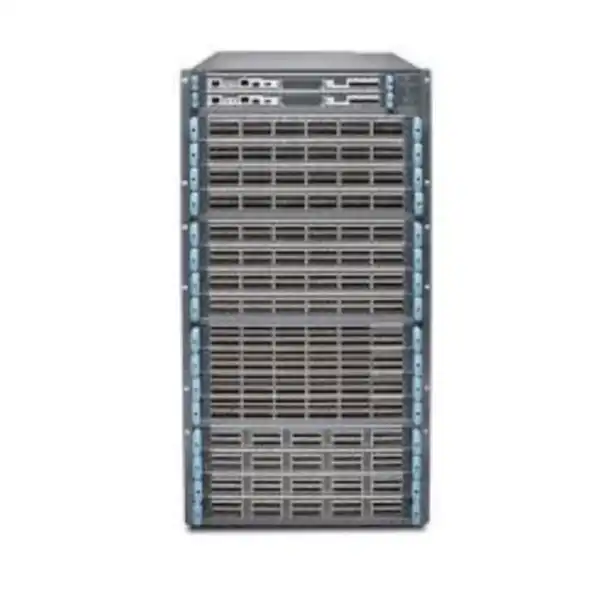
Juniper QFX10016 Data Center Switch Dubai
A high-density 21U modular spine and core platform for large-scale 10GbE, 40GbE and 100GbE networks, now best evaluated with lifecycle, installed-base compatibility and migration strategy in mind. The QFX10016 offers 16 line-card slots, up to 96 Tbps of system throughput and up to 32 billion packets per second of forwarding capacity, but Juniper has placed the QFX10000 hardware family on an end-of-life path.
Direct answer: what the QFX10016 is and what matters before you source it
Important 2026 lifecycle notice for Dubai buyers
Juniper’s QFX Series hardware lifecycle table lists the QFX10000 hardware family under an end-of-life announcement dated July 15, 2025. The same table lists January 15, 2026 as the last-order date for QFX10016 chassis and related QFX10000 hardware SKUs, January 15, 2029 as the end of engineering date, Junos OS 24.4 as the last software version, and January 15, 2031 as the end-of-support date. Because the current market is beyond the listed last-order date, a QFX10016 request in Dubai should not be treated as an ordinary new-platform purchase.
This does not automatically make an existing QFX10016 environment unsuitable. Large data center switches often remain operational for years after their last-order milestone when they are under valid support, have an appropriate spare strategy and run a supported software train. The important distinction is between continuing a platform you already operate and selecting it for a new network that is expected to have a long growth and support horizon. Those are different purchasing decisions and should be evaluated separately.
For installed-base requirements, the practical questions are whether the exact spare or expansion SKU can still be sourced from authorized or legitimate channels, whether the part is compatible with the existing chassis and power bus, whether Juniper support applies to that hardware, and whether the procurement makes economic sense compared with migration. For a greenfield deployment, FourTeck recommends evaluating a current Juniper switching architecture with the required port speeds, fabric scale, routing features, telemetry and lifecycle window rather than buying an end-of-life platform simply because its headline capacity appears attractive.
Where the QFX10016 fits in a data center architecture
The QFX10016 was designed as a large modular building block for environments where fixed-configuration top-of-rack switches do not provide enough aggregate port density or where a centralized modular spine/core platform is preferred. The chassis provides sixteen horizontal line-card slots and a separate switch-fabric architecture based on Switch Interface Boards. This makes it materially different from a fixed 1U or 2U switch: the buyer selects the chassis, control redundancy, fabric redundancy, line cards, transceivers, power and supporting accessories as a system rather than buying a single sealed appliance.
At its maximum published scale, the QFX10016 provides up to 96 Tbps of system throughput and 32 Bpps of forwarding capacity. Juniper documents maximum densities of 2,304 10GbE ports, 576 40GbE ports and 480 100GbE ports, depending on the supported line-card and breakout combinations. Those values describe the potential of a fully built chassis; they do not mean a base chassis arrives with that connectivity. A base or redundant chassis still requires the correct line cards and optics for the intended network.
The platform can be used in Layer 3 IP fabrics, EVPN-VXLAN designs, large campus distribution/core roles, data center edge or interconnect scenarios, and traditional Layer 2/Layer 3 networks using MC-LAG. In practical spine deployments, the value of a modular platform is the number of leaf-facing high-speed ports that can be aggregated while retaining redundant control, fabric and power options. In a core role, route scale, buffering, resiliency and operational consistency with Junos OS may matter more than raw port count.
The right design therefore starts with traffic and failure-domain requirements, not chassis size. A 16-slot chassis can be excessive for a moderate data center if only a small number of interfaces are needed, while it can be appropriate for an existing facility where many leaf switches, WAN or DCI links converge into a common resilient core. For an estate already standardized on QFX10000, operational familiarity and spare commonality may provide real value, but the 2026 lifecycle position must be factored into every expansion decision.
Core QFX10016 hardware specifications
| Specification | QFX10016 value | Buyer relevance |
|---|---|---|
| Chassis type | Modular, 21U, 16 line-card slots | Requires proper four-post rack planning and a card-level bill of materials. |
| Maximum system throughput | Up to 96 Tbps | Capacity depends on the correct switch-fabric and line-card configuration. |
| Forwarding capacity | Up to 32 Bpps | Relevant for high packet-rate workloads and large aggregation roles. |
| Maximum 10GbE density | 2,304 ports | Achieved through supported line cards and channelization; breakout design must be planned. |
| Maximum 40GbE density | 576 ports | Useful for legacy high-density 40GbE fabrics and staged migrations. |
| Maximum 100GbE density | 480 ports | Requires suitable 100GbE line cards, optics, cabling and power budget. |
| Physical dimensions | Approximately 17.4 in wide × 36.6 in high × 35 in deep; mounting flanges extend to 19 in | Confirm rack depth, rail/mounting method, clearances and handling method. |
| As-shipped weight | About 522 lb base AC; 596 lb redundant AC; 591 lb redundant DC | Mechanical lift, rack loading and safe installation procedure are essential. |
| Cooling direction | Port-to-FRU / front-to-back airflow | Rack row airflow and adjacent equipment exhaust must be compatible. |
| Operating system | Junos OS | Feature support and licensing must be checked against the intended Junos release. |
| Published last software version in hardware lifecycle table | 24.4 | Important for long-term software and security planning. |
Specification ceilings are useful for comparing platforms, but a quotation should be based on the exact deployed configuration. A chassis with a few low-density cards has very different power, port count and cost characteristics from a system populated with high-density 100GbE cards. The right specification discussion is therefore configuration-specific rather than a simple copy of maximum values.
Line-card choices define the actual switch you deploy
The QFX10016 chassis is only the foundation. Line cards determine interface speed, density, encryption capability and a major portion of the power budget. Juniper documents several QFX10000 line cards for the chassis. When sourcing a card for an existing system, match the exact card SKU, intended Junos release, required optics and chassis power capability. Do not assume that every old chassis can accept every later, higher-power card without checking the hardware configuration and power bus.
QFX10000-30C
Thirty QSFP28 cages support 100GbE or 40GbE. Juniper also supports 10GbE through channelization of 40GbE ports with the appropriate breakout design. This card is a natural fit for high-density 100GbE spine connectivity or mixed 40/100GbE transitions.
Maximum published card power is 1,150 W, so a chassis populated heavily with 30C cards needs serious power planning. Optics are selected separately and must match link distance, fiber plant and peer interfaces.
QFX10000-30C-M
This 30-port 100/40GbE card adds MACsec capability for environments that need link-layer encryption on supported interfaces. It is relevant to data center interconnect, campus core or regulated designs where encrypted Ethernet links are part of the architecture.
The published maximum card power is 1,250 W, higher than the non-MACsec 30C. MACsec should be selected because the design requires it, not merely because the card is available, since power, lifecycle and compatibility all matter.
QFX10000-36Q
The 36Q provides thirty-six 40GbE QSFP+ ports, with twelve ports capable of 100GbE using QSFP28. The 40GbE interfaces can also be channelized to 10GbE using supported breakout cabling. This makes the card useful in estates that still carry substantial 10/40GbE connectivity.
Its maximum published power is 675 W, materially lower than the 30C family. That can influence an expansion decision when the required interface mix does not justify a higher-power 100GbE card.
QFX10000-60S-6Q
This card combines sixty 1/10GbE SFP/SFP+ ports with six 40GbE QSFP+ ports or two 100GbE QSFP28-capable interfaces, making it useful where a modular core must directly aggregate a large number of lower-speed fiber links.
Its maximum published power is 455 W. In a modern greenfield fabric, direct 1/10GbE aggregation at a core may not be the preferred topology, but it can remain valuable for installed-base continuity.
QFX10K-12C-DWDM
The coherent DWDM line card provides a specialized optical transport option for data center interconnect and high-capacity wavelength applications. Juniper describes six 200GbE coherent interfaces, with MACsec support in the QFX10000 family documentation.
This is not a generic replacement for a normal Ethernet line card. It needs a DCI design that accounts for optical reach, wavelengths, transport architecture, supported modules and a maximum published card power of 1,050 W.
Capacity planning: translate port counts into a real bill of materials
A common buying error is to start from the maximum port density and work backward. A better process starts with actual endpoints and uplinks. Count the leaf switches, routers, firewalls, storage networks, service appliances, DCI circuits and other systems that must connect. Record each interface speed, media type, redundancy requirement and expected growth. Then map that requirement to line-card slots and leave deliberate headroom rather than accidental unused capacity.
For example, a spine design with dozens of 100GbE leaf uplinks may favor 30C cards, while an older facility with many 40GbE connections may make better use of 36Q cards. A mixed environment can install different supported card types in the same chassis, but mixed cards create different power and optics requirements. They may also influence maintenance spares: keeping one spare of every line-card type can be more expensive and operationally complex than standardizing on fewer card types.
Oversubscription is another design input. The QFX10016 can provide very high slot and system capacity, but the overall fabric ratio depends on what is connected to it. In a leaf-spine topology, calculate total server-facing bandwidth per leaf and the aggregate bandwidth toward the spine. A 3:1 oversubscription target, for example, creates different spine port requirements from a 1:1 nonblocking design. The correct ratio depends on application behavior, east-west traffic patterns, storage traffic, backup windows and service-level objectives.
Also account for failure conditions. If the network must tolerate loss of a spine, line card, circuit or maintenance window without exceeding an acceptable oversubscription ratio, capacity should be checked in the degraded state, not only when all components are healthy. This is particularly important for mature QFX10016 estates where new expansion may consume the last free slots or power headroom. The fact that a slot is physically empty does not prove that the power system, optics plan or lifecycle strategy supports filling it.
Switch fabric, forwarding scale and deep buffering
The QFX10016 uses Switch Interface Boards to form the switching fabric. Juniper documents five SIBs as required for operation and a sixth as the n+1 redundant fabric element in the redundant configuration. With all six installed, the platform has a net switching capacity of up to 96 Tbps. The architecture is designed so that the line cards connect through the internal fabric without relying on a conventional midplane for the high-speed data path.
For buyers, fabric redundancy matters because a modular chassis is expected to survive individual component faults with less disruption than a simple fixed switch. The value is not only throughput; it is also the ability to replace field-replaceable components such as line cards, fan trays and certain other modules while preserving service according to the supported operational procedure. High availability still depends on configuration. A chassis with only one Routing and Control Board does not provide the same control-plane resilience as a redundant system.
Juniper publishes large logical scale for the QFX10000 family, including up to one million MAC addresses, up to two million host routes, up to two million FIB entries, 4,093 VLANs and 64-way ECMP. The family also uses a virtual-output-queue architecture and is documented with deep buffers of up to 100 milliseconds per port. These characteristics can be valuable in large fabrics, bursty workloads and mixed-speed environments where temporary traffic congestion would otherwise cause loss.
Scale figures should be treated as design ceilings, not an invitation to run every dimension at the maximum simultaneously. Network tables consume hardware resources in different ways, and software features can change resource behavior. A serious design validates the required MAC, ARP, route, multicast, filter, tunnel, VRF and neighbor scale for the exact Junos release. If an existing QFX10016 is already operating close to any resource limit, adding ports alone may not solve the next growth problem.
Junos OS, routing features and licensing decisions
QFX10016 runs Junos OS, giving operators a familiar operational model if they already manage Juniper QFX, EX, MX or SRX platforms. Junos features such as candidate configuration, commit and rollback, modular processes, routing protocols, filtering, telemetry and automation can simplify operations across a Juniper estate. However, feature availability should always be checked against the specific platform and software release rather than inferred from another Juniper product.
Juniper’s QFX10000 datasheet separates some advanced routing and overlay functions by software license. BGP and IS-IS are identified with Premium or Advanced feature licensing, while MPLS functions are associated with the Advanced feature license. EVPN-VXLAN overlays are also described under Premium or Advanced feature licensing. A quote that includes only hardware can therefore be incomplete if the design requires these licensed capabilities. Confirm both the software entitlement and the support entitlement, especially on an end-of-life platform where transferability and contract status may affect what can be supported.
High-availability software features include graceful Routing Engine switchover, nonstop active routing and nonstop bridging. These features are useful when a redundant control plane is installed and configured correctly. They are not a substitute for a sound network architecture. For example, two QFX10016 chassis may still be used to create device-level redundancy so that a full chassis or maintenance event does not isolate critical systems.
Automation and observability are also part of the operational decision. QFX10000 documentation lists APIs, scripting and tools such as Python, Ansible, Chef and Puppet, along with monitoring options such as sFlow, IPFIX, port mirroring and BGP Monitoring Protocol. The exact integrations that remain sensible in 2026 depend on the organization’s tooling and the last supported software path. A migration project should compare not just forwarding capacity but also how the replacement platform integrates with the current automation, telemetry and configuration-management workflow.
Because Juniper lists 24.4 as the last software version for the QFX10000 hardware under the relevant lifecycle announcement, software planning should be explicit. Confirm the exact maintenance release approved for your environment, the supported upgrade path from the currently installed release, feature behavior, known issues and the remaining support window. A platform can remain stable for years, but a frozen major release line changes the long-term risk calculation for security, interoperability and new feature requirements.
EVPN-VXLAN, Layer 3 fabrics and MC-LAG: choose the architecture intentionally
The QFX10000 family supports several network architectures rather than forcing one topology. A Layer 3 Clos fabric can use QFX10016 as a high-density spine, with leaf switches providing server-facing connectivity. This approach uses equal-cost multipath to spread traffic across multiple spine links and creates predictable failure domains. It is often the most natural architecture for scale-out data centers because additional leaf capacity can be introduced without extending large Layer 2 failure domains across the entire environment.
EVPN-VXLAN can overlay Layer 2 and Layer 3 services on top of an IP fabric. QFX10000 supports VXLAN Layer 2 and Layer 3 gateway functions and EVPN signaling. This can be useful when workloads need logical Layer 2 adjacency across a routed underlay or when the organization wants standards-based control-plane learning instead of flood-and-learn behavior. The design must still account for where routing occurs, how anycast gateways are implemented, how multihoming works and which devices act as VTEPs.
Juniper also documents important QFX10000 VXLAN constraints. MC-LAG is not supported together with VXLAN; EVPN multihoming active-active is used instead for redundant host or leaf connectivity in an EVPN-VXLAN environment. Juniper also notes that an IPv6 physical underlay is not supported for QFX10000 switches deployed in EVPN-VXLAN. Other restrictions can vary by software release. These details matter because a design that looks acceptable at a high-level protocol diagram may fail when platform-specific constraints are applied.
MC-LAG remains relevant for more traditional Layer 2 and Layer 3 designs outside the VXLAN constraint above. A pair of switches can present active-active aggregated connectivity to downstream equipment while keeping separate control planes. For an existing data center built around MC-LAG, a QFX10016 spare or expansion may preserve an established operational model. For a new data center, compare that operational model with EVPN multihoming and current platform capabilities before repeating a legacy topology solely for familiarity.
Architecture should also influence migration sequencing. If the long-term target is EVPN-VXLAN on a newer platform, adding a large amount of new QFX10016 capacity to an older MC-LAG core may extend the life of a design the organization plans to retire. In that case, the better investment can be a controlled migration in which old and new cores coexist temporarily, routes and VLANs are moved in stages, and rollback points are defined before each workload group transitions.
High availability: what redundancy actually means on a QFX10016
Modular systems are attractive partly because they can remove single points of failure inside one chassis. The QFX10016 can be configured with redundant Routing and Control Boards, redundant switch fabric through a sixth SIB, redundant fan subsystems and multiple power supplies. Juniper’s redundant AC and DC chassis configurations include two control boards, two fan trays, two fan tray controllers and six SIBs, with multiple power supplies sized according to the chosen configuration.
Redundancy should be assessed component by component. A second Routing and Control Board supports control-plane resilience and works with high-availability Junos capabilities. The sixth SIB provides n+1 switch-fabric redundancy. Two fan trays provide cooling resilience, although Juniper warns that only one fan tray should be removed while the switch is running and that the system can shut down if a thermal alarm persists. Power supplies should be configured with sufficient capacity plus redundancy rather than simply filling available bays without calculating the required load.
A fully redundant chassis still does not protect against every failure. A rack power incident, upstream fiber cut, configuration error, software defect or complete chassis outage can affect the system. Critical data centers commonly use two separate spine or core devices, diverse power distribution, diverse fiber paths and carefully designed routing so that traffic can survive loss of one device. The exact level of resilience should be linked to business recovery objectives rather than to a generic statement that the switch is “redundant.”
Lifecycle adds another dimension. On a platform past its last-order date, availability of replacement FRUs can become as important as internal redundancy. An organization may keep spare line cards, power modules, fan trays or control components based on failure impact and sourcing lead time. The inventory decision should consider which components are already covered by vendor support, which can be replaced under contract, and which are difficult to source. Overstocking obsolete parts ties up capital, but having no plan for a critical discontinued component can create an avoidable outage risk.
Power planning is a design task, not a final procurement checkbox
The QFX10016 is a large chassis with a power profile that changes dramatically according to the line cards and redundancy selected. Juniper publishes maximum power values of 625 W per QFX10016 SIB, 975 W per fan tray at maximum fan speed and 100 W for a Routing and Control Board. Maximum line-card values range from 455 W for a QFX10000-60S-6Q to 1,250 W for a QFX10000-30C-M. A heavily populated 100GbE chassis can therefore require substantially more power than a lightly populated mixed-speed system.
Juniper’s planning guidance calculates maximum base chassis consumption at 5,450 W for a base configuration and 6,250 W for a redundant configuration before line-card consumption is added. It then adds the maximum power of the installed cards and divides the total by the available power per power-supply configuration, rounding up and adding redundancy. This is the correct mindset for a quotation: the number of required power modules and feeds follows from the actual hardware mix.
For a Dubai data center, confirm the available A/B feeds, voltage and connector arrangement, PDU capacity, breaker headroom, rack power density and facility policy. A switch can be technically supported but operationally impractical if the target rack cannot provide the required redundant feeds. The thermal load also affects cooling. Electrical capacity, heat rejection and airflow should be checked together rather than by separate teams late in the installation process.
High-power line cards can also affect older chassis revisions. Juniper documentation notes that some QFX10016 chassis ship with an enhanced power bus for higher-wattage cards. If the requirement involves adding 30C-M, coherent DWDM or other high-power components to an existing chassis, identify the exact chassis hardware and power system rather than assuming slot compatibility is sufficient. FourTeck can use the installed part numbers, serial-level support information and proposed card mix to build a more defensible bill of materials.
Finally, plan the power budget under failure conditions. If the design requires n+1 power redundancy, the switch must continue to operate within the remaining power capacity when one supply or feed is unavailable. Juniper warns that a newly inserted line card may not power on if doing so would consume the redundant power margin. This is why a spare slot is not automatically usable capacity.
Rack, cooling and physical installation requirements
At 21U, the QFX10016 consumes half of a conventional 42U rack. Juniper specifies a four-post rack and notes that two QFX10016 chassis can physically fit in a standard 42U rack if the rack can carry the weight and adequate power and cooling are available. The fact that two chassis fit by rack units does not mean that every facility should place them together. Combined weight, cable density, redundant power feeds and thermal loading can make separate racks the safer design.
The chassis is approximately 35 inches deep and the spare chassis alone weighs about 220 lb. An as-shipped base AC configuration is around 522 lb, while a redundant AC system is listed around 596 lb before the complete production card and optics population is considered. Juniper explicitly instructs installers to use the proper mechanical lifting process and warns that the side handles are not intended for lifting the chassis. Installation therefore needs coordination with the data center’s rack-loading and safety procedures.
Cooling airflow enters from the port and line-card side and exits toward the field-replaceable-unit side through the fans and power supplies. Juniper calls this port-to-FRU cooling or airflow out. The rack row should maintain the same hot-aisle/cold-aisle orientation, and adjacent equipment should not exhaust hot air directly into the QFX10016 intake. Unrestricted airflow is essential because the system monitors internal temperature and can shut down components if cooling is inadequate.
Service clearance is equally important. Juniper’s quick-start guidance calls for at least 24 inches in front of and behind the chassis for personnel to install and remove hardware; NEBS guidance is more demanding at the front. Large line cards, fan trays and power modules need physical room to be removed without disturbing neighboring racks or cable bundles. A rack drawn correctly on a floor plan can still be difficult to service if a wall, containment door or dense patching area blocks FRU removal.
Cable management should be ordered and designed deliberately. Juniper notes that cable-management hardware and line cards are not included with base or redundant chassis configurations. A high-density QFX10016 can carry hundreds of fiber pairs or breakout legs, so labeling, bend radius, tray capacity, structured cabling pathways and maintenance access are operational issues, not decorative details. Poor cable management can turn a simple line-card replacement into a risky change window.
Optics, breakout cables and fiber plant compatibility
The port cage determines the form factor, but the actual link depends on the transceiver, fiber type, distance and peer device. QFX10000-30C and 30C-M use QSFP28 cages for 100GbE and 40GbE. The 36Q uses QSFP+ for 40GbE with selected ports capable of QSFP28 100GbE. The 60S-6Q combines SFP/SFP+ access with QSFP+ high-speed interfaces. The coherent DWDM card has a different optical design entirely. A quote should therefore list optics by exact interface requirement rather than simply saying “fiber modules included.”
For short data center runs, direct-attach copper, active optical cable or short-reach multimode optics may be suitable depending on the supported hardware matrix. Longer links may require single-mode optics. Breakout applications need compatible cables or transceivers and a port configuration that supports the desired channelization. If one 40GbE interface is split into four 10GbE links, that affects port numbering, patch-panel design, documentation and monitoring.
Do not overlook the far end of the link. A 100GbE port on a QFX10016 line card must connect to an interface that uses a compatible Ethernet standard, wavelength and fiber construction. Existing OM3/OM4 multimode cabling may support some distances but not others; existing single-mode trunks may use different connector types or patching conventions. For DCI, the optical transport path may include muxes, amplifiers or third-party systems, making a simple “100G LR” assumption inadequate.
Optics are also part of lifecycle risk. When maintaining an end-of-life chassis, confirm which Juniper-supported transceivers remain appropriate for the installed Junos release and line card. Unsupported third-party optics can introduce support ambiguity, especially during fault isolation. Some organizations deliberately standardize on vendor-qualified optics for core links while using alternatives in less critical access roles; the policy should be explicit and aligned with the support contract.
FourTeck can prepare an optics schedule that maps every QFX10016 port group to interface speed, optic type, wavelength or reach, fiber connector, peer equipment and redundancy role. That document often prevents more installation problems than a generic hardware list because it connects the switch purchase to the physical network that must actually carry traffic.
Operations, monitoring and change control
A core switch is an operational platform, not simply a collection of ports. Before expanding a QFX10016 estate, review how the device is currently monitored, backed up and changed. Junos supports configuration commit and rollback, event and operations scripts, telemetry and standard network-management interfaces. The organization should know which tools are authoritative for configuration, how changes are peer reviewed, how emergency rollback works and how software images are controlled.
Health monitoring should include Routing and Control Boards, line cards, SIBs, fan trays, power supplies, temperature sensors and interface optics. A single failed fan or power module may not immediately interrupt traffic because of redundancy, but leaving a degraded component unresolved removes the protection that redundancy was designed to provide. Lifecycle-stage platforms need disciplined alert ownership because replacement lead times can be longer than they were when the product was actively orderable.
Traffic visibility is also important when deciding whether to extend or replace the platform. QFX10000 supports mechanisms such as sFlow, IPFIX, SPAN/RSPAN/ERSPAN and BGP Monitoring Protocol according to the datasheet. Use available telemetry to identify real traffic peaks, microburst behavior, port utilization and growth rather than making the next capacity decision from interface speed alone. A 100GbE link that is usually 15% utilized has a different planning profile from a 40GbE link that reaches saturation during backup windows.
Software changes require a documented path. Juniper’s 24.4 release documentation still contains installation and upgrade guidance for QFX10008 and QFX10016. Before upgrading, check the source release, target maintenance release, required intermediate steps, configuration compatibility, feature changes and rollback strategy. If the chassis carries critical EVPN, BGP or MPLS roles, lab validation or a representative staging environment may be justified.
As end of engineering approaches, operational discipline becomes more important rather than less. Keep an inventory of chassis and FRU versions, software releases, support contracts, spare holdings and known hardware issues. That inventory becomes the foundation for migration planning and avoids the common problem of discovering during an outage that a spare card is the wrong revision or that a replacement chassis cannot accept the required power configuration.
When the QFX10016 can still be a rational choice
Installed-base expansion
If a business already operates QFX10016 chassis, has remaining support life and needs a specific compatible line card or FRU to maintain an existing design, targeted expansion may avoid a premature network-wide replacement. The decision should include the migration horizon so that new investment is not stranded immediately.
Spares for critical infrastructure
A verified spare line card, fan tray, power module or other supported FRU can reduce recovery time where the deployed QFX10016 remains business critical. Spare strategy should be coordinated with the Juniper support contract and actual failure exposure rather than purchasing arbitrary parts.
Short-horizon capacity bridge
An organization with a defined migration scheduled in the near term may use compatible QFX10016 capacity as a bridge if it is materially lower risk than accelerating a major redesign. The economics should include resale value, support, installation effort and the probability that the temporary hardware will be reused.
When a current platform should be evaluated instead
Greenfield data center
A new fabric expected to run for many years should normally begin with currently orderable hardware that has a longer engineering and software runway. Choosing an end-of-life chassis for a new build creates avoidable lifecycle pressure even if the initial purchase price appears favorable.
Need for higher-speed interfaces
If the growth plan depends on broad 400GbE or newer high-speed interface density, a platform centered on 10/40/100GbE economics is not the natural long-term choice. The replacement design should be sized around future leaf and DCI speeds rather than the currently installed cables alone.
Long support and feature roadmap
Organizations that require many years of new software features, evolving security capabilities or a long vendor engineering window should compare current Juniper offerings. The QFX10016 lifecycle table already defines a finite support path through January 2031.
Migration planning from an existing QFX10016 core or spine
A migration should begin with discovery. Document every active line card, port, optic, VLAN, routed interface, VRF, BGP peer, OSPF or IS-IS adjacency, EVPN/VXLAN role, MC-LAG relationship, firewall filter, QoS policy, multicast dependency, automation script and management integration. Also identify physical dependencies such as patch panels, fiber trunks, cross-connects and power feeds. This produces a real scope rather than a device-only replacement list.
Next, separate capabilities that must be preserved from legacy design choices that can be improved. The replacement switch may need the same number of 100GbE uplinks, but it may not need the same line-card layout. It may need EVPN multihoming rather than MC-LAG, different optics, more 400GbE capacity, newer telemetry or a different management platform. Treating a migration as a port-for-port cloning exercise can carry old constraints into a new architecture.
Build coexistence into the design. A large core rarely moves in one instant. The old QFX10016 and new platform may run in parallel while routing adjacencies, VLAN gateways, DCI circuits or leaf uplinks migrate by group. Define how the two environments exchange routes, where loops are prevented, which device owns each gateway during each stage and what the rollback action is if a workload fails after migration.
Capacity should be evaluated twice: once for the final state and once for the migration state. Parallel operation can temporarily consume more rack space, optics, power and cross-connects than either final design. A data center with no spare rack power or fiber paths can block a technically sound migration unless these temporary needs are identified early.
Finally, set an exit date for the QFX10016 estate. Lifecycle projects lose momentum when the old platform remains “temporarily” connected for years. Tie decommissioning to workload migration waves, contract dates and support milestones. Retain only the spares and configuration archives needed for the remaining period, then dispose of retired hardware through approved asset and data-handling procedures.
Dubai and UAE procurement considerations
For a QFX10016 requirement in Dubai, availability now depends much more on the exact SKU and sourcing channel than it did when the platform was actively orderable. A request for “one QFX10016” is incomplete because there are base and redundant chassis configurations, AC and DC options, line cards, SIBs, control boards, power systems, optics and accessories. The lifecycle status means the buyer should also establish whether the goal is vendor-supported replacement, existing stock, certified pre-owned equipment, laboratory use or migration support.
For production networks, provenance matters. A lower-priced secondary-market chassis may not carry the same support eligibility or service history as hardware sourced through an approved channel. Verify serial numbers, hardware revision, included FRUs, cosmetic and functional condition, software entitlement and support transferability before treating two quotations as equivalent. A “complete chassis” description can still omit line cards, optics, cable management or the redundant components your design assumes.
Logistics are significant because of the chassis weight and size. Confirm whether delivery includes appropriate packaging, data center dock handling, lifting equipment, rack installation and disposal of packing materials. If hardware is being imported into the UAE, lead time, warranty handling and return logistics should be understood before a critical replacement is needed. For an emergency spare, a lower acquisition price is not useful if the part cannot reach the site within the recovery objective.
Power cords and electrical interfaces must match the facility PDU and local deployment practice. Never assume that a chassis sourced from another region arrives with the right cables. The same applies to optics: the transceiver list should match the installed fiber plant in the Dubai site and the peer device at the far end. FourTeck can separate chassis, FRU, optic and service items in the quotation so that omissions are visible before purchase.
For new designs, use the QFX10016 requirement as an architectural reference rather than a mandatory SKU if the business objective is simply “large Juniper data center core.” Share the required port speeds, number of leafs, fabric topology, routing scale, security functions, power constraints and desired support horizon. That allows a current alternative to be compared on equivalent requirements rather than on model-name familiarity.
Practical evaluation matrix
| Decision area | QFX10016 strength | 2026 caution | What to verify |
|---|---|---|---|
| Port density | High-density 10/40/100GbE in one modular chassis. | No broad 400GbE line-card proposition in the classic QFX10016 design. | Five-year interface-speed roadmap. |
| Modularity | Sixteen slots allow mixed line cards and staged capacity. | Expansion parts are affected by family lifecycle. | Exact spare and line-card availability. |
| Resilience | Redundant control, fabric, cooling and power options. | Chassis-level failure still requires network-level redundancy. | Dual-device design, power feeds and spare policy. |
| Junos operations | Consistent Junos operational model and automation options. | Hardware lifecycle lists 24.4 as last software version. | Target maintenance release and support window. |
| EVPN-VXLAN | Supports EVPN-VXLAN overlay and L2/L3 gateway roles. | Platform-specific constraints apply, including no MC-LAG with VXLAN. | Exact underlay, multihoming and Junos feature support. |
| Power and space | One chassis can consolidate very high interface density. | 21U footprint, high weight and potentially large power demand. | Rack, PDU, cooling and lifting plan. |
Frequently asked buyer questions
Is the Juniper QFX10016 still orderable as new hardware?
Juniper’s published QFX hardware lifecycle table lists January 15, 2026 as the last-order date for QFX10016 and related QFX10000 hardware SKUs. In August 2026, a normal new factory order should therefore not be assumed. Existing stock, spares, secondary-market hardware or support replacement may exist, but availability and support eligibility must be checked for the exact SKU.
How many line cards does the QFX10016 support?
The chassis has sixteen line-card slots. Supported QFX10000 cards include different 10/40/100GbE and specialized coherent options. Line cards are not part of the bare chassis purchase, so a usable switch configuration requires the correct cards, optics and power design. Slot count alone does not prove that every card mix can be powered in every chassis configuration.
What is the maximum 100GbE density?
Juniper publishes up to 480 100GbE ports for a fully configured QFX10016. Achieving that density requires the appropriate high-density line cards and a system design that supports their fabric and power requirements. The exact bill of materials should be built from the number of required 100GbE links rather than assuming every deployment needs maximum density.
Can the QFX10016 support EVPN-VXLAN?
Yes, the QFX10000 family supports EVPN-VXLAN and L2/L3 gateway functions, subject to Junos release and license requirements. The platform also has specific constraints. For example, Juniper states that MC-LAG is not supported with VXLAN on QFX10000; EVPN multihoming active-active is used instead in an EVPN-VXLAN design. Validate all required functions against the target software release.
Does it support MACsec?
MACsec is available through specific QFX10000 line cards such as the QFX10000-30C-M, which provides 100/40GbE interfaces with MACsec capability. The coherent DWDM line-card option also has MACsec functionality in Juniper’s family documentation. MACsec should be included only where the network security architecture requires encrypted Ethernet links and the chosen card and software release support the intended mode.
What is included in a base QFX10016 chassis?
Juniper documents the base AC configuration with the chassis and power bus, one Routing and Control Board, two fan tray controllers, two fan trays, five AC power supplies, five SIBs and associated covers/cables. Line cards, cable-management hardware and the SATA SSD are identified as separate items. A production quote must therefore define more than the base chassis SKU.
What is included in the redundant configuration?
Juniper documents redundant configurations with two Routing and Control Boards, two fan trays, two fan tray controllers, six SIBs and multiple power supplies. AC and DC versions exist. The actual number of power supplies needed for a populated chassis still depends on the line-card mix and the required redundancy margin, so the chassis bundle does not eliminate the need for power calculation.
How much rack space and clearance does it need?
The QFX10016 is 21U and approximately 35 inches deep. Juniper requires a four-post rack and recommends service clearance in front of and behind the device, with additional NEBS clearance guidance. Because a redundant chassis can weigh close to 600 lb before full production population, a mechanical lift and rack load assessment are part of a proper installation plan.
What airflow direction does the chassis use?
Air enters on the line-card/port side and exits through the fan trays and power supplies on the FRU side. Juniper refers to this as port-to-FRU cooling or airflow out. The rack row must provide unrestricted intake air, and exhaust from neighboring equipment should not be directed into the QFX10016 intake.
Can I install any supported line card into an older QFX10016 chassis?
Do not assume so without checking. Juniper notes that some chassis use an enhanced power bus to support higher-wattage line cards. Card support also depends on Junos release and other hardware requirements. For an installed chassis, identify its exact configuration and proposed card before ordering an expansion.
Does QFX10016 licensing matter for BGP and EVPN?
Yes. The QFX10000 datasheet associates BGP and IS-IS with Premium or Advanced feature licensing and associates EVPN-VXLAN with Premium or Advanced licensing. MPLS is described under the Advanced feature license. A technically correct hardware configuration can still be functionally incomplete if the required software entitlement is omitted.
What should replace a QFX10016?
There is no responsible one-model answer without requirements. Replacement depends on port speeds, total fabric capacity, 100/400GbE density, EVPN/VXLAN architecture, routing scale, MACsec, DCI needs, automation, rack space, power and support horizon. FourTeck can compare current Juniper options against the actual QFX10016 configuration and migration constraints instead of selecting a successor from chassis size alone.
Support, spares and lifecycle governance through 2031
Juniper’s current published hardware milestone table lists end of support for the QFX10000 announcement on January 15, 2031. That date is important, but it should not be interpreted as a promise that every hardware part will be readily purchasable until then. Vendor support policies, contract eligibility and replacement mechanisms differ from normal product sales. Confirm the support status of each production chassis and any planned replacement hardware.
A practical lifecycle plan can divide the estate into three categories. First, production chassis that will remain in service and must be kept fully supported. Second, spare or lab hardware used to validate configurations and provide emergency recovery. Third, chassis scheduled for retirement that should not receive substantial new investment. This classification helps procurement prioritize scarce spares and prevents a temporary lab unit from becoming an undocumented production dependency.
Track end-of-support exposure at application level. If a QFX10016 carries the only path to a revenue-critical service, the migration deadline should be earlier than the vendor’s final support date. Waiting until 2031 to begin a large core redesign leaves no margin for procurement delays, data center change freezes, application testing or unexpected interoperability work. A multi-year migration program should have milestones well before vendor support ends.
Spare holdings should be reviewed annually. As more chassis are retired, some removed FRUs can become internal spares for the remaining estate, reducing the need for external purchases. Conversely, if a particular line-card type becomes difficult to source, it may accelerate migration of the workloads that depend on it. Lifecycle governance works best when operations, architecture, procurement and finance share the same inventory and retirement plan.
Software governance should be equally explicit. The hardware lifecycle table lists 24.4 as the last software version. Establish which 24.4 maintenance release is approved, how security advisories will be handled, which features are frozen and what replacement requirement is triggered if a future application needs a capability that cannot be delivered on the platform. This converts lifecycle from a vague future concern into concrete operational decisions.
What an accurate QFX10016 quotation should contain
A useful quotation is a configuration document, not only a price. For this platform, request enough detail to tell whether the system can be installed, powered, connected, licensed and supported as intended. The following checklist captures the items that most often change the bill of materials or expose risk.
Decision recap: six points that should drive the purchase
What FourTeck needs from you for an accurate Dubai quotation
The most useful request is a short technical inventory rather than only the model name. If some information is unknown, FourTeck can help identify it from the existing chassis and network design.
Plan the right next step for your QFX10016 environment
Whether you need a verified QFX10016 spare, a compatible line card, an optics and power bill of materials, or a migration from an existing QFX10000 core, the useful outcome is a configuration that matches your operational horizon. Share the current chassis details and network requirement so FourTeck can separate what should be maintained from what should be modernized.

Reviews
There are no reviews yet.