
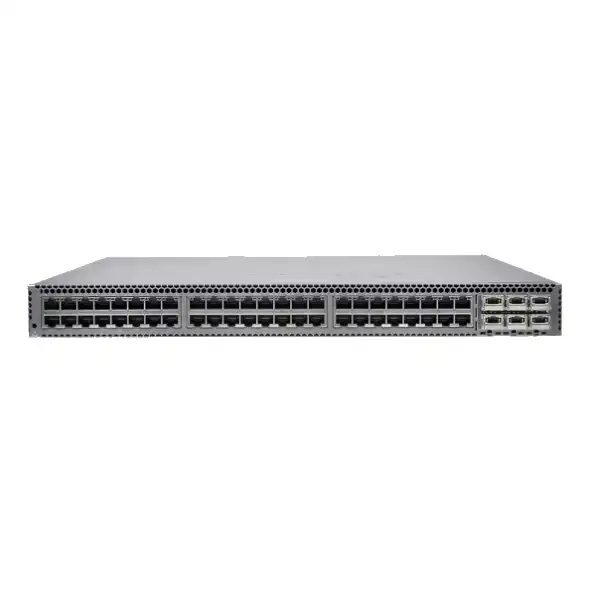
Juniper QFX5100 Data Center Switch
A practical buyer guide to the Juniper QFX5100 family for existing data centers, replacement projects and migration planning in Dubai. Review exact model differences, 10GbE and 40GbE port options, switching capacity, Junos capabilities, optics, airflow, lifecycle status and the decisions that matter before a quotation is raised.
Direct answer: what is the Juniper QFX5100 and should you still consider it?
QFX5100 family identity and model position
The phrase Juniper QFX5100 Data Center Switch identifies a product family rather than one single port configuration. That distinction is important at quotation stage because the QFX5100-48S, QFX5100-48T, QFX5100-24Q, QFX5100-24Q-AA and QFX5100-96S address different cabling, density and deployment requirements. A buyer who asks only for “QFX5100” has not yet supplied enough information to choose the physical switch correctly. The first task is therefore to translate the existing network requirement into an exact model and airflow/power variant rather than assuming every QFX5100 chassis is interchangeable.
Juniper positions the family as a low-latency data center switching platform. The 48S is an SFP/SFP+ oriented 1/10GbE access model with 40GbE uplinks. The 48T serves copper environments using tri-speed RJ-45 access ports. The 24Q focuses on QSFP+ density for native 40GbE or breakout-based 10GbE connectivity. The 96S provides a larger 2U footprint with substantially more 10GbE access ports. The 24Q-AA was a specialized application-acceleration-oriented variant and has a different lifecycle from the mainstream family. Treating these variants as one generic item can result in the wrong optics, wrong patching plan, wrong rack airflow, or a switch that cannot physically connect to the installed server interfaces.
QFX5100-48S
Designed around 48 SFP/SFP+ access ports for 1/10GbE connectivity plus six 40GbE QSFP+ ports. It is a common fit for server racks where fiber, DAC or supported SFP+ connectivity is preferred. Breakout on the QSFP+ interfaces can increase available 10GbE interface count in suitable designs.
QFX5100-48T
Provides 48 copper RJ-45 ports capable of 100 Mbps, 1GbE or 10GbE operation, together with six 40GbE QSFP+ ports. It can be useful when an existing rack depends on structured copper and 10GBASE-T rather than SFP+ server interfaces.
QFX5100-24Q
Starts with 24 QSFP+ 40GbE ports and can support a higher count with the appropriate expansion configuration. Each 40GbE interface can also be channelized into four 10GbE links with compatible breakout media, making this the family’s 40GbE-centric option.
QFX5100-96S
A 2U high-density access switch with 96 SFP/SFP+ 1/10GbE ports and eight 40GbE QSFP+ ports. It can consolidate more server-facing interfaces into one chassis but demands different rack, power and lifecycle planning from the 1U models.
QFX5100-24Q-AA
A specialized 24Q-based platform with enhanced CPU/storage resources and optional Packet Flow Accelerator capability. Its support lifecycle is distinct and, as of 2026, more restrictive than the mainstream 48S, 48T and 96S lifecycle milestones.
Verified hardware profile at a glance
The table below summarizes the major physical distinctions buyers normally need to resolve first. Exact part numbers may add airflow, power, service or bundle suffixes, so the base model should not be used as the sole ordering reference.
| Model | Access / data interfaces | 40GbE interfaces | Switching profile | Typical design question |
|---|---|---|---|---|
| QFX5100-48S | 48 × 1/10GbE SFP/SFP+ | 6 × 40GbE QSFP+ | Up to 1.44 Tbps / 1.08 Bpps for this model | Do the servers use SFP+, DAC, AOC or optical transceivers, and how many uplinks must remain native 40GbE? |
| QFX5100-48T | 48 × 100M/1/10GbE RJ-45 | 6 × 40GbE QSFP+ | Up to 1.44 Tbps / 1.08 Bpps for this model | Is the installed copper plant suitable for the required 10GBASE-T distances and rack heat load? |
| QFX5100-24Q | 40GbE QSFP+ native, with 10GbE breakout capability | 24 base / up to 32 with supported expansion | Up to 2.56 Tbps / 1.44 Bpps | How many ports must remain 40GbE and how many will be consumed by 4×10GbE breakout? |
| QFX5100-96S | 96 × 1/10GbE SFP/SFP+ | 8 × 40GbE QSFP+ | Up to 2.56 Tbps / 1.44 Bpps | Does 2U consolidation reduce operational complexity, or does it create too large a rack-level failure domain? |
Across the family, Juniper lists cut-through and store-and-forward switching modes. The platform was designed for low latency and sustained wire-speed operation, but a buyer should still evaluate actual workload behavior, congestion patterns, oversubscription and buffer requirements rather than treating a headline latency figure as a complete application-performance guarantee.
Performance, latency and data center architecture
The QFX5100 was created for data center environments where high port density and predictable forwarding matter more than campus access features. Juniper’s published family material cites up to 2.56 Tbps of Layer 2 and Layer 3 switching performance on the higher-capacity variants and very low latency under appropriate conditions. That makes the platform historically relevant for leaf-and-spine designs, server access, compute clusters, virtualization infrastructure and east-west traffic patterns. The important procurement lesson is that “QFX5100 performance” is not one universal number. The 48S and 48T have a different switching-capacity profile from the 24Q and 96S, and actual usable topology bandwidth also depends on how many uplinks are reserved, how breakout is configured, and whether traffic is concentrated on a limited set of egress interfaces.
For a top-of-rack design, the 48S offers a straightforward 10GbE server-access layout with six 40GbE ports that can be assigned to upstream fabric connections or repurposed as additional 10GbE interfaces where supported. If all 48 native 10GbE server ports are populated, the fabric-uplink design determines oversubscription. A pair of 40GbE uplinks provides a very different failure and congestion profile from four or six 40GbE uplinks. The same principle applies to the 48T, but copper 10GBASE-T introduces extra cabling and thermal considerations. For the 96S, the greater number of server-facing interfaces can improve density while simultaneously increasing the amount of traffic that must be carried by eight 40GbE uplinks.
The 24Q should be evaluated differently. Its native QSFP+ orientation makes it suitable for dense 40GbE aggregation or for designs that deliberately use breakout to create large numbers of 10GbE links. The breakout decision is architectural, not merely a cabling detail. Every QSFP+ interface consumed as four 10GbE channels is no longer available as a native 40GbE connection, so the final port plan should be documented before optics and cables are ordered. This is especially important in expansion projects where an existing configuration already consumes some QSFP+ ports for uplinks, Virtual Chassis links, inter-switch connectivity or specialized functions.
Low latency is valuable for application clusters, storage traffic and high-volume east-west workloads, but it should not be separated from queueing, buffer behavior and oversubscription. Juniper lists a 12 MB buffer capacity for the major QFX5100 models. That is a meaningful design parameter when comparing an older fixed switch to newer platforms, particularly for bursty workloads. A migration decision should therefore consider not only port speed but also traffic patterns, ECMP design, queueing, loss sensitivity, application behavior and the operational visibility required to troubleshoot microbursts.
Ports, optics and cabling: the most common source of ordering errors
SFP/SFP+ access on 48S and 96S
These models support pluggable transceiver or direct-attach approaches rather than fixed RJ-45 access. The exact server NIC, fiber type, reach and connector standard must match the selected module. Existing optics should not be assumed compatible simply because they fit mechanically.
10GBASE-T on 48T
The 48T is the family choice for copper RJ-45 access and supports multiple Ethernet speeds on the access ports. Cable category, length, patch-panel path and heat output should be reviewed before using the switch to preserve an older copper architecture.
QSFP+ 40GbE uplinks
The family uses QSFP+ for native 40GbE connectivity. Those ports may be used for uplinks, fabric links, high-speed endpoints or breakout. The chosen transceiver or cable must match reach, fiber plant and the device on the far end.
4×10GbE breakout
A 40GbE QSFP+ interface can be channelized into four 10GbE interfaces with supported breakout media. This can extend 10GbE density but changes the port map and should be reflected in both configuration and physical labeling.
Optics are often the hidden dependency in a QFX5100 replacement request. A failed switch can be replaced quickly only when the replacement preserves the existing port personality, software behavior, airflow direction and transceiver compatibility. If the old switch is replaced by a newer family instead, some installed optics or cables may need to change even when the nominal Ethernet speed remains the same. A sensible quotation therefore includes the switch, required power components, rail or rack-mount needs, optics, DAC/AOC cables, breakout assemblies and any support entitlement as separate confirmed line items.
For long-reach fiber, the link budget and fiber type must be validated. For short rack connections, DAC or AOC can simplify deployment, but cable length and bend radius matter. In a mixed-vendor environment, confirm support policies at both ends. In a data center that depends on structured copper, verify that patch panels and horizontal cabling are appropriate for 10GBASE-T at the intended distance. These checks are more valuable than simply ordering the cheapest transceiver type because they prevent commissioning delays and intermittent physical-layer faults.
Junos OS, Layer 2/Layer 3 functions and automation
QFX5100 operates with Junos OS, giving it a common operational model with many Juniper routing and switching platforms. Juniper’s family documentation identifies Layer 2 switching, IPv4 and IPv6 routing, OSPF, RIP, IS-IS and BGP capabilities, along with ECMP and additional data-center-oriented features. This breadth is one reason installed QFX5100 estates can remain operationally attractive: existing automation, configuration templates, monitoring practices and engineer familiarity can make a like-for-like replacement less disruptive than introducing a different vendor. That advantage must be weighed against the platform’s lifecycle status and the expected life of the refreshed environment.
For modern fabric use, Juniper documentation references technologies such as VXLAN and integration into software-defined or automated environments. It also cites automation support including Python, Chef, Puppet and zero-touch provisioning. These capabilities help reduce manual provisioning, but their actual usefulness depends on the Junos release in use, the organization’s automation stack and whether the required feature is supported on the exact QFX5100 model and software train. An older production switch should not be upgraded solely to obtain a feature without first checking the supported upgrade path, release notes, configuration compatibility and maintenance window.
Operational telemetry is another meaningful part of the platform’s design. Juniper describes Insight Technology capabilities for microburst monitoring, hotspot statistics and troubleshooting visibility. These functions are particularly relevant in data centers where an application experiences intermittent latency even though average interface utilization looks normal. A microburst can momentarily fill queues without showing as sustained high bandwidth in coarse monitoring intervals. The practical buyer decision is whether the existing monitoring model is sufficient or whether a replacement platform should be selected partly for improved telemetry and assurance capabilities.
Juniper also promotes Apstra as an intent-based data center management and assurance option for QFX environments. For organizations already using Apstra, replacement planning should include whether the exact hardware and software combination remains supported by the current Apstra design. For organizations not using fabric automation today, migration to a newer switch family can be an opportunity to revisit standardized templates, configuration compliance, intent validation and closed-loop assurance rather than recreating a legacy manual operating model on new hardware.
Lifecycle status: essential reading before buying a QFX5100 in 2026
Juniper currently labels the QFX5100 documentation as EOL and lists the QFX5120 as a recommended upgrade. That does not mean every QFX5100 chassis stopped functioning or became unsupported on the same day. It means procurement must be lifecycle-aware. Different part numbers have different last-order and end-of-support milestones. A replacement purchased for an existing environment may still be reasonable where the goal is to preserve service for a defined period, but it should not be treated as a default greenfield choice without comparing a supported current-generation alternative.
| QFX5100 group | Lifecycle point relevant in 2026 | Buyer implication |
|---|---|---|
| 48S / 48T mainstream SKUs listed in Juniper EOL table | Last order was July 1, 2022; listed end of support is July 1, 2027 for the referenced SKUs. | A 2026 procurement needs a clear plan for the remaining support horizon and for migration before the applicable support milestone. |
| QFX5100-96S listed SKUs | Last order was December 31, 2022; listed end of support is December 31, 2027. | The additional calendar time does not remove EOL risk; support entitlement and exact suffix still require validation. |
| QFX5100-24Q-AA listed SKUs | Juniper’s table lists end of support as August 31, 2025. | This specialized variant is already beyond that listed support date in 2026, so replacement or migration risk should be treated more conservatively. |
Lifecycle data should be checked against the exact ordering SKU, because suffixes can represent airflow, AC/DC power, service bundles or different hardware subvariants. A marketplace listing that says only “QFX5100-48S” may not reveal whether the unit matches the installed airflow direction, whether power supplies are included, whether serial numbers are eligible for vendor support, or whether the hardware has been refurbished. For a production data center, these points directly affect availability and operational risk.
The strongest reason to buy QFX5100 in 2026 is normally continuity: maintaining a validated estate, replacing failed hardware, supporting a temporary expansion, or buying time for a planned migration. The strongest reason not to buy it is lifecycle exposure. A new deployment expected to operate for several years should compare the QFX5120 and other current Juniper data center platforms before committing capital to an EOL generation.
When the QFX5100 still makes sense — and when it does not
Reasonable lifecycle-specific use cases
- Replacing a failed unit in a stable, validated QFX5100 rack while a broader refresh is already planned.
- Adding temporary capacity where changing optics, cabling or fabric architecture immediately would create disproportionate disruption.
- Maintaining identical operational behavior for an application environment with a defined retirement date.
- Creating a spare-hardware strategy for a legacy environment that cannot yet be migrated.
- Completing a controlled migration in phases where legacy and new hardware must coexist for a limited time.
Situations where a newer platform deserves priority
- A greenfield data center or major expansion with a multi-year support expectation.
- A design that needs 25GbE server access, 100GbE uplinks or another interface mix beyond the native strengths of the QFX5100 generation.
- A refresh intended to improve telemetry, automation, supportability or fabric standardization rather than preserve an old topology.
- A project where vendor support beyond 2027 is a contractual or compliance requirement.
- A procurement policy that does not permit EOL hardware in new production deployments.
This balanced view matters because a technically capable switch can still be a poor commercial decision if its support horizon does not match the intended asset life. Conversely, replacing an entire rack simply because one EOL switch failed can be unnecessarily disruptive if a compatible replacement allows a planned migration to proceed on schedule. The correct decision depends on risk tolerance, application criticality, budget, support policy, migration readiness and how long the legacy environment must remain in service.
Migration planning from QFX5100 to QFX5120
Juniper identifies QFX5120 as the recommended upgrade family and has published transition guidance for moving from QFX5100-48S and QFX5100-48T designs to QFX5120 alternatives. Migration should not be treated as a one-line hardware substitution. Port speeds, physical interfaces, optics, breakout behavior, Junos configuration, feature support, fabric architecture and rack cabling all need to be mapped. The objective is to preserve service requirements while gaining a supportable hardware life and, where useful, modernizing connectivity.
Start by recording the current QFX5100 role. A 48S used as a leaf switch with SFP+ server links and 40GbE fabric uplinks has different migration constraints from a 48T connected to copper 10GBASE-T servers. Inventory every active interface, including speed, transceiver, cable type, VLAN or routed function, LAG membership and upstream/downstream peer. Then identify which ports are unused but reserved for growth. This prevents a new platform from being sized only for today’s connected interfaces while eliminating the spare capacity that operations expects.
Next, examine the control-plane and fabric configuration. Document routing protocols, EVPN/VXLAN roles if present, MC-LAG or link aggregation, Virtual Chassis dependencies, BFD timers, QoS policies, multicast behavior, management routing, out-of-band access and automation hooks. A configuration may contain commands that look similar across generations but have different defaults or feature support. The migration plan should therefore be validated against the target Junos release rather than relying on a direct configuration copy.
Optics deserve a separate workstream. Some existing SFP+ and QSFP+ modules may remain usable in a new platform, while others may not be the preferred or supported option. Breakout relationships can also change. Confirm every transceiver by exact part number, reach, wavelength, connector and peer. If the migration introduces 25GbE or 100GbE, the cabling plant may need new modules or patching even if the physical fiber remains usable.
Finally, define cutover and rollback. A dual-running migration can be safer where rack space, ports and cabling permit. For a single-chassis replacement, pre-stage the target configuration, validate management access, label cables, confirm console availability and keep the legacy configuration export. The supportable outcome is not merely a newer switch: it is a tested design with known rollback steps, documented optics, updated monitoring and a clear operational handover.
High availability, Virtual Chassis and failure-domain design
QFX5100 supports several resiliency approaches, including redundant network paths, link aggregation, routing-based ECMP and Juniper Virtual Chassis or Virtual Chassis Fabric architectures in supported combinations. Juniper also documents MC-LAG capability for active/active dual-homing designs. The right method depends on whether the environment is primarily Layer 2, Layer 3 leaf-and-spine, or an existing virtualized switching design. A buyer should avoid assuming that adding a second switch automatically creates end-to-end high availability. Server NIC teaming, upstream topology, routing convergence, power feeds, cabling diversity and software compatibility all have to align.
In a top-of-rack pair, consider whether each server is dual-homed to both switches and whether both switches have independent upstream paths. A pair connected to the same power source or the same upstream device still contains shared failure points. Likewise, deploying a high-density 96S can reduce switch count but increases the number of server ports affected by a single chassis outage. That may be acceptable when servers have redundant links to another chassis, but it should be deliberate.
Virtual Chassis can simplify management by presenting multiple devices as one logical system, yet lifecycle and software compatibility become more important in mixed-member environments. Juniper has specific guidance for QFX5100 and QFX5110 interoperability that can require software preparation. If a legacy deployment uses Virtual Chassis or Virtual Chassis Fabric, the exact topology, member roles, Junos release and cabling should be captured before hardware is replaced. A switch that is electrically compatible may still fail to join the logical system if software requirements are not met.
For critical environments, failure-domain analysis should be included in the refresh decision. Ask how many servers, storage paths or application tiers are lost if one chassis, one power feed, one rack, one upstream spine or one control-plane function fails. That question often reveals whether a like-for-like QFX5100 replacement is enough or whether the project should be expanded into a more resilient topology refresh.
Power, airflow, rack and environmental planning
Data center switches are ordered as physical infrastructure, not just as forwarding capacity. QFX5100 variants are available with airflow orientations intended for hot-aisle/cold-aisle deployment, and the airflow suffix must match the rack design. Reversing airflow direction can create localized recirculation and undermine the cooling strategy even when the switch appears to operate normally at installation time.
Published power reference
Juniper lists approximately 150 W for QFX5100-48S, 335 W for 48T, 161 W for 24Q, 175 W for 24Q-AA and 263 W for 96S in the cited configurations. Use these as planning references, then validate the exact PSU and site feed.
Rack space
Most QFX5100 variants are 1U, while the 96S is 2U. Check usable rack depth, front/rear clearance, rail compatibility, cable-management space and the ability to remove fans or power modules without disturbing adjacent equipment.
Power-feed resilience
Where redundant power supplies are used, connect them to independent PDUs or feeds where the site design allows. Redundant modules connected to the same failing circuit do not provide full power-path resilience.
Thermal effect of copper
The 48T has a higher published power figure than the 48S. Dense 10GBASE-T racks should therefore be reviewed for thermal headroom, cable bulk and airflow obstruction instead of being treated as an identical physical replacement.
Software, licensing, support and entitlement questions
The commercial scope of a QFX5100 requirement can extend beyond the chassis. Junos software rights, feature licensing, support entitlement and access to software downloads should be confirmed for the exact use case. The family historically supported a broad feature set, but not every advanced feature should be assumed available without checking the relevant Junos release and license model. This is especially important for second-hand or refurbished equipment, where possession of the hardware does not automatically guarantee transferability of support or software-download rights.
For an existing supported installation, record the current support contract, serial number and software release before procuring a replacement. Determine whether the replacement unit can be added to the existing support framework and whether the intended Junos image is available for that hardware. If support is approaching an end-of-support date, compare the value of extending the legacy environment with the cost and risk of accelerating migration. A low hardware purchase price can be misleading if the unit cannot be supported for the required operating period.
Licensing should also be separated from physical interface capability. A port that exists on the front panel does not prove that every software feature a design requires is included in the base entitlement. Routing, fabric, automation and management functions may have product- and release-specific commercial rules. The quotation process should capture the required protocols and operational features so licensing can be checked against the exact SKU rather than added after deployment.
For Apstra-managed or heavily automated environments, include management-platform compatibility in the support review. The network is an integrated system: switch hardware, Junos version, automation platform, configuration model and support policy must remain aligned. This is one reason lifecycle migration should be planned as an operational project rather than a chassis-only purchase.
Deployment patterns and practical fit
Top-of-rack server access
The 48S is the clearest fit when racks use 10GbE SFP+ server links, while the 48T serves copper 10GBASE-T estates. Confirm dual-homing, uplink count and the expected growth in server ports before selecting a one-for-one replacement.
High-density 10GbE access
The 96S can reduce the number of chassis needed for large 10GbE estates. Check whether the larger failure domain is acceptable and whether eight 40GbE uplinks provide enough aggregate fabric capacity for the workload.
40GbE aggregation
The 24Q can serve as a dense 40GbE platform or be channelized for 10GbE breakout. It is most useful where the existing design already revolves around QSFP+ connectivity and where lifecycle limitations are accepted.
Legacy fabric continuity
A like-for-like replacement can preserve Junos configuration, physical interfaces and operational procedures while a larger refresh is prepared. This is often the strongest business case for QFX5100 procurement in 2026.
Training or lab environments
An EOL platform can still be useful in non-production labs where the goal is Junos familiarity, legacy configuration validation or migration rehearsal, provided procurement and software-access policies are understood.
Not ideal for long-horizon greenfield
A new data center seeking several years of mainstream vendor support, 25GbE server access or 100GbE-oriented fabrics should normally compare current-generation Juniper options before choosing QFX5100.
Sizing the switch around real traffic rather than port count alone
Port count is the first sizing input, but it is not the last. Begin with connected endpoints, interface speed and media type. Then estimate how many ports will be active simultaneously and where traffic flows. A rack of application servers that mostly communicate within the same rack creates a different uplink requirement from a distributed database or virtualization cluster whose traffic crosses the fabric continuously. Backup windows, storage replication, east-west service calls and VM migration can create short periods of high utilization that do not appear in daily averages.
Next, calculate uplink resilience and oversubscription. If 48 servers each have a 10GbE link, there is 480 Gbps of nominal server-facing capacity on one side of the switch. That does not mean the rack continuously transmits 480 Gbps, but it does demonstrate why the choice and number of 40GbE uplinks matters. If two uplinks are reserved for redundancy, determine whether they operate active/active, whether traffic is balanced effectively, and what happens when one path fails. Capacity during failure can be more important than capacity during normal operation.
For the 24Q, track breakout consumption precisely. One QSFP+ interface can become four 10GbE interfaces, but the port cannot simultaneously serve as a 40GbE uplink. A spreadsheet or port map should assign every physical interface to a function and reserve realistic growth. Similar planning applies to the 48S and 96S when QSFP+ breakout is used to increase 10GbE count.
Finally, consider the age of the design. If current servers are already moving toward 25GbE NICs or upstream fabrics toward 100GbE, buying additional 10/40GbE-only capacity may create another migration sooner than expected. A QFX5100 can solve an immediate capacity problem while worsening medium-term architecture debt. The procurement decision should therefore include a two- to three-year interface roadmap even when the immediate requirement is only one replacement chassis.
Where exact traffic data is available, use interface telemetry and application monitoring rather than guesswork. Peak utilization, queue drops, errors, microbursts and traffic distribution by uplink reveal whether the existing design is healthy. If the current switch is already constrained, replacing it with the same model restores hardware but not architecture headroom.
Procurement in Dubai and the UAE: what should be on the quotation?
A useful QFX5100 quotation should be specific enough that the receiving engineer can predict what will arrive and whether it can be installed. Because the family is EOL, provenance and lifecycle details matter more than they would for a current mainstream model. The quotation should state the exact base model and suffix, condition, included power supplies and fans, airflow orientation, rail or mounting accessories, optics or cables, software/support position, warranty terms and quantity. Where the unit is refurbished, that should be explicit rather than implied.
For UAE projects that must meet an internal procurement standard, include any documentation requirements up front: vendor authorization expectations, warranty statement, VAT documentation, serial-number schedules, support registration, delivery location and acceptance-test criteria. EOL hardware can be commercially viable only when the buyer understands exactly what level of support and replacement coverage is being purchased.
Installation and commissioning workflow
Record the existing state
Export configuration, interface status, optics inventory, LLDP neighbors, routing adjacencies, VLANs, LAG membership, software version, alarms and recent error counters.
Validate hardware
Confirm model suffix, airflow, PSU type, fans, rails, console access and serial details before the maintenance window. Verify that every required optic or cable is physically present.
Stage software and configuration
Choose a supported Junos image for the intended role, confirm feature compatibility and pre-stage management, authentication and baseline configuration where practical.
Label and migrate links
Map old-to-new ports, label both ends and move links in a controlled order. Check light levels or link state after each logical group instead of relocating an entire rack blindly.
Validate control plane
Confirm LAGs, spanning tree where applicable, routing neighbors, ECMP, management reachability, NTP, logging, monitoring and automation before restoring normal change controls.
Observe under load
Monitor errors, queue drops, traffic distribution, optics health and application behavior through the first peak period. A clean link-up test is necessary but not sufficient for production acceptance.
Buyer questions and technical answers
Is the QFX5100 still a good switch?
Technically, it remains a capable low-latency 10/40GbE data center platform for environments built around its interface speeds and Junos feature set. Commercially, however, it is an EOL family. That means “good” depends on the reason for buying it. For a time-limited replacement in an existing validated estate, it can be appropriate. For a new multi-year production build, the short remaining support horizon of many SKUs makes a current platform such as QFX5120 more defensible.
What is the difference between QFX5100-48S and QFX5100-48T?
The key distinction is server-facing media. The 48S uses SFP/SFP+ interfaces for 1/10GbE connectivity, while the 48T provides 48 tri-speed copper RJ-45 ports for 100 Mbps, 1GbE and 10GbE. Both provide six 40GbE QSFP+ ports. Choose based on existing NICs, cabling and physical-layer design, not on model-name similarity. The 48T also has a higher published power figure, which can matter in dense racks.
Can 40GbE QFX5100 ports be used for 10GbE?
Yes, supported QSFP+ interfaces can be channelized into four 10GbE links using compatible breakout cables or optics. The design consequence is that the parent 40GbE port is consumed by those four 10GbE channels. Breakout is therefore a port-allocation decision as well as a media decision. Create a complete port map before ordering breakout components.
Does QFX5100 support Layer 3 routing?
Yes. Juniper documents IPv4 and IPv6 routing and protocols including OSPF, RIP, IS-IS and BGP, with capabilities such as ECMP. The exact usable feature set should still be checked against the Junos release and licensing model. For a migration, verify configuration syntax and behavior on the target release instead of assuming a direct copy is sufficient.
Can QFX5100 be used in a leaf-and-spine fabric?
The platform was designed for data center access and fabric roles and Juniper has positioned it for Layer 3 fabrics, VXLAN-related use cases and EVPN-oriented architectures depending on software. For a 2026 project, the bigger question is whether an EOL 10/40GbE platform is the right foundation for the expected fabric life. A current platform may offer a better support horizon and faster interface options.
Can I reuse existing optics?
Possibly, but not automatically. Record the exact transceiver part number, speed, wavelength, reach and peer device. Check support for the QFX5100 model and Junos release, and repeat the same exercise for any replacement platform. Mechanical fit is not proof of vendor support or link-budget suitability. Third-party optics policies should also be reviewed where relevant.
What airflow option do I need?
Match the switch airflow to the site’s hot-aisle/cold-aisle design and to neighboring equipment. QFX5100 SKUs include airflow-oriented variants, commonly represented by AFI/AFO suffix conventions. Do not order based only on front-panel port count. The wrong airflow direction can create recirculation, alarms and long-term thermal risk even when the device powers on normally.
Is QFX5100 suitable for storage traffic?
It can carry high-speed data center traffic and was designed for low latency, but storage suitability depends on the storage protocol, loss sensitivity, queueing design, congestion, buffer requirements and vendor validation. Review the storage architecture rather than using switch latency alone as the selection criterion. Where storage support matrices exist, follow them.
Should I buy a spare QFX5100 for an existing data center?
A spare can reduce recovery time for a legacy environment that must remain in service, especially when equivalent hardware is becoming harder to source. The spare strategy should still include periodic validation, correct software, compatible airflow and power, and a migration deadline. Stocking spares should not become a substitute for replacing infrastructure beyond its acceptable support horizon.
What is the recommended replacement?
Juniper’s current QFX5100 documentation names the QFX5120 as a recommended upgrade and Juniper has published transition guidance for QFX5100-48S and 48T. The exact QFX5120 model should be selected from interface, speed, optics, fabric and software requirements; replacement is not necessarily a one-to-one part-number substitution.
Can QFX5100 and QFX5110 coexist?
Juniper documents mixed QFX5100/QFX5110 Virtual Chassis or Virtual Chassis Fabric scenarios, but software compatibility is important and some upgrade procedures are specific. If the requirement involves a mixed logical chassis, provide the current member models and Junos versions before hardware is ordered. Compatibility should be validated for the exact planned topology.
What information speeds up a quotation?
Provide the exact existing model/suffix, quantity, required port type, active port count, uplink speeds, optics or cable details, airflow direction, AC/DC power requirement, current Junos release, support requirement, deployment site and whether installation or migration is included. A current switch configuration and photos of front/rear labels can also remove ambiguity.
Comparing QFX5100 with a current-generation migration path
| Decision area | Continue with QFX5100 | Evaluate QFX5120 / newer platform |
|---|---|---|
| Primary objective | Preserve an existing 10/40GbE design with minimal short-term disruption. | Create a longer-lived, supportable design or modernize interface speeds. |
| Lifecycle | EOL; remaining support horizon depends on exact SKU. | Preferred when support horizon and future roadmap are major decision criteria. |
| Cabling disruption | Potentially lowest when replacing like for like. | May require optic, breakout or cabling changes; evaluate during design. |
| Interface roadmap | Best aligned to existing 1/10/40GbE requirements. | Better candidate when 25GbE or 100GbE connectivity is part of the next design phase. |
| Operational change | Can preserve established templates and procedures. | Creates an opportunity to refresh automation, assurance, telemetry and topology standards. |
The correct comparison is total project risk, not only switch purchase price. Include optics, support, engineer time, maintenance windows, migration complexity, remaining asset life and the cost of having to repeat the refresh. A QFX5100 replacement can be the economical choice for a platform scheduled for retirement in months. It can be the expensive choice for an environment expected to operate unchanged for several more years.
Operational checklist for an existing QFX5100 estate
Organizations keeping QFX5100 in production through the remaining lifecycle window should treat it as managed technical debt with explicit controls. The objective is stable service while migration progresses, not indefinite postponement.
Common procurement mistakes to avoid
Ordering only by family name. “QFX5100” does not reveal whether the rack needs SFP+, RJ-45, dense QSFP+ or 96-port access. Exact model and suffix are mandatory for a production purchase.
Ignoring airflow. A switch with the correct ports can still be wrong for the data center if airflow direction conflicts with the rack cooling design. Match the suffix and fan/PSU orientation to the installed environment.
Assuming optics are included. Chassis quotations and marketplace listings often separate transceivers and cables. Build the complete link bill of materials before purchase, especially when QSFP+ breakout is required.
Equating seller warranty with Juniper support. A supplier may provide hardware replacement terms without granting vendor software download or technical-support entitlement. Clarify both.
Buying EOL equipment without an exit plan. The remaining support horizon may be adequate for a transitional requirement but poor for a new five-year design. Document the intended retirement or migration milestone when approving the purchase.
Comparing switch price without migration cost. A newer platform may cost more initially but reduce repeated refresh work and provide a longer support window. Conversely, a like-for-like legacy replacement may be cheaper when the entire environment is already scheduled for retirement. Model the actual project.
Reusing configuration without validation. Even within Junos, feature availability and behavior can vary by platform and release. Review the target software and validate critical protocols, automation and monitoring before cutover.
Decision recap for QFX5100 buyers in Dubai
What FourTeck needs for an accurate QFX5100 quotation
The fastest route to a useful quotation is a short technical inventory. You do not need a perfect migration document; the following inputs are enough to identify the main dependencies and expose where clarification is needed.
Include suffix, airflow and AC/DC information from the chassis label if available.
State whether each unit is leaf, top-of-rack, aggregation, Virtual Chassis member, spare or lab device.
List active 1GbE, 10GbE and 40GbE links plus any breakout use and expected near-term growth.
Provide exact part numbers where possible, along with fiber type, reach and peer-device model.
Share the current Junos release and critical protocols such as BGP, OSPF, EVPN/VXLAN, MC-LAG or Virtual Chassis.
Define whether Juniper support is required and how long the business expects the environment to remain operational.
Specify Dubai/UAE site, rack position, maintenance-window constraints and whether onsite engineering is needed.
Indicate whether the request is like-for-like replacement only or should include a QFX5120/new-platform alternative.
Plan the right QFX5100 replacement or migration path
If your requirement is to keep an existing QFX5100 environment running, the priority is exact model compatibility, lifecycle, optics, airflow, software and support. If the project is a refresh, FourTeck can compare the existing port map and Junos requirements with a current Juniper alternative so the quotation reflects both short-term continuity and long-term supportability.

Reviews
There are no reviews yet.