
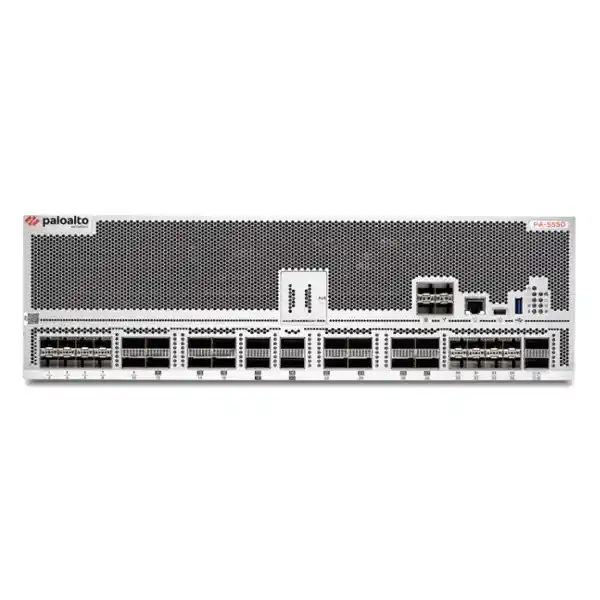
High-capacity data-centre security platform
Palo Alto Networks PA-5550 Quantum-Optimized Next-Generation Firewall in Dubai, UAE
The PA-5550 is built for organisations that need security inspection at data-centre and internet-edge scale without treating the firewall as a simple perimeter filter. It combines the Palo Alto Networks application-aware security model with a hardware platform designed for high traffic volumes, encrypted sessions and emerging post-quantum cryptography workloads.
Plan the right configuration
Share traffic volumes, interface needs, resilience goals and subscription requirements for a structured bill of materials.
Data centres, gateways and service-provider networks
Measured performance with security services enabled
3RU rack-mounted enterprise appliance
Licenses, optics and design dependencies must be confirmed
Direct answer for buyers
The Palo Alto Networks PA-5550 is a high-capacity next-generation firewall in the PA-5500 Series. It is mainly used to protect busy data-centre links, internet gateways, large enterprise networks and service-provider environments where application identification, policy enforcement, threat prevention and encrypted-traffic inspection must operate at substantial scale. Organisations considering it should have clear traffic measurements, growth assumptions and an agreed security architecture. Before proceeding, confirm the exact appliance variant, required interfaces and transceivers, power design, rack allocation, management method, subscriptions, support term, logging strategy and resilience approach. Performance should be evaluated against the security functions that will actually be enabled, not only a headline firewall-throughput figure.
What the PA-5550 does
The appliance acts as a policy-enforcement point between critical network zones. Rather than making decisions only from ports and IP addresses, the Palo Alto Networks security model is designed to identify applications, users and content so policies can reflect business intent. In a data-centre design, this can support north-south inspection between internal systems and external networks, segmentation between trust zones, secure access to hosted services and visibility into traffic patterns that would otherwise be difficult to control consistently.
Its quantum-optimized positioning refers to hardware designed to process modern and emerging cryptographic workloads, including post-quantum encrypted traffic. This does not remove the need for a broader cryptographic migration plan. Buyers still need to inventory applications, certificates, algorithms, dependencies and replacement timelines. The firewall is one component in that programme, not a complete quantum-readiness strategy by itself.
Who should consider it
The PA-5550 may be appropriate for organisations whose validated requirements exceed branch or midrange firewall designs. Typical buyers include large enterprises, financial institutions, government networks, cloud and hosting operators, managed security providers, telecom environments and organisations consolidating several high-speed security boundaries onto a resilient platform.
It is not automatically the correct choice for every large company. A buyer with moderate traffic, limited high-speed interfaces or a simple branch requirement may achieve a better technical and commercial fit with another model. Conversely, a network expecting rapid growth, unusually high connection rates or extensive encrypted inspection may need a larger PA-5500 Series model. FourTeck can help translate business requirements into a sizing discussion rather than selecting from model names alone.
Business challenges the platform can help address
High-volume inspection
Large internet and data-centre links can overwhelm appliances sized only around nominal bandwidth. The PA-5550 is intended for environments where inspection capacity, sessions and connection rates must be assessed together.
Encrypted traffic visibility
As more applications use encryption, security teams need a controlled decryption strategy that considers privacy, performance, certificates, exclusions and regulatory requirements rather than enabling inspection indiscriminately.
Policy consistency
Complex networks often accumulate inconsistent rules across zones and devices. Central management and application-aware policy can help teams standardise controls, subject to sound governance and change procedures.
Future cryptographic load
Post-quantum migration may increase processing requirements. A quantum-optimized firewall can form part of a broader crypto-agility programme, but application readiness and policy remain essential dependencies.
PA-5550 suitability matrix
| Requirement | Suitable when | Confirm before ordering |
|---|---|---|
| Data-centre perimeter | Multiple high-speed links require application-aware security inspection. | Traffic profile, interface count, optics, routing and failover design. |
| Internet gateway consolidation | Several security boundaries are being consolidated onto fewer platforms. | Peak load, maintenance windows, segmentation and failure-domain risk. |
| Encrypted inspection | The organisation has a defined policy for decrypting selected traffic. | Certificate process, legal exclusions, application compatibility and performance impact. |
| Resilient architecture | Service continuity requires a supported multi-appliance design. | Current PAN-OS support, clustering method, HSCI links and operational procedures. |
| Managed security service | A provider needs tenant-aware operational scale and centralised control. | Management architecture, logging, tenancy model, subscriptions and support responsibilities. |
Verified and procurement-relevant information
| Brand | Palo Alto Networks |
|---|---|
| Product | PA-5550 Quantum-Optimized Next-Generation Firewall |
| Product family | PA-5500 Series |
| Primary deployment | High-speed data centre, internet gateway and service-provider environments |
| Firewall throughput | Up to 120 Gbps, subject to vendor test conditions and software configuration |
| Threat-prevention throughput | Up to 175 Gbps, subject to vendor test methodology and enabled functions |
| IPsec VPN throughput | Up to 100 Gbps under stated vendor conditions |
| Form factor | 3RU rack-mounted appliance |
| Dimensions | Approximately 13.21 cm high × 43.94 cm wide × 75.69 cm deep |
| Airflow | Front to back |
| Operating temperature | 0°C to 50°C |
| Power architecture | Supports up to four load-sharing AC or DC power supplies; required quantity depends on voltage and redundancy design |
| High-speed interconnect | HSCI connectivity supports Inter Firewall Link design for supported NGFW clustering |
| Management | PAN-OS local management and supported central-management options; licensing and software version dependent |
| Subscriptions | Security subscriptions and support are selected separately according to required services and term |
| Availability | Contact FourTeck for current UAE model, license, quantity and lead-time options |
Published performance numbers are useful for initial comparison but do not replace solution sizing. Real results vary with PAN-OS release, traffic mix, packet size, enabled protections, decryption use, logging, routing and deployment design. FourTeck can help create a requirement sheet for vendor-aligned confirmation.
Configuration, licensing and compatibility dependencies
The base appliance should not be treated as a complete security solution by itself. The final bill of materials may include support, threat-prevention services, DNS-related protection, URL filtering, malware-analysis services, data-protection capabilities, IoT visibility, cloud management, logging capacity, optics, cables and installation services. Exact names and bundles can change with vendor programmes and region, so they should be confirmed at quotation time.
Network compatibility also needs more than a port-count check. The design team should validate transceiver types, fibre standards, link speeds, breakout requirements, routing protocols, MTU, link aggregation, upstream and downstream equipment, out-of-band management and time synchronisation. For resilience, confirm the supported architecture for the chosen PAN-OS release. The PA-5500 Series provides high-speed HSCI connectivity for Inter Firewall Links used in supported clustering designs, but the topology and operational model must be planned carefully.
Power and rack planning are equally important. A 3RU chassis with front-to-back airflow requires suitable cabinet depth, clear intake and exhaust paths, correct power circuits and an agreed redundancy level. The quantity and type of AC or DC power supplies depends on the site voltage and resilience requirement. Do not finalise an order until facilities, network and security teams have reviewed the physical design.
A practical purchase and deployment journey
Measure the environment
Collect peak and average throughput, packets per second, concurrent sessions, new sessions per second, VPN load, application mix and growth expectations.
Define security functions
List the protections, decryption policies, remote-access requirements, segmentation controls, logging destinations and operational reports that will be enabled.
Validate architecture
Confirm interfaces, optics, routing, rack, power, clustering, management, log retention and integration with identity and monitoring systems.
Build the quotation
Prepare the exact appliance variant, quantity, subscriptions, support term, accessories, services and regional delivery information.
Implement and verify
Rack, cable, configure, test failover, validate policies, check monitoring and complete controlled cutover and handover documentation.
Performance planning beyond headline throughput
A firewall can process different traffic types at very different rates. Small packets, high connection churn, extensive security profiles, TLS decryption, complex policy, VPN encryption and heavy logging all affect resource use. For that reason, a 100 Gbps internet link does not automatically mean a firewall advertised above 100 Gbps is correctly sized. The design must consider the busiest realistic operating condition, the functions that remain active during peak periods and the capacity reserve needed for growth, maintenance or component failure.
Start with monitoring data from routers, existing firewalls, load balancers and flow collectors. Review at least several representative business cycles rather than one quiet day. Separate internet, data-centre, inter-zone, VPN and backup traffic because each may have a different packet profile and security policy. Identify scheduled peaks such as replication, software distribution, market opening, payroll processing or customer campaigns. Where traffic is expected to migrate from other devices, include those volumes in the future-state model.
FourTeck can help organise these inputs into a sizing worksheet. The result should describe assumptions clearly, including growth period, enabled services, resilience model and acceptable utilisation. This makes the quotation easier to review and reduces the risk of choosing a model solely because it is familiar or appears powerful on paper.
Application control, threat prevention and encrypted traffic
The business value of a next-generation firewall comes from applying security policy to meaningful traffic context. Application identification can help distinguish approved business use from risky or unnecessary activity even when several applications share common ports. User and group context can support rules aligned with job function, while content inspection and threat-prevention services can evaluate traffic for malicious patterns. These capabilities depend on correct policy design, subscriptions, updates and operational review.
Encrypted traffic is a central design question. Decryption can improve visibility, but it introduces certificate management, privacy, legal, application-compatibility and performance considerations. Organisations should classify which traffic may be inspected, which categories must be excluded and how endpoint trust will be established. Business owners, legal teams and privacy stakeholders may need to approve the policy. A pilot is advisable for sensitive or complex applications so unexpected certificate pinning, mutual TLS or legacy behaviour can be identified before broad rollout.
Post-quantum readiness adds another layer. The PA-5550 is positioned for processing post-quantum encrypted traffic, yet a firewall cannot independently modernise every application and certificate chain. Buyers should pair the platform decision with a cryptographic inventory, vendor-roadmap review and phased migration plan. The objective is crypto-agility: the ability to identify and change algorithms without uncontrolled disruption.
Resilience, management and operational control
High-capacity firewalls often protect services whose downtime has broad business impact. Resilience therefore includes more than purchasing two appliances. The design should consider physical paths, upstream routers, downstream switching, power feeds, racks, management connectivity, software compatibility, configuration synchronisation, session behaviour and maintenance procedures. A supported clustering or redundancy architecture must be validated against the intended PAN-OS release and interface design.
Central management can help security teams maintain consistent policy, templates, updates and visibility across several firewalls. The correct choice between local management, Panorama and supported cloud-management options depends on the estate, operating model, licensing, data residency and administrative separation. Logging also needs deliberate capacity planning. Decide which events are retained locally, forwarded to a central platform or stored in a cloud service, and define retention according to operational and regulatory needs.
Operational readiness should include named owners, change approval, backup procedures, software lifecycle management, health monitoring, alert escalation, incident response and periodic policy review. Training and documentation reduce dependence on a small number of administrators. When FourTeck prepares an implementation scope, these responsibilities can be separated into customer tasks, deployment tasks and optional ongoing support.
Ideal business environments and use cases
Large enterprise internet edge
Suitable for organisations consolidating high-speed internet connections while applying application control, threat prevention, VPN and segmentation policies. Confirm peak encrypted traffic and resilience requirements.
Data-centre security zones
Can enforce policy between application tiers, shared services, partner links and external networks. East-west inspection design must account for latency, routing and failure domains.
Cloud and hosting operators
May support high-volume hosted environments that require central policy and visibility. Tenant separation, logging, service boundaries and operational responsibilities need careful definition.
Financial and regulated networks
Useful where strong segmentation, visibility and controlled change are required. The appliance supports the technical controls, while governance, evidence collection and compliance interpretation remain organisational responsibilities.
Managed security services
A possible fit for providers operating large traffic volumes. Management scale, service-level boundaries, customer isolation and subscription architecture should be modelled before selection.
Post-quantum preparation
Can form part of a programme to handle emerging cryptographic workloads. It should be paired with application discovery, crypto inventory, migration priorities and vendor readiness assessments.
Integration and operational considerations
A PA-5550 deployment normally touches several teams. Network engineers must validate routing, switching, VLANs, dynamic protocols, link aggregation, MTU and quality-of-service behaviour. Security architects must define zones, policies, decryption, threat profiles and administrative roles. Infrastructure teams must prepare rack space, power, cabling and environmental capacity. Application owners should identify critical flows, certificate behaviour and acceptable test windows. Operations teams need monitoring, backup, escalation and maintenance procedures.
Identity integration may be used to apply user- or group-aware policy. DNS, directory, certificate, NTP and logging systems must be reachable and resilient. If SIEM, SOAR, ticketing or network-monitoring platforms will consume events, agree on formats, event volumes, retention and alert ownership. Automation should be introduced with change controls, version management and testing rather than allowing scripts to modify production policy without safeguards.
Migration from an existing firewall deserves its own workstream. Rule conversion is not simply a syntax exercise: old rules may be duplicated, unused, too broad or based on different application definitions. A good migration reviews objects, services, NAT, routing, VPNs, certificates, security profiles, logging and dependencies. Establish rollback criteria and capture before-and-after test evidence. FourTeck can discuss whether the requirement is supply only, assisted configuration or a broader migration engagement.
Questions to resolve before requesting a quotation
Provide current and forecast throughput, packet rates, sessions, VPN traffic and the proportion expected to undergo decryption.
Identify threat prevention, URL controls, DNS protection, malware analysis, data protection, IoT visibility and other desired services.
List link speeds, media, port quantities, optics, breakout cables, routing protocols and management connections.
Clarify appliance quantity, clustering design, HSCI connectivity, redundant paths, power feeds and maintenance expectations.
Confirm local, Panorama or cloud management, administrator separation, log destinations and retention period.
State whether the quote should include rack installation, base configuration, migration, testing, documentation, training or ongoing support.
PA-5550 procurement checklist
☐ Exact PA-5550 AC or DC appliance variant
☐ Required appliance quantity and resilience design
☐ Measured peak throughput and session profile
☐ Expected decryption percentage and traffic types
☐ Interface speeds, quantities and media types
☐ Optics, cables and breakout requirements
☐ Security subscriptions and license term
☐ Support level and coverage period
☐ PAN-OS and management-platform compatibility
☐ Logging destination and retention capacity
☐ Rack depth, 3RU allocation and airflow clearance
☐ AC or DC power feeds and redundancy target
☐ Installation, migration and testing scope
☐ Destination, delivery coordination and target schedule
How FourTeck can assist
FourTeck can help convert an initial product request into a practical procurement scope. This may include reviewing traffic measurements, identifying missing technical inputs, discussing model fit, preparing a bill of materials, clarifying subscriptions, checking accessory needs and coordinating a quotation. Where deployment support is required, the scope can address rack planning, base configuration, policy migration, validation, documentation and handover.
The objective is not to add every possible service. It is to identify what the customer’s team will perform, what should be included in the project and which assumptions require confirmation. Visit the FourTeck firewall services overview or send the project requirement for review.
UAE availability and support guidance
Contact FourTeck to confirm current UAE availability for the PA-5550, the required power variant, subscriptions, support and accessories. Availability may depend on quantity, license region, vendor lead time and the completeness of the bill of materials. Delivery and project coordination can be discussed after the exact requirement is confirmed.
For projects across Dubai, Abu Dhabi, Sharjah and Ajman, FourTeck can coordinate requirement review, quotation preparation and deployment-scope discussions from one consolidated project brief. Installation and configuration should be stated explicitly in the quotation when needed. Browse the enterprise firewall product range for related options.
GCC Availability
FourTeck can assist organisations planning PA-5550 deployments across GCC markets by reviewing the requirement before the appliance, licenses and services are quoted. A regional project may involve offices, data centres or service-provider facilities in the United Arab Emirates, Saudi Arabia, Kuwait, Qatar, Bahrain or Oman, but the correct configuration should be built around the actual destination and network design rather than a generic regional bundle. Share the required quantity, power preference, interface plan, subscription term, support expectation, deployment location and intended schedule. Product availability, licensing rules, delivery planning, service visits, project scope and vendor lead time can vary by country and requirement. FourTeck can coordinate model-selection discussions, quotation preparation, accessory review, configuration scope and installation planning without claiming fixed delivery or onsite dates before these factors are confirmed. For a Kuwait-based enquiry, the FourTeck Kuwait technology portal provides an additional regional contact route.
Africa Availability
Organisations evaluating the PA-5550 for African projects can ask FourTeck to review the appliance requirement, subscription plan, transceiver needs, power design, management architecture, implementation scope and support expectations. Projects in East Africa and other regions may differ significantly in destination logistics, available data-centre facilities, power standards, service arrangements and local operating conditions. Availability and fulfilment can depend on the exact model, quantity, license region, shipping route, vendor lead time and installation requirements. Buyers should provide the destination country, deployment site, traffic profile, quantity, preferred schedule and whether remote or onsite assistance is expected. FourTeck can then offer appropriate procurement and planning guidance without implying local inventory or guaranteed delivery. Regional resources include FourTeck Kenya, FourTeck Uganda and the broader FourTeck Africa technology site.
Related products, services and alternatives
Other PA-5500 Series models
Consider smaller or larger models when validated capacity, interfaces or growth assumptions differ. Do not blend specifications across the series.
Panorama management
Centralised management may be relevant for multi-firewall estates. Platform capacity, deployment method and licensing should be reviewed.
Security subscriptions
Select services according to threat, URL, DNS, malware, data and IoT requirements. Names and bundles are vendor-policy dependent.
Firewall migration service
Useful when policies, NAT, VPNs and routing must move from an existing platform with testing, rollback and documentation.
Installation and configuration
Can cover physical installation, initial setup, interfaces, routing, management, policies and agreed validation activities.
Alternative enterprise firewalls
Where platform standardisation, budget, interfaces or operations differ, FourTeck can discuss other enterprise firewall categories without assuming equivalence.
Why businesses contact FourTeck
A request for a PA-5550 often begins with a model name but requires decisions across networking, security, licensing, facilities and operations. FourTeck helps buyers clarify those decisions before a quotation is finalised. Assistance can include capacity questions, interface review, subscription selection, bill-of-material preparation, compatibility discussion, delivery coordination, installation planning, migration scope and support options.
This approach is useful for procurement teams that need comparable quotations and for technical teams that need assumptions documented. It also helps identify items that may otherwise be missed, such as optics, power cords, central-management capacity, logging, certificates, maintenance windows or knowledge transfer. Learn more about FourTeck’s business technology approach or discuss the requirement directly with the sales and solutions team.
Frequently asked questions
What type of deployment is the PA-5550 intended for?
It is positioned for high-speed data-centre, internet-gateway and service-provider deployments. Suitability still depends on measured traffic, security services, interfaces and resilience requirements.
Is the PA-5550 suitable for a normal branch office?
Usually it would be larger than a typical branch requirement. A branch-focused model may be more appropriate unless the site has unusually high capacity or consolidation needs.
Are security subscriptions included with the appliance?
Do not assume they are included. The final quotation should list the appliance, support, required security subscriptions and their terms separately or within a confirmed bundle.
What does quantum-optimized mean for this firewall?
The platform is designed to process modern and emerging post-quantum cryptographic workloads at scale. It supports, but does not replace, an organisation-wide cryptographic inventory and migration programme.
Can the PA-5550 inspect encrypted traffic?
It can support decryption-based inspection where configured, but performance, certificate management, privacy, legal exclusions and application compatibility must be evaluated before deployment.
How should resilience be designed?
Confirm the supported PAN-OS architecture, appliance quantity, HSCI connectivity, cluster behaviour, redundant network paths, power feeds and operational procedures with the solution design team.
What information is needed for an accurate quotation?
Provide destination, quantity, traffic and session data, interfaces, optics, subscriptions, support term, management choice, resilience design and required installation or migration services.
Can FourTeck help with migration from another firewall?
Migration assistance can be discussed, including rule review, NAT, routing, VPNs, test planning, rollback, documentation and handover. Scope depends on the existing environment.
Is the PA-5550 currently available in Dubai?
Contact FourTeck to confirm current UAE availability. Timing may depend on appliance variant, quantity, licenses, accessories and vendor lead time.
How is warranty and support confirmed?
The quotation should state the applicable vendor support or warranty terms, service level and coverage period. These details should be reviewed before ordering.
Build a PA-5550 requirement that can be quoted accurately
Send FourTeck your traffic profile, interface plan, subscription needs, support term and deployment scope. The team can help confirm the model, licenses, accessories and UAE project requirements.

Reviews
There are no reviews yet.