
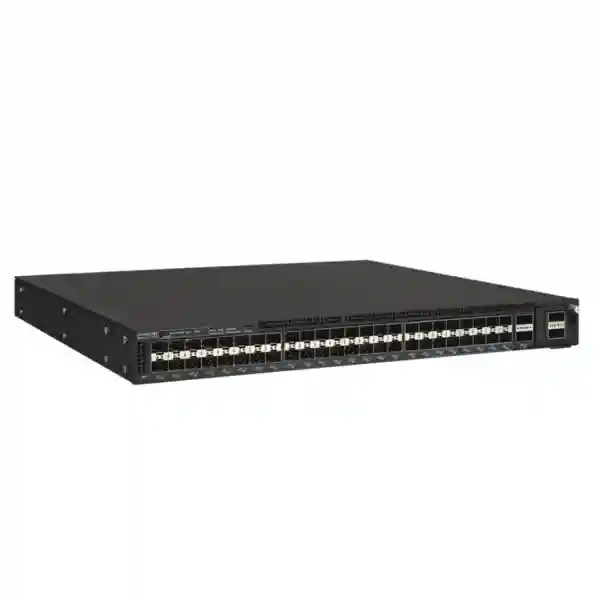
RUCKUS ICX 7550-48 Network Switch
The RUCKUS ICX 7550-48 is built for business and campus networks that need a dense 48-port Gigabit Ethernet access layer without PoE, while still requiring enterprise routing, resilient stacking, high-speed uplink flexibility and room for future network growth. For buyers comparing RUCKUS ICX 7550-48 Dubai options, the most important questions are not only the unit price. The design should also confirm the correct airflow direction, power configuration, uplink modules and optics, stack design, software feature requirements, management method and the exact role the switch will perform in the wider LAN.
Vendor-published specifications for the ICX 7550-48 include 48 10/100/1000 Mbps RJ45 access ports, up to four 1/10 GbE SFP/SFP+ modular uplink ports, up to four 40 GbE QSFP+ ports, 416 Gbps switching capacity, 309 Mpps forwarding capacity, stacking of up to 12 units and up to 960 Gbps aggregate stack bandwidth. The model does not provide PoE/PoE+, so organizations powering wireless access points, cameras, phones or other powered devices should plan separate PoE switching or evaluate the PoE variants in the ICX 7550 family.
What the RUCKUS ICX 7550-48 is designed to do
The ICX 7550-48 sits in the enterprise access-switching layer for networks that need many standard Gigabit copper connections and stronger capabilities than a basic unmanaged or lightly managed switch can provide. It is particularly relevant when an organization has desktop PCs, printers, servers, wired room endpoints, building systems, non-PoE appliances or downstream switches that need reliable 1GbE connectivity. The 48-port density reduces the number of access switches required in a rack compared with smaller models, while the uplink and stacking architecture allows the access layer to be connected to distribution or core switches with significantly more bandwidth than the individual 1GbE edge ports.
For customers researching a RUCKUS ICX 7550-48 price, the correct commercial comparison should include more than the chassis. A complete bill of materials may need power supplies, fan or airflow selection, uplink modules, SFP/SFP+ or QSFP+ optics, patch leads, rack accessories, software or support entitlement, management platform requirements and professional configuration. A quotation that leaves these items undefined can look attractive at first but still create delays when the switch reaches site and cannot be connected to the intended fiber plant, stack or power design.
FourTeck can help buyers structure that requirement before requesting a final commercial offer. The process can cover access-port count, current VLANs, inter-VLAN routing, uplink speed, fiber type, stack length, redundancy expectation, rack environment and management preference. Customers planning a wider cybersecurity or network-edge refresh can also review related infrastructure through FourTeck Firewall Dubai, while broader UAE networking and IT requirements can be discussed through FourTeck UAE.
Verified ICX 7550-48 specifications that matter to buyers
48 Gigabit copper ports
The model provides 48 10/100/1000 Mbps RJ45 access ports, making it suitable for dense wired user and device connectivity where 1GbE at the edge remains appropriate.
High-speed uplink options
The platform supports modular 1/10 GbE SFP/SFP+ uplinks and up to 40 GbE QSFP+ connectivity. The exact module and optic selection should be matched to the intended fiber and peer switch.
416 Gbps switching capacity
The published full-duplex switching capacity is 416 Gbps, with published forwarding performance of 309 Mpps. These figures help buyers compare the model within the ICX family.
Stacking up to 12 units
Up to 12 switches can be stacked, with published aggregate stack bandwidth up to 960 Gbps for the ICX 7550-48 configuration. Stack architecture should be planned before optics and cabling are ordered.
Layer 3 network services
The platform supports enterprise routing functions including static routing, OSPF and BGP, as well as VRF, allowing the switch to take on more advanced roles than simple Layer 2 access switching where the design requires it.
Resilience and operations
The product family supports redundant power options, hot-swappable internal power supplies and fans, reversible airflow, sFlow, MACsec, Energy Efficient Ethernet and VxLAN. Final feature use depends on software, design and configuration.
Important: ICX 7550-48 is the non-PoE model
A frequent procurement error is assuming that every 48-port enterprise access switch provides Power over Ethernet. The RUCKUS ICX 7550-48 does not provide PoE/PoE+. That distinction matters if the switch will connect directly to wireless access points, IP phones, surveillance cameras, access-control readers or other endpoints that expect power from the Ethernet cable. In those environments, the design may need dedicated PoE switches, local power injectors or a different ICX 7550 variant such as a PoE or multigigabit PoE model.
The non-PoE design can still be a strong fit where the connected devices already have local power, where the switch is serving desktops and wired infrastructure, or where power delivery is handled by another access layer. Buyers should therefore begin with an endpoint inventory rather than selecting only by port count. This simple check prevents ordering the right number of ports in the wrong electrical configuration.
Selection checklist before requesting a quote
Port demand
Count active wired endpoints, planned growth and spare capacity. Confirm whether every endpoint needs only 1GbE and whether any devices require PoE.
Uplink design
Document the peer switch, uplink speed, fiber type, connector, distance and redundancy requirement before choosing SFP+, QSFP+ or related modules.
Stack topology
Decide whether the deployment will use one standalone unit or a multi-switch stack. Stack length, cabling path and failure planning affect the bill of materials.
Power and airflow
Confirm rack power, UPS capacity, power-supply redundancy and desired airflow direction so the hardware matches the equipment-room cooling plan.
Routing and segmentation
List VLANs, VRFs, static routes, dynamic-routing requirements, ACLs and any east-west segmentation so the proposed configuration is reviewed before cutover.
Management
Confirm whether the network will be managed through switch CLI, an existing RUCKUS management environment or another supported operational workflow.
RUCKUS ICX 7550-48 Network Switch Dubai
Customers searching for the RUCKUS ICX 7550-48 Dubai model are commonly planning office, campus, education, hospitality, retail, data-room or multi-floor LAN upgrades where a large number of wired Gigabit devices must be consolidated into a manageable enterprise access layer. Dubai deployments often mix legacy 1GbE desktops with higher-speed distribution links, Wi-Fi infrastructure, IP telephony, cameras, servers and cloud-dependent business applications. In that environment, the ICX 7550-48 is most relevant when the 48 copper edge ports are needed but endpoint power is supplied separately. Its non-PoE status should be confirmed early because many Dubai projects include access points and cameras that would otherwise require a PoE switch.
For a Dubai quotation, buyers should provide more detail than the model number. The commercial request should state whether the switch will operate standalone or in a stack, the required uplink speed, the fiber path to the distribution layer, the number and type of optics, preferred airflow direction, desired power redundancy and whether Layer 3 routing will be performed on the access switch. A high-rise office may have short in-building fiber uplinks, while a campus or warehouse environment may use longer links between communications rooms. Those differences can change the correct optic and transceiver selection even when the core switch model is the same.
Dubai organizations also benefit from planning the switch as part of the complete network rather than as an isolated purchase. Firewall throughput, VLAN boundaries, wireless traffic, server access, guest networks and management security all affect how the access layer should be configured. The ICX 7550-48 supports enterprise features such as OSPF, BGP, VRF, MACsec, sFlow and VxLAN, but the requirement should be driven by the intended architecture rather than by enabling every available feature. FourTeck can help structure the bill of materials and configuration scope so procurement teams can compare like-for-like offers and technical teams know what will be delivered.
If the Dubai project includes switch replacement behind a new firewall, branch connectivity or segmentation work, network-security planning should be coordinated at the same time. This reduces the chance of discovering after installation that uplink capacity, VLAN design or rack power does not match the rest of the environment. For related implementation support, customers can review FourTeck IT services in the UAE and then request a model-specific quotation with the exact switch, modules, optics and service scope required.
RUCKUS ICX 7550-48 Network Switch UAE
For organizations searching for a RUCKUS ICX 7550-48 UAE supplier or quotation, a national deployment can involve very different site profiles across Dubai, Abu Dhabi, Sharjah and other emirates. A head office may use stacked access switches with redundant uplinks, while smaller branches may use a single switch with a simpler topology. Standardizing on one model can reduce operational variation, but only when the port type, power requirements and uplink design are appropriate for every location. Because the ICX 7550-48 is non-PoE, UAE companies should separate locations that need powered endpoints from those that primarily connect locally powered workstations, servers, printers and infrastructure devices.
A multi-site UAE procurement request should identify the number of switches per site, expected rack layout, UPS availability, temperature-controlled environment, fiber distances and the peer devices at the distribution or core layer. Where a stack is planned, the configuration should also define the intended stack topology and whether uplinks will be distributed across different stack members for resilience. The platform supports up to 12 switches in a stack and up to 960 Gbps aggregate stack bandwidth for the ICX 7550-48 design, giving network teams a scalable path while retaining one logical access layer for larger wiring closets.
UAE buyers frequently ask whether they should choose this model or a PoE alternative. The answer depends on the endpoint inventory. If the switch will directly power Wi-Fi access points, cameras or desk phones, the non-PoE 7550-48 will require an alternative power arrangement. If the cabinet already contains separate PoE switching or the connected equipment has local power, the 48-port non-PoE design may avoid buying unused power-delivery capability. The same logic applies to uplinks: 10GbE may be sufficient for some closets, while denser user populations or aggregation designs may benefit from 40GbE connectivity where supported by the peer devices and modules.
Procurement teams should request a written bill of materials that separates chassis, power, fan or airflow requirement, uplink modules, optics, support and services. Technical teams should provide the VLAN, routing, management and security requirements needed at deployment. This combined approach makes a UAE RUCKUS ICX 7550-48 quote easier to evaluate and reduces last-minute substitutions that can affect compatibility or installation timing.
RUCKUS ICX 7550-48 Network Switch Uganda
Organizations researching the RUCKUS ICX 7550-48 Uganda market may be planning campus networks, corporate offices, education facilities, healthcare environments, financial branches, hospitality sites or centralized IT infrastructure that needs a reliable 48-port access layer. In Uganda, the practical buying discussion often extends beyond the switch specification to fiber reach between buildings, power continuity, cabinet readiness, spares planning and the ability to support remote sites consistently. The ICX 7550-48 offers a dense 1GbE copper edge with enterprise routing and stacking, but it should be matched to a site design that accounts for those operational realities.
For a Kampala-based data room or a multi-building institutional campus, high-speed uplinks and stacking can simplify how many access closets are managed. For regional offices, a standalone unit may be more practical if local port demand does not justify a stack. In both cases, the non-PoE design must be checked against endpoint requirements. Schools, hotels and offices increasingly use access points, IP phones and cameras, and those devices may need separate PoE switching. The 7550-48 is better suited when the 48 copper ports are primarily for devices that already have power or when a dedicated PoE layer exists elsewhere in the cabinet.
Uganda procurement teams should also document the fiber interfaces at both ends of each uplink. Selecting a switch without confirming single-mode versus multimode fiber, connector type, distance and peer-switch capability can result in mismatched optics. The same applies to stack planning: if several switches will operate as one logical unit, the required stack connectivity should be specified from the start rather than added after the shipment reaches site. Power-supply redundancy and UPS capacity should be considered for locations where business continuity is important.
For regional planning and broader East African infrastructure discussions, buyers can reference FourTeck Africa. A useful RUCKUS ICX 7550-48 Uganda quotation request should include site count, access-port requirement, uplink medium, desired stack size, power and airflow needs, VLAN and routing requirements, management approach and any installation or remote-support scope expected from the supplier.
RUCKUS ICX 7550-48 Network Switch Kampala
A RUCKUS ICX 7550-48 Kampala deployment is often relevant to organizations with concentrated user populations in offices, universities, hotels, hospitals, financial institutions, NGOs, technology companies and public-sector facilities. Kampala networks can have a mixture of modern wireless access, wired desktop estates, server rooms and links between floors or neighboring buildings. The 48-port density allows an IT team to consolidate many wired endpoints into each access closet, while the higher-speed uplink capability helps prevent the access layer from being limited by a single 1GbE connection to the rest of the network.
When evaluating the ICX 7550-48 for a Kampala site, begin with a floor-by-floor port map. Count active data outlets, printers, locally powered devices, network appliances and any downstream switches. Then identify devices that require PoE. The distinction is important because the ICX 7550-48 does not provide PoE. If access points or cameras are connected directly in the same closet, the design may use a separate PoE switch or a different ICX model. This endpoint mapping is more reliable than choosing a switch only because 48 ports appear sufficient on paper.
For larger Kampala offices, stacking can simplify management by allowing several switches to operate as a coordinated system. Published support for up to 12 stack members gives room for substantial access-layer growth, but a stack should be engineered with the expected traffic and failure scenarios in mind. Network teams should decide where uplinks terminate, how links are distributed, which switches carry critical endpoints and how the design behaves if one member, power supply or uplink fails. The same planning should cover UPS runtime, rack ventilation and airflow direction.
Commercially, a Kampala buyer should request the switch together with all required components rather than accepting an incomplete chassis-only quote. That request can include uplink modules, approved transceivers, patch leads, power options, support, configuration and implementation. Providing the existing switch model, core or distribution model, fiber details, VLAN list and required routing features helps the supplier confirm a compatible proposal and avoids unnecessary changes during deployment.
RUCKUS ICX 7550-48 Network Switch Arua
For organizations looking for a RUCKUS ICX 7550-48 Arua solution, the buying priorities can differ from those of a large capital-city campus. A regional branch, education facility, healthcare site, NGO office, hotel or administrative center may value high port density and enterprise manageability while also needing careful planning for power quality, remote support and uplink resilience. The ICX 7550-48 can provide a strong wired access foundation where many standard Gigabit devices need to connect to a central communications room, but every supporting component should be chosen with the site conditions in mind.
Arua deployments should first confirm whether the switch is connecting locally powered endpoints or powered devices. The model is non-PoE, so access points, IP phones, cameras or other PoE endpoints cannot draw power from its Ethernet ports. If the site needs both dense data ports and powered endpoints, a mixed design can separate non-PoE users onto the ICX 7550-48 and PoE devices onto dedicated PoE switching. This can be useful when only part of the endpoint estate requires power, but it adds rack, power and management considerations that should be documented before procurement.
Remote manageability is another important factor for regional sites. The switch supports enterprise network-management and monitoring capabilities such as sFlow and Layer 3 routing features, which can help a central IT team operate the access layer as part of a broader network architecture. However, effective remote operations depend on secure management access, documented configurations, reliable upstream connectivity and a recovery plan. A spare optic, backup configuration and clear port labeling can be more valuable in a regional branch than adding complexity that local staff cannot easily support.
When requesting a RUCKUS ICX 7550-48 Arua quote, include the expected number of users, current cabinet size, UPS availability, uplink distance, fiber type, peer switch, desired support arrangement and whether the site is part of a larger WAN. This context allows the supplier to recommend the correct modules and service scope and helps the customer budget for a complete deployment rather than only the switch hardware.
RUCKUS ICX 7550-48 Network Switch Mbarara
A RUCKUS ICX 7550-48 Mbarara project may serve a university environment, hospital, hospitality property, financial branch, agribusiness office, professional organization or growing commercial campus. These sites often need dependable switching for a mixture of user workstations, locally powered devices, servers and infrastructure connections while maintaining enough uplink capacity to carry traffic back to a central core. The ICX 7550-48 provides 48 standard Gigabit copper access ports and enterprise switching features, making it a candidate for wiring closets where PoE is not required directly from the device.
For education and healthcare environments around Mbarara, segmentation is usually an important design consideration. Student, staff, administration, medical, guest, laboratory, finance, CCTV and building systems may need to be separated through VLANs and routing policies. The ICX 7550 platform supports Layer 3 services and VRF, which gives architects options for structured segmentation, but the actual design should be based on security policy and operational requirements. A switch should not be treated as a security boundary by assumption; firewall and access-control rules should be coordinated with the switching plan.
The uplink design deserves equal attention. A 48-port access switch can create significant aggregate traffic even when individual users connect at 1GbE. Buyers should therefore identify expected traffic patterns and choose uplink capacity accordingly. A small branch may be comfortable with a 10GbE connection, while a larger campus closet may need additional uplink bandwidth or link redundancy. Fiber type and distance must be verified so that the correct SFP+ or QSFP+ components are supplied.
Mbarara customers should also plan for maintainability. If the switch will be installed in a remote or lightly staffed location, configuration backup, labeled cabling, power protection and a documented replacement procedure can reduce recovery time. A well-prepared quote should include the chassis, required power configuration, airflow choice, uplink modules, transceivers, support and any installation services needed to bring the switch into service correctly.
RUCKUS ICX 7550-48 Network Switch Gulu
Customers considering the RUCKUS ICX 7550-48 Gulu model may be supporting education, government, healthcare, NGO, commercial, hospitality or regional enterprise operations where a central communications room needs many stable wired connections. The switch is particularly relevant when 48 Gigabit Ethernet access ports are required for locally powered devices and where the organization wants enterprise management and routing capabilities rather than a basic access switch. Its non-PoE design should be treated as a deliberate specification, not an overlooked limitation.
Gulu sites that use Wi-Fi access points, VoIP handsets or surveillance cameras should decide how those devices will receive power. One approach is to deploy the ICX 7550-48 for standard data endpoints and use a separate PoE switch for powered devices. Another is to choose a PoE model for the entire closet when most ports require power. The better option depends on endpoint counts, rack capacity, power budget, maintenance preferences and future expansion. This is why an accurate port schedule is more useful than simply requesting a 48-port switch.
For institutions with several buildings or departments, the uplink path should be mapped before hardware is ordered. The ICX 7550-48 supports high-speed uplink options and stacking, but the final design should align with the core switch, fiber plant and traffic demand. If multiple closets are connected over longer distances, the design may favor single-mode fiber and appropriate transceivers. If several switches share one rack, stacking can simplify operations, provided the cabling, power and resiliency plan is clearly defined.
A practical Gulu quotation request should also state whether configuration, installation, remote commissioning or post-deployment support is required. Organizations with centralized IT teams may prefer pre-staged configurations and documented handover so local staff only need to connect labeled cables. Others may require a complete onsite scope. Separating hardware, optics, implementation and support in the quotation makes the commercial offer easier to compare and prevents technical assumptions from being hidden inside one line item.
RUCKUS ICX 7550-48 Network Switch Kenya
For customers researching a RUCKUS ICX 7550-48 Kenya supplier, the switch can be considered for enterprise offices, campuses, financial institutions, universities, hospitality environments, logistics operations and multi-site organizations that need a scalable Gigabit access layer. Kenya deployments may range from dense Nairobi office towers to regional branches and industrial sites, so the same model can require very different supporting components. The 48-port non-PoE configuration is best suited to locations where powered endpoints are handled separately or where most connected equipment already has its own power source.
A Kenya network standardization project should first define the site types. Large offices may use multiple stacked switches with redundant uplinks, while branch sites may use one standalone unit. The ICX 7550-48 supports stacking of up to 12 units and enterprise Layer 3 capabilities, so it can scale within a structured campus design. However, scale should not be confused with simplicity. More switches in a stack require careful planning for stack links, uplink distribution, software consistency, configuration backup and power resilience.
Uplink optics are another frequent procurement issue. The buyer should specify whether the link is 10GbE or 40GbE, the distance, fiber mode, connector type and the exact peer interface. An optic described only as “SFP” is not enough information to guarantee compatibility. Where links connect different floors or buildings, the physical fiber plant should be tested and documented before cutover. This avoids troubleshooting a switching problem that is actually caused by cabling or mismatched transceivers.
Kenya customers should also consider lifecycle operations. The quotation can include staging, configuration, remote or onsite support, spares strategy and a clear list of supplied accessories. Businesses with multiple sites benefit from consistent naming, VLAN standards, management access, logging and backup procedures. These operational details can reduce support effort over time and make the ICX 7550-48 easier to manage as part of a wider wired and wireless network.
RUCKUS ICX 7550-48 Network Switch Kuwait
A RUCKUS ICX 7550-48 Kuwait deployment can support corporate offices, education, hospitality, healthcare, retail, logistics and enterprise campus environments that need dense wired access with strong uplink and Layer 3 capabilities. In Kuwait, equipment-room design is especially important because network hardware should operate in properly controlled indoor environments with appropriate ventilation, rack spacing and UPS protection. The ICX 7550 family supports reversible airflow and redundant power options, so buyers should specify the desired airflow orientation and power configuration rather than assuming every shipped unit is identical.
The 48-port model is non-PoE. This means it does not directly power Wi-Fi access points, cameras or IP phones. Kuwait organizations modernizing office wireless networks should therefore confirm whether those powered devices connect to separate PoE switches. A mixed cabinet can work well when only a limited number of ports require power, while a PoE-heavy environment may be better served by a PoE variant. The endpoint schedule should determine the choice, especially for new office fit-outs where access points, cameras and phones may represent a large share of the access layer.
For larger enterprise deployments, the ICX 7550-48 can be stacked and integrated with high-speed uplinks to a distribution or core layer. The network team should identify whether it needs OSPF, BGP, VRF, VxLAN, MACsec or other enterprise features and confirm the intended software and management design. Not every deployment needs every feature. A simple branch may use VLANs and static routing, while a larger campus may use dynamic routing and more complex segmentation.
A Kuwait quotation should be built from the complete site requirement: number of access ports, switch quantity, stack plan, power redundancy, airflow, uplink modules, optics, rack accessories, support and implementation scope. Where several sites are involved, use a per-site bill of materials so procurement and engineering teams can see exactly what will be installed at each location and can identify any differences before the order is released.
RUCKUS ICX 7550-48 Network Switch Ghana
Organizations looking for a RUCKUS ICX 7550-48 Ghana solution may be upgrading office networks, university campuses, hotels, financial institutions, healthcare environments or multi-site enterprise infrastructure. In Accra, Kumasi and other business centers, wired switching is often part of a broader modernization project that includes faster wireless, new firewalls, server connectivity and improved segmentation. The ICX 7550-48 can provide 48 Gigabit copper access ports with enterprise-class switching features, but the design should account for its non-PoE configuration and the supporting uplink components required for the site.
Ghana buyers should begin with an endpoint and cabling survey. Count user ports, printers, locally powered appliances, wireless access points, cameras and any special systems. Separate devices that need PoE from those that only need data. If the majority of ports are standard data connections, the ICX 7550-48 may be a sensible access switch while powered devices are placed on dedicated PoE switching. If most ports need power, a PoE model may reduce cabinet complexity. This choice should be made before the quotation stage so pricing reflects the actual design.
Fiber and uplink planning is equally important. A 48-port switch with only a low-speed uplink can become a bottleneck when many users access cloud applications, centralized servers or high-throughput wireless networks. The ICX 7550-48 offers higher-speed uplink options, and the correct choice should be based on traffic demand, peer-switch capability and the existing fiber plant. For multi-building campuses, confirm distance and fiber type before selecting transceivers.
Operational planning can include power protection, configuration backup, spare optics and clear documentation for local support teams. Ghana customers should request a complete bill of materials and avoid comparing offers that list only the switch chassis. The more accurate commercial comparison includes power, uplinks, optics, support and any staging or configuration service required to make the hardware deployable.
RUCKUS ICX 7550-48 Network Switch Nigeria
A RUCKUS ICX 7550-48 Nigeria deployment may support large office networks, financial services, education, hospitality, oil and gas administration, healthcare, logistics, retail or distributed enterprise branches. Nigerian organizations often need access switching that can scale to dense user populations while remaining manageable across multiple sites. The ICX 7550-48 provides 48 standard Gigabit copper ports, enterprise Layer 3 capabilities and stack support, giving network architects flexibility to use it as a standalone access switch or as part of a larger stacked access layer.
Power planning is especially important in any environment where supply quality or generator and UPS transitions must be considered. The network design should define which circuits feed the rack, expected UPS runtime and whether redundant power is required. The ICX 7550 family supports redundant power options and hot-swappable power supplies and fans, but the ordered configuration should explicitly match the resilience requirement. A redundant-capable platform does not provide business continuity by itself unless the power feeds, UPS design and upstream network are also engineered appropriately.
The model is non-PoE, so Nigerian offices deploying large numbers of access points, IP phones or surveillance devices need a separate power-delivery plan. This may involve dedicated PoE access switches or selecting a PoE ICX 7550 variant. The network team should also consider uplink capacity. A 10GbE uplink may suit some branches, while a dense campus closet or server-facing access layer may justify higher aggregate bandwidth. The choice should be based on measured or expected traffic and the capabilities of the distribution layer.
For multi-site deployments in Lagos, Abuja and other locations, standard configuration templates can improve consistency. VLAN names, management addressing, routing policies, monitoring, firmware practices and configuration backups should be documented and repeated across sites where appropriate. Procurement should then request the same complete accessory list for each standard site type. This approach makes a RUCKUS ICX 7550-48 Nigeria rollout easier to budget, stage and support than ordering individual switches without a defined architecture.
RUCKUS ICX 7550-48 Network Switch Seychelles
For a RUCKUS ICX 7550-48 Seychelles project, hospitality, resort, government, education, financial and professional-service environments may need a compact but capable wired core or access layer that supports many local devices and reliable uplinks. Island deployments often benefit from more deliberate logistics planning because replacement parts, optics and accessories may not be as quickly available as in a major distribution hub. The switch should therefore be ordered as a complete solution with the required power configuration, uplink modules, transceivers and spare strategy defined in advance.
Hospitality networks are a useful example. Guest Wi-Fi, staff systems, point-of-sale terminals, property-management systems, cameras, building controls and back-office devices may all share the wider network but require careful segmentation. The ICX 7550-48 can provide dense 1GbE wired connectivity and enterprise Layer 3 features, but it does not provide PoE. Access points and cameras therefore require separate PoE switching or an alternative model. For resorts with many powered edge devices, this distinction should be included in the network design before the switch is selected.
Redundancy planning can be valuable for sites where a network outage affects guest operations, payments or communications. A stacked design may simplify management and provide more flexible uplink placement, while redundant power and multiple upstream links can reduce single points of failure when implemented correctly. However, redundancy should be end-to-end. Two power supplies connected to the same unprotected circuit or two uplinks following the same vulnerable physical path do not provide the same resilience as genuinely independent resources.
Seychelles buyers should ask for clear lead-time and logistics information without assuming stock or delivery dates. A quotation can also include one or more spare optics, configuration backup, remote-support procedures and labeled cabling information. These relatively small planning steps can make a significant difference when the support team is not located next to the site and when shipping a replacement component requires additional coordination.
RUCKUS ICX 7550-48 Network Switch procurement and compatibility guidance
The safest way to buy the ICX 7550-48 is to treat it as part of a complete network design. Start by documenting the existing or planned core and distribution switches. Record available uplink interfaces, supported speeds, transceiver requirements and fiber distances. Next, identify the access-layer VLANs, routing boundaries, endpoint classes and management method. Finally, define physical requirements such as rack space, airflow, power feeds and UPS capacity. These inputs allow the switch, optics and services to be quoted as one compatible bill of materials.
Do not assume that a transceiver with the correct speed will automatically be suitable. The optic must match wavelength, fiber type, reach, connector and the supported interface on both ends of the link. The same principle applies to stacking and uplink modules. Buyers should request exact part references on the quotation and ask the technical team to confirm how each item will be used. This is particularly important when a quote includes third-party optics or when an existing core switch comes from another vendor.
Software and support should also be discussed before purchase. Routing, management and advanced features may depend on the intended software release and operational model. Organizations with change-control procedures should decide whether the switch will be staged before delivery, whether firmware will be standardized with existing RUCKUS infrastructure and whether a configuration template will be provided. A controlled deployment usually reduces troubleshooting compared with installing a factory-default switch directly into a production rack.
Frequently asked questions
Is the RUCKUS ICX 7550-48 a PoE switch?
No. The ICX 7550-48 is the 48-port non-PoE variant. If endpoints need power over Ethernet, use separate PoE switching or evaluate an appropriate PoE model from the ICX 7550 family.
How many Ethernet ports does the ICX 7550-48 provide?
It provides 48 10/100/1000 Mbps RJ45 access ports. The platform also supports modular high-speed uplink connectivity, which should be configured according to the intended peer switch and fiber design.
What are the published switching and forwarding capacities?
Vendor-published figures for the ICX 7550-48 are 416 Gbps switching capacity and 309 Mpps forwarding capacity. Real deployment behavior still depends on configuration, traffic patterns and the wider network architecture.
Can multiple ICX 7550-48 switches be stacked?
Yes. The ICX 7550 platform supports stacks of up to 12 switches, and the published aggregate stack bandwidth for the ICX 7550-48 configuration is up to 960 Gbps. The exact stack design should be planned before procurement.
Does it support Layer 3 routing?
Yes. The platform supports Layer 3 functions including static routing, OSPF and BGP, as well as VRF. Which features should be enabled depends on the network design and software environment.
What information should I provide for a RUCKUS ICX 7550-48 quotation?
Provide the number of switches, site location, access-port count, stack requirement, uplink speed, fiber type and distance, peer switch model, power redundancy, airflow preference, routing features, management method, installation scope and any support requirement.
Is the ICX 7550-48 suitable for Wi-Fi 6 networks?
The ICX 7550 family is designed for modern enterprise wired access and is positioned by RUCKUS for contemporary campus environments. For a Wi-Fi 6 deployment, confirm whether the specific access points require PoE and multigigabit edge ports. The ICX 7550-48 itself provides standard 1GbE non-PoE copper access ports, so some wireless designs may be better matched to another ICX 7550 variant.
Why contact FourTeck for the ICX 7550-48
The value of supplier support is greatest before the purchase order is placed. A switch can be technically correct but commercially incomplete if the quote omits required optics, power components or implementation work. FourTeck can help buyers translate a model request into a fuller bill of materials by reviewing the intended port count, uplinks, stacking, routing, power and deployment scope. This is especially useful for procurement teams that receive a part number from an engineer but still need to compare offers on an equivalent basis.
For broader infrastructure requirements, FourTeck can also coordinate the switching discussion with firewall, IT support and regional network planning. This allows the access layer to be considered alongside segmentation, internet edge capacity, wireless traffic and ongoing operations rather than being treated as a standalone hardware purchase. The objective is to reduce assumptions and make the final quotation easier for both technical and commercial teams to approve.
Customers should request current availability, warranty or support terms, region-specific part references and delivery information directly at the time of quotation. No stock level, delivery date or warranty entitlement should be assumed from a product page because those items can vary by region, configuration and supplier channel.
Decision recap
Choose the ICX 7550-48 when you need 48 standard Gigabit copper access ports, enterprise Layer 3 capabilities, stackability and high-speed uplink options, and when endpoint PoE is not required from this switch. Reconsider the model if most connected devices need PoE or multigigabit copper at the edge.
Quotation checklist
Send switch quantity, location, access-port count, endpoint power needs, stack size, uplink speed, fiber details, peer-switch model, power redundancy, airflow preference, routing needs, management method, support term and installation scope. This gives the sales team enough context to prepare a useful offer.
Related network planning
If the switch is part of a larger refresh, review firewall capacity, VLAN segmentation, wireless traffic, UPS design and monitoring at the same time. Coordinated planning reduces the risk that one upgraded component creates a new bottleneck elsewhere.
Talk to FourTeck about your RUCKUS ICX 7550-48 requirement
Share your network diagram, required port count, uplink plan and site details so the proposed bill of materials can be checked before purchase. FourTeck can assist with quotation coordination, compatibility discussion and deployment-scope planning for Dubai, UAE and regional projects. For a direct sales conversation, use the FourTeck contact process and include the exact model name RUCKUS ICX 7550-48 Network Switch in your request.
If the project includes broader network security, switching and infrastructure requirements, describe them together. A combined requirement makes it easier to align access switching, routing, firewall segmentation, wireless connectivity and support responsibilities instead of treating each component as an isolated purchase.

Reviews
There are no reviews yet.