
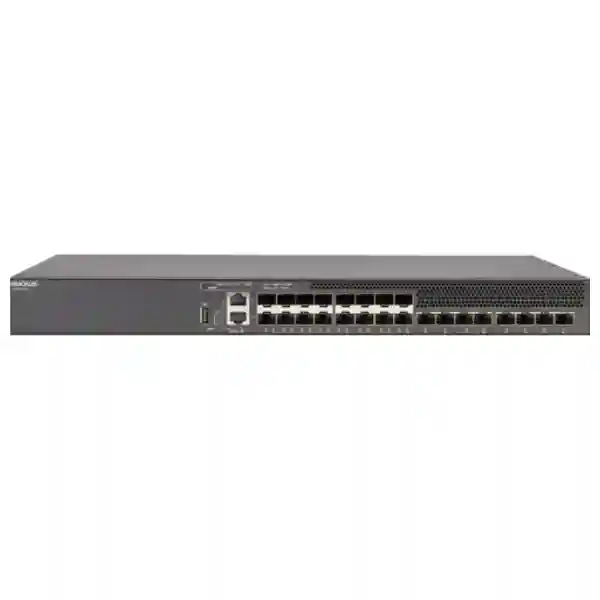
RUCKUS ICX 8200-24FX 10G Fiber Switch
The RUCKUS ICX 8200-24FX is built for organizations that need a fiber-first access or aggregation platform without jumping directly to a much larger chassis design. It combines dense 1/10GbE optical access with 1/10/25GbE SFP28 connectivity for uplinks or stacking, making it relevant to campuses, data-center edge networks, hospitality properties, education, managed networks, distributed enterprises and sites where long-distance fiber or electrically isolated links are preferred over copper.
Choose the ICX 8200-24FX when your design calls for many 10GbE fiber-facing ports, higher-speed 25GbE uplink or stacking capability, routing and segmentation features, and stack growth without the footprint of a modular core switch.
What the RUCKUS ICX 8200-24FX is designed to do
RUCKUS positions the ICX 8200 family as a stackable enterprise access platform, and the ICX 8200-24FX is the 10G fiber-focused member of that family. Official RUCKUS information identifies the platform with a maximum switching capacity of 720 Gb/s, support for stacking up to 12 switches, aggregate stack bandwidth up to 1200 Gb/s, Layer 3 capabilities including static routing, RIP and OSPF, sFlow, VRF and VXLAN. The 24FX is a non-PoE fiber model, so it is intended to connect through optical interfaces rather than directly powering endpoints such as access points, phones or cameras. That distinction matters during design: powered edge devices still need PoE access switches or injectors elsewhere in the topology, while the 24FX concentrates on high-speed fiber transport and aggregation.
The physical port layout is commonly documented as sixteen 1/10GbE SFP+ interfaces together with eight 1/10/25GbE SFP28 interfaces used for high-speed connectivity and stacking. RUCKUS product information also describes support for up to twenty-four 10GbE SFP+ connections and up to eight 25GbE SFP28 connections in the model’s capability profile. Before purchasing optics, confirm the exact interface mode, software release, supported transceiver, fiber type, connector type and distance requirement for every link. A fiber switch purchase is not complete until the optics and patching plan are correct.
Maximum switching capacity published by RUCKUS for the ICX 8200-24FX.
Switches per stack, allowing the design to grow while retaining a unified logical stack model.
SFP28 connectivity for higher-speed uplinks or stacking where supported by the deployment design.
The model is fiber-oriented and does not provide PoE/PoE+ endpoint power.
Key capabilities and practical buyer benefits
Dense 10G fiber access
A fiber-dense access layer is useful where servers, wireless aggregation, building-to-building links, distribution switches or high-bandwidth endpoints need optical connectivity. It also helps when cable distance, electromagnetic isolation or existing fiber plant makes optical Ethernet preferable to copper.
25GbE uplink and stacking paths
The SFP28 interfaces allow architects to avoid constraining a dense 10G edge behind a small uplink. Where the upstream design supports it, 25GbE can provide additional headroom for aggregated traffic, inter-switch links or stack connectivity.
Layer 3 routing
Static routing, RIP and OSPF support allow the switch to participate in routed campus or aggregation designs. Buyers should map which VLANs remain switched, which interfaces become routed, and where the firewall or core routing boundary sits before deployment.
VRF, VXLAN and traffic visibility
VRF can separate routing domains, VXLAN supports overlay-oriented segmentation use cases, and sFlow can improve traffic visibility. The value of each feature depends on software release, licensing where applicable and the broader network architecture.
Optics, fiber and compatibility checklist
The most common purchasing mistake with a fiber switch is to treat the chassis and the optics as one decision. They are separate. Each link needs a transceiver and fiber plan that matches speed, reach, wavelength, connector and the device on the far end. For short data-room links, multimode fiber may be appropriate. For campus, metro or long building-to-building links, single-mode fiber is often required. The correct option depends on actual distance and the installed cabling plant, not just the switch model.
- Document every port by source device, destination device, required speed, fiber type, connector, approximate distance and redundancy role.
- Verify supported RUCKUS optics and software compatibility before ordering third-party or generic transceivers. Support outcomes can depend on using validated optics.
- Check whether a 25GbE SFP28 port will run at 25GbE, 10GbE or 1GbE in the intended configuration and whether the far-end equipment supports the same mode.
- Plan spare optics, labeled patch leads, cleaning tools and test procedures for critical links. Many apparent switch problems are actually caused by dirty connectors, damaged fiber, incorrect polarity or mismatched optics.
- Confirm rack power, cooling, airflow direction, management addressing, console access and out-of-band management before the installation window.
Where this switch fits in a network
The ICX 8200-24FX can serve several roles depending on topology. In a campus, it can aggregate fiber from remote cabinets or building zones before forwarding traffic toward a core. In a data-center edge role, it can connect servers, appliances or storage-facing network devices that use 10GbE optical links. In hospitality, education or multi-building commercial sites, it can consolidate long-distance fiber runs that would be impractical over copper. It may also be used as a distribution layer between PoE access switches and an upstream firewall or core platform.
Because it does not provide PoE, the 24FX should not be selected as a direct replacement for a powered edge switch where access points, phones or cameras must receive power from the same device. A better design in that case may use PoE access switches at the edge and the ICX 8200-24FX as the optical aggregation layer. This separation can be especially clean where each floor or remote building has its own PoE switch and fiber returns to a central equipment room.
Related FourTeck resources on this website
A switching project normally touches routing, firewalling, cabling, optics, VLAN design and support processes. Review the FourTeck firewall product catalog when the ICX 8200-24FX will connect to an internet edge or segmentation firewall, and the firewall deployment and support services page when the project includes policy design, VPN, routing or migration work. The FourTeck service background gives additional context for infrastructure planning, while the sales and consultation page is the direct route for a quotation or deployment discussion.
For larger security projects that may sit upstream of the RUCKUS switching layer, examples of verified same-site product pages include the Barracuda CloudGen Firewall F1000 Revision B for high-capacity data-center and regional edge requirements, the Barracuda CloudGen Firewall F12 Revision A for smaller branch-focused security designs, the Barracuda CloudGen Firewall F180 Revision B for mid-range deployments, and the Barracuda CloudGen Firewall F280 Revision C for larger multi-service edge designs. These are not substitutes for the ICX 8200-24FX; they are related security platforms that may connect to the switching layer in a complete network architecture.
RUCKUS ICX 8200-24FX 10G Fiber Switch Dubai
Customers searching for a RUCKUS ICX 8200-24FX 10G Fiber Switch in Dubai are usually planning one of three projects: a new high-speed office or campus network, an upgrade from 1GbE fiber distribution, or a consolidation of multiple optical links into a stackable switching platform. Dubai environments often combine office floors, server rooms, warehouses, hospitality buildings, retail locations or mixed-use facilities where fiber is used between communications rooms because distance and building layout exceed practical copper limits. In these projects, the question is not simply whether the switch supports 10GbE. The buyer needs to confirm how many 10GbE endpoints will connect on day one, how many will be added later, what the upstream core or firewall can accept, and whether 25GbE links should be reserved for uplink or stack capacity.
For a Dubai deployment, procurement should begin with an interface schedule. List each fiber run, its termination room, the equipment at both ends, expected speed and approximate distance. Buildings may already have OM3 or OM4 multimode fiber between floors, while inter-building links may use single-mode fiber. Those two situations require different optics. The ICX 8200-24FX can be an effective aggregation choice when the installed fiber plant is valuable and the organization wants to increase bandwidth without redesigning every remote closet. Where PoE access devices are present, the 24FX normally belongs upstream of PoE switches rather than replacing them directly.
Dubai buyers should also plan rack environment, power, cooling and cable management. Dense optical patching can become difficult to troubleshoot when labels are inconsistent or patch cords block airflow. Allocate rack space so fiber bends are controlled, use clear port naming, retain a tested console path and document management IP addresses before cutover. If the 24FX connects to a firewall, determine whether routing should occur on the switch, on the firewall or on a separate core. Moving large amounts of east-west campus traffic through a security appliance unnecessarily can create bottlenecks; conversely, routing sensitive VLANs entirely on the switch may bypass security controls that the organization expects.
FourTeck can help Dubai customers frame these questions before requesting commercial pricing. The useful quote is the one that covers the switch, required optics, support expectations, rack and cabling assumptions, software requirements and any implementation services instead of listing only the chassis. Buyers can also review the broader product and service resources on the Firewall Dubai site when the switch is part of a larger security refresh. Ask sales to confirm current commercial availability and lead time rather than assuming stock, because enterprise switching availability can change by region and project quantity.
RUCKUS ICX 8200-24FX 10G Fiber Switch UAE
For UAE organizations, the RUCKUS ICX 8200-24FX is relevant when a single design must support high-speed optical links across headquarters, branches, campuses, warehouses, data rooms or distributed facilities. The procurement discussion usually includes more than the switch itself because UAE enterprise networks frequently combine multiple ISPs, firewall clusters, Wi-Fi access layers, IP telephony, CCTV, cloud connectivity and site-to-site links. The 24FX works best when its role is clearly defined inside that architecture. It may aggregate fiber from access switches, connect 10GbE appliances, serve as a routed distribution point or provide a stackable optical access layer. Each role changes the port allocation, uplink design and failure-domain planning.
A useful UAE design exercise is to separate access, distribution and security boundaries. If multiple branch or floor switches feed the 24FX, identify which VLANs should remain local, which should be routed centrally and which must pass through a firewall for inspection. RUCKUS support for static routing, RIP, OSPF, VRF and VXLAN provides several design options, but features should be chosen for a specific operational reason. Simpler networks may benefit from a straightforward VLAN and OSPF design, while larger multi-tenant or segmented environments may use VRF to keep routing tables separate. VXLAN can support overlay-oriented designs, but it should not be introduced simply because the feature exists.
Commercial buyers should request a bill of materials that includes optics and support. For every SFP+ or SFP28 port, confirm whether the far end uses 1GbE, 10GbE or 25GbE, and verify the exact transceiver against RUCKUS compatibility guidance. If existing fiber will be reused, arrange link testing before installation so weak optical budgets, contaminated connectors or incorrect fiber types are not discovered during a production cutover. Include spare transceivers for critical routes and maintain an asset list that maps optic serials and ports where operational policy requires it.
For a broader UAE infrastructure discussion, FourTeck can coordinate switching with security and network services through the existing Firewall Dubai product and services pages on this site. The key buying questions are capacity, topology, optics, management, support and migration timing. Ask for confirmed lead time and current pricing for the exact quantity and support term required. Avoid basing a design on generic web prices because enterprise switch pricing can vary with source, support bundle, taxes, currency and project volume.
RUCKUS ICX 8200-24FX 10G Fiber Switch Uganda
Organizations evaluating a RUCKUS ICX 8200-24FX 10G Fiber Switch in Uganda often need reliable fiber aggregation between buildings, server rooms, access cabinets or operational sites where copper distance is impractical. Universities, hotels, hospitals, financial organizations, NGOs, logistics operators and multi-site businesses may already have single-mode fiber between facilities and want to move from 1GbE to 10GbE without replacing the entire cable plant. In that situation, the 24FX can provide a concentrated optical access layer with higher-speed uplink or stacking capability, but the design should begin with an audit of the existing fiber routes rather than an assumption that every strand is ready for 10GbE.
The Uganda procurement checklist should include fiber type, distance, connector condition, splice count, patch-panel labeling and power stability at each network location. Long links may need single-mode optics, while short equipment-room runs may use multimode transceivers. Before increasing speed, test optical loss and clean connectors. A link that operated at 1GbE can still expose marginal conditions when moved to a different optic or speed. For remote sites, spare optics and clearly labeled patch cords can reduce recovery time when a transceiver or cable fails. The switch itself is only one component in that operational chain.
Where power quality or generator transitions are a concern, place the switch on appropriately sized UPS protection and document restart behavior for connected devices. Because the ICX 8200-24FX is not a PoE switch, remote access points, cameras and phones need powered access switches or separate power arrangements. A practical topology is often to keep PoE switching close to endpoints and bring fiber uplinks back to the 24FX. This reduces long copper runs and centralizes high-speed aggregation while preserving endpoint power at the edge.
FourTeck’s Uganda technology site can be used for wider local IT and networking context when planning a deployment. For the 24FX quote itself, provide the number of switches, approximate fiber distances, required 10GbE and 25GbE ports, preferred support term, and whether configuration or migration assistance is needed. This gives sales and engineering teams enough information to build a useful bill of materials without inventing requirements.
RUCKUS ICX 8200-24FX 10G Fiber Switch Kampala
Kampala buyers searching for the RUCKUS ICX 8200-24FX are commonly dealing with dense office campuses, hospitality properties, education facilities, data rooms and organizations that have outgrown 1GbE inter-floor or building links. Kampala network designs can include several communications rooms across a single property, with fiber already installed between floors or buildings. The 24FX is particularly relevant where many of those links need to converge on one stackable platform and where a 25GbE path toward a core, server environment or higher-capacity distribution layer can improve headroom.
The city-level planning question is often how to upgrade bandwidth without turning the project into a complete replacement of access switches, cabling and security equipment. A staged approach may retain existing PoE access switches for user devices while replacing the aggregation layer first. Each remote switch can connect through 10GbE fiber if supported, and high-volume uplinks from the 24FX can be assigned to the core. This design separates endpoint powering from optical aggregation and can simplify troubleshooting because fiber links are concentrated in one location.
Kampala organizations should also decide how much routing belongs at the aggregation layer. If the switch routes between user, server, voice or management VLANs, define access control upstream so sensitive networks do not become unintentionally reachable. VRF may be useful where business units or tenants need distinct routing domains. OSPF can simplify route exchange in larger routed campuses. Smaller deployments may remain easier to operate with static routing. The correct choice depends on staff skills, network scale and support model, not on the desire to enable every available feature.
For procurement, specify whether the project requires new optics or reuse of existing transceivers. Do not assume older SFP+ modules will be supported or reliable in the new switch. Ask for a compatibility review before ordering. Also define how the installation will be staged, including backup configuration, port naming, maintenance window, rollback plan and post-cutover checks. FourTeck’s Uganda resources can support broader planning, while the quote request should include exact port counts and fiber distances so the proposed configuration fits the Kampala site rather than a generic template.
RUCKUS ICX 8200-24FX 10G Fiber Switch Arua
In Arua, a RUCKUS ICX 8200-24FX project is more likely to be driven by campus or multi-building connectivity than by very short rack-only links. Organizations with dispersed buildings, education campuses, healthcare facilities, hospitality sites, government operations or logistics compounds may use fiber because it can cover distances that are unsuitable for copper Ethernet and avoids electrical potential differences between buildings. The 24FX provides a way to aggregate those optical links at 10GbE while reserving higher-speed SFP28 interfaces for uplinks or stacking.
Arua deployments should put additional emphasis on resilience and local troubleshooting. If a fiber link fails, the root cause may be the switch port, optic, patch lead, splice, outdoor cable route or far-end device. Clear labeling and a basic link test procedure can significantly reduce diagnosis time. For important sites, keep compatible spare optics and patch cords, and document which fibers are active and which are reserved. If two paths are available between critical buildings, consider a redundant topology rather than leaving a single fiber route as the only connection.
Power planning is equally important. The switch itself should be protected by UPS capacity appropriate for the desired runtime and local power conditions. Remote access equipment may have separate UPS requirements. Since the ICX 8200-24FX does not provide PoE, it will not power cameras, wireless access points or IP phones at the far end; those endpoints normally connect through PoE access switches located closer to users. When designing an Arua site, verify that each remote communications room has adequate power, ventilation and physical security as well as fiber.
When requesting a quotation, provide a simple site map if possible: central rack, remote buildings, approximate distances, current link speeds and planned growth. This allows the bill of materials to reflect actual optical reach and port counts. If the deployment will be supported from Kampala or another central IT team, include out-of-band management and remote-access requirements so engineers can recover the switch without a site visit for every issue. FourTeck can use these details to shape a more practical Arua proposal and avoid unnecessary or mismatched optics.
RUCKUS ICX 8200-24FX 10G Fiber Switch Mbarara
Mbarara organizations considering the RUCKUS ICX 8200-24FX may be supporting education, healthcare, hospitality, retail, industrial, agribusiness or regional branch operations that depend on stable links between server rooms and remote network cabinets. A 10G fiber aggregation switch can be useful where multiple 1GbE uplinks have become congested or where new Wi-Fi, surveillance, backup and cloud traffic is increasing demand on the backbone. The main design task is to determine whether the existing fiber plant and access switches can take advantage of the higher speed.
Start by measuring current utilization rather than upgrading based only on complaints. Check uplink peaks during backups, video use, software updates, busy wireless periods and server replication. If existing 1GbE links regularly saturate, moving selected trunks to 10GbE can remove a real bottleneck. If utilization is low, performance problems may instead come from Wi-Fi, routing, firewall inspection, ISP capacity or application servers. The 24FX is a high-speed transport tool; it does not automatically solve every network delay.
For Mbarara deployments, consider maintenance logistics. Fiber optics and patching should be standardized so replacements can be sourced and installed predictably. Use consistent transceiver types where practical, maintain an approved spare list and record software versions before the switch enters production. If several ICX switches will be stacked, define the stacking topology and cable plan before installation. RUCKUS supports up to twelve switches in a stack on the platform, but the right number for a site depends on failure-domain policy, rack layout and operational preference.
Security boundaries should also be documented. If the switch aggregates hospital, guest, staff, CCTV or production networks, decide which traffic can route locally and which must pass through a firewall. VRF and VLAN segmentation can help separate services, but they need clear addressing and policy. In the quote request, include existing fiber type, desired uplink speeds, management requirements and any implementation support. A detailed requirement reduces the risk of receiving a generic bill of materials that omits optics, spare components or installation planning.
RUCKUS ICX 8200-24FX 10G Fiber Switch Gulu
Gulu buyers evaluating the RUCKUS ICX 8200-24FX often need a backbone that can connect multiple buildings, server areas or operational zones with more capacity than traditional 1GbE fiber aggregation. Education campuses, healthcare facilities, accommodation properties, NGOs and regional offices can all have layouts where fiber is the natural medium for inter-building connectivity. The 24FX provides a dense optical platform for consolidating these links while keeping the option for higher-speed SFP28 uplinks or stacking.
The most important pre-purchase step is a physical-layer survey. Confirm how many fiber pairs exist, whether they are single-mode or multimode, their estimated lengths and where they terminate. Inspect and clean patch panels before moving production links. If the switch will replace an older unit, record the existing port map and VLAN tagging in advance. A well-documented cutover can move links methodically and validate each service, while an undocumented cutover can turn a simple hardware upgrade into hours of tracing cables and guessing VLAN membership.
Gulu sites that depend on centralized IT teams should include remote-management resilience in the design. The ICX 8200 family provides out-of-band management and console options, and these should be connected where practical. If the main production network is misconfigured, out-of-band access can allow recovery without requiring immediate travel. Back up the configuration after major changes, use named administrators, restrict management access and synchronize time so logs remain useful during troubleshooting.
For critical links, consider redundancy at more than one layer. Two uplinks on the same physical fiber route may still fail together if the cable is cut. Where possible, identify diverse paths and independent power protection. A purchase request should describe which connections are mission critical and what outage tolerance is acceptable. FourTeck can then help align switch quantity, optics, spare planning and implementation services with the actual Gulu environment. The goal is a maintainable fiber network with enough capacity for growth, not simply the maximum number of configured ports.
RUCKUS ICX 8200-24FX 10G Fiber Switch Kenya
Kenya buyers searching for the RUCKUS ICX 8200-24FX 10G Fiber Switch may be planning enterprise, campus, hospitality, education, service-provider, logistics or data-center edge networks that require dense optical access. Nairobi and other business centers often have organizations with multiple communications rooms, high-capacity wireless networks, cloud-dependent users, CCTV, voice and application servers sharing the same backbone. A 10GbE fiber aggregation layer can reduce congestion between access and core tiers, but the design should be based on measured traffic and a clear growth plan.
The ICX 8200-24FX becomes particularly useful where many 10GbE links must converge on a stackable platform. The 25GbE-capable SFP28 interfaces can provide additional uplink capacity toward a core or data-center switch. When planning those links, verify that the far-end platform supports the chosen speed and optic. A 25GbE port does not create 25GbE end-to-end performance if the core, cabling, transceiver or upstream path remains limited to a lower rate. Capacity planning should follow the complete traffic path.
Kenya procurement teams should ask vendors to separate chassis, optics, licenses or support where applicable, and services in the commercial response. This makes competing quotations easier to compare. Confirm warranty and support terms, but do not rely on generic marketplace listings that may bundle third-party warranties or omit manufacturer support. For production networks, optical compatibility and support access can matter more than a small difference in purchase price.
FourTeck’s Kenya IT solutions site provides regional context for related networking requirements. When requesting the 24FX, include the number of 10GbE access links, desired 25GbE uplinks, existing fiber type, rack location, switch stack size, routing expectations and any migration window. This allows the proposal to reflect the actual network. If the project connects to firewalls or secure branch links, document those interfaces too so routing and VLAN boundaries can be planned before hardware arrives.
RUCKUS ICX 8200-24FX 10G Fiber Switch Kuwait
Kuwait organizations evaluating the RUCKUS ICX 8200-24FX often need high-density fiber connectivity for corporate offices, hospitality, education, healthcare, retail groups, industrial campuses or data-room aggregation. Fiber is attractive where network cabinets are distributed across large buildings or compounds and where higher bandwidth is required between access and core layers. The 24FX can consolidate 10GbE fiber links and use SFP28 interfaces for faster uplinks or stacking, but environmental and operational planning remains important even in modern conditioned facilities.
Rack cooling and cable management should be treated as design items. Dense optical connections create many patch cords, and poor routing can obstruct airflow or make service work risky. Use labeled fiber management, maintain bend radius and keep spare length controlled. Kuwait’s hot external climate makes conditioned equipment rooms essential; vendor operating limits are not a substitute for proper cooling. Plan UPS support, confirm rack power and avoid placing network equipment in unconditioned utility spaces.
For multi-site Kuwait businesses, the switch may aggregate internal campus traffic while firewalls or routers handle WAN and internet security. Decide whether OSPF should run between the 24FX and upstream routing devices or whether static routing is sufficient. OSPF can simplify a larger topology, but static routes can be easier to audit in smaller networks. VRF can isolate routing domains for tenants or business units if the design requires it. Each feature should have an operational owner and documented purpose.
FourTeck’s Kuwait technology site can support wider networking and security discussions. For a useful 24FX quotation, specify whether optics are required, the fiber type and distance, the number of switches, support expectations and whether onsite or remote implementation services are needed. Confirm current lead time for the exact quantity rather than assuming general availability. If the switch is part of a firewall refresh, include the required firewall-to-switch interface speeds so the security edge does not become an unintended bottleneck.
RUCKUS ICX 8200-24FX 10G Fiber Switch Ghana
Ghana buyers considering the RUCKUS ICX 8200-24FX may be upgrading campus backbones, office distribution networks, hospitality sites, universities, financial institutions, industrial facilities or regional data rooms where 1GbE fiber no longer provides enough headroom. The 24FX is useful when many optical links need to converge on a manageable stackable platform and when the organization wants the option to scale uplinks toward 25GbE. The commercial decision should be tied to a network capacity plan rather than only the number of ports printed in a specification.
Begin with a traffic map. Identify which remote closets or systems generate the most traffic and which services are time sensitive. Backup, video, wireless aggregation and virtualization can create large peaks that are not visible during casual daytime checks. If the current backbone is saturated, 10GbE links can provide immediate relief. If the WAN or firewall remains the limiting component, the switching upgrade should be coordinated with those devices so the new capacity can be used effectively.
Optical design in Ghana should account for the installed cable plant and maintenance process. Single-mode fiber is common for longer building-to-building distances, while multimode may be used inside facilities. Match each optic to the fiber and distance. Maintain a clean-fiber procedure and keep approved spare transceivers for critical paths. Where a site has remote facilities, document the entire link route and patch points so a technician can identify the affected segment quickly.
FourTeck’s Ghana IT product and services site can support broader local infrastructure planning. When requesting a RUCKUS ICX 8200-24FX quotation, provide port counts, desired speeds, expected stack size, existing fiber type, routing requirements and whether the project needs configuration or migration support. Also ask for current support and availability details in writing. A complete proposal should make clear what is included and what still needs to be sourced, particularly optics and fiber patching.
RUCKUS ICX 8200-24FX 10G Fiber Switch Nigeria
Nigeria organizations evaluating the RUCKUS ICX 8200-24FX can use the platform as a 10GbE fiber aggregation layer for enterprise headquarters, campuses, hospitality properties, universities, industrial sites, telecom-adjacent environments and multi-building facilities. The practical value is the ability to concentrate many optical access links and still retain higher-speed SFP28 connectivity toward a core or stack. For large sites, that can simplify the backbone compared with using many small standalone switches, provided the stack and uplink design are engineered for the expected traffic.
Power resilience is a major planning topic for any critical network. Protect switches, upstream firewalls, routers and connected access devices with UPS systems sized for the intended runtime and load. If a generator supports the site, test transition behavior rather than assuming the network will remain stable through every power event. Keep configuration backups outside the switch so a hardware replacement can be restored quickly. For very important sites, define a spare strategy that includes optics and, where business impact justifies it, additional hardware.
Nigeria deployments may span significant campus distances, making single-mode fiber and appropriate optical reach important. Do not mix optics based solely on connector shape. Wavelength, fiber type, power budget and supported distance must match at both ends. If older fiber is being reused, test it before migration. Cleaning and inspection should be part of commissioning, particularly when patch panels have been in service for years.
FourTeck’s Nigeria IT services site provides regional context for wider network projects. For the 24FX purchase, ask for a bill of materials that clearly separates the switch, optics, support and implementation. Provide the intended topology, number of 10GbE links, number of 25GbE uplinks, stack requirements and routing plan. If the switch will sit behind a firewall cluster, include those interface speeds and VLAN requirements so the security and switching designs remain aligned.
RUCKUS ICX 8200-24FX 10G Fiber Switch Seychelles
Seychelles customers considering the RUCKUS ICX 8200-24FX often operate hospitality, resort, government, education, utility or business environments where buildings are distributed across a property and fiber is preferred for backbone links. A 10GbE optical aggregation switch can support high-bandwidth traffic from Wi-Fi, guest services, surveillance, business systems, media and back-office applications while avoiding long copper runs. The 24FX is especially relevant when several building or floor switches need to return to a central data room through fiber.
Island deployments deserve careful spare and lifecycle planning because replacement parts may not be available locally at short notice. Define which components can fail and what would be required to restore service. Compatible spare optics are a practical minimum for critical fiber links. For sites where network downtime affects guest operations or essential services, consider redundant uplinks and a documented replacement process. Keep software images, configuration backups and hardware inventory records available to the support team.
Environmental control is also important. Network equipment should be installed in clean, air-conditioned rooms protected from excessive humidity, salt exposure, dust and uncontrolled heat. Fiber patch panels should be enclosed and maintained so connectors remain clean. If outdoor fiber routes connect separate structures, use appropriate cable construction and ensure building-entry protection and pathways are designed by qualified infrastructure teams. The switch belongs in the protected equipment environment, not in exposed service areas.
For a Seychelles quotation, include the number and location of buildings, approximate link distances, fiber type if known, expected speeds, required redundancy and support model. If central IT support is remote, prioritize out-of-band management and a local hands-and-eyes procedure for power, patching and optic replacement. FourTeck can use that information to prepare a bill of materials that reflects island logistics and operational continuity rather than treating the request as a standard office switch purchase. Confirm lead time, shipping scope and support arrangements before committing to a project schedule.
Frequently asked questions about the RUCKUS ICX 8200-24FX
Is the ICX 8200-24FX a PoE switch?
No. RUCKUS lists PoE/PoE+ as not supported on the ICX 8200-24FX. If phones, cameras or wireless access points need power, use PoE access switching at the endpoint layer and connect those switches to the 24FX over fiber where appropriate.
How many switches can be stacked?
RUCKUS publishes support for up to twelve switches per stack in the ICX 8200 platform, with aggregate stack bandwidth up to 1200 Gb/s. The preferred stack size should still reflect rack layout, failure-domain policy and operational needs.
Does the ICX 8200-24FX support 25GbE?
Yes. RUCKUS lists up to eight 25GbE SFP28 interfaces on the model. Verify transceiver compatibility and the supported speed on both ends of the link before ordering optics.
Can it do Layer 3 routing?
Yes. Official RUCKUS specifications list Layer 3 support including static routing, RIP and OSPF. VRF and VXLAN are also listed. Design and software requirements should be confirmed for the intended release and architecture.
Which optics should I buy?
Choose optics only after confirming speed, fiber type, distance, connector and vendor support. For production environments, use RUCKUS-supported transceivers or optics validated for the exact hardware and software combination. A quote should identify optics separately so the buyer can verify that each link is covered.
Decision recap: when the ICX 8200-24FX makes sense
Good fit when
- You need many fiber-facing 1/10GbE connections.
- 25GbE uplinks or stacking can provide useful headroom.
- You want a stackable platform with Layer 3 options.
- The installed network already uses significant fiber between rooms or buildings.
Check alternatives when
- Most endpoints need copper PoE connections directly from the switch.
- Your uplink requirement is far beyond 25GbE and needs a larger core platform.
- Only a few 1GbE fiber ports are needed and a smaller model would meet the requirement.
- Your network team requires capabilities not supported by the 24FX feature set.
Quotation checklist
To receive a more accurate quotation, send the information below with your request. This prevents delays caused by repeated questions and reduces the chance of receiving the wrong optics or incomplete hardware.
- Quantity of RUCKUS ICX 8200-24FX switches required.
- Number of 1GbE, 10GbE and 25GbE links required now and expected later.
- Fiber type, approximate distance and connector information for each critical link.
- Stack size and desired uplink topology.
- Whether the switch will perform Layer 3 routing and which routing protocol is expected.
- Support term, software expectations and any requirement for configuration, migration or documentation.
- Target delivery country and project schedule so lead time can be confirmed.
Talk to FourTeck about your fiber switching project
Share your topology, port count, fiber distances and target location. FourTeck can help structure the requirement, confirm the appropriate model and prepare a quotation covering the ICX 8200-24FX, compatible optics and any related implementation needs. Pricing, stock and lead time should always be confirmed for the specific quantity and destination.

Reviews
There are no reviews yet.