
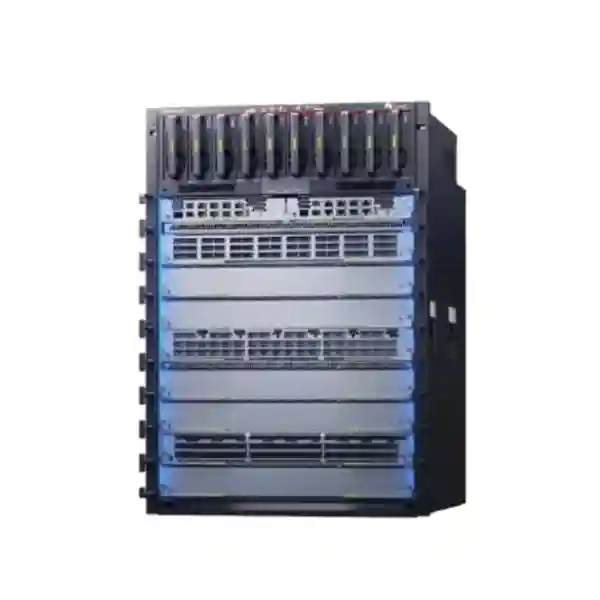
Huawei CloudEngine CE16808
The Huawei CloudEngine CE16808 is a modular data-center switch in the CloudEngine 16800 family for organizations building high-capacity core, spine, aggregation, and private-cloud fabrics. Huawei documents eight service slots for the CE16808, a Clos switching architecture with cell switching and virtual output queuing, front-to-back airflow, and compatibility with multiple generations of high-speed line cards. It is a platform to design around a complete bill of materials rather than a chassis-only purchase: the final solution can depend on main processing units, switching fabric units, service cards, transceivers, power modules, software version, licenses, redundancy objectives, cabling, rack depth, cooling, and the surrounding leaf or top-of-rack network.
Choose the CE16808 when the network design needs a modular eight-slot CloudEngine 16800 chassis with room for high-density high-speed interfaces, resilient fabric design, and long-term expansion. Before ordering, confirm the exact line cards, switching fabric generation, optics, power modules, software train, feature requirements, and redundancy design because headline chassis specifications do not define a complete deployable system.
What the Huawei CloudEngine CE16808 is built to do
Huawei positions the CloudEngine 16800 family as a high-performance data-center switching platform. The CE16808 sits between the four-slot CE16804 and sixteen-slot CE16816, giving architects eight service slots while retaining the modular control, switching-fabric, power, and fan architecture of the family. In a typical data-center design, a CE16808 may be considered for a core or spine role where many leaf or top-of-rack switches must converge into a resilient Layer 2/Layer 3 fabric. Huawei documentation also shows CE16808 and CE16816 systems used as core switches with CE9800-series devices operating as top-of-rack switches, which helps frame the product as a data-center backbone platform rather than an access-layer switch.
The buying decision should therefore start with topology and traffic rather than a model name. Document the number of racks, leaf switches, uplink speeds, oversubscription target, east-west traffic, north-south traffic, storage-network requirements, virtualization strategy, routing protocols, EVPN/VXLAN design, failure domains, growth horizon, and maintenance model. An eight-slot chassis can be populated in many different ways, and the line-card mix directly determines port density, media type, breakout possibilities, cable plant, optics count, and future upgrade options. A procurement request that says only “CE16808” is incomplete for most production deployments.
Huawei-listed service slots for the CE16808 chassis.
Fabric architecture with cell switching and VoQ in Huawei’s published platform specifications.
CloudEngine 16800 platform line-card options include 400GE interfaces; compatibility must be matched to the correct CE16808 fabric generation.
Airflow orientation designed for data-center equipment rooms.
Verified CE16808 platform facts and configuration cautions
Huawei’s currently indexed English CloudEngine 16800 product material lists the CE16808 with eight service slots and nine switching-fabric-module slots, using Clos architecture, cell switching, and virtual output queuing. The same product material lists front-to-back airflow and data-center virtualization functions such as M-LAG, virtual systems, CSS, and VXLAN-related capabilities. Huawei’s line-card documentation shows hot-swappable CloudEngine 16800 cards spanning multiple interface generations, including 400GE, 100GE, and 40GE families, with individual cards tied to specific switching fabric unit generations. Because the CloudEngine 16800 family has evolved across hardware and software releases, a final quotation should identify the exact chassis assembly, MPU, SFU, LPU or service-card part numbers, power architecture, software release, and optical modules rather than relying on a generic family datasheet.
| Planning item | CE16808 guidance | What to confirm in the quote |
|---|---|---|
| Chassis scale | Eight service slots | Exact chassis assembly and compatible control/fabric modules |
| Fabric | Clos, cell switching, VoQ | SFU generation, quantity, redundancy and line-card compatibility |
| Interfaces | Multiple high-speed line-card families | Required 10/25/40/100/200/400GE mix, breakout, optics and fiber type |
| Airflow | Front-to-back | Rack aisle orientation, clearance, blanking and cooling capacity |
| Software and features | Data-center L2/L3 and virtualization feature set | Target VRP release, license requirements, interoperability and feature dependencies |
Published switching-capacity figures can differ between Huawei pages, hardware generations, and measurement conventions. Treat any headline number as a reference tied to a specific platform release; use the exact BOM and current Huawei documentation for final capacity validation.
How to size a CE16808 before procurement
Start by drawing the target fabric. Count every leaf, border leaf, service leaf, storage switch, firewall pair, load balancer, edge router, and external interconnect that will terminate on the CE16808. Record both day-one and three-to-five-year port requirements. For each link, specify nominal speed, expected average and peak utilization, breakout requirement, optical reach, fiber type, redundancy path, and whether the link must be physically diverse. This turns an abstract chassis purchase into a port-and-fabric design that can be mapped to actual service cards.
Next, define failure behavior. A modular core normally requires redundancy across control planes, switching fabrics, power feeds, uplinks, peer devices, and routing paths. The chassis alone cannot remove a shared failure domain. Two core switches connected to one upstream router, one PDU, one optical path, or one leaf uplink can still leave the application dependent on a single component. Document what should happen if a service card fails, an SFU is removed, a power module is lost, a fabric peer is rebooted, or an upstream carrier becomes unavailable. Maintenance requirements are equally important: the architecture should allow planned software and hardware work without turning every change into a complete data-center outage.
Finally, build the procurement package. Include chassis, MPUs, SFUs, line cards, power modules, fans, rails or mounting accessories where applicable, transceivers, breakout cables, patch leads, software and licenses, support entitlement, spare strategy, staging services, configuration, migration, acceptance testing, documentation, and training. Ask the supplier to mark every line as required, optional, included, or customer-provided. For broader deployment planning, FourTeck’s network and security service guidance can help buyers define implementation scope alongside the hardware purchase, while the deployment planning resource provides a useful model for controlled change, testing, rollback, and handover.
Compatibility, optics, and fabric-generation checks
CloudEngine 16800 line cards are not interchangeable without regard to fabric generation. Huawei’s platform documentation associates specific 100GE and 400GE cards with particular SFU types, and some newer high-density cards are specifically described for the CE16808 chassis. The safest approach is to validate the full card-to-SFU-to-software compatibility matrix for the proposed BOM. Do not order optics only from the port speed. Confirm connector type, wavelength, reach, single-mode or multimode fiber, FEC requirements, breakout support, peer-device compatibility, and whether the intended transceiver is supported in the target software release.
Interoperability also deserves a test plan. If the CE16808 will peer with non-Huawei leaf switches, routers, firewalls, storage systems, or optical transport devices, document required standards and features such as BGP, OSPF, EVPN, VXLAN, LACP, MLAG behavior, MTU, LLDP, ECN/PFC where applicable, MACsec where required, and monitoring protocols. Standards support can reduce vendor dependency, but implementation details, timers, defaults, and feature interactions still need validation. A staged lab or pre-production test is valuable for large migrations because it proves the intended design before production traffic is moved.
Huawei CloudEngine CE16808 Dubai
Customers searching for Huawei CloudEngine CE16808 Dubai are usually not looking for a simple boxed Ethernet switch. The CE16808 is a modular data-center platform, so a useful Dubai quotation should begin with the intended role: core, spine, aggregation, data-center border, high-performance private cloud, or another design approved by the customer’s architect. Dubai organizations operating server rooms, enterprise data centers, colocation footprints, financial systems, hospitality platforms, logistics applications, retail infrastructure, cloud-connected offices, or regional IT hubs may require very different port mixes even when they choose the same chassis. The quote should therefore specify which service cards, switching fabric units, MPUs, power modules, optics, and software components are included instead of presenting only a chassis price.
For a Dubai deployment, rack and facilities planning can be as important as switching capacity. Confirm usable rack depth, rail or mounting requirements, front-to-back airflow orientation, cold-aisle and hot-aisle alignment, available A/B power feeds, UPS capacity, PDU socket types, grounding, and cable-management space. High-density optical cards can create substantial fiber bundles; patching should be labeled, strain-relieved, and arranged so a line card or fan module can be serviced without disturbing unrelated links. If the switch is part of a pair, spread uplinks across both devices and avoid putting both systems on the same power or physical path when the site architecture allows diversity.
Commercially, buyers should ask for a complete bill of materials and current lead-time confirmation. Do not assume stock, warranty, support term, or delivery date until it appears in a written quotation. Include required quantity, deployment location, target date, interface speeds, fiber distances, number of leaf switches, high-availability design, software requirements, and desired installation services in the inquiry. FourTeck’s Dubai infrastructure and security portal can be used to coordinate the wider network context, and FourTeck UAE provides the broader company resource for UAE technology requirements.
If the CE16808 will sit behind or beside security appliances, make the switching and firewall teams agree on VLAN ownership, routing boundaries, BGP or static-route handoffs, MTU, link aggregation, redundant paths, and logging responsibilities before installation. A high-capacity core switch can expose weaknesses in surrounding design if edge devices, firewalls, optics, or servers cannot sustain the planned traffic. Request a topology review before ordering so the hardware configuration matches the actual data-center architecture rather than an isolated datasheet target.
Huawei CloudEngine CE16808 UAE
A Huawei CloudEngine CE16808 UAE project may span more than one emirate, data center, branch aggregation point, or disaster-recovery site. That makes standardization important. Before selecting card quantities, define whether every site will use the same chassis profile or whether the primary location will carry denser high-speed cards while a secondary site uses a smaller population. Standard hardware can simplify spares and operations, but over-building every location can increase cost. A practical design separates mandatory common components from site-specific interfaces and keeps enough spare capacity for controlled growth.
UAE procurement teams should also distinguish between a chassis bundle and a production-ready system. Ask the supplier to list the exact CE16808 chassis part number, MPU generation, SFU generation and count, each line card, every optical transceiver, power module quantity, fan configuration, software license, support entitlement, and accessory. If the design includes 100GE or 400GE links, confirm the peer switch or router supports the same lane structure, breakout mode, FEC settings, and optical standard. If 10GE or 25GE breakout is planned from higher-speed ports, include the breakout cable or optic architecture in the acceptance test rather than assuming it will work from the connector type alone.
For multi-site UAE networks, operations planning should cover software governance and change control. Decide who owns VRP upgrades, configuration backups, AAA integration, out-of-band management, NTP, telemetry, SNMP where used, syslog, route-policy changes, fabric automation, and emergency access. Document a rollback path for major upgrades and define which links must remain available during maintenance. A modular chassis is valuable because components can be designed with redundancy, but operational resilience still depends on disciplined procedures and a topology that avoids shared failure domains.
Customers comparing CE16808 procurement with security-edge projects can review FourTeck’s verified product catalogue and perimeter network security planning page. These are separate product categories, but they help map where the data-center core ends and policy enforcement begins. For a CE16808 quote, send the complete physical and logical topology so the switching BOM can be reviewed together with surrounding routers, firewalls, servers, and optical links.
Huawei CloudEngine CE16808 Uganda
Buyers searching for Huawei CloudEngine CE16808 Uganda are likely planning a substantial enterprise, service-provider, government, education, financial, or shared data-center environment rather than an ordinary office LAN. The first question is whether an eight-slot modular chassis is appropriate for the actual aggregation requirement. Map current and future uplinks from server rows, campus cores, branch concentrators, security appliances, storage networks, and carrier handoffs. In environments where bandwidth is growing in stages, a modular chassis can allow expansion by adding compatible service cards, but that flexibility is useful only when the original fabric, power, and software design anticipates the intended growth path.
Uganda deployments should plan carefully for power continuity and serviceability. A core switch may remain electrically connected during utility interruptions through UPS and generator infrastructure, yet a resilience design should also account for independent feeds, PDU diversity, surge protection, grounding, and enough cooling to maintain a stable rack environment. If replacement modules or specialized optics are not immediately available locally, the buyer should define a spare strategy before commissioning. Critical spare candidates depend on the final BOM and could include optics, cables, power modules, and other field-replaceable components. The correct spare list should come from the actual architecture and vendor support model rather than a generic checklist.
Network design should also reflect how Uganda sites connect to the wider organization. If the CE16808 aggregates regional WAN, internet, data-center, or cloud traffic, verify routing-policy ownership, BGP or OSPF design, route summarization, redundant carrier paths, MTU, and monitoring. For campus or private-cloud fabrics, validate EVPN/VXLAN and automation requirements against the chosen software version. If storage traffic uses lossless Ethernet features, engage the server and storage teams in the design because queueing, PFC/ECN behavior, NIC settings, and application expectations must be aligned end to end.
FourTeck’s Uganda technology resource can support regional enquiry context without implying stock or a local warehouse. When requesting a quotation, include city, quantity, target commissioning date, card and optic requirements, rack information, support expectations, and whether staging or remote configuration assistance is required. Lead time, import arrangements, warranty registration, and service scope should be confirmed in writing for the specific order.
Huawei CloudEngine CE16808 Kampala
For a Huawei CloudEngine CE16808 Kampala project, the most useful starting point is to identify what the city site is concentrating. A Kampala headquarters or data-center location may aggregate office campuses, remote branches, application servers, virtualization clusters, internet circuits, and disaster-recovery links in one facility. That concentration can justify a modular core, but it also raises the consequence of design mistakes. The CE16808 should be treated as part of a dual-device or otherwise resilient architecture where business continuity requires it, with independent paths for uplinks, management, power, and upstream connectivity as far as the site permits.
Port planning should be explicit. Count the number of 10GE, 25GE, 40GE, 100GE, 200GE, or 400GE connections that are truly needed, then map them to supported line cards and breakout modes. Do not buy a high-density card only because it offers the largest headline speed. The right card is the one that matches peer interfaces, fiber plant, transceiver reach, expected traffic, and growth. Where legacy systems remain at lower speeds, design a migration path that avoids filling expensive high-speed slots with temporary connections that could be aggregated elsewhere.
Kampala teams should also plan remote operations. A core switch should have protected out-of-band management, named administrator accounts, AAA integration where appropriate, configuration backups, time synchronization, telemetry or SNMP monitoring, syslog, and documented emergency access. If support engineers may work remotely, avoid exposing management directly to the public internet. Use a controlled management path and record each change. Before cutover, create an acceptance test that checks every critical VLAN, routed network, uplink bundle, routing neighbor, redundancy event, optic level, and monitoring alarm.
Commercial requests should state whether the requirement is chassis-only, a partially populated system, or a complete configured solution. Ask for separate line items for hardware, optics, licenses, support, staging, installation, migration, and training. This makes competing quotations easier to compare and prevents a low chassis price from hiding missing modules. Buyers can also review the FourTeck solution approach to understand how requirements are translated into deployment scope before a final order is placed.
Huawei CloudEngine CE16808 Arua
A Huawei CloudEngine CE16808 Arua requirement should be evaluated against site scale, logistics, and the role the location plays in the wider network. Arua may be part of a distributed organization where a regional facility connects local offices, public services, education systems, healthcare platforms, branch applications, or backhaul links to a central data center. If the CE16808 is being considered for such a site, confirm that the number of high-speed links and expected growth genuinely require an eight-slot modular chassis. In some architectures the CE16808 may be central at a primary data center while smaller fixed or modular switches serve regional locations; in others, a high-capacity regional node can be justified by local aggregation and resilience requirements.
Logistics should influence the BOM. Long-distance support and replacement workflows make it important to identify components with the greatest operational impact. Optics, patch cords, power modules, and selected field-replaceable units may deserve local or regional spares depending on the final design. Label every optic and fiber pair, keep a printed or offline port map, and record serial numbers and support entitlement at handover. A spare is useful only if technicians know where it belongs and can replace it safely without introducing a new fault.
Power and environmental planning should be conservative. Confirm stable conditioned rack space, UPS runtime, generator transition behavior, grounding, airflow direction, and front/rear clearance. If the site uses a single equipment room for servers, routing, security, and switching, calculate total thermal and electrical load rather than assessing the CE16808 in isolation. Cable management should preserve service access to fan and card areas. Fiber should have controlled bend radius and protected routing so routine maintenance does not create intermittent optical faults.
For procurement, provide the complete destination and intended delivery terms, but do not assume availability or shipment timing until it is quoted. Ask for a BOM that identifies compatible fabric modules and service cards, software release, transceivers, support coverage, and any professional services. A pre-shipment staging test can be valuable for a regional site: power the chassis, verify all modules, load the agreed software, validate optics, apply baseline configuration, and document management access before equipment travels to the final location.
Huawei CloudEngine CE16808 Mbarara
Organizations researching Huawei CloudEngine CE16808 Mbarara should focus on whether the platform supports the site’s long-term aggregation plan. A regional university, hospital group, financial organization, public-sector network, manufacturing operation, or enterprise hub may have a mix of server traffic, campus traffic, surveillance, voice, internet access, private WAN, and cloud applications. Those workloads should be segmented logically and mapped to appropriate routing and policy boundaries. The CE16808 can provide a high-capacity switching core, but security policy may still belong on dedicated firewalls or service devices depending on the architecture.
The interface design should avoid unnecessary complexity. If most downstream devices connect at 10GE or 25GE, determine whether those links should terminate directly on the modular core or be aggregated by leaf switches with fewer high-speed uplinks. This can improve port efficiency and simplify cabling. If servers or storage are moving toward 100GE or higher-speed connectivity, identify which traffic actually needs that capacity and whether the server NICs, storage arrays, hypervisors, and optical plant can use it. Purchasing high-speed core ports without end-to-end readiness can leave expensive capacity unused.
Mbarara deployment planning should also include maintenance windows and knowledge transfer. The handover package should contain physical diagrams, logical diagrams, IP addressing, VLAN and VRF assignments, routing neighbors, link-aggregation membership, optic types, cable labels, administrator roles, backup procedure, and software version. Train at least two responsible staff members or ensure the support contract defines who performs changes. Core-network knowledge concentrated in one person is an operational risk regardless of hardware redundancy.
When requesting commercial terms, ask for written confirmation of the support path, replacement procedure, warranty or service entitlement, and whether software updates are included under the quoted coverage. If the CE16808 will be deployed as part of a new server or private-cloud project, schedule switch staging before application migration so routing, VLANs, MTU, redundancy, and monitoring can be tested with representative traffic before the business cutover.
Huawei CloudEngine CE16808 Gulu
For Huawei CloudEngine CE16808 Gulu enquiries, resilience and operational simplicity should be considered alongside raw switching performance. A high-capacity modular switch may become the central connection point for many services, so every dependency around it deserves review. Identify whether the site has two independent upstream paths, whether server and access layers are dual-homed, whether power is protected by independent feeds, and whether management remains reachable during a partial network failure. Hardware redundancy inside the chassis is valuable, but it cannot compensate for one carrier, one PDU, one fiber route, or one upstream router if all critical traffic still depends on that single element.
The CE16808’s eight service slots allow a design to separate interface roles if desired, for example placing server-facing, fabric-facing, border, or migration links on different cards. That can improve serviceability, but the exact layout should follow failure-domain and capacity analysis. Consider what traffic remains if one line card is removed and whether the surviving paths have enough bandwidth. During migration, temporary parallel links may be needed between old and new cores. Reserve ports for that transition rather than filling every slot with steady-state connections on day one.
Gulu projects should include practical monitoring. Optical receive and transmit levels, interface errors, CRC counters, queue drops, CPU and memory trends, routing-neighbor state, power status, fan status, temperature, and fabric health can help engineers identify a developing issue before users report an outage. Decide where logs and telemetry are collected and how long they are retained. Time synchronization across switches, firewalls, servers, and monitoring platforms is essential for correlating events during troubleshooting.
Procurement should be phased only when compatibility is protected. If the project buys a chassis now and line cards later, verify that the planned future cards are supported by the selected SFU generation and software. Document the intended expansion path in the original BOM and have the supplier confirm it. This reduces the risk of discovering later that a desired high-speed card requires a different fabric generation or software upgrade that was not anticipated in the first purchase.
Huawei CloudEngine CE16808 Kenya
Huawei CloudEngine CE16808 Kenya buyers commonly need a platform capable of supporting dense data-center, cloud, ISP, financial, enterprise, or large-campus aggregation. Whether the target facility is in Nairobi, Mombasa, or another location, the design should begin with traffic flows between racks, internet edges, WAN connections, private cloud, storage, and disaster-recovery links. A CE16808 can provide an eight-slot modular core, but the value comes from selecting the right service-card population and fabric architecture for the real topology. Oversubscription should be intentional, not accidental: model how much downstream bandwidth can converge on each uplink during normal operation and after a link or node failure.
Kenya projects that connect to multiple carriers or data centers should define routing policy before hardware arrives. For BGP environments, document local preference, MED use where relevant, route filtering, communities, default-route strategy, maximum-prefix protection, failover expectations, and how routes are exchanged with firewalls or edge routers. For EVPN/VXLAN fabrics, define route reflector placement, VTEP addressing, anycast gateway behavior, VRF design, and the boundary between underlay and overlay troubleshooting. These design choices affect operations more than a raw throughput figure.
Fiber and optics planning is equally important. Confirm whether links use single-mode or multimode plant, expected distance, patch-panel loss, connector type, and transceiver support at both ends. For breakout designs, verify cable mapping and switch configuration on each side. Keep spare optics for critical link types if the support model and risk assessment justify it. Optical inventory should be labeled by speed and reach to prevent a technician from inserting a physically compatible but electrically or optically unsuitable module during an incident.
Regional buyers can use FourTeck Kenya for Kenya-focused enquiry context. A useful quotation request should include target city, chassis quantity, required port speeds, number of leaf switches, routing and overlay protocols, redundancy requirement, desired support term, optics distances, and commissioning date. Do not assume stock or local replacement availability until the quotation confirms it. For high-impact migrations, request staging, software baseline validation, and a documented acceptance test before the production cutover.
Huawei CloudEngine CE16808 Kuwait
A Huawei CloudEngine CE16808 Kuwait deployment often belongs in an enterprise data center, telecom environment, private-cloud platform, major campus, or regional services hub where availability requirements are higher than those of an ordinary office network. The design should make clear which services depend on the core and how they continue during component maintenance. If the CE16808 is deployed as a redundant pair, spread leaf uplinks, edge connections, and server fabrics across both systems. Ensure the routing or MLAG design provides deterministic behavior during failure and recovery, and test those events under controlled conditions before the network is accepted.
Facilities planning matters in Kuwait’s climate even though the switch belongs in a conditioned room or data center. Verify that HVAC capacity, airflow direction, rack blanking, hot-aisle/cold-aisle practice, and environmental monitoring keep the equipment within vendor limits. Do not use external ambient temperature as a proxy for the rack environment; the relevant conditions are inside the data center and at the switch air intake. Power architecture should include the correct input modules, independent PDU paths where required, UPS and generator support, and grounding that complies with the facility design.
Commercial evaluation should compare complete configurations, not model labels. One CE16808 quote may contain a different fabric generation, line-card mix, optic count, support term, or license set from another, producing a large price difference even though both reference the same chassis. Ask vendors to provide an itemized BOM and identify any part that is optional or excluded. Confirm whether installation, configuration, migration, and support are separate services or bundled. Clarify who owns rack mounting, fiber patching, IP addressing, routing changes, and application testing.
For country-specific enquiries, FourTeck Kuwait can be used as the regional starting point. Provide the current core topology, desired uplink speeds, site redundancy requirement, and future expansion target when requesting a quote. This allows the proposed CE16808 configuration to be checked against the actual fabric instead of being treated as a generic chassis sale.
Huawei CloudEngine CE16808 Ghana
Huawei CloudEngine CE16808 Ghana enquiries may come from organizations building or refreshing a central data center, private cloud, large enterprise campus, carrier network, financial platform, education environment, government system, or multi-site service hub. The CE16808 is best evaluated where there is a real need for modular high-speed aggregation and growth. Begin with a traffic map: identify server-to-server flows, internet and WAN traffic, storage, backup, replication, voice, video, and security inspection paths. Decide which traffic remains local to the data center and which crosses the core, because east-west traffic can dominate modern virtualized environments even when internet bandwidth appears modest.
A Ghana project should also consider disaster recovery and geographic diversity. If a second site exists, determine the inter-site bandwidth, latency, routing, encryption, and replication requirements before choosing port speeds. The core switch can provide high-capacity interfaces, but the end-to-end service depends on carrier capacity, edge routers, firewalls, optical transport, and application design. If the DR link is much slower than the internal data-center fabric, document the bottleneck and ensure routing policies behave predictably during a failover.
Operational readiness should include local documentation and remote support procedures. Keep configuration backups outside the switch, protect administrator access, synchronize time, and forward important logs to a central platform. Create a maintenance checklist for optics, interface errors, fabric health, power, fan status, and environmental alarms. For organizations with limited specialist staff on site, the design should minimize unusual one-off configurations and use consistent naming, VLAN, VRF, and routing standards so remote engineers can troubleshoot reliably.
When obtaining a commercial proposal, request confirmation of shipping terms, support registration, warranty or service coverage, and expected replacement process for the quoted destination. If regional procurement is coordinated centrally, FourTeck Africa can provide a broader enquiry route for African infrastructure projects. The order should not be released until the CE16808 BOM, optics, power, software, and support components have been checked as one compatible system.
Huawei CloudEngine CE16808 Nigeria
For Huawei CloudEngine CE16808 Nigeria deployments, scale and resilience frequently drive the design. Large enterprises, financial institutions, cloud and hosting environments, service providers, universities, public-sector platforms, and multi-branch organizations can generate high east-west and north-south traffic. A modular eight-slot chassis gives the architect flexibility to combine high-speed service cards, but capacity should be based on measured and forecast demand. Collect interface utilization from the current core, server virtualization statistics, backup windows, storage replication, internet peaks, WAN traffic, and expected application growth. Use those measurements to select card density and uplink speed rather than sizing only from employee count.
Power continuity deserves explicit engineering. The data-center electrical design should identify independent feeds, UPS paths, generator support, PDU capacity, grounding, and the failure scenario for each component. If the two core switches in a redundant pair share one upstream PDU or room circuit, the network retains a hidden single point of failure. Cooling and airflow must remain stable during generator operation and maintenance events. Monitor intake temperature and fan status rather than assuming the room’s nominal thermostat guarantees suitable chassis conditions.
Nigeria’s large geographic footprint can also make remote operations important. Use centralized authentication where appropriate, role-based administration, protected out-of-band management, configuration archiving, telemetry, and clear change records. If the core supports branches or regional sites, routing policy should prevent a fault in one area from propagating unnecessarily across the network. BGP filters, OSPF area design, summarization, VRF separation, and route-leak policy should be documented and tested. For EVPN/VXLAN designs, keep underlay and overlay troubleshooting procedures separate so teams can isolate reachability, control-plane, and application problems quickly.
A Nigerian procurement request should identify the destination city, exact quantity, desired support term, port and optic matrix, software requirements, rack and power constraints, deployment date, and whether installation or migration is required. Ask for a current written lead time and avoid treating online availability as confirmed stock. The final acceptance test should include redundancy events, routing convergence, optic health, management access, monitoring, and traffic validation at representative loads.
Huawei CloudEngine CE16808 Seychelles
A Huawei CloudEngine CE16808 Seychelles requirement should be designed with island logistics, service continuity, and realistic scale in mind. The CE16808 is a substantial modular data-center platform, so the buyer should first verify that the site truly needs an eight-slot high-speed core. A national service provider, large hospitality group, government platform, financial network, cloud or hosting environment, or centralized enterprise data center may justify that class of equipment, while smaller sites may be better served by a different architecture. Use port count, traffic growth, redundancy, and application criticality to make the decision.
Where specialist replacement parts may require international shipment, spare planning is especially important. The final BOM should identify which components are essential to maintain service and which are already protected through chassis redundancy. Keep spare optics for critical interconnects when justified, and consider the replacement lead time for power, fan, control, fabric, and service modules under the selected support contract. A large spare inventory is not automatically efficient; the goal is to cover credible high-impact failures without tying up budget in parts that the support provider can replace quickly enough for the required service level.
International connectivity and disaster-recovery design should also be considered. If the data center depends on submarine cable or carrier services for cloud and off-island access, the core switch may have far more internal capacity than the external paths. That is normal, but routing and application expectations should reflect it. Define how services behave if one external circuit is lost, how critical applications are prioritized, and whether a secondary carrier or local service path is available. Monitor external bandwidth separately from internal fabric capacity so troubleshooting does not incorrectly blame the core for upstream congestion.
Before shipping, a staged acceptance test can reduce risk. Verify the chassis, every installed module, software baseline, optics, management access, configuration backup, routing neighbors, link aggregation, and monitoring alarms. Photograph and label the port map, pack sensitive optics correctly, and provide installation instructions for the receiving team. Commercial documents should specify delivery terms, support coverage, warranty registration, and remote or onsite service scope without assuming a local warehouse or engineer unless that presence is explicitly confirmed.
Deployment workflow: from design to acceptance
Collect current topology, traffic, rack, power, optics, protocols, software, security boundaries, and growth targets.
Select chassis, MPUs, SFUs, service cards, optics, power, licenses, support, spares, and accessories as one compatible system.
Inspect hardware, load the agreed software, verify modules, create the baseline, test management, and validate critical optics.
Use a documented change plan with backups, rollback, named owners, timed checkpoints, and application validation.
Test routing, link aggregation, redundancy, monitoring, optics, management, traffic paths, and fault scenarios.
Deliver diagrams, BOM, serials, software versions, backups, credentials process, support contacts, and maintenance procedures.
Related FourTeck products and services to consider
A data-center core does not operate in isolation. Buyers should coordinate the CE16808 with upstream security, edge routing, rack infrastructure, server connectivity, and operational support. The following verified pages on the same FourTeck site can help define adjacent requirements without assuming that every environment needs the same products.
A branch-class security appliance reference that illustrates how firewall sizing, licensing, VPN, and security services differ from core switching requirements.
Useful where a smaller office or branch security layer must connect back to the data-center network through VPN or WAN services.
A high-end security and SD-WAN platform reference for designs where the CE16808 connects to a substantial data-center edge.
A smaller firewall product reference that can help procurement teams separate branch-edge requirements from data-center core requirements.
Another branch security reference for multi-site organizations designing secure paths into a centralized CE16808-based data-center fabric.
Send the topology, port matrix, target software, redundancy goals, destination, support term, and deployment date for a configuration review.
Frequently asked questions about Huawei CloudEngine CE16808
How many service slots does the CE16808 have?
Huawei lists eight service slots for the CloudEngine CE16808. The chassis also uses dedicated control, switching-fabric, power, and cooling components, so the service-slot count should not be confused with the complete module count.
Does the CE16808 support 400GE?
Huawei’s CloudEngine 16800 platform documentation includes 400GE line-card options, and current line-card material identifies 400GE cards supported in CE16808 configurations. Compatibility depends on the exact line card, switching-fabric generation, and software release, so the final BOM must be validated as a matched platform.
Can the CE16808 be used as a data-center core switch?
Yes. Huawei documentation shows CE16808 and CE16816 switches used as core switches in typical data-center networks with CE9800-series switches operating as top-of-rack devices. The correct role still depends on the customer’s topology, capacity, redundancy, and feature requirements.
What should be included in a CE16808 quotation?
A production quotation should identify the chassis assembly, main processing units, switching fabric units, service or line cards, power modules, fans, optics, breakout cables, licenses, software and support entitlement, accessories, and any staging, installation, configuration, migration, testing, or training services. Ask the supplier to mark exclusions clearly.
What is the Huawei CE16808 price in Dubai?
There is no single meaningful chassis price for every deployment because the line-card population, fabric generation, optics, power, software, support term, and services can change the total substantially. Request a current itemized quotation based on the required port matrix and deployment scope.
Is the CE16808 suitable for EVPN/VXLAN fabrics?
Huawei’s CloudEngine 16800 specifications list VXLAN-related and data-center virtualization capabilities. Confirm the exact EVPN/VXLAN features, scale, interoperability, and software dependencies needed by the intended architecture before purchase.
Can I mix older and newer CloudEngine 16800 line cards?
Do not assume compatibility from the chassis name alone. Huawei associates different line-card families with specific switching-fabric unit generations. Validate each proposed card, SFU, MPU, software version, and optic against current Huawei compatibility information.
What information should I send FourTeck for sizing?
Send the existing and target topology, number of racks and leaf switches, required port speeds, fiber distances, desired protocols, HA design, current traffic, growth estimate, rack and power details, target software, destination country and city, deployment date, and desired support term. This allows the quote to be engineered around the real network.
Quotation checklist for Huawei CloudEngine CE16808
Current diagram, target diagram, rack count, leaf count, traffic peaks, oversubscription target, growth plan, DR links, and internet/WAN boundaries.
Each required speed, quantity, connector, breakout, optical reach, peer device, and spare-port target.
Core-pair behavior, control-plane redundancy, fabric redundancy, dual power, path diversity, uplink distribution, and maintenance goals.
BGP, OSPF, EVPN, VXLAN, M-LAG, VRFs, telemetry, QoS, lossless Ethernet, MACsec, automation, and any interoperability constraints.
Rack dimensions, airflow orientation, A/B power, UPS/PDU details, grounding, cable management, cooling, and out-of-band management.
Destination, quantity, target date, warranty/support term, staging, installation, migration, testing, documentation, training, and spare strategy.
Decision recap: is CE16808 the right chassis class?
The CE16808 makes sense when the network genuinely benefits from an eight-slot modular CloudEngine 16800 chassis, high-speed line-card flexibility, data-center fabric features, and a resilient core or spine design. It is not a product to select from a single throughput number. The correct decision depends on required interfaces, fabric generation, software, routing and overlay design, peer-device compatibility, facilities, operational skills, and growth. If those inputs are not yet known, the next step is discovery and BOM engineering rather than ordering.
For buyers comparing the CE16808 with a security platform, remember that core switching and firewalling solve different problems. The CE16808 is designed to move and route large volumes of data-center traffic; a firewall enforces security policy and inspection. Many production architectures need both, with a clearly documented boundary between them. Review FourTeck’s product catalogue for adjacent platforms and use the sales consultation page to submit the complete network requirement.
Attach a topology diagram, port matrix, required speeds and optics, desired protocols and features, redundancy model, rack and power information, software preferences, destination, target date, and support requirements. FourTeck can then prepare a configuration-led quotation without assuming stock, price, warranty, or delivery terms that have not been verified for the order.

Reviews
There are no reviews yet.