
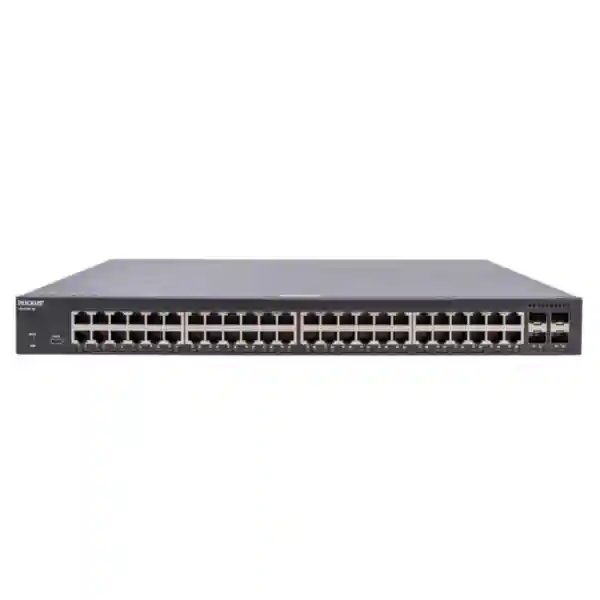
RUCKUS ICX 8100-48-X Stackable Network Switch
The RUCKUS ICX 8100-48-X is the 10G uplink variant in the ICX 8100 access-switch family, built for organizations that want forty-eight 10/100/1000 Mbps copper access ports, four 10 GbE SFP+ uplink ports and the operational simplicity of stacking. The “-X” suffix matters: current RUCKUS documentation distinguishes these 10G models from non-X ICX 8100 switches, and stacking is supported on the X-series when the required FastIron software is installed. That distinction should be confirmed before purchase because the non-X ICX 8100-48 and the ICX 8100-48-X have different uplink and stacking capabilities.
FourTeck can help buyers turn the model number into a complete bill of materials by reviewing port count, 10G optics or DAC requirements, rack and power details, firmware baseline, stack design, VLAN plan, management approach and integration with firewalls, wireless access points and upstream aggregation. Availability, commercial terms, support entitlement and deployment scope should be confirmed in the quotation rather than assumed from a product listing.
Access: 48 × 10/100/1000 Mbps copper ports.
Uplinks: 4 × 10 GbE SFP+ ports on the -X model.
Stacking: Supported on eligible ICX 8100 X-series software, up to four units according to current RUCKUS documentation.
Power to endpoints: This ICX 8100-48-X ordering code is the non-PoE variant, so powered APs, cameras and phones require a PoE model or separate power strategy.
A single 1RU access switch can serve up to forty-eight copper Ethernet endpoints, helping reduce rack sprawl in offices, hotels, education environments and branch networks.
Four 10 GbE SFP+ ports give the -X model a practical uplink path toward aggregation, servers or stack links without restricting the design to 1G optical uplinks.
Up to four eligible X-series units can be stacked when the supported FastIron release and correct stack topology are used, simplifying administration across a larger access layer.
A complete quotation should identify switch quantity, power cords, optics or DACs, rack accessories, support, software expectations and any installation or configuration service required.
What buyers should verify before ordering the ICX 8100-48-X
The most important purchasing check is the exact suffix. RUCKUS treats the ICX 8100-48-X as a 10G variant, while the similarly named ICX 8100-48 is a non-X model. The X-series designation is tied to the higher-speed SFP+ uplinks and to stacking capability. Current RUCKUS guidance also makes software version part of the stacking requirement, so a buyer should not assume that two switches will stack simply because both have the correct hardware. The intended FastIron release, upgrade path and management method should be part of the deployment plan before the units arrive on site.
Port and uplink plan
Count active copper endpoints, reserve growth ports and map each 10G SFP+ connection. Confirm transceiver type, fibre grade, connector, distance and whether a DAC is more appropriate for short rack-to-rack links.
PoE requirement
The ICX 8100-48-X is not the PoE ordering code. If access points, IP phones, cameras or other powered devices must draw power from the switch, compare the appropriate ICX 8100 PoE X-series model instead of adding injectors after purchase.
Stacking and firmware
Plan the stack as a software-and-cabling design, not only a hardware feature. Verify every member is an eligible -X model, align FastIron versions, select stack links and document the preferred unit order and maintenance procedure.
Where the RUCKUS ICX 8100-48-X fits
This model is most relevant where the access layer needs many Gigabit copper connections but the uplink or inter-switch layer should operate at 10 GbE. Typical examples include office floors with desktops and printers, hospitality back-office networks, classrooms and labs, retail or branch sites, building-management networks and mixed wired environments where forty-eight access ports provide a useful density point. Because the specific ICX 8100-48-X is non-PoE, it fits especially well when connected devices have their own power or when PoE is handled by other switches. If the access layer is primarily wireless APs, cameras or IP phones, the PoE variants should be evaluated as part of the same design exercise.
The switch should also be selected in the context of the upstream security and routing architecture. A campus or branch design may place the ICX access layer behind a firewall, with VLANs carried toward an aggregation or security boundary. FourTeck’s network security and firewall services can help buyers align switching, segmentation and gateway policy when the project includes both access infrastructure and perimeter security.
RUCKUS ICX 8100-48-X Stackable Network Switch Dubai
For organizations searching for a RUCKUS ICX 8100-48-X stackable network switch in Dubai, the practical buying question is usually not whether a forty-eight-port switch can be installed, but whether the exact uplink, optics, rack, software and network design match the site. Dubai offices often combine wired users, meeting rooms, IP telephony, wireless infrastructure, CCTV, building systems and cloud applications on one structured network. The ICX 8100-48-X gives a network team forty-eight Gigabit copper access ports while retaining four 10 GbE SFP+ ports for higher-speed connectivity toward aggregation or for supported stacking. That balance can suit office floors, business centres, education facilities, hotels and branch environments that need dense access without moving to a modular chassis.
Dubai buyers should first distinguish the -48-X from nearby ICX 8100 variants. This exact model is the non-PoE X-series version, so it is not the right ordering code when every edge device needs switch-delivered power. A mixed design may use the ICX 8100-48-X for desktops, printers, servers, building controllers or other independently powered devices, while PoE switches serve access points, phones and cameras. That split can be operationally sensible when it reflects the real endpoint mix, but it should be planned rather than discovered during installation. Buyers should also reserve spare ports and uplink capacity for growth rather than filling all forty-eight access ports on day one.
The 10G SFP+ uplinks require their own bill-of-material review. The correct optic depends on distance, fibre type, connector standard and the upstream device. Short connections in the same rack may be candidates for compatible direct-attach cabling, while inter-floor or building links generally require optical transceivers and suitable fibre. A quotation should state these parts explicitly so the switch does not arrive without the components required to connect it. The power cord and rack installation details should also be checked for the UAE project standard and the actual cabinet.
Stacking adds another design layer. RUCKUS documentation identifies stacking support on the 10G ICX 8100 “-X” models and ties that function to supported FastIron releases. Dubai IT teams planning two to four switches as a logical stack should therefore include firmware alignment, stack cabling, configuration backup and maintenance procedure in the implementation plan. FourTeck can help buyers prepare a model-and-accessory checklist, compare the access switch with the rest of the LAN and security architecture, and request a current quotation through the FourTeck Dubai contact page. For broader UAE infrastructure requirements, the FourTeck UAE technology portfolio provides additional context on enterprise networking and IT solutions.
RUCKUS ICX 8100-48-X Stackable Network Switch UAE
UAE procurement teams evaluating the RUCKUS ICX 8100-48-X often need one standard access-switch model that can be repeated across offices, branches, warehouses, hospitality properties or education sites while maintaining a consistent uplink strategy. The model’s forty-eight Gigabit copper ports make it a dense access option, and the four 10 GbE SFP+ uplinks give the network designer more headroom than a 1G-uplink access switch. That can be useful where each access switch aggregates many simultaneous users, where file transfers and cloud traffic converge on the uplink, or where the switch must connect to a higher-capacity distribution layer.
A UAE rollout should begin with a repeatable site template. Define how many copper ports are expected per location, how many should remain reserved, which VLANs will be used, what uplink speed and media are required and whether switches will operate standalone or in supported stacks. If stacking is part of the standard design, the project documentation should state the approved FastIron baseline and the procedure for adding or replacing a member. This is especially important when switches are procured in phases, because hardware may arrive at different times with different factory software. Aligning the software before production reduces avoidable commissioning problems.
The exact model also affects endpoint planning. The ICX 8100-48-X is not the PoE version. A UAE branch dominated by laptops, workstations, printers, servers and other self-powered equipment may use it efficiently, while a wireless-first or surveillance-heavy site may need PoE-capable alternatives. Procurement should therefore classify endpoints by both data port and power requirement. This prevents a common mistake: choosing a switch by port count alone and later discovering that dozens of APs, cameras or phones require injectors or a different switch.
Commercial comparison should be based on the complete deployed solution rather than switch hardware only. Include optics, fibre patching, compatible DACs where applicable, power cords, rack accessories, support entitlement, configuration work, migration effort and spare strategy. For organizations standardizing across multiple Emirates, maintaining the same naming, VLAN, firmware and backup approach can reduce support complexity. FourTeck can help organize those requirements into a bill of materials and implementation scope, while current availability and lead time remain quotation-dependent. Buyers can review the FourTeck security product collection when the switch is part of a broader branch or campus refresh that also includes firewalls and segmentation controls.
RUCKUS ICX 8100-48-X Stackable Network Switch Uganda
Organizations looking for the RUCKUS ICX 8100-48-X in Uganda may be planning a new office network, expanding a campus, replacing smaller unmanaged switches or standardizing wired access across several sites. The forty-eight Gigabit copper ports are useful where a single communications cabinet serves many desks, printers, local systems and other Ethernet devices, while four 10 GbE SFP+ ports provide a higher-speed path toward an aggregation switch, server segment or stack connection. For procurement teams comparing a 24-port and a 48-port access layer, the decision should reflect endpoint count, cabinet layout, growth and resilience rather than simply choosing the larger model.
Uganda deployments can vary significantly between central business locations and sites where fibre availability, carrier handoff and technical access are more constrained. That makes pre-deployment documentation valuable. Identify the uplink medium and distance before selecting optics; confirm whether the upstream device accepts the intended transceiver type; and document spare optics or patch leads for sites where replacement logistics could take longer. If the switch will be installed in a stack, confirm the exact X-series model on every member and align the FastIron release before commissioning. Stacking can simplify administration, but only when cabling, software and recovery procedures are treated as part of the design.
Power planning also matters. The ICX 8100-48-X is the non-PoE variant, so a network with many Wi-Fi access points, IP phones or surveillance cameras should not assume those devices can be powered from this switch. A practical Uganda network may use separate PoE access switches for powered endpoints and the 48-X for high-density self-powered devices, or it may select a PoE X-series variant instead. UPS sizing should account for the complete rack, including switches, firewall, router, fibre equipment and any PoE load on other devices, rather than looking at one switch in isolation.
For country-wide or multi-site projects, a standard site checklist can improve consistency: approved firmware, VLAN IDs, management addressing, naming format, uplink optics, configuration backup and escalation contacts. FourTeck’s Uganda IT solutions site covers networking and related infrastructure requirements and can support a commercial discussion without implying stock at a particular city. Buyers should request a current quote for the exact switch, quantity, accessories and service scope, and should avoid assuming delivery timing until the order and destination are confirmed.
RUCKUS ICX 8100-48-X Stackable Network Switch Kampala
A Kampala buyer searching for the RUCKUS ICX 8100-48-X stackable switch is often dealing with a dense office, school, hotel, professional-services environment or multi-floor business network where the access cabinet needs more than a small branch switch. Forty-eight Gigabit Ethernet ports provide room for many wired endpoints, but the model becomes more attractive when the design also needs 10 GbE optical or SFP+ connectivity upstream. Four 10G SFP+ ports allow the switch to feed a faster distribution layer or participate in an eligible ICX 8100 X-series stack, helping the access layer scale beyond one standalone unit.
In Kampala, the first design check should be the communications room rather than the product brochure. Verify rack depth and free rack units, power availability, UPS capacity, cable management and the route to the upstream switch or server room. A 10G uplink is only useful when the complete link is designed correctly. Fibre type, connector, optic wavelength and distance need to match at both ends. If copper devices are distributed across several floors, it may be better to place access switches closer to users and use fibre uplinks than to stretch horizontal cabling beyond recommended limits. The switch choice should therefore be considered together with structured cabling and cabinet placement.
The model’s non-PoE status is another critical point for Kampala deployments. A hotel, school or office can easily have a large number of APs, cameras and IP phones. Those devices will not receive endpoint power from an ICX 8100-48-X, so the design should either use PoE-capable switching for those ports or provide a separate approved power method. Splitting self-powered endpoints and PoE endpoints across purpose-selected switches can be sensible, but it should be documented in the rack layout and port schedule so moves, adds and changes remain manageable.
For stacking, confirm that every proposed unit is an X-series ICX 8100 model and that the planned FastIron release supports the required operation. Record how stack members are cabled, which ports are reserved and how configuration backups will be stored. Kampala organizations with limited maintenance windows should also plan a spare strategy for optics, patch leads and power accessories. FourTeck can help organize a quotation around these deployment details through its Uganda networking channels, while actual product availability and service scheduling should be confirmed before purchase rather than assumed from the page.
RUCKUS ICX 8100-48-X Stackable Network Switch Arua
For an Arua deployment, the RUCKUS ICX 8100-48-X can be evaluated as a high-density wired access switch for organizations that need many Gigabit Ethernet connections and a clean fibre or 10G path back toward a core location. Sites outside the largest commercial centres often benefit from extra attention to logistics and replaceable accessories because an otherwise minor missing component can delay commissioning. The switch itself provides forty-eight 10/100/1000 Mbps access ports and four 10 GbE SFP+ uplink ports, but the final installed solution may also require optics, fibre patch cords, rack mounting, power accessories and a known-good software baseline.
Before ordering for Arua, map the endpoint mix carefully. If most connections are desktops, printers, servers, controllers or other equipment with its own power supply, the non-PoE ICX 8100-48-X may be a straightforward fit. If the cabinet must power Wi-Fi access points, IP phones or cameras, the access-switch plan needs a PoE-capable model for those ports. This distinction is more important than the headline port count because adding dozens of injectors later creates extra power, cabling and maintenance complexity. A port schedule that identifies data-only and PoE-required endpoints makes the correct model mix clear before the procurement request is issued.
The uplink should be specified with equal care. Determine whether the connection is within one rack, between rooms, between buildings or over a longer campus fibre path. That information drives the choice between DAC and optical transceivers and helps avoid incompatible fibre. For sites where replacement parts may not be immediately available, consider including an appropriate spare optic and patch lead in the approved bill of materials. If two or more X-series switches will be stacked, document the topology and FastIron requirement before shipment so the commissioning team knows what must be verified on arrival.
Arua buyers should also separate product procurement from unsupported assumptions about local stock or delivery. Request a quotation with the destination, quantity, required accessories and desired deployment support so logistics can be confirmed against the real order. Where the switch is part of a broader Uganda network refresh, FourTeck can help review structured cabling, upstream firewalling, VLAN segmentation and configuration requirements as one scope. A simple acceptance checklist—physical inspection, firmware verification, uplink test, VLAN test, stack validation if used and configuration backup—can reduce commissioning risk and make future support easier.
RUCKUS ICX 8100-48-X Stackable Network Switch Mbarara
Mbarara organizations considering the RUCKUS ICX 8100-48-X may be expanding a business campus, education facility, healthcare environment, hotel, branch network or regional office where a forty-eight-port access switch offers better density than multiple small switches. The product is designed around Gigabit copper access with four 10 GbE SFP+ uplinks on the X variant. That makes it useful when many edge devices share a cabinet but the upstream connection should have more capacity than a single Gigabit link. The real design question is whether those ports, power characteristics and uplinks fit the actual endpoint and traffic profile.
A Mbarara project should classify connected devices before switch selection. User workstations, printers and some local systems may only require data connectivity, while wireless access points, cameras and IP phones usually require PoE from the network or another power source. The ICX 8100-48-X is the non-PoE ordering code, so a network dominated by powered endpoints should consider the appropriate PoE model rather than trying to retrofit power after installation. Where both device types exist, a mixed-switch design can keep the rack efficient while ensuring each endpoint receives the right service.
For fibre connectivity, specify the link rather than simply asking for “SFPs.” The team should know the fibre type, connector, approximate distance, upstream interface and required speed. A 10G SFP+ optic must be compatible with both the switch and the physical path. When procurement and installation teams are different, this information should appear in the bill of materials and the site diagram. If the project uses stacking, reserve the necessary SFP+ resources, verify X-series eligibility, align FastIron software and document the stack member order and configuration backup process.
Operational readiness is particularly useful for regional sites. Keep an electronic copy of the port schedule, VLAN plan, switch configuration and firmware information. Label fibre pairs and rack ports consistently, and retain spare patch leads where practical. These steps reduce troubleshooting time and make remote support more effective if a local technician needs guidance. FourTeck can help Mbarara buyers prepare the equipment and configuration scope for quotation, but availability, shipment timing and onsite service should be confirmed for the specific project rather than inferred from general Uganda coverage.
RUCKUS ICX 8100-48-X Stackable Network Switch Gulu
For businesses, institutions and project sites in Gulu, the RUCKUS ICX 8100-48-X can serve as a dense managed access switch where forty-eight Gigabit copper ports are needed and the uplink must scale to 10 GbE. The four SFP+ uplink ports on the -X model are especially relevant when several access-layer devices share traffic toward a central firewall, aggregation switch, server room or campus backbone. Buyers should evaluate the model within the complete topology, because the benefit of 10G uplinks depends on the upstream equipment, fibre infrastructure and traffic design rather than on the switch alone.
Gulu deployments may also prioritize maintainability. A network serving education, healthcare, hospitality, administration or distributed operations should be documented so that routine changes do not require rediscovering the topology. Before commissioning, label the switch, rack position, management address, uplink ports, fibre pairs and VLAN trunks. Keep a configuration backup and record the FastIron version. If stacking is used, document member numbers and stack links. RUCKUS identifies stacking on eligible ICX 8100 X-series models and requires a supported software baseline, so the project plan should include firmware validation instead of assuming factory software is ready for the intended stack design.
Endpoint power is another decision point. The ICX 8100-48-X does not provide the PoE functionality associated with the P and PF variants. A cabinet containing many independently powered endpoints can use the 48-X effectively, while a wireless or CCTV-heavy cabinet will generally need PoE-capable switching. Planning this before purchase avoids additional injectors, power strips and troubleshooting points. A simple endpoint inventory listing device type, data speed, VLAN and PoE requirement usually makes the correct switch mix obvious.
For procurement, include enough detail to quote the full working link: switch quantity, power cord requirement, rack accessories, exact optics or DACs, support, software expectations and configuration service if required. Gulu projects that depend on remote support should consider a small set of approved spares for optics and patching, because those low-cost items can otherwise create avoidable downtime. FourTeck can coordinate a commercial discussion for the ICX 8100-48-X through its Uganda technology channel and can align the access switch with firewall, cabling and broader network requirements, while specific delivery and service arrangements remain subject to the final quotation.
RUCKUS ICX 8100-48-X Stackable Network Switch Kenya
Kenya buyers searching for a RUCKUS ICX 8100-48-X network switch are often comparing managed access options for offices, schools, hospitality, retail, branches and enterprise edge networks. The model combines forty-eight Gigabit Ethernet copper access ports with four 10 GbE SFP+ uplink ports, giving it a useful role where endpoint density is high but the distribution path should not be constrained to 1G. It is also part of the ICX 8100 X-series group that supports stacking under the required FastIron software conditions, allowing a design with up to four eligible units to be managed as a coordinated access stack when that architecture fits the site.
The best Kenya deployment starts with traffic and endpoint mapping. Count desktops, printers, local appliances and other copper devices; identify all APs, cameras and IP phones that require PoE; and estimate the traffic that will converge on the uplinks. The ICX 8100-48-X is the non-PoE variant, so powered endpoints need a different switch model or another approved power approach. This distinction can materially change the bill of materials. A buyer should also reserve ports for expansion and avoid designing a new cabinet with every port occupied from the first day.
For 10G uplinks, optical selection should be specific. Confirm whether the path is multimode or single-mode fibre, the connector type, approximate distance and the transceiver supported at the upstream device. Short rack connections may use suitable DACs when both sides support them. If stacking is used, identify which SFP+ ports are dedicated to stack links and which remain available for uplink traffic. The software baseline should be standardized across all units, with configuration backups retained before upgrades or topology changes.
Multi-site Kenyan organizations can reduce operational effort by using the same site template for switch naming, VLANs, management addressing, firmware and documentation. That approach is often more valuable than small differences in individual hardware price because it simplifies rollout and troubleshooting. FourTeck’s Kenya enterprise networking site covers networking and security requirements for local projects and can be used to start a quotation discussion. Buyers should provide quantity, destination, optics, accessory requirements and desired support scope so availability and logistics can be confirmed for the actual order.
RUCKUS ICX 8100-48-X Stackable Network Switch Kuwait
In Kuwait, the RUCKUS ICX 8100-48-X can be considered for office, hospitality, education, commercial and branch networks that need a full forty-eight-port Gigabit access layer with 10 GbE uplink capability. Four SFP+ uplink ports allow the switch to connect toward higher-capacity distribution equipment or participate in a supported X-series stacking design. The model is particularly relevant when organizations want to standardize a large number of wired connections without committing to a larger modular switching platform at every access location.
Kuwait projects should include environmental and rack planning alongside network design. Equipment should be installed in a properly conditioned communications room or data cabinet with stable power, suitable UPS protection and controlled airflow. The switch should not be treated as suitable for an uncontrolled hot area simply because it is enterprise network hardware. Cabinet layout should preserve service access to fibre and copper patching, and cable management should avoid excessive bend or strain on SFP+ connections. These basic installation practices make later maintenance much easier.
The endpoint mix determines whether this exact model is appropriate. The ICX 8100-48-X is the non-PoE 48-port X variant, so it does not replace PoE access switching where APs, cameras or IP phones need power over Ethernet. In a Kuwait office with many desktops and independently powered systems, it may be a clean fit. In a wireless-heavy venue, an ICX 8100 PoE X-series model may be more appropriate. Procurement should review the device schedule and choose each access switch according to both data and power needs.
Stacking requires additional validation. Eligible X-series members need the supported FastIron baseline, matching software and a planned SFP+ stack topology. The quotation should also account for optics or DACs, power cords, rack accessories and support. FourTeck’s Kuwait IT and network solutions site provides a regional path for discussing switching and security requirements. Buyers should request current availability for the exact part number rather than relying on generic ICX 8100 stock statements, because model suffix, quantity and accessory requirements can affect procurement.
RUCKUS ICX 8100-48-X Stackable Network Switch Ghana
Ghana organizations evaluating the RUCKUS ICX 8100-48-X may be looking for a managed access switch that can consolidate many wired devices while still providing 10 GbE connectivity to the next layer of the network. The forty-eight copper Gigabit ports are useful for business users, printers, locally connected systems and other self-powered Ethernet devices, while four SFP+ uplink ports give the design options for fibre distribution, faster server connectivity or an eligible stack. This combination can be relevant to office campuses, education facilities, hospitality, retail, professional services and distributed organizations that want a repeatable access-layer standard.
For Ghana procurement, the model suffix should be written explicitly on the request for quotation. An ICX 8100-48 without the -X suffix is not equivalent for uplink and stacking expectations. The X-series designation identifies the 10G variant, and current RUCKUS guidance ties stacking to X-series hardware and supported FastIron software. If a project expects two, three or four units to form a stack, include firmware verification, stack-link allocation and a documented upgrade process in the commissioning scope. This prevents the common situation where the physical switches are correct but their software is not aligned for the desired feature.
The switch is also non-PoE. Ghana sites deploying extensive wireless, surveillance or VoIP should therefore review the endpoint power plan before selecting this exact model. A network may intentionally use non-PoE switches for user data and dedicated PoE switches for APs, cameras and phones, or it may simplify the rack by selecting PoE-capable variants. Either approach can work when it is driven by endpoint counts, UPS capacity and operational preferences. What should be avoided is assuming that all forty-eight access ports can power devices.
Regional logistics are easier when the full bill of materials is confirmed in advance. Specify optics by fibre type and distance, include correct patching, confirm power cord requirements, decide whether spare optics are needed and state any configuration or onsite support requirement. FourTeck’s Africa technology solutions site can be used for broader regional coordination. For Ghana specifically, availability, shipping route and deployment arrangements should be confirmed in the formal quotation; the page does not imply a local warehouse, immediate stock or a fixed delivery time.
RUCKUS ICX 8100-48-X Stackable Network Switch Nigeria
Nigeria enterprises and institutions considering the RUCKUS ICX 8100-48-X may need a dense wired access platform for head offices, branches, hotels, education campuses, professional-service environments or multi-site networks. The switch provides forty-eight 10/100/1000 Mbps access ports and four 10 GbE SFP+ uplink ports in the X-series configuration. That allows a design in which many edge users connect at Gigabit speed while traffic is aggregated over higher-speed fibre or SFP+ links toward a distribution, firewall or server layer.
In larger Nigerian deployments, consistency across sites can be a stronger operational advantage than selecting different switches for each branch. A standard ICX 8100-48-X template can define rack position, management VLAN, naming, trunk ports, uplink media, firmware and backup process. Where more than one unit is installed, the network team can evaluate supported stacking to simplify management. RUCKUS documentation limits ICX 8100 stacking to the 10G “-X” models and requires an appropriate FastIron release, so software lifecycle should be part of the rollout plan. If sites are commissioned at different times, a controlled firmware baseline helps prevent drift.
The non-PoE nature of this exact ordering code is also important in Nigeria, where many branch projects combine wireless access, CCTV and IP telephony with the wired LAN. Those powered endpoints need either a PoE variant or a separate approved powering method. A good bill of materials separates data-only ports from powered ports and then selects the switch mix. This can also improve UPS planning because PoE load may dominate the rack’s total power requirement even when the data switching requirement is modest.
For 10G fibre links, request the correct optics rather than a generic “SFP+ module.” State fibre type, distance and upstream equipment, and consider spares for critical sites. Procurement should also confirm power cords, rack accessories, support and any configuration service. FourTeck can coordinate Nigeria requirements as part of its Africa-focused technology coverage, but product availability, delivery timing and onsite work should always be confirmed against the specific destination and order. Buyers can also review the Palo Alto PA-410 branch firewall as an example of a complementary security layer when the access switch forms part of a secured branch architecture.
RUCKUS ICX 8100-48-X Stackable Network Switch Seychelles
Seychelles buyers may consider the RUCKUS ICX 8100-48-X for hotels, resorts, offices, education facilities, public-sector environments and business sites that need a dense wired access layer with higher-speed uplinks. The forty-eight Gigabit copper access ports can consolidate many room, office or back-of-house connections, while the four 10 GbE SFP+ ports give the network designer a suitable path toward fibre distribution or an upstream aggregation layer. In hospitality and island environments, careful bill-of-material planning is especially valuable because a missing optic, patch lead or power accessory can be more disruptive than the cost of the part itself.
A Seychelles deployment should start by separating wired access from powered-device requirements. The ICX 8100-48-X is the non-PoE model. Guest-room devices, staff computers and controllers may be self-powered, while Wi-Fi access points, cameras and IP phones often require PoE. If a site has many powered endpoints, choose the appropriate PoE switching alongside or instead of the 48-X. This is particularly important in hospitality networks where wireless density can be high and the access-switch power budget becomes a core design requirement rather than an accessory decision.
Fibre and stacking plans should also be explicit. Identify whether 10G links run within one rack, between buildings or across a wider property, then select compatible SFP+ optics and fibre. If multiple X-series units will be stacked, confirm the FastIron baseline, the maximum supported stack size for the design and the ports reserved for stack connectivity. Keep a spare strategy proportionate to the site’s criticality. A spare compatible optic, fibre patch lead or tested configuration backup can be operationally valuable where replacement logistics are not immediate.
Seychelles procurement should request a complete commercial quotation with exact model, quantity, optics, cables, support, shipping destination and any deployment assistance. That allows logistics to be planned realistically and avoids unsupported assumptions about local inventory. FourTeck can discuss the ICX switch within a broader Africa and Indian Ocean infrastructure requirement, including firewalling, VLAN segmentation, Wi-Fi integration and structured network design. Where the project includes a compact branch firewall, the Palo Alto PA-415 product page illustrates one complementary security option whose final suitability would still need to be sized separately.
Management, stacking and deployment guidance
The ICX 8100 family is designed for enterprise access connectivity with multiple management approaches across the wider RUCKUS ecosystem. For the ICX 8100-48-X, buyers should decide how the switch will be administered before rollout rather than treating management as an afterthought. A standalone site may use local FastIron administration, while an organization with many sites may prefer centralized workflows where supported. The exact management architecture, licensing or cloud requirements should be confirmed against the current RUCKUS platform and the organization’s operational standards.
Stacking is one of the reasons buyers search specifically for the -X variant. Current RUCKUS documentation states that stacking is supported only on the 10G ICX 8100 models identified by the “-X” suffix and supports up to four units when the required FastIron software is used. A stack should therefore be designed with a known software baseline and dedicated stack links. Before any firmware upgrade, retain configuration backups and review release notes, especially where the switch is already carrying production VLANs or management dependencies. Avoid mixing assumptions from older non-X documentation with the X-series hardware.
The physical topology should also account for failure domains. Stacking can simplify logical administration, but it does not automatically create redundant power, redundant upstream devices or redundant fibre paths. If network availability is important, map what happens when a switch, uplink, optic, fibre pair, UPS or upstream firewall fails. A good access-layer design combines manageable switching with deliberate resilience in the surrounding infrastructure.
Related FourTeck products and services for a complete network design
An access switch normally works as part of a broader network rather than as a standalone purchase. FourTeck’s firewall and security product catalogue can help buyers review security gateways that sit upstream from the switching layer, while the deployment and firewall services page explains how segmentation, routing, VPN and network policy can be aligned with LAN design. The FourTeck Firewall Dubai overview provides additional background on the security-focused service scope.
For compact branch security, the Palo Alto Networks PA-410 is relevant when a small site requires an application-aware firewall upstream of the ICX access layer. Where a branch also needs integrated PoE on selected firewall interfaces, the Palo Alto Networks PA-415 can be reviewed as a separate security option. These products should be sized independently from the switch based on inspected traffic, VPN, interface and subscription requirements.
Organizations standardizing on Sophos can review the Sophos XGS 88 firewall appliance for smaller protected sites. Larger or more WAN-intensive environments may compare a platform such as the Barracuda CloudGen Firewall F12 or the Barracuda CloudGen Firewall F18 Revision B depending on the required security and connectivity scope. These internal product references are not presented as automatic pairings with the ICX switch; they are examples of upstream security devices that can be considered when a project includes access switching, routing and firewall policy together.
Frequently asked questions about the RUCKUS ICX 8100-48-X
Is the RUCKUS ICX 8100-48-X stackable?
Yes. Current RUCKUS documentation identifies stacking support on the 10G ICX 8100 models with the “-X” suffix, including the ICX 8100-48-X, with support for up to four units when the required FastIron software is used. The exact firmware baseline should be verified before commissioning a stack.
How many ports does the ICX 8100-48-X have?
The ordering description identifies forty-eight 10/100/1000 Mbps copper access ports and four 10 GbE SFP+ uplink ports. The SFP+ ports are important to the -X designation and should be planned with the correct optics or DACs for the intended topology.
Does the ICX 8100-48-X provide PoE?
No. The ICX 8100-48-X is the non-PoE 48-port X-series variant. If the project must power Wi-Fi access points, cameras, IP phones or other PoE endpoints from the switch, compare an appropriate PoE model in the ICX 8100 family and confirm its power budget.
What should be included in a quotation?
A useful quotation should identify the exact ICX8100-48-X part number, quantity, required regional power cords, optics or DACs, fibre patching where applicable, rack accessories, support entitlement, firmware or configuration expectations and any installation or migration service. This prevents the hardware from arriving without the components needed to place it into service.
Can I replace a non-X ICX 8100-48 with the -X model without changes?
The two models share the ICX 8100 family name, but the -X model has different uplink and stacking expectations. Treat a replacement as a planned network change. Verify software, optics, uplink configuration, management settings and any automation before moving production traffic.
Is the switch suitable for a wireless-heavy network?
It can participate in the network, but the exact ICX 8100-48-X does not provide PoE. If wireless access points need power from the access switch, a PoE-capable model is typically more appropriate for those ports. The 48-X can still serve self-powered devices or other parts of the wired edge.
How should I choose 10G optics?
Select optics from the actual link requirements: upstream device, fibre type, connector, distance and approved compatibility. Do not order generic SFP+ modules without checking the physical path and both endpoints. For short in-rack links, a suitable DAC may be simpler where supported.
Decision recap and quotation checklist
Choose the RUCKUS ICX 8100-48-X when your design specifically calls for a non-PoE, forty-eight-port Gigabit access switch with 10 GbE SFP+ uplinks and X-series stacking capability. Do not select it solely because “48-port ICX 8100” appears in a requirement; confirm that the -X uplinks, non-PoE behavior and FastIron stacking prerequisites match the deployment.
Network details
- Number and type of copper endpoints.
- PoE-required devices listed separately.
- VLANs, trunks and management network.
- Standalone or stacked deployment.
Uplink details
- 10G link distance and fibre type.
- Upstream switch or firewall interface.
- Required SFP+ optics or DACs.
- Spare optics for critical sites if needed.
Commercial details
- Exact quantity and delivery destination.
- Power cord and rack accessories.
- Support entitlement and term.
- Installation, configuration or migration scope.
Request a scoped ICX 8100-48-X quotation
Send the switch quantity, destination, endpoint count, PoE requirement, uplink distances, fibre type, stacking requirement and preferred support scope. FourTeck can use those details to prepare a cleaner bill of materials and reduce the risk of missing optics, power accessories or software prerequisites. For wider regional planning, the approved FourTeck network includes FourTeck UAE, FourTeck Uganda, FourTeck Kenya, FourTeck Kuwait and FourTeck Africa. These links provide regional context; specific product availability and service scope remain subject to quotation.

Reviews
There are no reviews yet.